A Work Project, presented as part of the requirements for the Award of a Master Degree in International Management from the NOVA – School of Business and Economics.
HOW ARE NEW TECHNOLOGIES AFFECTING SPORT MARKETING IN THE FIELD OF SAILING?
An Analysis of Technological Trends and Their Effects on Sailing Marketing
VERA ANNEGRET MAAG (30727)
A Project carried out in the International Master in Management Program, under the Supervision of:
Professor Luis Manuel da Silva Rodrigues
LIST OF CONTENTS
ABSTRACT ... 3
1. Introduction ... 4
2. Literature Review ... 4
2.1. Definition Sport Marketing ... 5
2.2. Technological Trends in Sailing Marketing ... 6
2.2.1. Social Media ... 7
2.2.2. Drones ... 9
2.2.3. Tracking with Global Positioning Systems (GPS) ... 10
2.2.4. Virtual / Augmented Reality ... 12
3. Methodology ... 14 3.1. Research Design ... 14 3.2. Participants ... 15 3.3. Procedure ... 16 4. Analysis ... 16 4.1. Results ... 16 4.2. Discussion ... 21 5. Conclusion ... 23
5.1. Limitations and Outlook ... 24
6. References ... 26
7. Appendix ... 31
7.1. Appendix 1: List of interview participants / experts ... 31
7.2. Appendix 2: Questionnaire with guiding questions ... 32
ABSTRACT
In a time where sports are changing rapidly due to new technologies, this paper sheds light on recent technological innovations in the rather unknown sport of sailing. By applying a qualitative research method in the form of expert interviews, the three most important trends could be identified: social media, drones and GPS. All three trends together are successful when used in live-broadcasting and help to make sailing more transparent and easier to understand. In addition, it could be found out that foiling brings sailing closer to people with its exciting technological features, which do not need many explanations.
1. Introduction
“The message is loud and clear: the [sport] industry is undergoing more disruption than ever”, David Dellea, Director Sports Business Advisory, PwC Switzerland (PwC 2017). This holds particularly true for the marketing of different sports, which affects customer behavior around the globe and brings sport and fans together. Since ever, sport has been highly dependent on fans and spectators as they are the ones generating higher sales. Consequently, it is more than clear that sport marketing and its way of attracting and involving customers is crucial and needs to be done in a proper way. By now, new technological trends as drones or virtual reality (VR) / augmented reality (AR) are changing the way sport is brought to the customer base; a change from a general, frontal approach to a highly personalized one. Specific and rather unpopular types of sports as sailing are the ones profiting the most from this development. For a long time, sailing has been a sport only for interested and passionate sailors – a small world with few opportunities for profit. New technologies and especially their effects on how sailing is promoted are slowly changing this status. Drones follow racing ships in the middle of the big, blue ocean, deliver incredible live-footage and give spectators the impression of being on the boat themselves. Live tracking systems enable fans all over the world to follow their favorite team in races and social media brings sailors and fans closer by providing possibilities to communicate with each other. In a nutshell: new technologies are disrupting sport marketing in a way which was never seen before. In this work project, the biggest technological trends and their effects on marketing will be analyzed with a special focus on the, up to now, rather unknown sport of sailing.
2. Literature Review
Today’s sailing sport is broadly diversified. It consists of many different boat classes and even more events and championships. Like all other sports, sailing can be divided into two categories
of participants: interested people and performance athletes. Comparing the number of performance athletes to other sports, sailing needs to be regarded as a niche sport. However, the number of people who are interested in the sport demonstrates that this sport is not disappearing: worldwide 250 million people are considered as interested in sailing. In Germany alone, 7.5 million people out of a population of approximately 82 million are interested. In addition, the sailing market generates sales of several billion euros (Sponsors 2018). Therefore, it has the potential to become more popular by doing proper sport marketing, although confusing structures in the different sailing federations and unclear boat class hierarchies are still a major problem.
This work focuses on sport marketing as an instrument to promote sailing itself. Therefore, the technological trends in this field are not considered as tools that help to gain sponsors or promote specific products but to make sailing itself more popular. The aim of this work is to analyze how new technological trends have affected the marketing of sailing. However, this subject has not gained much academic attention so far. Thus, as the relevant research is limited, the literature review sheds light over the available research of general sport marketing and adds sailing-specific information if literature is available.
2.1. Definition Sport Marketing
Over the last years, sport marketing has become an increasingly important aspect as its instruments are the main path to customer hearts. By definition, it can be applied to a wide range of either popular or unknown sport types. Splitting up sport marketing into its two components, the term sport can be defined as an “activity involving physical exertion and skills in which an individual or team competes against another or others for entertainment” (“Sport,” n.d.). Subsequently, the definition of marketing states that “marketing is managing profitable customer relationships” (Kotler and Armstrong 2010). Thereby, the key to marketing success is to ensure a status of customer satisfaction, which retains old customers and generates new
ones (Kotler and Armstrong 2010). Bringing both separate definitions together, sport marketing can be described as a “coherent system to match sport consumers with sport products” (Mullin, Hardy, and Sutton 2007) and mainly consists of actions and advertisements which are designed to get and keep the interest of sport customers. Sport marketing can be divided into two categories: marketing of sport and marketing through sport (Mullin, Hardy, and Sutton 2007). In contrast to the second category, the first one focuses on the sport itself and not on brands which promote a product. Therefore, the first category will be the topic of this work project.
2.2. Technological Trends in Sailing Marketing
Researchers have observed great innovations in sport marketing over the past few years and figured out that especially new technologies had a great impact on its development. This holds also true for sailing. In her article, Danielle Berclouw highlights social media, drones, live-tracking via GPS and new formats as the main trends in sailing (Berclouw 2015). These trends are supported by Miller and Cave who mention GPS tracking and drones as important innovations and add the technology of VR as another essential tool (Cave and Miller 2015). Although the above-mentioned trends are sailing-specific, they also play a role in the field of general sport marketing: Deloitte’s report about trends in the sport industry indicates that advertising is moving “to digital and social channels” (Reports 2017). PwC is even more specific and argues that social media platforms are used to engage fans. Furthermore, the company states that VR and wearables, which include technologies like GPS, are trends in the field of sport (PwC 2017). Combining the statements of these studies and articles, one can identify four main technological trends in the field of sailing marketing: social media, drones, GPS tracking and VR / AR. The following section will focus on these four trends.
2.2.1. Social Media
One of the most striking trends in the last years in sport marketing has been the increase of social media usage. According to Williams and Chin, social media can be defined as “the tools, platforms, and applications that enable consumers to connect, communicate, and collaborate with others” (Williams and Chinn 2010). These platforms are enjoying great popularity around the globe (Tucci, Mason, and Benefield 2017) with a user base that has grown by 170% over the last eight years and that states 2.62 billion people by today (Statista 2018). In the field of sport marketing, social media has an increasing influence (Pedersen and Thibault 2014) with Facebook, YouTube and Twitter being the ones used most often by sport teams and athletes (Witkemper, Lim, and Waldburger 2012). Especially sportsmen from action sports like surfing, skiing or sailing are using social media platforms to promote their sport. Examples are the professional surfer Kelly Slater with 1.3 million Instagram followers (Thorpe 2017) or the German Sailing League which had a media reach of three million contacts over social media in 2017 (Segel-Bundesliga 2017) .
The main reason for social media being used more frequently in sport marketing is that it offers a new way of connecting with consumers. It provides a possibility to communicate directly, and not via another medium, with fans and delivers real-time content and customized messages. Thus, social media represents a tool which allows to attract new customers and build personal relationships (Tucci, Mason, and Benefield 2017). These relationships are far stronger than the ones built through traditional marketing (radio, TV, etc.) which is due to the fact that communication is personalized and interaction stronger (Witkemper, Lim, and Waldburger 2012). Advertisements on social media target users’ personal interests and therefore, fulfill their needs by a higher degree than common methods. Nevertheless, traditional marketing tools are still important to reach customers and need to be taken into account for a successful marketing strategy. This holds also true for the sport of sailing where marketing instruments like TV are
still crucial. In the Extreme Sailing Series for example, a big sailing competition, TV is, next to social media, a “tool for education” (Nelson 2017). Thus, social media helps fans to understand the basics of sailing and can raise awareness if applied properly (Nelson 2017). Correctly used, fans get more engaged and communicate with other fans or their favorite team. Thus, social media is becoming a main tool for interaction between the fan and the athlete (Vale and Fernandes 2018). On the one hand, this leads to a stronger community feeling from the fan’s point of view due to the fact that a better experience is witnessed and a stronger feeling of identification with the athlete is generated (Meng, Stavros, and Westberg 2015). On the other hand, social media has become an opportunity for sport teams to build strong long-term relationships with fans as retrieved data helps to understand customer needs better (Witkemper, Lim, and Waldburger 2012). Furthermore, social media allows athletes to convert interest into positively developing fan numbers if unique content is generated and if an authentic and real culture is created (Robinson and Boyer 2012). This advantage as well as the fact that social media is becoming easier to access via mobile devices (Meng, Stavros, and Westberg 2015) show in particular why social media is gaining ground in the field of sport marketing.
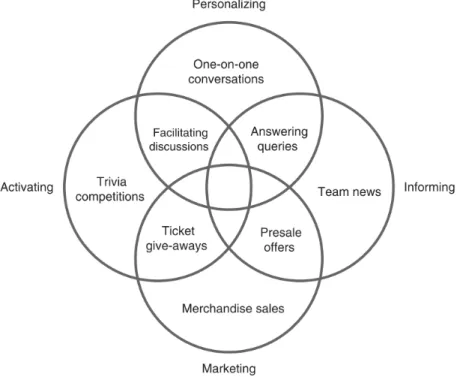
Sport teams and athletes use various platforms for different purposes: YouTube is used to share videos, Twitter to give short information blocks and Facebook to advertise via events, short videos and pictures (Vale and Fernandes 2018). Thus, all social media platforms have different objectives when used. They can be categorized into the “four types of communication […]: Informing, Marketing, Personalizing and Activating” (Meng, Stavros, and Westberg 2015), which is demonstrated in Figure 1. Social media platforms can fulfill either one or a combined number of communication goals. For example, YouTube with its videos is used to inform, Twitter personalizes and informs, and Facebook is an “allrounder” contributing to all four communication types. The more the four communication types are considered, the more successful the team or athlete will be with its social media platforms.
Figure 1: The Four Types of Communication (Source: Meng et al. 2015)
2.2.2. Drones
Drones are another technological trend. A drone is defined as an unmanned aerial vehicle, which is a “pilotless aircraft […] either remotely and fully controlled from another place […] or programmed and fully autonomous” (ICAO 2009). Already since the beginning of 2010, action sportsmen have used drones to promote their sport (Thorpe 2017). Thus, athletes like surfers, skaters or mountain bikers were the ‘digital forerunners’ with regard to this technology. The World Surf League was among the first to use drones to deliver live-footage of surf events with the aim to align fans more to athletes by providing a closer footage (Thorpe 2017). By now, drones are not only used in action sports anymore but also in common sports like football or tennis. They are also used for marketing purposes, either to transmit live-events or to produce exciting advertisements. Therefore, drones are supplementing and not killing the existing types of media: they simply help to deliver better footage of the different sport activities (Thorpe 2017).
Besides, drones offer many other advantages. They are able to deliver images from the “inside of sport facilities” (Nadobnik 2016) and are significantly cheaper than a helicopter outdoors. In addition, they respond more to the desire of fans of being as close as possible to the sport because they fly lower and closer compared to a helicopter (Patel 2016). Especially in the field of sailing, where wind plays an important role, drones are the better tool as they produce less downwash. Hence, they do not hinder the sailing boats and can get much closer than a helicopter (Hebbel-Seeger, Horky, and Theobalt 2017). Consequently, while other new technologies may have helped to break down barriers of time, drones break down barriers of space (Thorpe 2017). On the one hand, they come so close that spectators have the impression of being on the sport ground as well. On the other hand, drones enable the viewer to get a different sense of the surrounding by filming from various angles and heights (Patel 2016). Many perspectives can be shown which is especially beneficial for the sport of sailing as “spatial, tactical and situational dimensions of events” can be combined and help to deliver a better overview (Hebbel-Seeger, Horky, and Theobalt 2017). Therefore, it is not surprising that 71.5% of the participants of a survey claim that drones have a positive effect on sailing (Hebbel-Seeger, Horky, and Theobalt 2017).
Although drones still face some challenges as ethical issues concerning privacy (Boucher 2014), flying restrictions near airports or handling problems when filming indoors (Patel 2016), they are definitely on the rise. Even common sport broadcasts like SKY are “increasingly using aerial drones as part of [their] live sport broadcast” (Patel 2016).
2.2.3. Tracking with Global Positioning Systems (GPS)
GPS itself is already a long-known technology with its first mentioning in 1944 (Aughey 2011). However, its increasing relevance in sport marketing over the past few years is remarkable. By now, this tool is widely used in many sports as it provides a large amount of data about the athletes (Conroy et al. 2017). GPS tracks their movements by working with satellites. They
deliver the exact position of a device by calculating how much time radio signals, which are sent by the device itself, need to reach different satellites (Aughey 2011).
In sport marketing, GPS offers many different advantages, especially since mobile devices like smartphones, which are used by many sportsmen, can be tracked as well (Ferri 2016). As above-mentioned, GPS delivers a wide range of data and thus, a detailed activity profile of an athlete (Conroy et al. 2017). Hence, fans become the opportunity to follow their team on trainings and even on competitions via GPS. Thereby, fans are even able to compare different athletes and to see how their favorite one performs. This is for example the case in Australian Football where covered distances of different teams can be compared (Aughey 2011). Another example are action sports like biking where it is difficult to follow the athletes with the naked eye. During competitions, fans can track their favorite athlete and follow them easily via tablets or mobile phones which gives a feeling of presence at the race court (Georacing n.d.). This is also the case in the field of sailing, where it is even more difficult to follow the race as boats are far away on the water and as decisions are based on invisible tactics, wind and currents. With GPS systems like TracTrac or SailTracks, sailing has gained the opportunity to show spectators onshore what is happening on the race course by providing live-data about positions in the race (P. Baur 2011). Thus, GPS has made it possible to bring sailing virtually closer to the fans and to make it more understandable by providing detailed information (M. Baur n.d.). These details can furthermore be shared and discussed on social media which creates a community among athletes and fans (Ferri 2016). An often-mentioned example is the running sport where applications like “Runtastic” build a community, promote the sport and lead to a higher overall participation (Ferri 2016). The facts that GPS devices are getting better on a steady base (Conroy et al. 2017), that acquiring costs are declining and that they are easily portable only support this development (Aughey 2011).
Although GPS offers a wide range of advantages, it still has some major drawbacks with regard to sport marketing. Until now, athletes struggle to find a proper way to cope with the masses of available data. Furthermore, signal quality is still varying with changing locations (Conroy et al. 2017). Thus, data can be unprecise which might lead to disappointed fans, who stop following the athlete in the worst case. Nevertheless, GPS is used for many different individual and team sports by now (Conroy et al. 2017) and with its further development, more precise data and the possibility to track athletes perfectly in indoor sports, more and more sport types will use this technology to align sport and fans in the future.
2.2.4. Virtual / Augmented Reality
Although existing research about VR and AR in sport marketing is still at its beginning, both terms are already typical buzzwords including a wide range of applications. Both technologies are often mentioned in the same breath but they are not the same. While AR “describes the visual alignment of virtual content with real-world contexts” (Scholz and Duffy 2018), VR is a system where “a user is immersed in a human-computer environment that can be perceived or interacted with” (Van Kerrebroeck, Brengman, and Willems 2017). To be more precise: with AR, the camera of the phone or the app is used to bring different aspects virtually to life, while the real world is the background and the base (Time Inc., n.d.). In contrast to that, VR is built on a completely virtual environment. The person experiencing VR is not present but has the sense of being there (Neumann et al. 2017). VR can be divided into two types: interactive VR and 360° videos (Stuart 2018). Interactive VR is mostly experienced with VR headsets like the Oculus Rift. It is furthermore the more vivid type of VR, as the user is able to shape his surroundings by acting within it (Stuart 2018). 360° videos in turn, can be watched either with a headset or online. As the name suggests, users can check out the given area with a 360° angle (Stuart 2018). However, interaction with the environment is not possible with this type of VR.
With regard to sport marketing, both VR and AR are increasingly used, which is due to the various advantages both technologies offer. The first and strongest argument for the rising utilization is that a new type of audience, which is interested in this type of technology, can be targeted (Time Inc., n.d.). In addition, advertisement can be adjusted to different countries and time zones, which makes it highly important for personalized advertisement (Sander and Altobelli 2011). Furthermore, fans feel more integrated and engaged through VR and AR and have a more vivid experience (Van Kerrebroeck, Brengman, and Willems 2017). The two technologies can even built up a community as “the environment does not need to be limited to a single person” (Neumann et al. 2017). With AR, different people can experience the same add-ins via various tools like smartphones or tablets and with VR, different people can interact in the same, built-up environment without being physically present.
Besides these combined strengths, each technology has its specific advantages when it comes to sport marketing. AR is mostly used because the normal environment can be perceived differently by discovering virtual add-ins. Thus, fans feel safe in their known and familiar atmosphere and can, at the same time, explore a new type of sport (Scholz and Duffy 2018). With regard to sailing, AR offers the possibility to explain the sport live during races. The AC Liveline system, which is also used during one of the biggest sailing competitions, the America’s Cup, is a good example. “This revolutionary graphics system enables embedded technical aids for viewers, such as ahead-behind lines so audiences can clearly see who is leading the race” (Salm 2013). VR, one the other hand, can also be experienced from a familiar place although the perceived environment is not familiar. It is exactly this aspect which introduces the main advantage of VR for both brands and sport marketing: the user can be brought to places he or she would otherwise never want to go to or never be able to go to (Time Inc., n.d.). Examples include the first virtual climb of the Mount Everest (Time Inc., n.d.) or a virtual visit in the Wimbledon stadium and a meeting with Andy Murray (Hobbs 2016). Both
examples show that fans can be brought as close to the sport as never before which offers many marketing opportunities. This fact can also be applied to sailing but VR is only starting in this field. VR reality games like MarineVerse are rising and have the aim to both educate and to entertain. From the point of view of marketing, these games offer the possibility to make people more familiar with sailing by offering real-life experiences with water movements and boat heeling (Hodges 2016). So far, no other advertising tool is able to let people experience sailing in a way that is that close to real-life, which makes it a very promising instrument.
Although the above-mentioned advantages are crucial when it comes to sport marketing, VR and AR are still at the very beginning and one has to see if their development will be successful (Vayntraub 2018). By now, only one thing is clear: AR and VR can give fans the impression of doing a sport on their own. Fans can experience a unique adventure which can be used in sport marketing to attract new fans. This is especially the case for action sports like surfing, as Dave Prodan, VP of Communications at the World Surfing League confirms: “It has been the best thing for surfing so far” (WSL 2015).
3. Methodology
After having conducted a literature review, which sheds light on the status quo of new technologies in sport and sailing marketing, a qualitative research was carried out in the form of expert interviews. Participants were asked about their personal opinions with regard to the development of new technologies in the field of sailing with a special focus on the four identified main technological trends.
3.1. Research Design
A qualitative research design was applied by conducting semi-structured in-depth interviews. This approach was chosen to ensure that the results are based on reliable expert opinions. A quantitative approach would have gathered more, but qualitatively poorer data due to
knowledge lacks with regard to technological trends, which is why a qualitative design was applied. The interviews were based on a questionnaire with open questions which led to varying answers. The participants were encouraged to state their personal opinion and to give input which goes beyond the asked questions if desired.
The questionnaire was split into two different sections. The first section aimed at learning about the personal opinions regarding new technologies in sailing marketing. Thus, participants were asked about their perception of rising technologies in this field. In addition, they were questioned about general perceived effects resulting from these technologies, as for example better targeting options or opportunities to make sailing more popular. Furthermore, a personal valuation of the current status of sailing was demanded in order to be able to categorize the sport. In the second section, specific questions about the identified four main technological trends were asked. Questions in this section were related to the main advantages of the respective technology, to effects on the sailing community and to possible developments in the future. The questionnaire with the guiding questions can be found in Appendix 2.
3.2. Participants
Participants were acquired over either cold-calling or personal contacts from the first author. All of them can be considered as experts in the field of sailing. A total of 11participants could be won for the same number of in-depth interviews with 9.1% being female and 90.9% being male. The experts have diverse backgrounds ranging from performance athletes training for the Olympic Games to employees of the German Sailing League. For a more detailed overview of participants, see Appendix 1. All participants have a German background which is why the following results will only be relatable to Germany.
3.3. Procedure
An in-depth interview was conducted with each participant which resulted in a total number of 11 interviews. They were conducted between the 23rd of October 2018 and the 20th of November
2018 and had a duration of 25 – 40 minutes each. The interviews began with a brief introduction about the topic of this work project and background information about the first author, before starting with the open questions. An audio-recording was made of each of the interviews. Furthermore, they were transcribed verbatim, whereby side sounds like laughter were left out. As all the interviews were held in German, the relevant statements of each interview were translated into English and can be found in Appendix 3. To obtain more detailed transcriptions, the first author can be contacted and complete interviews transmitted. All interviews were analyzed and compared by the first author and the resulting outcomes are presented in the following section.
4. Analysis
4.1. Results
The results of the qualitative research show that the four main trends in the field of sailing marketing were correctly identified. As shown in Figure 2, at least 75% of all participants consider social media, drones, GPS tracking and VR / AR as technological trends. However, the latter seems to be less crucial as it is not seen as an important technology by everyone. In addition to the four identified trends, foiling was repeatedly mentioned as another important technology: 75% consider foiling to be a crucial trend when it comes to marketing of sailing. Foiling is a new way of sailing where boats are not gliding through the water but flying over it. Similar to aircraft wings, foils use the water circulation under the water to generate the necessary strength to lift the boat up into the air (Chisnell 2017).
Figure 2: Agreement of Participants on Technological Trends in Sailing Marketing Olympic Athletes (3) Journalists (2) German Sailing League (2) Tracking Systems (2) Boat fairs (1) Coaches (1) Total (11) GPS Social Media Drones VR / AR Foiling
In contrast to the other four technologies, foiling is not an external trend used by the sport of sailing but an internal trend, developed especially for sailing and other watersports. This fact makes foiling a promising technology because it is able to include sailing-specific issues. All the five discussed technologies have several effects on sailing marketing. These effects are shown in Figure 3 and will be analyzed in the following section.
Figure 3: Agreement of Participants on Effects / Tendencies of Identified Trends
Olympic Athletes (3) Journalists (2) German Sailing League (2) Tracking Systems (2) Boat
fairs (1) Coaches (1) Total (11)
Ge ne ra l Technologies increased perception of sailing Foiling contributed the most
to this development NTA*
Technologies enable better
targeting of focus group NTA*
New trends are more effective marketing tools than old ones
NTA*
Drones and GPS via live-broadcasting are successful Only spectacular content attracts new fans
* If NTA, then total number was reduced by participants who did not talk about this issue to ensure correct relations = Main effects / tendencies based on % of agreement of participants
The table shows the effects of each technological trend as well as overarching ones. Furthermore, the percentage of agreeing participants is displayed in accordance with the conducted interviews. These percentages lead to the identification of the six most important effects and tendencies which are marked with a yellow color.
Olympic Athletes (3) Journalists (2) German Sailing League (2) Tracking Systems (2) Boat
fairs (1) Coaches (1) Total (11)
Soc ial M edi a Channel ranking: 1.Instagram, 2.Facebook, 3.YouTube NTA*
Enables closer relationships between athletes and fans Makes communication easier Increases number of
spectators / reach
Time effort of good content as main disadvantage
Dr
on
es
Close images make sailing
more transparent
Decrease production costs for marketing
GP
S
Visualization explains sailing, also understandable for non-sailors
More potential for the future
(regarding data) NTA*
Its main drawback is
reliability NTA*
VR
It is only a showcase nothing more
Needs to be spectacular Too expensive by now
Fo
il Attracts sailors and
non-sailors as it is extraordinary and fast
Two crucial effects on sailing marketing could be identified from a general point of view. Firstly, the appearance of the new trends has led to an increased perception of the sailing sport, which is confirmed by all experts. The technologies contributed either to a higher perception, as interesting content increased the attention put on sailing, or created a perception in the first place. Thus, they have contributed to an increase in reach. This improves marketing opportunities as more people can be addressed and attracted. Secondly, the interviewed experts agree that the marketing potential of GPS and drones is only explored with live-broadcasting. Live-broadcasting combines these two trends with social media or a website and transmits sailing races. Championships, for example, are streamed live on social media with a GPS system providing a leaderboard and live-images from drones. Sailors and non-sailors get a clear picture of what is happening on the water and can follow races even from distant places, which was not possible before. Hence, live-broadcasting offers the possibility to promote and explain the sailing sport by showing it from a closer perspective and is therefore an important marketing tool.
The third crucial effect lies in the field of social media and states that communication is made easy with this technology. This holds true for two perspectives: the perspective of fans who can simply communicate with the sailor by writing messages and the perspective of athletes who are able to share the personal development and private stories by posting pictures, videos and texts. Thus, sailing has gained a platform with social media over which content can be communicated easily. With regard to marketing, this is a big advantage as the fan base can be easier targeted and does not need to be contacted via expensive tools like TV. The facilitated communication has a positive side effect which is supported by three quarter of the experts: it enables closer relationships between athletes and fans. As athletes become more visible due to a better flow of information, followers get the feeling that a bond is created. This results in possible closer relationships between athletes and fans which in turn, simplifies communication
once again and helps to create a lasting bond. For marketing purposes this is helpful as a loyal fan base can be better estimated and content better adapted to the needs.
The fourth important effect considers the power of drones. It states that the close images, which drones are able to deliver, make sailing more tangible and more transparent. The possibility to show sailing from different perspectives and to follow the athletes on the water, leads to a better overview over race courses and boat maneuvers. Furthermore, drones deliver incredible, action-loaded pictures from the water which makes sailing more interesting for followers. This increase in transparency in combination with exciting content helps to attract new fans and to keep the interest of the existing one. As above-mentioned this is exactly what marketing is about and therefore, drones are an important trend. However, as analyzed before, drones themselves with their ability to create images, do not offer a great potential for marketing success. It is the combination of drones, social media and also GPS, which creates positive effects for sailing marketing: As created content can be distributed over social media, a platform is given to distribute the content which is able to excite followers.
Also the fifth main effect is related to a tool which is more successful when combined with other technologies: GPS. The very positive effect of this tool when it comes to commercialization of the sailing sport is its explanatory nature. Its ability to visualize races helps significantly to explain sailing and to decrease its complexity. Even people who do not know anything about sailing, profit from this effect and are able to follow the sport instantly. This is due to the fact that sailing’s main goal with regard to racing - crossing the finish line first - is shown via a leaderboard in the tracking system. Thus, sailing is made visible, no matter if the race is close to shore or across the ocean. This is advantageous for marketing purposes as fans can be easier attracted with understandable content and a wider range targeted as non-sailors can be in the focus group, too. However, similar to drones, GPS alone is only marginally helpful when it comes to marketing. In order to be able to have a certain reach, social media,
GPS and, in the best case, drones need to be combined. It is remarkable that three quarters of the participants agree that GPS has more potential for the future regarding the acquisition of more data. The experts have the opinion that more information about wind or currents would deliver more insights and make it more precise.
Lastly, the sixth crucial effect is related to the sailing-specific technology of foiling. All experts agree that foiling boats are able to attract the interest of both sailors and non-sailors due to their spectacular appearance and their incredible speed. This effect makes sailing more marketable and increases reach: Among the five identified technological trends, foiling has created the highest awareness for sailing in the past two years and it might also be able to increase attention in the future. This fact makes it a very promising tool with regard to marketing if the created reach can be explored properly.
Analyzing the results and the main effects, it is furthermore remarkable that VR / AR do not seem to have a significant effect or tendency for sailing marketing. Although three quarter of the participants agreed that VR is a technological trend in the field of sailing marketing, no significant effect or tendency could be found in this field.
4.2. Discussion
With the exception of two outliers, namely the outcomes regarding VR / AR and foiling, the results from the conducted interviews were in accordance with the expectations. This fact is remarkable as the literature review was mostly based on general sport marketing and not specifically on sailing marketing. An explanation might be the argument that sailing is not that different to other sports when it comes to its marketing practices and therefore, experiences the same technological trends as other sports. Looking closer at each of these technologies, similarities and discrepancies between general and sailing marketing will be discussed in the following section.
Firstly, the findings regarding effects of social media correlate strongly with the existing literature. Especially the fact that action sportsmen are able to promote their sport better due to social media is obviously perfectly relatable to sailing as social media is a platform which simplifies communication between athletes and fans. Secondly, the existing findings about drones correlate with the experts’ opinions, too. This seems logical as images from drones make any sport more transparent, especially sports that cannot be watched from close by. Thirdly, GPS needs to be considered as more important in the field of sailing compared to general sport marketing. This is explained by the fact that sailing can hardly be watched from shore as it has, in contrast to surfing for example, a predetermined race course on the water. Thus, the fact that races can be visualized, explains why GPS needs to be considered as more important in sailing marketing. Via live-broadcasting, the races can be seen and fans can follow the sport. The term live-broadcasting or live-streaming is also known in the field of general sport marketing. However, live-streaming is in most sports just a live-picture streamed via social media. Sailing and a few other sports are special with regard to live-broadcasting as they include GPS systems to visualize the race. Consequently, sailing correlates up to a certain degree with other sports when it comes to the delivery of live images.
As above-mentioned, the results of VR / AR show differences to the literature. In contrast to existing findings, VR / AR do not seem to have any clear effect or tendencies in the field of sailing. The lack of experience with these technologies might be a reason: concrete cases of VR usage in the field of sailing are difficult to find and only rarely known by experts. Additionally, the findings from the interviews are related to Germany while the existing literature is related to the world which might cause differences in perception. Consequently, one might question the importance and even the existence of the VR trend in Germany. As another remarkable fact, foiling was identified as a fifth trend in addition to the trends known from existing literature. Naturally, this technology is not a trend in general sport marketing due to its unique features
which are used especially in sailing and other watersports. As academic research about sailing-specific topics is rare, this trend could not be identified before the interviews.
In contrast to foiling, all the other trends are external ones, influencing sailing from outside. They were not developed in the field of sailing and hence, one might ask the question, how sailing is specifically taking advantage from the caused effects of these ‘external factors’. This critical question can be answered by analyzing different sailing events. All major championships like for example the Kiel Week use live-broadcasting. Drones, social media and GPS systems may have been developed outside the sailing field at first, but they were partly adapted to sailing. GPS systems in sailing for example, were specifically designed for the race courses and show precisely which boat is leading by taking wind shifts, boat speed and currents into consideration. By using this slightly modified live-broadcasting, big events are able to show spectators the sport and get more attention. This holds also true for the German Sailing League, where live-broadcasting was even adapted to the specific needs of this format. In addition to drones, on-board cameras film the live-action on board of the boats and hence, deliver even closer images. In addition, the live-broadcasting is accompanied with live comments explaining what is happening on the water. In doing so, the German Sailing League is able to attract both sailors and non-sailors and is promoting their format in the best possible way: by making the product attractive. The question if sailing in specific is able to profit from externally developed technologies can thus be answered with a clear yes.
5. Conclusion
To conclude, one can say that in sailing marketing, it is still crucial to align the sport and fans. New technologies have definitely had an effect on the possibilities to do so. Overall, they have led to two overarching effects: firstly, they have helped to increase the perception of sailing and thus, the possible marketing reach of the sport. By offering new and exciting content and by
both sailors and non-sailors. Secondly, the introduction of live-broadcasting was a big success for the sailing sport. It includes the three trends of social media, drones and GPS and has had a positive effect on the possible reach. This is due to the fact that showing where sailors are and what they do from a close and interesting perspective, explains the complex sport of sailing on the one hand and delivers interesting insights on the other hand.
Besides, some technologies have led to important effects by themselves. Social media, for example, made communication easier. Interested people can be addressed easily with the right content and athletes can be contacted trough different channels like Facebook or Instagram. In addition, drones deliver close images from the water and help to make sailing more transparent. These images help to attract more fans as they are not only able to make the sport more tangible but also more interesting. Furthermore, GPS itself also has an important effect: it explains complex sailing races by bringing it down to the essential and understandable question: who is leading? With a leaderboard and real-time tracking even non-sailors are able to follow races on the water. Lastly, an additional technology which increases sailing’s reach was identified: foiling. With its breathtaking features and its speed, it makes sailing more interesting than it has ever been and attracts even non-sailors.
All in all, one is therefore able to say, that the effects of the new technologies in sailing marketing are definitely present. Moreover, the identified main effects are highly positive and offer great potential for the future.
5.1. Limitations and Outlook
Although a reasonable number of expert interviews was conducted in this qualitative research paper, the gathered data might not be accurate. As the experts have own opinions, the data is highly subjective. Furthermore, the data is not statistically representative and can therefore not be validated. In addition, the participants are naturally experts in the field of sailing, which is necessary to get qualitatively good answers. However, statements might hence be biased as the
view from inside the sailing community can differ from the outside view. This effect can also appear due to the fact that all experts were from Germany. The results can therefore differ from expert opinions from other countries. Lastly, as the interviews were conducted and led by the first author, resulting conversations during the interview might have included opinions from the first author which could influence the experts’ opinions.
Consequently, it would be plausible to extend the present qualitative research by a quantitative one. In doing so, the now gathered experts’ opinion could be compared and current results strengthened. In addition, participants of the quantitative research should include both sailors and non-sailors in order to exclude possible biases. Besides a quantitative research on technological trends, it could furthermore be interesting to extend the research question to other possible game-changing factors in sailing. Trends like new sailing formats, which simplify the racing and make it more understandable for non-sailors as well, might have a big influence in the future and could be included. Thus, technological changes and fundamental changes could be put against each other and the scope of their effects compared.
This qualitative research paper may hence be seen as an indicator for the direction into which the sport of sailing is heading. Furthermore, it can be considered as a starting point for further future research regarding revolutionary and disrupting trends in the field of sailing marketing.
6. References
Aughey, Robert J. 2011. “Applications of GPS Technologies To Field Sports.” International
Journal of Sports Physiology and Performance 6 (3): 295–310.
https://doi.org/10.1123/ijspp.6.3.295.
Baur, Marcus. n.d. “Turning Sailing Into a 21st Century Media Sports With SAP Sailing Analytics.” SAP Website. Accessed November 26, 2018.
https://www.sap.com/assetdetail/2017/08/685e5337-cd7c-0010-82c7-eda71af511fa.html. Baur, Paul. 2011. “SAP Sets Sail for Innovation.” News SAP. 2011.
https://news.sap.com/2011/06/real-time-data-tracking-sailing/.
Berclouw, Danielle. 2015. “How Modern Technology Is Bringing Sailing to Masses.” Scuttlebutt. 2015. https://www.sailingscuttlebutt.com/2015/08/19/how-modern-technology-is-bringing-sailing-to-the-masses/.
Boucher, Philip. 2014. Civil Drones in Society - Societal and Ethics Aspects of Remotely
Piloted Aircraft Systems. JRC Science and Policy Reports.
https://doi.org/10.2788/14527.
Cave, Andrew, and Alex Miller. 2015. “New Technology Puts Sailing on the Map.” The Telegraph. 2015. https://www.telegraph.co.uk/investing/business-of-sport/sailing-technology/.
Chisnell, Mark. 2017. “Foiling and Foil Shapes, a Beginner’s Guide.” Scuttlebutt. 2017. https://www.sailingscuttlebutt.com/2017/06/02/foiling-foil-shapes-beginners-guide/. Conroy, Matthew, Varley Aspire, Sports Excellence, and Technology Sydney. 2017.
“Unpacking the Black Box : Applications and Considerations for Using GPS Devices in Sport.” International Journal of Sports Physiology and Performance 12 (April): 18–26. https://doi.org/10.1123/ijspp.2016-0236.
International Conference on Computational Science, 80:301–12.
https://doi.org/10.1016/j.procs.2016.05.345.
Georacing. n.d. “Georacing - Inshore and Offshore Solutions for Your Sailing Events.” Accessed October 10, 2018. http://www.georacing.com/sailing/.
Hebbel-Seeger, Andreas, Thomas Horky, and Cora Theobalt. 2017. “Usage of Drones in Sports Communication – New Aesthetics and Enlargement of Space.” Athens Journal of
Sports, 1–17.
Hobbs, Thomas. 2016. “Jaguar Says VR Is Helping It Sell an ‘Incredible Amount of Cars’ as It Launches Andy Murray Experience.” Marketing Week. 2016.
https://www.marketingweek.com/2016/06/21/vr-is-helping-us-sell-an-incredible-amount-of-cars-says-jaguar-as-it-launches-andy-murray-experience/.
Hodges, Toby. 2016. “Virtual Reality for Sailors With New Specially Targeted Apps.” Yachting World. 2016. https://www.yachtingworld.com/yachts-and-gear/virtual-reality-sailors-new-specially-targeted-apps-77052.
ICAO. 2009. Unmanned Aircraft Systems. Cir 328 AN/190. Vol. 23. https://doi.org/10.1016/B978-0-12-374518-7.00016-X.
Kerrebroeck, Helena Van, Malaika Brengman, and Kim Willems. 2017. “When Brands Come to Life: Experimental Research on the Vividness Effect of Virtual Reality in
Transformational Marketing Communications.” Virtual Reality 21 (4): 177–91. https://doi.org/10.1007/s10055-017-0306-3.
Kotler, Philip, and Gary Armstrong. 2010. Principles of Marketing. Pearson Education. https://doi.org/10.2307/1250103.
Meng, Matthew D, Constantino Stavros, and Kate Westberg. 2015. “Engaging Fans Through Social Media : Implications for Team Identification.” Sport, Business and Management:
Mullin, Bernard J., Stephen Hardy, and William A. Sutton. 2007. Sport Marketing.
Nadobnik, Jarosław. 2016. “The Use of Drones in Organizing the Olympic Games.” Handel
Wewnetrzny 6 (365): 288–99.
Nelson, Chris. 2017. “Media Is Key to Commercial Success of Extreme Sailing Series.” The National. 2017. https://www.thenational.ae/business/media-is-key-to-commercial-success-of-extreme-sailing-series-1.11207.
Neumann, David L., Robyn L. Moffitt, Patrick R. Thomas, Kylie Loveday, David P. Watling, Chantal L. Lombard, Simona Antonova, and Michael A. Tremeer. 2017. “A Systematic Review of the Application of Interactive Virtual Reality to Sport.” Virtual Reality 22 (3): 183–98. https://doi.org/10.1007/s10055-017-0320-5.
Patel, Sahil. 2016. “Eye in the Sky: Fox Sports Is Bringing Drones to Sporting Events.” Digiday UK. 2016. https://digiday.com/media/eye-sky-fox-sports-bringing-drones-sporting-events/.
Pedersen, Paul M., and Lucie Thibault. 2014. Contemporary Sport Management 6th Edition. PwC. 2017. “Sports: The Most Disrupted of All Industries? - PwC Sports Survery 2017,” no.
September: 36.
Reports. 2017. “Deloitte’s Sports Industry Starting Lineup Trends Expected to Disrupt and Dominate 2017.” Deloitte.
Robinson, Josh, and Lucien Boyer. 2012. “How Can Sports Marketing Utilise Social Media?”
Campaign (UK), 2012.
http://search.ebscohost.com/login.aspx?direct=true&db=bth&AN=73951514&lang=es& site=eds-live.
Salm, Jon. 2013. “How Data Visualization Changed the Way We Experience Sailing.” Visually. 2013. https://visual.ly/blog/how-data-visualization-changed-the-way-we-experience-sailing/.
Sander, Matthias, and Claudia Fantapié Altobelli. 2011. “Virtual Advertising in Sports Events: Does It Really Work?” International Journal of Sports Marketing and
Sponsorship 12 (3): 28–42. https://doi.org/10.1108/IJSMS-12-03-2011-B004.
Scholz, Joachim, and Katherine Duffy. 2018. “We ARe at Home: How Augmented Reality Reshapes Mobile Marketing and Consumer-Brand Relationships.” Journal of Retailing
and Consumer Services 44 (May): 11–23.
https://doi.org/10.1016/j.jretconser.2018.05.004.
Segel-Bundesliga. 2017. “2017 Medienresonanz Deutsche Segel-Bundesliga.”
http://segelbundesliga.de/content/uploads/2018/02/Medienauswertung-DSBL-Saison-2017_final.pdf.
Sponsors. 2018. “Segeln: Herausforderungen Einer Nischensportart.” Sponsors. 2018.
https://www.sponsors.de/news/magazin/segeln-herausforderungen-einer- nischensportart?active=1&fbclid=IwAR3SwSjxjaD9bonOt8TWz2x6LKEVZcLBrafp-ETn5g0hdjDEgQJq43N55i8.
“Sport.” n.d. Oxford Dictionaries. https://en.oxforddictionaries.com/definition/sport.
Statista. 2018. “Number of Social Media Users Worldwide from 2010 to 2021 (in Billions).” 2018. https://www.statista.com/statistics/278414/number-of-worldwide-social-network-users/.
Stuart, Henry. 2018. Virtual Reality Marketing: Using VR to Grow a Brand and Create
Impact. 1 edition. London: Kogan Page.
Thorpe, Holly. 2017. “Action Sports, Social Media, and New Technologies.” Communication
& Sport 5 (5): 554–78. https://doi.org/10.1177/2167479516638125.
Time Inc. n.d. “Groundbreaking Capturing Everst Virtual Reality Series Debuts with Multi-Platform Launch across Time Inc.’s Sport Illustrated and LIFE VR Properties.” Time
Tucci, Jack, Kevin Mason, and Michael Benefield. 2017. “The Best Play for NCAA Division II Sports Marketing Is the Social Media Pivot.” Journal of Marketing Perspectives 1: 41–47.
Vale, Leonor, and Teresa Fernandes. 2018. “Social Media and Sports: Driving Fan
Engagement With Football Clubs on Facebook.” Journal of Strategic Marketing 26 (1): 37–55. https://doi.org/10.1080/0965254X.2017.1359655.
Vayntraub, Aleksandra. 2018. “KICKING AND STREAMING: Social Media, Experiential Campaigns, and a VR App Will Transform World Cup 2018.” PRWeek (U.S. Edition), 2018.
Williams, Jo, and Susan J Chinn. 2010. “Meeting Relationship-Marketing Goals Through Social Media : A Conceptual Model for Sport Marketers Relationship-Marketing Process.” International Journal of Sport Communication 3: 422–37.
Witkemper, Chad, Choong Hoon Lim, and Adia Waldburger. 2012. “Social Media and Sports Marketing: Examining the Motivations and Constraints of Twitter Users.” Sport
Marketing Quarterly 21 (3): 170–83.
WSL. 2015. “Behind the Scenes: Samsung VR in Tahiti.” World Surf League Homepage. 2015.
7. Appendix
7.1. Appendix 1: List of interview participants / experts
The following list shows with whom the expert interviews were conducted:
1. Alexander Beck, owner of a sailing blog (hightide.cc) and marketing employee of a German automotive group
2. Axel Uhl, Chief Development Architect SAP; part of the SAP Sailing team 3. Carsten Kemmling, founder and reporter at segelreporter.com
4. Dirk Kreidenweiß, Show Director and Member of the Board at INTERBOOT, Hamburg Boat Show and Tuning World Bodensee
5. Jakob Meggendorfer, performance athlete in the 49er class training for the Olympic Games 2020
6. Marcus Baur, Managing Director at SailTracks 7. Oliver Schwall, CEO at the German Sailing League
8. Peter Ganzert, Head of the training center Baden-Württemberg and leading state instructor
9. Philipp Buhl, performance athlete in the Laser class training for the Olympic Games 2020
10. Sophie-Karolin Wehner, Project Management at the German Sailing League 11. Thomas Plößel, performance athlete in the 49er class, bronze medal winner at the
7.2. Appendix 2: Questionnaire with guiding questions
Questionnaire Work Project Vera Maag
Background Information: Topic and Goals of the Work Project
My work project on the subject „How are new Technologies Affecting Sport Marketing in the Field of Sailing? - An Analysis of Technological Trends and Their Effects in Sailing“ is being conducted in the field of Marketing at NOVA School of Business and Economics in Lisbon, Portugal.
This work project contains an analysis of the status quo with regard to the effects of new technologies on sport marketing. Furthermore, it examines how these technological trends affect the marketing approaches, in particular in the field of sailing, and points out possible consequences.
The work project is supposed to deliver a qualitative, academic overview over changes in sailing’s sport marketing and to indicate to which direction future research could head to.
General Questions:
1. Do you consider sailing to be a niche or rather a popular sport?
2. Consider the definition of sport marketing: a system to match sport consumers with sport products (Mullin, Hardy, and Sutton 2007, 11) which mainly consists of actions and advertisements designed to get and keep the interest of sport customers. Do you think that your team/event/company performs marketing activities?
3. What technological trends did you see over the last years?
4. In my work project, I identified five main technological trends in the field of sport marketing: social media, virtual/augmented reality, GPS, drones and artificial intelligence. Do you agree that these five are important trends?
5. Out of the 5 identified trends; a. which ones are you using? b. which two the most? 6. Do you think these technologies:
a. have any effect on your overall marketing success? b. have changed the relationship to your fans? If yes, how?
c. give you new possibilities to promote the sport of sailing? If yes, why?
7. Compared to traditional marketing tools like TV, newspaper or radio, do you think that the new technologies are better / more effective in the field of sailing?
The following questions are depending on what participants answered with regard to the usage of technologies. Questions only need to be answered if this type of technology is used by the participant.
a) Social Media:
1. Which platforms are the ones you consider to be the most important ones?
2. Did your presence on social media change anything about your fan / customer base? Do you have any data about that?
3. What do you think is the biggest advantage of social media with regard to marketing in sailing?
4. Do you think this technological trend will continue or just stay for a short period of time?
b) Drones:
2. Do you think that drones:
a. have changed the way sailing is viewed by fans? If yes, why?
b. have increased the number of viewers of sailing events? Do you have any numbers about changes since drones are used?
3. Are drones an asset on its own or only when combined with one of the other technologies?
c) Virtual/ Augmented Reality:
1. How did you use VR/AR with regard to your marketing strategy?
2. Did you get any positive/negative response from your fan / customer base? 3. Do you think this trend will continue and unfold more potential in the future? 4. How do you think will AR/VR affect sailing marketing in the future?
d) GPS:
1. Since a few years, sailing and GPS tracking are closely related when it comes to racing. Is this technology already well established?
2. Is GPS tracking mostly used on its own or in combination with social media platforms in sailing?
3. Do you have any data about how GPS tracking has changed the number of viewers? 4. Do you think that GPS tracking helps non-sailors to understand the sport of sailing better
7.3. Appendix 3: Relevant interview parts
1. Jakob Meggendorfer About Live-broadcasting:
Jakob Meggendorfer: Yes, I mean, first of all, drones deliver just an image and you have to
distribute this image then. And this means, a drone alone, which creates images, has no big effect. This means, one has to combine it somehow with another technology. Either live-broadcasting with GPS, live-stream or social media, yes.
2. Philipp Buhl About the Importance of Foiling for Sailing
Philipp Buhl: Yes, well, the America’s Cup has given a big boost in – when was it? 2013. The
America’s Cup is somehow like the Formula 1 of sailing, I would say. This means, it is the pioneer with regard to technologies and it has a big reach anyways and I think that with foiling, this all became a very big topic in all areas no matter if monohulled boats, yachts, catamarans, dinghies or a small boats like moths, which I own by myself. This is interesting for many people. Also for people who are not interested in sailing, if they see a video they say: Damn, that’s crazy. How does this work?
3. Philipp Buhl about Better Targeting Opportunities
Philipp Buhl: Let us take the following example: Worldwide, there are several million people
interested in the sailing sport and with social media – I am not an expert here, but by using the right hashtags and so on and in general, with this network, you are able to reach mainly people who are interested in a similar sport. Your reach in the worldwide sailing community is relatively big. You simply do not reach any people who are not interested anyways but you are able to reach many out of the million interested in the sailing sport because social media is damn clever.
Philipp Buhl: Exactly, to formulate it precisely, yes, thank you.
4. Oliver Schwall About the Importance of TV
Oliver Schwall: If you ask a market developer, which medium has the biggest power – it will
still be TV, right? Or at least the big media brands. No matter if CNN or Al Jazeera […]. Well, I think that we are still relying on the fact that old media, and not social media, that the media brands, so to speak, pick up the sport and integrate it into their program. This is the biggest lever. […] Because this brings the attention first of all, this is were the millions are who say, oh look sailing is exciting.
5. Thomas Plößel About Instagram vs. YouTube
Thomas Plößel: They [social media channels] have specialized themselves, right? Instagram is
really about quick information, short things, bam, bam and with YouTube people sometimes even watch a 20 minutes video from us. Yes, this has rather become a type of news platform, a media library.
6. Jakob Meggendorfer About Advertisements on Facebook
Jakob Meggendorfer: I would say that Facebook lost importance over the last years. But this
may also be my personal impression because I rarely use it anymore. Well, if it is important then only due to the groups because otherwise there is so much advertisement and so much rubbish which I personally do not want to see.
7. Marcus Baur About Social Media Channels in the Younger Generation
Marcus Baur: I just had this topic with my daughter. They made a statistic in her 8th grade about
which Apps are used by pupils and in fact, YouTube was the most popular one. And zero, totally zero, was Facebook. Nobody uses this anymore. […] The second most important is Instagram.
8. Thomas Plößel About Easier Communication Possibilities
Thomas Plößel: And then, there are many people who just write us. On Facebook and Instagram
you can simply write a message, just like this. […] And there are daily messages from random people. Also Instagram, Facebook and so on, this is really crazy. And of course this is a type of getting closer to the follower.
9. Sophie-Karolin Wehner About Easier Communication Possibilities
Sophie-Karolin Wehner: Our target group is getting younger and younger. Therefore, the
channels for our target groups are – obviously, that we are using more and more mobile communication and social media channels.
10. Philipp Buhl About how Social Media Affects Reach
Philipp Buhl: Self-marketing consists for me obviously of things like social media or so because
it is easy. Competitors worldwide are as quick – or to say it differently: other sports are spreading with the same speed as sailing. That is why you are still below the radar compared to other sports. Nonetheless, it helps to generate a specific reach.
11. Carsten Kemmling About Facebook’s Effects
Vera Maag: Has Facebook changed the number of your readers?
Carsten Kemmling: Yes, definitively. […] It is really important to trigger. So yes, it is an
important medium for me.
12. Peter Ganzert About Advantages of Drones
Peter Ganzert: That is exactly the biggest advantage of drones. You can get really close and
follow the races without impeding the sailors with motorboat waves. You simply have a different perspective and also at the start, you can see what sailors could have done. […] Well, this perspective is a great thing and the fact that you can get really close to the sailors without disturbing them.
13. Carsten Kemmling About Drones’ Cost Factor
Carsten Kemmling: And this has all become significantly cheaper, this whole drone story and
especially the sailing sport is profiting from this development because you can see things, which you could not see before. They also had live-broadcasting at the Kieler Woche from the 470 boat class and this is not the coolest boat but suddenly, you are so close that, even as a sailor, you think, wow, amazing.
14. Oliver Schwall About the Effect of Drones for the German Sailing League
Oliver Schwall: Well, the one thing is of course the option that we have, I would not say
invented, but somehow created also together with SAP: the live-broadcasting. That nowadays, you are able to document a sport without much effort. And we are also able to reduce the complexity of the sport by making it understandable through technologies.
15. Thomas Plößel About the Cost Factor of Drones
Thomas Plößel: So, then the thing with the drones got started. This was especially beneficial
for event organizers, I would say, because the drones and their aerial views help especially in the field of sailing to facilitate the presentation, to say who is first and so on for the spectators and also with a low budget. A helicopter, they told us once, costs 2000€ or 1000€ or 400€, who knows, but a lot of money. A drone costs only once 500€. […]. Well, the costs decreased extremely for this technology.
16. Axel Uhl About the Combination of GPS and Other Technologies
Axel Uhl: This depends on how active the community is and on how social media is used to
distribute the whole thing over the corresponding channels. And if there is nobody who does it, it is surely not a sure-fire success. […] There needs to be somebody who cares.
17. Philipp Buhl About the Combination of GPS and Other Technologies
Philipp Buhl: Well, I am a big fan of this tracking and also how they are doing it at our world
cups now, that there is something from the bird’s-eye view with the live-camera and then more or less from the same view, it is transmitted to the virtual tracking and the live positions - and this helps, even us sailors. […] And it is helpful for the spectator, but you cannot win masses of fans with only GPS. Because if you take something boring – that is what I actually want to say – if you take something boring and explain it properly, it is still boring. However, if you make something spectacular out of something boring, then it works.
18. Sophie-Karolin Wehner About GPS’ advantages
Sophie-Karolin Wehner: And we use this [live-broadcasting] to explain sailing, which is
actually by itself an exciting sport. And of course, to take some of its complexity away or rather to concentrate on the speed and the leader because this is something everybody understands.
19. Axel Uhl About the Effect of GPS on Sailing
Axel Uhl: Well, it changes everything. It makes the things visible.
20. Marcus Baur About the Effects of VR
Marcus Baur: Well, I am not a VR fan. There is an idea, where we want to do an around the
world race together with SAP, where one can login at any time and race and it would simulate the surrounding which is on the ship. Would many people do it? I am not sure. I do not think that this is a significant technology for sailing. […] Well yes, this works always like the VR station at the Kieler Woche – if you want to bring the experience to the people, ok – but it is better to go sailing with them.
21. Marcus Baur About the Potential of AR
Marcus Baur: I see more potential with AR, where you can fade in information into your field
of view.
22. Philipp Buhl About the Need for Spectacular Experiences
Philipp Buhl: And if you want to use it – to come back to the core issue – to win fans, it can be
a cool tool. I mean, if the people can see the on-board view so to speak, similar to a GoPro but just nicer with: I am moving my head and I see a different picture. This makes sense with the
right images. However, if you try to show a boring laser regatta with zero wind – this does not help a lot.
23. Sophie-Karolin Wehner About How VR Will Not Attract New Sailors
Sophie-Karolin Wehner: It is the question if it is not nicer for sailors than for non-sailors
because the sailor understands the whole stuff around him. […] What is missing with regard to the real sailing is of course the water, the wind and all the stuff around you. Well, I would say, but I also know the sport for exactly that reason, that I would miss something which makes sailing fascinating: the fight with the nature, if you want to explain it a little exaggerated.
24. Carsten Kemmling About the Effects of Foiling on Non-Sailors
Carsten Kemmling: It has just brought attention to the sport, it got interesting outside of the
sailing scene when these boats simply start to fly. This is a totally different picture, a totally different video.
25. Dirk Kreidenweiß About the Effects of Foiling on Non-Sailors
Dirk Kreidenweiß: This is a point where I think that it is marketable in a telegenic way because
there is action, sometimes people even get hurt and thus, you can make it popular and distribute it all over the world.
26. Philipp Buhl About the Effects of Foiling on Non-Sailors
Philipp Buhl: A foiling moth or the AC which goes with 50 knots and where the water is
splattering all over and where they are flying around with a big gap to the water – there you do not have to be a sailor anymore. Then, it is not about racing anymore, then it is about a
high-tech machine and how it works. I think, also non-sailors watch sailing then. And if you are able to transmit it with great pictures, even more.
27. Alexander Beck About the Effects of Foiling on Non-Sailors
Alexander Beck: Foiling really gets people up from their couch. There also these foiling weeks
now – for example at Stickl at Lake Garda, there are foiling courses now. The Waszp is a big topic there now, the Quant, the catamarans – Nacra 17 with its foils. Well, everything has to foil at the end of the day and you will find it in every magazine from Sail24 to the bourgeois Yacht. Foiling is always a big topic to gain people’s attention.