Original
Received 27/3/2012 Accepted 10/12/2012 (005604)
1 Consejo Nacional de Investigaciones Científicas y Técnicas – CONICET, Universidad Nacional de Santiago del Estero – UNSE, Avda Belgrano (S) 1912, CP 4200, Santiago del Estero, República Argentina, e-mail: [email protected]
*Corresponding author
Rheology of spreadable goat cheese made with autochthonous
lactic cultures differing in their ability to produce exopolysaccharides
Frau Silvia FLORENCIA1
1 Introduction
Some lactic acid bacteria (LAB) are able to synthesize extracellular polysaccharides also called exopolysaccharides (EPS). They are long-chain and high molecular weight polymers able to dissolve or disperse in water and enhance fermented product texture and viscosity. Lactic acid bacteria (LAB) that produce EPS play an important role in the dairy industry because of their contribution to the consistency and rheology of fermented milk products. The EPS polymers can be considered as natural biothickeners because they are produced in situ by the LAB-starters that have General Recognised As Safe (GRAS) status (BANIK; KANARI; UPADHYAY, 2000; BROADBENT et al., 2001; DE VUYST et al., 2001; DUBOC; MOLLET, 2001; RUAS-MADIEDO; HUGENHOLTZ; ZOON, 2002; ASLIM; YÜKSEKDAG; BEYATLI, 2005; SÁNCHEZ MARTÍNEZ, 2005). Therefore, the EPS produced also have economic importance (WELMAN; MADDOX, 2003; SOYDEMIR, 2008). The EPS produced by LAB have been used in several dairy products. Most of the studies have been conducted on yogurt in which significant advantages such as increased viscosity or lowered syneresis have been gained (WACHER-RODARTE et al., 1993; JIMÉNEZ-GUZMÁN et al., 2009). These characteristics might also be used in the production of other dairy products such as spreadable cheeses, on which only few studies have been made (JIMÉNEZ-GUZMÁN et al., 2009). The EPS have extensively been used as gels, emulsifiers, and stabilizing agents.
Very limited information on the application of EPS-producing cultures in spreadable cheeses is available.
Spreadable cheeses are obtained by acid or mixed coagulation and characterized as slightly acid soft homogeneous products that are white in color and smooth-textured to palate (GUINEE; PUDJA; FARKYE, 1999). The rheological properties of these products play a determining role in the consumer acceptance (FRAU, 2011); this variety of cheese would greatly
benefit from EPS-producing strains because of the acidification
method used in its manufacture allows sufficient time for the culture to grow and produce EPS and its high moisture content. Hassan (2008) showed that EPS formed large masses of a dense filamentous structure in acid-coagulated cheese. Such masses, although forming separate entities, seem to be interacting with the protein network. The presence of the EPS within the structure reduces protein-protein interactions and cheese rigidity (HASSAN, 2008).
Rheology allows knowing both cheeses texture and body, features that are affected by the parameters involved in their processing and the addition of EPS producing-strain. Viscoelastic properties of cheeses are related to their quality and acceptability (HASSAN et al., 2004).
Rheological characterization of Argentinean cheeses will allow the introduction of a new concept not used so far and promote work within an area tightly closed to the sensory analysis (CASTAÑEDA, 2002).
The aim of this study was to compare the rheology of spreadable cheeses elaborated with autochthonous lactic starter cultures without the addition of EPS producing strain (EPS–) in
the same starter with EPS– producing strain (EPS+).
2 Materials and methods
2.1 Starter culture
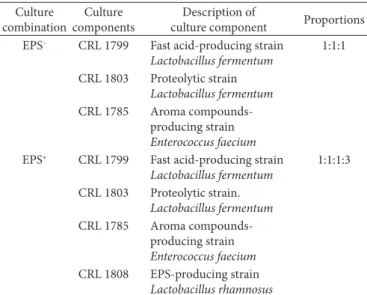
The strains used in this study were isolated in the Laboratory of Centro de Referencia para Lactobacilos (CERELA, Tucumán, Argentina) from goat cheeses elaborated in Santiago del Estero. The criteria for selecting these strains are explained in Frau (2011). The autochthonous starter culture combinations used in this study are listed in Table 1.
Abstract
The aim of this study was to compare the rheology of spreadable cheeses elaborated with autochthonous lactic starter cultures without the addition of exopolysaccharide-producing strain in the same starter with exopolysaccharide-producing strain. From a rheological standpoint, both samples were characterized as weak viscoelastic gels and pseudoplastic products. It was concluded that cheese made with exopolysaccharide-producing strain showed smaller G’, G”, and η* values over the range of frequencies studied and smaller critic stress values than the cheese without exopolysaccharide-producing strain. The results obtained indicate that cheeses without exopolysaccharide-producing strain need to be added with any texture enhancer product.
Keywords: rheology; spreadable cheese; exopolysaccharide.
All the samples were studied and the linear viscoelastic region was determined by stress sweep measurements. In order to create a rheogram describing the structure of each sample, a frequency sweep was carried out (KEALY, 2006; HASSAN et al., 2003). From the stress sweep, the value for the critical stress was found, and it was determined whether it corresponds to the fluency threshold (BENNA-ZAYANI et al., 2008; SAN MARTÍN et al., 2007). The linear viscoelastic region was determined by stress sweep measurements. The stress was linearly increased from 1 to 5.000 Pa at a frequency of 1 Hz. During the time of the experiment, 1 data point was collected per second.
Dynamical rheological measurements (frequency sweep) were used to determine the elastic or storage module (G’), viscous or loss module (G”), and complex viscosity (η*) of the cheeses elaborated in terms of frequency (ω); the parameters used were 1-100 Hz set at 1.5 Pa. These parameters enable the rheological characterization of viscoelastic materials such as the spreadable cheeses under study.
For each batch produced, three separate samples were tested and the average was calculated.
2.5 Statistical analysis
Data were processed using the rheometer own software. Analysis of variance (ANOVA) was carried out using STATISTICA software (version 6.0), in which the effect of culture combination and replicates were estimated for all response variables. The Tukey’s test was used to determine whether the averages of two sets of measurements were significantly different at P < 0.05.
3 Results and discussion
3.1 Stress sweep
The stress sweep carried out on the EPS– and EPS+ samples
indicates that both have a critical stress value: EPS-, 3630.7 Pa;
EPS+, 1363.1 Pa. It can be seen that the EPS– cheese shows a
higher critical value for the stress than that of the EPS+ cheese.
The decrease in the value of the critical stress for the EPS+ sample
can be explained by the decrease in the number of interactions between the protein aggregates due to the presence of EPS in the continuous phase surrounding them.
The critical value of stress (τc) indicates a transition between the linear regime and non-linear regime. Depending on the material, τc can be taken as the yield stress value; this can be done if the viscoelastic analysis shows a maximum of G” (LARIBI et al., 2005; BENNA-ZAYANI et al., 2008). The viscous modulus (G”) did not reach its maximum for either sample (EPS– and EPS+ chesses); Figure 1 shows the curves
obtained for each cheese. The results show that the spreadable cheeses did not have yield stress even if the strain–stress curves show a critical stress. The latter could be attributed to the end of the linear regime or to a drastic change in the rheological behaviour but not to the presence of a threshold (BENNA-ZAYANI et al., 2008).
2.2 Cheese manufacture
Two vats of cheese (three liters each) were made on one day from fresh goat milk obtained from a local farm. For each trial, six litters of milk were pasteurized at 75 °C for 30 minutes, then cooled to 37 °C, and 0.035 g/L of CaCl2 were added. After that, the milk was divided into two batches (three liters each). One of the batches was inoculated with EPS-, and the other one with
EPS+ starter culture (Table 1); both batches were inoculated at
1%. The inoculated milks were incubated at 37 °C until pH < 6, when the bovine curdle was added (20% of the amount needed for enzymatic coagulation) and incubated at 37 °C for 1 hour. Next, the cheese curds were first salted (1.5% of the milk weight) and then placed in cheesecloth at 30 °C until pH < 4.5 facilitating syneresis of the curd. The cheese obtained in this way was packed in polyethylene bags and matured at 7 °C for 5 days. Samples from each cheese were taken on day zero and 7 days after manufacture for rheological studies. The values reported are the means of the 6 cheese making trials (FRAU, 2011).
2.3 Experimental design
Each experimental block consisted of two cheeses made from the same batch of goat milk and fermented with two combinations (Table 1). This block structure was replicated three times.
2.4 Rheological measurements
The rheological characteristics of the experimental spreadable cheese were obtained using an AR 1000 rheometer (TA Instuments, Leatherhead, Surrey, UK). A 25 mm stainless steel parallel plate geometry with gap size of 1 mm was used. All experiments were performed at a constant temperature of 25 °C using a Peltier plate to control temperature. The samples were carefully placed on the plate using a plastic spoon (KELLY; DONNEL, 1998).
Table 1. Culture combinations used as starters (FRAU, 2011).
Culture combination
Culture components
Description of
culture component Proportions EPS– CRL 1799 Fast acid-producing strain
Lactobacillus fermentum
1:1:1
CRL 1803 Proteolytic strain
Lactobacillus fermentum
CRL 1785 Aroma compounds-producing strain
Enterococcus faecium
EPS+ CRL 1799 Fast acid-producing strain
Lactobacillus fermentum
1:1:1:3
CRL 1803 Proteolytic strain.
Lactobacillus fermentum
CRL 1785 Aroma compounds-producing strain
Enterococcus faecium
CRL 1808 EPS-producing strain
Lactobacillus rhamnosus
EPS+: starter containing exopolysaccharide-producing bacterial strain; EPS−: starter
possibly to the additional particles added to the web (ROEFS; DE GROOT-MOSTERT; VAN VLIET, 2000; HERNÁNDEZ-TINOCO et al., 2004).
The interesting data obtained through this type of dynamic (or oscillatory) measurements are the contributions to the internal structure of the sample from the elastic and viscous module, G’ and G” (Pa), respectively, and the complex viscosity, η* (Pa s) (KEALY, 2006).
EPS+ cheese show smaller values of G’ and G” than EPS–
throughout the entire range of frequencies under study (i.e. 1-100 Hz); which was also noted by which is also observed by Hassan et al. (2003).
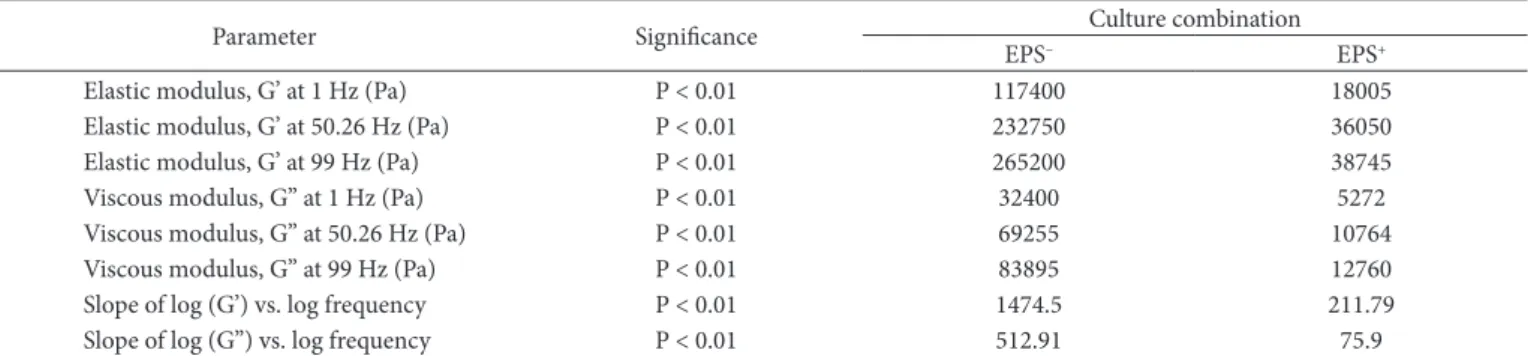
In order to compare G’ and G”, it was necessary to choose a data point at a single frequency because these values are functions of the frequency of oscillation; the following values 1, 50.26, and 99 s–1 were arbitrarily chosen for comparison.
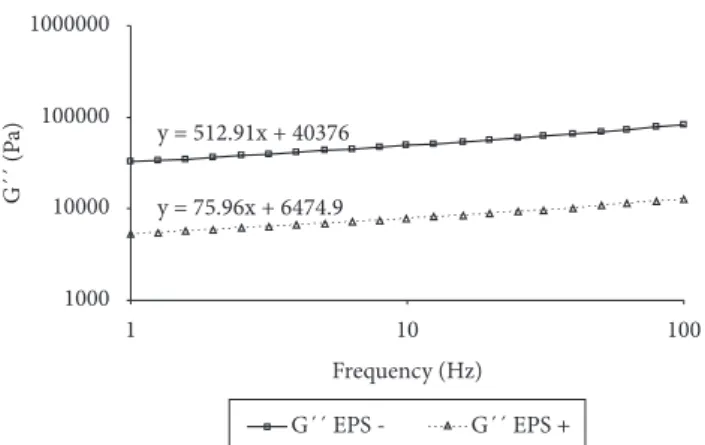
Full data are shown in Figures 2 and 3. It was determined that there are significant differences (p < 0.01) between the EPS– and
EPS+ cheeses. The values for G’and G” obtained are included
in Table 2. Applying a small stress (<< critical stress) on the gel causes
a reversible stretching of the threads making up the cheese matrix. However, if the stress applied is higher than the critical stress, the threads break.
Frequency sweep
Figures 2 and 3 show that both EPS– and EPS+ cheeses
exhibited characteristics typical of a weak viscoelastic gel, with G’ greater than G”, and both showed some frequency dependence. G’ and G” showed similar frequency dependence, but the moduli of cheese made with EPS− showed more
frequency dependence [higher slope of log (G’) and log (G”) vs. log (frequency)] than that of the EPS+ cheese (Table 2). In both
types of samples analysed the elastic component contributes than the viscous module to viscoelasticity more (G’ > G”) which leads to a structure resembling a solid within the range of frequencies studied, which was also observed by other authors (MESSENS et al., 2002; SAN MARTÍN et al., 2007).
The rise of G’ with ω might be due to casein particles fusion as a consequence of the rearrangement of inter- and intra-molecular forces, which in turn results in an increased contacting surface between the casein aggregates, and
Figure 1. G’ and G” variation with stress EPS– and EPS+ cheeses.
G’: elastic modulus; G”: viscous modulus; EPS+: starter containing
exopolysaccharide-producing bacterial strain; EPS− : starter without
exopolysaccharide-producing bacterial strain.
Figure 2. G’ variation with ω in EPS– and EPS+ cheeses. G’: elastic
modulus; G”: viscous modulus; EPS+: starter containing
exopolysaccharide-producing bacterial strain; EPS−: starter without
exopolysaccharide-producing bacterial strain.
Table 2. Viscoelastic parameters of cheese made with different culture combinations.
Parameter Significance Culture combination
EPS– EPS+
Elastic modulus, G’ at 1 Hz (Pa) P < 0.01 117400 18005
Elastic modulus, G’ at 50.26 Hz (Pa) P < 0.01 232750 36050
Elastic modulus, G’ at 99 Hz (Pa) P < 0.01 265200 38745
Viscous modulus, G” at 1 Hz (Pa) P < 0.01 32400 5272
Viscous modulus, G” at 50.26 Hz (Pa) P < 0.01 69255 10764
Viscous modulus, G” at 99 Hz (Pa) P < 0.01 83895 12760
Slope of log (G’) vs. log frequency P < 0.01 1474.5 211.79
Slope of log (G”) vs. log frequency P < 0.01 512.91 75.9
rearrangement during structure formation results in dense clusters of aggregates and lower G’ values (HASSAN et al., 2003).
The difference in the protein network structure between EPS– and EPS+ samples will contribute to differences in flow
behaviour. The presence of EPS reduced G” relatively more than G’ (Figure 2 and 3), and therefore, EPS+ curd cheeses appeared
more elastic in nature than EPS−.
The elastic modulus (G’) dominates the at-rest response of the samples implying that at the frequencies tested, the sample behaves as a solid (Figure 2 and 3).
Figure 4 shows a typical pseudoplastic profile (KEALY, 2006) for both EPS– and EPS+ cheeses. It is expected that the
complex viscosity η* relates somehow to the cohesiveness of the sample (estimating deformation before the structure breakdown) (KEALY, 2006).
Clearly, measurements in the linear viscoelastic region involve probing the structure of the sample in a non-destructive manner, but an irreversible deformation takes place in the mouth. However, it is likely that these quantities can indicate the initial experience of a consumer (KEALY, 2006).
The rheological results agree with the macroscopically appearance of experimental cheeses (Figure 5 and 6). EPS–
samples showed little pleasant structure, and not as much unctuosity as expected from a spreadable cheese, unlike the EPS+ cheese samples. When stirring the cheeses, it was observed
that EPS+ samples quickly and easily became homogeneous
(Figure 6), whereas the samples made using EPS− after identical
stirring exhibited syneresis, which led to a macroscopically granular appearance (Figure 5). A likely reason why EPS+
samples broke down more easily than EPS− samples is that
there are fewer protein-protein interactions at the critical sites (where the strands are thinnest) to overcome in the network (HASSAN et al., 2003). These results would point out that EPS– cheese needs to be added with an additive enhancing their
textural attributes.
The decrease of the critical stress in the EPS+ samples
can be explained by the decreased possibility of interactions between the protein aggregates due to the presence of EPS in the continuous phase surrounding the aggregates. This most probably also contributed to the lower values of G’ and G” in the EPS+ chesses as compared to EPS− cheeses (Table 2), which
was also observed by Skriver (1995). Lucey et al. (1997, 1998) and Hassan et al. (2003), and suggests that an extensive particle
Figure 3. G” variation with ω in EPS– and EPS+ cheeses. EPS+: starter
containing exopolysaccharide-producing bacterial strain; EPS−: starter
without exopolysaccharide-producing bacterial strain.
Figure 4. Complex viscosity (η*) in EPS- and EPS+ cheeses. EPS+:
starter containing exopolysaccharide-producing bacterial strain; EPS−: starter without exopolysaccharide-producing bacterial strain;
η*: complex viscosity.
Figure 5. Spreadable cheese made with EPS– culture. Macroscopically
appearance.
Figure 6. Spreadable cheese made with EPS+ culture. Macroscopically
producing genetic variant. Journal of Dairy Research, v. 71, p. 116-120, 2004. PMid:15068074. http://dx.doi.org/10.1017/ S0022029903006605
HASSAN, A. N. et al. Microstructure and Rheology of Yogurt Made with Cultures Differing Only in Their Ability to Produce Exopolysaccharides. Journal of Dairy Science, v. 86, p. 1632-1638, 2003. http://dx.doi.org/10.3168/jds.S0022-0302(03)73748-5
HERNÁNDEZ-TINOCO, A. et al. Rheometry and scanning electron microscopy study of casein curds added with mequite seed gum and soy proteins. Latin American Applied Research, v. 42, p. 195-202, 2004.
JIMÉNEZ-GUZMÁN, J. et al. Use of an exopolysaccharide-producing strain of Streptococcus thermophilus in the manufacture of Mexican Panela cheese. LWT - Food Science and Technology, v. 42, p. 1508-1512, 2009.
KEALY, T. Application of liquid and solid rheological technologies to the textural characterisation of semi-solid foods. Food Research International, v. 39, p. 265-276, 2006. http://dx.doi.org/10.1016/j. foodres.2005.07.016
KELLY, A. L.; O’DONNELL, H. J. Composition, Gel Properties and Microstructure of Quarg as Affected by Processing Parameters and Milk Quality. International Dairy Journal, v. 8, p. 295-301, 1998. http://dx.doi.org/10.1016/S0958-6946(98)00084-3
LARIBI, S. et al. Comparative yield stress determination for pure and interstratified smectite clays. Rheologica Acta, v. 44, p. 262-269, 2005. http://dx.doi.org/10.1007/s00397-004-0406-3 LUCEY, J. A. et al. A comparison of the formation, rheological
properties and microstructure of acid skim milk gels made with bacterial cultures or glucono-d-lactone. Food Research International, v. 31, p. 147-155, 1998.
LUCEY, J. A. et al. Properties of acid casein gels made by acidification with glucono-d-lactone. 2. Syneresis, permeability and microstructural properties. International Dairy Journal, v. 7, p. 389-397, 1997. MESSENS, W. et al. Rheological properties of high-pressure-treated
Gouda cheese. International Dairy Journal, v. 10, p. 359-367, 2002. http://dx.doi.org/10.1016/S0958-6946(00)00066-2
ROEFS, S. P. F. M.; DE GROOT-MOSTERT, A. E. A.; VAN VLIET, T. Structure of acid casein gels.1.formation and model of gel network. Colloids Surf, v. 50, p. 141-159, 1990. http://dx.doi. org/10.1016/0166-6622(90)80259-7
RUAS-MADIEDO, P.; HUGENHOLTZ, J.; ZOON, P. An overview of the functionality of exopolysaccharides produced by lactic acid bacteria. International Dairy Journal, v. 12, p. 163-171, 2002. http:// dx.doi.org/10.1016/S0958-6946(01)00160-1
SAN MARTÍN, M. et al. Yield, composition and rheological characteristics of cheddar cheese made with high pressure procesed milk. LWT - Food Science and Technology, v. 40, p. 697-705, 2007. SÁNCHEZ MARTÍNEZ, J. Potencial biotecnológico de bacterias
lácticas silvestres en productos lácteos fermentados: actividad metabólica y producción de exopolisacáridos. 2005. Tesis (Doctoral)-Instituto de Productos Lácteos de Asturias, Universidad de Oviedo, Villaviciosa, 2005.
SKRIVER, A. Chacterization of stirred yoghurt by rheology, microscopy and sensory analysis. 2011. Tesis (Doctoral)- Royal Veterinary and Agricultural University Denmark, Denmark, 1995.
4 Conclusion
Both EPS– and EPS+ cheeses exhibited features of a weak
viscoelastic gel although significant differences can be observed between the rheological parameters G’ and G” of the samples.
Both samples were characterized as pseudoplastic products. It was observed that including EPS producing-strain to the starter cultures of spreadable goat cheeses affects positively their rheology since an enhanced texture was achieved without using gums or stabilizers.
The rheological characterization of spreadable goat cheeses embodies an innovating tool for cheese standardization.
References
ASLIM, B.; YÜKSEKDAG, Z. N.; BEYATLI, Y. Exopolysaccharide production by Lactobacillus delbrueckii ssp. bulgaricus and
Streptococcus thermophilus strains under different growth conditions. World Journal of Microbiology & Biotechnology, v. 21, p. 673-677, 2005. http://dx.doi.org/10.1007/s11274-004-3613-2 BANIK, R. M.; KANARI, B.; UPADHYAY, S. N. Exopolysaccharide
of the gellan family: prospects and potential. World Journal Microbiology & Biotechnology, v. 16, p. 407-414, 2000. http:// dx.doi.org/10.1023/A:1008951706621
BENNA-ZAYANI, M. et al. Stabilisation of W/O/W double emulsion by polysaccharides as weak gels. Colloids and Surfaces A: Physicochemical and Engineering Aspects, v. 316, p. 46-54, 2008. http://dx.doi.org/10.1016/j.colsurfa.2007.08.019
BROADBENT, J. R. et al. Use of exopolysaccharide-producing cultures to improve the functionality of low fat cheese. International Dairy Journal, v. 11, p. 433-439, 2001. http://dx.doi.org/10.1016/S0958-6946(01)00084-X
CASTAÑEDA, R. La reología en la caracterización y tipificación de quesos. Tecnología Láctea Latinoamericana, v. 26, p. 48-53, 2002. DE VUYST, L. et al. Recent developments in the biosynthesis and
applications of heteropolysaccharides from lactic acid bacteria.
International Dairy Journal, v. 11, p. 687-707, 2001. http://dx.doi. org/10.1016/S0958-6946(01)00114-5
DUBOC, P.; MOLLET, B. Applications of exopolysaccharides in the dairy industry. International Dairy Journal, v. 11, p. 759-768, 2001. http://dx.doi.org/10.1016/S0958-6946(01)00119-4
FRAU, F. Desarrollo de quesos untables de cabra usando fermentos lácticos autóctonos, como estrategia tecnológica para la cuenca caprina de Santiago del Estero. 2011. Tese (Doutorado em Ciencia e Tecnologia de Alimentos: Modalidade Engenharia)-Facultad de Agronomía y Agroindustrias, Universidad Nacional de Santiago del Estero, Santiago del Estero, 2011.
GUINEE, T.; PUDJA, P.; FARKYE, N. Fresh Acid-Curd Cheese Varieties. In: FOX, P. F. (Ed.). Cheese: Chemistry, Physics and microbiology. Maryland, 1999. cap. 13, p.363-419.
HASSAN, A. N. J. Possibilities and Challenges of Exopolysaccharide-Producing Lactic Cultures in Dairy Foods. Journal of Dairy Science, v. 91, p. 1282-1298, 2008. PMid:18349221. http://dx.doi. org/10.3168/jds.2007-0558
HASSAN, A. N. et al. Microstructure and rheology of an acid-coagulated cheese (Karish) made with an exopolysaccharide-producing
non-WACHER-RODARTE, C. et al. Yogurt production from reconstituted skim milk powders using different polymer and non-polymer forming starter cultures. Journal of Dairy Research, v. 60, p. 247-254, 1993. http://dx.doi.org/10.1017/S0022029900027564 WELMAN, A. D.; MADDOX, I. S. Exopolysaccharides from lactic
acid bacteria: perspectives and challenges. Trends Biotechnology, v. 21, n. 6, p. 269-274, 2003. http://dx.doi.org/10.1016/S0167-7799(03)00107-0
SOYDEMIR, E. Determination of whey based medium requirements and growth characteristics for the production of yoghurt starter cultures. 2008. Tesis (Master of science in Biotechnology and Bioengineering)-University of Pretoria, Pretoria, 2008.