ABSTRACT
Original Scientific Article
Cheeses as ready-to-eat food should be considered as a potential source of foodborne pathogens, primarily Listeria monocytogenes. The aim of present study was to determine the microbiological quality of soft, semi-hard and hard cheeses during the shelf-life, with particular reference to L. monocytogenes. Five types of cheeses were sampled at different time-points during the cold storage and analyzed for presence of Salmonella and L. monocytogenes, as well as lactic acid bacteria,
Escherichia coli, coagulase-positive staphylococci, yeasts, molds, sulfite-reducing clostridia and L. monocytogenes counts. Water activity, pH and NaCl content were monitored in order to evaluate the possibility of L. monocytogenes growth. Challenge test for L. monocytogenes was performed in soft whey cheese, to determine the growth potential of pathogen during the shelf-life of product. All analyzed cheeses were compliant with microbiological criteria during the shelf-life. In soft cheeses, lactic acid bacteria increased in the course of the shelf-life period (1.2-2.6 log increase), while in semi-hard and hard cheeses it decreased (1.6 and 5.2 log decrease, respectively). Soft cheeses support the growth of L. monocytogenes according to determined pH values (5.8-6.5), water activity (0.99-0.94), and NaCl content (0.3-1.2%). Challenge test showed that L. monocytogenes growth potential in selected soft cheese was 0.43 log10 cfu/g during 8 days at 4°C. Water activity in semi-hard and hard cheeses was a limiting factor for Listeria growth during the shelf-life. Soft, semi-hard and hard cheeses were microbiologically stable during their defined shelf-life. Good manufacturing and hygienic practices must be strictly followed in the production of soft cheeses as Listeria-supporting food and be focused on preventing (re)contamination.
Key words: cheese, shelf-life, L. monocytogenes
Available online at www.macvetrev.mk
Macedonian Veterinary Review
INTRODUCTION
Microbiological stability and safety of food during storage is related to many factors. Ready-to-eat food products, including cheeses, are intended for consumption without any treatment between final production step and consumption. The course of microbiological changes in different cheeses during storage and shelf-life depends on the production technology and cheese type (pasteurization, starters, acidity, ripening, etc.), physico-chemical properties
MICROBIOLOGICAL QUALITY OF SOFT, SEMI-HARD
AND HARD CHEESES DURING THE SHELF-LIFE
Josip Vrdoljak
1, Vesna Dobrani
ć
2, Ivana Filipovi
ć
2, Nevijo Zdolec
21
PU
Đ
A D.O.O., Economic Zone
Č
aporice 133, 21240
Č
aporice, Croatia
2Department of Hygiene, Technology and Food Safety,
Faculty of Veterinary Medicine, University of Zagreb,
Heinzelova 55, 10000 Zagreb, Croatia
Received 1 July 2015; Received in revised form 3 November 2015; Accepted 19 November 2015
Corresponding author: Assist. Prof. Nevijo Zdolec, PhD E-mail address: [email protected]
Present address: Department of Hygiene, Technology and Food Safety, Faculty of Veterinary Medicine, University of Zagreb,
Heinzelova 55, 10000 Zagreb, Croatia Phone: ++38512390192
Copyright: © 2015 Vrdoljak J. This is an open-access article published under the terms of the Creative Commons Attribution License which permits unrestricted use, distribution, and reproduction in any medium, provided the original author and source are credited.
Competing Interests: The authors have declared that no competing interests exist.
Available Online First: 4 December 2015 Published on: 15 March 2016
http://dx.doi.org/10.1515/macvetrev-2015-0068
(acidity, moisture content, salt content), storage conditions (microclimate, handling, packaging).
Listeria monocytogenes is the most important foodborne pathogen in cheese microbiology, mainly in the post-processing phase (5). European Regulation on microbiological criteria of food (EC 2073/2005) categorizes foods into two groups, supporting or not supporting the growth of
L. monocytogenes. Foods with pH ≤4.4 or water activity (aw) ≤0.92, or products with pH ≤5.0 and aw ≤0.94, as well as products with shelf-life less than 5 days are considered as safe regarding
Listeria outgrowth (4). Recent survey conducted by EFSA showed that 0.06% of soft and semi-soft cheeses (n=3452) are exceeding the level of 100 cfu/g at the end of shelf-life. The occurrence of
L. monocytogenes in cheese samples was 0.47% (6). In Croatia, microbiological surveys in recent years were mainly performed on traditional dairy products from non-pasteurized milk, and L. monocytogenes
present study was to evaluate the microbiological quality of pasteurized-milk cheeses during the shelf-life with particular reference to L. monocytogenes
prevalence and counts. The growth potential of L. monocytogenes was also evaluated in soft whey cheese during the shelf-life.
MATERIAL AND METHODS
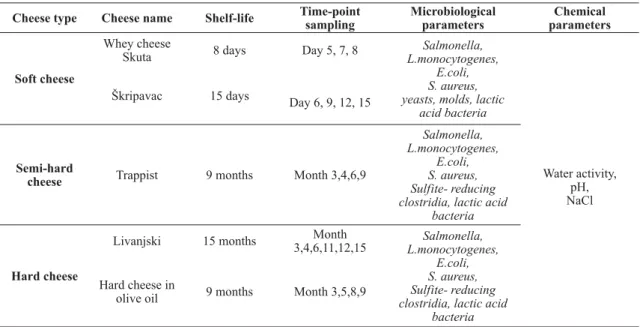
Soft, semi-hard and hard cheeses were produced according to standard procedure in a local cheese producing plant and sampled at the end of production. Ten units of each cheese were sampled, stored in laboratory at 4°C and periodically analyzed during defined shelf-life (Table 1).
Cheese type Cheese name Shelf-life Time-point sampling
Microbiological parameters
Chemical parameters
Soft cheese
Whey cheese
Skuta 8 days Day 5, 7, 8 L.monocytogenes,Salmonella, E.coli, S. aureus, yeasts, molds, lactic
acid bacteria
Water activity, pH, NaCl Škripavac 15 days
Day 6, 9, 12, 15
Semi-hard
cheese Trappist 9 months Month 3,4,6,9
Salmonella, L.monocytogenes,
E.coli, S. aureus, Sulfite- reducing clostridia, lactic acid
bacteria
Hard cheese
Livanjski 15 months Month
3,4,6,11,12,15 L.monocytogenes,Salmonella, E.coli, S. aureus, Sulfite- reducing clostridia, lactic acid
bacteria
Hard cheese in
olive oil 9 months Month 3,5,8,9
For microbiological analyses, 25 g of sample was diluted in 225 ml of appropriate media (Buffered Peptone Water, Half-Fraser Broth or Peptone salt water) and homogenized for 2 min (Stomacher, Sedward, UK). Serial decimal dilutions were prepared and 0.1 ml or 1 ml of selected dilution were used for evaluation of lactic acid bacteria count (MRS, Merck, Darmstadt, Germany) at 30°C for 48 h, Staphylococcus aureus (Baird Parker agar, Merck, Germany) at 37°C for 48 h, Escherichia coli
(Rapid E. coli, Bio-Rad, France) 37/44°C for 24 h, and sulfite-reducing clostridia (Iron Sulphyte Agar, bioMerieux, Marcy l’Etoile, France). Salmonella
spp. was determined following a standard ISO 6579 method and Molecular Detection System (MDS, 3M, USA). L. monocytogenes presence and count was determined using ISO 11290-1 and 11290-2, respectively.
Water activity (aw) was determined by means of HygroPalm AW1 (Rotronic, Switzerland),
Table 1. Sampling scheme and parameters monitored in cheese during shelf-life
pH with pH-meter (pH 510, Eutech instruments, Netherlands) and NaCl following Mohr’s method. Challenge test was performed in whey cheese “skuta” (shelf-life 8 days) inoculated with mixed culture of L. monocytogenes (two strains of cheese origin and L. monocytogenes ATCC 7644). The strains were grown in Brain Hearth Infusion Broth (bioMerieux, France) at 37ºC for 24 h. One ml of each culture was centrifuged at 10000 g for 10 min, followed by supernatant removal and washing the cells with sterile saline water. Cells were diluted in 1 ml of sterile saline water and serially diluted to determine the cell number, using PALCAM agar (Merck, Germany) incubated at 37ºC for 24-48 h.
Appropriate dilutions were taken for cheese portion inoculation to obtain an inoculation level of 30-50 cfu/g. Cheese samples were inoculated in triplicate, vacuum-packed and stored at 4ºC for 8 days.
L. monocytogenes count, pH and water activity were determined at day 0 and at the end of shelf-life.
RESULTS
The results of the microbiological and chemical analyses of cheeses during the storage are summarized in Table 2. Foodborne pathogens
Cheese type Cheese name Microbiological parameter and sampling day Microbial counts (log10 cfu/g)
Results of physico-chemical analyses
pH aw NaCl (%)
Soft cheese
Whey cheese Skuta
Lactic acid bacteria Day 5 Day 7 Day 8 Yeasts Day 5 Day 7 Day 8 4.20±0.07 4.60±0.05 6.80±0.02 2.47±0.01 2.77±0.11 2.95±0.12 6.21±0.02 6.53±0.01 5.80±0.02 0.945±0.01 0.960±0.01 0.990±0.01 0.12±0.02 0.23±0.03 0.29±0.04 Škripavac
Lactic acid bacteria Day 6 Day 9 Day 12 Day 15 Yeasts Day 6 Day 9 Day 12 Day 15 6.62±0.15 6.50±0.07 7.25±0.12 7.82±0.14 2.30±0.11 2.54±0.06 2.58±0.07 2.77±0.10 6.28±0.02 6.40±0.03 6.55±0.03 6.20±0.01 0.950±0.02 0.960±0.01 0.978±0.02 0.990±0.02 1.10±0.02 1.10±0.02 1.20±0.01 1.22±0.02 Semi-hard cheese Trappist
Lactic acid bacteria Day 90 Day 120 Day 180 Day 270 6.20±0.12 5.04±0.10 4.80±0.08 4.62±0.10 5.40±0.04 5.48±0.02 5.80±0.04 5.96±0.02 0.910±0.01 0.900±0.04 0.866±0.03 0.806±0.02 1.51±0.02 1.68±0.03 2.12±0.06 2.85±0.03 Hard cheese Livanjski
Lactic acid bacteria Day 90 Day 120 Day 180 Day 330 Day 360 Day 450 7.20±0.15 5.83±0.10 4.60±0.12 3.40±0.12 2.20±0.05 2.00±0.02 5.52±0.03 5.60±0.02 5.72±0.05 5.80±0.02 5.92±0.02 5.97±0.02 0.900±0.02 0.907±0.05 0.880±0.03 0.795±0.03 0.791±0.06 0.650±0.04 1.85±0.02 2.20±0.02 2.28±0.04 3.30±0.01 3.35±0.02 3.62±0.03
Hard cheese in olive oil
Lactic acid bacteria Day 90 Day 150 Day 240 Day 270 6.80±0.11 6.78±0.14 6.75±0.05 6.42±0.04 5.72±0.02 5.80±0.04 5.84±0.03 5.90±0.03 0.890±0.02 0.870±0.03 0.842±0.04 0.760±0.04 1.74±0.02 1.75±0.02 1.80±0.04 1.92±0.03 Table 2. Results of microbiological and physico-chemical analyses of cheeses during the shelf-life
L. monocytogenes counts were below 10 cfu/g in all cheese samples during storage. Population of lactic acid bacteria increased during the storage of soft cheeses, reaching 7-8 log cfu/g at the end of shelf-life. The pH values, water activity and NaCl content in soft cheeses were in the range of
Listeria-supporting values. Semi-hard and hard cheeses were characterized by decrease of lactic acid bacteria counts during the storage and a slight pH increase. The pH values and NaCl content found in semi-hard and semi-hard cheeses were not a limiting factor for
Listeria growth. However, it is evident that water activity was below values that enables the growth of most foodborne pathogens.
Since soft cheeses showed to be supporting of
Listeria growth according to their physico-chemical
characteristics, the challenge test was performed with L. monocytogenes. Results of L. monocytogenes
growth potential in whey cheese skuta are shown in Table 3, as well as pH and aw values (Table 4). Despite high water activity and optimal pH, L. monocytogenes inoculated in low numbers (30-50 cfu/g) didn’t reach a critical limit of 100 cfu/g in cheese stored at 4 ºC for 8 days.
DISCUSSION
phase of post-processing was monitored in order to evaluate compliance with microbiological criteria, with particular reference to L. monocytogenes
counts. In relation to overall microbiological quality, results showed that soft, semi-hard and hard cheeses were microbiologically stable during their defined shelf-life. Microbiological stability of semi-hard and hard cheeses relies on several hurdles including starter cultures competitiveness, increased salt content and, most importantly, low water activity (2, 9). Physico-chemical values and their changes during the storage of semi-hard and hard cheeses in our study are in line with previous reports (11, 13, 15). L. monocytogenes was not present in viable counts, however it should be stressed that secondary contamination is possible during the cutting of the cheese into quarters or halves, followed by packaging. Prevention of contamination with Listeria at this point should be based on Good Hygienic Practice and verification of sanitation programs.
Soft cheeses in general are of limited durability, because of high moisture content and high pH which support the proliferation of some spoilage microorganism like Enterobacter spp.
Batch Sample L. monocytogenes
number (log10 cfu/g) Day 0
L. monocytogenes number (log10 cfu/g)
Day 8
Growth potential (log10 cfu/g)
I
1a 1b 1c
1 1.60 1.69
1.84 1.90
1.69 0.24
II
2a 2b 2c
1.47 1.30 1.69
1.90 1.95
1.95 0.43
III
3a 3b 3c
1.30 1.60 1.69
1.69 1.30
1.90 0.09
Table 3. Growth potential of Listeria monocytogenes in whey cheese skuta
Table 4. pH and aw in whey cheese skuta during challenge test
Batch Sample
Day 0 Day 8
pH aw pH aw
I
1a 1b 1c
6.22 6.30 6.06
0.952 0.950 0.955
5.80 5.48 5.62
0.992 0.996 0.998
II
2a 2b 2c
6.42 6.23 6.30
0.960 0.958 0.950
5.45 5.50 5.62
0.993 0.997 0.998
III
3a 3b 3c
6.17 6.15 6.22
0.952 0.980 0.976
5.50 5.46 5.52
0.998 0.997 0.994
bacterial kinetics in cheeses made from pasteurized milk during their shelf-life at different storage conditions, and related application of bio-protective strategies (3).
CONCLUSION
Compliance with microbiological criteria at the end of cheese production (final product) doesn’t guarantee that microbiological hazards are excluded. Listeria monocytogenes is a ubiquitous bacteria and secondary contamination of products is possible under poor hygienic conditions. Despite the fact that the growth of the pathogen is limited in semi-hard and hard cheeses by low water activity, the secondary (surface) contamination could result in hazardous products. The significance of following strict hygienic procedures is evident even more in soft cheese production, since they support the growth of L. monocytogenes.
REFERENCES
1. Antunac, N., Hudik, S., Mikulec, N., Maletić, M., Horvat, I., Radeljević, B., Havranek, J. (2011). Proizvodnja i kemijski sastav Istarske i Paške skute. Mljekarstvo 61, 326-335. (in Croatian)
2. Bishop, J.R., Smukowski, M. (2006). Storage temperatures necessary to maintain cheese safety. Food Protect. Trends 26, 714-724.
3. Coelho, M.C., Silva, C.C.G., Ribeiro, S.C., Dapkevicius, M.L.N.E., Rosa, H.J.D. (2014). Control of Listeria monocytogenes in fresh cheese using protective lactic acid bacteria. Int. J. Food Microbiol. 191, 53-59.
http://dx.doi.org/10.1016/j.ijfoodmicro.2014.08.029
PMid:25222327
4. Commision regulation (EC) No 2073/2005 on microbiological criteria for foods. Official Journal of the European Union L338/1-338/26.
5. Donelly, C.W. (2004). Growth and survival of microbial pathogens in cheese. In: Fox, P.F., McSweeney, P.L.H., Cogan, T.M., Guinee, T. P. (Eds.), Cheese - Chemistry, Physics and Microbiology, Third Edition – Vol. 1: general aspects. (pp 541-559), London: Elsevier Ltd.
http://dx.doi.org/10.1016/s1874-558x(04)80081-2
6. EFSA (2013). Analysis of the baseline survey on the prevalence of Listeria monocytogenes in certain ready-to-eat foods in the EU, 2010-2011 Part A: Listeria monocytogenes prevalence estimates. EFSA Jounal 11, 3241.
7. Kozačinski, L., Hadžiosmanović, M. (2001). The occurrence of Listeria monocytogenes in home-made dairy products. Tierartz Umsch. 56, 590-594.
8. Ledenbach, L.H., Marshall, L.T. (2009). Microbiological spoilage of dairy products. In: Sperber, W.H., Doyle, M.P. (Eds.), Compendium of the microbiological spoilage of foods and beverages (pp 41-67), Springer Science.
ttp://dx.doi.org/10.1007/978-1-4419-0826-1_2
9. Leong, W.M., Geier, R., Engstrom, S., Ingham, S., Ingham, B., Smukowski, M. (2014). Growth of Listeria monocytogenes, Salmonella spp., Escherichia coli O157:H7 and Staphylococcus aureus on cheese during extended storage at 25 °C. J. Food Protect. 77, 1275-1288.
http://dx.doi.org/10.4315/0362-028X.JFP-14-047
PMid:25198588
10. Litopoulou-Tzanetaki, E., Tzanetakis, N. (2011). Microbiological characteristics of Greek traditional cheese. Small Rum Res. 101, 17-32.
http://dx.doi.org/10.1016/j.smallrumres.2011.09.022
11. Marijan, A., Džaja, P., Bogdanović, T., Škoko, I., Cvetnić, Ž., Dobranić, V., Zdolec, N., Šatrović, E., Sverin, K. (2014). Infl uence of ripening time on the amount of certain biogenic amines in rind and core of cow milk Livno cheese. Mljekarstvo 64, 159-169.
http://dx.doi.org/10.15567/mljekarstvo.2014.0303
12. Markov, K., Frece, J., Čvek, D., Delaš, F. (2009). Listeria monocytogenes and other contaminants in fresh cheese and cream from Zagreb city area domestic production. Mljekarstvo 59, 225-231.
13. Matić, A., Kalit, S., Salajpal, K., Ivanković, S., Sarić, Z. (2014). Consumers’ preferences and composition of Livanjski cheese in relation to its sensory characteristics. Mljekarstvo 64, 170-177.
http://dx.doi.org/10.15567/mljekarstvo.2014.0304
14. Melo, J., Andrew, P.W., Faleiro, M.L. (2015). Listeria monocytogenes in cheese and the dairy environment remains a food safety challenge: The role of stress responses. Food Res. Int. 67, 75-90.
http://dx.doi.org/10.1016/j.foodres.2014.10.031
15. Merćep, A., Kirin, S., Zdolec, N., Cvrtila Fleck, Ž., Filipović, I., Njari, B., Mitak, M., Kozačinski, L. (2010). Quality of Trappist cheese from Croatian dairy plant. Mljekarstvo 60, 288-298.
16. Papaioannou, G., Chouliara, I., Karatapanis, A.E., Kontominas, M.G., Savvaidis, I.N. (2007). Shelf-life of a Greek whey cheese under modified atmosphere packaging. Int. Dairy J. 17, 358-364.
http://dx.doi.org/10.1016/j.idairyj.2006.04.001
17. Pintado, C.M.B.S., Oliveira, A., Pampulha, M.E., Ferreira, M.A.S.S. (2005). Prevalence and characterization of Listeria monocytogenes isolated from soft cheese. Food Microbiol. 22, 79-85.
18. Rosshaug, P.S., Detmer, A., Ingmer, H., Larsen, M.H. (2012). Modeling the growth of Listeria monocytogenes in soft Blue-White cheeses. Appl. Environ. Microbiol. 78, 8508-8514.
http://dx.doi.org/10.1128/AEM.01865-12
PMid:22983971 PMCid:PMC3502931
19. Rudolf, M., Scherer, S. (2001). High incidence of Listeria monocytogenes in European red smear cheese. Int. J. Food Microbiol. 63, 91-98.
http://dx.doi.org/10.1016/S0168-1605(00)00413-X
20. Zdolec, N., Lazić, S., Kozačinski, L., Hadžiosmanović, M., Filipović, I. (2007). The inhibitory activity of lactic acid bacteria isolated from fresh cow cheese. Mljekarstvo 57, 5-13.