ISSN 0104-6632 Printed in Brazil
www.abeq.org.br/bjche
Vol. 28, No. 03, pp. 483 - 494, July - September, 2011
Brazilian Journal
of Chemical
Engineering
DYNAMIC AND STEADY-SHEAR RHEOLOGICAL
PROPERTIES OF XANTHAN AND GUAR GUMS
DISPERSED IN YELLOW PASSION FRUIT PULP
(
Passiflora edulis f. flavicarpa
)
I. C. F. Moraes
1, L. H. Fasolin
2, R. L. Cunha
2*and F. C. Menegalli
21
Department of Food Engineering, Faculty of Zootechnic and Food Engineering, University of São Paulo, USP, CEP: 13635-900, Pirassununga - SP, Brazil.
2Department of Food Engineering, Faculty of Food Engineering, Phone: + (55) (19) 3521-4047,
University of Campinas, UNICAMP, CEP: 13083-862, Campinas - SP, Brazil. E-mail: [email protected]; [email protected]
(Submitted: October 27, 2010 ; Revised: March 18, 2011 ; Accepted: April 18, 2011)
Abstract - Yellow passion fruit pulp is unstable, presenting phase separation that can be avoided by the addition of hydrocolloids. For this purpose, xanthan and guar gum [0.3, 0.7 and 1.0% (w/w)] were added to yellow passion fruit pulp and the changes in the dynamic and steady-shear rheological behavior evaluated. Xanthan dispersions showed a more pronounced pseudoplasticity and the presence of yield stress, which was not observed in the guar gum dispersions. Cross model fitting to flow curves showed that the xanthan suspensions also had higher zero shear viscosity than the guar suspensions, and, for both gums, an increase in temperature led to lower values for this parameter. The gums showed different behavior as a function of temperature in the range of 5-35oC. The activation energy of the apparent viscosity was dependent on the shear rate and gum concentration for guar, whereas for xanthan these values only varied with the concentration. The mechanical spectra were well described by the generalized Maxwell model and the xanthan dispersions showed a more elastic character than the guar dispersions, with higher values for the relaxation time. Xanthan was characterized as a weak gel, while guar presented a concentrated solution behavior. The simultaneous evaluation of temperature and concentration showed a stronger influence of the polysaccharide concentration on the apparent viscosity and the G’ and G” moduli than the variation in temperature.
Keywords: Yellow passion fruit; Xanthan; Guar; Rheology.
INTRODUCTION
Tropical fruits are pleasant because of their exotic aroma and flavor, besides being a natural source of vitamins, minerals and other important nutritional components. Yellow passion fruit (Passiflora edulis f.,
flavicarpa) is a plant native to Brazil; the fruit is
commercialized in natura or as a pulp and is known for its distinctive acid flavor. Passion fruit pulp is used to produce blends of juices, ice cream, jams, nectars and other desserts. A number of ingredients
can be added to these products in order to manipulate their rheological properties and texture, but sugar and hydrocolloids are the most widely used for this purpose. Hydrocolloids are high-molecular weight hydrophilic biopolymers and can change the continuous phase viscosity, preventing the serum separation that is common in non-clarified juices and fruit pulps.
Xanthan gum is an extracellular polysaccharide obtained from a wide range of bacteria of the genus
(1→4)-β-D-glucopyranosyl backbone, substituted by a trisaccharide side-chain at C-3 on alternate glucose residues. This polysaccharide adopts a helical conformation in aqueous solution, presenting a helix-coil transition at a determined temperature, which depends on the ionic strength of the solution, the nature of the electrolyte, the pH (to a lesser extent) and the acetyl and pyruvate acetal contents (Bresolin
et al. 1998, Morris, 2006). Xanthan also presents
pronounced shear thinning behavior in aqueous solution, making it an interesting ingredient to be employed as a thickening or stabilizing agent (Morris, 2006).
Guar gum is a polysaccharide obtained from the seed endosperm of Cyamopsys tetragonolobus. It is a
galactomannan, consisting of a (1→4)-β-D-
mannopyranosyl backbone partially substituted at O-6 by α-D-galactopyranosyl side groups. The ratio of mannose to galactose in guar is about 1.6-1.8:1
(Wientjes et al., 2000). The structure of this
polysaccharide includes a flexible, extended coil that presents no conformational changes when subjected to temperature variations (Lapasin and Pricl, 1995), but is slightly affected by the pH and ion concentration, presenting shear thinning behavior in aqueous solution, even at low concentrations (Wang
et al., 2000). This gum has been extensively used as
a thickening and stabilizing agent in many sectors of food and other industries (Wu, 2009).
Foods are complex multicomponent systems and their rheological properties depend strongly on the composition of the ingredients. Thus, it is important to understand the role of gums in these systems, as well as their interactions with other ingredients. A number of research projects have studied the effect of gums on the rheological properties of food dispersions in very complex or model systems (Wei
et al., 2001; Mandala et al., 2004; Choi and Yoo,
2006; Sopade et al., 2008; Achayuthakan and
Suphantharika, 2008), but the interaction of gums
with fruit pulps has received little attention. In addition, during the manufacturing process of fruit pulps, their properties can vary due to changes in the temperature or solids content. Thus, the aim of this work was to evaluate the rheological behavior of xanthan and guar gums dispersed in a complex system (yellow passion fruit pulp) by steady- and oscillatory-shear measurements, varying the temperature and the biopolymer concentrations.
MATERIAL AND METHODS
Material
The passion fruit (Passiflora edulis f. flavicarpa degener) was kindly provided by the Cooperativa de
Agricultores de Marília (Marília, Brazil). The fruits
were washed and pulped manually and then passed through a finisher (0.5 mm diameter). The composition of the yellow passion fruit pulp was determined according to Ranganna (1977) and the results are shown in Table 1. The guar and xanthan gums were kindly donated by Star & Arty (Campinas, Brazil).
Preparation of the Dispersions
Guar or xanthan gum was mixed with the passion fruit pulp with strong mechanical stirring (1750 rpm) for 1 hour. Dispersions were prepared at three different concentrations for each gum (0.3, 0.7 and 1% w/w). In addition, the pulp with added sucrose (3:1; pulp:sucrose w/w) and the raw pulp were analyzed. The dispersions prepared with xanthan or guar were denominated MaX or MaG, respectively, followed by the gum concentration (e.g., MaX1 corresponded to the addition of 1% w/w xanthan gum). Pure yellow passion pulp was denominated Ma and the pulp with added sucrose called MaS.
Table 1: The physicochemical properties of the yellow passion fruit pulp
Parameters Content
Soluble Solids (°Brix) 11.8 ± 0.0 Moisture (% w/w) 85.0 ± 0.2 Total sugars (% w/w) 5.70 ± 0.1 Reducing sugars (% w/w) 2.46 ± 0.1 Acidity (% w/v) 4.33 ± 0.0 Lipids (% w/w) 0.19 ± 0.0 Protein (% w/w) 1.12 ± 0.1 Ash (% w/w) 0.52 ± 0.1 Fiber (% w/w) 0.11 ± 0.0
Rheological Measurements
Rheological measurements were carried out by using a stress-controlled rheometer (Carri-Med CSL2 500, TA Instruments, England), with concentric cylinders (32mm height, 13.83mm internal diameter and 15mm external diameter) or cone-plate geometry (60mm diameter, 2° angle,
truncation 58μm), depending on the dispersion
viscosity. All the measurements were carried out in triplicate.
Steady-Shear Rheology
Flow curves were obtained by an up-down-up steps program using different shear stress ranges for each sample in order to obtain a maximum shear
rate value ranging from 0 up to 100 s-1. Seven
different temperatures between 5 and 35°C were used for the steady shear rate measurements and the curves were fitted to the Herschel-Bulkley and Cross models (Equations (1) and (2)) (Steffe, 1996; Rao 1999). The dependence of the viscosity on temperature was evaluated using the Arrhenius equation (Equation (3)).
n 0 k
σ = σ + γ (1)
0 m ( )
1 ( )
∞ ∞ η − η
η γ = η + + τγ
(2)
Ea RT
( ) Ae
⎛ ⎞
⎜ ⎟
⎝ ⎠
η γ = (3)
In these equations, is the shear stress (Pa), 0 is
the yield stress (Pa), k is the consistency index (Pa.sn); γ is the shear rate (s )−1 ; n is the flow behavior index; ( )η γ is the apparent viscosity (Pa.s)
at a determined shear rate; η0 and η∞ are the
Newtonian vistosity at zero and infinite shear rate (Pa.s); is the time constant (s); m is a rate constant; A is a fitting parameter (Pa.s), R is the universal gas constant (8.314 kJ/kmol.K), T, temperature (K) and Ea is the activation energy (kJ/kmol).
The combined effect of gum concentration and temperature was estimated by using Equation (4) (Steffe, 1996).
2 2
Ea
Y( ) a exp b C
RT
⎛ ⎞
γ = ⎜ + ⎟
⎝ ⎠
(4)
where Y represents the apparent viscosity (Pa.s), the elastic modulus (G’) or the viscous (G”) modulus (Pa), a2 (Pa.s or Pa) and b2 are fitting parameters and
C the concentration (% w/w).
Dynamic Shear Rheology
The viscoelastic properties were analyzed at 5, 20 and 35°C by oscillatory measurements. A strain amplitude sweep (0.01 – 10%) at a fixed frequency
(ω = 1Hz) was performed to establish the linear
viscoelasticity regime. Then, a frequency sweep between 0.01 and 10 Hz was performed within the linear viscoelasticity domain for each sample. The loss tangent (tan δ), the elastic or storage (G’) and the viscous or loss (G”) moduli were determined as a function of the frequency and the generalized Maxwell model fitted to the data (Equations (5) and (6)): ( )
( )
( )
2 n i i 2 i i 1 G G 1 ω = λ ω ′ =+ λ ω
∑
(5)( )
( )
n i i 2 i i 1 G G 1 ω = λ ω ′′ =+ λ ω
∑
(6)where n is the number of Maxwell elements considered, Gi the plateau modulus (Pa), λi the
relaxation time (s) and ω the frequency (Hz).
The rheological parameters (G’ and G”) obtained in the temperature range from 5 to 35°C were reduced to an arbitrary reference temperature of 20°C to evaluate the time-temperature superposition (TTS) (Equation (7)).
ref
0 ref ref T o T a T η ρ
= η ρ (7)
where η0 (Pa.s) is the maximum Newtonian viscosity
obtained from the Cross model, T (K) the absolute temperature and ρ (kg/m3) the sample density. The subscript ref is related to the reference temperature.
The TTS principle suggests that all relaxation times have the same temperature dependence
(Ferry, 1980). The parameter aT is an empirical
RESULTS AND DISCUSSION
Steady Shear Rheology
The flow curves showed shear thinning behavior and the smallest values for shear stress or viscosity were found for the raw pulp (Figure 1(a)), followed by that with added sucrose (Figure 1(b)). In addition, a decrease in the shear stress values was
observed at higher temperatures for all dispersions (Figure 1). The fruit pulp consists of solid particles dispersed in a liquid medium and higher temperatures increase particle mobility, with a consequent decrease in the viscosity. However, the addition of gum led to higher values for shear stress or viscosity (Figure 1(c)-1(h)), which were more pronounced for the guar dispersions as compared to the xanthan dispersions.
Figure 1: Flow curves for yellow passion fruit pulp with added sucrose, guar or xanthan
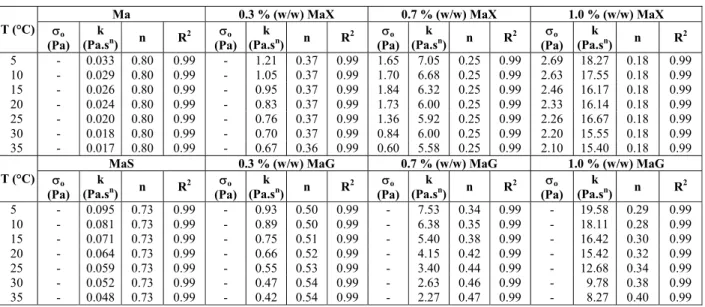
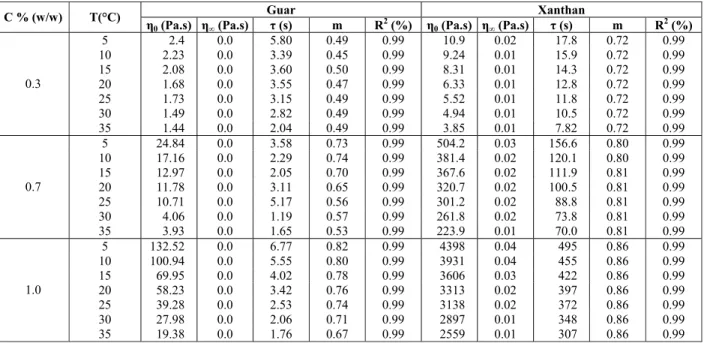
The rheological parameters obtained for all the formulations using the Herschel-Bulckley and Cross models are shown in Tables 2 and 3, respectively. The Cross model was used to evaluate the Newtonian viscosity (zero– and infinity-shear), and also the dependence of viscosity on the shear rate. Nevertheless, the Cross model could not be adequately fit to experimental data for raw pulp and pulp with added sucrose since these samples showed smaller deviations from Newtonian behavior and a narrower apparent viscosity range. The Herschel-Bulkley model fitted the experimental data well, but only the MaX07 and MaX1 dispersions showed yield stress. The shear thinning behavior of the guar and xanthan dispersions was greater than for the pulp with sucrose and for the raw pulp. The pseudoplasticity increased, i.e, the flow behavior index (n) decreased, with an increase in the concentration of the biopolymers, as reported by other authors (Genoveze and Lozano; 2001; Tiban et al., 2003; Sopade et al., 2008). The fitting of the Cross model corroborated these findings, since the parameter ‘m’ was related to the flow index (n), and m values tending to zero are associated with Newtonian behavior. Lower values for the flow behavior index (n), or higher ‘m’ values for the xanthan formulations, implied a greater decrease in the apparent viscosity at increased shear rates. These results can be attributed to an improved particle-particle interaction, which could lead to particle-particle aggregation and greater orientation of the movement.
The flow index (n) is generally independent of the
temperature, as observed for the Ma, MaS and MaX systems. However, the pulp with added guar (Table 2) showed an increased flow behavior index (or smaller m values) with an increase in temperature. This behavior was more pronounced at higher guar concentrations, in agreement with the studies carried out by other authors with other polysaccharides (Jampen et al., 2000; Grigelmo-Miguel et al., 1999). The consistency index (k) is a rheological parameter that reflects the values of the viscosity. This parameter showed very similar values for the two polysaccharides at the same concentration, but had a greater temperature dependence for the guar dispersions than for the xanthan dispersions. Most of the gum dispersions showed a considerable decrease in apparent viscosity with the increase in temperature, whereas the xanthan dispersions were quite stable between 0 and 100°C (Yevlampieva et al., 1999).
On the other hand, an increase in guar gum concentration did not affect the values of the time constant ( ) (Table 3), but the same parameter showed a large increase with the increase in xanthan concentration. This parameter is indicative of the rate of exponential stress decrease when subjected to shear forces (Ravi and Bhattacharya, 2004).The reciprocal time constant (1/τ) gives a critical shear rate that provides a useful indicator of the shear rate for onset of shear thinning. Thus, a lower values indicates a slower breakdown of the structure and/or of agglomerates because of the greater resistance to flow. An increase in temperature also decreased the time constant of the guar and xanthan dispersions.
Table 2: Herschel-Bulkley model rheological parameters for raw yellow passion fruit pulp with added sucrose, guar or xanthan gum at different concentrations.
Ma 0.3 % (w/w) MaX 0.7 % (w/w) MaX 1.0 % (w/w) MaX T (°C) σo
(Pa) k
(Pa.sn) n R
2 σo
(Pa) k
(Pa.sn) n R
2 σo
(Pa) k
(Pa.sn) n R
2 σo
(Pa) k
(Pa.sn) n R
2
5 - 0.033 0.80 0.99 - 1.21 0.37 0.99 1.65 7.05 0.25 0.99 2.69 18.27 0.18 0.99 10 - 0.029 0.80 0.99 - 1.05 0.37 0.99 1.70 6.68 0.25 0.99 2.63 17.55 0.18 0.99 15 - 0.026 0.80 0.99 - 0.95 0.37 0.99 1.84 6.32 0.25 0.99 2.46 16.17 0.18 0.99 20 - 0.024 0.80 0.99 - 0.83 0.37 0.99 1.73 6.00 0.25 0.99 2.33 16.14 0.18 0.99 25 - 0.020 0.80 0.99 - 0.76 0.37 0.99 1.36 5.92 0.25 0.99 2.26 16.67 0.18 0.99 30 - 0.018 0.80 0.99 - 0.70 0.37 0.99 0.84 6.00 0.25 0.99 2.20 15.55 0.18 0.99 35 - 0.017 0.80 0.99 - 0.67 0.36 0.99 0.60 5.58 0.25 0.99 2.10 15.40 0.18 0.99
MaS 0.3 % (w/w) MaG 0.7 % (w/w) MaG 1.0 % (w/w) MaG T (°C) σo
(Pa) k
(Pa.sn) n R
2 σo
(Pa) k
(Pa.sn) n R
2 σo
(Pa) k
(Pa.sn) n R
2 σo
(Pa) k
(Pa.sn) n R
2
Table 3: Cross model rheological parameters for yellow passion fruit pulp with added guar or xanthan gum at different concentrations
Guar Xanthan C % (w/w) T(°C) η
0 (Pa.s) η∞ (Pa.s) τ (s) m R2 (%) η0 (Pa.s) η∞ (Pa.s) τ (s) m R2 (%)
5 2.4 0.0 5.80 0.49 0.99 10.9 0.02 17.8 0.72 0.99 10 2.23 0.0 3.39 0.45 0.99 9.24 0.01 15.9 0.72 0.99 15 2.08 0.0 3.60 0.50 0.99 8.31 0.01 14.3 0.72 0.99 20 1.68 0.0 3.55 0.47 0.99 6.33 0.01 12.8 0.72 0.99 25 1.73 0.0 3.15 0.49 0.99 5.52 0.01 11.8 0.72 0.99 30 1.49 0.0 2.82 0.49 0.99 4.94 0.01 10.5 0.72 0.99 0.3
35 1.44 0.0 2.04 0.49 0.99 3.85 0.01 7.82 0.72 0.99 5 24.84 0.0 3.58 0.73 0.99 504.2 0.03 156.6 0.80 0.99 10 17.16 0.0 2.29 0.74 0.99 381.4 0.02 120.1 0.80 0.99 15 12.97 0.0 2.05 0.70 0.99 367.6 0.02 111.9 0.81 0.99 20 11.78 0.0 3.11 0.65 0.99 320.7 0.02 100.5 0.81 0.99 25 10.71 0.0 5.17 0.56 0.99 301.2 0.02 88.8 0.81 0.99 30 4.06 0.0 1.19 0.57 0.99 261.8 0.02 73.8 0.81 0.99 0.7
35 3.93 0.0 1.65 0.53 0.99 223.9 0.01 70.0 0.81 0.99 5 132.52 0.0 6.77 0.82 0.99 4398 0.04 495 0.86 0.99 10 100.94 0.0 5.55 0.80 0.99 3931 0.04 455 0.86 0.99 15 69.95 0.0 4.02 0.78 0.99 3606 0.03 422 0.86 0.99 20 58.23 0.0 3.42 0.76 0.99 3313 0.02 397 0.86 0.99 25 39.28 0.0 2.53 0.74 0.99 3138 0.02 372 0.86 0.99 30 27.98 0.0 2.06 0.71 0.99 2897 0.01 348 0.86 0.99 1.0
35 19.38 0.0 1.76 0.67 0.99 2559 0.01 307 0.86 0.99
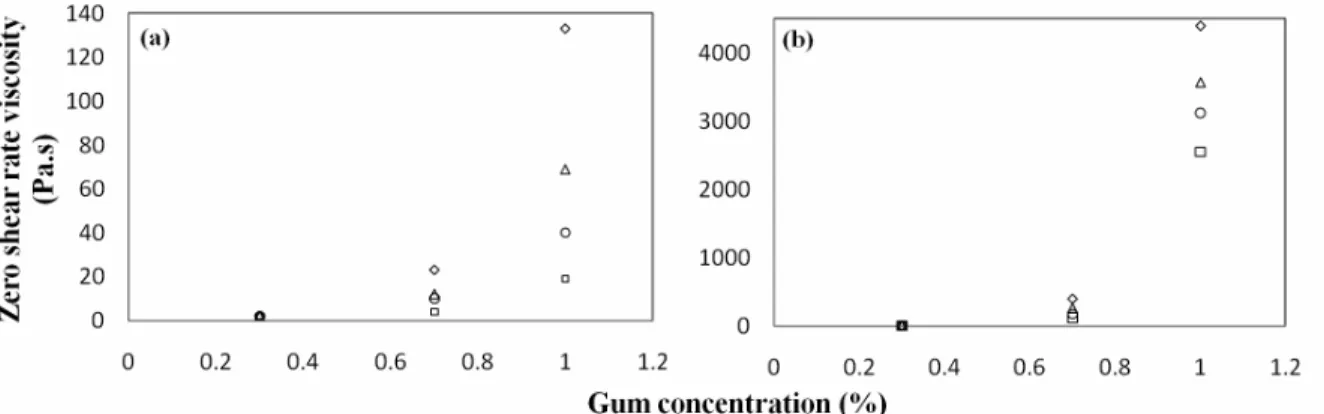
The Newtonian viscosity at zero shear rate and the time constant were smaller for guar as compared to xanthan, confirming that the latter biopolymer, when added to passion fruit pulp, formed a more structured system. However, an increase in polysaccharide concentration led to an increase in the zero shear rate viscosity (η0) (Table 3 and Figure
2), which could be properly described by a power law equation characteristic of concentrated polymer solutions (Equation (8)) (Zhang et al., 2007):
b o aC
η = (8)
where η0 (Pa.s) is the zero shear rate viscosity, C (%,
w/w) the gum concentration, and a (Pa.s) and b are fitting parameters.
The results could not be fitted to this equation because of the small amount of data. The b value is an indicative of the presence of junctionsor specific attractive forces in the polymer solution. However, it is clear from Figure 2 that the b parameter for the xanthan dispersions was much higher than it was for the guar dispersions and the zero shear rate viscosity increased much more for xanthan, reaching values close to 4000 Pa.s, while for guar these values did not exceed 140 Pa.s. Thus, the lower b values for the guar dispersions could indicate there are no specific interactions between this gum and the yellow passion
pulp (Zhang et al., 2007). Thus, the enhanced
viscosity can be attributed to the increase in polysaccharide concentration, leading to greater entanglement between the macromolecular chains
(Zhang et al., 2007). For the xanthan dispersions, the higher b values could be attributed to the greater complexity of this branched biopolymer.
The non-linear Arrhenius model was also used to fit the data for apparent viscosity as a function of 1/T (Equation (3)) to determine the activation energy. The activation energy was almost constant as a function of the shear rate for dispersions with flow indexes independent of the temperature (Figure 3). However, the activation energy decreased with the increase in shear rate for the guar formulations. Since the activation energy is a parameter that determines the dependence of viscosity on temperature, higher values of the activation energy show that the apparent viscosity is more dependent on temperature changes.
Figure 2: Dependence of the zero-shear-rate viscosity on the gum concentration (a) Guar and (b) Xanthan; 5°C (); 15°C (U); 25°C ({); 35°C ( ).
Figure 3: Activation energy of apparent viscosity determined by fitting an
Arrhenius model as a function of shear rate. Temperature range (5°C – 35°C).
Dynamic Rheology
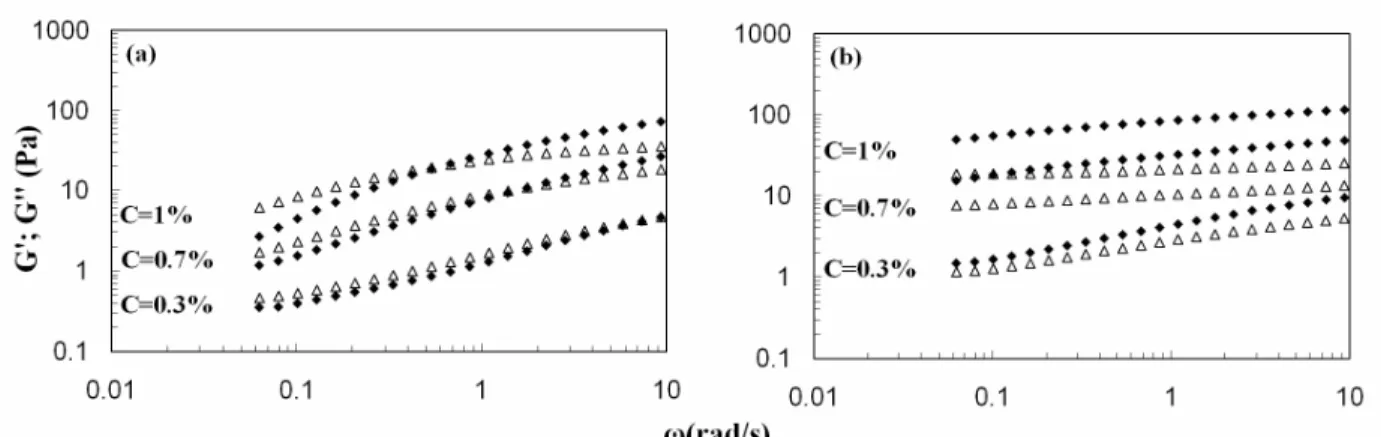
Frequency sweeps obtained from oscillatory shear measurements are shown in Figure 4. The raw pulp (Ma) and the pulp with added sucrose (MaS) were not characterized by dynamic measurements because their storage modulus (G’) tended to zero. All guar dispersions showed the typical behavior of concentrated solutions (Figure 4(a)). At low frequencies there was enough time for entanglement to occur and be disrupted during the oscillation period, which allowed viscous flow to predominate over the elastic character. With an increase in frequency, the time became insufficient for disruption of the entanglement and the dispersion behaved as a cross-linked network with the elastic response predominating over viscous flow (G’>G”), as observed by Choi and Yoo (2006). On the other hand, the xanthan formulations presented a weak gel-like behavior (G’/G”<10) (Figure 4(b)), indicating a dominance of the elastic properties over viscous flow, as observed with tomato products (Valencia et al., 2002; Sánchez et al., 2002), yellow potato puree (Fasina et al., 2003) and jaboticaba pulp (Sato and Cunha, 2007).
The loss tangent (tan δ=G”/G’) showed values
smaller than unity and with a weak dependence on the frequency for all the samples formulated with xanthan (Figure 5(b)). On the other hand, guar dispersions showed tan δ values greater than unity at low frequencies, decreasing to below unity with the increase in frequency. The decrease in tan δ with an
increase in frequency indicated that the system was
in a pre-gel regime (Shon et al., 2007) (Figure 5(a)). An increase in temperature led to displacement of the crossover point to higher frequencies, but this point was also dependent on the guar concentration.
The generalized Maxwell model (Equations (5) and (6)) fit the experimental values well for the dispersions with biopolymer gums and the values for Gi (relaxation modulus) and λi (relaxation time) at
three different temperatures are shown in Table 4. To satisfactorily describe the viscoelastic behavior of the dispersions, from three to six Maxwell elements
were necessary. The Gi and λi parameters were
Figure 4: Dynamic moduli as a function of frequency for dispersions with different gum concentrations at 20°C. G’: Full symbols; G”: open symbols: (a) Guar and (b) Xanthan.
Figure 5: Loss tangent at different temperatures and gum concentrations (% w/w). (a) Guar and
(b) Xanthan.
Table 4: Generalized Maxwell parameters for yellow passion fruit pulp with added guar and xanthan gums
Guar gum Xanthan
1% 0.7% 0.3% 1% 0.7% 0.3% T (°C)
Gi λi Gi λi Gi λi Gi λi Gi λi Gi λi
3.80 20.60 1.49 9.85 0.61 10.67 50.37 81.66 14.38 31.53 1.85 27.60 14.75 3.21 6.31 1.02 1.52 0.74 26.57 4.92 10.13 3.12 2.67 1.92 24.87 0.75 13.43 0.20 4.28 0.13 28.91 0.59 12.62 0.48 4.60 0.30 31.99 0.18 21.85 0.046 - - 33.29 0.07 15.52 0.07 5.16 0.049 38.60 0.043 - - - - 328.94 0.0015 342.73 0.0009 3.38 0.0002 5°C
87.40 0.005 - - -
3.60 18.3 2.10 16.69 0.87 11.14 48.41 58.54 14.83 74.47 1.10 14.77 13.60 3.16 7.38 1.37 1.34 0.85 20.87 5.53 11.61 4.48 2.20 0.62 24.47 0.74 14.65 0.25 3.77 0.12 19.24 1.08 14.80 0.66 3.35 0.068 29.04 0.18 25.38 0.05 - - 20.82 0.23 19.32 0.08 65.90 0.0004 38.34 0.045 83.12 0.0038 - - 26.50 0.004 52.73 0.002 79.71 0.0004 20°C
89.45 0.004 - - -
2.25 15.38 0.98 10.24 1.37 7.35 44.18 72.65 10.04 60.86 1.32 26.99 8.38 2.28 3.75 0.71 1.77 0.69 28.64 4.54 13.29 3.52 1.38 1.16 18.25 0.57 10.57 0.13 4.14 0.10 30.00 0.57 16.20 0.41 2.94 0.14 26.71 0.15 18.47 0.025 - - 33.65 0.07 16.05 0.07 33.90 0.0004
37.7 0.0389 90.0 0.0008 - - 132.19 0.03 52.39 0.004 - - 35°C
In general, we observed that the Gi values
decreased with an increase in relaxation time (Table 4) for the same conditions of temperature and gum concentration, which is in agreement with the values
obtained by Bayram et al. (1998). The increase in
relaxation time could be associated with the formation of intermolecular aggregates, which was facilitated by an increase in the polysaccharide concentration and the biopolymer characteristics. The more limited molecular movement caused by a higher molecular density led to a greater degree of entanglement between the biopolymers in the yellow passion fruit pulp. Moreover, differences in the viscoelastic properties of the xanthan and guar gums could also be related to the flexibility of the biopolymer chains, considering the greater rigidity of xanthan as compared to guar (Fernandes, 1995) due to the helical conformation adopted by the former and molecular entanglements of the latter.
The Cox-Merz Rule
The Cox-Merz rule states that the complex shear viscosity at a given frequency is equal to the steady shear viscosity at the same shear rate. This rule has been applied to a number of polymers, solutions and complex food systems (Tiziani and Vodovotz, 2005; Yasar et al., 2009; Storz et al., 2010). However, in the case of xanthan and guar dispersions, higher values for the complex viscosity were observed as compared to the apparent viscosity within the frequency and shear rate range studied (Figure 6). This departure from the Cox-Merz rule could be explained by structural damage due to the excessive shear used to obtain the flow curves (Chamberlain and Rao, 1999). For xanthan, this behavior could be attributed to disruption of the hydrogen bonds that associate their chains and that were disrupted at high deformation during the steady shear rate(Cuvelier and Launay, 1986). For the galactomannans, this could be explained by structural decay due to the effect of the stress deformation applied to the system by oscillatory or steady shear (Chamberlain and Rao, 1999). This departure from the expected behavior is in agreement with the behavior shown by a wide range of food dispersions (Alvarez et al., 2004; Tárrega et al., 2005, Yasar et al., 2009).
Time-Temperature Superposition
This is based on the superposition of the isothermal oscillatory frequency data into a single master curve, using a temperature dependent shift factor, aT, to extend the frequency axis by several
orders of magnitude (Nickerson et al., 2004). The aT
factor relates the dynamic storage (G’) or loss modulus (G”) at a given temperature with the same variable (G’ref, G”ref), at an arbitrarily selected reference
temperature (Tref) (Van azer et al., 1963; Silva et al.,
1994), multiplied by the thermal density ratio due to the thermal expansion effect caused by the entropic nature of the stored elastic energy (Equation (7)).
The log aT values (within reasonable error) must be
similar in order for the superposition of all the viscoelastic moduli to occur (Ferry, 1980). The superposition suggests that the material is thermo-rheologically simple, which means that all the relaxation times change identically with the temperature. On the other hand, a thermo-rheologically complex material does not show superposition of the curves, which is typical of systems that present morphological changes with changes in temperature, such as immiscible blends and multiphasic or
semi-crystalline domains (Nickerson et al., 2004). The
elastic and viscous moduli reduced up to 20°C, as can be seen in Figure 7. This method was not effective for guar dispersions (Figure 7(a)), which could be attributed to temperature-dependent structural alterations in this biopolymer. However, xanthan did not present conformational changes within the temperature range studied and its rheological properties were not sensitive to temperature. The xanthan curves (Figure 7(b)) showed superposition, indicating that the changes in the rheological properties were due only to temperature and that there were probably no structural changes.
Combined Effect of Temperature and Gum Concentration on the Rheology
The combined effects of temperature and gum concentration on the apparent viscosity or dynamic moduli (G’ and G”) for MaX and MaG dispersions were combined into a simple equation (Equation (4)) to predict the rheological behavior at any temperature and concentration, as shown in Table 5. This equation has already been used for aqueous xanthan solutions and presented good results (Xuewu et al., 1996).
Figure 6: Steady-shear and complex viscosity as a function of frequency and shear rate for yellow passion pulp at 20°C. Open symbols: ηap; full symbols: η*. (a) Guar and (b) Xanthan.
Figure 7: Time-temperature superposition for yellow passion fruit pulp with added biopolymers (1% w/w).
(a) Guar and (b) Xanthan. Full symbols: G’; Open symbols: G”.
Table 5: Fitted parameters used to predict the rheological behavior of yellow passion fruit pulp for the combined effect of temperature and the concentrations of xanthan and guar gums.
Sample Rheological
properties a2 b2
Ea/R
(J/gmol) R
2
G’ (0.05Hz) 0.0116 3.96 1971.22 0.9420 G” (0.05 Hz) 0.1723 3.93 1272.07 0.9696 MaG
ηap (10s-1) 0.0049 2.54 1904.39 0.9800
G’ (0.05Hz) 11.57 3.12 512.48 0.9912 G” (0.05 Hz) 8.44 2.29 258.92 0.9986 MaX
ηap (10s-1) 0.94 2.11 292.32 0.9909
CONCLUSIONS
The addition of guar gum and xanthan to yellow passion pulp resulted in quite different rheological behavior, despite the fact that both presented shear thinning behavior. Guar, a neutral polysaccharide, showed the characteristics of concentrated dispersions and did not present yield stress. However, xanthan, a polyelectrolyte, showed a weak gel behavior, yield stress and more pronounced
a more structured passion fruit pulp dispersion, while the guar gum dispersions were more susceptible to the conditions of concentration and temperature.
REFERENCES
Achayuthakan, P. and Suphantharika, M., Pasting and rheological properties of waxy corn starch as affected by guar gum and xanthan gum, Carbohydrate Polymers, 7 (1) 1, 9-17 (2008). Alvarez, M. D., Fernández, C. and Canet, W.,
Rheological behavior of fresh and frozen potato puree in steady and dynamic shear at different temperatures. European Food Research Technology, 218, (6), 544-553 (2004).
Bayram, G., Yilmazer, Ü. and Orbey, N., Viscoelastic properties of suspensions with weakly interacting particle. Journal of Applied Polymer Science, 70, (3), 507-514 (1998).
Bresolin, T. M. B., Milas, M., Rinaudo, M. and Ganter, J. L. M. S., Xanthan-galactomannan interactions as related to xanthan conformations. International Journal of Biological Macromolecules, 23, (4), 263-275 (1998).
Chamberlain, E. K. and Rao, M. A., Rheological properties of acid converted waxy maize starches in water and 90% DMSO/10% water. Carbohydrate Polymers, 40, (4), 251-260 (1999). Choi, S. and Yoo, B., Rheological effect of gum
addition to hot pepper-soybean pastes. International Journal of Food Science and Technology, 41, 56-62 (2006).
Cuvelier, G. and Launay, B., Concentration regimes in xanthan gum solutions deduced from flow and viscoelastic properties. Carbohydrate Polymers, 6, (5), 321-333 (1986).
Fasina, O. O., Walter Jr., W. M., Fleming, H. P. and Simunovic, N., Viscoelastic properties of restructured sweetpotato puree. International Journal of Food Science and Technology, 38, (4), 421-425 (2003).
Fernandes, P. B., Influence of galactomannan on the structure and thermal behavior of xanthan/ galactomannan mixtures. Journal of Food Engineering, 24, (2), 269-283 (1995).
Ferry, J. D., Dependence of viscoelastic behavior on temperature and pressure, Viscoelastic properties of polymers. Wiley, New York, 264-320 (1980).
Genoveze, D. B. and Lozano, J. E., The effect of hydrocolloids on the stability and viscosity of cloudy apple juice. Food Hydrocolloids, 15, (1), 1-7 (2001).
Grigelmo-Miguel, N., Ibarz-Ribas, A. and Martín-Belloso, O., Rheology of peach dietary fibre suspensions. Journal of Food Engineering, 39, (1), 91-99 (1999).
Jampen, S., Britt, I. J. and Tung, M. A., Gellan polymer solution properties: Dilute and concentrated regimes. Food Research International, 33, (7), 579-586 (2000).
Lapasin, R. and Pricl, S., Rheological of industrial polysaccharides: Theory an applications. Chapman & Hall, New York (1995).
Lapasin, R., Pricl, S. and Tracanelli, P., Rheology of hydroxyethyl guar gum derivatives. Carbohydrate Polymers, 14, (4), 411-427 (1991).
Mandala, I. G., Savvas, T. P. and Kostaropoulos, A. E., Xanthan and locust bean gum influence on the rheology and structure of a white model-sauce. Journal of Food Engineering, 64, (3), 335-342 (2004).
Morris, V. J. Bacterial Polysaccharides. In Stephen, A. M., Phillips, G. O. and Williams, P. A. (Eds), Food Polysaccharides and their applications, CRC Press, Boca Raton, 413-454 (2006).
Nickerson, M. T., Paulson, A. T. and Speers, R. A., Time-temperature studies of gellan polysaccharide gelation in the presence of low, intermediate and high levels of co-solutes. Food Hydrocolloids, 18, (5), 783-794 (2004).
Ranganna, S., Manual of analysis of fruit and vegetable products. Tata McGraw-Hill Publishing Company Limited, New Dehi (1977).
Rao, M. A. Rheology of fluid and semisolids foods: principles and application. Maryland, Aspen, p. 443 (1999).
Ravi, R. and Bhattacharya, S., Flow behavior of chickpea (Cicer arietinum L.) flour dispersions: Effect of additives. Journal of Food Engineering, 65, (4), 619-624 (2004).
Rochefort, W. E. and Middleman, S., Rheology of xanthan gum: salt, temperature, and strain effects in oscillatory and steady shear experiments. Journal of Rheology, 31, (4), 337-369 (1987). Sánchez, M. C., Valencia, C., Gallegos, C., Ciruelos,
A. and Latorre, A., Influence of processing on rheological properties of tomato paste. Journal of the Science of Food and Agriculture, 82, (9), 990-997 (2002).
Sato, A. C. K. and Cunha, R. L. Influence of temperature on the rheological behavior of jaboticaba pulp. Ciencia e Tecnologia de Alimentos, 27, (4), 890-896 (2007).
Journal of Applied Polymer Science, 104, (3), 1408-1414 (2007).
Silva, J. A. L., Gonçalves, M. P. and Rao, M. A., Influence of temperature on the dynamic and steady-shear rate rheology of pectin dispersions. Carbohydrate Polymers, 23, (2), 77-87 (1994). Sopade, P. A., Halley, P. J., Cichero, J. A. Y., Ward,
L. C., Liu, J. and Varliveli, S., Rheological characterization of food thickeners marketed in Australia in various media for the management of dysphagia. III. Fruit juice as a dispersing medium. Journal of Food Engineering, 86, (4), 604-615 (2008).
Steffe, J. F., Rheological Methods in Food Process Engineering. Freeman Press. East Lansing (1996). Storz, H., Zimmermann, U., Zimmermann, H. and
Kulicke, W. –M., Viscoelastic properties of ultra-high viscosity alginates. Rheologica Acta, 49, (2), 155-167 (2010).
Tárrega, A., Durán, L. and Costell, E., Rheological characterization of semisolid dairy desserts. Effect of temperature. Food Hydrocolloids, 19, (1), 133-139 (2005).
Tiban, N. N., Pilizota, V., Subaric, D., Milicevic, D. and Kopjar, M., Influence of hydrocolloids and sweeteners on flow behavior of peach nectar. Acta Alimentaria, 32, (4), 383-393 (2003).
Tiziani, S., Vodovotz, Y., Rheological effects of soy protein addition to tomato juice. Food Hydrocolloids, 19, (1), 45-52 (2005).
Valencia, C., Sánchez, M. C., Ciruelos, A., Latorre, A., Franco, J. M. and Gallegos, C., Linear viscoelasticity of tomato sauce products: influence of previous tomato paste processing. European Food Research Technology, 214, (5), 394-399 (2002).
Van Wazer, J. R., Lyons, J. W., Kim, K. Y. and Colwell, R. E., Viscosity and flow measurements – A laboratory handbook of rheology. Interscience, New York (1963).
Wang, Q., Ellis, P. R. and Ross-Murphy, S. B., The stability of guar gum in aqueous system under acidic conditions. Food Hydrocolloids, 14, (2), 129-134 (2000).
Wei, Y. P., Wang, C. S. and Wu, J. S. B., Flow properties of fruit fillings. Food Research International, 34, (5), 377-381 (2001).
Wientjes, R. H. W., Duits, M. H. G., Jongschaap, R. J. J. and Mellema, J., Linear rheology of guar gum solutions. Macromolecules, 33, (26), 9594-9605 (2000).
Wu, M. Shear-thinning and viscosity synergism in mixed solution of guar gum and its etherified derivatives. Polymer Bulletin, 63, (6), 853-863 (2009).
Xuewu, Z., Xin, L., Dexiang, G., Wei, Z., Tong, X. and Yonghong, M., Rheological models for xanthan gum. Journal of Food Engineering, 27, (2), 203-209 (1996).
Yasar, K., Kahyaoglu, T. and Sahan, N., Dynamic rheological characterization of salep glucomannan/ galactomannan-based milk beverages. Food Hydrocolloids, 23, (5), 1305-1311 (2009).