EffEct of SwinE RESiduE RatES on coRn, common
BEan, SoyBEan and whEat yiEld
(1)laércio Ricardo Sartor(2), alceu luiz assmann(3), tangriani Simioni assmann(4), Paulo Egidio Bigolin(5), mário miyazawa(3) & Paulo cesar
de faccio carvalho(6)
SummaRy
Swine residue (SR) applied as nutrient source of crops such as corn, bean, soybean and wheat, besides representing an environmental-friendly way of disposing of organic waste resulting from swine production, may significantly increase grain yields, replacing mineral fertilizer. the objective was to evaluate the effect of SR rates on corn, common bean, soybean and wheat yields from 2002 to 2007, in comparison with mineral fertilizer. the experiment was carried out at the instituto agronômico do Paraná – iaPaR, Pato Branco, PR and consisted of increasing SR rates (0, 15, 30, 45, and 60 m3 ha-1) and one treatment with
mineral fertilizer (nPK 4-30-10), using 250 kg ha-1 for bean and 300 kg ha-1 for
corn, soybean and wheat. also, in the treatment with mineral fertilizer, 60, 120 and 90 kg ha-1 n was applied as topdressing to bean, corn and wheat, respectively.
there were significant increases of grain yield in all evaluated years and crops with increasing SR rates, especially in the grass species under study. also, with increasing SR rates applied every six months, K, P, ca and mg were accumulated in the soil and the ph increased. the application of 60 m³ ha-1 SR increased
yields and exceeded the yield obtained with the recommended mineral fertilizer, indicating this amount as adequate for these crops.
index terms: fertilizer, micronutrient, foliar nitrogen, organic residues, foliar phosphorous.
(1) Received for publication in April 1, 2011 and approved in January 10, 2012.
(2) Professor da universidade tecnológica federal do Paraná, campus de dois Vizinhos, Estrada para Boa Esperança, km 04, caixa Postal 157, cEP 85660 000 dois Vizinhos (PR). E-mail: [email protected]
(3) Pesquisador do instituto Agronômico do Paraná. BR 158, km 497, Bairro Bom Retiro, cEP 85505 970 Pato Branco (PR). E-mails: [email protected]; [email protected]
(4) Professora da universidade tecnológica federal do Paraná, campus de Pato Branco. Via do conhecimento, km 1, cEP 85503-390 Pato Branco (PR). E-mail: [email protected]
(5) Graduação em agronomia pela universidade tecnológica federal do Paraná. E-mail: [email protected]
RESumo: PRODUTIVIDADE DE MILHO, FEIJÃO, SOJA E TRIGO EM RESPOSTA à APLICAÇÃO DE DEJETOS LÍQUIDOS DE SUÍNOS
A utilização de dejeto líquido de suínos (DLS) como fonte de nutrientes no cultivo de grãos como milho, feijão, soja e trigo, além de ser uma forma de descarte dos dejetos orgânicos resultantes da atividade suinícola, pode contribuir para aumento significativo no rendimento de grãos, substituindo assim o fertilizante mineral. Este trabalho teve o objetivo de avaliar o efeito da utilização de DLS no rendimento de grãos de milho, feijão, soja e trigo no período de 2002 a 2007, contrastando com a fertilização mineral. O experimento foi conduzido no Instituto Agronômico do Paraná (IAPAR), Estação Experimental de Pato Branco, PR, sobre um Latossolo Vermelho distroférrico, com a aplicação das doses de DLS de 0, 15, 30, 45 e 60 m3 ha-1 e um tratamento com adubação mineral. Como adubação de cobertura, no tratamento com adubação mineral, utilizaram-se 60, 120 e 90 kg ha-1 de N para feijão, milho e trigo, respectivamente. Em todos os anos e para todas as culturas, foram observados aumentos significativos da produção de grãos em função das crescentes doses de DLS aplicadas, especialmente para as gramíneas. Também, com crescentes doses de DLS, aplicadas semestralmente, ocorre acúmulo de K, P, Ca e Mg no solo, com aumento do pH. O uso de 60 m³ ha-1 de DLS favorece a obtenção dos maiores rendimentos de grãos e supera o obtido com a adubação mineral recomendada, o que sugere ser essa a quantidade adequada a ser usada para essas culturas.
Termos de indexação: fertilizantes, fósforo foliar, micronutrientes, nitrogênio foliar, resíduos orgânicos.
intRoduction
the swine residues (SR) as a function of their chemical characteristics have a high fertilizing potential, which may replace, in part or totally, mineral fertilizer to increase crop productivity and reduce the production costs of farms, especially in major swine producers. in addition, the application of SR in the soil has been advocated as an alternative to reduce its polluting effects to the environment, with benefits both technical and economic (Queiroz, 2004), enabling to develop an integrated livestock and agriculture, thus diversifying the source of income and promoting economic stability in the property (Konzen, 1997).
the South Region of Brazil accounts for approximately 60 % of technified swine production, generating approximately 450.5 million tons of waste per year (Konzen, 2003). in 2010, the pork production was estimated at 3.19 million tons, i.e., an increase of almost 20 %, of which 57 % was concentrated in the states of Paraná, Rio Grande do Sul and Santa catarina, the latter with the largest share (Abipecs, 2010), which would generate 540 million tons of waste; this fact alone calls for the study of ways of using SR.
the recommendation of reference doses of SR is somewhat difficult due to the variability in nutrient concentrations among swine farms. Also, the response of grass and legume crops may differ, considering the biological n fixation by the legume crop. Scherer et al. (1986) recommended the
application of 40 m3 ha-1 SR as reference for corn
production, whereas ceretta et al. (2005) observed a greater corn grain yield at 85 m3 ha-1 SR. Results
of corn response to SR fertilization were reported elsewhere (Almeida, 2000; franchi, 2001), but there is little information about the response to SR application in soybean, common bean, wheat and corn grain yield in the same area in consecutive years using this organic fertilizer.
this work aimed to evaluate the potential of SR as fertilizer on maize, common bean, wheat and soybean yields by increasing doses of manure and comparisons with the use of mineral fertilizer.
matERialS and mEthodS
the experiment was initiated in november 2002 in an area of the instituto Agronômico do Paraná (iAPAR) in Pato Branco, state of Paraná, in the physiographic region called the third Paraná Plateau (latitude 26º 07’ S, longitude 52º 41’ w; 700 m asl). the rainfall in the last 10 years was on average 2000 mm per year. the regional climate was classified as cfb (humid subtropical), according to Köppen (maak, 1968) and the soil as oxisol (Embrapa, 2006). the soil chemical properties were determined before the implementation of the experiment and in 2006 (tables 1 and 4).
summer crop and wheat or oats in winter (table 2). the grain yield of these crops, except for the oats, is presented in this paper.
the experiment was arranged in a randomized complete block design with four replications. the treatment consisted of the application of SR doses of 0, 15, 30, 45, and 60 m3 ha-1 and a treatment with
mineral fertilization of 250 kg ha-1 for common bean
and 300 kg ha-1 nPK 4-30-10, for corn, soybean and
wheat, plus 60, 120 and 90 kg ha-1 n as side dressing
for common bean, corn and wheat, respectively, in 2002, 2003, 2004, 2005, 2006 and 2007. fertilization with n alone was applied in the mineral fertilizer treatment to corn, wheat and common bean.
in the plot with mineral fertilization no SR was applied. the mineral fertilizer was applied in the rows of the respective crop (base fertilization), while n in these plots was applied as sidedressing when the plants had 4-6 true leaves (stage V4 to V6).
SR rates were applied one week before each sowing date of respective crops, in other words, approximately every six months, resulting in a total of 10 SR applications to each plot over the six study years. the chemical characterization of SR (table 3) was based on the averages of the organic fertilizer analysis in the six years of evaluation, with no significant differences among the years at a significance level of 5 %. the SR dry matter was determined (4.6 ± 0.5 % dm) after oven-drying the manure at 65 °c to constant weight. the pH and total n content of the manure was determined by methods used by Almeida (2000). the P and K levels were analyzed as described by tedesco et al. (1995). the pH of the slurry was 7.5 ± 0.3.
corn, soybean, common bean and wheat were sown in the no-tillage system. Each corn plot consisted of five rows spaced 0.90 m apart with approximately 5.5 plants m-1. the corn
hybrid Pioneer 30f53 was planted at a density of approximately 60,000 plants ha-1. three central
rows of each plot were harvested to evaluate the maize grain yield, eliminating 1m from each end, resulting in a total assessed area of 21.6 m2.
Each wheat plot consisted of 26 rows in which cultivar iPR 136 was sown, in a row spacing of 0.17 m and a plant density of approximately 350 seeds m-2.
the wheat grain yield of an estimated area of 31.5 m2 in the plot was harvested and assessed.
for common bean each plot consisted of 10 rows spaced 0.45 m apart and 16 seeds of cultivar iAPAR
table 1. Soil chemical properties prior to the experiment
depth ph cacl2 om al3+ ca2+ mg2+ K+ P V
cm g dm-3 cmol
c dm-3 mg dm-3 %
0.0– 5.0 4.5 43 0.6 4.2 2.6 0.3 10 42
5.0–10.0 4.6 37 0.4 4.1 4.2 0.2 5 44
10.0–20.0 4.6 34 0.6 3.5 0.6 0.1 3 40
om: organic matter, V: base saturation.
table 3. nitrogen, phosphorus and potassium contents and amounts in the swine slurry applied to corn, wheat, soybean and common bean
nutrient kg m-3 Rate applied (m
3 ha-1)
15 30 45 60
kg ha-1
n 2.70 ± 0.22(1) 40.5 81.0 121.5 162.0
P 2.03 ± 0.19 30.4 60.9 91.3 121.8
K 1.40 ± 0.31 21.0 42.0 63.0 84.0
(1) Average content of the six application; calculation on a wet basis. table 2. crop rotation from 2002 to 2008 in the
experimental area
2002 2003 2004 2005 2006 2007 2008
Summer corn corn corn
Bean Soybean Bean
--Graúna were sown per meter in the growing season 2003/2004 and iPR tiziu in 2007/2008. the grain yield was calculated from harvesting an area of 10.8 m2 of the plot, corresponding to the three central
rows, disregarding 1m at the row ends.
A semeadura da soja foi realizada no espaçamento 0,45 m. Soybean cultivar codEtc 205 was planted in rows spaced 0.45 m apart, on the wheat residues, at a density of 300,000 seeds ha-1. the soybean grain
yield was evaluated from a harvested area of 7.2 m2.
for the grain yield of all crops, the mass was corrected to 13 % moisture and converted to kg ha-1, and
the crop-specific cultural treatments were applied when necessary with constant monitoring.
the sampling for foliar analysis in maize was performed only in the 2006/2007 growing season, in the flowering stage, when more than 50 % of the plants were in full flowering, and the first leaf opposite the first ear was collected. the leaves were dried in a forced air oven at 60 °c and then ground and sent to the laboratory for the foliar analysis of n, P and K by the Kjeldahl method, as described by tedesco et al. (1995).
the results of the evaluations were submitted to analysis of variance. the homogeneous variables in the treatments were assessed by the f test. when the results were significant at 5 %, polynomial regressions were fitted to the SR rates and grain yield, seeking the model with the highest degree of significance. the maximum technical efficiency (mtE) was obtained from the maximum point of a quadratic equation. the statistical program used was StAtGRAPHicS® (manugistics, 1997).
RESultS and diScuSSion
corn
maize production increased linearly with the application of SR doses in all seasons (figure 1a). the greatest response was observed in the corn crop of 2006/2007 growing season, where each cubic meter of SR applied corresponded to an increase of 59.9 kg ha-1 corn grain. in 2002/2003 and 2004/2005,
the increases were 25.7 and 54.1 kg ha-1 grain per
cubic meter of applied SR, respectively.
the differences between the harvests were mainly due to the gradual yield increase over the years, which may be coupled to an improvement in soil fertility (table 4) due to the SR application (ceretta et al., 2003; Berwanger et al., 2008), and an increase in the water retention capacity, reducing erosion, improving aeration and creating a better environment for the development of soil microbial flora by the addition of organic matter to the soil,
especially in no-tillage systems (Alves et al., 2008). when adding the grain yield of three corn crops after the consecutive SR applications, it was observed that the rate of 60 m3 ha-1 SR resulted in a
higher yield than mineral fertilization based on soil analysis (figure 1b). the grain yield increased by 55 % at 60 m³ ha-1 SR over the unfertilized control,
while the mineral fertilizer increased the yield by 51 % over the control. in the 2006/2007 growing season there was also an increase in n and P contents (figure 2) in corn leaves, confirming the contribution of organic fertilizer to the availability of nutrients required by the maize crop. the response in maize n content to the application of increasing SR doses had a quadratic behavior, where the dose of 39.43 m3 ha-1
SR resulted in a higher accumulation of leaf n, with 20.6 g kg-1 (figure 2a). the decrease of n content
at higher SR rates can be explained by the model of dilution of n proposed by Lemaire et al. (1997).
According to malavolta (1981), the value indicated as the critical level in the maize leaf is approximately 30 g kg-1 n, although this value can sink to a level
of 10.1 g kg-1 when analyzing the whole plant. the
figure 1. corn grain yield (kg ha-1) as related
to the application of swine residue rates of 0, 15, 30, 45, and 60 m3 ha-1 in the growing
same results were found by trani et al. (1983), who proposed the concentration of 30.0 g kg-1 n as the
critical level for the crop. the n leaf concentration at a SR dose that reached the maximum technical efficiency (39.4 m3 ha-1 SR) was greater than that
found in the mineral fertilizer treatment with base fertilization plus n as sidedressing, which resulted in a content of 19.2 g kg-1 n in leaves.
the P accumulated in corn leaves was quadratically related to increasing SR doses, and the mtE was reached with 42.8 m3 ha-1 SR, which resulted in the
content of 3.06 g kg-1 (figure 2b). this is higher
than the critical value for corn of 2.2 g kg-1 (trani
et al., 1983). Barcellos (1991) noted that with the application of 40 m3 ha-1 SR, the P uptake increased
by 38 % in corn shoots. in this paper, the application of 30 m3 ha-1 SR resulted in an increase of 32 %
in P uptake compared to the control treatment. the P leaf concentrations in the mineral fertilizer treatment were lower than the SR rate that reached mtE, however did not differ, but were characterized as sufficient for crop development.
the Zn contents in the leaves had a quadratic relation to the accumulation of the nutrient, and mtE was achieved at 41 m3 ha-1 SR, leading to a content
of 18.7 mg kg-1 (figure 2c). the observed value was
below the critical level mentioned by trani et al. (1983) of 20 mg kg-1 Zn in corn leaves.
According to Pereira et al. (2007), the critical level for Zn deficiency is in the range of 15–20 mg kg-1.
in the mineral fertilizer treatment, the nutrient concentration was low, which can be related to the fact that this nutrient is present in the applied fertilizer mixture. the Zn is among the minerals with the greatest impact, in view of the low plant demand and its excessive concentration in swine manure, owing to the high doses used in animal feed and low assimilation by animals.
the other nutrients K, ca, mg, cu, and mn determined in the corn leaf were not affected by increasing SR doses with an average of 24.3 g kg-1,
4.3 g kg-1, 2.8 g kg-1, 17.3 mg kg-1 and 53.4 mg kg-1,
respectively, and did not differ from mineral fertilization with leaf concentrations of 26.2 g kg-1,
4.0 g kg-1, 2.6 g kg-1, 12.1 mg kg-1, and 52.9 mg kg-1
for K, ca, mg, mn, and cu, respectively. All other nutrient values were above the levels considered critical for the crop, with the exception of ca.
wheat
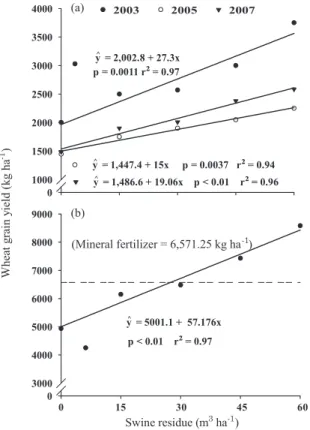
wheat production increased linearly with SR application (figure 3). there was an increase of 27.3, 15.0 and 19.6 kg ha-1 of wheat grain in the
harvests of 2003, 2005 and 2007, respectively, per ton of SR applied. this difference was mainly due to climatic factors, since there was less rainfall in the harvest of 2005 than in 2003 (figure 3a).
in the sum of the wheat grain yield of three years, the result of applying over 30 m3 ha-1 SR exceeds
the yields with mineral fertilization. ceretta et al. (2005) assessed SR doses in winter crops and observed a linear increase in dry matter production and grain yield, confirming the results obtained with wheat production in the experiment. Aita et al. (2006) observed an increase in oat dry matter production of 109 % over the control at 80 m3 ha-1
SR. in a study performed by Assmann et al. (2007) with a mixture of forage oat + ryegrass, the greatest response in forage yield was observed at 80 m3 ha-1
SR, providing an increase of 34 % over the control treatment without SR.
this yield increase can also be due to the increase in n caused by the application of SR because, n is a major component of SR of which about 50 % is in the mineral form (ceretta et al., 2003). when n is applied, it has an immediate effect on plant growth and this may explain the higher yield achieved in the SR treatments compared to the treatment in which mineral fertilizer is used (figure 3b).
common bean
in the 2003/2004 growing season, the maximum response in bean grain yield was achieved with 60 m3 ha-1 SR, with an increase of 97 % in grain yield
over the control without fertilizer. the bean grain yield with mineral fertilizer was 2,683 kg ha-1, equivalent
to the production achieved with the application of approximately 50 m3 ha-1 SR (figure 4a).
the common bean yield in the 2007/2008 growing season increased linearly with increasing SR application rates (figure 4b). A 50 % yield increase was observed with the application of 60 m3 ha-1 SR
over the control.
when the yield obtained with SR is compared to the use of mineral fertilizer, the effect for the use of SR was higher in all growing seasons, in the case of common bean for quantities above 45 m3 ha-1 SR. in
a study of Shen & Shen (2001) with SR application to common bean the increased dry mass yield was confirmed and attributed to the higher P, K and ca concentrations in the plant leaves that received SR, considering the symbiotic nitrogen fixation capacity of this legume.
Scherer (1986) evaluated grain production in maize/bean and bean/maize systems in two soils (oxisol and inceptisol) using manure and mineral n; the response in grain yield in common bean was achieved with the application of 80 and 40 kg ha-1
n on both soils, with grain yield increases of 37 and 33 % compared to the control, respectively. the responses with manure were achieved with 80 m3 ha-1 for both soils with a 42 % increase,
compared to the control.
Soybean
the soybean yield was 2,902 kg ha-1 with the
application of 60 m3 ha-1 SR, an average increase figure 3. wheat grain yield (kg ha-1) as related to
the application of 0, 15, 30, 45, and 60 m3 ha-1 of
swine residue for the growing seasons of 2003, 2005 and 2007 (a) and wheat yield accumulated in the three harvests compared to the use of swine residue and the mineral fertilizer as recommended for wheat (b).
figure 4. common bean grain yield (kg ha-1) as
affected by the application of 0, 15, 30, 45, and 60 m3 ha-1 swine residue in the growing seasons
of 25 % compared to the control without SR (figure 5). the average production in the mineral fertilizer treatment was 2,405 kg ha-1, equivalent to the
application of 50 m3 ha-1 SR. techio et al. (2009)
observed grain yields of 1,657 kg ha-1, in the control
plot to 2,352 kg ha-1 with the application of up to
88 m3 ha-1 SR, unlike in our study, since it was the
third year of SR application.
with use of up to 45 m3 ha-1 SR, soybean yield did
not change (figure 5). this difference in response of soybean compared to corn, wheat and common bean is primarily because soybean has a good capacity for symbiotic n fixation. the response of soybean can be attributed to n, but also to the amounts of other nutrients applied via SR, which can possibly supply the crop with the use of 60 m3 ha-1 SR.
the responses of the four crops were basically a result of soil fertility improvement due to SR
application (Basso et al., 2005; Assmann et al., 2007; Berwanger et al., 2008), which is observed in table 4. from 2002 to 2006, the soil pH increased as result of SR and mineral fertilizer applications. we also observed an increase in the concentration of om and mineral n at higher SR rates. in addition, K, P, ca and mg accumulated in the soil by the successive applications and increasing SR doses, as reported by Sherer et al. (2010). these conditions were reflected in the crop response in grain yield and leaf nutrient content.
Applying rates of 0–80 m3 ha-1, Assmann et
al. (2007) observed increased K content (0.37 to 1.35 cmolc dm-3) in the 0–5 cm layer. these same
authors also noticed Al3+ reduction and pH increase,
which was attributed to the formation of soluble organic complexes with the organic acids (citric, tartaric, malonic, oxalic) present in the organic material, which were leached to deeper soil layers, and by the formation of insoluble complexes with organic substances of high molecular weight, adsorbed on the surface of soil particles (miyazawa et al., 1993).
Some authors show that soil P content of 50 and 120 mg dm-3 or higher, are considered high and
critical (Sharpley & Halvorson, 1994). However, the maximum found in this study was 28 mg dm-3
P. mineral n as well, when excessive in the soil, can result in contamination problems. However, in the same soil class, Assmann et al. (2007) found no leaching of mineral n for applications up to of 80 m3 ha-1 SR, with values above 92 mg dm-3 n of
soil in the 0–5 cm layer, above the value found in 2006 in this study (table 4).
the om content in the soil did not change with increasing SR doses. Scherer et al. (2010) found no increase either in soil organic matter with SR application, and attributed this to the low om
figure 5. Soybean grain yield (kg ha-1) at rates of 0,
15, 30, 45, and 60 m3 ha-1 swine residue in the
growing seasons 2005/2006 and with mineral fertilizer as recommended for soybean.
table 4. Soil chemical properties in 2002 and 2006, in the 0–20 cm layers, as affected by swine residue rates
SR year ph cacl2 om al3+ ca2+ mg2+ K+ P V n-min
m3 ha-1 g dm-3 cmol
c dm-3 mg dm-3 % mg dm-3
0
2002 4.6 38 0.5 3.9 2.5 0.2 6.0 42
2006 5.7 39 0.0 7.5 4.1 0.5 6.5 67 40.7
15 20022006 5.54.6 4038 0.00.5 3.97.0 2.54.0 0.20.4 6.09.9 4267 45.0 30 20022006 5.64.6 4238 0.00.5 3.98.1 2.54.1 0.20.7 23.06.0 4270 53.1 45
2002 4.6 38 0.5 3.9 2.5 0.2 6.0 42
2006 6.0 40 0.0 8.6 4.4 0.7 23.1 77 49.5
contents of the SR, for which in the present study 4.6 % dm was found. this effect may have resulted in little variation in the mineral n concentrations at different SR rates. in addition, the considerable nutrient extraction with the grain yields of corn, soybean, common bean, and wheat must also be taken into account.
concluSionS
1. the application of swine residue to maize, bean, soybean and wheat crops increases the grain yield and can replace the use of mineral fertilizer by the application of SR rates of 45-60 m³ ha-1.
2. the semiannual applications within six years of study contribute to the improvement of crop yields, increasing the K, P, ca and mg content in the soil.
3. the n, P and K concentrations in maize leaf increased with increasing SR applications, indicating that SR could be used as a nutrient source with specific dosage.
litERatuRE citEd
AitA, c.; PoRt, o. & GiAcomini, S.J. dinâmica do nitrogênio no solo e produção de fitomassa por plantas de cobertura no outono/inverno com o uso de dejetos de suínos. R. Bras. ci. Solo, 30:901-910, 2006.
ALmEidA, A.c.R. uso associado de esterco líquido de suínos e plantas de cobertura de solo na cultura do milho. Santa maria, universidade federal de Santa maria, 2000. 144p. (tese de mestrado)
ALVES, m.V.; SAntoS, J.c.P.; GoiS, d.t.; ALBERton, J.V. & BAREttA, d. macrofauna do solo influenciada pelo uso de fertilizantes químicos e dejetos de suínos no oeste do estado de Santa catarina. R. Bras. ci. Solo, 32:589-598, 2008. ASSmAnn, t.S.; ASSmAnn, J.m.; cASSoL, L.c.; diEHL, R.c.;
mAntELi, c. & mAGiERo, E.c. desempenho da mistura forrageira de aveia-preta mais azevém e atributos químicos do solo em função da aplicação de esterco líquido de suínos. R. Bras. ci. Solo, 31:1515-1523, 2007.
ASSociAÇÃo BRASiLEiRA dA indÚStRiA PRodutoRA E EXPoRtAdoRA dE cARnE SuÍnA - ABiPEcS. Produção de carne suína de 2004 a 2009. Available at: < http://www. abipecs.org.br/pt/estatisticas/mercado-interno.html>. Accessed 11 Jan., 2011.
BARcELLoS, L.A.R. Avaliação do potencial fertilizante do esterco líquido de bovinos. Santa maria, universidade federal de Santa maria, 1991. 108p. (tese de mestrado)
BASSo, c.J.; cEREttA, c.A.; duRiGon, R.; PoLEtto, n. & GiRotto, E. dejeto líquido de suínos: ii - Perdas de nitrogênio e fósforo por percolação no solo sob plantio direto. ci. Rural, 35:1305-1312, 2005.
BERwAnEGER, A.L.; cEREttA, c.A. & SAntoS, d.R. Alteração no teor de fósforo no solo com aplicação de dejetos líquidos de suínos. R. Bras. ci. Solo, 32:2525-2532, 2008. cEREttA, A.c.; duRiGon, R.; BASSo, c.J.; BARcELLoS,
L.A.R. & ViEiRA, f.c.B. características químicas do solo sob aplicação de esterco líquido de suínos em pastagem natural. Pesq. Agropec. Bras., 38:729-735, 2003.
cEREttA, c.A.; BASSo, c.J.; PAVinAtto, P.S.; tREntin, E.f. & GiRotto, E. Produtividade de grãos de milho, produção de matéria seca e acúmulo de nitrogênio, fósforo e potássio na rotação aveia preta/milho/nabo forrageiro com aplicação de dejeto líquido de suínos. ci. Rural, 35:1287-1295, 2005.
EmPRESA BRASiLEiRA dE PESQuiSA AGRoPEcuÁRiA – EmBRAPA. Sistema brasileiro de classificação de solos. Rio de Janeiro, 2006. 412p.
fRAncHi, E.A.G. dinâmica do nitrogênio no solo e produtividade de milho, aveia e ervilhaca com o uso de dejetos de suínos em sistema de plantio direto. Santa maria, universidade federal de Santa maria, 2001. 70p. (tese de mestrado) KonZEn, E.A. fertilização de lavoura e pastagem com dejetos
de suínos e cama de aves. Sete Lagoas, Embrapa milho e Sorgo, 2003. 3p. (Embrapa-cnPmS. circular técnica, 31) KonZEn, E.A. Valorização agronômica dos dejetos suínos:
utilização dos dejetos suínos como fertilizantes. in: cicLo dE PALEStRAS SoBRE dEJEtoS SuÍnoS no SudoEStE GoiAno, Rio Verde, 1997. Anais... Rio Verde, 1997. p.113-136.
LEmAiRE, G. ed. diagnosis of the nitrogen status in crops. Berlin, Springer, 1997. 56p.
mAAK, R. Geografia física do estado do Paraná. curitiba, Banco de desenvolvimento do Paraná, 1968. 350p.
mALAVoLtA, E. manual de química agrícola – adubos e adubações. 3.ed. São Paulo, Agronômica ceres, 1981. 596p. mAnuGiSticS. Statgraphics Plus for windows. (version 4.1).
Rockville, maryland, 1997.
miyAZAwA, m.; PAVAn, m.A. & cALEGARi, A. Efeito de material vegetal na acidez do solo. R. Bras. ci. Solo, 17:411-416, 1993.
PEREiRA, n.m.Z.; ERnAni, P.R. & SAGoi, L. disponibilidade de zinco para o milho afetada pela adição de Zn e pelo pH do solo. R. Bras. de milho e sorgo, 3:273-284, 2007. QuEiRoZ, f.m.; mAtoS, A.t.; PEREiRA, o.G. & oLiVEiRA,
R.A. características químicas de solo submetido ao tratamento com esterco líquido de suínos e cultivado com gramíneas forrageiras. ci. Rural, 34:1487-1492, 2004. ScHERER, E.E.; cAStiLHoS, E.G. & AitA, c. utilização de
ScHERER, E.E.; nESi, c.n. & mASSoti, Z. Atributos químicos do solo influenciados por sucessivas aplicações de dejetos suínos em áreas agrícolas de Santa catarina. R. Bras. ci. Solo, 34:1375-1383, 2010.
SHARPLEy, A.n. & HALVoRSon, d.A. the management of soil phosphorus availability and its impact on surface water quality. in: LAL, R. & StEwARt, B.A. Soil processes and water quality. madison, American Society of Agronomy, 1994. p.7-89.
SHEn Q.R. & SHEn Z.G. Effects of pig manure and wheat straw on growth of mung bean seedlings grown in aluminium toxicity soil. Biores. technol., 76:235-240, 2001.
tEcHio, J.w.; cAStAmAnn, A.; cALdEiRA, m.H.; ZAnELLA, S. & EScoStEGuy, P.A.V. diagnose nutricional de plantas de soja, cultiva em solo com adubação residual de dejetos de suínos, utilizando o dRiS. in: SimPÓSio intERnAcionAL SoBRE GEREnciAmEnto dE RESÍduoS dE AnimAiS, 1., florianópolis, 2009. uso dos resíduos da produção animais como fertilizante. Anais... florianópolis, 2009.
tEdESco, m.J.; GiAnELLo, c.; BiSSAni, c.A.; BoHnEn, H. & VoLKwEiSS, S.J. Análise de solo, plantas e outros materiais. Porto Alegre, universidade federal do Rio Grande do Sul, 1995. 174p.