context in social interactions mediated by cellular mobile
devices
1DOI: 10.1590/1809-5844201814
Marcel Ayres
(Universidade Federal da Bahia, Faculdade de Comunicação, Programa de Pós-Graduação em Comunicação e Cultura Contemporâneas. Salvador – BA, Brasil)
https://orcid.org/0000-0003-3476-890X
José Carlos Ribeiro
(Universidade Federal da Bahia, Instituto de Psicologia, Programa de Pós-Graduação em Psicologia. Salvador – BA, Brasil. Universidade Federal da Bahia, Faculdade de Comunicação, Programa de Pós-Graduação em Comunicação e Cultura Contemporâneas. Salvador – BA, Brasil)
https://orcid.org/0000-0003-2208-3364
Abstract
In this paper, we seek to understand how users of cellular mobile devices perceive the privacy context in everyday situations and, from this perception, if and how they adjust their respective performances in mediated social interactions. To do so, we retrieve concepts about privacy, including psychosocial aspects of this phenomeno n, and use the Privacy Process Model (PPM), an analytical model that allows the analysis of interactional behaviors through the regulation of privacy in four different dimensions: informational, social, psychological and physical. In our analysis, we used reports from university students from the Brazilian Northeast region, users of cellular mobile devices, aiming to identify which strategies are usually used to regulate the privacy context, considering, in this case, the informational dimension – that is the dimension that covers the selection and appropriation of resources and applications present in these devices for the accomplishment of informational exchanges.
Keywords: Privacy. Social interactions. Privacy Process Model. Mobile devices. Young university students.
Introduction
The growing panorama of Information and Communication Technologies (ICTs) connected to the Internet today generates, among other outcomes, a great offer of digital environments that allow the experimentation of new forms of self-exposition and sociability.
1 This paper is product of a broader research entitled “Perceptions on uses and appropriations of mobile communication devices in contemporary interactional practices: a study with Brazilian university students”, which was developed with the support of the National
Different from face-to-face interactions, in which the interactors share the same physical environment for symbolic dialogic exchanges, in the interactions mediated by the ICTs, these exchanges occur through technical apparatuses that extend the interactions in space-time (THOMPSON, 2011). That is, individuals do not need to be necessarily in the same space or in the same temporality to interact with each other. This change in the relationship with time and space in the interactions makes the intimacies of the domestic world or even
friendship or professionals relations acquire different meanings when we are present and
interacting with others in physical or digital environments.
In a connected and mobile society, public and private spheres hybridize and
influence, to a greater or lesser extent, how we produce and consume information for each
other (CARON; CARONIA, 2007). With the mobile communication devices, and through the different applications that are present in these devices, such as Facebook, Instagram, YouTube, WhatsApp, among others, individuals begin to construct a singular, and increasingly complex, myriad of narratives about themselves and interactional practices, based on representational schemes and social experiences mediated by the use of state-of-the-art technological devices and environments (RIBEIRO, 2016a).
Whether commenting on friends’ posts, sharing classroom pictures, checking in on a trip or chatting on different applications, people produce and consume a large stream of symbolic information and referrals that to a certain extent change not only how we interact, but either how we are conceiving the world around us.
In a socio-economic context in which travel is frequent and people take portable,
mobile new technologies with them, more and more places become potential locations for communications. Space begins to move, and the “where” loses the
immobility of a specific location to become a sort of aura that accompanies the user. A real definition of both public and private spaces is underway, based on
interpenetration, or even apparent blending, of public and private, professional and intimate spaces (CARON; CARONIA, 2007, p.15-16).
This post-massive scenario (LEMOS, 2010), in which communication becomes decentralized and can be performed synchronously or asynchronously through different personal technical devices, privacy becomes a topic widely discussed in different
perspectives, whether governmental, legal, economic or scientific. In academic field, specifically, privacy is present in disciplines such as Philosophy, Sociology, Psychology,
Communication, Political Science, Law, Architecture, among others, each one observing aspects and particularities that will permeate their respective research interests.
review on the concept of privacy from of studies aimed at exploring some of the psychosocial aspects of this phenomenon (WESTIN, 1967; ALTMAN, 1975; DERLEGA; CHAIKIN, 1977; BURGOON, 1982; MARGULIS, 2003; NISSENBAUM, 2010; BOYD; MARWICK, 2011; DIENLIN, 2014).
Based on the analytical model proposed by Dienlin (2014), we introduce the Privacy
Process Model (PPM) – an approach that integrates theories and empirical findings of
privacy research into a single model that assists researchers in understanding and evaluating this phenomenon in different social situations (whether in immediate physical presence or mediated by technologies). Based on the model proposed by Dienlin (2014), we sought to understand the behaviors adopted by users of cellular mobile devices from the perception of the privacy context in the mediated interactions. The analysis relies on responses from a survey conducted with university students aged from 18 to 25 in six cities in the northeastern region of Brazil.
Privacy as a process of regulation
For Westin (1967), privacy can be understood as a kind of voluntary and temporary withdrawal or separation that an individual may have from the rest of society, whether in
physical or psychological form. From this withdrawal, specific conditions of privacy arise,
such as solitude, anonymity, intimacy and reserve, each composed of its own characteristics. By solitude, it means the possibility of being free of the immediate presence and/or surveillance of the other(s). Anonymity would be the possibility of not identifying with other(s). Intimacy, in turn, would be the freedom to choose with whom we wish to maintain relationships and exchange information that can be considered private. Finally, reserve would be a limitation or selection of what is or is not exposed from itself to the other(s).
The studies by Westin (1967) served as a starting point for the social psychologist Irwin Altman (1975), who extended the concept of privacy from the emphasis on the regulation of the individual to this separation, depending on the context and the people involved in a given social situation. Altman’s (1975) social penetration studies investigates issues related to personal space, territoriality, agglomeration and privacy. In privacy investigations
specifically, Altman (1975) identified that the regulation of boundaries between individuals would be based on oppositional qualities between accessibility and inaccessibility.
for social interaction or noninteraction changes over time and with different circumstances. The idea of privacy as a dialectic process, therefore, means that there is a balancing of opposing forces – to be open and accessible to others and to be shut off or closed to others – and that the net strength of these competing forces changes over time (ALTMAN, 1975, p.23).
Palen and Dourish (2003) point out that this process of regulating borders would not be a simple application of rules, but a continuous management between different spheres of action and degrees of self-exposure. This approach softens a tight and dichotomous view of privacy, seen as simply opening or closing access to something/someone. Thus, starting from the perspectives of Westin (1967) and Altman (1975), we could say that privacy,
in addition to a voluntary process of separation, would be at the same time a flexible or
even elastic phenomenon, since its regulation would be contextual; that is, what would be considered private to an individual, a society or even a culture, could vary considerably
depending on how the interactional situations were configured in other contexts.
Burgoon (1982), on the other hand, advances in Altman’s studies by demonstrating how privacy can be regulated from four different dimensions: informational, social, psychological and physical. By informational privacy, we mean the control people can have about what will or will not be shared about them in different communication media. Social privacy, on the other hand, would be the person’s ability to decide or choose who to socially interact with or not. Psychological privacy appears associated with individuals’
internal questions about how they feel about information they are free to express. Physical privacy, in turn, would define the adjustment of physical/spatial boundaries between people, whether at distance or even using concrete elements to isolate or distance something/ someone (DIENLIN, 2014).
Studies on privacy regulation in digital contexts (NISSENBAUM, 2010; BOYD, 2014; NEJM, 2016) demonstrate how the uses and appropriations of ICTs in interactions
can affect the way privacy is perceived and, consequently, how actors will select means and
resources to perform for each other from this perception (GOFFMAN, 1985). Currently, the regulation of privacy has an interdependent relationship with the technological mediation in which the interactions occur, that cannot be considered as neutral in this process. The persistance, replicability, scalability and searchability of information (BOYD; MARWICK, 2011), which are exchanged through technological mediation and digital environments, modify the interactional dynamics, since these same information, which were previously
more ephemeral or restricted to specific physical environments, gain scale and network
mobility, since they can be accessed in different places and temporalities.
technologies, the type of information being shared, the social roles of the individuals involved
in the interaction and the way this information is transmitted can alter the information flow and, consequently, the perception of privacy itself.
The Privacy Process Model (PPM)
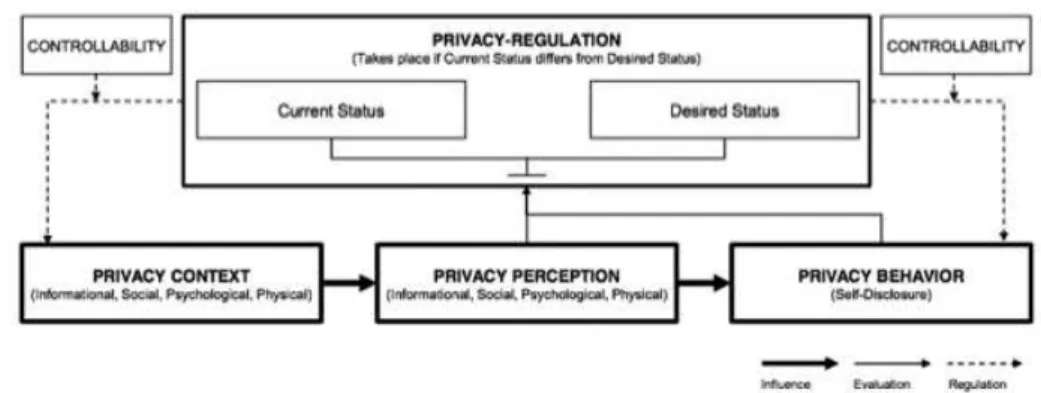
To understand how the perception of privacy in cellular-mediated interactions can affect how individuals expose themselves and interact with each other on a daily basis, we suggest the PPM as a possible analytical model for this issue. Starting from privacy as a separation/detachment of the other(s) that can be characterized in different conditions (WESTIN, 1967), with continuous adjustments at the individual borders (ALTMAN, 1975) and having four dimensions, informational, social, psychological and physical (BURGOON, 1982), Dienlin (2014) proposed an analytical model of privacy having some key elements, as expressed in Figure 1.
Figure 1 – The Privacy Process Model
Source: Dienlin (2014).
The privacy context would be related to the degree of privacy, which, according to Dienlin (2014), can be measurable. That is, it would be the given situation that can be evaluated in a descriptive and objective way by the individual. The privacy perception, in turn, would be the ability of individuals to perceive the context in which they are involved and, from there, to compare the privacy status of this context with the desired privacy status. Depending on the perception of the context, individuals would, then, assume a privacy behavior, that is, if people were in a situation they thought was more private, they could be more willing to share information or perform actions they would not do in a situation they thought had less privacy.
not be possible to have control over the perception of privacy. According to Dienlin (2017), if the current context status and desired privacy status are not matching, people would
be dissatisfied and would tend to seek a balance by adjusting in context or behavior. To
exemplify a situation in which the privacy status of the context presents itself differently from the desired status for the individual, let us imagine a particular circumstance in which this individual receives an important call in his cellular mobile device, however, he is in a work meeting. When realizing that, in that context, there is no possibility of simply removing other people from the meeting, the individual may seek to adjust aspects of the context (e.g., ask to leave the room and go to a place where he/she cannot be monitored
by others) or adjust aspects of behavior (e.g., requesting leave to answer the phone in the
environment, but speaking with the lowest volume so as not to disturb the meeting; putting the phone in silent mode and ignoring the call; or even choosing to send a text message to explain the situation he/she is in).
Dienlin (2017) argues for the importance of studying privacy in view of its complexity and its different dimensions. In this perspective, the author describes the main implications of the PPM model in seven axioms:
1. Any given situation (privacy context) leads to a particular sense of
intimacy and confidentiality (privacy perception). 2. The higher the level of privacy perception, the more people will engage in a subsequent act of
self-disclosure (privacy behavior). 3. For the privacy context as well as for the privacy perception, the dimensions of informational, social, psychological, and physical privacy can be differentiated. 4. For the privacy perception as well as for the privacy behavior, people perceive a current status of privacy, which they compare with a desired status of privacy. 5. If there is a discrepancy between current status and desired status, people engage automatically in a privacy regulation process. In the privacy regulation process, people aim to change either the privacy context or the privacy behavior. 6. In order for a privacy regulation to be able to take place, the controllability of either privacy context or privacy behavior needs to be warranted. 7. All elements shall be assessed not in a normative but in a descriptive heuristic (DIENLIN, 2017, p. 38).
Starting from the model proposed by the PPM, we made in this article an exploratory
qualitative analysis based on statements of university students from the brazilian Northeast
would achieve a regulation of context elements and their respective behaviors - something
that would be considered more difficult, though not impossible, in contexts of interaction
with immediate physical presence or face to face.
Method
For our analysis, we used data from a broader qualitative exploratory research
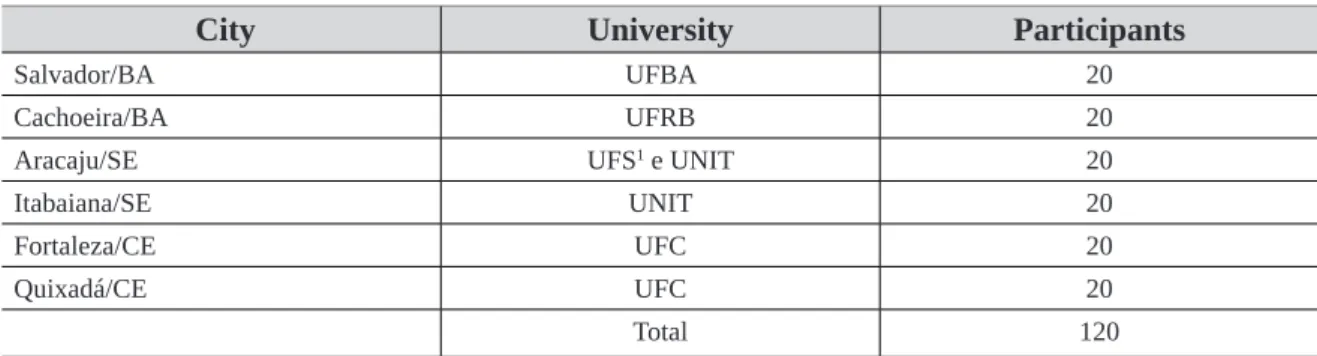
(DESLAURIERS, 2008; SAMPIERI, COLLADO; LUCIO, 2006) which examined the perceptions of university students in the brazilian Northeast about the uses and appropriations of mobile digital communication, as well as their implications of everyday interactional practices. As total, 120 interviewees from seven university centers were installed in six cities in the northeastern region of the country, three capitals and three cities in the interior, according to the table below:
Table 1 – Sample used for the analysis
City University Participants
Salvador/BA UFBA 20
Cachoeira/BA UFRB 20
Aracaju/SE UFS1 e UNIT 20
Itabaiana/SE UNIT 20
Fortaleza/CE UFC 20
Quixadá/CE UFC 20
Total 120
Source: Prepared by the authors.
Survey participants were accessed in a convenience (or accessibility) sampling from the researchers’ contact networks. Of the 120 participants, 61 were men and 59 were women, ranging in age from 18 to 25 years old (M = 21.26 years old / Median = 23 years old). Data collection was performed through individual interviews in semi-structured format (with approximately 30 minutes of duration), which were recorded and later transcribed to texts in digital format. Before the interviews were recorded, an explanation on the purposes of the research was given, and then all participants were asked to sign a Free and Informed Consent Form, registering their agreement to participate in the research.
The interview sessions followed a previously elaborated script, based on the model developed by Ribeiro (2016b) in his research on perceptions of the uses of mobile devices by Portuguese university students. The participants’ talks were analyzed through content analysis (BARDIN, 2009) from the categorical systems proposed by Ribeiro (2016b),
seeking the detection of aspects and qualitative indicators that enabled the understanding
appropriations of mobile devices (cellphones) and on their possible implications for everyday interactional practices.
The transcripts of the interviews were analyzed and categorized through a qualitative
data analysis application, the ATLAS.TI (version 8), for IOS and Windows operating systems. ATLAS.TI allowed the distribution, processing and visualization of data (textual segments) in a clear, direct and detailed way through the generation of reports. Thus, the transcribed data were processed in two moments: the labeling of the data based on the thematic axes predicted by the theoretical categories and the data analysis based on the concepts and discussions brought by the literature.
The analysis developed in this article was based on the selection of responses from the interviews carried out in the broader research, in which the participants described situations and behaviors that were adopted from the perception of the privacy context in the daily interactions via cellular mobile devices.
Perception of the informational privacy context
Based on the PPM model proposed by Dienlin (2014) and other mobile communication studies (ZHAO; ELESH, 2008; BOYD; MARWICK, 2011; AYRES; RIBEIRO, 2015; RIBEIRO, 2016b; AYRES, 2016; NEJM, 2016) we analyze, from the interviews of our research, if the users of cellular mobile devices identify particularities in the perception of the privacy context in situations in which they use these apparatuses and if there is also
a sense of greater control of the information flow through the use of resources on these
devices and their applications.
According to the respondents’ statements, the selection of a particular resource available on their mobile device (e.g., voice connection, text message, photo or video)
and/or a specific application (e.g, WhatsApp, Snapchat, Instagram, Facebook) to establish
interactions is directly linked to the perception of privacy of the physical environment and
the social situation. If they are in a classroom or even watching a film in the cinema, for example situations that are continuously monitored or that require focused interactions
(GOFFMAN, 2010), participants report that using the text modality would be a plausible strategy to not give access to information or even to not interrupt the attention of those who might be sharing the same physical space at the moment. On these aspects, we highlight some lines:
The advantage is that you can see [...] You can read the messages without the risk of exposure or that others may have access. This can sometimes happen with the audio (Male participant, 20 years old, student of UFBA, Salvador/ BA – Our translation).
These responses are close to findings of Ayres’ (2016) empirical research on
WhatsApp uses and appropriations, in which the text modality appeared as the most used among university students from Salvador (BA) and metropolitan region.
The interviewees of our research also indicated that they had difficulties in knowing, at first, the exact place and context where their interactors are in the moment of
cellphone-mediated interaction – which would imply, again, in the selection, in some cases, of
the text modality instead of voice calls or audio messages. This difficulty is common in
the interactions mediated by cellular mobile devices, which are nowadays connected to the Internet and amplify and reinforce what Boyd and Marwick (2011) denominate as a collapsed context – a context composed of several invisible audiences that can access information that we share, voluntarily or not, through the use of cellular mobile devices and/or digital environments.
In this collapsed context, responses show that calls or audio message tend to be overlooked depending on the person with whom they are interacting or even the situation they are in. For example, one of the participants (Male, 22 years old, student of UFC, Quixadá/CE) says: “It’s more about who you’re sending to, it’s more direct to who you’re sending an audio. The person can hear very loudly and if it’s something secretive, it’s going to lose that, that secret, let’s say, of the message”. In other words, in order not to create constraints or even allow others who are not engaged in the interaction to access the information being exchanged, users tend to send text messages as a privacy context control strategy. Mobile communication complicates this scenario, since even knowing the interactor and the aspects of its routines, it is not possible to state precisely where he/she is and if, at that moment, he/she is available to give continuity to the intended interaction.
In addressing cases where they use photo and video applications (such as Instagram and Snapchat) on their mobile devices, participants are concerned about some implications of self-exposure in these situations. Some, for example, point out that although they have some control over what they will or will not display through photographs and videos (through selection and editing of images), they perceive a lack of control over the record and sharing made by others. The responses of the following participants exemplify this:
I say: Are you filming me? Where are you posting this? With whom will you share? But today everyone is photographed and filmed and we do not even know it, right? There should be a lot of photos and videos of us that we may not be
aware of (Female participant, 19 years old, student of UFRB, Cachoeira/BA).
However, when these records and sharing are performed by people considered to be intimate, such as family members, partners and/or friends, the concern with exposing themselves to photographs and videos is mitigated, but it is still latent. As the two participants point out below:
It depends on the situation and the person. If it’s a stranger snapping me, I ask
“What is this?” [laughs] But if it’s a friend, I do not think there’s any problem
(Female participant, 18 years old, student of UFC, Fortaleza/CE);
It depends on whose camera is. If it’s from someone you know, it’s ok, do you
understand? In some cases, I even feel uncomfortable if it’s embarrassing for
me. If they are unknown, I am left without reaction... I get worried (Female participant, 18 years old, student of UFS, Aracaju/SE).
Regarding the technical possibility of access to other individuals through a cellular mobile device, the participants of our research identify positive and negative aspects that may vary depending on the situation. For some of them, it would be an advantage to
have quick access to others, regardless of the time and place, when he wished to establish
interactions; however, depending on the person or situation, this rapid and continuous access could be seen as a negative point, since the user might not be available or even interested in establishing that interaction (QUAN-HAASE; COLLINS, 2008).
The implications of this continuous access to other(s) in the interactions mediated by cellular mobile devices appear, according to some of the lines analyzed, to trigger a feeling of less controllability of the privacy context, once an interaction is initiated (through the sending of a text message, audio, among others) generates an expectation of reciprocity between the interactors that can be reinforced through signals, which indicate that a certain user is connected or even using his device at that moment (as it happens in some instant messenger applications and social network websites). This sense of “lack of privacy” was
identified in our research, as we can observe in the following statements:
I would say that you lose a little [...] unavailability. For example: if you want to read a book, just stay on the beach or do anything – then when you come back, you have 300 messages in WhatsApp [...]. So, the people for whom you may be available they always want you to be available. And if you do not put a limit, you became a slave of the cellphone, to always be immediately answering people (Female participant, 23 years, student of UFBA University, Salvador / BA).
Even with the possibility of choosing what and with whom to share certain information, the perpetual contact (KATZ; AAKHUS, 2002), derived from the relations established through mobile communication devices (and especially cellular devices), seems to reinforce the perception of a constant availability for socialization - which can generate, for example, breaks in social expectations among interacting agents and, more broadly, destabilization in the interaction process experienced between them.
Concluding remarks
We propose in this paper an analysis of the perception of the informational privacy context based on the statements of university students from the Brazilian Northeast who use cellular mobile devices in everyday interactions. In order to do this, we used the concept of privacy as the possibility of separating or distancing individuals from society under different conditions (solitude, intimacy, anonymity and reserve), in which they can regulate their personal borders based on four dimensions: informational, social, psychological and physical.
To analyze these reports, we use the PPM model proposed by Dienlin (2014, 2017), which presents how the perception of the privacy context in a given social situation, together with the regulation of the current and desired privacy status, can act on individuals’ actions in face-to-face or mediated social interactions. In this perspective, these individuals would have the ability to control or adjust elements of the context and their behaviors, but it would not be possible to control the perception associated with the experience of the situation. The PPM model served as a guide, not only to guide the look on the process of social construction of privacy, but to understand that it goes beyond an informational aspect.
Based on the analysis, we identified some aspects that are related to the interactional
they wish to communicate in the symbolic exchange effected with the interacting agents.
Here, we do not point out these factors as unique, but as important points that we identify
in the participants’ statements and indicate possible motivations around the choices and uses of certain media and informational modalities present in cellular mobile devices – generating actions (behaviors) resulting from these choices.
About self-exposure by sharing photos and videos in applications such as Instagram and Snapchat, for example, participants report having a greater sense of control over the intended image of themselves, since they can edit and select what they want or not to be published in digital environments. However, they demonstrate at the same time, concern about the collapsed context, from the register and the sharing of photos and videos by other users. On the other hand, when they are in a context where there is the presence of family and friends (people considered more intimate), for example, concerns about these records and sharing of photos and videos are mitigated.
Participants also reported that technical accessibility to the other through cellular
mobile devices is viewed positively when they wish to have quick or immediate contact with other interactors. However, in situations where they are required for interaction, this
accessibility may be viewed negatively, since they may be in situations where they are not available or do not wish to interact. That is, this point of tension between technical accessibility and social availability complicates and problematizes the notion of always on (TURKLE, 2008) and the notion of privacy as dichotomous processes of access to something/someone.
Finally, we reinforce the idea that the experience of privacy, carried out from the uses of cellular mobile devices and experienced in interactions through social network websites, instant messengers, among other applications of sharing of contents and relationships, cannot be considered as something exclusive or individual. In agreement with Petronio (2002), we pointed out that individuals would be, contemporaneously, co-owners of private information about themselves and others. This way, we avoid here the understanding of privacy as an absolute phenomenon, and we understand that there is a scale in which, depending on the situation experienced, the individual can perceive more or less privacy.
This reflection also demonstrates the importance of discussions about how individuals
control and circulate information that they deem private.
References
ALTMAN, I. Environment and social behavior: personal space, privacy, crowding and territory. Monterey, CA: Brooks Cole, 1975.
AYRES, M.; RIBEIRO, J. C.; A Representação de si em interações sociais mediadas por instant messengers: O Caso WhatsApp. In: XXXVIII CONGRESSO BRASILEIRO DE CIÊNCIAS DA COMUNICAÇÃO, Rio de Janeiro, 2015. Anais... Available at: <http://portalintercom.org.br/anais/nacional2015/resumos/R10-0273-1.pdf>. Accessed on: October 1, 2017.
BARDIN, L. Análise de conteúdo. Lisboa: Edições 70, LDA, 2009.
BOYD. D.; MARWICK, A. Social privacy in networked publics: Teens’ Attitudes, Practices, and Strategies. 2011. Available at: <https://www.danah.org/papers/2011/SocialPrivacyPLSC-Draft.pdf>. Accessed on: October 1, 2017.
BOYD, D. It’s complicated: the social lives of networked teens. New Haven: Yale University Press, 2014. BURGOON, J. K. Privacy and communication. In: BURGOON, M. (Ed.). Communication Yearbook 6. Beverly Hills, CA: Sage Publications, 1982, p.206-249.
CARON, A. H.; CARONIA, L. Moving cultures: mobile communication in everyday life. Québec: McGill-Queen’s University Press, 2007.
DERLEGA V. J.; CHAIKIN A. L. Privacy and self-disclosure in social relationships. Journal of Social Issues, v.33, n.3, p.2-115, 1977.
DESLAURIERS, J. O delineamento da pesquisa qualitativa. In: POUPART, J. et al. A pesquisa qualitativa. Petrópolis, RJ: Vozes, 2008.
DIENLIN, T. The Privacy Process Model. In: GARNETT, S.; HALFT, S.; HERZ, M. MÖNIG, J. M. Medien und Privatheit [Media and privacy]. Passau: Stutz, p.105-122, 2014.
______. The psychology of privacy: Analyzing processes of media use and interpersonal communication. 2017, 200 f. Tese (Doutorado em Psicologia). University of Hohenheim. Stuttgart, Alemanha.
GOFFMAN, E. A Representação do Eu na Vida Cotidiana. Petrópolis: Vozes, 1985. ______. Comportamentos em lugares públicos. Petrópolis: Vozes, 2010.
KATZ, J. E.; AAKHUS, M. A. Perpetual contact:mobile communication, Private Talk, Public Performance. Cambridge, UK: Cambridge University Press, 2002.
LEMOS, A. Celulares, funções pós-midiáticas, cidade e mobilidade. Revista Brasileira de Gestão Urbana
(Brazilian Journal of Urban Management), v.2, n.2, p.155-166, 2010.
MARGULIS, S. T. On the status and contribution of Westin’s and Altman’s theories of privacy. Journal of Social Issues, v.59, n.2, p.411-429, 2003.
NEJM, R. Exposição de si e gerenciamento da privacidade de adolescentes nos contextos digitais. 2016, 266 f. Tese (Doutorado em Psicologia) – Programa de Pós-Graduação em Psicologia, Universidade Federal da Bahia, Salvador.
NISSENBAUM, H. Privacy in context: technology, policy, and the integrity of social life. Stanford: Stanford University Press, 2010.
PALEN, L; DOURISH, P. Unpacking ‘privacy’ for a networked world. In: Proceedings of the SIGCHI conference on human factors in computing systems, Fort Lauderdale, New York: ACM, 2003. p.129-136. Available at: <https://dourish.com/~dourishc/publications/2003/chi2003-privacy.pdf>. Accessed on: October 1, 2017.
QUAN-HAASE, A.; COLLINS, J. L. I’m there, but I might not want to talk to you. Information, Communication & Society, v.11, p. 526-543, 2008.
RIBEIRO, J. C. Controle de informações sociais em ambientes digitais: repercussões na construção da narrativa de si. In: FERNANDEZ, E.; DONARD, V. (Orgs.). O psicólogo frente ao desafio tecnológico:
novas identidades, novos campos, novas práticas. Recife: Editora UFPE; UNICAP, 2016a, p.87-99.
______. Percepções sobre usos e apropriações de dispositivos comunicacionais móveis nas práticas interacionais contemporâneas: um estudo com jovens universitários portugueses. Relatório de pesquisa de
pós-doutorado não publicado. Universidade Nova de Lisboa. Lisboa, 2016b.
SAMPIERI, R. H.; COLLADO, C. F.; LUCIO, P. B. Metodologia de pesquisa. São Paulo: Mc-Graw-Hill, 2006.
THOMPSON, J. B. A mídia e a modernidade: uma teoria social da mídia. 12. ed. Petrópolis: Vozes, 2011.
TURKLE, S. Always on/always on you: The tethered self. In: KATZ, J. E. (Ed.). Handbook of Mobile Communication Studies, Cambridge, MA. MIT Press, 2008, p.121-137.
WESTIN, A. Privacy and freedom. New York: Athenaeum, 1967.
ZHAO, S.; ELESH, D. Copresence as ‘being with’. Information Communication and Society, Londres, v.11, n.4, 2008.
Marcel Ayres
Doctoral student in Contemporary Communication and Culture – UFBA. Bachelor in Social
Communication with qualification in Journalism (Faculty of Communication – UFBA). Ex-scholarship
holder of the Tutorial Education Program and the Digital Technologies Advertising Observatory. He is a researcher at GITS – Research Group on Interaction, Digital Technologies and Society (UFBA / CNPQ). Specialist in Marketing by FGV. Main publications: Breves comentários sobre a análise de conversações em sites de Redes Sociais (co-authoring book chapter), Interface entre jogos sociais e política: oportunidades e estratégias de diferenciação (co-authoring book chapter), Netnografia e
Coolhunting: Identificando aspectos comportamentais e tendências nas mídias sociais (co-authoring
book chapter), Mídias Sociais e Eleições 2010 (partnership book organization). E-mail: marcel. [email protected].
José Carlos Ribeiro
He has a PhD in Contemporary Communication and Culture from the Universidade Federal da Bahia (Federal University of Bahia – UFBA), a post-doctoral degree from Universidade Nova de Lisboa (CAPES grant – EST-SENIOR process 99999.005938/2014-07). He is a professor at the Institute of Psychology (UFBA) and researcher associated with the Graduate Programs in Psychology (UFBA) and Contemporary Communication and Culture (UFBA). He is coordinator of GITS – Research Group on Interactions, Digital Technologies and Society (UFBA/CNPQ) and collaborating professor of LAB404 – Research Laboratory in Digital Media, Networks and Space (UFBA/CNPQ). He is currently coordinator of the Graduate Program in Psychology (UFBA). Main publications: A cidade é o palco: performance e interações mediadas no espaço (co-authoring paper), Interações em
interacionista e dramatúrgica (co-authoring paper), Performances Interacionais e Mediações Sociotécnicas (partnership book organization), Práticas Interacionais em Rede (partnership book organization), Mídias Sociais: saberes e representações (organização de livro em parceria), A
influência das representações sobre os nordestinos nas relações intergrupais entre usuários de uma
rede social digital (co-authoring book chapter), Controle de Informações Sociais em Ambientes Digitais: repercussões na construção da narrativa de si (book chapter), Contextos cotidianos, dispositivos comunicacionais móveis e práticas interacionais: aspectos de culturas em movimento (book chapter). E-mail: [email protected].
Received on: 12.19.2017 Accepted on: 04.01.2018