Rogério Paulo Guerreiro Rosa
Licenciado em Ciências deEngenharia Electrotécnica e de Computadores
Assessing Self-Organization and Emergence
in Evolvable Assembly Systems (EAS)
Dissertação para obtenção do Grau de Mestre em Engenharia Electrotécnica e de Computadores
Orientador :
José António Barata de Oliveira,
Professor Auxiliar, FCT-UNL
Co-orientador :
Luís Domingos Ferreira Ribeiro,
Doutor, UNINOVA
Júri:
Presidente: Doutor Pedro Alexandre da Costa Sousa
Arguente: Doutor Tiago Oliveira Machado de Figueiredo Cardoso
iii
Assessing Self-Organization and Emergence in Evolvable Assembly Systems (EAS)
Copyright cRogério Paulo Guerreiro Rosa, Faculdade de Ciências e Tecnologia,
Univer-sidade Nova de Lisboa
Acknowledgements
I would like to acknowledge several people that helped me through the development and writing of my thesis.
I would like to thank to Prof. José Barata for being my supervisor and for the possi-bility of developing such an interesting work as well as for all the opportunities that he has provided to me, in special the participation on the IDEAS project.
A special recognition to Prof. Luis Ribeiro. More than a supervisor, he is a friend. The great success of the end of my journey in the university is thanks to him, he always motivated me, guided and helped me when necessary. His professionalism, personality, ambition, had a high influence on me. It was a truly honour to work with him, and I really hope to have that honour again.
I would like to thank my lab colleagues, Andre Cavalcante, Steffen Schutz, Andre Rocha, Ângelo Veiga and Mauro Dias, who have provided a great environment during the development of this thesis.
To my colleagues from FCT-UNL that give me their support and friendship since the beginning of this journey: João Virote, Luis Sousa, Hugo Silva, Filipe Correia and Hugo Lopes, I would like to thank them for their friendship and support during this journey.
Abstract
There is a growing interest from industry in the applications of distributed IT. Cur-rently, most modern plants use distributed controllers either to control production pro-cesses, monitor them or both.
Despite the efforts on the last years to improve the implementation of the new manu-facturing paradigms, the industry is still mainly using traditional controllers. Now, more than ever, with an economic crisis the costumers are searching for cheap and customized products, which represents a great opportunity for the new paradigms to claim their space in the market.
Most of the research on distributed manufacturing is regarding the control and com-munication infrastructure. They are key aspects for self-organization and there is a lack of study on the metrics that regulate the self-organization and autonomous response of modern production paradigms.
This thesis presents a probabilistic framework that promotes self-organization on a multiagent system based on a new manufacturing concept, the Evolvable Assembly Sys-tems/Evolvable Production Systems. A methodology is proposed to assess the impact of self-organization on the system behavior, by the application of the probabilistic frame-work that has the dual purpose of controlling and explaining the system dynamics.
The probabilistic framework shows the likelihood of some resources being allocated to the production process. This information is constantly updated and exchanged by the agents that compose the system. The emergent effect of this self-organization dynamic is an even load balancing across the system without any centralized controller.
The target systems of this work are therefore small systems with small production batches but with a high variability of production conditions and products.
x
the FP7-IDEAS proejct. This work has extended these agents and the outcome has been tested in the IDEAS demonstrators, as the changes have been incorporated in the latest version of the architecture, and in a simulation and more controlled environment were the proposed metric and its influence were assessed.
Resumo
Existe um crescente interesse de parte da indústria na áreas das aplicações distríbui-das em IT. Actualmente, a maioria distríbui-das fábricas faz uso de controladores distribuidos tanto para controlo de processos de produção, para os monitorar ou para ambas as apli-cações.
Apesar dos esforços nos últimos anos para melhorar a implementação dos novos pa-radigmas de manufactura, a indústria ainda usa principalmente controladores tradicio-nais. No entanto, agora mais que nunca, em ambiente de crise económica os consumido-res procuram por produtos baratos e customizados, repconsumido-resentando uma grande oportu-nidade para os novos paradigmas reclamarem o seu espaço.
A maioria da investigação nos sistemas distribuídos é focada na infra-estrutura de comunicação e controlo. São ambos aspectos fundamentais para a auto-organização, no entanto existe uma lacuna no estudo de métricas que regulam a auto-organização e a resposta autónoma dos paradigmas modernos de manufactura.
Esta tese apresenta um enquadramento probabilístico que promove a auto-organização num sistema multiagente baseado num conceito de manufactura novo, os Sistemas Evo-lutivos de Assemblagem/Sistemas EvoEvo-lutivos de Produção. É proposta uma metodo-logia para avaliar o impacto da auto-organização no comportamento do sistema após a aplicação do enquadramento probabilistico que tem um duplo propósito, que consiste em controlar e explicar a dinâmica do sistema.
xii
Os sistemas alvos deste trabalho são pequenos sistemas, com pequenos lotes de pro-dução mas com alta variedade nas condições de propro-dução e nos produtos.
Os agentes que compõem o sistema têm origem na arquitectura agente de base do projecto FP7-IDEAS. Este trabalho estende esses agentes e o resultado foi testado nos de-monstradores do IDEAS, assim como as alterações foram incorporadas na última versão da arquitectura, e em simulação num ambiente controlado a métrica proposta e a sua influência foi avaliada.
Acronym
AGV Automatic Guided Vehicle AMI Agent Machine Interface ASk Atomic Skills
BA Broker Agent
BMS Bionic Manufacturing Systems CLA Coalition Leader Agent
CSk Composite Skills
EAS Evolvable Assembly Systems EPS Evolvable Production Systems
DA Deploy Agent
DPWS Devices Profile for Web Services DSk Decision Skills
FMS Flexibile Manufacturing Systems HMS Holonic Manufacturing Systems HUA Handover Unit Agent
IADE IDEAS Agent Development Environment MA Mechatronic Agent
MAC Mechatronic Agent Class
MMAS Mechatronic Multi-Agent Systems MRA Machine Resource Agent
PA Product Agent
PSiA Product Sink Agent PSoA Product Source Agent
RFID Radio-Frequency Identification
RMS Reconfigurable Manufacturing Systems RTT Round Trip Time
Contents
1 Introduction 1
1.1 Background . . . 1
1.2 Research Problem and Contributions . . . 2
1.3 Thesis Outline . . . 2
2 State-Of-The-Art 5 2.1 Manufacturing Paradigms . . . 5
2.1.1 Evolvable Production Systems . . . 6
2.1.2 Multi-Agent systems . . . 8
2.2 On Emergence, Self-Organization and Mechatronic Systems . . . 10
2.2.1 Emergence . . . 10
2.2.2 Self-Organization . . . 12
2.2.3 Challenges in a mechatronic context . . . 13
2.3 Integrated discussion . . . 13
3 Architecture 15 3.1 IADE . . . 15
3.1.1 Skill Definition . . . 15
3.1.2 Area Definition . . . 16
3.1.3 IADE Agent Architecture . . . 17
3.1.4 Agent interactions functional view . . . 19
3.1.5 Simplified IADE stack and self-organization assessment . . . 21
3.2 Emergence and Self-Organization in IADE . . . 24
3.2.1 Contextualizing Emergence and Self-Organization. . . 24
3.2.2 A metric to promote and assess self-organization and emergence . 25 4 Implementation 27 4.1 Mechatronic Agents . . . 27
xvi CONTENTS
4.1.2 IADE Main Interactions . . . 34
4.1.3 Reduced Stack - Data Model . . . 37
4.1.4 Reduced Stack - Interactions . . . 45
4.2 A tool to generate networks of skills . . . 47
4.2.1 Concept . . . 47
4.2.2 Network Generator Algorithm . . . 49
5 Results and Validation 51 5.1 Industrial Demonstrators . . . 51
5.1.1 Festo Cell . . . 51
5.1.2 IDEAS Pre-Demonstrator . . . 54
5.1.3 Masmec Demonstrator . . . 58
5.2 Simulations . . . 63
5.2.1 Skill Composition Tests . . . 64
5.2.2 Assessing Emergence and Self-Organizing tests . . . 68
6 Conclusion and Future Work 75 6.1 Conclusions . . . 75
6.2 Future Work and Scientific Contributions . . . 76
7 Appendix 1 - FIPA Request 85
8 Appendix 2 - FIPA Contract Net Protocol 87
List of Figures
2.1 MAS generic architecture . . . 9
3.1 Composite Skill Example. . . 16
3.2 Area Example . . . 17
3.3 IADE Agents. . . 17
3.4 IADE - Interaction flow at the start-up . . . 20
3.5 IADE - Interaction during runtime . . . 21
3.6 Simplified IADE Stack agents . . . 22
3.7 Simplified IADE Stack - Interactions flow during configuration . . . 23
3.8 Simplified IADE Stack - Interactions flow during execution . . . 23
3.9 System Example . . . 24
3.10 Scope of the decision metric . . . 25
4.1 IADE - Mechatronic Agent Class . . . 29
4.2 IADE - Skill Class . . . 30
4.3 IADE - Yellow Pages classes . . . 32
4.4 IADE - Transport System classes . . . 33
4.5 IADE - Registering and Subscribing for Agents . . . 34
4.6 Plugging Agents in docking point . . . 35
4.7 IADE - CLA Negotiation . . . 35
4.8 IADE - PA Negotiation . . . 36
4.9 IADE - PA Moving . . . 37
4.10 IADE Execution . . . 37
4.11 Simplified IADE Stack - Mechatronic Agent Class Diagram . . . 38
4.12 System example . . . 40
4.13 Simplified IADE Stack - Product Agent state machine . . . 44
4.14 Simplified IADE Stack - Yellow Pages Agent Class Diagram . . . 45
4.15 Simplified IADE Stack - Interactions between YPA and TSA . . . 45
xviii LIST OF FIGURES
4.17 Simplified IADE Stack - PA Negotiation Interactions . . . 47
4.18 System Example . . . 48
4.19 Decomposition of the Pick and Place Skill . . . 49
5.1 Festo Cell. . . 52
5.2 Festo Cell Layout . . . 52
5.3 Festo Cell - Feeder positions . . . 53
5.4 Festo Cell - Gripper 1 - Pick and Place . . . 54
5.5 Festo Cell - Gripper 2 - Pick and Place . . . 54
5.6 Festo Cell - Controllers . . . 55
5.7 IADE Pre-Demonstrator Layout. . . 55
5.8 IADE Pre-Demonstrator - Stacker Skills . . . 56
5.9 IADE Pre-Demonstrator - Stacker Axis horizontal positions. . . 56
5.10 IADE Pre-Demonstrator - Glue Skill . . . 57
5.11 IADE Pre-Demonstrator - Test Skill . . . 57
5.12 IADE Pre-Demonstrator - Pick and Place Skill. . . 57
5.13 IADE Pre-Demonstrator - Controllers . . . 58
5.14 Masmec Demonstrator Layout . . . 59
5.15 Masmec Demonstrator - Manual Load Skill . . . 60
5.16 Masmec Demonstrator - Screw Skill . . . 60
5.17 Masmec Demonstrator - Test Skill. . . 61
5.18 Masmec Demonstrator - Label Skill . . . 61
5.19 Masmec Demonstrator - Label Skill . . . 61
5.20 Masmec Demonstrator - Labelling Station - Label Unit. . . 62
5.21 Masmec Demonstrator - Manual Unload Skill. . . 62
5.22 Masmec Demonstrator - Automatic Unload Skill . . . 63
5.23 Masmec Demonstrator - Controllers . . . 63
5.24 Simulated System . . . 68
5.25 Average Metric Evolution and Product Number Evolution forT1 . . . 70
5.26 Contribution of PA types for the CLA implementing A in Area 1 (T1) . . . 71
5.27 Contribution of PA types for the CLA implementing A in Area 2 (T1) . . . 71
5.28 Comparison of the metric values computed by the CLAs and seen by PAs over time in both areas for A (T1) . . . 72
5.29 Comparison of the metric values computed by the CLAs and seen by PAs over time in both areas for B (T1) . . . 73
5.30 Average Metric Evolution and Product Number Evolution forT2 . . . 73
5.31 Comparasion of the Speed of the System with negotiation and without negotiation . . . 74
7.1 Protocol FIPA Request . . . 85
LIST OF FIGURES xix
9.1 Contribution of PA types for the CLA implementing A in Area 1 (T2) . . . 89
9.2 Contribution of PA types for the CLA implementing A in Area 2 (T2) . . . 90
9.3 Comparison of the metric values computed by the CLAs and seen by PAs over time in both areas for A (T2) . . . 90
List of Tables
3.1 Possible Interaction between the IADE Agents, x denotes interaction . . . 19
3.2 Possible Interaction between the Simplified IADE Agents . . . 22
4.1 Metric Values Example . . . 40
4.2 Metric values - Case 1. . . 42
4.3 Metric values - Case 2. . . 42
4.4 Total Metric values - Case 1 . . . 43
4.5 Total Metric values - Case 2 . . . 43
5.1 Messages Processed at PA level . . . 66
5.2 Requests Received by CLAs . . . 66
5.3 Refuses Sent by CLAs . . . 66
5.4 Refuses Received by CLAs . . . 67
5.5 Execution Requests Received by MRAs . . . 67
5.6 Execution Times for CLAs . . . 67
5.7 Average PAs requests processed by CLAs (T1) . . . 71
1
Introduction
1.1
Background
In a continuous changing world with a more demanding, both from a product customiza-tion and sustainability points of view, with changing consumer habits and the subsequent decrease at the products life-cycle, a change in the established productions paradigms is required to maintain competitiveness in a global market.
In 1990’s some competitive priorities as responsiveness, flexibility, quality, concern for the environment and international competitiveness have emerged [1], forcing the industry to search for new approaches on manufacturing control. Self-diagnostics, self-repair, self-organization, flexibility, extendibility are some of properties desired for the new generation of manufacturing control systems. To meet these requirements several new approaches have emerged, the Holonic Manufacturing Systems (HMS) [2], inspired on the holonic concept introduced by the philosopher Arthur Koestler [3], the Bionic Manufacturing Systems (BMS) based on biological organisms [4,5], Reconfigurable Man-ufacturing Systems (RMS), designed for a rapid change in the system structure [6], and the Evolvable Assembly Systems (EAS) [7] and Evolvable Production Systems (EPS) [8], that closely relate to this work.
Despite the continuous efforts, the prototype implementations based on these ap-proaches are not yet mature, facing some technical challenges, implying that it is not yet feasible to readily apply these concepts in an industrial context.
1. INTRODUCTION 1.2. Research Problem and Contributions
of the prototypes do not allow the proper validation of the reference architectures. Fur-thermore, although most of the architectures are conceptually simple, their implementa-tion is technically challenging. It is often the case that the implementaimplementa-tion often fails to meet industrial standards or its applicability is narrowed to extremely simple cases. For this reason, there are only a few cases of industry-oriented prototypes. These emerging paradigms are extremely promising. Hence the prototyping at a pre-industrial stage is of paramount importance. This is the direction taken by the present work which was integrated with the FP7 IDEAS project.
1.2
Research Problem and Contributions
The present work, supported by the scientific background of the FP7 IDEAS project [11], has a strong implementation and prototyping contribution. In particular, it stands as a proof-of-concept of the feasibility of some Evolvable Production Systems related con-cepts, namely emergence and self-organization. Self-organization is a central topic in the dynamics of modern production paradigms. It is also normally linked with unpre-dictability and abnormal behaviour. More conservative industrialists perceive it as "the system doing all sort of dangerous actions (undesired emergent behaviour) on its own".
In this context, the present implementation oriented work aims at showing how self-organization can be introduced in a mechatronic stack. Furthermore, and with the pur-pose of clarifying how (un)predictable these systems may be, the interactions between some of the agents, in the IDEAS stack, were studied, in simulation, to uncover the hid-den dynamics of self-organization in the context of the IDEAS project.
For this purpose the stack was first applied to three pre-industrial demonstrators to assess the validity of the implementation.
Afterwards, in simulation, a decision metric was designed and applied to the system in order to quantify how likely some agents are to take some decisions. The same agent stack was considered.
In this context, the results of this work contributed to the IDEAS project, as part of the official implementation, and to raise the awareness that self-organizing mechatronic systems are not necessarily unpredictable as their dynamics can be explained.
1.3
Thesis Outline
This thesis is composed by six main chapters: Introduction,State-of-the-Art,Architecture, Implementation,Results and ValidationandConclusion and Future Work.
The first and present chapter,Introduction, gives a short introduction of the research
1. INTRODUCTION 1.3. Thesis Outline
TheState-of-the-Art chapter briefs the context of this thesis. Initially presents a short resume on the new paradigms for manufacturing systems and multi-agent systems, and finally briefly discusses about emergence and self-organizing in the context of mecha-tronic systems.
On theArchitecturechapter, the IDEAS reference architecture is presented, including
the supporting concepts and reference agent interactions. The decision metric used, later on, to assess the self-organization response is also detailed.
The fourth chapter, Implementation, presents the implementation of the architecture
detailed in the previous chapter. The entities that compose the system, the interactions between them and the developed algorithm that implements the suggested decision pro-cess are also fully detailed.
TheResultschapter presents three real physical layouts where system has been tested
and validated, and details the results obtained through simulation when assessing the proposed decision metric.
Finally, the chapterConclusion and Future workis a critic overview of the work
2
State-Of-The-Art
2.1
Manufacturing Paradigms
In the 70’s people started to become more fashion-conscious, demanding up-to-date prod-ucts incorporating the latest gadgets, leading to a new trend of raising prodprod-ucts variety with a smaller life-cycle [12]. However, the industry questioned this trend, promoting campaigns to limit the product diversity and low-priced quality products. This strategy proved to be wrong since the profits did not increase, the markets were composed of many niches and the costumer tastes kept changing, being necessary to promote flexibil-ity to face the new markets trends without increasing the production costs [12]. All this culminated with the emergence of the Flexible Manufacturing Systems (FMS). The man-ufacturing flexibility concept means the ability to produce different products efficiently through a manufacturing resources reconfiguration [13].
The Agile Manufacturing concept introduced by Nagel and Dove at the Iacocca in-stitute [14] implies that agility is the ability to thrive and prosper in an environment of constant and unpredictable change [15]. The agile paradigm differs from the FMS by being more than flexible covering different areas from management to shop-floor control.
2. STATE-OF-THE-ART 2.1. Manufacturing Paradigms
interaction between the parts is, however, easier to describe and contextualize than it is to implement. It is, nevertheless, a central concept in most modern production paradigms as it stands as the first step towards complexity encapsulation. This means the holonic approach, and others that follow, can conceptually support a multilevel description of a mechatronic system.
The Bionic Manufacturing Systems (BMS) [4], similarly to HMS, take inspiration in living organisms focusing on organs. In this context, a manufacturing system is a com-position of cells and organs. The BMS relies on a kind of product agent that is able to produce itself by enacting a self-organization system response. The main concept is that the shop-floor components are able to dynamically interact with each other exchanging DNA like data. Later an extension of BMS with learning capabilities was proposed [19]. Although the philosophical background differs from HMS, the same base ingredients are shared: complexity encapsulation, self-organization, decentralization of the decision problem( and also of mechanisms that jointly contribute to solve a production problem, whose scope exceeds the one of individual parts).
The Reconfigurable Manufacturing Systems (RMS) [6,20] are designed to have capa-bilities for a fast reconfiguration and integration of the system components. To achieve these capabilities, a RMS system should be designed with some characteristics such as:
Modularity, Integrability, Convertibility, Diagnosability, Customization and Scalability [21].
The RMS do not envision a new specific paradigm, but they set guidelines on how tech-nology should be to support such dynamic shop-floors. The main enabler of the suc-cessful application of these emerging paradigms, probably does not lie in paradigms nor technology alone, but rather when both are conveniently combined. In [22], the author identify three fundamental gaps that frequently limit the correct path from conceptual-ization to implementation.
2.1.1 Evolvable Production Systems
The EAS/EPS paradigms [7], recently introduced, shares some particularities with the HMS, BMS and RMS, which, not surprisingly, are the idea of encapsulation and self-organization.
2. STATE-OF-THE-ART 2.1. Manufacturing Paradigms
• Principle 1: "The most innovative product design can only be achieved if no assem-bly process constraints are posed. The ensuing, fully independent, process selection procedure may then result in an optimal assembly system methodology".
• Principle 2: "Systems under a dynamic condition need to be evolvable. i.e., they
need to have an inherent capability of evolution to address the new or changing set of requirements".
• Principle 3: "EPS systems are based in intelligent, process oriented, self-contained,
self-organizing modules that can aggregate to deliver different functionalities on demand".
To achieve this an EAS/EPS system must be designed taking into consideration the following features [26,27]:
• Modularization: Similarly to HMS, BMS and RMS paradigms the notion of
inde-pendent modules should be present on an EPS/EAS system.
• Granularity: An EPS/EAS should allow several levels of granularity (i.e. one
mod-ule can be a simple gripper or the whole robot).
• Plugability: The ability to handle the introduction of new modules while the system is running. The system must be able to redesign the internal dynamics in order to keep its efficiency.
• Reconfigurability: The system needs to be able to handle the redesign of the layout
without compromising any functionality.
All these features bring the EAS/EPS very close to RMS, being mistakenly consid-ered the same concept with different interpretations, however, some differences between the concepts can be spotted. The RMS focuses on the reconfigurability of system com-ponents while EAS is focused on the adaptability. As stated before the EAS/EPS allow several levels of module granularity, the RMS follow an approach of "transport-handling-assembly-finalisation" block, which implies a limitation on granularity [28].
2. STATE-OF-THE-ART 2.1. Manufacturing Paradigms
2.1.2 Multi-Agent systems
Although there is not a consensus about the definition of an Agent, in this work the adopted definition is the given by Wooldridge [29,30,31]:
”An agent is a computer system that is situated in some environment, and that is capable of autonomous action in this environment in order to meet its delegated objec-tives.”
Autonomous action is indeed the most important characteristic when defining an
agent. Other important characteristics include Reactivity, Rationality, Proactiveness, Social Ability,Adaptability,ContinuityandMobility[30,32,33].
Although, these characteristics affect most the individual architecture of an agent, there are at least two, social-ability and mobility, that can only be expressed in a multia-gent context.
The prominence of the others normally defines the agent’s behaviour. Reactive agents normally require less computational effort in their decision process. However, they may be sensitive to decision myopia. On the other hand, Rational agents consume more com-putational resources and, although decision myopia may not constitute a problem, the time required to enact a decision can be too long. In this context, the perception of the world that led to that decision may not be valid any more when the decision becomes effective.
It is reasonable to envision an agent as a problem solver. In a multi-agent context one is therefore considering a distributed set/network of problem solvers. Furthermore, the components of this network can make use of their social-ability to collectively solve problems.
From a technological point of view, the implementation of such system implies the existence of an agent platform upon which the reference architecture can be instantiated.
Regardless of the agent characteristics the architecture normally defines generic classes of agents and their interactions. The focus on this generic design is fundamental to sup-port the encapsulation, self-organization and scalability requirements of modern paradigms.
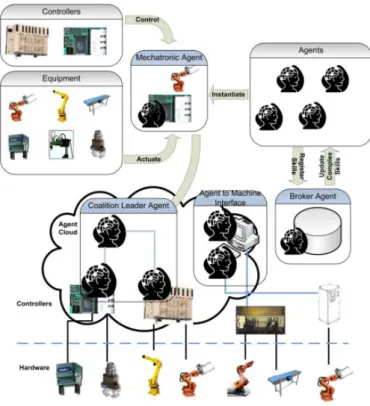
The Figure2.1[26] represents one of such generic architectures for a MAS framework regarding the EAS/EPS concepts. It is derived from the CoBASA architecure [32]. The architecture contains the following agents:
• Mechatronic Agent (MA): It is a threefold entity constituted by an equipment, its
controller and the active logical part (the agent). The mechatronic agent is, in this context, a self-containing pluggable unit.
2. STATE-OF-THE-ART 2.1. Manufacturing Paradigms
Figure 2.1: MAS generic architecture
about the other agents present in the system. It also facilitates their interactions.
• Coalition Leader Agent (CLA): The function of this agent is to promote the
organi-zation between the other agents in order to aggregate the functionalities provided by them. It is therefore paramount in promoting the emergent behaviour that leads to an organized structure.
• Agent Machine Interface (AMI): Is the agent that controls the hardware modules.
This agent works as an intermediary between the mechatronic equipment and the agent when the full integration of the mechatronic agent cannot be attained.
The purpose of the architecture is also a fundamental point that needs to be consid-ered as it definitely influences the implementation decisions and supporting technolo-gies. For instance, the generic architecture depicted in Figure2.1 is focused on system engineering. The IDEAS architecture detailed in the next chapter also entails fast re-engineering, but includes other aspects such as control and material handling in an emer-gence and self-organization framework.
2. STATE-OF-THE-ART 2.2. On Emergence, Self-Organization and Mechatronic Systems
specially in the academic domain of EPS/EAS in particular:
• MAS - oriented: [34,35] preliminary implementations on a didatic kit based on the
CoBASA architecture but featuring material handling.
• Web Service - oriented: [36] a similar implementation exploring web service
tech-nology in particular the emerging Devices Profile for Web Services (DPWS) stack.
Some basic self-organization mechanisms were explored in these papers that eventu-ally led to the solution presented in this work.
2.2
On Emergence, Self-Organization and Mechatronic Systems
2.2.1 Emergence
Emergence and Self-organization are central concepts in recent production paradigms and architectures. They are also frequently used in an loosely way. The concept of emer-gence is attributed to G. H. Lewes. Lewes observed that "although each effect is the resultant of its components, we cannot always trace the steps of the process, so as to see in the product the mode of operation of each factor" [37]. Holland supports roughly the same definition: "there are regularities in system behaviour that are not revealed by direct inspection of the laws satisfied by the components" [38]. If one inspects other definitions of emergence the notion that the whole is more than the sum of the parts dangerously emerges to "raise the spectre of illegitimately getting something out of nothing" [39].
There appears to be several ingredients to identify emergence. Whether or not the observer is one of these decisive ingredients is one of the most relevant discussion top-ics. While some authors deem the observer necessary, see for instance [40] that claims that "the concept of emergence is much better captured through the sound analysis of the observer’s structure", others reject the observer as condition to identify emergence [41]. There is a very important qualitative, phenotype-like, dimension of emergence that con-veys significance to the observer which is generally rejected by pure reductionists. This debate revolves around the "how" and the "why". While pure reductionists contend that emergence is associated with a certain degree of ignorance from the observer in respect to the "how", they often neglect the "why" which, due to the observer’s inability to fully grasp the causal matrix, hinders pure determinism and prevents him from, in most cases, relating the mechanisms that explain how a set of parts lead to useful phenomena as an whole [42]. The why normally relates to a set of observable properties which can be more or less salient according to [37]:
• "Radical novelty: emergents have features that are not previously observed in the
2. STATE-OF-THE-ART 2.2. On Emergence, Self-Organization and Mechatronic Systems
features of emergents are neither predictable nor deducible from lower or micro-level components. In other words, radically novel emergents are not able to be anticipated in their full richness before they actually show themselves."
• "Coherence or correlation: emergents appear as integrated wholes that tend to maintain some sense of identity over time. This coherence spans and correlates the separate lower-level components into a higher-level unity."
• "Global or macro level: since coherence represents a correlation that spans separate
components, the locus of emergent phenomena occurs at a global or macro level, in contrast to the micro-level locus of their components. Observation of emergents, therefore, is of their behaviour on this macro level."
• "Dynamical: emergent phenomena are not pre-given wholes but arise as a complex system evolves over time. As a dynamical construct, emergence is associated with the arising of new attractors in dynamical systems (i.e., bifurcation)."
• "Ostensive: emergents are recognized by showing themselves, i.e., they are
osten-sively recognized. (...)Because of the nature of complex systems, each ostensive showing of emergent phenomena will be different to some degree from previous ones."
In [43] the following properties are additionally considered as pertaining to emer-gence:
• "Interacting parts - The parts need to interact - parallelism is not enough. Without interactions, interesting macro-level behaviours will never arise. The emergents arise from the interactions between the parts."
• "Decentralized control - Decentralized control is using only local mechanisms to influence global behaviour. There is no central control. i.e. no single part of the system directs the macro level behaviour. The actions of the parts are controllable. The whole is not directly controllable (...)"
• "Two-Way Link - In emergent systems there is a bidirectional link between the macro-level and the micro level, the parts give rise to an emergent structure. (...) In the other direction, the emergent structure influences the parts"
• "Robustness and Flexibility - (...) Emergents are relatively insensitive to perturba-tions or errors (...)"
2. STATE-OF-THE-ART 2.2. On Emergence, Self-Organization and Mechatronic Systems
• Diachronic emergence - is a time based process requiring a favourable convergence of factors, typically the critical accumulation of "components, or ingredients and forerunners of that phenomena" that in the right mix can trigger a disruption in the system leading to different system phases.
• Synchronic emergence - is related to the point and scale of the observation process
itself. From a specific point of view correlations between otherwise uncorrelated entities may become evident.
• Descriptive emergence - relates to the description of emergence properties in the macro level where they are visible and measurable. It is a form of emergence that suits the observers descriptive purposes in respect to the observed system.
It is however difficult to devise rules on how to decide on the time frame and scale of the observations. The link between emergence and self-organization has been widely debated.
2.2.2 Self-Organization
A general definition of self-organization is: "a system is self-organizing if it acquires a spatial, temporal or functional structure without specific interference from the outside. By specific we mean that the structure or functioning is not impressed on the system, but that the system is acted upon from the outside in a non specific fashion"[45].
Self-organization is often observed in natural systems yet in most cases the organiza-tion of these systems happens at critical state. This sort of organizaorganiza-tion is typically cited in the literature as Self-Organized Criticality (SOC). The concept is normally attributed to Bak, Tang and Wisenfeld when they proposed the sandpile model as an example of the quantification of SOC [46]. As detailed in [46] "the system naturally evolves to the state without detailed specification of initial conditions (i.e. the critical state is an attrac-tor of the dynamics). Moreover, the critical state is robust with respect to variations of parameters, and the presence of quenched randomness".
As detailed in [43] this ability to retain order is fundamental in the characterization of self-organization and further, in addition to the previously described properties, in the identification of pure emergent systems, pure self-organizing systems or systems that denote both.
2. STATE-OF-THE-ART 2.3. Integrated discussion
these systems take such an actions. Yet most current research is pointing in the direction of developing increasingly distributed and pluggable component-based systems. One of the main challenges is therefore overcoming the absence of general indications and guidelines on evaluating the state of the system which renders very difficult its guidance through a trajectory including the best possible states as opposed to a path that, leading to the same final result, may hinder the overall response.
2.2.3 Challenges in a mechatronic context
The successful implementation of modern production paradigms is currently less a tech-nological issue and more a matter of modelling. If the current development trend con-tinues it is fundamental to define a methodology to design the next generation of pro-duction systems. Emerging approaches propose a radically different way of building systems where global models are replaced by open system architectures that emphasize the generic interactions between the system’s components and how these should influ-ence it has an whole. These systems are designed for emerginflu-ence and indeed it can be the most fruitful way of conceiving and managing complex production systems that result from the composition of thousands, maybe millions of intelligent components.
It is therefore necessary to understand how the existing notions of emergence and self-organization may apply to a mechatronic system. Bedau proposes the notion of Weak Emergence [39,41], which may be useful for this purpose, that determines that the sys-tem’s macro-states can be derived from its micro-states and its micro-dynamic. Bedau also sustains that this link must be supported by a simulation process given the potential complexity of the causal matrix. Bedau’s definition appears has a reaction to the more traditional conception of Emergence (Strong Emergence) that is more restrictive in the two-way link between the whole’s behaviour and the parts. In the context of this work, the author shall follow Bedau’s notion of Emergence as, to a great extent, the purpose of the paper is to uncover the inner dynamics that govern a Mechatronic Multi-Agent system (MMAS) as an whole.
As for the concept of self-organization the author perceive it as a natural property of the mechatronic systems discussed. These systems make massive use of autonomous behaviour in an attempt to continuously adjust to changing production conditions while maintaining a productive organizational state. In this respect the author’ view is aligned with the characteristic properties of self-organization as defined in [43].
2.3
Integrated discussion
2. STATE-OF-THE-ART 2.3. Integrated discussion
There has been a wide debate relating with the small implantation of these emerging production approaches in concrete industrial scenarios. One of the main difficulties is that most of these concepts are easy to explain and understand but they are difficult to implement. The EPS/EAS paradigm is an example of such efforts. In particular it has been undertaking development and refining activities for almost one decade and, only recently, in the scope of the IDEAS project, the first pre-industrial prototypes have emerged.
The project has also been voted as an FP7 success story [47], and part of this success has to do with the focus on concepts but also on the instantiation of those concepts in a technological framework. As stated before, one of the biggest contributions of this work lies in the implementation and refinement of part of the IDEAS architecture.
This architecture strongly relies in emergence and self-organization. These concepts are normally perceived as the sources of disturbances and undesired behaviour. It is therefore also important to start to formalize and understand the dynamics of such sys-tems in order to show that, although they create production environments that are very different from the current ones, there is a considerable added value in adopting them.
3
Architecture
This chapter starts by defining two supporting concepts, namely skill and area, which are required to explain the generic interactions between the IADE agents. The agents and their interactions are then defined and finally the adaptations considered for the study on self-organizing as well as the metric are presented.
3.1
IADE
The IDEAS Agent Development Environment (IADE) is a library developed under the IDEAS project and based on the JADE platform.
The results of this thesis are supported by IADE and, simultaneously, this work con-tributed to its implementation. The principal contributions consist in the partial develop-ment of the Mechatronic Agents (MA), tools and Yellow Pages services. The implemen-tation of the Transport System is out of the scope of this work.
The final results presented on this thesis are an important study in order to support the system configuration, which also provided feedback to the IADE agent stack.
3.1.1 Skill Definition
The generic and dynamic functionalities provided by the agents in IADE are expressed as skills. There are three skill types in the architecture. TheAtomic Skills (ASk)are the link
3. ARCHITECTURE 3.1. IADE
which can contain any other skills including others CSks. A CSk contains a workflow of skills that defines the process. Unlike ASks the CSks never directly interact with the hard-ware. In this context, they simply mediate the execution at agent level. Decision Skills (DSk)are a special skill type which performs decisions during the process execution and,
according to the result of that decision, the process will take different paths.
The Figure3.1depicts a potential composite skill. Important points about the picture include the fact that, as stated before, a CSk can contain any other skill. In particular, a CSk can define a sequence, as in the main CSk portrayed in Figure 3.1, or a parallel execution on the top branch of the DSk. The decision skill is based on the evaluation of a user defined expression. If the expression evaluates to true, the top branch is executed. If it evaluates to false the other branch executes. Only ASks can interface the hardware and each different skill may be controlled by a different agent. A skill can exist even if there is not an agent to control it. In this sense, skills are just descriptions and only come to live when associated with specific instances of agents.
Skills are also comparable entities. In this context, two agents can exchange skill information and verify if the skills are the same even if their instantiation, on the shop-floor, is different. In this context, agents can allocate and replace comparable skills. This fact leads to the notion of area defined next.
Figure 3.1: Composite Skill Example
3.1.2 Area Definition
3. ARCHITECTURE 3.1. IADE
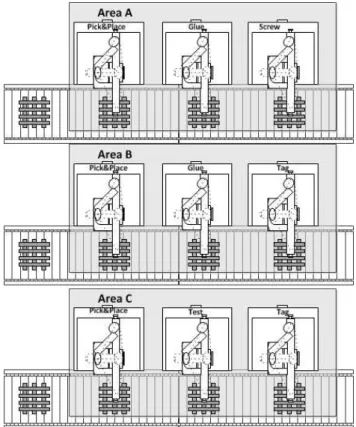
is exemplified a system with two distinct physical areas, both with similar modules.
Considering the example on Figure 3.2a MA deployed on area A can only allocate skills of other agents that are physically located on that area, the same rule is applied for a MA deployed on area B.
Figure 3.2: Area Example
This definition prevents agents from allocating skills of other agents that may match the requirements of a CSk, but that are not physically accessible. This restriction is spe-cially important when dealing with ASks (and hardware manipulation). For this reason, different agents can belong to areas of different sizes, so that in case we have CSks that are composed by others CSKs the controlling agents are able to allocate skills in a wider area of the system boosting self-organization.
3.1.3 IADE Agent Architecture
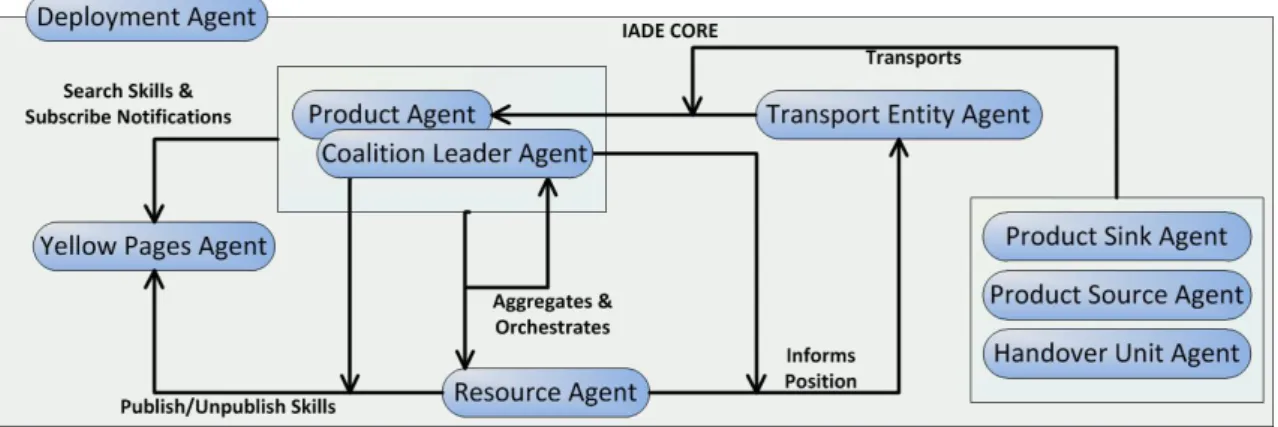
The IADE architecture (Figure 3.3) is designed to support self-organizing, robust and reconfigurable systems. The IADE architecture explores and extends JADE’s agent struc-ture and infrastrucstruc-ture in particular: FIPA compliant communication support, basic agent architecture, service publishing and subscribing functionalities.
Figure 3.3: IADE Agents
The agents that compose the IADE core are:
• Machine Resource Agent (MRA)is the simplest agent present on IADE core. This
3. ARCHITECTURE 3.1. IADE
system. The MRA only contains atomic skills that are indivisible and directly re-lated with hardware. As a consequence, any reconfiguration attempt of functional-ities provided by MRA will require some changes at the controller level. Although these changes are out of the agent control, the MRA provides the required mecha-nisms to handle them in a generic way.
• Coalition Leader Agent (CLA)is the agent that supports the composition of skills.
This means that it is possible to build and execute process using the skills available in the system. The CLA is able to react to disturbances in the environment such as the addition or removal of functionalities and faults under its coalition. Adding functionalities does not necessarily lead to a reaction by the CLA, since the agent can choose not to reconfigure itself if everything is stable. In case of removal or fault, whenever possible, the CLA will negotiate a replacement in order to keep the system running. The ability of negotiation places the CLA as a pillar of self-organization in the system.
• Yellow Pages Agent (YPA)is responsible for managing the information provided
by others agents. It provides an infrastructure that allows other MAs to register their information or query about others, it also offers a subscription service which notifies the subscribers each time an agent informs the YPA about a change on its state. The system is composed by several YPAs and each one stores the correspond-ing information of the agents that belong to a specific area.
• Deploy Agent (DA) is an auxiliary agent and is able to receive a serialized IADE
agent, rebuild it and deploy the agent on the controller where the DA is running. This agent allows the system to be configured through external tools.
• Transport Entity Agent (TEA)is the agent that abstracts the transport entities (i.e.
conveyors or automates guided vehicles). It is responsible for the computation of transporting costs between locations in the system.
• Handover Unit Agent (HUA)is the agent responsible for controlling the physical
handover of a product from one TEA to another. This agent processes the transport cost from TEAs and interacting with other HUAs, computes the transport spanning tree, that contains the best routes between each pair of HUAs/TEAs on the system.
• Product Source Agent (PSoA)this agent is a special case of HUA and is responsible
for introducing new products in the physical environment.
• Product Sink Agent (PSiA)is the responsible agent for retrieving products from
the environment, similarly to PSoA this agent is a special case of HUA.
• Product Agent (PA)is an extension of the CLA agent. The PA represents a product
3. ARCHITECTURE 3.1. IADE
between PAs and CLAs is the interaction with the TEA, the PA should combine the information given by the TEA, CLA and RA to optimize the production process.
3.1.4 Agent interactions functional view
Table3.1[48] details all the possible interactions between the agents described.
Table 3.1: Possible Interaction between the IADE Agents, x denotes interaction MRA CLA PA TEA HUA PSoA PSiA YPA
MRA - x x x - - - x
CLA x x x x - - - x
PA x x - x - x x x
TEA x x x - x x x x
HUA - - - x x - - x
PSoA - x x x - - - x
PSiA - x x x - - - x
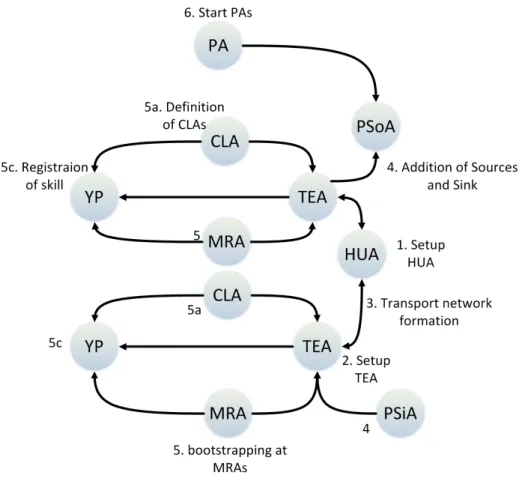
These agents include all the shop-floor entities, although they can be extended to incorporate new functionalities without changing their internal behaviours and the com-munication protocols, as is the case of the PA. When launched, the agents have to per-form some configuration routines which include communicating with other agents for the purpose of setting up the environment and synchronize the start of some activities. The Figure3.4depicts the interaction flow that occurs when the agents are launched. It also encovers part of the engineering methodology.
The system setup starts with the deployment of the HUAs. After all HUAs have been started the TEAs are added to the system. There is one HUA between two or more TEAs and together they form the transport network. This implies changing transport costs (the cost of traversing each TEA), and the construction of the routing tables (at HUA level).
Sources and Sinks are added afterwards. From this point, the transport system is fully operational and is ready to route any product agents. However, without any resources, the PAs would not have anywhere to go.
The next step is therefore the addiction of resource agents and the bootstrap of their atomic skills. From this moment on PAs, whose process description only includes the available skills at the initialized MRAs, can start producing.
Nevertheless, the purpose of the architecture is to enable skill composition, so that more complex processes can be supported by the system. In this context, these processes can be supported by defining the adequate CLAs. Simultaneously as these agents are plugged on the system, they register their skills in the YPA that is associated with the TEA where the specific MRA or CLA executes its skill.
3. ARCHITECTURE 3.1. IADE
the system, the PAs can be launched and start producing. Their entrance on the system is always mediated by the PSoA and their exit is controlled by the PSiA.
Figure 3.4: IADE - Interaction flow at the start-up
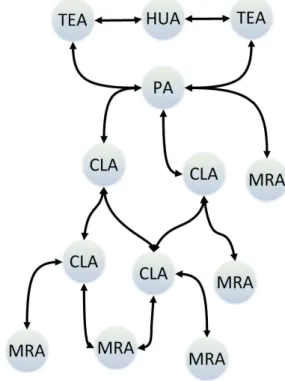
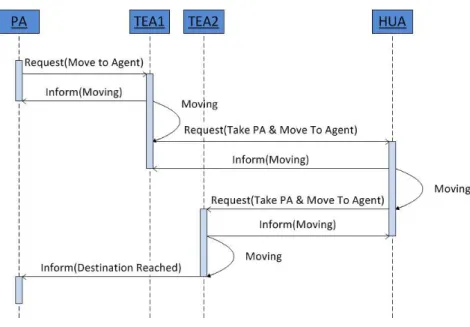
The Figure 3.5shows the interactions flow between the PAs, CLAs and MRAs during the process execution. The PAs, unlike CLAs cannot respond to incoming messages, because the PAs are autonomous from an execution point of view and are a top level entity, on the other hand, the MRAs only react when they receive an incoming message. The CLAs have the ability to receive and send execution requests. The PAs, during their execution, are attached to a TEA, this TEA changes according to the PAs physical location. When a PA needs to be transported, it performs a transport request to the corresponding TEA. The TEAs when are transporting a PA they displace it (physically and logically) to one of its neighbours through a HUA. However the TEAs neighbours are only HUAs which do not communicate with the PAs. The HUA, when receiving a PA, re-routes it to the neighbour TEA, that is part of the best path for the PA destination. Finally, when the PA reaches the destination the target TEA informs the PA and that TEA becomes responsible to handle the future transport requests from the PA.
3. ARCHITECTURE 3.1. IADE
Figure 3.5: IADE - Interaction during runtime
In fact the PA is, indeed, the top level decision maker and the ultimate responsible for the execution of its process plan. Although these interactions appear simple in this high level architectural view, there is a considerable number of actions happening to support them.
In particular, before deciding where to execute next, the PA contacts the TEA, that is currently associated with it, and queries it for all the agents, and transport cost associated with their location, where the next skill in the process plan can be executed. It then contacts the corresponding MRAs or CLAs for an estimation of the execution cost. With both these values it computes a combined cost and commits to an execution location. The PA then requires the transport (following the logic already described).
When at the execution location, the PA will require the execution to the corresponding agent. If this agent is a CLA it may, correspondingly, trigger other agents in cascade.
As shown later in the results chapter, performance is the price paid for the liberty of reconfiguring the system in an had-oc way. The depth of the composition should be carefully regulated and understood to maintain the desired system response.
3.1.5 Simplified IADE stack and self-organization assessment
3.1.5.1 Reduced Agent Stack
3. ARCHITECTURE 3.1. IADE
work and have been studied in [49], a simplified version of the IADE stack was consid-ered (Figure3.6).
Figure 3.6: Simplified IADE Stack agents
As detailed in the picture, the number of classes considered to model the transport system has been reduced. From an instantiation point of view, there is only one instance of the transport system agent. This instance controls the entire transport system.
The re-mapping of these interactions is detailed in Table 3.2. In comparison with Table 3.1one of the main differences, aside on the type of agents, is that in the reduced version the CLAs and MRAs interact directly with the area YPAs to inform about their skills. In the IADE stack this interaction is always mediated by the TEAs.
Table 3.2: Possible Interaction between the Simplified IADE Agents MRA CLA PA TSA YPA
MRA - x x - x
CLA x x x - x
PA x x - x x
TSA - - x - x
The system is started in a fairly similar way (Figure3.7). First the transportation agent is started, then the area YPA is initialized and, finally, the MRAs and CLAs are added to the system. Upon entrance they register in the corresponding YPA.
Once the entire system is setup, the PAs can be launched. Note that the reference in-teractions between PAs, CLAs and MRAs remain the same and that the self-organization assessment will focus on these specifically.
3. ARCHITECTURE 3.1. IADE
Figure 3.7: Simplified IADE Stack - Interactions flow during configuration
The PA will subsequently contact the YPAs to set the execution on the different loca-tions. A consequence of such set of interactions, is that the transport cost is not considered in the decision process.
Figure 3.8: Simplified IADE Stack - Interactions flow during execution
With the set of interactions fixed it is now important to define the decision metric that is involved in the decision of where the execute and frame the whole process under the scope of emergence and self-organization.
3. ARCHITECTURE 3.2. Emergence and Self-Organization in IADE
3.2
Emergence and Self-Organization in IADE
3.2.1 Contextualizing Emergence and Self-Organization
In characterizing the emergent and self-organizing aspects of the system one needs first to consider it under the framework of the emergence and self-organization. In respect to emergence the author follows Bedau’s notation [39]: "MacrostateP of S with micrody-namicDis weakly emergent ifP can be derived fromDandS’s external conditions but only by simulation.". In the present caseSdenotes an IADE system.
Figure 3.9: System Example
A brief example on how to apply the concept of weak emergency shall be provided now. In this case, Figure3.9shows a systemSthat is composed by a conveyor and a area with three stations. From an agent point of view, the station would be abstracted and controlled by a CLA. Under its coalition each one of the robots would be considered as an MRA with skills A, B and A respectively. The interactions between the IADE agents that compose this system defines the microdynamicD. The microdynamic has been fully characterized from a functional point of view in the previous section.
It is important to remind, at this point, that Bedau’s definition of weak emergence is completely generic and detached from any context.
In the mechatronic example provided, or in any IADE system, the purpose is not to attain a specif macrostateP but rather ensure, by promoting self-organization, that the physical system is in a set of desired states.
The size of this set of states depends on the size of the system and the enumeration of all the elements in the set defeats the purpose of using self-organization as the driving force to keep the system under control. In fact if the state space of the system can be easily enumerated then probably the EPS approach is not suitable for that specific system.
3. ARCHITECTURE 3.2. Emergence and Self-Organization in IADE
For instance in Figure3.9, if one of the MRAs implementing A breaks down the other may re-parametrize itself to, not only do its job with the native parametrization, but also do the other agent’s job.
The loss of performance is obvious but the overall system remains operational. This is fairly different from current shop-floors where the same scenario would crash the entire process. This is definitely added value that can only be considered in an emergent and self-organizing perspective.
From a architectural point of view, the process is still controlled by the several PAs (which are the decision makers). This results in a wide range of decisions that need to come together as a self-organizing whole.
Choosing the right decision metric can on the one side improve this process and, on the other side, help explaining the self-organizing dynamics.
3.2.2 A metric to promote and assess self-organization and emergence
As previously stated the PAs dynamically choose the agents that will execute the skills in their process plan. This feature occurs through negotiation. In the simplified stack library the negotiation process is slightly different on the way the decision is made. With or without the transport system, when a PA commits to executing in a specific location/a-gent that alocation/a-gent can have an estimate of its future workload and can use this knowledge to attract or repel more PAs. Such kind of look ahead metric can dynamically capture the joint future intentions of all the PAs on the system. It can also justify and explain why some resources are more attractive than others. In this context, the proposed metric follows this philosophy and is focused on the interactions between the PAs and the first layer of agents that provide a direct match for the PA’s required skills (Figure3.10).
Figure 3.10: Scope of the decision metric
3. ARCHITECTURE 3.2. Emergence and Self-Organization in IADE
have a history or can in the future invoke the given CLA.
The PP i term in Equation 3.1 is related with the mix of PAs in the system, and its
value is reduced when a skill execution of CLA is performed, since the agent knows that there is one agent less to request the invocation of the skill. TheP(CLAx|PP i)term is
related with the history of successful negotiations for the skill. A successful negotiation will increase the value ofP(CLAx | PP i) since the agent considers now that there is a
certain agent that will require the execution of its skill. The purpose is to, as previously stated, capture what is likely to be the future state of the system.
PCLAx= PXtypes
i=0
PP iP(CLAx|PP i) (3.1)
The Equation 3.2is the decision metric itself. By using this metric the agent attempts to minimize the execution cost for a set of skills in its process plan. In fact, what the metric is computing is the joint cost of executing the process plan over the available resources. As the dynamic of the system changes the value of P(CLAx) so changes the cost for
subsequent PAs trying to execute in the system.
Dm=
CLAXrequired
i=0
PCLAi (3.2)
The main restriction of this metric is that the computation ofP(CLAx)requires some
global knowledge about the system, in particular the current mix of PAs on system. In the conventional version of IADE this is controlled by the Product Sink and Sources Agents, and in the reduced version of the stack it is available as shared data.
The expected outcome of this metric is that the system will be able to balance the load of the PAs on the available CLAs on first tier of resources.
It is also important to stress that the metric is not meant to be an optimized metric for load balancing. The scope of the present work is not to perform scheduling based on an agent systems. For this purpose, there are several specialized papers [50].
The focus of the work is clarifying self-organization and emergence in a mechatronic context. Hence the dual purpose of the metric, showing load balancing and explaining the dynamics that led to it.
4
Implementation
This chapter describes the implementation of the concepts used on this thesis as well as an additional tool used to support testing and validation.
4.1
Mechatronic Agents
4.1.1 IADE Data Model
As it was stressed before the IADE library is composed by six agents, the CLA and MRA agents are particular cases of the Mechatronic Agent Class (MAC). The MAC is an ab-stract class (Figure4.1) that contains the common behavioural logic and communication protocols for those agents. The most relevant data fields that compose this agent include:
• OMACState:this field is used to fulfil a conventional automation concept and track
the machine status. It is applicable or used when the agent is attached to a physical resource.
• Skills: is the list of skills provided by an agent. Each skill present on this list
con-tains the required information for the local execution and publishing purposes.
• ExecutorEngine:is the engine responsible for skill execution. This class is abstract,
and each mechatronic agent subclass must have its own implementation.
• NegotiatiorEngine:is the engine responsible for the negotiation of skills to be
4. IMPLEMENTATION 4.1. Mechatronic Agents
is in charge of the proposal evaluation during negotiation and to do the proposal when a negotiation request is received.
• MyType: this field contains information about the agent subtype, such as MRA,
CLA, TSA, PA or any new type defined in a customized solution. It is used to identify the agent type on the system during the deployment.
• YellowPages: is a library that provides the mechanisms to access the YPA
ser-vices. This library contains the mechanisms that facilitate a parametric querying for agents and skills.
• ExecutorResponder: this field is a class that enables the server logic for the MAC
agents to be able to receive and reply to execution requests. The protocol supported is the FIPA Request Protocol [51] (appendix 1).
• NegotiatorResponder: is the server side of negotiator. Provides the mechanisms
that enable mechatronic agents to handle negotiation requests. The protocol sup-ported is the FIPA Contract Net [52] (appendix 2).
• ExecutorInitiator: is the client side of executor. This class enables the MAC agents
to do execution requests. The protocol supported is the FIPA Request [51] (ap-pendix 1).
• NegotiatorInitiator: is the client side of negotiator, like the ExecutorInitiator it
en-ables the MAC agents to perform negotiation requests. The protocol supported is the FIPA Contract Net [52] (appendix 2).
• ExecutionScheduler: is the execution manager. This class manages the execution
queue ensuring that the skills are executed by the correct order (the order in which they were requested).
As stated before, the CLA and MRA agents are extensions of the MAC. The main difference between them lies in the execution logic. The CLA execution consists in an logic of composite skills and the CLA orders other agents to execute the skills present on its composite skill. The MRA only contains atomic skills. Each skill is related with a hardware function that is executed by a specific controller.
The PA is a special case of a CLA, since it is autonomous from the execution point of view. When launched, the PA starts by the execution of its process and is not able to process other execution or negotiation requests. This agent also includes mechanisms to interact with TSAs, which are supported by the following fields:
• MoveRequestis a field that provides the mechanisms for PAs to order
4. IMPLEMENTATION 4.1. Mechatronic Agents
Figure 4.1: IADE - Mechatronic Agent Class
• MoveCost: is a field that enables the PA to request the transport costs to various
positions. This cost together with the proposals of agents (MRA or CLA) helps the PA to decide which are the best agents to execute the skills on its process.
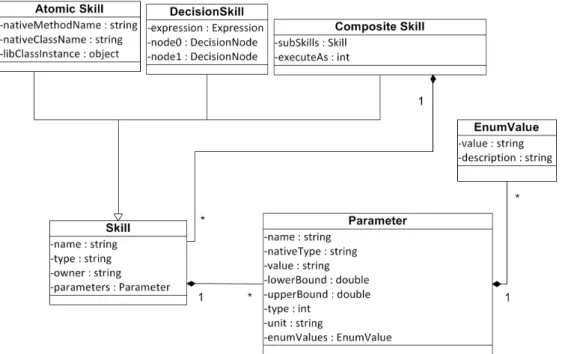
One of the most significant data structures present in the IADE library is the Skill
abstract class (Figure 4.2). The skill is a representation of the functionalities that agents provide to the system.
The main fields that compose the skill abstract class are:
• Name:this field works from a query point of view as the skill id, however it is not
unique since an agent can have more than one skill with the same name but with a different parametrization.
• Type: identifies the skill type (CSk, ASk or DSk). It is particularly important for
agents to identify the skills on the execution queue and know how do execute it.
• Owner: this field is mostly used on skills that are to be executed by other agents.
Defines the agents (pre-defined or negotiated) that can execute the skill. When the list is empty the agent will proceed with a negotiation process to allocate the owner.
• Parameters: is a list of parameters. The parameters behave like I/O lines, where
4. IMPLEMENTATION 4.1. Mechatronic Agents
The parameter is composed by thenamewhich is the identifier of the parameter, the
nativeTypeidentifies the data type of the parameter,valueis the field that keeps the
parameter’s value,lowerBoundandupperBounddefine the lower and upper values
acceptable for this parameter, thetypeindicates if it is an input or output parameter, the fieldunitstores the unit type (i.e. kilogram, meter, litre, etc) and theenumValues
field is a list of enumerated values. The parameter is an important part of the skill parametrization.
Figure 4.2: IADE - Skill Class
The skill abstract library is extended by three different skill classes. TheAtomic Skill (ASk)represents an indivisible functionality and is directly related with a hardware
re-source, theComposite Skill (CSk)is a skill that groups others skills. The formed group
of skills can be executed in a sequential or parallel logic, and theDecision Skill (DSk)is
a special skill with anexpressionwhere the values of process parameters are evaluated.
In order to link the ASk to a hardware resource it contains two additional fields, the
nativeMethodNamethat stores the method to be invoked when this skill is to be executed
and thenativeClassNamethat has the class name where the method is implemented. The CSk includes a list withsubSkillsand a fieldexecuteAsthat indicates which is the execution
logic of this skill (sequential or parallel). The DSk is composed by anexpressionfield that
stores the condition to be evaluated, thenode0andnode1are classes that store the skills to be executed according to result of the evaluated expression, thenode0is executed when
the expression evaluates to true, andnode1is executed otherwise.
4. IMPLEMENTATION 4.1. Mechatronic Agents
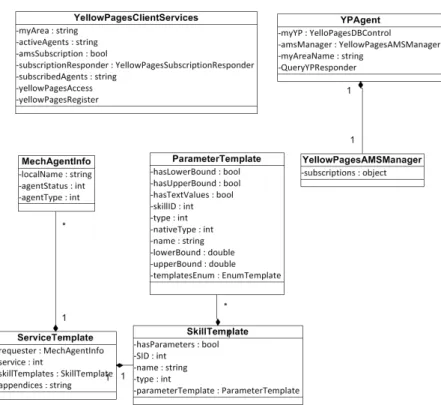
the desired requirements for information management on IADE. It supports non block-ing queries, which means that, an agent can perform a request without beblock-ing blocked while is waiting for the answer. It contains a subscription service where an agent can subscribe for events related to others agents and receive notifications when the status of the subscribed agent changes. Each YPA only stores the information relative to its area, and consequently it is possible to reduce the load on YPA and improve the response time.
The Yellow Pages is divided in two parts (Figure 4.3), the server side (YPA) and the client side. The YPA is composed by the following fields:
• DBControl: this class is responsible for the management of the skill database. It
provides the infrastructure to perform the requests from the others agents.
• SubscriptionManager: is responsible to manage the lists of subscriptions. When
an agent changes the internal state, this manager sends a message to all subscribers notifying them about the changes.
• SubscriptionRegister: this field is a behaviour that receives requests to subscribe
or unsubscribe the subscription service.
• MYAreaName:identifies the area for which that YPA is responsible.
• QueryYPResponder: is a behaviour that responds to query requests. It uses the
protocol FIPA Request to do non blocking queries.
The client side is a class that contains the mechanisms to perform the requests and the subscriptions:
• MyArea:stores the name of the area where the client is located.
• SubscriptionResponder: is a behaviour that receives and processes notifications
about agent changes.
• SubscribedAgents: this field is a list with the agents for which the notification
service has been subscribed.
• YellowPagesAccess: is the behaviour responsible to perform queries to the server
which includes the operations for registering and de-registering the agent.
The communication between the server and the client uses a special structure. The
Service Templatedefines which service is being required (query or data change operation).
This is stored on the service field. TheAgentInfo field is a class which stores the basic
4. IMPLEMENTATION 4.1. Mechatronic Agents
Figure 4.3: IADE - Yellow Pages classes
The AgentInfo and SkillTemplate behave like hybrid fields, they can contain input information to the YPA or output information returned by the YPA.
The TSA (Figure 4.4) is an abstract class and is the core of the Transport System (TS). The TS is composed by four agents that are extensions of the TSA. They are theTransport Entity Agent (TEA),Handover Unit Agent (HUA),Product Source Agent (PSoA)andProduct Sink Agent (PSiA). The PSoA and PSiA are particular cases of the HUA, they allow PAs to
enter or leave the system.
The TSA comprises the most fields that are used by all agents in the TS:
• Area:this field stores the area name where the TSA operates.
• Capacity: this field is a constant related with the physical limitations of the
trans-port system. It stores the amount of products that fit in the part of the system that is controlled by the TSA.
• Queue:is a list with products, sorted by arrival time, that are present on the TSA.
• MoveRequest: this field is a behaviour that receives requests to move products.
This behaviour can receive the request directly from the product or by an interme-diary (i.e. the case when the product destination is not located on the same TEA where the PA currently is).
• TablesReceiver:is a behaviour that is responsible to handle the tables with the costs