UNIVERSIDADE NOVA DE LISBOA
Faculdade de Ciências e Tecnologia
Departamento de Engenharia Electrotécnica e de Computadores
Customisable e-Training Programmes based on
Trainees Profiles
By
Diogo Miguel Frias de Figueiredo
MSc. Dissertation presented at Faculdade de Ciências e Tecnologia of
Universidade Nova de Lisboa to obtain the Master degree in Electrical and
Computer Engineering, held under the guidance of
Ricardo Luís Rosa Jardim-Gonçalves
João Filipe dos Santos Sarraipa
Lisboa
Customisable e-Training Programmes based on Trainees Profiles
Copyright © 2010 por Diogo Miguel Frias de Figueiredo e Universidade Nova de
Lisboa.
A
CKNOWLEDGEMENTS
During the long years of the realisation of my course and dissertation, I encountered
many people that in some way supported me and contributed to this „long walk‟ that changed
my life. Now, thanks to them, it‟s time for the acknowledgments.
To my parents and grandparents that supported and believed in me from the time I
couldn‟t walk all the way to this moment, every moment between and I‟m sure they will
continue forever, words aren‟t enough to thank you properly. For my parents and grandparents: “Muito obrigado por tudo, não só por me ajudarem a acabar o curso e a tese, mas também, com o vosso tempo e dedicação, deram-me os alicerces para ser a pessoa
que sou hoje.”
To Rita, for supporting me in every way, without you, it wouldn‟t be possible to finish this dissertation. More than that, you are a beacon of kindness and warm feelings, thank you, my love, for making me a better person and making my life a dream-state reality from which I
don‟t want to wake up from. “Obrigado, minha meia laranja <<”.
To my advisor, Professor Ricardo Gonçalves, for the time devoted in assisting me, the readiness in helping in any problem and your clear and motivating guidance that was essential in the completion of this dissertation as well as in other lectures of the course.
To all colleagues at GRIS, especially to João Sarraipa, Fernando Ferreira and Carlos Agostinho, for their advices and perspectives. The input from João Sarraipa was especially valuable and without his patient and assertive guidance the outcome of this dissertation and
implementation wouldn‟t be the same. I owe you so many surfing lessons.
To my friends, the ones that I know all my life and I hope will be there always, André Vasconcelos, João Lino, Marco Gonçalves, João Silva, Henrique Torres, Gonçalo Luz, Júlio Luta. To the ones that I‟ve met in University and who endured my long nights during this
course, thank you for being there for me. To the „my core‟ group, Bruno Alves, David
Gonçalves, Fábio Coelho, Pedro Arruda, Ricardo Farinha, David Alves, Mónica Martins, Marco Fonseca and André Duarte, thank you for putting up with my non-stop talking and for the great moments we shared. To Tiago Gaspar, my friend, my great friend, thank you for
everything, for the moments with the „core‟ group, for the patience, long talks and so much more.
Finally, I would also like to thank all the BEST people that I know and haven‟t met yet,
A
BSTRACT
Online training (e-training) is a major driver to promote the development of competencies and knowledge in enterprises. A lack of customizable e-training programmes based on trainees‟ profiles and of continuous maintenance of the training materials prevents the sustainability of industrial training deployment. This dissertation presents a training strategy and a methodology for building training courses with the purpose to provide a trainee oriented industrial training development. The training strategy intends to facilitate the management of all the training components and tasks to be able to build a training structure focused in a specific planned objective. The methodology for building e-training courses proposes to create customizable training materials in an easier way, enabling various organizations to participate actively on its production.
Additionally a customisable training programme framework is presented. It is supported by a compliant ontology-based model able to support adaptable training contents, orchestration service, facilitating the efficiency and acceptance of the e-training programmes delivery.
K
EYWORDS
The keywords of this dissertation are: Customizable e-training Programmes,
R
ESUMO
A formação “online” (“e-training”) tem sido um factor fundamental no desenvolvimento
de conhecimento e competências nas empresas. A sustentabilidade da formação é vital para o seu sucesso e depende da manutenção dos materiais de formação disponíveis e do desenvolvimento de novos materiais. È neste âmbito que esta dissertação apresenta uma estratégia de formação e uma metodologia para a criação de cursos de formação focalizados nos perfis dos formandos. A estratégia de formação que aqui se mostra tenciona facilitar a gestão de todos os componentes de formação de modo a permitir a criação de uma estrutura de formação focada num objectivo específico. A metodologia apresentada propõe a criação de materiais formativos de uma forma eficiente, permitindo várias organizações participarem activamente na produção dos mesmos.
Aliada á metodologia, é também apresentada uma solução que permite a customização de programas de formação, suportada por um modelo baseado numa ontologia. A solução permite a orquestração de materiais formativos de acordo com as necessidades do utilizador, facilitando a eficiência e posterior aceitação da formação
“online”.
P
ALAVRAS
-C
HAVE
T
ABLE OF
A
CRONYMS
ADDIE Analysis, Design, Development, Implementation, Evaluation
ADL Advanced Distributed Learning
AICC Aviation Industry CBT (Computer Based Training) Committee
API Application Programming Interface
CAM Content Aggregation Model
CTO Chief Technical Officer
EU European Union
HR Human Resources
HTML HyperText Markup Language
IDEF0 Integration Definition for Function Modeling
IEEE Institute of Electrical and Electronics Engineers
IPR Intellectual Property Rights
ISD Instruction System Development
IT Information Technology
JSP Java Server Pages
JVM Java Virtual Machine
KISS Keep it Short and Simple
LCMS Learning Content Management System
LMS Learning Management System
LO Learning Object
LOM Learning Object Metadata
MOODLE Modular Object Oriented Developmental Learning Environment
OWL Web Ontology Language
PDK Programming Development Kit
PPT Microsoft PowerPoint
QTI Question and Test Interoperability
RDF Resource Description Framework
RTD Research & Technical Development
SCO SCORM Learning Object
SME‟s Small and Medium Enterprises SN Sequencing and Navigation
SS Simple Sequencing
TC Training Course
TiCW Training in Collaborative Working
TM Training Module
W3C World Wide Web Consortium
WebCT Web Course Tools
T
ABLE OF
C
ONTENTS
1. Introduction ... 13
1.1. Motivation ... 14
1.2. Research Method ... 14
1.3. Research Problem and Question(s) ... 16
1.4. Background Observation ... 17
1.5. Hypothesis ... 17
1.6. Dissertation Outline ... 18
2. Basic Concepts and Methodologies in E-training Development ... 19
2.1. Basic Concepts: ... 19
2.1.1. Learning, E-Learning ... 19
2.1.2. Training, E-Training ... 19
2.1.3. Web – based training ... 20
2.1.4. Virtual Classrooms ... 20
2.1.5. Blended Learning ... 20
2.1.6. Training Structure ... 21
2.2. Methodologies in E-training Development ... 23
2.2.1. ADDIE ... 23
2.2.2. Dick and Carey Systems Approach Model ... 25
2.2.3. Training Development Methodology (Target Wise) ... 27
2.2.4. Conclusions... 28
3. E-learning Standards Overview ... 30
3.1. IEEE-LOM ... 31
3.1.1. Guidelines in Learning Objects creation ... 31
3.1.2. Introduction to IEEE LOM ... 31
3.1.3. IEEE LOM Standard Overview ... 32
3.2. IMS Simple Sequencing ... 34
3.2.1. Introduction IMS SS ... 34
3.2.2. IMS Overview ... 35
3.3. SCORM ... 40
3.3.1. Introduction... 41
3.3.2. CAM Overview ... 42
3.3.3. SN Overview ... 44
3.4. Learning Management Systems ... 45
3.4.1. Definition ... 45
3.4.2. Current LMS’s ... 46
3.5. Conclusions ... 47
4. Training Organization ... 48
4.1.1. Ontology use ... 48
4.1.2. Social Ontologies (Folksonomies) ... 49
4.1.3. Training Organization using an Ontology ... 50
4.1.4. Conclusions ... 51
4.2. An Approach to Industrial e-training ... 52
4.2.1. A Training Strategy as a System ... 53
4.2.2. E-Training Course’s Development Methodology ... 57
5. Proof-Of-Concept Implementation, Testing and Validation ... 64
5.1. Proof – of – Concept Implementation ... 64
5.1.1. Technologies used ... 64
5.1.2. Architecture ... 66
5.1.3. Considerations and remarks ... 68
5.2. Implementation Testing and Hypothesis Validation ... 69
5.2.1. CoSpaces UseCase ... 69
5.2.2. CoSpaces Adaptable Training Programme Service ... 78
5.2.3. Dissemination and Hypothesis Validation ... 81
6. Conclusions and Future Work ... 82
7. References ... 84
8. Annexes ... 88
8.1. Course and Modules Synopsis Example ... 88
8.1.1. Fundamentals in Collaborative Working (FCW) Course Synopsis ... 88
8.1.2. Module 0 - Introduction to FCW Course ... 89
8.1.3. Module 1 - Basics on Collaboration and Definitions ... 89
8.1.4. Module 2 - Collaborative Working Environments ... 90
8.1.5. Module 3 - Views on Collaboration ... 91
8.1.6. Module 4 - Key to successful Collaboration ... 91
T
ABLE OF
F
IGURES
Figure 1.1 – Classical research methodology [76] ... 15
Figure 2.1 – Flow chart of the Dick and Carey Design Model [59] ... 25
Figure 3.1 – LOM base scheme [16] ... 33
Figure 3.2 – IMS SS Scope ... 36
Figure 3.3 – IMS SS Activity Tree ... 37
Figure 3.4 – IMS SS Activity Clusters ... 38
Figure 3.5 – IMS SS Navigation Control Nodes ... 39
Figure 3.6 – IMS SS Rule Bases Sequencing ... 39
Figure 3.7 – IMS SS Rule Bases Sequencing assignment rollup rules ... 40
Figure 4.1 – Relationship structure of the Training System Knowledge Base ... 51
Figure 4.2 – Training System Overview ... 54
Figure 4.3 – Training System detailed view ... 56
Figure 4.4 – An e-training course building methodology ... 58
Figure 4.5 – Training courses slides ... 60
Figure 4.7 – Web based course (in Flash) ... 63
Figure 5.1 – Implementation Architecture [76] ... 66
Figure 5.2 – Training System Knowledge Base in Protégé ... 67
Figure 5.3 – TiCW Curriculum ... 72
Figure 5.4 – TiCW Curriculum with detailed courses ... 74
Figure 5.5 – FCW Course Module’s structure [74] ... 75
Figure 5.6 – EFB Course Module’s structure [74] ... 75
Figure 5.7 – DCO Course Module’s structure [74] ... 75
Figure 5.8 – CCS Course Module’s structure [74] ... 75
Figure 5.9 – DDC Course Module’s structure [74] ... 76
Figure 5.10 – MPI Course Module’s structure [74] ... 76
Figure 5.11 – CAC Course Module’s structure [74] ... 76
Figure 5.12 – CUI Course Module’s structure [74] ... 77
Figure 5.13 – Example of module in flash ... 77
Figure 5.14 – TiCW User interface – Part1 ... 79
Figure 5.15 – TiCW User interface – Part2 ... 79
Figure 5.16 – CoSpaces Training Keywords List ... 80
1. I
NTRODUCTION
As the economy turns more to a knowledge based-industry, keeping all the members of an organization up to date is becoming an increasing challenge. With the rise of e-Learning, the continuous training is now possible and online industrial training is a major driver to promote the development of competencies and knowledge in organizations.
A lack of a continuous maintenance of the training materials prevents the sustainability of industrial training deployment [21]. The delivery of skills needed for their business by using e-learning has, objectively many advantages over conventional training delivery techniques. Delivery costs are considerably lower and staff will not be off site while training. Downtime is minimized and productivity maintained. [4]
From the start of e-Learning it was assumed that the managers of small and medium
enterprises (SME‟s) would recognize that e-Learning could help deliver just in time training at the working place. Although there is a need for continuous staff training (updating professional knowledge and skills) and that e-Learning is identified as a relative low cost solution compared to standard training.
Research carried out in several European and national projects reveals that e-Learning
isn‟t that much applied in small and medium sized companies (SME‟s) [1]. E-Learning is still used mainly in big companies, where there is sufficient knowledge and resources to develop and implement sustainable training strategies. Only the IT sector and a few more others use regularly e-Learning, but unfortunately the few activities undertaken by SME‟s usually are of
rather poor quality [2] and consequently the effect of the training doesn‟t often reach the desired outcome.
One possible solution is to involve SME‟s into sharing knowledge and collaboration by
building communities of practice and to develop business-oriented models of training to meet their needs [12]. Also, by delivering content in small pieces over time as part of a large process, corresponding to the needs of SME staff for faster learning in the context of their work, it would be interesting to, by creating a simple application based on a training development methodology, serve several SME‟s in the training of non private knowledge.
Despite setbacks in the past, mostly caused by exaggerated expectations and inappropriate approaches and products, e-learning is still considered as a key for the solution of the Human Resources (HR) and training problems of European SMEs. To work towards sustainable learning strategies, however, e-learning has to be embedded in intelligent and
Human resources and training for achieving business competence, particularly e-competence, represents factors on which competitive advantages are going to be built. E-Learning can further contribute to the achievement of such competences and at the same time can meet the pronounced needs for flexibility in SME‟s. It is important, however, to design effective models and lines of intervention to help SME‟s to build participative suitable
models of training i.e. within communities of practice. [12]
1.1. Motivation
On the level of European policies, e-learning is seen as one of the prerequisites to
achieve the Lisbon objectives: “by facilitating knowledge and skills acquisition, by providing
flexible learning opportunities for students and citizens, personalizing learning and by creating new collaborative learning opportunities. E-learning could become an efficient and cost effective tool for fostering workforce development and it can lead to cost savings
through better utilization of a user‟s time, efficiencies in personnel resources in institutions
providing education and training as well as reductions in physical requirements” [19][54][4]. The Internet has been growing exponentially, and thus, the information within. Courses and training programs available followed the Internet growth, making it harder to identify the adequate course or program for a specific profile. Allowing the possibility of automatically identifying courses and programs relevant to a certain topic, and customized to a user profile is relevant to anyone who seeks training, and thus, it will help the development and adoption of e-learning.
This is in line with the Lisbon Treaty, where one of its goals is that EU should “…
become the most competitive and dynamic knowledge-based economy in the world…”, for
that it is needed active support for the development and adoption of e-learning throughout Europe [28][3].
1.2. Research Method
Figure 1.1– Classical research methodology [76]
The classical research method is based on the 7 steps:
1. Research question / Problem: This step is the most important for a research,
because it is in this step that is defined the „area of interest‟. Even though the research statement is not declarative like a hypothesis, the research question must be targeted in a way that its study is feasible and there is possibility of being confirmed or refuted. Typically there are several other questions to complement and narrow the focus of the main research question. The research question is defined in section 1.3.
2. Background / Observation: The Background / Observation are based on the study
of prior work on the subject. The work done previously and other topics that related to the subject at hand are studied, not only for better understanding of the topic, but also to distinguish the previous work from the one being developed and its impact. Studying the state of the art is then a really important step and it‟s advised to read the literature review, projects, and several types of documents (reading materials with high newness and low reliability and crossing then with high reliability and low newness). With a better understanding of the prior work done in the area, several iterations can be done between steps 1 and 2, in order to better focus on the development of something of interest. The Background / Observation are extended throughout sections 2, 2.2, 3 and 4.
3. Formulate hypothesis: Formulating a hypothesis is defining the expectations of the
4. Design experiment: This step includes all the detailed planning of the experimental
phase. This phase is usually composed by the design of a prototype or systems architecture and since the research outcome needs to be measurable, in this phase it‟s also needed to
develop a plan for validation which can be replicated by others in a feasible way. The theoretical design is defined in section 4.2 and the proof-of-concept implementation is defined in section 5.
5. Test hypothesis / Collect data: This step is required for evaluating the hypothesis
proposed and to evaluate the outcomes of the system / architecture designed. It should be created a test battery to identify the maximum variety of results. The Test hypothesis / Collect data step is defined in section 5.2.1.
6. Interpret / Analyze results: The Interpret / Analyze results step takes place after all
tests were done and the data output is collected. In order to interpret and analyze the results, if applicable, it is suggested that qualitative and quantitative data analysis should be applied to the results. With a detailed analyses of the outcomes it can lead to a weakening of the confidence of the hypothesis, but this should not be interpreted has a failure, but rather a way to improve the original approach with a new expertise on the subject.
When positive results are obtained, it is possible to consider the future research and provide recommendations. Discussion regarding literature, research objectives and questions should be taken into account, and draw conclusions out of it. Interpretation / Analysis results from the implementation can be found in section 5.2.2.
7. Publish findings: With solid results, either in line of the original hypothesis or
against it, it should result in a contribution to the scientific community. Accordingly to the type of research, scientific papers should be written to present intermediate results (e.g. in conferences), consolidated results (e.g. in journals) and finalized with a dissertation about the hypothesis. The scientific validation and hypothesis verification is found in section 5.2.3
1.3. Research Problem and Question(s)
How to improve e-training acceptance in the industry?
o How to improve e-training development?
o Is it possible to generate automatically a course depending on the profile of a
trainee?
1.4. Background Observation
Finding time for training is difficult. And the more senior the trainee the more he or she will find it difficult to allocate time for personal development. This is particularly true of senior practitioners in the professions such as the law, accountancy and engineering, etc.
Despite the recognition that training is a necessary component of successful development, it is difficult to allocate the requisite amount budget; and it is axiomatic that poor training is worse than no training.[22]
When a suitable training partner is found, the location or timetable often does not fit the immediate requirements. It is extremely common that training is identified as part of the appraisal process but suitable courses usually are not available for several weeks or even months. This can lead to demotivation and even to the loss of a collaborator under certain circumstances.[9]
The biggest problem in selecting a suitable training is the question of measuring how much of the learned material is actually retained by course delegates after they return to the workplace. Most studies imply that the rate of retention is frighteningly low. But with e-training, because delegates can learn in their own time and at their own pace, they do much better than when they are on formal training courses.
On the other hand, having a just in time training availability, providing the trainee with tools that allow him/her to use it whenever he/she wants is proving to be a major advantage in delivering trainings. Not only is more cost effective, by not having a trainer physically present, but the trainee can control the pace of learning, according to his/her learning methods, and even allowing the trainee to focus on what the trainee really needs, even allowing to take the lesson more than once. [26]
By allowing the creation of courses based on the user profile / interests, individuals seeking training on a specific topic would have the possibility of learning about relevant topics in their positions without the need of a trainer, saving in time and funds, and avoiding
following courses that aren‟t relevant for the user needs.
1.5. Hypothesis
1.6. Dissertation Outline
In the current section the context and needs that this contribution in focused on are presented, evidencing the need for a solution in the e-learning industry, the automatic generation of courses according to the user needs and profile.
Next in Chapter 2 are presented several basic concepts relevant within this dissertation. The Chapters 3 and 4.1 act as the state of the art review. Firstly it is presented several training methodologies that are used to create courses, Chapter 3 addresses the study of e-learning standards and applications and the Chapter 4.1 presents ontology‟s as a
potential solution. In each chapter is found a brief conclusion about the topic studied.
In Chapter 4.2 is presented a training development system that allows a rapid development of courses and training materials. Chapter 5 refers the experimental developments taken for achieving the final objectives.
2. B
ASIC
C
ONCEPTS AND
M
ETHODOLOGIES IN
E-
TRAINING
D
EVELOPMENT
2.1. Basic Concepts:
For better understanding of this document, the author presents in this section referenced definitions of key concepts relevant within this dissertation.
2.1.1. Learning, E-Learning
Learning is acquiring new knowledge, behaviours, skills, values or preferences, and it may involve processing different types of information. Learning functions can be performed by different brain learning processes, which depend on the mental capacities of the learning subject/agent, the type of knowledge which has to be acquitted, as well as on the socio-cognitive and environmental circumstances. [6]
It is understand that learning is the absorption of knowledge about a particular subject. From this, it is possible to define and understand what e-learning is.
A usual accepted definition for e-learning is: The delivery of a learning, training or education program by electronic means. E-learning involves the use of a computer or electronic device (e.g. a mobile phone) in some way to provide training, educational or learning material. [7]
2.1.2. Training, E-Training
Training is the act of teaching someone how to do something, such as a job, or teaching the skills and attitudes that will have a direct impact on job performance, such as operations, human resources policies, or management and leadership. [5]
Like in learning and e-learning, the definition of e-training is closely related to training. E-training is a term that is used to describe a number of techniques that use computer technology to deliver instructional material to trainees. [21]
E-training is usually understood as e-learning, the author finds it relevant to distinguish them. The core idea is the same, to pass on knowledge, but in training the knowledge is more task-oriented (e.g. know to do, how to use, how to install).
models (e-learning and e-training) as they both attempt to achieve similar kinds of outcomes (e.g. higher-order thinking) but in different contexts and with differing degrees of generalization or specificity. [10] For now, e-training is seen as a sub-category of e-learning, a term used for industry training.
2.1.3. Web – based training
A web-based training delivery method allows the course participants to extend the training time-span according to their needs and within a specific personal time allocation by accessing the materials via a browser or a network-connected application. By depending on general access to the course material, connectivity, performance and availability demands are also relevant issues to the training deployment.
With this delivery method each learner is able to execute the content in a preferred approach, e.g. always displaying examples of a certain learning topic first, as is the case of an example-oriented strategy. The learning objectives achieved can be validated by built-in assessments that allow electronic marks through the evaluation. Web-based training offers the highest flexibility but also the need for additional discipline since the organization of the learning process is controlled by the user. Thus, the learner can be focused and concentrated to make a profitable use of learning materials.[67]
2.1.4. Virtual Classrooms
Virtual classrooms are an alternative training delivery that has to be supported by a specific platform. It provides many of the advantages of the classroom training without the constraint of a fixed location. The participants join the course via web-based training or related technologies. This means that the participants are not required to come to a particular training location but must possess the necessary technical environment to participate. Since this delivery method requires fast internet access it is only suitable for those persons who have access to such a connection. This means that it is more appropriate for smaller target groups and not for large-area dissemination. Virtual training has a higher demand on the performance and availability of the platform than the administrative use for classroom training. [67]
2.1.5. Blended Learning
as classroom training. A typical example of this would be a combination of technology-based materials and face-to-face sessions used together to deliver instruction. [67]
2.1.6. Training Structure
In this chapter it will be described the four categories of the training structure, with a top to bottom perspective. Starting from the training curriculum, training programmes, training courses and training modules, these are the four identifiable categories within the training structure. Below is a brief description of these categories.
2.1.6.1. Training Curriculum
A training curriculum is the set of related instructional elements and content offers in a given field of study [37].
It‟s designed to establish the underpinning that is to be used to frame down training course elements. There could be several training curriculum areas, and each usually has at least one course defined with its direct contents of such area. Nevertheless there are some training topics that are used by other areas, so it is usual to find courses that exist in several training curriculums. Such relations give some complexity to the classification of these training elements.[67]
A dynamic training curriculum is one where at least one curriculum element does not have an associated training course, as opposed to fixed and variable curriculum types. By modularization, designating the number of stand-alone curricular units as the required elements of a training programme enables such dynamism of design. The dynamic training curriculum is therefore flexible, learner-centric and competency-based. This conceptual framework holds instructional elements (modules and materials) by focusing on atomic competences and skills within established domains.[38]
2.1.6.2. Training Programme
A Training Programme is a significant long-term training activity which comprises a set of courses.[36]
The main difference between a training curriculum and a training programme is that a training programme is designed to develop specific skills, and the training curriculum embraces all the fields of area of study. It is usual to find several training programmes within a particular training curriculum.
2.1.6.3. Training Courses
A training course is an ordered process or succession of a number of lectures dealing with a subject. [68] It is conceived in a way that meets the specific desires and expectations of a determined target audience.[67] A training course is divided in several modules, accordingly to the topics that are addressed.
2.1.6.4. Training Modules
A training module is a small piece of a training course with a very clear objective.[67]
2.2. Methodologies in E-training Development
Closely related to the type of training and tools used, are the methodologies used for training development. In this section the author presents a brief overview of the main training development methodologies that are used at the moment.
Methodologies establish the set of working methods that guide development processes, thus streamlining activities by providing the set of practices, procedures and rules that steers progress towards goals. [38] In this section is presented an overview of relevant methodologies in e-training development.
2.2.1. ADDIE
The ADDIE Model is a widely used model, and it also serves as a base model for several other training methodologies. These other systems use ADDIE as a generic model, typically with minor changes. There are probably over 100 different variations of the generic ADDIE model. [56]
ADDIE stands for Analysis Design, Development Implementation, and Evaluation. The acronym represents also the order in which is advisable to build the model, and each step has an outcome that feeds the subsequent step. [56]
Below is the order of the ADDIE model and a short description of each stage: [56][58] [58]
Analysis --> Design --> Development --> Implementation --> Evaluation
Analysis: During analysis, the designer identifies the learning problem, the
goals and objectives, the audience‟s needs, existing knowledge, and any other relevant characteristics. Analysis also considers the learning environment, any constraints, the delivery options, and the timeline for the project. There are also defined performance measurement indicators for the tasks to be trained and an outline of the budget.
Design: A systematic process of specifying learning objectives. Detailed
storyboards and prototypes are often made, and the look and feel, graphic design, user-interface and content are determined here. Other than identifying and list the learning steps required to perform the task, it is also developed performance tests to show mastery of the tasks to be trained. Also it is listed the entry behaviours that the learner must demonstrate prior to training.
materials based on the Design phase by listing all activities that will help the students learn the task, selecting the delivery methods such as handouts, videos, etc. While developing the instructional courseware, it is also reviewed the existing material to avoid explaining the same twice.
Implementation: During implementation, the goal is to develop a procedure for
training the learner and the teacher. Materials are delivered or distributed to the students group. After delivery, the effectiveness of the training materials is evaluated.
Evaluation: This phase consists of a formative and a summative evaluation.
Formative evaluation is presented in each stage of the ADDIE process. Summative evaluation consists in tests designed for criterion-related referenced items and providing opportunities for feedback from the users. Revisions are made as necessary. In this phase it is reviewed and evaluated each passed phase (Analysis, Design, Development and Implementation), to ensure that the training in development will accomplish its objectives.
The ADDIE model has been criticized by some as being too systematic, that is, too linear, too inflexible, too constraining, and even too time-consuming to implement. As an alternative to the systematic approach, there are a variety of systemic design models that emphasize a more holistic, iterative approach to the development of the training. Rather than developing the instruction in phases, the entire development team works together from the start to rapidly build modules, which can be tested with the student audience, and then revised based on their feedback. [56]
The systemic approach to development has many advantages when it comes to the creation of technology-based training. To create engaging metaphors or themes, artists and writers work together in a process that validates the creative approach with students early in the development cycle. Programmers and designers garner agreement as to which learning activities are both effective as well as possible, given the constraints of the client's computers or network.
programmers and artists in the design phase, who have no formal background in instruction, warrant the extra time required and additional compensation for this time?" [58]These are all considerations that need to be taken into account in designing a purely systemic training development methodology based on the ADDIE model.
2.2.2. Dick and Carey Systems Approach Model
Another well-known instructional design model is The Dick and Carey Systems Approach Model. The model was originally published in 1978 by Walter Dick and Lou Carey in their book entitled “The Systematic Design of Instruction”.
Dick and Carey made a significant contribution to the instructional design field by championing a systems view of instruction as opposed to viewing instruction as a sum of isolated parts. The model addresses instruction as an entire system, focusing on the interrelationship between context, content, learning and instruction. According to Dick and Carey, components such as the instructor, learners, materials, instructional activities, delivery system, and performance environments interact with each other and work together to bring about the desired student learning outcomes. [59]
The Dick and Carey Design Model describe all the phases of an iterative process that starts by identifying instructional goals and ends with summative evaluation. This model is applicable as shown below.
Figure 2.1– Flow chart of the Dick and Carey Design Model [59]
1) Instructional Goal: Desirable state of affairs by „Instruction Needs Analysis‟:
Analysis of a discrepancy between an instructional goal and the present state of affairs or a personal perception of needs.
2) Instructional Analysis: Its purpose is to determine the skills involved in
reaching a goal. In this step it‟s made an analysis from which it is build a list of
steps and skills that should be followed in order to correctly reach the objectives defined in the previous step.
3) Entry Behaviours and Learner Characteristics. The purpose of this step is
to determine which of the required enabling skills the learners need to bring to the learning task. Intellectual skills and abilities such as verbal comprehension and spatial orientation as well as traits of personality are examples of common requirements.
4) Performance Objectives. Its purpose is to translate the needs and goals into
specific and detailed objective functions, determining whether the instruction is related to its goals or not. The lesson planning is focused on appropriate conditions of learning and measuring the development performance by assisting learners in their study efforts.
5) Criterion-Referenced Test Items. Purpose: To diagnose individual
possessions of the necessary prerequisites for learning new skills in order to check the results of student learning during the process of a lesson. In this step it is also provided documents of student‟s progress for parents or administrators that are useful in evaluating the instructional system itself (Formative / Summative evaluation).
6) Instructional Strategy. Purpose: To outline how instructional activities will
relate to the accomplishment of the objectives. It is advisable to create tasks reflected in the objectives and increase the effectiveness of teaching strategies by choosing the appropriate delivering system.
7) Instructional Materials. Purpose: To select printed or other media intended to
convey events of instruction. Use of existing materials when it is possible or evaluating the need for the development of new materials.
8) Formative Evaluation. Purpose: To provide data for revising and improving
instructional materials. To revise the instruction in order to make it as effective as possible for larger number of students.
whole conducted after the system has passed through its formative stage Small scale/ Large Scale Short period/ Long period. [59]
2.2.3. Training Development Methodology (Target Wise)
Training Development Methodology is a method designed to build trainings that improve the performance of employees and train customers on using products and services. This training development methodology is widely used, and consists on the following steps [63]:
1) Needs Analysis:
In this step the training development project is analyzed and the training needs are identified by investigating:
The needs, competencies, preferences and other characteristics (e.g. language skills, cultural differences) of the target audience that the training solution must be tailored to.
The characteristics of the target audience‟s environment that may affect the
design of the training solution.
The skills, knowledge and/or attitudes that must be improved or trained. Based on this data, it‟s developed the learning objectives that describe what learners should
be able to do or know after they have completed the training. It‟s also identified
the types of training materials that will be most effective in meeting these learning objectives (e.g. Web-based training, instructor-led training, virtual classroom training [i.e. instructor-led training delivered via Internet using videoconferencing tools], video, audio, and job aids such as quick reference guides or checklists).
2) Design Phase:
Based on the outcome of the Needs Analysis, it‟s made the design of the training
materials that need to be created. Depending on the type of training material, this design consists of the following:
A course curriculum (list of the courses including course titles, high-level course goals, and course types that will be developed).
For each course, a course outline shows the structure of the course (modules, topics, subtopics, learning objectives, learner activities).
scripts, video scripts, instructor and student manuals and PowerPoint presentations for instructor-led or virtual classroom training, job aids like quick reference guides and checklists.
For each type of course that will be developed, a prototype module showing the
course type‟s look and feel, navigation, instructional design, and level and type of
interactivity.
3) Development Phase:
Based on the outcomes of the Needs Analysis and Design phases, it‟s developed the actual training materials – e.g. Web-based course, audio and video recordings, quick reference guides, and final draft instructor and student guides – that will be provided to the learners. This phase will also encompass a pilot test of the developed training materials. Based on the test feedback, final changes will be made to the training materials.
4) Deployment Phase:
In this phase of the training development methodology it‟s deployed the training
materials that were created in the Development phase. This deployment may include activities like:
Web-based training, audio or video recordings:
Burning Web-based training courses, audio or video recordings on CD-ROM or DVD
Uploading Web-based courses, audio or video recordings to a network server
Storing Web-based courses in a Learning Content Management System (LCMS)
5) Quality Assurance:
At the end of every phase of the training development methodology the deliverables resulting from the phase will undergo a quality check as a form of a review.
2.2.4. Conclusions
It is important to have a methodology that allows several entities to collaborate on the developing of the training curriculum, so that more easily the methodologies could be
training materials, using known tools to facilitate the development of web based courses. [21]
3. E-
LEARNING
S
TANDARDS
O
VERVIEW
Specifications and standards in e-learning enable different independent assets of learning to coexist for effective and better learning outcomes and also support properties like durability, accessibility, scalability etc. [12]
Many organizations like IMS, IEEE, ARIADNE, and AICC are making standards in the field of e-learning and most of the standards made by them are becoming the de facto standards in e-learning. These organizations are working on different aspects, like LOM [44] with tagging learning content by IEEE, QTI for question and testing interoperability by IMS etc. SCORM from ADL initiative adopted and adapted many specifications and standards from other organization to deal with different aspects of e-learning simultaneously. [12]
These technologies have typically been applied in ad hoc and divergent forms: Innumerable courses, course components and systems for managing and delivering them have been developed independently of one another, often at great expense.[13]
Although there has been an effort in reducing costs in the creation of courses, by improving the platforms in order to decrease the number of teachers and content creators, there is still a major struggle in reusing materials, because contents which were developed in
proprietary formats may not include the core data, so it‟s not easy to recover the contents
with all the information associated with the original content.[12]
As in any industry, this rapidly evolution of Standards comes parallel to the manufacture of new products. Initially, the design and other facilities become propriety of the manufacturing company but in case of non satisfaction of the user needs, industry comes up with common standards. Presently, all indicators show that we are in a transition period of standards in e-learning. [12]
There is still some work to be done towards the creation of common standards. Several reasons can be identified as the main cause of the slow adoption of standards, like the fact that standards are very young. So the organizations responsible for creating them are not yet sure about the standards, changing drastically between versions; and the fact that most of the standards are complex to a common institution person dealing with the e-learning content and tools. The task of creating a standard in an emerging field like e-learning is difficult, it‟s
like trying to hit a moving target that itself is changing constantly. [12] [13]
objective of the implementation is to automatically create a list of courses to be followed, and not to create a binding-standard of another standard.
3.1. IEEE-LOM
In this section is presented the IEEE Standard for Learning Object Metadata. A widely used standard in e-learning and its usage is still growing. But first, for a better understanding
of the LOM, and the process in general, let‟s study some guidelines in the construction of learning objects.
3.1.1. Guidelines in Learning Objects creation
A Learning Object is any grouping of materials that is structured in a meaningful way and is tied to an education objective. In the creation of a Learning Object, the author should consider how it relates to other existing Learning Objects and other educational materials available in the platform. [15]
Associating Metadata, which is information about the Learning Object itself (as opposed to the information in the Leaning Object that is part of the learning experience), is useful because that is how search engines within the platform can locate and identify the Learning Objects.
Finally there are some key-words to keep in mind when creating the Learning Object:
Interoperable, making it possible to work with other Learning Objects and with Learning Management Systems; Reusable, allowing others the use of the objects created, even in different ways that firstly the object was designed for; Discoverable, adding the information needed for quick and easy discovery so it can be found by other developer; and Durable, by using the latest metadata standards so the lifespan long.[15]
3.1.2. Introduction to IEEE LOM
Metadata is the information about an object, be it physical or digital. As the number of objects grows exponentially and our needs for learning expand equally dramatically, the lack of information or metadata about objects‟ places a critical and fundamental constraint on our ability to discover, manage, and use objects. This standard addresses this problem by
defining a structure for interoperable descriptions of learning objects.[14]
non-digital, which can be used, re-used and referenced during e-learning. Examples of Learning Objects include multimedia content, instructional content, learning objectives, instructional software and software tools, and persons, organizations, or events referenced during technology supported learning. [12]
Synchronization across organizations for defining standards of common interfaces across different concerns is one of the biggest problem in defining the Standards and Specification. It seems very encouraging that this specification is used by Content Aggregation Model (CAM) of SCORM (specification).[12]
The Learning Object Metadata (LOM) is widely accepted and implemented in its current form, and its further standardization brings with it risks of significant revision or even outright rejection. Consequently it has been agreed by many stakeholders that stabilizing and supporting the standard in its present form is currently more important that in further standardization. As a further result, the LOM will not be subjected to further incremental revisions and minor changes.[13]
3.1.3. IEEE LOM Standard Overview
IEEE LOM is a multi-part standard that specifies Learning Object Metadata. The Standard Overview specifies a conceptual data schema that defines the structure of a metadata instance for a learning object. It is defined as any entity – digital or non-digital- that may be used for learning, education, or training. A Learning Object describes relevant characteristics of content to which it applies such characteristics may be grouped in general, life cycle, metadata, educational, among others.[14]
LOM comprises a hierarchy of elements. At the first level there are nine categories, each of which contains sub-elements. These sub-elements may be simple elements that hold data, or can be aggregated with other elements, containing further sub-elements. Each element semantics is determined by its context, depending on the parent or container element in the hierarchy and other elements in the same container. For example, the various Description elements (1.4, 5.10, 6.3, 7.2.2, 8.3 and 9.3) derive their context from their parent element. In addition, description element 9.3 also takes its context from the value of element 9.1 Purpose in the same instance of Classification. [16]
groups the features related to the history and current state of this learning object and those who have affected this learning object during its evolution; c)The meta-metadata category groups information about the metadata instance itself (rather than the learning object that the metadata instance describes); d) The technical category groups the technical requirements and technical characteristics of the learning object; e) The educational category groups the educational and pedagogic characteristics of the learning object; f) The rights category groups the intellectual property rights and conditions of use for the learning object; g) The relation category groups features that
define the relationship between the learning object and other related learning objects; h)
The annotation category provides comments on the educational use of the learning object and provides information on when and by whom the comments were created; i)
The classification category describes this learning object in relation to a particular classification system. [14]
Figure 3.1– LOM base scheme [16]
The data model specifies that some elements may be repeated either individually or as a group, for example: although the elements 9.3 (Description) and 9.1 (Purpose) can only occur once within each instance of the Classification container element, the Classification element may be repeated thus allowing many descriptions for different purposes. [16]
data elements. The value space defines the restrictions, if any, on the data that can be entered for that element. For many elements, the value space allows any string of Unicode character to be entered, whereas other elements entries must be drawn from a declared list or must be in a specified format (e.g. date and language codes). Some element data types simply allow a string of characters to be entered, and others comprise two parts, as described below: LangString items contain Language and String parts, allowing the same information to be recorded in multiple languages; Vocabulary items are constrained in such a way that their entries have to be chosen from a controlled list of terms - composed of Source-Value pairs - with the Source containing the name of the list of terms being used and the Value containing the chosen term; DateTime and Duration items contain one part that allows the date or duration to be given in a machine readable format, and a second that allows a description of the date or
duration (for example “mid summer, 1968”). [16]
When implementing the LOM as a data or service provider, it is not necessary to support all the elements in the data model, nor need the LOM data model limit the information which may be provided. The creation of an application profile allows a community of users to specify which elements and vocabularies they will use. Elements from the LOM may be dropped and elements from other metadata schemas may be brought in; likewise, the vocabularies in the LOM may be supplemented with values appropriate to that community. [60]
3.2. IMS Simple Sequencing
IMS Simple Sequencing allows several interesting actions in the e-leaning platforms such as SCORM, thus, IMS Simple Packaging and Sequencing is briefly described in this chapter.
3.2.1. Introduction IMS SS
The IMS is a consortium formed by almost 200 commercial, governmental and other entities. Currently, the IMS has some 80 contributing members, a significant number of which are American and British commercial entities, but which also include universities and federal governmental agencies. [13]
IMS SS declares the relative order in which electronic learning activities are to be presented to a learner and the conditions under which a resource is selected, delivered, or skipped during presentation. [17]
IMS SS is labelled as simple because the specification considers only a limited number of common sequencing strategies, not because the specification itself is simple.[17] It relies on the concept of learning activities, such as content or test questions. Activities are associated with other activities into a hierarchy, resulting in an activitytree. A parent activity and its childrenare referred to as a clusterof activities.[17]
3.2.2. IMS Overview
The Simple Sequencing model is intended to provide base level support for sequencing learning activities. It is purposely neutral with regard to models of pedagogy and the use of instructional strategies, but it describes only fairly simple behaviours‟ in order to limit the specification and especially conformance verification to a manageable scope. Below are described the main concepts used in IMS SS.[18]
Conceptual Model
Sequencing occurs within a conceptual runtime environment which translates navigation events into navigation requests to the sequencing engine. Results of sequencing are then used to modify or create the user interface which the learner sees. This model is intended to give enough background to an implementer to understand how the Simple Sequencing Specification can fit into a complete delivery environment.[18]
Scope
Figure 3.2– IMS SS Scope
Learning Activity
A Learning Activity is a pedagogically neutral unit of instruction, knowledge, assessment, etc. It can have sub-activities and may be nested to an arbitrarily deep level. Each activity may have a tracking status associated for each learner that is assigned to experience the activity. Activities can be attempted any number of times, or the number can be specified. They can be suspended, abandoned, exited normally, etc. All activities are performed within the context of a parent activity. [18]
Activity Tree
as a curriculum, AA as an assigned task, and AAA as a lesson.[18]
Figure 3.3– IMS SS Activity Tree
The Simple Sequencing Specification defines the canonical traversal of the activity tree as pre-order traversal. Using the example in Figure 4.3, this means that, starting from A, the traversal would go to AA, then AAA, then AAB, then AAC, then AB, then ABA, etc. Note that the reverse pre-order traversal is not just a mirror image of the forward pre-order traversal. Using the example in Figure 4.3 again, the precedent of AC is ABCA, not AB.
The default traversal path can be modified through the association of sequencing rules created by a learning designer. Traversal is triggered by a sequencing request, which in turn is triggered by the learner through navigational events or by the delivery system itself. Sequencing rules are evaluated at runtime and can be conditional based on tracking status. Activities are always delivered one at a time and may have auxiliary resources associated with them. [18]
In IMS the activity tree can be represented as an organization element in the IMS Content Packaging Specification. The top level activity is the organization itself, and each node in the tree is an item in the organization. However, the Simple Sequencing Specification itself makes no assumptions about packaging of the learning content. The same Simple Sequencing behaviours and rules defined in this overview could be used for content that is assembled and managed dynamically by an intelligent tutoring system, for example. [18]
Activity Resources
The Simple Sequencing Specification assumes that some content resources may be able to communicate results, and others not. For example, a resource may be a "dumb" document or HTML page, or it may be a SCO as defined in SCORM. Simple Sequencing assumes that some results that map to the status data model defined in the specification; however, it does not define how to communicate the data. There can be different ways to do this, all of which would work with Simple Sequencing. Therefore, how a content resource can communicate results must be defined elsewhere.
If no content resource is associated with a leaf node, Simple Sequencing does not specify any particular behaviour. This is an example of anundefined behaviour, which is outside the scope of the Simple Sequencing Specification. [18]
Activity Clusters
Simple Sequencing rules are associated with clusters of activity nodes. In Simple Sequencing, the term cluster refers to a single node and its immediate children. The scope of
a particular rule never extends beyond the cluster. For example, many rules govern how to handle the sub-activities in a cluster, or rollup the result of the sub-activities in a cluster. Those rules are associated with the parent node in the cluster. Other rules are associated
with a specific activity and do not affect its children. [18]
Figure 3.4– IMS SS Activity Clusters
Navigation Control Modes
Figure 3.5– IMS SS Navigation Control Nodes
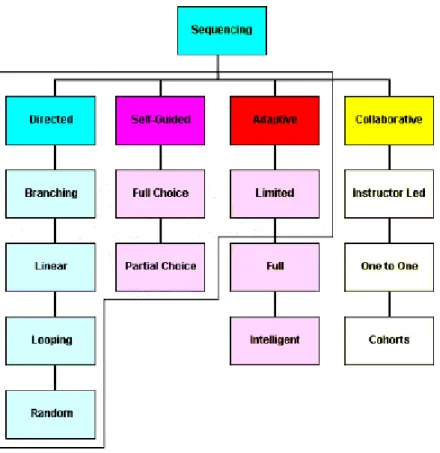
The basic control modes that govern this behaviour are choice and flow, each of which can be enabled or disabled. If choice is disabled, the user is not allowed to choose but must follow the defined flow. If flow is enabled, the user is guided through the activities according to the structure of the tree. Both can be enabled at the same time, in which case the user can choose any activity, but can also be guided. However, both cannot be disabled at the same time.[18]
The same control modes can be specified for all the clusters in an activity tree, or they can be different for different clusters. For example, the learner may be guided by flow through a sequence of exercises within which she is free to choose different practice items.
Rule-based Sequencing – Conditional Rules
Complex navigation behaviours may be achieved by assigning rules to different nodes at different levels of nesting. Figure 4.5 shows how the traversal of the tree as the user continues from activity to activity when flow is enabled can be affected by rules. In this example, specific nodes have a rule that specifies that they should be skipped under certain conditions. To each cluster is given a rule called "control mode" that enables flowing through its children, and specific nodes are given a conditional rule that states that it should be skipped.
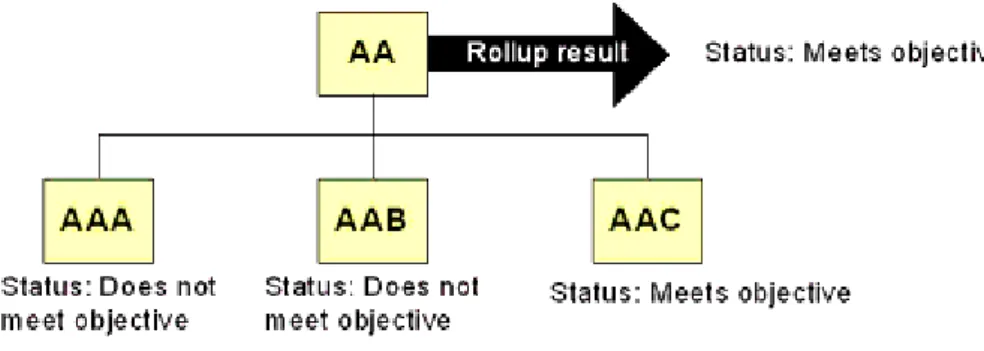
Many of the conditional rules defined in Simple Sequencing are based on data collected by tracking the results of activities. When an activity contains sub-activities, in other words when it is the parent node in an activity cluster, the results of the sub-activities are rolled up into summary results for the cluster. This is not always desirable. For example, whether a learner succeeded in a free practice should not affect the result of a course. Rollups can be controlled in two ways. One way is by the assignment of rollup rules to a cluster, as shown in Figure 4.6. The other way is by "tagging" a particular sub-activity to specify it should not be included in rollups. [18]
Figure 3.7– IMS SS Rule Bases Sequencing assignment rollup rules
The IMS Simple Sequencing it‟s very well documented and established. Although its
design limits some interaction, it supports the majority of the sequencing needs of the
e-learning methods, so it‟s a standard to take in consideration. For more information about the
IMS SS, please refer to:
IMS Simple Sequencing Best Practice and Implementation Guide - Version 1.0: This document provides an overview and describes how the IMS Simple Sequencing Information Model and XML Binding can be applied to specific types of interoperability scenarios. This is the best place to start, but also contains very technical reading. [18]
IMS Simple Sequencing Information and Behaviour Model - Version 1.0. This document describes the data structures in detail, technical reading. [56]
IMS Simple Sequencing XML Binding - Version 1.0. This document describes how to encode the sequencing objects in XML and provides the corresponding XML schema; Technical Manual to be consulted together with the previous documents. [77]
3.3. SCORM
Initiative) is considered to be a collection of standards and specifications for e-learning. By borrowing from previous work of other specifications and standards from other organizations, it was putted together a model to creating and deploying e-learning with a mentality oriented to a strong server supporting the solution. [12]
For the purpose of this dissertation SCORM was studied as a solution for the problem that this dissertation wants to solve. Although it was decided that SCORM wasn‟t going to be
used, studying its design was very interesting and helpful for the development of the implementation.
3.3.1. Introduction
SCORM 2004 is the evolution of the underlying standards and specifications. In the most recent version (SCORM 2004), it has been introduced the sequencing, which is a set of rules that specifies the order in which a learner may experience content objects. Below are presented the main standards and specifications that SCORM adopted:
1. IEEE Data Model for Content Object Communications
2. IEEE ECMAScript Application Programming Interface for Content to Runtime Services Communication
3. IEEE Learning Object Metadata (LOM)
4. IEEE Extensible Mark-up Language (XML) Schema Binding for Learning Object metadata Data Model
5. IMS Content Packaging
6. IMS Simple Sequencing [12]
SCORM encapsulates these specifications in three broad categories as follows:
1. Content Aggregation Model
It represents a learning strategy for designers and implementers of instruction to aggregate learning resources for the purpose of delivering a desired learning experience. There are two terms mostly used in Content Aggregation Model: Item and SCO. Example of Items in SCORM is standalone text file, media file etc. SCO are collection items which are treated as a unit for the LMSs.
2. Runtime Environment
be communicated between SCOs and LMSs.
3. Sequencing and Navigation
It is based on the IMS Simple Sequencing (SS) Specification. It also describes how learner and system initiated navigation events can be triggered and processed.[12]
From the three categories presented, it was decided to study both Content Aggregation Model and the Sequencing and Navigation. The Runtime Environment was considered of no use for this project. Below is presented an overview of the Content Aggregation Model (CAM) and Sequencing and Navigation (SN).
3.3.2. CAM Overview
The SCORM CAM represents a learning-taxonomy of neutral means for designers and implements an instruction that aggregates learning resources for the purpose of delivering the desired learning experience. A learning resource is any representation of information that is used in a learning experience. Learning experiences consist of activities that are supported by electronic or non-electronic learning resources.
One activity in the process of creating and delivering learning experiences involves the creation, discovery, and gathering together, or aggregation, of simple assets into more complex learning resources and then organizing the resources into a predefined sequence of delivery. The SCORM CAM supports this process and is made up of the following:
• Content Model: Nomenclature defining the content components of a learning
experience.
• Content Packaging: Defines how to represent the intended behaviour of a learning
experience (content structure) and how to aggregate activities of learning resources for movement between different environments (content packaging).
• Metadata: A mechanism for describing specific instances of the components of the
content model.
• Sequencing and Navigation: A rule-based model defining a set of rules that
describe the intended sequence and ordering of activities. The activities may or may not reference learning resources to be delivered to the learner. [20]
A content package contains two major components:
• A special XML document describing the content structure and associated resources
manifest file.
• The content (i.e., physical files) making up the content package. [20]
A manifest is an XML document that contains a structured inventory of the content of a package. If the content package is intended for delivery to an end user, the manifest also contains information about how the content is organized. The scope of a manifest is elastic. A manifest can describe part of a course that can stand by itself outside of the context of a
course (an “instructional object”), an entire course, a collection of courses, or just a collection
of content that is to be shipped from one system to another. When packaging a collection of courses, such a content package would typically have to be disaggregated in order to be delivered to learners in a practical LMS run-time system. At this point there is no consensus or standard on how to publish a very large or very complex package in a practical LMS, because different LMS systems and repositories use different methods to represent or store the learning content to deliver to learners. The general rule is that a package always contains a single top-level manifest that may contain one or more (sub)manifests. The top-level manifest always describes the package. Any nested (sub)manifests describe the content at the level at which the (sub)manifest is scoped, such as course, instructional object or other. [20]
The manifest is composed of four major sections:
1. Metadata: Data describing the content package as a whole.
2. Organizations: Contains the content structure or organization of the learning
resources making up a stand-alone unit or units of instruction. A definition of sequencing intent can be associated with the content structure.
3. Resources: Defines the learning resources bundled in the content package.
4. (sub)Manifest(s): Describes any logically nested units of instruction (which can be
treated as stand-alone units). [20]
![Figure 1.1 – Classical research methodology [76]](https://thumb-eu.123doks.com/thumbv2/123dok_br/16571375.738025/17.892.237.620.112.398/figure-classical-research-methodology.webp)
![Figure 2.1 – Flow chart of the Dick and Carey Design Model [59]](https://thumb-eu.123doks.com/thumbv2/123dok_br/16571375.738025/27.892.183.716.699.1048/figure-flow-chart-dick-carey-design-model.webp)
![Figure 3.1 – LOM base scheme [16]](https://thumb-eu.123doks.com/thumbv2/123dok_br/16571375.738025/35.892.132.788.486.894/figure-lom-base-scheme.webp)