CUIDADO É FUNDAMENTAL
UNIVERSIDADE FEDERALDO ESTADODO RIODE JANEIRO. ESCOLADE ENFERMAGEM ALFREDO PINTO R E V I S T A O N L I N E D E P E S Q U I S A RESEARCH
CUIDADO É FUNDAMENTAL
UNIVERSIDADE FEDERALDO ESTADODO RIODE JANEIRO. ESCOLADE ENFERMAGEM ALFREDO PINTO
DOI: 10.9789/2175-5361.2017.v9i2.536-544
DOI: 10.9789/2175-5361.2017.v9i2.536-544 | Freitas LCM; Guedes MTS; Santiago LC | Proposal for a software-prototype...
Proposta de um software-protótipo para uso na assistência a
pacientes com cateter central de inserção periférica (PICC)
Proposal for a software-prototype to assist patients with peripherally
inserted central catheter (PICC)
Propuesta de software-prototipo para uso en la asistencia a los pacientes
con catéter central insertado periféricamente (PICC)
Luiz Célio Martins Freitas1; Maria Teresa dos Santos Guedes2; Luiz Carlos Santiago3
This article was prepared from the Master’s thesis: Nursing care for patients submitted to peripherally inserted central catheter: proposal of a software-prototype, 2014, Federal University of the state of Rio de Janeiro. Center for Biological and Health Sciences. School of Nursing Alfredo Pinto. Postgraduate Program - Master in Nursing.
How to quote this article:
Freitas LCM; Guedes MTS; Santiago LC. Proposal for a software-prototype to assist patients with peripherally inserted central catheter (PICC). Rev Fund Care Online. 2017 abr/jun; 9(2):536-544. DOI: http://dx.doi. org/10.9789/2175-5361.2017.v9i2.536-544
ABSTRACT
Objective: To propose a software prototype as a strategy to improve the communication process and records pertaining to the nursing care of patients undergoing Peripherally Inserted Central Catheter (PICC), and describe the steps for designing a software prototype. Methods: Intervention Research was used in the Intervention Process modality and as a method of operation the Prototyping associated to computer tools.
Results: A simple graphics interface computerized model was created and designed to be used in open or private virtual networks. Conclusion: Development of the software prototype to run on web network will make the practical implementation process. It adds that validation with health staff will be carried out before use.
Descriptors: Software; Catheter; Nursing Care; Informatics in Nursing; Technology; Communication.
1 Doctoral Candidate in Nursing and Biosciences. Postgraduate in Oncology Nursing. Expertise in PICC for newborns, children and
adults. President of the National Cancer Institute’s (INCA) Central Venous Catheters Studies and Control. Supervising Nurse for the Cancer Hospital (INCA) vascular access devices.
2 Doctoral Candidate in Nursing and Biosciences. Master of Science in Nursing. Postgraduate in Oncology Nursing. Nursing
Coordinator of the National Cancer Institute’s (INCA) Tumors National Bank.
3 Post-doctor. Professor of the Alfredo Pinto Nursing School at Federal University of the State of Rio de Janeiro (UNIRIO) of
RESUMO
Objetivo: Propor um software-protótipo como estratégia para melhorar o processo de comunicação e os registros relativos ao cuidado de enfermagem a pacientes com cateter central de inserção periférica (PICC) e descrever os passos para a construção de um protótipo de software. Métodos:
Utilizou-se da Pesquisa de Intervenções, na modalidade de Processo de Intervenção e como método de operacionalização a Prototipação associados a instrumentos de informática. Resultado: Foi criado um modelo computadorizado de interface gráfica simples e projetado para uso em redes abertas ou fechadas. Conclusão:O desenvolvimento do software-protótipo para funcionar em rede web tornará o processo de implantação mais prático. Acrescenta-se que validação com equipe de saúde será realizada antes da utilização.
Descritores: Software; Cateter; Cuidados de Enfermagem; Informática em Enfermagem; Tecnologia; Comunicação.
RESUMEN
Objetivo: Proponer un prototipo de software como una estrategia para mejorar el proceso de comunicación y del registro de los cuidados de enfermería a pacientes con catéter central insertado periféricamente (PICC) y describir los pasos para construir un prototipo de software.
Métodos: Se utilizaron las intervenciones de investigación, en forma de proceso de intervención y cómo el método de funcionamiento de prototipos asociado con herramientas informáticas. Resultado: Se creó un modelo de ordenador de interfaz gráfica simple y diseñada para su uso en redes abiertas o cerradas. Conclusión: El desarrollo del prototipo de software se ejecute en la red web hará que el proceso de aplicación práctica. Añade que la validación con el personal de salud se llevará a cabo antes de su uso.
Descriptores: Catéter; Atención de Enfermería; Software; Informática Aplicada a la Enfermería; Tecnología; Comunicación.
INTRODUCTION
It is possible to say that today we live a dynamic process in relation to what was agreed as a Technological or Electronic Revolution due to the transformations in the digital information field. In addition to that, there are other aspects to be considered as the advancements and constant innovations originated from the development of the New Information and Communication Technology (NICT).1
The dimension of the information technology revolution is intended to promote interaction between technology and society. Both supplement each other in relation to the information society and the NICT end up transforming the concept of knowledge. The solid and fixed knowledge does not exist anymore and knowledge must be permanently reconstructed. There is a constant flow of new information, access and interaction for the continuous learning maintenance. There arises the necessity to communicate and share knowledge, providing mobility for the continuous learning.2
As information advances, certain functions are automatically being eliminated giving way to new abilities that come up, transforming the cognitive ecology and complete: organizations’ knowledge engineers and
socio-technical evolution promoters will be as essential as machine specialists. Thus, developing competences and abilities in the search, treatment and storage of information becomes individuals’ competitive differential. The point is not only about having a great amount of information, but also treating, analyzing and storing it in a way that all people involved have access without having to face time and geographic restrictions and this information adding value to the decision making process.3
The NICT has determined significant changes in the most diversified fields of human work as, for example, in the field of health, especially that concerning patients treatment processes, intervention management, remote education as an intelligent form of permanent professional training maintenance, use of computers for carrying out a range of activities necessary for the daily tasks developed in the field of health and the communication in electronic networks of the attended individual’s health data, among others.4
The computer is definitely inserted in the contemporary labor relations world. Information technology is increasingly fundamental for everyone. It entails an irreversible process where the alliance between technological knowledge and professional practices will always demand that people face these challenges, including nurses.4
Nurses face a new challenge in relation to the technological transformations and their insertion in the labor world, that is, it is essential to obtain training with the intent to integrate new technologies to nursing, ascribing a new configuration to the systematization of their actions. Besides, it is affirmed that an ongoing techno-scientific basis of the knowledge is essential to carrying out their profession. According to their analysis, the more techno-scientific advances are inserted in field of health, the more evident it is the necessity of a nursing science capable of following up and attending to the demands originated by this process.5
The present study will focus on Peripherally Inserted Central Catheter (PICC). In general terms the venous catheter has peculiar characteristics and complications that can interfere with the final results of the treatment given to patients. Also, they can equally interfere with the nursing planned assistance to the patient.6
The empirical observation originated from the practical assistance sheds light on the fact that many nurses, from the most diversified areas of the same hospital unit, manipulate the PICC without making the proper registrations and, therefore, interfere in the follow-up of the expected performance and efficiency of the therapeutically installed devices, implying in a series of consequences for the individual.
On the other hand, upon observing the NICT insertion in the daily professional practice in the field of health, we notice how fundamental it is to learn how to deal with it and develop the essential means for the appropriate utilization in the hospital environment.
The follow-up on the NICT evolution and introduction in our field of work and the absence of several possibilities of
taking full advantage for specific use in practical situations incurs in a mismatch between what is carried out with brand new technology and the absence or delay in information and communication reproduction among the teams.
It is necessary to emphasize that the core of the problem attributed to this study is eminently based on the underutilization of the information technology available in the hospital environment.
The motivation to develop and implement computerized hospital information systems has been financial and administrative, that is, geared towards recording expenses, reducing cost, and documenting patient care for legal reasons. However, although the currently used systems aid nurses to give more focus to their practices, they end up failing in providing the adequate resources for the necessary support to the professional practice performance.7
The motivating objectives for the utilization of the NICT in the nursing assistance area are: (1) reducing the time spent registering patients information; (2) eliminating redundancies and inaccuracy in the registered information; (3) improving the time in which the communicated data is provided; (4) optimizing the access to information; (5) providing information that professionals need so that they can make the best decisions regarding patients’ care.7
In this respect, nurses can spend less time on daily management tasks when they deal with papers and documentations, being able to devote more time to specific problems and patients’ individual necessities.
Essential to the design of evaluations, records, and decision making processes related to patients’ care, softwares still continues to be designed and distributed without a major involvement of nurses. Isolated efforts on the part of some nurses and the development of specific software or software prototype for the utilization in providing nursing care have been observed in this study, which demonstrates that these professionals devote themselves to achieve efficiency in their studies and take steps towards specific interventions in the information and communication technology area, shedding light on and contributing to the practice of nursing.
“The point is not if a multimedia system will be designed (it will), but when, how and under what conditions”.1:453
The possibility of creating and applying a device that provides a solution to the problems pointed out was observed in the NICT, characterizing the PICC used by nurses in intravenous therapies as object of study.
In summary, the PICC is a long and flexible catheter, inserted by a peripheral vein, progressing through it to the central venous system. Its edge is installed in the inferior third of the inferior vena cava. Its use has been expanding due to the positive results, more knowledge on the part of the nurses about the several vascular devices and their indications, development of more biocompatible materials in the production of PICC, and better risk management with more safety and comfort for the client. Today its use
is extended to all the areas and clinics of a hospital unity besides providing outpatient and home care.8
The main objective of this study was to propose a software-prototype as a strategy to improve nursing records information and communication processes related to patients undergoing PICC. Our specific objective is to identify the most adequate communication processes to be used by nurses when recording procedures related to the care of patients undergoing PICC and describing the phases for designing a software-prototype to optimize those records.
METHODS
It is a study of the type of Intervention Research, in the modality of Implantation Process9 and, as a method of operation, Prototyping.10 It was developed in the period between April 2013 and July 2014.
Considering the objective to propose a software-prototype, only the three first phases of the six ones that make up the prototyping method were used in this study. These phases were chosen because they best represent the most appropriate approach, presenting well defined and enlightening phases that will enable the developer to create a software model (Figure 1).
Figure 1 – Prototyping Diagram based on the Pressman
model (2011)
Source: Modified from Figure 1.8 Prototyping. In: PRESMAN, R. S. Engenharia de software. 3 ed., São Paulo: Pearson Makron Books; 2011.
The ethical precepts in research with human beings, defined by Resolution 466/12 of the National Health Council regarding ethics in research, were met upon the submission of this study to the Research Ethics Committee of the Federal University of the State of Rio de Janeiro (CEP-UNIRIO). It was approved by the consolidated opinion no. 471.023. As the objective of this study was to develop a tool in a virtual environment, a Free and Clarified Consent Term was not necessary.
In the first phase - requisites collection and refining - the prototype content was established. Bearing in mind that the specific nursing care to patients undergoing PICC
start before their insertion and culminate with the device removal, It was established that the content should involve the pre-insertion nursing consultation, insertion, evolution and removal of the PICC.
To identify and extract the significant and fundamental variables that should make up the recordings on the PICC utilization, a reference consultation was made originated from health data banks and specialized books on intravenous therapy and/or central venous catheters.
In the second phase - brief project elaboration - having the variables, a base tool of the data recordings was created. For such we chose to use Microsoft Office Access® (MSAccess) version 2000 because, after projecting each page quickly, we were able to visualize them in Hyper Text Markup Language (HTML) format and had the feeling of visualizing an internet page. This way, it was possible to analyze and determine the necessary functions and requisites for designing the software-prototype.11,12
In the third phase - prototype design - starting with the data recording base tool elaborated in the first phase, with the necessary requisites clearly identified, which should include in the records on the pre-insertion nursing consultation, insertion, evolution and removal of the PICC, the process of designing the software prototype was established. For such it was necessary to include a computer system professional with a background in system analysis and software design as well as the utilization of other free software with accessible programming language. We started by establishing a holistic view of the software by identifying the primary functions it should perform, and then generating the software prototype to be used for recording PICC procedures in patients.
Two computer tools were used to design the prototype: PostgreSQL version 9.3 and the JAVA language version 7. PostgreSQL was chosen for being considered a robust and reliable system, besides being extremely flexible and rich in resources. One of its compelling features is having resources similar to a major data bank. In addition to that, it is a versatile, safe and free data bank available under a Berkeley Software Distribution (BSD) license, of public domain, open coded, for unrestricted use.13,14,15
The choice of the JAVA language was because it is considered a powerful language in complex distributed environments as the Internet, but its versatility enables the programmer to go beyond, offering a powerful programming language of general use, with enough resources for designing a variety of applications that may or may not depend on the use of connectivity resources.
RESULTS
To gather the state of the art, we consulted health data banks and cross-referenced the terms (in Portuguese, English and Spanish) from 1985 to 2014. No results of software produced by nurses and related to PICC utilization for the care practice were produced, which proved the innovation of the study.
In the first phase or phase of collection and refinement of the requisites- we consulted a health data bank (Flowchart 1). After reading the references, we extracted significant and essential variables that should make up the software-prototype and the elaboration of the data recording base tools.
Table1 – Theoretical basis used for the design of Peripherally Inserted Central Catheter (PICC) pre-insertion consultation,
insertion, evolution and removal recording tools
Data tools Number of references used Same examples of references 16-27 1. Consultation before PICC insertion
Nursing Process
Assessment for indication PICC Physical assessment
Venous assessment
35 Hadaway L. Choosing the right vascular access device, Part I. Nursing. 2002;32(9):75.
2. PICC insertion PICC insertion record
Relevant data insertion of PICC Insertion techniques
PICC assessment (Pre and immediate post-insertion)
Protocols.
44
Alexandrou E, Spencer T, Frost S, Mifflin N, Davidson PM, Hillman KM. Central venous catheter placement by advanced practice nurses demonstrates low procedural complication and infection rates--a report from 13 years of service. Crit Care Med. 2014;42(3):536-543.
3. PICC assessment
3.1. Care and handlings 67
Dórea E, Castro TE, Costa P, Kimura AF, Santos FG. Práticas de manejo do cateter central de inserção periférica em uma unidade neonatal. Rev Bras Enfermagem. 2011;64(6):997-1002.
We point out that the processing of the procedures to be followed from the PICC pre-insertion to the removal are peculiar to each health institution.
The variables used for the elaboration of the basic data recording instruments for pre-insertion consultation, insertion, evolution and removal of the PICC were extracted from the theoretical foundations found in Table 1.
Having the significant and essential variables which should make up the software-prototype,the study moved to the second phase where the rapid design or basic instrument of data recording was elaborated using the MSAccess® tool version 2000 originating the structured data recording base tool which enabled a good visualization of its total content to evaluate and decide the action that should be executed. Four pages were created and named “PICC pre-insertion nursing consultation”, “PICC insertion data”, “Evolution” and “PICC Removal”.11
From the basic instrument of structured data registration, we proceeded to the third phase where the process of constructing the prototype was elaborated.
A holistic vision of the software was established by identifying the primary functions it should perform, then a software prototype was generated to be used for recording nursing care procedures of patients undergoing PICC by using PostgreSQL version 9.3 and JAVA version 7 tools.13,14
The software-prototype was designed to run online and enable geographically distant users to have fast access for consultation and data insertion, popularizing the information among diverse health teams within any institution, enabling them to operate through an intranet or an open web system.
The software-prototype computerized model was named
“PICC System” and is made up of five modules: Module
1 - Control: this is the software domain area (access control, recording control, data bank control); Module 2 - User: this is registered users access area for controlling the recordings
related to the patients (patient registration, include, edit the nursing care with the patient); Module 3 - Graphics: graphically presents the number of interventions performed and the number and reasons that lead to PICC removal; Module 4 - Reports: allows the visualization of the patient’s data and their copy if necessary; Module 5 - Search: allows the consultation of patients and their data without needing to be a registered user. These modules and their peculiarities are presented and explained along the presentation of the results.
The graphic interface of the software-prototype was elaborated to be simple, clear, straightforward and objective, a fact already observed since the first page (Figure 2).
Figure 2 – Software main page
Module 1 - software access page. This page is also
considered the starting point for modules 2 and 4. Through the login software, owners have access to the main page or “home”, through which they can register users, control accesses, control the data bank and all the system. Likewise, through this page the user has access to the main page.
Module 2, registered users have access to the software
main page. To the left of the screen, there are command buttons for registration, graphics and access control, that is, users will take over the control of the tool. Through the command button “registration” users will have access to the “patient’s registration page”. They will find a list of registered patients in a table where the columns present data as: registration number, name, sex, diagnosis, clinic of origin, and actions. Through the command “include” users can register new patients and positioning the mouse on the icon of the column “actions” they will be able to edit previous registrations, have access to the “patient menu” or delete registered patients.
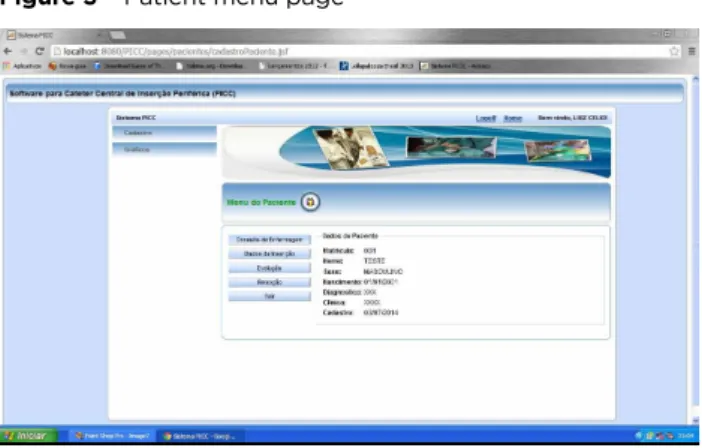
To include the nursing care recordings the user will access the “patient menu” (Figure 3). This presented in subdivisions as: PICC pre-insertion nursing consultation, PICC insertion data, PICC evolution and PICC removal.
Figure 3 – Patient menu page
Source: Author’s property
Upon accessing the registration page of the “pre-PICC nursing consultation”, the patient’s registration number, name, clinic, sex, date of birth, and diagnosis appear as registered. In addition to that, this page has 4 (four) tabs for recordings: main data, patient status, skin evaluation and venous assessment.
In the tab “main data” are: PICC indication, name of the professional that requested the insertion, and recording of other patient’s current medical problems. Such data will confirm the perfect request of PICC indication and problems that can interfere with the device insertion procedure.
In the tab “patient status”, data related to the patient’s general status are inserted at the moment of the consultation. These data can interfere with the insertion procedure increasing the propensity to the occurrence of problems during and after the application of the technique.
In the tab “skin evaluation”, data related to the following items are inserted: color, texture, vascularity, moisture, and skin deficits; presence of lesions, masses and tumors, besides the muscle-skeletal analysis: deformities and amplitude of movements. Such data can interfere directly with the PICC insertion and progression, patients’ safety, and PICC’s dwell time. This data also help define the ideal anatomic area for the insertion of the PICC.
The venous evaluation is the main indication of a vascular access device and for this reason it deserves attention in this software. In the tab “venous assessment” the conditions of the peripheral veins as visibility, palpation, venous caliber and alterations are important recordings as well as the previous catheters. In this tab, nurses will register the suggested place for installation, written and oral directions provided, and the signature of the Free and Clarified Consent Term.
Upon accessing the page “insertion data”, the patient’s registration number, name, clinic, sex, date of birth, and diagnosis will appear as registered. In addition to that, the page has two tabs for recordings: main and supplementary data. In the main data tab are data related to the PICC used (supplier, brand name, batch, material, caliber, number of lights); and data related to the technique (kind of procedure, number of trials, number of PICC used, number of delivery systems used, anthropometric data of the patient and catheter, analgesia, procedure time and choice of vein).
In the tab “complementary data”, immediate post-insertion recordings are made: the RX control, PICC edge locating, which heparin blocking is used and its volume, PICC functioning, PICC fixation to the skin, the dressing used, the external connector used in the PICC - all with pre-related options for the choice. In addition to that, there is space for possible complications during the insertion process, and also space for comments or observations related to the procedure.
On the page “PICC evolution data”, the patient’s’ registration number, name, clinic, sex, date of birth and diagnosis appear as registered. The date of entry also appears automatically. In addition to that, this page has 4 (four) tabs for recordings: main data, handling, problems and resolution data.
Users have the option to save only one tab as evolution, according to their criteria of evaluation at the moment of the care service.
In the tab “main data” there are blanks for recording patient’s’ current geographic location, and both the installed PICC and patients’ anthropometric data in order to observe the external changes related to problems.
The tab “handling” was designed to record various kinds of PICC handling (activation, deactivation, maintenance, blood sample collection, change of dressing) and provides options for users to mark only those which have been performed, all followed by consultation of national and international norms established by nursing societies in intravenous therapy and references found in this study.
In the tab “problems”, users will find the most common problems related to PICC utilization listed and will be able, with a mouse click, to mark those which they will face.
In the last tab called “resolution data” users will be able to record the conduct taken for the solution of the detected problem, confirm whether the conduct was effective or not, and make observations.
The last page of the patient menu is the “PICC data removal” where users will find the most common causes contributing to a PICC removal listed, only by marking one of them. In addition to that, there are places for recording additional care which are part of catheters removal process such as delivering the catheter edge for blood sample culture or collection for the catheter hemoculture. The PICC’s dwell time in the patient should also be registered.
Module 3 of the software is about gathering the inserted
data for statistical production. In the main page of the software we found a button to the left of the screen called “graphics”. By clicking on the same user there will be two options: number of interventions and reason for removal.
Clicking on the first option users will be directed to the page “number of interventions graphic” where they will have access to a graphic which shows the number of PICC insertions and removals monthly. In case users choose the second option they will be directed to the page “removal reasons graphic” where they will have access to a pizza graphic that presents the reasons for removing the PICC, its number and general percentage.
Module 4 of the software is about visualizing all the
patient’s data upon requesting the report. In the main page of the software we find a button to the left of the screen called “report”. By clicking on this button users will have two options: patients and consultations.
Clicking on the first option users will be directed to the patients’ page where they will be able to request what they need and will have access to a graphic demonstrating the number of insertions and removal of the PICC monthly. In case users choose the second option, they will be directed to the page “removal reasons graphic” where they will have access to a pizza graphic presenting the reasons for removal of the PICC, its number and general percentage.
Module 5 was elaborated to aid non-registered users or
those who only wish to make a brief consultation about the patient and their PICC. In the software access page there is an area called patient’s consultation. Users will only need to insert the patient’s registration number and click on the “search” button. They will be directed to a page called “patient’s menu” where the main data and supplementary data of the PICC insertion and removal are presented descriptively.
DISCUSSION
It is necessary to clarify that no literature was found which did not support this study.
In the first phase of the study - requisites collecting and refining phase - it was observed that the number of references specifically related to the nursing care of patients undergoing the PICC and obtained by consulting the health data bank was inferior to expected. This is so if we consider that the utilization of the PICC by nurses began at the end of the 1980s. Such fact leads us to think that assisting nurses need to produce more scientific material. Otherwise, the examined production appears consistent and plentiful of essential information.
The second phase of the study - brief project elaboration - showed that nurses can resort to computer science, free software, most of the time contained in program packages installed in their computers, for a better construction and evaluation of the necessary requisites. The visual disposition of the variables becomes clearer, easier to evaluate and determine the working requisites of a software prototype when resorting to these tools.
In the third phase of the study - prototype design - the adherence of a computer science professional was essential for the decision of the best tools to be used for such. The prototype was then designed including all the necessary variables and executing the primary functions it should perform, and then generating the software prototype to be used for recording data related to the nursing care of patients undergoing PICC.
Still, the software prototype was designed to work in a web browser and used on the Internet or private networks. This will enable sharing information in a fast way among a greater number of professionals, meeting the essential objective of information and communication technology - sharing and popularizing data.
Computers and systems have evolved through time from the heavy machines of the past to the use of computers in the present in all aspects of the everyday life and work places. However, the processes used to implement these systems seem not to have evolved adequately.10
We understand that, time has come for a change in the way nurses operationalize systems and projects implementations, working diligently on the system or software design, incorporating relevant techniques. Information technology evolution must be allied to assistance, and the data that make up a system or software must be those necessary to providing nursing care produced from the evidence of practice and/or previous studies. A targeted approach can improve nursing care quality provided to attend to the demands of the complex health environments of today.
According to the evaluation of the results and bearing in mind that what matters is not whether a multimedia system will be developed, for it will certainly be, but when, how and under what circumstances this development will take place, we can say that the objectives of the study were satisfactorily met.
CONCLUSION
Technically, the present study was a challenge to the authors because it required computer science knowledge. This is so, because in spite of this knowledge having already been incorporated to nursing science, it is not a reality in the undergraduate curriculum yet. This fact points to the need of the nursing academic community to master and develop interactive multimedia aiming to provide theoretical and practical training towards improving nurses’ professional practice.
Through the consultation of the data bank we can affirm the innovation of the results of this study in the nursing area.
We dare to affirm that the utilization of an operationalization method, still little applied in research on nursing as the prototyping for software design and specifically geared towards the inherent needs to handle PICC, constitutes an essential mark for nursing. It will be developed during the entire 21st century and will be characterized, among other aspects, by technological propositions that optimize various professional practices.
The fact that the software prototype was developed to work on a web network will make the implementation processes more practical. These can be inserted or made interactive with the system already in use at health institutions. A practical team training should be implemented before its utilization.
We believe that the construction of this software-prototype will contribute to the supplementation not only of nurses’ actions regarding PICC but also other health professionals. In addition to that, nothing was more pleasant that the effort to approach the daily NICT practice, for they already constitute essential tools for consolidating the Nursing Science and have proven to contribute to improving health services and assistance to the population.
We envision that the future utilization of this software in daily assistance, in the hospital environment, can bring contributions such as:
• Optimization of recordings and documentation on PICC utilization in patients (with better quality, more legible, chronologically ordered, complete and timely) and grouped in only one place, providing nurses with what to look for and what to implement in patients’ care undergoing PICC;
• Information system adequate to daily practice needs creating the opportunity to obtain clinical data of quality in addition to the great quantity of these data to support research activities and improvements in the quality of the service provided.
• Sharing information related to PICC in real time, rapidly, with all the professionals direct or indirectly involved with patients.
• Possibility of evaluating the care provided from PICC insertion to removal, which will translate into reducing or eliminating risks of mistakes,
and consequently more safety for patients and professionals who take care of them.
• Increase the visibility of nurses’ work compared to other health professionals of the team.
It would be highly useful if more nurses developed studies designing or actively participated in designing software-prototype or systems for use in patients’ daily care so that the clinical variables recorded could be of real importance and attend to all the necessities of the nursing practice.
Finally, the objectives of this study were achieved upon designing the software-prototype, describing its development process and point out possible future contributions from its utilization.
The evaluation of this innovative resource for nursing care of patients undergoing PICC as well as its refinement will be the object of further studies.
REFERENCES
1. Castells M. A sociedade em rede – a era da informação: economia, sociedade e cultura. 6th ed. São Paulo (SP): Paz e Terra; 2012. 2. Oliveira GP. Novas tecnologias da informação e da comunicação e
a construção do conhecimento em cursos universitários: Reflexões sobre acesso, conexões e virtualidade. [accessed 17 May 2013] Available in: <http://www.rieoei.org/deloslectores/344Pastre.pdf>. 3. Lévy P. A inteligência coletiva – por uma antropologia do
ciberespaço. 8th ed. São Paulo (SP): Loyola; 2011.
4. Santiago LC. A informatização dos serviços de enfermagem: a busca de informações acerca do uso do computador no cotidiano da prática profissional hospitalar [tese]. Ribeirão Preto (SP): Universidade de São Paulo; 2009.
5. Dalri, MCB, Carvalho, EC. Planejamento da assistência de enfermagem em pacientes portadores de queimadura utilizando um software: aplicação em quatro pacientes. Ver Lat Am Enfermagem. 2002;10(6):787-793.
6. Martin LGR, Segre CAM. Manual Básico de Acessos Vasculares. São Paulo (SP): Atheneu; 2010.
7. Hannah KJ, Ball MJ, Edwards MJA. Introdução à informática em enfermagem. 3th ed. Porto Alegre (RS): Artmed; 2009.
8. Infusion Nurses Society. Infusion Nursing Standards of Practice. J Infs Nurs. 2011;34(suppl 1):S11.
9. Polit DF, Beck CT. Fundamentos de Pesquisa em Enfermagem: Avaliação de evidências para a prática da enfermagem. 7th ed. Porto Alegre (RS): Artmed; 2011.
10. Presman RS. Engenharia de software. 3th ed. São Paulo (SP): Pearson Makron Books; 2011.
11. Goldschmidt MHC. Apostila de iniciação ao microssoft access. [accessed 30 Jun 2014]. Available in: http://www.lce.esalq.usp.br/ gabriel/Apostila1.pdf.
12. Silva MS. Criando sites com HTML. São Paulo (SP): Novatec; 2008. 13. Baltazar A. et al.. Apostila PostgreSQL 8,4. [accessed 30 Jun
2014]. Available in: <http://gilbertexbom.com/bd2/2InfoT_210/ postgresql210_t.pdf>.
14. Oracle Corporation. Java. [accessed 30 Jun 2014]. Available in: https://www.java.com/pt_BR/download/faq/whatis_java.xml. 15. Arantes AC. Comparativo de licenças de código aberto. Belo Horizonte
(MG): Universidade Federal de Minas Gerais. [accessed 30 Jun 2014]. Available in: <http://homepages.dcc.ufmg.br/~alison/Monografia_ Especializacao_Comparativo_licencas_codigo_aberto.pdf>. 16. Hadaway L. Choosing the right vascular access device, Part I.
Nursing. 2002;32(9):75.
17. Ahlin C, Klang-Söderkvist B, Brundin S, Hellström B, Pettersson K, Johansson E. Implementation of a written protocol for management of central venous access devices: A theoretical and practical education, including bedside examinations. J Infs Nurs. 2006;29(5):253-259.
18. Alexandrou E, Spencer T, Frost S, Mifflin N, Davidson PM, Hillman KM. Central venous catheter placement by advanced practice nurses demonstrates low procedural complication and infection rates--a report from 13 years of service. Crit Care Med. 2014;42(3):536-543. 19. Bowers L, Speroni, K.G., Jones, L., Atherton, M. Comparison of
occlusion rates by flushing solutions for peripherally inserted central catheters with positive pressure luer-activated devices. J Infs Nurs. 2008;31(1):22-27.
20. Dórea E, Castro TE, Costa P, Kimura AF, Santos FG. Práticas de manejo do cateter central de inserção periférica em uma unidade neonatal. Rev Bras Enferm. 2011;64(6):997-1002.
21. Hughes ME. Reducing PICC migrations and improving patient outcomes. BJN. 2014;23(suppl 2):S12-18.
22. Hadaway L. Technology of flushing vascular access devices. J Infs Nurs. 2006;29(3):129-145.
23. Jasinsky LM, Wurster J. Occlusion reduction and heparin elimination trial using an antireflux device on peripheral and central venous catheters. J Infs Nurs. 2009;32(1):33-39.
24. Juvé ME. Intravenous catheter declotting. J Infs Nurs 2007;26(4):245-251.
25. Krzywda EA, Edmiston CEJr. Central venous catheter infections – Clinical aspects of microbial etiology and pathogenesis. J Infs Nurs. 2002;25(1):29-35.
26. Sartori NR, Tessuto MC, Almeida CBP. Manutenção e cuidados pós-inserção do PICC: revisão integrativa de literatura. Nursing (São Paulo). 2012;15(173):538-545.
27. Brasil, Ministério da Saúde, Instituto Nacional de Câncer José Alencar Gomes da Silva. Serviço de utilização de cateter venoso central de inserção periférica (PICC): Rotinas internas do INCA. Rio de Janeiro: INCA; 2009. Received on: 08/03/2016 Reviews required: 24/05/2016 Approved on: 19/09/2016 Published on: 10/04/2017 _________
Author responsible for correspondence:
Luíz Célio Martins Freitas Rua Joaquim Távora, 215/301 Icaraí, Niterói/RJ Email: [email protected] ZIP-code: 24230-541