Process-based indicators to assess storm induced coastal hazards Óscar Ferreira, Theocharis A. Plomaritis, Susana Costas
CIMA/FCT, University of Algarve, Campus de Gambelas, 8005-139, Faro, Portugal; oferreir/tplomaritis/[email protected]
Corresponding author: Óscar Ferreira ([email protected])
Abstract
Storms are responsible for several hazards (e.g. overwash, erosion, inundation) in coastal areas, leading to the destruction of property and loss of life in populated areas. Various
indicators are used to express potential storm impact and describe the associated hazards. The most commonly used indicators include either forcing parameters (e.g. wave height, sea level) or coastal morphologies (e.g. dune height or berm width). Whereas they do not represent the processes associated with storm induced hazards in coastal areas. Alternatively, a hazard could be better characterised if process-based indicators are used instead. Process-based indicators express the result of the forcing mechanisms acting over the coastal morphology and reflect both hydrodynamic and morphological characteristics. This work discusses and synthesizes the most relevant process-based indicators for sandy shores subject to overwash, erosion and inundation promoted by storms. Those include: overwash depth, potential and extent; shoreline, berm or dune retreat; vertical erosion; and inundation depth and extent. The selection of a reduced set of process-based indicators to identify coastal hazards induced by storms in sandy coasts will facilitate comparison of different coastal behaviours for distinct storm return periods, and help to optimise coastal management plans, thereby contributing to the reduction of coastal risks.
1
Process-based indicators to assess storm induced
2
coastal hazards on sandy coasts
3 Óscar Ferreira, Theocharis A. Plomaritis, Susana Costas
4 CIMA/FCT, University of Algarve, Campus de Gambelas, 8005-139, Faro, Portugal;
5 oferreir/tplomaritis/[email protected]
6 Corresponding author: Óscar Ferreira ([email protected])
7
8 Abstract
9 Storms are responsible for several hazards (e.g. overwash, erosion, inundation) in
10 coastal areas, leading to the destruction of property and loss of life in populated areas.
11 Various indicators are used to express potential storm impact and describe the
12 associated hazards. The most commonly used indicators include either forcing
13 parameters (e.g. wave height, sea level) or coastal morphologies (e.g. dune height or
14 berm width). Whereas they do not represent the processes associated with storm
15 induced hazards in coastal areas. Alternatively, a hazard could be better characterised
16 if process-based indicators are used instead. Process-based indicators express the
17 result of the forcing mechanisms acting over the coastal morphology and reflect both
18 hydrodynamic and morphological characteristics. This work discusses and synthesizes
19 the most relevant process-based indicators for sandy shores subject to overwash,
20 erosion and inundation promoted by storms. Those include: overwash depth, potential
21 and extent; shoreline, berm or dune retreat; vertical erosion; and inundation depth
3 4 5 6 7 8 9 10 11 12 13 14 15 16 17 18 19 20 21 22 23 24 25 26 27 28 29 30 31 32 33 34 35 36 37 38 39 40 41 42 43 44 45 46 47 48 49 50 51 52 53 54 55 56 57 58
22 and extent. The selection of a reduced set of process-based indicators to identify
23 coastal hazards induced by storms in sandy coasts will facilitate comparison of
24 different coastal behaviours for distinct storm return periods, and help to optimise
25 coastal management plans, thereby contributing to the reduction of coastal risks.
26
27 Keywords: indicators; hazards; storms; overwash; inundation; erosion
28
29 1. Introduction
30 Storms impacting sandy coastal areas produce hazards such as erosion and inundation
31 that, in turn, promote risk to life and property damage in occupied areas, and the
32 alteration and/or fragmentation of habitats. Recent examples include the severe
33 coastal erosion and associated destruction of property caused by Hercules storm
34 (January 2014) that impacted the southwest coasts of France and England (Castelle et
35 al., 2015; Masselink et al., 2016a,b); the inundation and loss of life caused by the
36 Xynthia storm (February/March 2010) in western France (e.g. Bertin et al., 2012); the
37 vast destruction caused by the superstorm Sandy (October/November 2012), in the
38 coastal mid-Atlantic states of the USA (Bennington and Farmer, 2015; Clay et al., 2016),
39 or by hurricane Katrina (August 2005), at the Golf coast of the USA (Link, 2010;
40 Kantha, 2013). Potential coastal damages and risks are expected to increase in the
41 near future not only in association with climate change (e.g. sea level rise, change in
42 frequency and magnitude of storms) but also due to increasing human occupation in
43 coastal areas (Neumann et al., 2015).
61 62 63 64 65 66 67 68 69 70 71 72 73 74 75 76 77 78 79 80 81 82 83 84 85 86 87 88 89 90 91 92 93 94 95 96 97 98 99 100 101 102 103 104 105 106 107 108 109 110 111 112 113 114 115 116
44 Indicators, as a metric for coastal state, dynamics, behaviour or hazard, are a
45 straightforward way to express complex data and information and can therefore be an
46 important tool in the dialog among stakeholders (Carapuço et al., 2016). They are
47 often based on a parameter that is used to characterise a coastal area. Coastal hazard
48 indicators are commonly used to express the potential storm impacts in coastal areas,
49 helping to identify and prioritise vulnerable regions (Nguyen et al., 2016). Storm
50 related hazards have been expressed in the literature by a large number of different
51 indicators that have been recently synthesised by the review works of Carapuço et al.
52 (2016) and Nguyen et al. (2016). For coastal erosion and flooding hazards Carapuço et
53 al. (2016) identified (and recommended) the use of several geoindicators, like
54 shoreline/baseline position, shoreline evolution, beach/barrier elevation or beach 55 slope. Nguyen et al. (2016) synthesized the existing indicators in literature related to
56 storm surge-driven flooding and coastal vulnerability and included geoindicators (e.g.
57 coastal slope, geomorphologic characteristics), hydrodynamic indicators (e.g. wave 58 height, tidal range, surge height) and coastal evolution indicators (e.g. erosion rate, 59 shoreline/coastline position). The aforementioned indicators, which represent a
60 summary of the ones that have been widely used and referred to in the international
61 literature, include forcing/driver parameters, coastal morphology characteristics and
62 even coastal evolution. It is, however, not clear how to select the most representative
63 parameter for a given hazard. The most commonly used parameters describe either
64 the driving mechanisms or the coastal morphology, rarely integrating both or fully
65 representing the processes associated with storm induced hazards in coastal areas.
66 Moreover, these indicators hardly differentiate relevant time-scales (or return periods)
121 122 123 124 125 126 127 128 129 130 131 132 133 134 135 136 137 138 139 140 141 142 143 144 145 146 147 148 149 150 151 152 153 154 155 156 157 158 159 160 161 162 163 164 165 166 167 168 169 170 171 172 173 174 175 176
67 and/or values that are averaged over time, which can cause difficulties (and
68 exaggerated simplicity) in their application.
69 To fully characterise a coastal hazard it is necessary to use a set of indicators that
70 combines the forcing mechanism and its effect on the coastal morphology, i.e.
71 process-based indicators. The majority of the indicators found in the literature cannot
72 be considered process-based. Process-based indicators can only be obtained from the
73 application of models that incorporate physical forcing mechanisms and that include
74 realistic coastal morphology elements, resulting in a parameter or set of parameters
75 that express the effects of the processes acting on the coastal system.
76 This work reviews and synthesizes the most relevant process-based coastal indicators
77 that can be applied for sandy coasts subject to storm-induced coastal hazards. The
78 main hazards assessed are: overwash, inundation, and erosion. The main goal is to
79 propose a set of process-based indicators that can serve as a reference for coastal
80 hazard studies on sandy shores. The rationale for using process-based indicators is
81 described in section 2. The definition, discussion and selection of indicators for each
82 analysed coastal hazard are detailed in section 3. Section 4 provides a synthesis of the
83 proposed indicators and their applicability, based on the use of simple parameters
84 highly representative of coastal hazards. Final considerations on current limitations
85 and future use of process-based indicators at sandy coasts are discussed in section 5.
86 87 2. Process-based indicators 179 180 181 182 183 184 185 186 187 188 189 190 191 192 193 194 195 196 197 198 199 200 201 202 203 204 205 206 207 208 209 210 211 212 213 214 215 216 217 218 219 220 221 222 223 224 225 226 227 228 229 230 231 232 233 234
88 The vast majority of recommended coastal hazard related indicators in the literature
89 (see reviews by Bush et al., 1999; Carapuço et al., 2016; Nguyen et al., 2016) only take
90 into account: (i) the characteristics of the physical/morphological features of the
91 coastal system, or (ii) the driving mechanism. Combinations between both,
92 representing the processes and the consequent hydrodynamic or morphological
93 results (process-based indicators), are not commonly used and have not yet been the
94 subject of a synthesis. Process-based indicators are directly related to hazard and
95 represent the interaction between driving mechanisms and the coastal morphology.
96 The process-based indicators are therefore obtained by using formulations or models
97 (from simple to complex) that will combine the driving mechanisms (e.g. storm
98 parameters like wave height, wave period, storm duration or sea level) and the coastal
99 system morphology (such as beach face slope, dune height, berm width, grain size or
100 bathymetry) (Figure 1, steps 1 and 2). The result will be an impact (e.g. erosion,
101 overwash occurrence) that can be expressed through an indicator that has a physical
102 meaning (e.g. flood depth, shoreline retreat). Overall, results can be reclassified into
103 new classes that express different levels of hazard according to stipulated
104 limits/thresholds allowing an illustrative mapping of the hazard (Figure 1, steps 3 and
105 4). These thresholds can be defined locally or regionally, allowing a comparison of the
106 hazard intensity within a specific coastal area and also between different coastal areas.
107 Furthermore, such indicators can often be used to estimate (or to indicate) the extent
108 of the hazards, allowing the representation of the spatial distribution of the coastal
109 hazard. However, it is worth mentioning that the thresholds depend on the hazard
110 receptor-type (e.g. dunes, salt marsh, houses, infrastructure), defined according to the
111 Language of Risk (Gouldby and Samuels, 2005) and, therefore, comparisons should be
239 240 241 242 243 244 245 246 247 248 249 250 251 252 253 254 255 256 257 258 259 260 261 262 263 264 265 266 267 268 269 270 271 272 273 274 275 276 277 278 279 280 281 282 283 284 285 286 287 288 289 290 291 292 293 294
112 restricted to similar receptors. These indicators are comparable in concept to the
113 Coastal State Indicators (CSI), introduced by van Koningsveld et al (2005). CSI are
114 defined as “issue-related parameters that can simply, adequately and quantitatively
115 describe the dynamic-state and evolutionary trends of a coastal system” (Davidson et
116 al., 2006, 2007). The use of process-based indicators can therefore include alongshore
117 and cross-shore variability as well as time-dependency (e.g. inclusion of time-scales or
118 return periods). The indicators must, however, remain simple on application and
119 expression to ensure their applicability by most coastal managers. Examples of
120 commonly used process-based indicators (e.g. Wright and Short, 1984 or Masselink
121 and Hegge, 1995) include beach morphodynamic state indicators such as the surf
122 scaling parameter (Guza and Inman, 1975) and the surf similarity parameter (Battjes,
123 1974). However, these are not commonly applied to indicate the degree of coastal hazard.
124 In fact, widely accepted process-based indicators to represent storm hazard at sandy
125 coasts have not yet been defined and used.
126 297 298 299 300 301 302 303 304 305 306 307 308 309 310 311 312 313 314 315 316 317 318 319 320 321 322 323 324 325 326 327 328 329 330 331 332 333 334 335 336 337 338 339 340 341 342 343 344 345 346 347 348 349 350 351 352
127 Figure 1. Scheme representing the steps needed to obtain a process-based indicator,
128 and its use for hazard assessment. Driving mechanisms and coastal morphology (Step
129 1) are integrated in numerical models (from simple to complex) to produce a
process-130 based indicator (step 3) that can be used to express the hazard degree (step 4).
131 Two possible approaches can be used to obtain the indicator’s variability through time:
132 event approach and response approach (see Divory and McDougal, 2006; Bosom and
133 Jiménez, 2011; Ferreira et al., 2016). The event approach, also called deterministic,
134 uses the extreme probability distribution of the physical forcing parameter and the
135 present day coastal morphology (or any simulated condition) to determine the
136 process-based indicator. The storm parameter (e.g. wave height) for a given return
137 period is obtained from the corresponding extreme distribution. A formulation/model
138 (Step 2 on Figure 1) is then applied for the dominant (or other) morphological
139 condition and the process-based indicator is obtained (e.g. overwash depth, shoreline
140 retreat) for that return period. In this approach the obtained indicator is then
141 associated with one value of a storm parameter, for a given return period, losing
142 significant information on the natural variability of the process (Sánchez-Arcilla et al.,
143 2009). The response approach, also called the probabilistic approach, uses the entire
144 forcing parameter time-series (e.g. water level, wave height, storm duration) to obtain
145 the indicators for all known conditions (e.g. runup, erosion) through time. A probability
146 distribution of extremes must be fitted to the obtained indicator time-series and the
147 indicator associated with a given return period will be computed from its own
148 probability distribution. This method is particularly recommended when the forcing
149 variables are poorly correlated or statistically independent (Bosom and Jiménez, 2011).
357 358 359 360 361 362 363 364 365 366 367 368 369 370 371 372 373 374 375 376 377 378 379 380 381 382 383 384 385 386 387 388 389 390 391 392 393 394 395 396 397 398 399 400 401 402 403 404 405 406 407 408 409 410 411 412
150
151 3. Proposed process-based indicators
152 A large number of the indicators that are currently used are frequently poorly defined
153 (Carapuço et al., 2016). The existing lack of standardization of concepts and
154 assumptions restricts the comparability between indicators and among different
155 coastal areas (Nguyen et al., 2016). The use of different indicators may even result in
156 significantly different hazard estimates, requiring greater caution in the selection of
157 the appropriate indicators (Hanslow, 2007). All above expressed shortcomings call for
158 a standardized approach, with clear guidelines for the determination and applicability
159 of hazard indicators. Indicators should, therefore, be as simple as possible,
160 unambiguous, reproducible in different coastal regions, and based on a consistent
161 methodology that enables comparison between sites (see Carapuço et al., 2016;
162 Nguyen et al., 2016). Moreover, they should be suitable for defining the
163 morphodynamic and hydrodynamic state of sedimentary coasts, in support of coastal
164 zone management (Davidson et al., 2006).
165 The indicators analysed in this paper are process-based and therefore describe the
166 dynamic interaction between the coastal morphological states and the driving
167 mechanisms of the particular hazard. The computation of the proposed indicators for
168 existing (or hindcast) data time-series, and subsequent probabilistic analysis of the
169 indicators’ distribution, will allow their use in association with return periods. Since the
170 selected indicators are applicable to sandy coastal areas and can be associated with a
171 given probability of occurrence, they allow direct comparisons or ranking of the hazard
172 intensity between different coastal areas. For each indicator a set of thresholds can be
415 416 417 418 419 420 421 422 423 424 425 426 427 428 429 430 431 432 433 434 435 436 437 438 439 440 441 442 443 444 445 446 447 448 449 450 451 452 453 454 455 456 457 458 459 460 461 462 463 464 465 466 467 468 469 470
173 established (at local, regional or international level) that can be used to classify and
174 rank the hazard. Those limits will not be the subject of detailed analysis in this paper,
175 although application examples will be mentioned after the physical description of each
176 indicator.
177
178 Overwash indicators
179 Overwash occurs when wave induced runup overtops the foredune ridge or the
180 highest beach/barrier elevation if the dune is absent. Following Matias and Masselink
181 (2017) the overwash is a discontinuous flow of seawater and sediment over the
182 dune/beach crest, which will propagate inland for a given extent (distance to the initial
183 dune/beach crest position). The two main indicators reflecting overwash induced
184 hazards are: overwash potential and overwash depth. Overwash potential is defined as
185 the vertical difference (in meters) between the potential wave runup (along an
186 imaginary extended beach/dune slope) and the dune/beach crest elevation (Matias et
187 al., 2012, 2016; Figure 2). Overwash depth can be defined (adapted from Donnelly,
188 2008) as the water depth (in meters) at a point (dune crest or backbarrier) during an
189 overwash event. Overwash depth decreases with the distance across the backbarrier
190 until reaching a zero value at the maximum inland overwash extent (Figure 2).
191 Computation of both indicators requires the use of empirical equations to predict the
192 runup (e.g. Holman, 1986; Stockdon et al., 2006; see Matias et al., 2012 for a review on
193 formulations) and a digital terrain model. For complex environments, such as partially
194 engineered coastlines or areas with a complex geomorphological framework,
process-195 based models should be used to determine such indicators.
475 476 477 478 479 480 481 482 483 484 485 486 487 488 489 490 491 492 493 494 495 496 497 498 499 500 501 502 503 504 505 506 507 508 509 510 511 512 513 514 515 516 517 518 519 520 521 522 523 524 525 526 527 528 529 530
196 Both indicators (overwash potential and overwash depth) state a vertical difference
197 between a water level associated with the overwash and the terrain (Figure 2). The
198 overwash potential is easier to use because of its computational simplicity since it
199 compares the result of a runup formulation with the height of the dune/berm crest.
200 The overwash depth needs extra formulations to determine the effective water lens
201 depth at the crest and its cross-shore variability (see Donnelly, 2008). However, the
202 overwash depth has the advantage of being physically representative of the actual
203 process as it can be applied not only at the dune/beach crest but also at the
204 backbarrier up to the maximum extent of the overwash (Figure 2). The computation of
205 the overwash depth can be performed using the formulations proposed in Donnelly
206 (2008), relating the overwash depth with infiltration and the velocity of the overwash
207 flux. However, this approach has not been calibrated for all grain-sizes and assumes a
208 simplified morphology. Overwash depth values at the back of the dune can be
209 estimated by using an exponential decay that varies according to infiltration and lateral
210 expansion of the flow. This also allows the definition of a maximum overwash extent
211 which represents the total cross-shore extension of the overwash and can be applied
212 as an indicator of the area prone to be flooded (e.g. Garcia et al., 2010; Ferreira et al.,
213 2016; Christie et al., 2017). The inclusion of processes like infiltration and lateral
214 expansion increases the applicability of the method by providing free parameters that
215 can be set to local conditions and used as calibration parameters. A more effective
216 (but also more complex and computationally demanding) way to compute the
217 overwash depth is to use 1D or 2D numerical models. Other potential indicator to state
218 the overwash hazard (for expected damages) is the overwash velocity. This is currently
219 obtained (with limited field validation) by using models and it is therefore of restricted
533 534 535 536 537 538 539 540 541 542 543 544 545 546 547 548 549 550 551 552 553 554 555 556 557 558 559 560 561 562 563 564 565 566 567 568 569 570 571 572 573 574 575 576 577 578 579 580 581 582 583 584 585 586 587 588
220 application. Alternatively, the overwash velocity can be estimated as a function of the
221 overwash depth at the dune crest, as determined by Donnelly (2008) and Matias et al.
222 (2016).
223 Existing studies mostly use the overwash depth and the overwash potential to
224 determine the possibility of overwash for a given event. Negative values of these
225 indexes are associated with swash or collision states, according to the storm impact
226 scale proposed by Sallenger (2000), while positive values imply overwash (e.g. Almeida
227 et al., 2012; Rodrigues et al., 2012) or higher hazard levels such as inundation (e.g.
228 Bosom and Jiménez, 2011). Several researchers have applied the overwash potential
229 indicator in order to find a storm threshold for morphological changes (e.g. Stockdon
230 et al., 2007; Almeida et al., 2012; Armaroli et al., 2012; Del Río et al., 2012; Haerens et
231 al., 2012; Trifonova et al., 2012). The use of the overwash depth is still limited (e.g.,
232 Ferreira et al., 2016; Poelhekke et al., 2016; Valchev et al., 2016; Christie et al., 2017)
233 since it is not directly obtained by the most commonly used formulas (e.g. Holman,
234 1986; Stockdon et al., 2006) and has been rarely measured in the field, leading to lack
235 of validation. However, it has to be stated that overwash depth is a measurable value
236 in the field in contrast with the overwash potential. For gravel barriers and laboratory
237 conditions, such measurements have been obtained by Matias et al. (2011) as a result
238 of the Bardex Project (Williams et al., 2009). Future application of the overwash depth
239 and overwash potential values should be based on severity scales, to be developed at
240 local, regional or even international levels, as a function of the potential hazard
241 associated with each overwash level. Specific depth damage curves can then be
242 obtained to assess the risk associated with overwash such as already exists for riverine
243 floods. 593 594 595 596 597 598 599 600 601 602 603 604 605 606 607 608 609 610 611 612 613 614 615 616 617 618 619 620 621 622 623 624 625 626 627 628 629 630 631 632 633 634 635 636 637 638 639 640 641 642 643 644 645 646 647 648
244
245 Fig 2. Cross-shore and plan view representing the concept and application of overwash
246 indicators. Grey squares represent the location of the hazard receptors (e.g. houses).
247 OD – overwash depth; OP – overwash potential; OE – overwash extent.
248
249 Inundation indicators
250 Inundation, which is here defined according to the concept proposed by Sallenger
251 (2000), occurs when the storm related still water level (tide + surge) is sufficient to
252 completely and continuously submerge a barrier (i.e. the dune crest or the highest
253 barrier elevation). Inundation should not be confused with overwash, were an
254 intermittent runup level overpasses the barrier for short periods (seconds), and must
255 be treated separately as different time (hours to days) and spatial (larger areas and
256 depths) scales are involved. Important processes for tide/surge interactions that can
257 affect the water level (surge height) are surge propagation during the tidal cycle and
258 wind forcing. The continental shelf depth and width are important factors on the
259 amplification (mainly for shallow and wide shelves) of both processes (see Fortunato et
260 al., 2016). Finally, the storm trajectory and the timing of the storm affect the total
651 652 653 654 655 656 657 658 659 660 661 662 663 664 665 666 667 668 669 670 671 672 673 674 675 676 677 678 679 680 681 682 683 684 685 686 687 688 689 690 691 692 693 694 695 696 697 698 699 700 701 702 703 704 705 706
261 water level (Bertin et al., 2012). For small areas, the total water level can be assumed
262 constant but when the inundation affects very large areas a variable level could be
263 applied (Breilh, et al., 2014).
264 The extent of the inundation can be determined through several methods with
265 different degrees of complexity. A simple bathtub model approach can be used for
266 areas with low morphological complexity (Figure 3). In this method, a given area
267 becomes inundated if its elevation is less than the water level (Poulter and Halpin,
268 2008) while a vertical water depth can be computed at each point. The method does
269 not account for infiltration, roughness or shear stress and therefore it can lead to
270 overestimation. An adaptation can be performed in order to reduce the level of error
271 on the estimation of the inundated area and water depth by using a tilted water
272 surface (Figure 3) along a sloping plane (see Sekovski et al., 2015) based on historical
273 information and cartography. Problems arise from the application of this simple
274 methodology when the total inundated area is large and therefore the time needed to
275 achieve complete inundation is too long when compared with the actual flooding time.
276 This is particularly valid in inundation areas subjected to tides, where the inundation
277 level can occur for just a few hours. In such cases, more complex methods, such as the
278 flood intensity index (Dottori et al., 2016) should be applied. This index reproduces
279 flooding processes using as theoretical background the 1D uniform flow equation, and
280 considers the vertical differences between the water level at a given source of the flow
281 and the elevation of the adjacent terrain. Inundation models, such as LISFLOOD (De
282 Roo et al., 2000), which can account for lateral connectivity and permeability, can also
283 be used to better represent the inundation area and depth. The main indicator to be
284 used on hazard assessment should be the flood depth (see Figure 3) at each hinterland
711 712 713 714 715 716 717 718 719 720 721 722 723 724 725 726 727 728 729 730 731 732 733 734 735 736 737 738 739 740 741 742 743 744 745 746 747 748 749 750 751 752 753 754 755 756 757 758 759 760 761 762 763 764 765 766
285 position, which expresses the intensity of the hazard and its variability along each
286 considered coastal region. Other useful indicators worth of mentioning are the total
287 flood extent (see Figure 3) from a given reference point (e.g. the shoreline), and the 288 percentage of flooded area per coastal sector (from the shoreline to a given previously
289 defined hinterland limit). The overflowing discharge volume can also be used. This
290 indicator is a function of the overflow depth at the crest of a dune or dyke multiplied
291 by its length and integrated over time using the rectangular weir discharge equation of
292 Kindsvater and Carter (1957). The extension of the overflowing discharge volume can
293 be calculated by a step by step increase in the water level until the total volume is
294 reached. Similarly, the volume can be used in combination with the tilting bathtub
295 method to compare inundation volumes.
296 An example of the application of the tilted bathtub method can be found in Sekovski et
297 al. (2015). The authors used both the flood depth (total water level at a given point)
298 and the flood extent to evaluate present-day and future flood hazards at coastal cities
299 from Emilia-Romagna (Italy). An inter comparison of the above methods to assess the
300 inundation caused by the Xynthia storm to La Faute-sur-Mer is provided by Breilh et al.
301 (2013) and Vousdoukas et al. (2016). Furthermore, Vousdoukas et al. (2016) applied
302 the above indicators to assess the flood hazard along the entire European coast.
303 Poulter and Halpin (2008) used and improved the bathtub method by incorporating
304 the hydrological connectivity between grid cells by considering that only cells that have
305 a connection with the open sea or with nearby cells are considered flood-prone. Perini
306 et al. (2016) used the tilted bathtub approach and the Cost Distance tool of ArcGIS to
307 produce a least-path cost analysis and to remove isolated areas without hydrological
308 connectivity in order to improve the final flood maps.
769 770 771 772 773 774 775 776 777 778 779 780 781 782 783 784 785 786 787 788 789 790 791 792 793 794 795 796 797 798 799 800 801 802 803 804 805 806 807 808 809 810 811 812 813 814 815 816 817 818 819 820 821 822 823 824
309
310 Fig 3. Cross-shore and plan view representing the concept and application of the
311 inundation indicators. White polygons represent the location of the hazard receptors
312 (e.g. houses, hotels). FD – Flood depth; FE – Flood extent.
313
314 Erosion indicators
315 Erosion in this paper simply refers to short-term (episodic) effects driven by storm
316 events or storm groups effecting coastal areas, excluding continuous erosion caused by
317 persistence of sediment scarcity. Storm-induced erosion can be observed as a vertical
318 lowering of the beach/dune system (or by scarp or bluff formation, including
319 subsequent dune avalanching) or as a horizontal inland displacement of the coast (e.g.
320 barrier rollover). The erosion associated with storms will not necessarily result on an
321 overall and definitive displacement of the shoreline since the coast can recover to its
322 original configuration if there is enough sediment available. However, the promoted
323 vertical and horizontal shifts are capable of producing destruction and damages if
324 occupation or other receptors are present. Three main indicators can be proposed:
325 shoreline/berm retreat, dune foot retreat, and vertical erosion (all in meters) at a given
326 point (e.g. dune foot, dune crest, at the infrastructure) (Figure 4). The shoreline/berm
327 retreat and the dune foot retreat represent the horizontal displacement produced by
829 830 831 832 833 834 835 836 837 838 839 840 841 842 843 844 845 846 847 848 849 850 851 852 853 854 855 856 857 858 859 860 861 862 863 864 865 866 867 868 869 870 871 872 873 874 875 876 877 878 879 880 881 882 883 884
328 the storm at a given coastal feature (Figure 4), and can be directly compared with
329 occupation to assess vulnerability. The use of the shoreline/berm retreat versus the
330 dune foot retreat as indicators depends very much on the exposed elements to be
331 assessed. For coastal areas with infrastructure located on the beach berm or on the
332 beach face (e.g. bars, amenities) the shoreline/berm retreat should be used, which can
333 then be transformed (or not) into a remaining beach width or into a distance to
334 occupation. For coastal areas where development and infrastructure (e.g. houses,
335 roads) are located on the dune or at the hinterland, the dune foot retreat should be
336 applied. This can also be transformed into a remaining distance to the developed area
337 when necessary/applicable. The use of the shoreline/berm retreat versus the dune
338 foot retreat also depends on the coastal morphology; at sandy coasts without a dune
339 the shoreline/berm retreat should be used. The vertical erosion corresponds to the
340 vertical difference between the original morphology and the computed/observed
341 morphology during and after the storm (Figure 4). Vertical differences can result in
342 potential damage for the existing development on the beach. This indicator can be
343 equally used on the berm, dune or backbarrier, for any storm and given morphological
344 characteristics, allowing the cross-shore determination and comparison of the vertical
345 erosion indicator. The retreat/erosion indicators can be computed by using relatively
346 simple analytical models, such as the convolution model (Kriebel and Dean, 1993),
347 Larson’s method (Larson et al., 2004), the erosion structural function (Mendoza and
348 Jiménez, 2006), or the ShoreFor behaviour model (Davidson et al., 2013), among many
349 others. These models use relatively simple analytical formulations that integrate
350 driving mechanisms (such as wave height, storm duration and sea level) jointly with
351 the morphological and sedimentological characteristics of the coastal area (e.g. dune
887 888 889 890 891 892 893 894 895 896 897 898 899 900 901 902 903 904 905 906 907 908 909 910 911 912 913 914 915 916 917 918 919 920 921 922 923 924 925 926 927 928 929 930 931 932 933 934 935 936 937 938 939 940 941 942
352 height, berm width, beach slope or grain size) to determine coastal erosion (volume or
353 retreat) induced by each storm. All the above methods deal with swash and collision
354 conditions but not with overwash and inundation. For the later regimes, the erosion
355 processes are different and generally more complex. Process-based models, like
356 XBeach (Roelvink et al., 2009), can also be employed to determine the same indicators,
357 for all regimes and with greater detail but requiring a higher level of computational
358 complexity and available data for model calibration. Process-based models like XBeach
359 reproduce the processes occurring at coastal areas during a storm, containing the
360 essential physics of dune erosion, overwash, avalanching, swash, infragravity waves
361 and wave groups (Roelvink et al., 2009). Finally, if LIDAR (Light Detection and Ranging)
362 or similar resolution/quality data (e.g. from UAVs or satellite imagery) exists for pre-
363 and post-storm conditions the erosion indicators can also be computed based on
364 direct measurements (for example by comparing pre and post storm digital terrain
365 models) and for all storm impact regimes following the method of Stockdon et al.
366 (2007).
367 According to Ciavola et al. (2015) dune erosion volume, berm retreat or dune height
368 reduction can be used directly or against thresholds to identify areas prone or resistant
369 to erosion hazards. Nevertheless, the use of process-based erosion indicators is not
370 widespread, with trend indicators such as shoreline position, high water line,
371 vegetation line or scarp location (see Hanslow, 2007) being the most widely used. The
372 sub-aerial beach and dune volume are also used as coastal indicators (Hanslow, 2007;
373 Armaroli et al., 2012) but not necessarily as process-based indicators, with exceptions
374 such as the use of the erosion resistance index by Judge et al. (2003), the eroded
375 volume and the beach retreat (e.g. Mendoza and Jiménez, 2006), and the dune
947 948 949 950 951 952 953 954 955 956 957 958 959 960 961 962 963 964 965 966 967 968 969 970 971 972 973 974 975 976 977 978 979 980 981 982 983 984 985 986 987 988 989 990 991 992 993 994 995 996 997 998 999 1000 1001 1002
376 stability factor by Armaroli et al. (2012). Examples of use of process-based erosion
377 indicators also include the distance between the dune and the shoreline or the
378 comparison between the momentary coastline position and a given landward
379 boundary, such as the dune foot (see Davidson et al., 2006).
380
381 Fig 4. Cross-shore and plan view representing the concept and application of the
382 erosion indicators. White polygons represent the location of the hazard receptors (e.g.
383 houses, hotels). SBR – Shoreline/Berm retreat; DFR – Dune foot retreat; VE – Vertical
384 erosion.
385
386 4. Summary of indicators and discussion of use
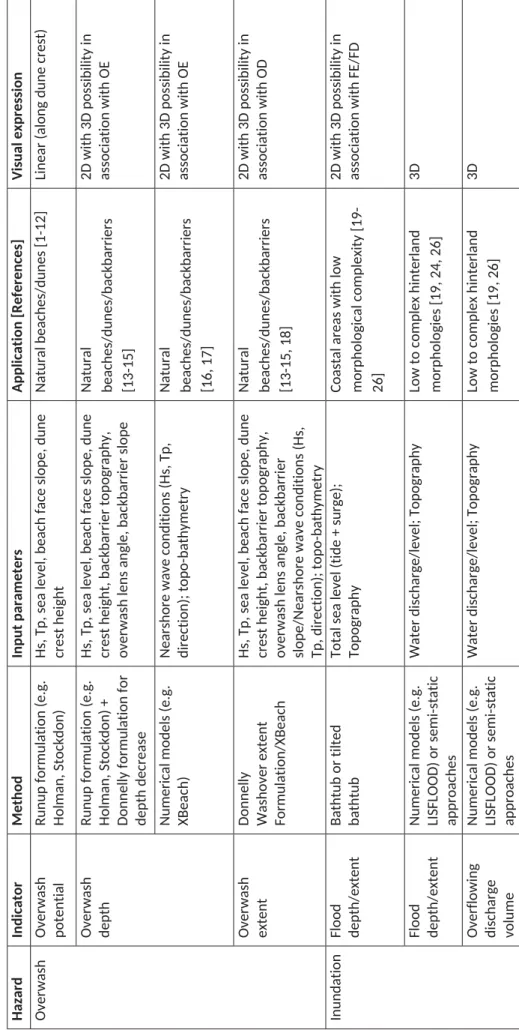
387 A synthesis of the reviewed and proposed indicators for three main analysed hazards
388 (overwash, inundation and erosion), on sandy shores, can be found in Table I. The
389 proposed process-based indicators are all simple in concept and refer to a measurable
390 distance, permitting a cartographic expression of the hazard (see figures 2 to 4).
391 Several indicators report a vertical difference to the initial topographic surface
1005 1006 1007 1008 1009 1010 1011 1012 1013 1014 1015 1016 1017 1018 1019 1020 1021 1022 1023 1024 1025 1026 1027 1028 1029 1030 1031 1032 1033 1034 1035 1036 1037 1038 1039 1040 1041 1042 1043 1044 1045 1046 1047 1048 1049 1050 1051 1052 1053 1054 1055 1056 1057 1058 1059 1060
392 (overwash depth, overwash potential, flood depth, vertical erosion) representative of
393 an interaction between driving processes (e.g. water level, runup) and such surface (as
394 is the case for overwash depth, overwash potential and flood depth) or the result of
395 the morphodynamic process measured as a difference between pre and post-event
396 surfaces (vertical erosion). Others (overwash extent, flood extent, shoreline/berm
397 retreat, and dune foot retreat) register the cross-shore extent of the hazard. The
398 alongshore integration of both (vertical and horizontal indicators) allows, in most
399 cases, for an overall three-dimensional cartography of the hazard, including the
400 potentially affected areas and the vertical level of action. That is, for instance, the case
401 of the joint use of the overwash/flood depth and the associated extent. The vertical
402 erosion indicator, since it is immediately associated with an inland position, allows a
403 direct three-dimensional representation of the hazard when expressed alongshore.
404 The here-reviewed and proposed indicators can be applied on natural sandy (or
405 gravely) beaches with or without dune systems or backbarriers. Although the
406 indicators are not necessarily limited in their use, some of the proposed approaches
407 are, and they can only be applied to coastal areas with low morphological complexity.
408 This includes the case of the determination of the flood depth/extent by using a
409 bathtub (or tilted bathtub) approach. Most of the existing formulations and models are
410 also not completely adapted to heavily developed hinterlands (e.g. dominated by
411 impermeable surfaces) and will require some adaptation. Previous knowledge of the
412 dominant processes during storms will also help to correctly select the methods and
413 indicators to use in the most cost-effective way.
1065 1066 1067 1068 1069 1070 1071 1072 1073 1074 1075 1076 1077 1078 1079 1080 1081 1082 1083 1084 1085 1086 1087 1088 1089 1090 1091 1092 1093 1094 1095 1096 1097 1098 1099 1100 1101 1102 1103 1104 1105 1106 1107 1108 1109 1110 1111 1112 1113 1114 1115 1116 1117 1118 1119 1120
414 A direct comparison on the applicability of selected (based on the works of Carapuço
415 et al., 2016 and Nguyen et al., 2016) geo- and driver- based indicators against the
416 proposed process-based indicators is expressed at Table II. Most geo- and driver-based
417 indicators are easier to obtain since they can be directly extracted from existing
418 cartography or field measurements (geoindicators) and from instrumental
419 measurements or hindcast predictions (driver-based indicators) often available on-line.
420 They are commonly converted into several simple semi-quantitative values (e.g. from 1
421 to 5) that are added (quantified) alongshore to permit a representation of the hazard,
422 making them simple to use even for non-experts. They are therefore still used as a
423 simple methodology to classify the coast according to its vulnerability (e.g. Jiménez et
424 al., 2016). They do not, however, account for the acting processes and can therefore
425 affect the final results as observed by Judge et al. (2003) when considering the crest
426 height as a predictor of dune vulnerability. Process-based indicators require both geo-
427 and driver-based information and the additional use of formulations/models, to obtain
428 a final value. If using return periods, a statistical analysis (for either the event or
429 response approach) is also required. This implies, from the users, a higher expertise on
430 coastal dynamics, including the perception of the physical processes acting in coastal
431 areas and responsible for hazards. This reduces the applicability of process-based
432 indicators to users with sufficient background on coastal dynamics. Process-based
433 indicators have, however, several advantages that will, most probably, increase their
434 future use. Most indicators have the possibility of including both detailed longshore
435 variability and cross-shore expression of the hazard, while driver-based indicators have
436 a reduced representativeness of the longshore variability, mainly if wave propagation
437 models are not used. Most used geo and driver-based indicators are also not able to
1123 1124 1125 1126 1127 1128 1129 1130 1131 1132 1133 1134 1135 1136 1137 1138 1139 1140 1141 1142 1143 1144 1145 1146 1147 1148 1149 1150 1151 1152 1153 1154 1155 1156 1157 1158 1159 1160 1161 1162 1163 1164 1165 1166 1167 1168 1169 1170 1171 1172 1173 1174 1175 1176 1177 1178
438 include the cross-shore expression of the hazard (with the exception of the erosion
439 rate).
440 Geo- and driver-based indicators when used alone are often site-specific and hardly
441 comparable between coastal areas. Process-based indicators present an outcome that
442 can be easily compared among sites. For instance, the vertical expression of a hazard
443 (e.g. flood depth or overwash depth) can be compared between coastal regions with
444 similar settings and a higher value of the indicator will represent a potentially higher
445 hazard. That is not the case for driver-based indicators, for instance. A higher wave
446 height or water level cannot be compared between coastal areas since the hazard will
447 depend on the relationship with the coastal elevation. A lower value of a driver-based
448 indicator can be responsible for a higher hazard if the coastal elevation is low, and the
449 opposite is also valid. This prevents the compared use of geo- and driver-based
450 indicators to assess the hazard for distinct coastal areas. The extensive use of
process-451 based indicators, for different coastal regions will allow, in the future, the
452 development of hazard levels/scales that can be internationally adopted. Since
453 process-based indicators can be associated with a given probability of occurrence and
454 can be directly compared between coastal regions, they can also be used to rank the
455 hazard intensity for vast coastal areas, for equal return periods. It must however be
456 stressed that, for the moment, no universal application of indicators exists and that
457 there are no internationally widely accepted intervals to classify each indicator
458 according to the potential hazard. This is still work to be performed, to be based on the
459 lessons learned from the application of process-based indicators at a large-scale.
1183 1184 1185 1186 1187 1188 1189 1190 1191 1192 1193 1194 1195 1196 1197 1198 1199 1200 1201 1202 1203 1204 1205 1206 1207 1208 1209 1210 1211 1212 1213 1214 1215 1216 1217 1218 1219 1220 1221 1222 1223 1224 1225 1226 1227 1228 1229 1230 1231 1232 1233 1234 1235 1236 1237 1238
460 The here proposed process-based indicators do not integrate feedback mechanisms
461 resulting from the interaction between morphology and forcing agents (e.g. waves,
462 currents). That is also the case for geoindicators and for indicators solely based on
463 driving mechanisms. The hazard and consequent risk can change as a result of
464 feedback mechanisms. For instance, the lowering of a dune by overwash will increase
465 the overwash potential and the overwash depth, leading to an increase in the hazard
466 when compared with the initial (and considered) situation/morphology. The feedback
467 mechanism can occur differently alongshore, as a function of the nearshore, shoreface
468 and dune morphologies. In cases where feedback mechanisms may be highly relevant,
469 these (and other indexes) may not fully reflect the impacts associated with a given
470 event. In those cases only process-based models with high resolution
topo-471 bathymetric grids, after validation and calibration, may be helpful to better understand
472 the hazard in coastal areas. It must be also kept in mind that the indicators must
473 remain simple in concept and application to ensure their use by most coastal
474 managers. Highly complex indicators requiring extreme computational effort and a
475 high degree of specialization will probably fail to be widely applied by most coastal
476 end-users, including managers.
477
478 5. Conclusions, limitations and future improvements
479 The current use of process-based indicators is still on its infancy, being necessary to
480 establish a set of the most relevant indicators that can better express potential hazards
481 at sandy (and gravelly) shores:
482 • Overwash: overwash depth, potential and extent;
1241 1242 1243 1244 1245 1246 1247 1248 1249 1250 1251 1252 1253 1254 1255 1256 1257 1258 1259 1260 1261 1262 1263 1264 1265 1266 1267 1268 1269 1270 1271 1272 1273 1274 1275 1276 1277 1278 1279 1280 1281 1282 1283 1284 1285 1286 1287 1288 1289 1290 1291 1292 1293 1294 1295 1296
483 • Inundation: flood depth and extent;
484 • Erosion: shoreline/berm and dune foot retreat, and vertical erosion.
485 The future use of process-based indicators to quantify coastal hazards is
486 recommended, mainly when compared to the most classical and commonly used geo-
487 and driver-based indicators, since they allow:
488 a) better quantification of the hazard by representing the interaction between
489 forcing mechanisms and morphology;
490 b) better expression of the alongshore and cross-shore (extent) variability of the
491 hazard, including its three-dimensional representation (longshore, cross-shore
492 and vertical); and
493 c) comparison between coastal areas.
494 The development of the process-based indicators’ potential will rely on their
495 generalised use in the future. Only an increase in their use will allow the definition of
496 common hazard levels for distinct coastal regions and a large-scale application to vast
497 areas (e.g. at pan-European level). A few limitations still exist that prevent the wider
498 use of these indicators. These include:
499 i) limited available quality data for several regions, regarding either
500 morphologic and hydrodynamic parameters, which is particularly relevant
501 when long-term time-series (e.g. wave characteristics) are needed to better
502 define return periods;
503 ii) restricted current use of formulations and models by end-users and namely
504 coastal managers; 1301 1302 1303 1304 1305 1306 1307 1308 1309 1310 1311 1312 1313 1314 1315 1316 1317 1318 1319 1320 1321 1322 1323 1324 1325 1326 1327 1328 1329 1330 1331 1332 1333 1334 1335 1336 1337 1338 1339 1340 1341 1342 1343 1344 1345 1346 1347 1348 1349 1350 1351 1352 1353 1354 1355 1356
505 iii) reduced possibility of integrating feedback mechanisms, with the exception
506 of the most complex process-based models.
507 The first limitation will be solved (with time) by the ongoing and increasing
508 improvement on data access (and quality) worldwide, including on-line access to
509 coastal morphology and wave/water level series. To obviate the second limitation an
510 improvement will be needed on the transfer of knowledge from the coastal scientific
511 community towards coastal end-users. The third limitation will be solved by integrating
512 process-based models into user-friendly frameworks for generalised use. The
513 improved and generalised use of process-based indicators will provide coastal
514 managers with a highly relevant tool to evaluate coastal hazards and risks and,
515 therefore, to better establish and implement disaster risk reduction in the future, in
516 the most cost-effective way.
517
518 Acknowledgments
519 This work was supported by the European Community's 7th Framework Programme
520 through the grant to RISC-KIT (“Resilience-increasing Strategies for Coasts – Toolkit”),
521 contract no. 603458, and by contributions by the partner institutes. Susana Costas
522 research is funded through the “FCT Investigator” program (ref. IF/01047/2014). This
523 work was also supported by the Portuguese Science Foundation (FCT) through the
524 grant UID/MAR/00350/2013 attributed to CIMA/University of Algarve
525 526 References 1359 1360 1361 1362 1363 1364 1365 1366 1367 1368 1369 1370 1371 1372 1373 1374 1375 1376 1377 1378 1379 1380 1381 1382 1383 1384 1385 1386 1387 1388 1389 1390 1391 1392 1393 1394 1395 1396 1397 1398 1399 1400 1401 1402 1403 1404 1405 1406 1407 1408 1409 1410 1411 1412 1413 1414
527 Almeida, L.P., Ferreira, O., Taborda, R., 2011. Geoprocessing tool to model beach
528 erosion due to storms: application to Faro beach (Portugal). Journal of Coastal
529 Research, SI 64, 1830-1834.
530 Almeida L. P., Vousdoukas M. V., Ferreira O., Rodrigues, B.A., Matias, A., 2012.
531 Thresholds for storm impacts on an exposed sandy coastal area in southern Portugal,
532 Geomorphology, 143, 3-12. DOI: 10.1016/j.geomorph.2011.04.047
533 Armaroli, C., Ciavola, P., Perini, L., Calabrese, L., Lorito, S., Valentini, A., Masina, M.,
534 2012. Critical storm thresholds for significant morphological changes and damage
535 along the Emilia-Romagna coastline, Italy. Geomorphology, 143, 34-51.
536 DOI: 10.1016/j.geomorph.2011.09.006
537 Battjes, J.A., 1974. Surf similarity. Coastal Engineering’74, 446-480.
538 Bennington, B. and Farmer, E.C., 2015. Learning from the impacts of Superstorm Sandy.
539 Ed. J. Bret Bennington and E.Christa Farmer. Academic Press. Elsevier, 123 p.
540 Bertin, X., Bruneau, N., Breilh, J.F., Fortunato, A.B., Karpytchev, M., 2012. Importance
541 of wave age and resonance in storm surges: The case Xynthia, Bay of Biscay. Ocean
542 Modelling, 42, 16-30. DOI: 10.1016/j.ocemod.2011.11.001
543 Bosom, E. and Jiménez, J.A., 2011. Probabilistic coastal vulnerability assessment to
544 storms at regional scale - application to Catalan beaches (NW Mediterranean). Natural
545 Hazards and Earth System Sciences, 11, 475-484. DOI: 10.5194/nhess-11-475-2011
546 Breilh, J.F., Chaumillon, E., Bertin, X., Gravelle, M., 2013. Assessment of static flood
547 modeling techniques: application to contrasting marshes flooded during Xynthia
1419 1420 1421 1422 1423 1424 1425 1426 1427 1428 1429 1430 1431 1432 1433 1434 1435 1436 1437 1438 1439 1440 1441 1442 1443 1444 1445 1446 1447 1448 1449 1450 1451 1452 1453 1454 1455 1456 1457 1458 1459 1460 1461 1462 1463 1464 1465 1466 1467 1468 1469 1470 1471 1472 1473 1474
548 (western France). Natural Hazards Earth Systems Science, 13, 1595-1612.
549 DOI:10.5194/nhess-13-1595-2013
550 Bush, D.M., Neal, W.J., Young, R.S., Pilkey, O.H., 1999. Utilization of geoindicators for
551 rapid assessment of coastal-hazard risk and mitigation. Ocean and Coastal
552 Management, 42, 647-670. DOI: 10.1016/S0964-5691(99)00027-7
553 Callaghan , D.P., Nielsen, P., Short, A., Ranasinghe, R., 2008. Statistical simulation of
554 wave climate and extreme beach erosion. Coastal Engineering, 55(5), 375-390.
555 DOI:10.1016/j.coastaleng.2007.12.003
556 Carapuço, M.M., Taborda, R., Silveira, T.M., Psuty, N.P., Andrade, C., Freitas, M.C.,
557 2016. Coastal geoindicators: Towards the establishment of a common framework for
558 sandy coastal environments. Earth-Science Reviews, 154, 183-190. DOI:
559 10.1016/j.earscirev.2016.01.002
560 Castelle, B., Marieu, V., Bujan, S., Splinter, K.D., Robinet, A., Senechal, N., Ferreira, S.,
561 2015. Impact of the winter 2013-2014 series of severe Western Europe storms on a
562 double-barred sandy coast: Beach and dune erosion and megacusp embayments.
563 Geomorphology, 238, 135-148. DOI: 10.1016/j.geomorph.2015.03.006
564 Christie, E.K., Spencer, T., Owen, D., McIvor, A.L., Möller, I., Viavattene, C., 2017.
565 Regional coastal flood risk assessment for a tidally dominant, natural coastal setting:
566 North Norfolk, southern North Sea. Coastal Engineering, in press. DOI:
567 10.1016/j.coastaleng.2017.05.003 1477 1478 1479 1480 1481 1482 1483 1484 1485 1486 1487 1488 1489 1490 1491 1492 1493 1494 1495 1496 1497 1498 1499 1500 1501 1502 1503 1504 1505 1506 1507 1508 1509 1510 1511 1512 1513 1514 1515 1516 1517 1518 1519 1520 1521 1522 1523 1524 1525 1526 1527 1528 1529 1530 1531 1532
568 Ciavola, P., Ferreira, O., van Dongeren, A., de Vries, J., Armaroli, C., Harley, M., 2015.
569 Prediction of storms impacts on beach and dune systems. In: Hydrometeorological
570 Hazards: Interfacing Science and Policy. Ed: Philippe Quevauviller, John Wiley & Sons.
571 Clay, P.M., Colburn, L.L., Seara, T., 2016. Social bonds and recovery: An analysis of
572 Hurricane Sandy in the first year after landfall. Marine Policy, 74, 334-340. DOI:
573 10.1016/j.marpol.2016.04.049
574 Davidson, M.A., Aarninkhof, S., van Koningsveld, M., Holman, R.A., 2006. Developing
575 coastal video monitoring systems in support of coastal zone management. Journal of
576 Coastal Research, SI 39, 49-56.
577 Davidson, M.A., van Koningsveld, M., de Kruif, A., Rawson, J., Holman, R., Lamberti, A.,
578 Medina, R., Kroon, A., Aarninkhof, S., 2007. The CoastView project: Developing
video-579 derived Coastal State Indicators in support of coastal zone management. Coastal
580 Engineering, 54, 463-475. DOI: 10.1016/j.coastaleng.2007.01.007
581 Davidson, M.A., Splinter, K.D., Turner, I.L., 2013. A simple equilibrium model for
582 predicting shoreline change. Coastal Engineering, 73, 191-202. DOI:
583 10.1016/j.coastaleng.2012.11.002
584 De Roo, A.P.J., Wesseling, C.G., van Deursen, W.P.A., 2000. Physically base driver basin
585 modelling within a GIS: the LISFLOOD model. Hydrological Processes, 14, 1981-1992.
586 DOI: 10.1002/1099-1085(20000815/30)14:11/12<1981::AID-HYP49>3.0.CO;2-F
587 Del Río, L., Plomaritis, T.A., Benavente, J., Valladares, M., Ribera, P., 2012. Thresholds
588 for storm impacts along European coastlines. Geomorphology, 143–144, 13–23.
589 DOI:10.1016/j.geomorph.2011.04.048 1537 1538 1539 1540 1541 1542 1543 1544 1545 1546 1547 1548 1549 1550 1551 1552 1553 1554 1555 1556 1557 1558 1559 1560 1561 1562 1563 1564 1565 1566 1567 1568 1569 1570 1571 1572 1573 1574 1575 1576 1577 1578 1579 1580 1581 1582 1583 1584 1585 1586 1587 1588 1589 1590 1591 1592
590 Divory, D. and McDougal, W.G., 2006. Response-based coastal flood analysis.
591 Proceedings of the 30th International Conference on Coastal Engineering, 5291-5301,
592 ASCE.
593 Donnelly, C., 2008. Coastal Overwash: Processes and Modelling. PhD Thesis. Lund
594 University, Sweden, 53 pp.
595 Dottori, F., Martina, M.L.V., Figueiredo, R., 2016. A methodology for flood
596 susceptibility and vulnerability analysis in complex flood scenarios. Journal of Flood
597 Risk Management, DOI: 10.1111/jfr3.12234
598 Durán, R., Guillén, J., Ruiz, A., Jiménez, J.A., Sagristà, E., 2016. Morphological changes,
599 beach inundation and overwash caused by an extreme storm on a low-lying embayed
600 beach bounded by a dune system (NW Mediterranean). Geomorphology, 274, 129-142.
601 DOI: 10.1016/j.geomorph.2016.09.012
602 Ferreira, O., Viavattene, C., Jiménez, J., Bole, A., Plomaritis, T., Costas, S., Smets, S.,
603 2016. CRAF Phase 1, a framework to identify coastal hotspots to storm impacts. E3S
604 Web Conf. 7, 11008 (FLOODrisk 2016: 3rd European Conference on Flood Risk
605 Management).
606 Fortunato, A.B., Li, K., Bertin, X., Rodrigues, M., Miguez, B.M., 2016. Determination of
607 extreme sea levels along the Iberian Atlantic coast. Ocean Engineering, 111, 471-482.
608 DOI:10.1016/j.oceaneng.2015.11.031
609 Garcia, T., Ferreira, O., Matias, A., Dias, J.A., 2010. Overwash vulnerability assessment
610 based on long-term washover evolution. Natural Hazards, 54, 225-244. DOI:
611 10.1007/s11069-009-9463-3 1595 1596 1597 1598 1599 1600 1601 1602 1603 1604 1605 1606 1607 1608 1609 1610 1611 1612 1613 1614 1615 1616 1617 1618 1619 1620 1621 1622 1623 1624 1625 1626 1627 1628 1629 1630 1631 1632 1633 1634 1635 1636 1637 1638 1639 1640 1641 1642 1643 1644 1645 1646 1647 1648 1649 1650
612 Gouldy, B. and Samuels., P, 2005. Language of Risk – Project Definitions. Report:
T32-613 04-01.Floodsite Project. Available at www.floodsite.net
614 Guza, R.T and Inman, D.I., 1975. Edge waves and beach cusps. Journal of Geophysical
615 Research, 80, 1328-1342. DOI: 10.1029/JC080i021p02997
616 Haerens, P., Bolle, A., Trouw, K., Houthuys, R., 2012. Definition of storm thresholds for
617 significant morphological change of the sandy beaches along the Belgian coastline.
618 Geomorphology, 143-144, 104-117. DOI:10.1016/j.geomorph.2011.09.015
619 Hanslow, D.J., 2007. Beach erosion trend measurement: A comparison of trend
620 indicators. Journal of Coastal Research, SI 50, 588-593.
621 Hinkel, J., Lincke, D., Vafeidis, A.T., Perrette, M., Nicholls, R.J., Tol, R.S.J., Marzeion, B.,
622 Fettweis, X., Ionescu, C., Levermann, A., 2014. Coastal flood damage and adaptation
623 costs under 21st century sea-level rise, Proceedings of the National Academy of
624 Sciences of the United States of America, 111, 3292–3297. doi:
625 10.1073/pnas.1222469111
626 Holman, R.A., 1986. Extreme value statistics for wave run-up on a natural beach.
627 Coastal Engineering, 9, 527–544.DOI: 10.1016/0378-3839(86)90002-5
628 Jiménez, A.C., Ávila, J.I.E, Lacouture, M.M.V., Casarín, R., 2016. Classification of beach
629 erosion vulnerability on the Yucatan Coast. Coastal Management, 44, 333-349. DOI:
630 10.1080/08920753.2016.1155038
631 Judge, E.K., Overton, M.F., Fisher, J.S., 2003. Vulnerability indicators for coastal dunes.
632 Journal of Waterway, Port, Coastal and Ocean Engineering, 129, 270-278. DOI:
633 10.1061/(ASCE)0733-950X(2003)129:6(270) 1655 1656 1657 1658 1659 1660 1661 1662 1663 1664 1665 1666 1667 1668 1669 1670 1671 1672 1673 1674 1675 1676 1677 1678 1679 1680 1681 1682 1683 1684 1685 1686 1687 1688 1689 1690 1691 1692 1693 1694 1695 1696 1697 1698 1699 1700 1701 1702 1703 1704 1705 1706 1707 1708 1709 1710
634 Kantha, L., 2013. Classification of hurricanes: Lessons from Katrina, Ike, Irene, Isaac and
635 Sandy. Ocean Engineering, 70, 124-128. DOI: 10.1016/j.oceaneng.2013.06.007
636 Kindsvater, C. and Carter, R., 1957. Discharge characteristics of rectangular thin-plate
637 weirs, Journal of the Hydraulics Division, ASCE, 83, 1453/1-1453/36.
638 Kriebel, D. and Dean, R.G., 1993. Convolution model for time-dependent beach-profile
639 response. Journal of Waterway, Port, Coastal and Ocean Engineering, 119, 204-226.
640 DOI: 10.1061/(ASCE)0733-950X(1993)119:2(204)
641 Larson, M., Erikson, L., Hanson, H., 2004. An analytical model to predict dune erosion
642 due to wave impact. Coastal Engineering, 51, 675–696. DOI:
643 10.1016/j.coastaleng.2004.07.003
644 Link, L.E., 2010. The anatomy of a disaster, an overview of Hurricane Katrina and New
645 Orleans. Ocean Engineering, 37, 4-12. DOI: 10-1016/j.oceaneng.2009.09.002
646 Long, J.W., de Bakker, A.T.M., Plant, N.G., 2014. Scaling coastal dune elevation changes
647 across storm-impact regimes. Geophysical Research Letters, 41.
648 DOI:10.1002/2014GL059616
649 Masselink, G. and Hegge, B., 1995. Morphodynamics of meso and macrotidal beaches:
650 examples from central Queensland, Australia. Marine Geology, 129, 1-23. DOI:
651 10.1016/0025-3227(95)00104-2
652 Masselink, G., Scott, T., Poate, T., Russell, P., Davidson, M., Conley, D., 2016a. The
653 extreme 2013/2014 winter storms: hydrodynamic forcing and coastal response along
654 the southwest coast of England. Earth Surface Processes and Landforms, 41, 378–391.
655 DOI: 10.1002/esp.3836 1713 1714 1715 1716 1717 1718 1719 1720 1721 1722 1723 1724 1725 1726 1727 1728 1729 1730 1731 1732 1733 1734 1735 1736 1737 1738 1739 1740 1741 1742 1743 1744 1745 1746 1747 1748 1749 1750 1751 1752 1753 1754 1755 1756 1757 1758 1759 1760 1761 1762 1763 1764 1765 1766 1767 1768
656 Masselink, G., Castelle, B., Scott, T., Dodet, G., Suanez, S., Jackson, D., Floc'h, F., 2016b.
657 Extreme wave activity during 2013/2014 winter and morphological impacts along the
658 Atlantic coast of Europe. Geophysical Research Letters, 43, 2135-2143. DOI:
659 10.1002/2015GL067492
660 Matias, A., Masselink, G., Turner, I., Williams, J.J., Ferreira, Ó., 2011. Detailed analysis
661 of overwash on gravel barriers. Journal of Coastal Research, SI 64, 10-14.
662 Matias, A., Williams, J., Masselink, G., Ferreira, O., 2012. Overwash threshold for gravel
663 barriers. Coastal Engineering, 63, 48-61. DOI: 10.1016/j.coastaleng.2011.12.006
664 Matias, A., Blenkinsopp, C.E., Masselink, G., 2014. Detailed investigation of overwash
665 on a gravel barrier. Marine Geology. 350, 27-38. DOI: 10.1016/j.margeo.2014.01.009
666 Matias, A., Masselink, G., Castelle, B., Blenkinsopp, C.E., Kroon, A., 2016.
667 Measurements of morphodynamic and hydrodynamic overwash processes in a
large-668 scale wave flume. Coastal Engineering, 113, 33-46. DOI:
669 10.1016/j.coastaleng.2015.08.005
670 Matias, A.. and Masselink, G., 2017. Overwash processes: lessons from fieldwork and
671 laboratory experiments. In: Coastal Storms: Processes and Impacts. Ed: Paolo Ciavola
672 and Giovanni Coco. John Wiley & Sons.
673 Mendoza, E.T. and Jiménez, J.A., 2006. Storm-induced beach erosion potential on the
674 Catalonian coast. Journal of Coastal Research, SI 48, 81-88.
675 Neumann, B., Vafeidis, A.T., Zimmermann, J., Nicholls, R.J., 2015. Future Coastal
676 Population Growth and Exposure to Sea-Level Rise and Coastal Flooding - A Global
677 Assessment. PLoS ONE, 10, e0118571.
1773 1774 1775 1776 1777 1778 1779 1780 1781 1782 1783 1784 1785 1786 1787 1788 1789 1790 1791 1792 1793 1794 1795 1796 1797 1798 1799 1800 1801 1802 1803 1804 1805 1806 1807 1808 1809 1810 1811 1812 1813 1814 1815 1816 1817 1818 1819 1820 1821 1822 1823 1824 1825 1826 1827 1828
678 Nguyen, T.T.X., Bonetti, J., Rogers, K., Woodroffe, C.D., 2016. Indicator-based
679 assessment of climate-change impacts on coasts: A review of concepts, methodological
680 approaches and vulnerability indices. Ocean and Coastal Management, 123, 18-43.
681 DOI: 10.1016/j.ocecoaman.2015.11.022
682 Perini, L., Calabrese, L., Salerno, G., Ciavola, P., Armaroli, C., 2016. Evaluation of coastal
683 vulnerability to flooding: comparison of two different methodologies adopted by the
684 Emilia-Romagna region (Italy). Natural Hazards and Earth Systems Science, 16,
181-685 194. DOI: 10.5194/nhess-16-181-2016
686 Poelhekke, L., Jäger, W.S, van Dongeren, A., Plomaritis, T.A., McCall, R., Ferreira, O.,
687 2016. Predicting coastal hazards for sandy coasts with a Bayesian Network. Coastal
688 Engineering, 118, 21-34. DOI: 10.1016/j.coastaleng.2016.08.011
689 Poulter, B. and Halpin, P. N., 2008. Raster modelling of coastal flooding from sea-level
690 rise. International Journal of Geographical Information Science, 22, 167-182.
691 DOI: 10.1080/13658810701371858
692 Ramirez, J.A., Lichter, M., Coulthard, T.J., Skinner, C., 2016. Hyperresolution mapping
693 of regional storm surge and tide flooding: comparison of static and dynamic models,
694 Natural Hazards, 82, 571–590. DOI: 10.1007/s11069-016-2198-z
695 Rodrigues, B. A., Matias, A., Ferreira, O., 2012. Overwash hazard assessment.
696 Geologica Acta, 10, 427-437. DOI: 10.1344/105.000001743
697 Roelvink, D., Reniers, A., van Dongeren, A.P., de Vries, J.V.T., McCall, R., Lescinski, J.,
698 2009. Modelling storm impacts on beaches, dunes and barrier islands. Coastal
699 Engineering, 56, 1133-1152. DOI: 10.1016/j.coastaleng.2009.08.006 1831 1832 1833 1834 1835 1836 1837 1838 1839 1840 1841 1842 1843 1844 1845 1846 1847 1848 1849 1850 1851 1852 1853 1854 1855 1856 1857 1858 1859 1860 1861 1862 1863 1864 1865 1866 1867 1868 1869 1870 1871 1872 1873 1874 1875 1876 1877 1878 1879 1880 1881 1882 1883 1884 1885 1886
700 Sallenger, A.H., 2000. Storm impact scale for barrier islands. Journal of Coastal
701 Research, 16, 890-895.
702 Sánchez-Arcilla, A., Jiménez, J.A., Peña, C., 2009. Wave-induced morphodynamic risks.
703 Characterization of extremes. Coastal Dynamics 2009, World Scientific (CD), paper 127.
704 Sekovski, I., Armaroli, C., Calabrese, L., Mancini, F., Stecchi, F., Perini, L., 2015. Coupling
705 scenarios of urban growth and flood hazards along the Emilia-Romagna coast (Italy).
706 Natural Hazards and Earth System Sciences, 15, 2331-2346, DOI:
10.5194/nhess-15-707 2331-2015
708 Silveira, T.M., Taborda, R., Carapuço, M.M., Andrade, C., Freitas, M.C., Duarte, J.F.,
709 Psuty, N.P., 2016. Assessing the extreme overwash regime along an embayed urban
710 beach. Geomorphology, 274, 64-77. DOI: 10.1016/j.geomorph.2016.09.007
711 Smallegan, S.M., Irish, J.L., van Dongeren, A.R., den Bieman, J.P., 2016. Morphological
712 response of a sandy barrier island with a buried seawall during Hurricane Sandy. 713 Coastal Engineering, 110, 102-110. DOI: 10.1016/j.coastaleng.2016.01.005
714 Stockdon, H.F., Holman, R.A., Howd, P.A., and Sallenger, A.H., 2006. Empirical
715 parameterization of setup, swash and run-up. Coastal Engineering, 53, 573-588.
716 DOI: 10.1016/j.coastaleng.2005.12.005
717 Stockdon, H.F., Sallenger Jr, A.H., Holman, R.A., Howd, P.A., 2007. A simple model for
718 the spatially-variable coastal response to hurricanes. Marine Geology, 238, 1-20.
719 DOI:10.1016/j.margeo.2006.11.004 1891 1892 1893 1894 1895 1896 1897 1898 1899 1900 1901 1902 1903 1904 1905 1906 1907 1908 1909 1910 1911 1912 1913 1914 1915 1916 1917 1918 1919 1920 1921 1922 1923 1924 1925 1926 1927 1928 1929 1930 1931 1932 1933 1934 1935 1936 1937 1938 1939 1940 1941 1942 1943 1944 1945 1946
720 Trifonova, E.V., Valchev, N.N., Andreeva, N.K., Eftimova, P.T., 2012. Critical storm
721 thresholds for morphological changes in the western Black Sea coastal zone.
722 Geomorphology, 143–144, 81–94. DOI:10.1016/j.geomorph.2011.07.036
723 Valchev, N., Andreeva, N., Eftimova, P., Prodanov, B., Kotsev, I., 2016. Assessment of
724 vulnerability to storm induced flood hazard along diverse coastline settings. E3S Web
725 Conference 7, 10002. FLOODrisk 2016 - 3rd European Conference on Flood Risk
726 Management.
727 van Koningsveld, M., Davidson, M.A., Huntley, D.A., 2005. Matching science with
728 coastal management needs: The search for appropriate coastal state indicators.
729 Journal of Coastal Research, 21, 399-411. DOI: 10.2112/03-0076.1
730 van Verseveld, H.C.W., van Dongeren, A.R., Plant, N.G., Jäger, W.S., den Heijer, C.,
731 2015. Modelling multi-hazard hurricane damages on an urbanized coast with a
732 Bayesian Network approach. Coastal Engineering, 103, 1-14. DOI:
733 10.1016/j.coastaleng.2015.05.006
734 Vousdoukas, M.I., Voukouvalas, E., Mentaschi, L., Dottori F., Giardino, A., Bouziotas, D.,
735 Bianchi, A., Salamon, P., Feyen, L., 2016. Developments in large-scale coastal flood
736 hazard mapping. Natural Hazards Earth System Science, 16, 1841-1853. DOI:
737 10.5194/nhess-2016-124.
738 Williams, J.J., Masselink, G., Buscombe, D., Turner, I., Matias, A., Ferreira, Ó., Metje, N.,
739 Coates, L., Chapman, D., Bradbury, A., Albers, A., Pan, S., 2009. BARDEX (Barrier
740 Dynamics Experiment): taking the beach into the laboratory. Journal of Coastal
741 Research, SI 56: 158-162. 1949 1950 1951 1952 1953 1954 1955 1956 1957 1958 1959 1960 1961 1962 1963 1964 1965 1966 1967 1968 1969 1970 1971 1972 1973 1974 1975 1976 1977 1978 1979 1980 1981 1982 1983 1984 1985 1986 1987 1988 1989 1990 1991 1992 1993 1994 1995 1996 1997 1998 1999 2000 2001 2002 2003 2004