Religious Minorities as an Opportunity for
Ghetto Niche Tourism Development (Case
Study: Isfahan, Iran)
NEDA FARSANI * [[email protected]]
Abstract |Niche tourism, whose emphasis on a specific tourism product can meet the needs of a par-ticular audience, has developed in the tourism area over recent decades. The dynamic and competitive nature of tourism means that staying alive in a competitive world needs the emergence of niche tourism. This paper tries to introduce Isfahan city (Iran) as a new destination for ghetto niche tourism develop-ment with an emphasis on religious minorities. Moreover, this research has two major purposes: 1) to investigate the attitude of domestic tourists for ghetto tourism development and 2) to measure national tourists’ awareness of this niche market. This study was conducted in Isfahan, Iran. Data was gathered through questionnaire using simple random sampling method. On the basis of the results of this study it can be concluded that domestic tourists are not familiar with the ghetto tourism concept; however, they are interested in ghetto tourism development (activities, attractions and strategies) in Isfahan city.
Keywords| Ghetto tourism, Isfahan, niche tourism, religious minorities
1. Introduction
According to Buhalis and Costa (2006) tou-rism is dynamic and competitive market and due to globalization and customer demand, new tourism products will emerge in the future. In addition, survival in a competitive tourism market needs the emergence of niche tourism. Robinson and Novelli (2005) noted that niche tourism is in opposition
to mass tourism and represents diversity and ways of marking difference. Moreover, niche tourism at-tracts tourists who spends more in the destinations (Weiler & Hall, 1992) and appears to offer tourists a more meaningful set of experiences in the kno-wledge that their needs and wants are being met. Therefore, it can be said that niche tourism is an opportunity to provide higher quality services to tourists who have a special interest. Niche tourism
*PhD in Tourism from the University of Aveiro (Portugal). Assistant Professor at Department of Museum and Tourism, Art University of Isfahan, Isfahan, Iran
2246
|
RT&D | n.o27/28 | 2017 | FARSANIdistinguishes between tourists and offers activities and facilities according to the study of their beha-viour, needs and motivation for travel. For niche tourism development, audience and place are two key components (Robinson & Novelli, 2005).
The primary purpose of this study is to intro-duce Isfahan city, Iran, as a place which it is argued has a high potential for ghetto niche tourism de-velopment. Furthermore, this paper aims to inves-tigate the attitude of audience/domestic tourists for ghetto tourism development (activities, attrac-tions and strategies) in Isfahan.
2. Theoretical framework
According to the Travel Industry Dictionary (2016), ghetto tourism is a visit to rundown urban neighbourhoods but which are worth visiting to observe different culture and lifestyles (e.g. Low-income families living in poor neighbourhoods, and racial and religious minorities).
Calimani (1987) noted that the word ghetto derives from borghetto, meaning neighbourhood, and can be traced back to medieval Venice, where it referred to the area of that city to which Jews were restricted. In European history, ghetto typi-cally referred to residential and other restrictions placed on Jews. Little Italy in the United States is one the most important ghetto tourism destina-tions. New York’s Historic Little Italy is a place where a number of people emigrating from Italy to America settled in New York (Conforti, 1996).
It is noteworthy that the people who live in this region have the same culture and they established stores which sell Italian goods and products and opened Italian restaurants offering Italian cuisine. Therefore, there is a little Italy in the middle of a modern city of America. This lifestyle has bit-tersweet experiences for residents. These urban neighbourhoods show people who never lived in their ancestral lands, but have preserved their cul-tural components. These groups are recognized as the minority in a city. The Jews living in New York’s Historic Little Italy make this region no-table as a destination that shows the lifestyle of religious minorities and is also known as a ghetto of America (Conforti, 1996).
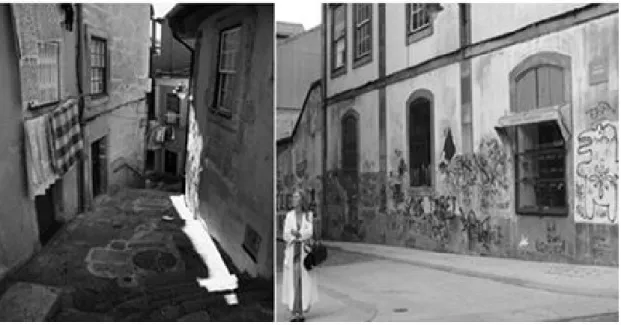
Ashworth (2002) addressed the Kazimierz dis-trict of Kraków (Poland) which was one of the largest and oldest districts of Jewish settlement as ghetto tourism destination where visitors can experience atrocity tourism and horror tourism. Warsaw (Poland) is a pioneer in Holocaust tourism and ghetto tourism development; ghetto tourism routes were identified in this city and in guide books such as the Rough Guide to Poland, the Nozyk Synagogue – ‘the only one of the ghetto’s three synagogues still standing’ was introduced as a tourist attraction (Browning, 2012; Cole, 2015). Furthermore, Nessy (2014) argued that slum tou-rism, or ghetto tourism is a type of tourism that involves visiting impoverished areas. Regarding this, the city of Porto (Portugal) organizes ghetto tours to encourage tourists to take one of the worst tours of Portugal (Figure 1).
Figure 1 |Guetto tourism destination in Porto (Portugal) Source: http://www.messynessychic.com/2014/10/09/ghetto-tourism-take-a- free-tour- of-run- down-portugal
Lastly, it can be said that slum tourism involves the creation of a brand-like attraction of informal settlements as part of a city’s image (Frenzel & Koens, 2012).
However, none of the above mentioned appro-aches takes into consideration ghetto tourism in a case study of Iran. Furthermore, up to this time, no significant work has been undertaken in the field of ghetto niche tourism to investigate the attitude of tourists for ghetto tourism development.
3. Methods
3.1. Case Study
This study was conducted in the city of Is-fahan. Isfahan is located on the main north–south and east–west routes crossing Iran, and it is Iran’s number one tourist destination for a good rea-son. Isfahan has many tourist attractions, Persian gardens, and important historic Islamic buildings which give it a visual appeal unmatched by any
other Iranian city, and the many artisans working here underpin its reputation as a living museum of traditional culture. It is noteworthy that religious minorities are another tourist attraction in Isfahan. The majority of Iranians associate themselves with the Shi’a branch of Islam and Isfahan is no exception. However, in some cities of Iran such as Isfahan, religious minorities have settled. In the city there are some special regions which are known as the settlements of three religious mi-norities and their communities – Zoroastrianism, Judaism, Christianity (Catholic and Orthodox).
Zoroastrians, as the oldest religious commu-nity of Iran, have had a long history reaching back thousands of years, and it has survived to the present day. In addition, Judaism also is among the oldest religions practised in Iran and the Bi-blical Book of Esther contains references to the experiences of the Jews in Persia. The history of immigrant Jews in Iran goes back more than 3000 years (The Achaemenid Empire (Cyrus the Great king)). Moreover, the majority of Christians in Isfahan are ethnic Armenians who immigrated to Iran during the Safavid Empire (1502 – 1736).
2248
|
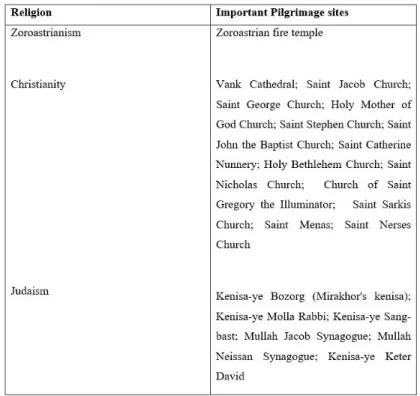
RT&D | n.o27/28 | 2017 | FARSANIIt is noteworthy that religious minorities have the same culture and especially Christians esta-blished stores in Isfahan which sell their goods and products and opened restaurants offering their cuisine and live music. Religious minorities have their regions – Julfa for Christian and Jubareh for Jews are excellent examples; their cemeteries (e.g.
Serah bat Asher Jewish cemetery in Linjan (Pir-i Bakran); Armenian Cemetery); their religious fes-tivals; celebrities and pilgrimage sites (Table 1) are all potentials for ghetto niche tourism deve-lopment in Isfahan (Figure 1).
Table 1 | Religious minorities pilgrimage sites in Isfahan, Iran (own construction)
3.2. Methodology
The main objective of this study is to introduce Isfahan city (Iran) as a new destination for ghetto niche tourism development with an emphasis on religious minorities. Regarding this, the research needs the audience studies. Thus, this study is an initial attempt to investigate the attitude of domestic tourists for ghetto tourism development. In addition, this paper strives to measure national tourists’ awareness of this niche market in Isfahan. In order to achieve these goals two hypotheses were developed:
H1: Domestic tourists are interested in ghetto tourism development (activities, at-tractions and strategies) in Isfahan city. H2: Domestic tourists are familiar with the ghetto niche tourism concept.
Data for this study was gathered through ques-tionnaires (close-ended questions). The question-naires were designed based on the ghetto tourism potentials (activities, attractions and strategies) which exist in Isfahan. The research methodology includes both primary and secondary research. The first phase consisted of a literature review of ghetto tourism. In the second phase, we focused on tou-rists and in order to study the attitude of domestic
tourists for ghetto tourism development a ques-tionnaire (on a 5-point Likert scale ranging from very low to very high) was designed and distribu-ted in the city (around attractions, hotels, airports etc.). The empirical part of this study was conduc-ted from April to July 2016. For determining sam-ple size, the researchers used Veal’s (2006) rules. Veal’s table (2006) illustrated that the sample size for infinite population (there were no official sta-tistics of the number of domestic tourists) should be 384 people. Thus a total of 400 questionnaires were distributed to domestic tourists in the city centre, historical heritage sites and hotels where more tourists can be found. After eliminating unu-sable responses from the completed questionnai-res, 385 responses were coded for data analysis. Cronbach’s alpha is 0.922, which presents a high level of reliability. Descriptive statistics were calcu-lated to ascertain the characteristics of the sample and to compare means and standard deviations for each multi-item scale.
4. Results
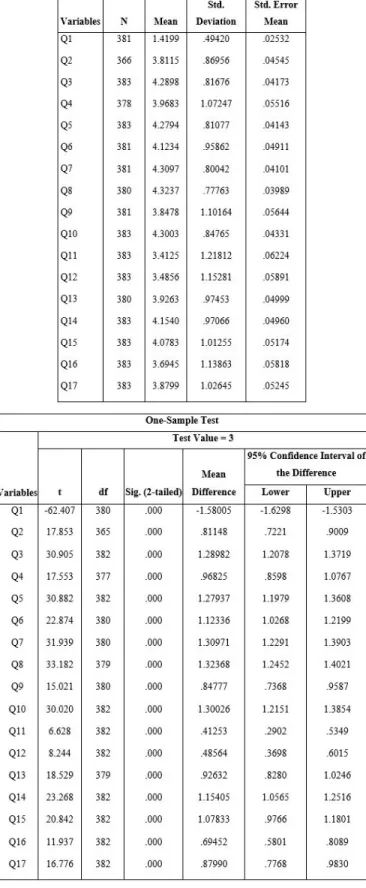
Among the survey participants, 56.6% were male, and 43.4% were female (Table 2). Most respondents were between 31 and 40 years of age (53.5%) (Table 2). Furthermore, approximately 54.9% of respondents had a Master’s degree (see Table 2). Based on the result of the descriptive analysis (on a 5-point Likert scale ranging from very low to very high) (Table 3), 60.5% of respon-dents were interested (high and very high on the scale) in being familiar with various cultures and religions; 82.8% (high and very high on the scale) of domestic tourists are interested in listening to religious music. In addition, 66.7% (high and very high on the scale) of respondents would like to visit holy places of religious minorities. Moreover, analysis of the data indicates that 83.1% (high and very high on the scale) of tourists are interested in
visiting the Synagogues of Isfahan. Furthermore, 76.4% (high and very high on the scale) of tourists would like to visit churches in the city and 85.4% (high and very high on the scale) of them are in-terested in the Zoroastrian fire temple. Besides, 89.9% (high and very high on the scale) of tourists enjoy visiting religious minorities’ cemeteries and 68.6% (high and very high on the scale) of them claim that they are interested in seeing the archi-tectural style of historical houses and holy places of religious minorities in Isfahan. Listening to holy books of religious minorities attended by 83.3% (high and very high on the scale) of tourists. In addition, 47.8% (high and very high on the scale) of respondents noted that they would like to le-arn religious minorities’ language and 49.3% (high and very high on the scale) of them are interested in learning about their history and their history of immigration to Isfahan. The results of descrip-tive analysis also illustrated that 72.2% (high and very high on the scale) of audiences paid particu-lar attention to historical houses of religious mi-norities in Isfahan. Further analysis demonstrated that 84.1% (high and very high on the scale) of tourists are interested in tasting local foods of re-ligious minorities and 71.1% (high and very high on the scale) of them like to hear folk music of religious minorities. Our results also found that 57.4% (high and very high on the scale) of per-sons who filled in the form mentioned that they wanted to be familiar with religious minorities’ ce-lebrities who are/were famous for the development of Isfahan city and 70.6% (high and very high on the scale) of them are interested in participating in religious minorities’ festivals in Isfahan. Lastly, the clearest result of the investigation (One Sam-ple t-test; — > 3and Sig < 0.05) (Table 4) is that domestic tourists are interested in ghetto tourism development in Isfahan city. However, analysis of the data with a One Sample t-test (— < 3 and Sig < 0.05) (Table 4) illustrated that respondents are not familiar with the ghetto niche tourism concept.
2250
|
RT&D | n.o27/28 | 2017 | FARSANI2252
|
RT&D | n.o27/28 | 2017 | FARSANI5. Conclusion
Niche tourism is a specific market segment which places emphasis on a well-defined product. It is noteworthy that niche tourism can be tailo-red to meet the needs, interests and motivations of the travel customer. The aim of the present pa-per is to identify Isfahan city as a destination that has a high potential for the development of ghetto tourism as new niche market. Isfahan can attract new customers with specific interest in the lifestyle and culture of religious minorities in Iran such as Zoroastrianism, Christianity and Judaism. In ad-dition, this study tries to investigate the attitude of domestic tourists towards ghetto tourism deve-lopment (activities, attractions and strategies) in Isfahan and is an initial attempt to measure natio-nal tourists’ awareness of this niche market. On the basis of the results of this research, it can be concluded that besides Little Italy in United States (Conforti, 1996); Warsaw (Poland) (Brow-ning, 2012; Cole, 2015) and Porto city (Portugal) Nessy (2014), Isfahan (Iran) can be introduced as a ghetto tourism destination. Ghetto tourism is a specialty form of travel tourism that has emerged during recent decades. It is obvious that the pu-blic are not familiar with the ghetto niche tourism concept and the results supported this expectation. Further analysis illustrated that domestic tourists are interested in ghetto tourism development (ac-tivities, attractions and strategies) in Isfahan city.
Acknowledgements
Neda Torabi Farsani carried out the work (Project : No; 9512/8 ) . This work is funded by Art uni-versity of Isfahan; the author would like to express her great appreciation to Art university of Isfahan for supporting the Project.
References
Ashworth, G. J. (2002). Holocaust tourism: the expe-rience of Kraków-Kazimierz. International Research in Geographical and Environmental Education, 11(4), 363-367.
Browning, C. R. (2012). Ghettos in German-Occupied Eas-tern Europe. In G. P. Megargee, & M. Dean (Eds.). The United States Holocaust Memorial Museum Encyclope-dia of Camps and Ghettos, 1933-1945. Bloomington: The Museum and Indiana University Press.
Buhalis, D. & Costa, C. (2006). Tourism management dy-namics: trends, management and tools. London and New York: Routledge.
Calimani, R. (1987). The Ghetto of Venice. Segrate: Oscar Mondadori.
Cole, T. (2015). Holocaust Tourism: The Strange yet Fa-miliar/the Familiar yet Strange. In T. Schult & D. Po-pescu (Eds.), Revisiting Holocaust Representation in the Post-Witness Era (1st ed., pp. 93-106). London : Pal-grave Macmillan.
Conforti, J. M. (1996). Ghettos as tourism attractions. Annals of Tourism Research, 23(4), 830-842.
Frenzel, F., & Koens, K. (2012). Slum tourism: develop-ments in a young field of interdisciplinary tourism rese-arch. Tourism geographies, 14(2), 195-212.
Nessy, M. (2014). Ghetto tourism: Take a free tour of run-down Portugal. Retrieved 2015, August 11, from http://www.messynessychic.com/2014/10/09/ghetto-tourism-take- a-free- tour-of- run-down- portugal/
Robinson, M., & Novelli, M. (2005). Niche tourism: an introduction. In M. Novelli (Eds.), Niche tourism: Con-temporary issues, trends and cases (1st ed., pp. 1-11). Oxford: Elsevier Butterworth-Heinemann
Travel Industry Dictionary (2016). Ghetto tourism, Retrieved 2016, August 12, from http://www. travel-industry-dictionary.com/ghetto-tourism. html
Veal, A. J. (2006). Research methods for leisure and tou-rism: A practical guide. London: Pearson Education.
Weiler, B., & Hall, C. M. (1992). Special interest tourism. London: Belhaven Press