# $ Rev Saúde Pública 2004;38(Supl):56-64 www.fsp.usp.br/rsp
BASS 4: a software system for ergonomic
design and evaluation of working hours
Carsten Schomanna, Wolfgang Stapela, Peter N ickela, Jens Edenb and Friedhelm
N achreinera
aCarl von Ossietzky Universität Oldenburg. Department of Psychology. Industrial and Organisational
Psychology Unit. Oldenburg, Germany. bInformatik. Consulting. Bad Zwischenahn, Germany
Presented at the XVI International Symposium on Night and Shiftwork, November 2003. Santos, SP, Brazil. Financial support: German Federal Ministry for Education and Research of the Federal Republic of Germany under Contract 01HW0130.
Received on 15/3/2004. Approved on 27/9/2004. Keywords
Shift work. Work hours. Planning. Workload. Software. Evaluation. Occupational health. Socioeconomic factors.
Correspondence to: Carsten Schomann
Carl von Ossietzky Universität Oldenburg Institut für Psychologie
Abteilung Arbeits & Organisationspsychologie D-26111 Oldenburg, Germany
E-mail: [email protected]
D escritores
Trabalho em turnos. Jornada de trabalho. Planejamento. Carga de trabalho. Software. Avaliação. Saúde ocupacional. Fatores
socioeconômicos.
Abstract
Objective
To extend an existing computer programme for the evaluation and design of shift schedules (BASS 3) by integrating workload as well as economic aspects.
Methods
The redesigned prototype BASS 4 includes a new module with a suitable and easily applicable screening method (EBA) for the assessment of the intensity of physical, emotional and cognitive workload components and their temporal patterns. Specified criterion functions based on these ratings allow for an adjustment of shift and rest duration according to the intensity of physical and mental workload. Furthermore, with regard to interactive effects both workload and temporal conditions, e.g. time of day, are taken into account. In a second new module, important economic aspects and criteria have been implemented. Different ergonomic solutions for scheduling problems can now also be evaluated with regard to their economic costs.
Results
The new version of the computer programme (BASS 4) can now simultaneously take into account numerous ergonomic, legal, agreed and economic criteria for the design and evaluation of working hours.
Conclusions
BASS 4 can now be used as an instrument for the design and the evaluation of working hours with regard to legal, ergonomic and economic aspects at the shop floor as well as in administrative (e.g. health and safety inspection) and research problems.
Resumo
Objetivo
Expandir um programa computacional existente para planejamento e avaliação dos horários de turnos (BASS 3) por meio da incorporação da carga de trabalho e características econômicas.
Métodos
# %
Rev Saúde Pública 2004;38(Supl):56-64 www.fsp.usp.br/rsp
CAD of working hours Schomann C et al
INTRODUCTION
There is a long tradition in ergonomics giving evi-dence that an ergonomic design of working hours, both with regard to the chronometry (e.g. the dura-tion) and the chronology of working hours (e.g. shift work), as well as to the distribution and pattern of work and rest periods within a certain period of time16,25,26,30 is capable of protecting workers against the risk of impairing effects (e.g. fatigue, accidents) and can provide for optimal working conditions in order to promote their health and well-being as well as the reliability and productivity of the work sys-tem.24 However, since the requirements encountered in the design of working hours, and especially in de-signing shift schedules, are becoming more and more complex and the claim for an economic optimization of labour is increasing, constructing rotas has become a cumbersome endeavour. Therefore, in order to sup-port those responsible for the design of work sched-ules at the shop floor a broad range of software tools have been developed. The solutions available are rang-ing from simple computerized spread sheets for a still manual design of shift schedules to computer aided generation, optimization and evaluation of shift schedules based on workforce requirements and vari-ous criteria for the design of working hours.15,22,27,28,42 Using computer support in designing acceptable shift schedules – acceptable from a legal, a collectively agreed, and especially from an ergonomics and an organizational perspective – may lead to a number of benefits27,28 such as:
a) developing, evaluating and improving shift schedules rather quickly, while effectively taking into account
• legal and collectively agreed requirements • evidence based ergonomics requirements • requirements, needs and the experience of workers
concerned
mental. Além disso, quanto aos efeitos interativos, tanto a carga de trabalho como os aspectos temporais, p. e., hora do dia, são considerados. Foram introduzidos em um outro módulo características e critérios econômicos de relevância. O novo programa permite também que sejam avaliadas diferentes soluções ergonômicas para problemas de planejamento segundo os custos financeiros.
Resultados
A nova versão do programa (BASS 4) tem a capacidade agora de processar simultaneamente vários critérios econômicos, ergonômicos, legais e acordados para o planejamento e avaliação do horário de trabalho.
Conclusões
O BASS 4 pode ser usado agora como um instrumento para planejamento e avaliação dos horários de trabalho, incluindo-se características econômicas, ergonômicas e legais, no setor de produção e em questões administrativas (p.e. fiscalização da saúde e segurança) e relacionados à pesquisa.
• requirements of the company (or employer) or customers
b) allowing for a participative approach in the design of working hours, e.g. by
• demonstrating interdependencies among requirements/ criteria and their effects on the resulting design
• thus enabling informed decisions about design alternatives
• promoting the acceptance of the resulting schedules by those concerned
# & Rev Saúde Pública 2004;38(Supl):56-64 www.fsp.usp.br/rsp CAD of working hours
Schomann C et al
The workload aspect is obviously one of the most important (but obviously also most neglected) fac-tors regarding the ergonomic design and evaluation of working hours, and thus one of the common rules states that, e.g. shift duration should be adapted to the workload, without being more specific, however, as to how this should be done. Although several as-pects of workload are involved when taking into ac-count the basic ergonomic criteria mentioned above, the design and evaluation of working hours is still lacking time-related (e.g. circadian rhythms) and job-based (e.g. work task, work conditions) workload as-pects, i.e. the intensity, duration and dynamics of dif-ferent kinds of workload. This neglect of workload aspects is most probably due to the complexity of the problems involved and the problems of measuring and specifying criterion functions for tolerable or acceptable workload and rest periods with regard to the design of working hours.38
Also still missing in the ergonomic computer aided design and evaluation of working hours are economic criteria which support the designer in optimizing schedules, e.g. without negative economic effects such as higher costs. Again feedback from companies identified this as a serious deficiency for BASS 3: while common commercial scheduling programmes show a complete neglect of ergonomic criteria, ergo-nomic approaches to the scheduling problem have greatly neglected the economic aspects of the prob-lem (for an exception see15). Companies wanted to know how much an ergonomically improved design would cost or to be able to estimate the costs associ-ated with different designs. Since a combination of different programmes did not seem promising, an at-tempt should be made to simultaneously take into account economic criteria and ergonomic criteria in designing as well as in evaluating working hours.
Therefore, in a research and development project supported by the German Federal Ministry for Edu-cation and Research under the program ‘Innovative work design’ an attempt has been made to develop workload and economic criteria/ requirements rel-evant for the design and evaluation of working hours and to integrate these criteria - along with existing legal, ergonomic and organizational requirements – in a software system for a computer aided design, evaluation and optimization of work schedules.
M ETH O D S
Development and integration of criteria related to workload
In the context of the design and the evaluation of
working hours, the integration of criteria related to workload should include the effects of working condi-tions (e.g. jobs, tasks, equipment, environment), and of working time arrangements (e.g. constraints related to time on task, time of day) as well as their interac-tions in order to be able to adequately consider the relevant parameters of workload, i.e. intensity, dura-tion and dynamics, and their interacdura-tions. At present, programmes for computer aided design of working hours are mainly able to consider aspects of time-re-lated constraints by taking into account general rec-ommendations (e.g. avoiding extended working days, providing for shorter nightshifts, or a fast forward rota-tion).15,22,27,28,37,42 In general this seems to be a promis-ing strategy since these recommendations are based on empirical evidence, e.g. studies based on national surveys1,18,25,29 or aggregating across different studies12 indicating an increase in the accident risk for working hours beyond the normal working day.
Although observing such recommendations have already been shown to be an effective and preventive strategy for reducing the operators’ risks of impair-ments imposed by their working hours, the results must remain insufficient without taking into account information about the nature of the task (e.g. mental or physical), the intensity and the extensity of work-load, and their interaction. As has been demonstrated in some studies2,8,9,11 there are compensatory proc-esses regarding performance and/or workload during night shifts. In addition, sometimes there are differ-ent job demands at night compared to those at day shifts. Considering such aspects factors apart from only time related ones become important. Therefore, some of the limitations of the above mentioned rec-ommendations are due to the fact that the intensity of workload will always depend on the characteristics of the job at hand and therefore the context of appli-cation of a certain shift schedule.
Since the context of application serves as the pri-mary source of information which determines the in-tensity of workload and its relevance for the design of shift schedules, a suitable instrument for the assess-ment of workload seemed to be necessary, i.e. suitable for practitioners at the shop floor, as they are the peo-ple who have to design shift schedules in practice.
There are certain specific requirements for the as-sessment of workload in the context of the design of working hours and therefore none of the existing in-struments in workload assessment could be expected to assess the information required, i.e. the intensity of physical, emotional, and cognitive workload and their
dynamics across the working day with a job adequate
# '
Rev Saúde Pública 2004;38(Supl):56-64 www.fsp.usp.br/rsp
CAD of working hours Schomann C et al
work during each shift in the working day or week, or whatever resolution might be appropriate for the job under consideration. Further requirements would be that such an instrument should be usable for people responsible for the design of working hours in prac-tice, at least at the level of a screening instrument (ac-cording to ISO 10075-320) while at the same time offer-ing a possibility to be integrated into a computer pro-gramme for the design of working hours. Such an in-strument has not been found; therefore a new and read-ily tailored instrument had to be developed.
Based on experiences with the evaluation and de-sign of shift schedules in different areas of applica-tion and with available (German) instruments for task analysis and the assessment of workload,14,31,33,35 core items were collected, pre-selected and adapted ac-cording to expert ratings and pre-tested using differ-ent video taped work sequences. This led to a first version of a rating scale (EBA, German abbreviation for ‘screening of workload at the workplace’39-41) with a total of 15 items on physical (6), emotional (4) and cognitive (5) workload components, an instruction how to use EBA and a form for filling in intensity ratings for each item in the appropriate resolution for a time-based assessment.
The suitability of this rating scale for the intended area of application was analysed in a field study in a manufacturing company (In the meantime more analyses in different fields of application have been performed, supporting the evidence gained from this study.). After giving a brief introduction on how to use the EBA rating scales, three ergonomics experts (researchers of the Industrial and Organisational Psy-chology Unit, Oldenburg) and three job experts (staff from the health, safety and environmental protection department) observed five different jobs (e.g. assem-bly, inspection) for about 20 minutes each and then filled in the rating scales for each job. This provided information about an integrative, not yet time related, assessment of workload as a first step to determine whether the items would be usable by different groups of raters, especially practitioners, and useful for dis-criminating between jobs. A time based assessment has been performed in a separate analysis,21 compar-ing the ratcompar-ings of two observers with psychophysi-ological recordings taken from workers across com-plete shifts. Due to space limitations the results of this study cannot be presented here.
Integrating criteria related to workload requires not only the assessment of workload but also a model of how these assessments can be incorporated into the design of shift schedules. Therefore a criterion func-tion had to be specified, taking into account the
com-bination of the individual items and dimensions of the intensity of workload from the EBA, combined with the extensity dimensions of workload (i.e. duration, chronological position, sequence of work-rest periods, i.e. the dynamics of workload) for hours at work in a shift schedule.23,36 Based on theoretical reasoning de-rived from basic ergonomic workload concepts19,36 the integration of job based (i.e. taken from EBA) and time based workload aspects (e.g. circadian rhythms) has recently been carried out, using conceptual approaches based on results of exploratory analyses of workload dynamics from the ergonomics literature.3,9,13,23,25,32,34 For the development of the criterion function, firstly, EBA ratings for a typical work week in an appropriate resolution were aggregated applying a bottleneck model, i.e. avoiding compensation across the different aspects or items of workload. Secondly, depending on these results an aggregation for time on task was car-ried out taking into account the multiplicative rela-tion between intensity and durarela-tion of workload. Thirdly, further aspects of chronology (i.e. time of day) were integrated. Next, a limit for the criterion function was established, with job and time based workload lev-els beyond this limit being assumed to result in im-pairments. Finally, the procedure of calculating this criterion function was integrated in BASS 4 and com-bined with the other criteria for the design and evalu-ation of working hours.
First results of such an integration of workload cri-teria into the design and evaluation of shift sched-ules will be presented.
Integrating economic aspects
Economic criteria (from business administration) have been identified and specified based on the rel-evant economic literature6 and legal and collectively agreed regulations (e.g. wage agreements), in order to allow for an evaluation and joint optimization of working time systems. The relevant criteria from an economic perspective are the costs of an arrange-ment of working hours. Based on the economic lit-erature the following types of costs have primarily been considered:
labour costs (to be differentially specified accord-ing to professional qualifications)
surcharges (additional labour costs, i.e. costs for work at specified times, e.g. overtime premium, costs for night work (e.g. night work bonus), costs for work on Saturdays or Sundays)
(extra) allowances (i.e. costs across the entire labour time, e.g. productivity pay or shift-worker bonus)
$ Rev Saúde Pública 2004;38(Supl):56-64 www.fsp.usp.br/rsp CAD of working hours
Schomann C et al
economic evaluation of working hours. Different work-ing time arrangements can then be compared based on these costs, as well as on the basis of total costs for each system. For the design and evaluation of work schedules these types of costs have been implemented as cost functions, using a linear optimization ap-proach5 (also known as operations research; i.e. maxi-mizing a linear function over a convex polyhedron). In the evaluation of generated or given shift sched-ules these costs will be considered and presented to the user on different levels of aggregation and in dif-ferent styles of representation.
RESU LTS
Development and integration of workload related criteria
The suitability of the EBA rating as a workload screening instrument was analyzed using a 2x5x15 analysis of variance with two observer groups (3 er-gonomics experts, 3 job experts), and five different jobs as between factors, and the 15 items of
the EBA as a within factor. Greenhouse-Geiser corrections for violations of spheric-ity (including results for εGG)44 were applied where appropriate.
With regard to possible general differences in the ratings between the two groups of raters and/or the five jobs neither of the main ef-fects nor their interaction were significant. However, the main effect for the Observer group factor was marginally significant, F(1, 25)=3.8, p=.063, indicating that both groups rated – in general – slightly differently. To understand this main effect, the significant interaction for Observer-group by Item, F(14, 350)=2.56, εGG=.09, p=.023, should be taken into account, indicating that there are
differ-ences in using (at least some of) the 15 items between both observer groups. A closer in-spection of the results revealed a tendency towards more conservative ratings, i.e. indi-cating higher levels of workload for static muscular work or demands on information processing for the job experts (practitioners) group, which was most probably due to the practitioners’ long time experience with the working conditions at hand. According to the non significant triple interaction (Item by Job by Observer group) there seemed to be no tendency for some experts to systematically rate some items at a different level for some jobs. These results would indicate an accept-able understanding and use of the concepts and items used in the EBA by practitioners as well as by ergonomics experts. The main effect for Items, F(14, 350)=31.59, εGG=.56, p<.001, and their interaction with Jobs, F(56, 350)=4.23, εGG=.41, p<.001, were highly significant. This reveals a suitable discrimination of different jobs by specific combinations or patterns of the items, especially since there is a non significant main effect for Jobs and therefore, a halo-effect (for Jobs) is unlikely to be operating for both ergonomics and job experts. As an example, Figure 1 shows the EBA ratings for an assembly and an inspection task, showing clear cut different profiles of workload.
Figure 2 shows an example for the concepts associ-ated with the workload criterion function in the de-sign and evaluation of working hours. This is illus-trated by a shift designed to begin at 07:00 and last-ing 8h. The indicated levels of workload (light bars in Figure 2) generally consist of job based workload assessments (EBA items for each hour of the shift aggregated across items on an hourly level), which are rather invariant across the whole shift. However, Figure 1 - Results of EBA assessments for different kind of jobs.
Inspection task Assembly task
Intensity of workload
9
8
7
6
5
4
3
2
1
EBA items for physical, emotional, cognitive workload
P2 P3 P4 P5 E1 E2 E3 E4 C1 C2 C3 C4 C5
P1
Figure 2 - An example for the concept of a workload criterion function for the design and evaluation of working hours.
130
120
110
100
90
80
Level of job and time based workload
130
120
110
100
90
80
Time of day [h]
... 7:30 8:30 9:3010:3011:3012:3013:3014:3015:30 16:30 ... Workload assessment
$
Rev Saúde Pública 2004;38(Supl):56-64 www.fsp.usp.br/rsp
CAD of working hours Schomann C et al
the resulting strain in the worker (resulting from the combination of job and time based workload, their interactions, accumulated for time on task; indicated by the bold line in Figure 2) is assumed to increase, since there is no break and thus no possibility for recuperation.
According to the conceptualized model and the ex-ample illustrated in Figure 2, the bold line would indi-cate that a shift duration of up to 7 hours would be acceptable, since during the 8th hour (and later on) the level of workload (in this case the strain within the worker) is beyond the specified limit (thin line in Figure 2). As there is no change in the job based level of work-load during the first 3h the increase in strain is based on a feedback effect of a non compensated high level of workload over time, i.e. with no break and thus no recu-peration, so that the next period (hour) of work will meet a reduced capacity for work, resulting in increased work strain and fatigue. In this case, this has been combined with a time based workload effect, e.g. a post lunch dip,10 which decreases working capacity as well.
Based on results like those presented in Figure 2 different interventions for the design of an accept-able shift schedule from a workload perspective would be possible: (1) limiting the duration of the shift to seven hours, (2) reducing the job based level of work-load through a reorganization of working conditions, (3) implementing an additional shift group in order to distribute the job based workload to parallel shift groups, and/or (4) providing adequate rest breaks in order to provide for recuperation and thus interrup-tions of the feedback loop.
So far, relevant components of the criterion func-tion have been identified, concepts for an integra-tion of these components and for the required calcu-lations have been drawn up and checked against theo-retical reasoning and results from field studies and have been adapted where appropriate. Lack of space, the provisional nature of these function(s) and their status of being still subjected to further testing do not allow for an extensive treatment here.
The criterion function is now being implemented in the software programme and will soon be avail-able for some first tests regarding the generation and optimization of shifts and shift schedules. In order to validate and improve the criterion function an inves-tigation using a time series approach for an analysis of the relation of the EBA instrument with psycho-physiological measures of work strain for a continu-ous workload assessment across complete shifts has recently been finished21 and will be used for adapt-ing the criterion function where appropriate.
Integrating economic aspects
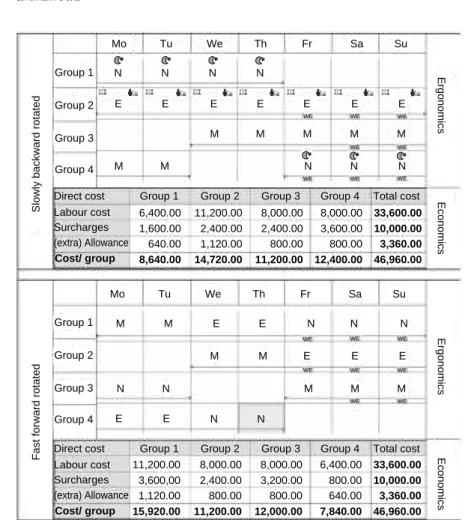
The implementation of the various time related cost functions now allows for a calculation of the costs associated with different shift schedules and with dif-ferent solutions for a given scheduling problem. These differences usually arise from a different design of the shifts, e.g. with regard to their start and end times and the manning of the demands for workforce, re-sulting in different surcharges and allowances, whereas the sequence of shifts, i.e. the kind of rota-tion, seems to be of less importance. This of course will have to be further tested in the future. It would, however, be consistent with the observation that man-agement generally does not care for or object to spe-cific kinds of rotations in shift systems, their main concern usually is that the system works and that it does so at a low level of costs. The results gained with the new module so far support the hypothesis that from an economic point of view it does not make much of a difference whether a shift system is rotated slowly backward or fast forward.
As an example Figure 3 shows the results of the economic evaluation of two different solutions for a given problem of continuous shift work, one slowly backward rotated and the other one fast forward ro-tated. The ergonomic evaluation for both systems shows a lot of violations of the ergonomic criteria (indicated by the number and the kind of symbols in the shift schedules in Figure 3) for the slowly back-ward rotated system as opposed to only a few viola-tions in the fast forward rotated system. However, the comparison of the economic costs (in €, or any other currency) for both solutions shows remarkable differ-ences only in the costs for each individual shift group per week, within and between schedules. Since the groups are rotating in a four weeks cycle these differ-ences balance out over a complete shift cycle in both systems, resulting in an indifference of total cost for both systems. These results clearly demonstrate that better shift rotas need not necessarily be associated with higher total costs, which is of importance in il-lustrating and supporting the ergonomic design of shift schedules from an economic point of view.
$ Rev Saúde Pública 2004;38(Supl):56-64 www.fsp.usp.br/rsp CAD of working hours
Schomann C et al
hours on Sunday), it is 56 hours (group 2; see Figure 3, with 7 x 8 hours) for the slowly backward rotated system, making these surcharges applicable and thus resulting in higher total costs. Assuming non-linear increasing surcharges beyond the legal permissible 48h per week would lead to even greater differentials for both solutions. The sensitivity of the implemented functions thus definitely needs further testing.
Using the implemented cost functions now allows for the evaluation of the detailed and total costs of a system, but more important, also of the costs associ-ated with any changes: it thus allows evaluating the costs associated with improvements regarding other criteria, which is always an important question when designing working hours according to ergonomic cri-teria. Another important step forward is that these func-tions can now be used in generating shifts and rotas, so that both ergonomic and economic criteria can be used for an optimization, showing the interdepend-encies in the results.
It should be noted, however, that the cost calcula-tions at the moment do not take into account
over-head costs, e.g. for maintenance, repairs, and services, and do not consider any effects of a bad shift design, e.g. compensating for health effects or effects regarding the risk of errors or accidents. This, of course, would probably change the balance considerably, e.g. by implementing surcharges for more than three night shifts in a row. Since such costs are difficult to estimate and to specify they have been left aside for the time being. However, the system in general would be open for such improve-ments. And it would seem most in-teresting to try and add a macro-economic perspective to the busi-ness management perspective adopted here for the moment.
D ISCU SSIO N
Computer aided design and evaluation of shift schedules should rather be regarded as a tool for supporting the designer than as an instrument for replacing her/his creativity, experience and profes-sional qualification. This is espe-cially true for the new aspects im-plemented in the programme BASS 4, because the more care is taken when assess-ing the job based workload or specifyassess-ing of the rel-evant economic costs, the better the criteria will work and the better they will support the evaluation, gen-eration, and optimization of shift schedules. Accord-ing to the results for the integration of workload as-pects the new EBA instrument seems to be a suitable and usable screening instrument for the intensity of workload and its temporal distribution for both ergo-nomics and job experts respectively. The concept of criterion functions, including the integration of job based and time based workload aspects, seems to be appropriate for an implementation into computer aided design and evaluation of shift schedules. However, fur-ther investigations, tests and adaptations will be nec-essary to improve the performance of the system. The new economics module allows for the assessment of the economic costs for a given or for alternative solu-tions for the design of a working time system and thus for the evaluation of the costs of (changes in) ergo-nomic criteria in the design of working time systems. This could be very helpful in convincing management that improvements in ergonomic design quality are not necessarily related to increased costs, but should,
Slowly backward rotated
Mo Tu We Th Fr Sa Su
Ergonomics
Economics
Ergonomics
Economics
Fast forward rotated
N N N N N N N N N N N N N N E
E E E E E
E
M M M M
M M
M
Group 1 Group 2 Group 3 Group 4 Total cost Group 1 Group 2 Group 3 Group 4 Direct cost Labour cost Surcharges (extra) Allowance Cost/ group 6,400.00 1,600.00 640.00 8,640.00 11,200.00 2,400.00 1,120.00 14,720.00 8,000.00 2,400.00 800.00 11,200.00 8,000.00 3,600.00 800.00 12,400.00 33,600.00 10,000.00 3,360.00 46,960.00
Mo Tu We Th Fr Sa Su
Group 1 Group 2 Group 3 Group 4 Total cost Direct cost Labour cost Surcharges (extra) Allowance Cost/ group 11,200.00 3,600,00 1,120.00 15,920.00 8,000.00 2,400.00 800.00 11,200.00 8,000.00 3,200.00 800.00 12,000.00 6,400.00 800.00 640.00 7,840.00 33,600.00 10,000.00 3,360.00 46,960.00
M M E E
M M E E E
M M M
E E Group 1 Group 2 Group 3 Group 4 WE WE WE WE WE WE WE WE
WE WE WE
WE WE
WE
WE
WE WE
$ !
Rev Saúde Pública 2004;38(Supl):56-64 www.fsp.usp.br/rsp
CAD of working hours Schomann C et al
REFEREN CES
1. Åkerstedt T. Work injuries and time of day – national data. Shiftwork Int Newsl 1995;12:2.
2. Andorre V, Quéinnec Y. Changes in supervisory activity of a continuous process during night and day shifts. Int J Ind Ergon 1998;21:179-86.
3. Andorre-Gruet V, Quéinnec Y, Concordet D. Three-process model of supervisory activity over 24 hours. Scand J Work Environ Health 1998;24(Suppl 3):121-7.
4. Bartenw erfer H , Kötter L, Sickel W. Beiträge zum Problem der psychischen Beanspruchung - II. Teil: Verfahren zur graduellen Beurteilung der psychischen Beanspruchung in der Industrie. Köln: Westdeutscher Verlag; 1963. (Forschungsberichte des Landes NRW, Band 141, Hefte 1131).
5. Bea FX, Dichtl E, Schweitzer M . Allgemeine Betriebsw irtschaftslehre. Grundfragen. Stuttgart: Lucius & Lucius; 2000. Band 1.
6. Bea FX, Dichtl E, Schweitzer M . Allgemeine Betriebsw irtschaftslehre. Leistungsprozess. Stuttgart: Lucius & Lucius; 2002. Band 3.
7. Beermann B. Leitfaden zur Einführung und
Gestaltung von Nacht- und Schichtarbeit. Dortmund: BAuA; 2001.
8. Bourdouxhe M, Quéinnec Y, Guertin S. The interaction between work schedules and workload: Case study of 12-hour shifts in a Canadian refinery. In: Hornberger S, Knauth P, Costa G, Folkard S, editors. Shiftwork in the 21st century: challenges for research and practice. Frankfurt: Peter Lang; 2000. p. 61-6.
9. Brathe B, Quéinnec Y, Verdier F. L’analyse de l’activité de travail en postes de nuit: Bilan de 25 ans de recherches et perspectives. Trav Hum 2004;67:41-61.
10. Craig A, Baer K, Diekmann A. The effects of lunch on sensory-perceptual functioning in man. Int Arch Occup Environ Health 1981;49:105-14.
11. Eilers K, Nachreiner F. Time of day effects in vigilance performance at simultaneous and successive discrimination tasks. In: Costa G, Cesana G, Kogi K, Wedderburn A, editors. Shift work, health, sleep and performance. Frankfurt: Peter Lang; 1990. p. 467-72.
12. Folkard S. Effects on performance efficiency. In: Colquhoun WP, Costa G, Fokard S, editor. Shiftwork: problems and solutions. Frankfurt: Peter Lang; 1996. p. 178-83.
13. Folkard S, Åkerstedt T, Macdonald I, Tucker P, Spencer M. Refinement of the three-process model of alertness to account for trends in accident risk. In: Hornberger S, Knauth P, Costa G, Folkard S, editors. Shiftwork in the 21st century: challenges for research and practice. Frankfurt: Peter Lang; 2000. p. 49-54.
14. Frieling E, Hoyos C. Fragebogen zur Arbeitsanalyse. Bern: Huber; 1978. [FAA; German version of the Position Analysis Questionnaire - PAQ].
15. Gärtner J, Hörwein K, Janke M, Wahl S.
Schichtplanassistent 3.0 – Flexible W erkzeuge für die Schichtplangestaltung. Angew Arbeitsw iss
1998;157:27-45.
16. Graf O. Über lohnendste Arbeitspausen bei geistiger Arbeit. In: Kraepelin E, editor. Psychologische Arbeiten. Berlin: Springer; 1922. v. 7. p. 548-611.
17. Grzech-Šukalo H , H änecke K, Jäger C, N achreiner F. Positive Gestaltungsbeispiele der DV-gestützen Schichtplangestaltung. Dortmund: BAuA; 2001.
18. H änecke K, Tiedemann S, N achreiner F, Grzech-Šukalo H. Accident risk as a function of hours at work and time of day as determined from accident data and exposure models for the German working population. Scand J Work Environ Health 1998;24(Suppl 3):43-8.
19. ISO 10075. Ergonomic principles related to mental work-load. General terms and definitions. Geneva: ISO; 1991.
20. ISO 10075-3. Ergonomic principles related to mental work-load. Part 3: Measurement and assessment of mental work-load. Geneva: ISO; 2004.
21. Klostermann A. Zur Evaluation von
Arbeitsanalyseverfahren anhand des “ Verfahrens zur Einschätzung der Belastung am Arbeitsplatz (EBA)” [Diplomarbeit]. Oldenburg: Carl von Ossietzky Universität; 2004.
22. Knauth P. Computergestützte Gestaltung diskontinuierlicher Schichtpläne nach
arbeitswissenschaftlichen Kriterien. Z Arbeitswiss 1987;41:224-6.
23. N achreiner F. Eigenzustandsskalierung zur Integration von Beanspruchungen. In: Rohmert W, editor. Ergonomie kombinierter Belastungen. Köln: Schmidt; 1982. p. 47-57.
in the long run, result in economic benefits by avoid-ing the resultavoid-ing costs of badly designed systems.
Integrating workload and economic aspects as cri-teria into computer aided design and evaluation of
$ " Rev Saúde Pública 2004;38(Supl):56-64 www.fsp.usp.br/rsp CAD of working hours
Schomann C et al
24. Nachreiner F. Ergonomics and standardization. In: Stellman JM, editor. Encyclopaedia of Occupational Health and Safety. Geneva: ILO; 1998. v. 1. p. 29.11-4.
25. Nachreiner F. Time on task effects on safety. J Hum Ergol (Tokyo) 2001;30:97-102.
26. Nachreiner F. Arbeitszeit und Unfallrisiko. In: Trimpop R, Zimolong B, Kalveram A, editors. Psychologie der Arbeitssicherheit und Gesundheit. Neue W elten – Alte Welten. Heidelberg: Asanger; 2002. p. 5-21.
27. Nachreiner F, Qin L, Grzech-Šukalo H, Hedden I. Computer-aided design of shift schedules. Ergonomics 1993;36:77-83.
28. N achreiner F, Grzech-Šukalo H , H änecke K, Q in L, Dieckmann P, Eden J, Lochmann R. Arbeitszeit ergonomisch gestalten. Eine Softw are zur Erstellung von Schichtplänen. Bremerhaven: W irtschaftsverlag NW; 1999.
29. Nachreiner F, Akkermann S, H änecke K. Fatal accident risk as a function of hours into work. In: Hornberger S, Knauth P, Costa G, Folkard S, editors. Shiftwork in the 21st century: challenges for research and practice. Frankfurt: Peter Lang; 2000. p. 19-24.
30. N achreiner F, Grzech-Šukalo H , M öhlmann D, Nickel P, Trauernicht K. Beteiligungsorientierte und sozialverträgliche Arbeitszeit- und Pausengestaltung im Stadt- und Regionalverkehr (SuRV). Berlin: Rev. di Bundesvorstand; 2003.
31. Pohlandt A, Schulze F. H andbuch mit PC-Programm REBA-AS. Rechnergestütztes D i al ogverfahren für di e Bew ertung und Gestal tung von
Arbei tstäti gkei ten unter Berücksi chti gung von Si cherhei t und Gesundhei tsschutz. Bochum: Technik & Information; 2001.
32. Rogers AS, Spencer MB, Stone BM. Validation and development of a method for assessing the risks arising from mental fatigue. Sheffield: HSE Books; 1999.
33. Rohmert W, Landau K. Das arbeitswissenschaftliche Erhebungsverfahren zur Tätigkeitsanalyse (AET). Bern: Huber; 1979.
34. Rutenfranz J, Knauth P, Nachreiner F. Arbeitszeitgestaltung. In: Schmidtke H, editor. Ergonomie. München: Hanser; 1993. p. 574-99.
35. Schmidt KH, Kleinbeck U, Ottmann W, Seidel B. Ein Verfahren zur Diagnose von Arbeitsinhalten: Der Job Diagnostic Survey (JDS). Z Arbeits
Organisationspsychol 1985;29:162-72.
36. Schmidtke H . M entale Beanspruchung durch informatorische Belastung. In: Schmidtke H, editor. Ergonomie. München: Hanser; 1993. p. 143-60.
37. Schönfelder E, Knauth P. A procedure to assess shift systems based on ergonomic criteria. Ergonomics 1993;36:65-76.
38. Schomann C, Pankonin C, Nachreiner F. Computer Aided design of working hours – integrating workload aspects and scheduling flexible work hours. Shiftwork Int Newsl 2001;18:158.
39. Schomann C, Stapel W, Nickel P, Meyer I, Janßen D, Eden J et al. Arbeitszeit ergonomisch gestalten – Entw icklung einer Softw are zur Evaluation und Gestaltung von Arbeitszeitsystemen. In: Zülch G, Stock P, editors. Arbeitszeitsysteme im
Dienstleistungsbereich und ihre Einführung. Karlsruhe: ifab; 2003. p. 43-54.
40. Schomann C, Klostermann A, Nickel P, Nachreiner F. Ergonomic design of working hours – integrating workload aspects. Shiftwork Int Newsl 2003;20:170.
41. Schomann C, Stapel W, Nickel P, Eden J, Nachreiner F. Arbeitszeit ergonomisch gestalten – Ein
Softwaresystem zur Evaluation und Gestaltung von Arbeitszeitsystemen. In: Gesellschaft für
Arbeitswissenschaft EV, editor. Arbeit + Gesundheit in effizienten Arbeitssystemen. Dortmund: GfA-Press; 2004. p. 275-8.
42. Wahl S, Muslija N, Angelova R, Slany W, Fingerlos R, Herber G et al. Shift-Plan-Assistant: SPA 4.0 – State of development. In: Hornberger S, Knauth P, Costa G, Folkard S, editors. Shiftwork in the 21st century: challenges for research and practice. Frankfurt: Peter Lang; 2000. p. 327-32.
43. Wedderburn A. Guidelines for shiftworkers. Eur Found Bull Eur Shiftwork Topics 1991;Suppl 3:11-6.