Trends Psychiatry Psychother. 2016;38(2) – 71-79 APRS
Development of Brazilian prototypes for short-term
psychotherapies
Desenvolvimento de protótipos brasileiros para psicoterapias de curta duração
Fernanda Barcellos Serralta,1 John Stuart Ablon2
Abstract
Introduction: The Psychotherapy Process Q-Set (PQS) proto-type method is used to measure the extent to which ideal
pro-cesses of diferent psychotherapies are present in real cases,
allowing researchers to examine how adherence to these models relates to or predicts change. Results from studies of short-term psychotherapies suggest that the original psychodynamic proto-type is more suitable for studying psychoanalysis and long-term psychodynamic psychotherapy than its time-limited
counter-parts. Furthermore, culture probably inluences how therapies
are typically conducted in a given country. Therefore, it seems appropriate to develop Brazilian prototypes on which to base studies of short-term psychodynamic and cognitive-behavioral processes in this country.
Objective: To develop prototypes for studying processes of short-term psychotherapies and to examine the degree of adhe-rence of two real psychotherapy cases to these models.
Methods: Expert clinicians used the PQS to rate a hypothetical ideal session of either short-term psychodynamic psychothera-py (STPP) or cognitive-behavioral therapsychothera-py (CBT). Ratings were
submitted to Q-type factor analysis to conirm the two groups.
Regressive factor scores were rank ordered to describe the pro-totypes. These ideal models were correlated with ratings of actu-al therapy processes in two complete psychotherapy cases, one STPP and the other CBT.
Results: Agreement levels between expert ratings were high
and the two ideal models were conirmed. As expected, the PQS ratings for actual STPP and CBT cases had signiicant correlations
with their respective ideal models, but the STPP case also adhe-red to the CBT prototype.
Conclusion: Overall, the indings reveal the adequacy of the pro -totypes for time-limited therapies, providing initial support of their validity.
Keywords: Psychotherapeutic processes, brief psychotherapy, psychodynamic psychotherapy, cognitive behavioral therapy.
Resumo
Introdução: O método dos protótipos derivados do
Psychothe-rapy Process Q-Set (PQS) mensura em que medida processos
de diferentes psicoterapias estão presentes em casos reais,
permitindo pesquisadores examinarem como a adesão a esses
modelos se relaciona com ou prediz a mudança. Resultados de
estudos com psicoterapias breves sugerem que o protótipo psi
-codinâmico original é mais adequado para estudar psicanálise e psicoterapia psicodinâmica de longo prazo do que suas variantes de tempo limitado. Além disso, a cultura provavelmente inluen -cia o modo como as psicoterapias são tipicamente conduzidas em determinado país. Portanto, parece apropriado o desen-volvimento de protótipos brasileiros para subsidiar estudos de processos psicodinâmicos e cognitivo-comportamentais de curto prazo neste país.
Objetivo: Desenvolver protótipos para o estudo dos processos de psicoterapias de curta duração e examinar o grau de adesão de dois casos reais de psicoterapia a esses modelos.
Métodos: Especialistas brasileiros usaram o PQS para avaliar uma sessão hipotética ideal de psicoterapia psicodinâmica breve (PPB)
ou de terapia cognitivo-comportamental (TCC). A análise fatorial do tipo Q foi realizada para conirmar os dois fatores. Os escores
fatoriais regressivos foram ordenados para descrever os protótipos. Os protótipos foram correlacionados com as avaliações de proces-sos reais de terapia em dois caproces-sos completos, um de PPB e outro de TCC.
Resultados: Houve alta concordância entre especialistas, e os
dois modelos ideais foram conirmados. Como esperado, os es -cores do PQS para os casos reais de PPB e TCC apresentaram
correção signiicativa com seus respectivos modelos ideais, mas o
caso de PPB aderiu também ao protótipo TCC.
Conclusões: No geral, os resultados revelam a adequação dos
protótipos para terapias com tempo limitado, fornecendo supor-te inicial de sua validade.
Descritores: Processos psicoterapêuticos, psicoterapia breve, psicoterapia psicodinâmica, terapia cognitivo-comportamental.
1 Programa de Pós-Graduação em Psicologia, Universidade do Vale do Rio dos Sinos (UNISINOS), São Leopoldo, RS, Brazil. 2 Department of Psychiatry, Harvard
Medical School, Psychotherapy Research Program, Massachusetts General Hospital, Boston, MA, USA.
Financial support: Conselho Nacional de Desenvolvimento Cientiico e Tecnológico (CNPq; grant no. 401268-2011-0) and Fundação de Amparo à Pesquisa do
Estado do Rio Grande do Sul (FAPERGS; grant no. 12/1651-6).
Submitted Jul 21 2015, accepted for publication Dec 01 2015. No conlicts of interest declared concerning the publication of this article.
Introduction
Psychotherapy research has repeatedly demonstrated
that diferent forms of short-term therapies lead to equivalent outcomes despite their diferences in terms
of theoretical background and technical features.1-3 Since diferent approaches have distinct theories of therapeutic action, this general result has led to the speciic versus nonspeciic efects debate. The adoption of the term
common factor implies researchers’ recognition that
diferent therapies include non-unique factors that are also eicacious, such as a therapeutic relationship
characterized by trust, kindness, and understanding, for example.4 The common factors theory proposes
that diferent psychotherapies share similar underlying
components that contribute to their outcomes.5,6 On
the other side of the debate, some authors7-9 airm that theory-driven speciic factors may have a stronger
role in psychotherapy results than is often assumed, since outcome studies have proven the superiority of some therapies for some particular disorders, and
even when equivalence is established, it is plausible to
consider the possibility that the two treatments work
via speciic (and diferent) paths to produce change.8
This does not however mean that common factors
should be overlooked. In fact, the common vs. speciic
factors division is a false dichotomy, since in face-to-face psychological treatments strong interdependence between treatment factors and relationship factors contributes to the progress and results of therapy.10-12
However, investigation of how these multiple variables
relate to outcomes requires other and more complex
methodologies than traditional randomized clinical trials (RCT).12 Much more research is needed to clarify the
mechanisms of change in psychotherapy.
Studying how processes afect change is not simple.
When researchers want to study mechanisms of change in psychotherapies, how can they really know which interventions are indeed being used and how they relate to changes? Ablon & Jones13 contributed to this ield by
developing an innovative methodology for measuring the
extent to which the ideal processes of diferent kinds of
psychotherapy are present in actual psychotherapies, to enable evaluation of how adherence to ideal processes is related to or predictive of change. This methodology can be applied to both controlled and naturalistic studies, i.e., to manualized and non-manualized therapies.
To develop the method, they irst asked a panel of
expert psychodynamic therapy (PDT) and cognitive-behavioral therapy (CBT) clinicians to describe an ideal therapy session using the Psychotherapy Process Q-Sort (PQS),9 a Q-sort type process measure. Prototypes
were generated by subjecting these ratings to a Q-type
factor analysis that yielded two factors, representing, respectively, the two psychotherapy models. Then, actual therapy sessions were rated with the PQS to access process variables.
In their pioneering study, Ablon & Jones13 examined therapy sessions of 100 patients from three diferent
archived samples: 30 patients with a wide range of neurotic disorders receiving 16 sessions of short-term psychodynamic psychotherapy (STPP), 32 patients receiving 16 sessions of CBT for unipolar depression, and 38 patients receiving 12 sessions of manualized STPP. Controlling for pretreatment scores, rates of adherence to prototypes were correlated to outcome. However, in the psychodynamic sample with posttraumatic stress disorder (PSTD) patients, neither of the prototype adherence rates predicted change. With the other samples, the prototypes were able to identify the active ingredients of therapy. Notably, therapists’ adherence to the PDT prototype predicted positive outcome in both STPP and CBT. On the other hand, therapists’ adherence to the CBT prototype showed little or no relation to outcome in either form of therapy. The study demonstrated that we cannot infer processes from the therapy approach being employed and that a feature theoretically related to one type of psychotherapy may be an active ingredient of another type.
When patients improve in RCTs, it is generally
assumed that the change was due to speciic interventions
delivered. However, since RCTs do not directly examine
whether speciic and common factors relate to outcome,10
this assumption can be fallacious. In fact, we have learned from process studies that psychotherapy brand names
might be misleading since two diferent approaches can
share many more features than is assumed by their theory of therapeutic action, even in controlled studies in which therapies are manualized.14 Moreover, change can occur due to a feature that is related to the ideal process
of a diferent therapy.13,15
It has been pointed out that even when delivering the same model of treatment, therapists’ attitudes and
techniques relect their individual style, the individual patient’s style and the unique ways that patient and
therapist interact.7 The diversity of styles and interaction
patterns in typical practice is expected to be even greater than the diversity found in controlled studies. Therefore, one of the major contributions of PQS-derived prototypes
is provision of a method for examining treatment idelity
in naturalistic psychotherapies.
The many applications of PQS to psychotherapy
research and the contributions made to diferent lines
of investigation can be found in a recent comprehensive review of PQS studies.16 What intrigues us is the fact that
a high degree of adherence to the alternative CBT model, as detailed next.
We highlight, for example, indings from Ablon &
Jones’s study of the three sets of archived treatment records mentioned above,13 in which adherence to the
PDT prototype was negative for the CBT sample, but both STPP samples exhibited a high degree of adherence to both prototypes. In fact, for the PSTD psychodynamic
sample, the degree of adherence was signiicantly higher
for the CBT prototype than for the PDT process. Another study17 found greater adherence to the CBT prototype in
a sample of naturalistic STPP sessions for panic disorder. However, CBT processes did not predict change. On
the other hand, PDT-speciic factors were only partially
related to change. Active ingredients included supportive stance of therapist and working alliance. Finally, using the Brazilian version of the PQS to analyze an intensive single case study of STPP, we found, contrary to our
expectations, that adherence was signiicantly closer to
CBT therapy processes than to PDT processes. Since we
noticed that speciic CBT techniques were not applied
in this case, we discussed some possible limitations of the PDT prototype being used, such as an absence of supportive interventions among its main features.18
Are psychodynamic therapists frequently not
fostering PDT processes when delivering short-term therapies? Results from this line of investigation suggest
that STPP technique might be more heterogeneous than CBT techniques and also that short-term therapies
may have many shared processes. Since traditional psychodynamic treatments are not brief, we hypothesized that the PDT prototype may not capture STPP process as well as it does with long-term PDT and psychoanalysis.
Furthermore, culture also probably inluences how
therapies are typically conducted in a given country. Therefore, it seems appropriate to develop Brazilian prototypes to provide a basis for studies of short-term psychodynamic and cognitive-behavioral processes and outcomes in this country. Thus, our aim in this study
is to develop a modiied psychodynamic prototype for
studying STPPs and a short-term CBT prototype and to test them on two complete cases of short-term therapy, one cognitive behavioral and one psychodynamic. Our hypotheses are: 1) the STPP prototype will be distinct from the short-term CBT prototype, although some degree of common factors should be present; 2) the correlation between the existing and the new CBT prototypes will be stronger than the correlation between the existing PDT and the new STPP prototype; 3) the psychodynamic case will exhibit closer adherence to the STPP prototype than to the traditional PDT prototype, to the traditional CBT prototype and to the short-term
CBT prototype; 4) the CBT case exhibit closer adherence
to both CBT prototypes than to either psychodynamic prototype (PDT and STPP).
Method
This is a two-phase study. The objective of phase 1 was to develop new STPP and CBT prototypes and phase 2 was designed to test these prototypes using two actual cases of complete short-term therapy, one psychodynamic and one cognitive-behavioral. The study protocol was approved by the Research Ethics Committee at the private university where the study was conducted. Therapists and patients gave their informed consent to audio recording of therapy sessions.
Stage 1: Development of STPP and
short--term CBT prototypes
Participants
The participants were 18 psychotherapists (3 males and 15 females), 9 experts in STPP and 9 experts in CBT. The expertise criteria adopted were: minimum of 8 years of clinical practice with adults (Mean = 21.17 years; standard deviation [SD] = 10.02), recognition among peers as an expert and experience teaching and/or supervising at post-graduate level in Brazilian universities or other recognized institutions that train psychotherapists. It is important to point out that these respondents are national authorities on their respective approaches and can be considered models for their colleagues. The number of respondents is limited by both the expertise criteria and characteristics of the Q-methodology (see the Procedures section for more
details). Mean age was 48.06 years (SD = 11.90). Although the STPP therapists were signiicantly older
than the CBT therapists (t = -3.125, p = 0.007), the
groups were equivalent in terms years of clinical practice
with adults (t = -2.018, p = 0.061).
Instrument
The Psychotherapy Process Q-Set (PQS)9 is a Q-sort
population of views and so items, rather than people, are regarded as samples. Unlike with R methods, researchers using Q methodologies are interested in examining the relationships between a large set of data
(variables that relect diferent perceptions, opinions,
experiences or processes) in a single person or in a small number of people. Therefore, the number of people that respond to a Q-sort is always smaller than the set of items to be sorted. Whereas R methods use a normative scale, in contrast, Q-sorts use an ipsative scale. The forced distribution of Q-sort ratings eliminates rater bias deriving from the tendency to use the extremes of a scale
(the halo efect). Typically, analysis and interpretation of
Q-sort data includes calculation of the correlation matrix of all ratings (Q-sorts). Here, correlation is the degree of agreement or disagreement between respondents’ views. The next step is usually application of a factor analysis procedure to identify natural clusters of Q-sorts; people who share the same point of view will cluster together.21,22
The reliability of the assessments made by the two groups of experts was calculated using Cronbach’s alpha
coeicient. These assessments were then subjected
to a Q-type factor analysis with varimax rotation. A Q factor analysis is computed using the same procedure as a conventional R factor analysis. In R factor analysis, columns represent variables and rows represent people. In a Q factor analysis the matrix is inverted, i.e. people (STPP and CBT experts) are “variables” (columns) and PQS items are “samples” (rows). An R factor analysis
identiies variables that are similar to one another; Q-factor analysis identiies rows of data (in this case,
STPP and CBT experts) that have similar views.
We used linear regressions to determine the contribution of each Q-item to the two factors (STPP and CBT prototypes). Factor scores represent the weighted sum of each Q-item. The items with the highest factor
scores are most deining of the factor, and the items with the lowest factor scores are least deining of the factor.
Comparisons between the newly-developed prototypes and traditional CBT and PDT prototypes were made by correlating their factor scores and by describing their most prominent characteristics.
Results
In Stage 1, experts rated the PQS according to an ideal session of STPP or CBT. All respondents found that the PQS items did capture the most important processes of their theoretical model. Analyzing these ratings, we found high concordance among experts, with an
equivalent alpha of 0.92 in both groups.
characteristic (category 1) to the most characteristic (category 9). Items are evaluated in relation to each other (ipsatively) rather than to an objective standard
(normatively). The inal pile number to which each card is assigned relects how well that item characterizes the
therapy process relative to the other items. The PQS has shown good inter-rater reliability,9,15,19 construct
validity,19 and discriminant validity15 in prior research. We
used the Brazilian Portuguese version of PQS,20 which has shown semantic equivalence with the original PQS
and comparable inter-rater reliability.
Procedures
Following Ablon & Jones’ original procedures,13
experts rated the PQS items according to a hypothetical ideal session of either STPP or CBT. The STPP therapists were asked to rate each of the PQS items against a 9-point scale to represent how characteristic or uncharacteristic that item was for describing an ideally-conducted STPP session. The CBT therapists did the same for an ideal short-term CBT session. All respondents were also asked whether any important feature of therapy was not covered by the PQS items. Note that this procedure included all of the PQS items, not just therapists’ actions but also patients’ behaviors and patient-therapist interactions. This is because the prototypes are not only intended to
capture the techniques used by the therapist, but also
processes that are expected or typical of a particular approach. These include how therapist and patient work together in sessions, which is consistent with the notion that psychotherapy is an interpersonal process
in which patient and therapist inluence each other.
Nevertheless, when desirable, therapist, patient and interaction items can be analyzed separately.
Analysis
psychodynamic prototypes.13 The correlation between the
two cognitive-behavioral prototypes was 0.85, showing high convergence between these models. As expected, the correlation between the original PDT model and the new STPP model was strong (r = 0.62) but lower than that found between CBT prototypes.
Table 3 lists the most prominent items in the STPP prototype that are not highlighted in the original PDT prototype.
These results from phase 1 of the study suggest that the short-term prototypes developed are reliable and valid. We then proceeded to analysis of the psychotherapy cases.
Stage 2: Case analysis
In this step, we analyzed the adherence of two complete cases of therapy against the psychodynamic and cognitive-behavioral prototypes.
Case 1 - Psychodynamic
Patient: female, single, 50 years old, completed higher education, depressed, anxious and with a severe We performed a principal components factor analysis
with varimax rotation. As expected, we found two factors that together explain 65.15% of the variance. It was observed that all of the CBT respondents loaded
signiicantly onto factor 1 (named CBT), with factor loadings ranging between 0.647 and 0.765 (averaged
0.726). However, although six of the STPP respondents
loaded signiicantly onto factor 2 (named STPP), three loaded signiicantly onto both factors and, unexpectedly,
their loadings were higher for the CBT model, meaning that their view of STPP shares many features with the ideal CBT process, more than would be expected for two
diferent approaches.
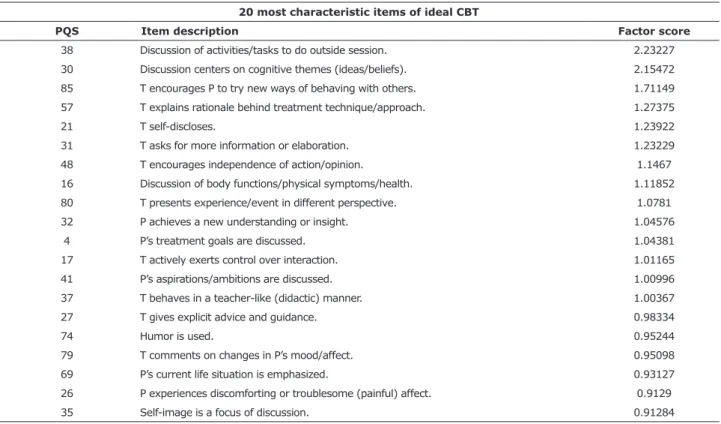
Tables 1 and 2 list a summary of the 20 items with the highest factor scores for the STPP and CBT models, respectively. Note that each prototype contains all of the 100 items in the PQS, not only the items that appear in the tables. Prototypes include characteristic,
non-characteristic and neutral items and relect what
is prominent as well as what is missing in a therapy process. Also, prototypes are derived from all PQS items, not only from therapist items, allowing further study of the whole process.
We then compared the STPP and CBT prototypes with Ablon & Jones’ broader cognitive-behavioral and
Table 1 - Rank ordering of Q-items by factor scores on STPP factor
20 most characteristic items of ideal STPP
PQS Item description Factor score
67 T interprets warded-of wishes/feelings/ideas. 1.98847
36 T points out P’s use of defensive maneuvers. 1.90944
40 Interpretations refer to actual people in P’s life. 1.80603
89 T acts to strengthen defenses. 1.59831
92 P’s feelings/perceptions are linked to past. 1.30716
23 Dialogue has a speciic focus. 1.29973 82 P’s behavior in hour reformulated by T in new ways. 1.21765
100 T interprets transference. 1.18658
97 P introspective, explores inner thoughts/feelings. 1.14712
46 T communicates in clear coherent style. 1.12177
45 T adopts supportive stance. 1.12089
6 T is sensitive to P’s feelings, attuned, empathic. 1.11099
28 T accurately perceives therapeutic process. 1.10586
81 T emphasizes P’s feelings to deepen them. 1.10583
86 T conident/self-assured (vs. uncertain/defensive). 1.10277
73 P is committed to the work of therapy. 1.10202
90 P’s dreams or fantasies are discussed. 1.05468
65 T clariies/restates/rephrases P’s communication. 1.04675
98 Therapy relationship is discussed. 1.00499
Case 2 - Cognitive-behavioral
Patient: female, adult, married, compulsive buyer. Therapist; trained CBT psychologist with more than 10 years of CBT practice. Treatment duration: 12 sessions. heart problem. Focus of treatment: elaboration of
mourning and preparation for major surgery. Treatment
duration: 31 sessions. Therapist: clinical psychologist
with seven years’ experience in PDT.
Table 3 - Specific items of STPP prototype compared to original PDT prototype
PQS Item description
40 Interpretations refer to actual people in P’s life. 89 T acts to strengthen defenses.
23 Dialogue has a speciic focus.
28 T accurately perceives therapeutic process. 73 P is committed to the work of therapy.
97 P introspective, explores inner thoughts/feelings. 81 T emphasizes P’s feelings to deepen them. 86 T conident/self-assured (vs. uncertain/defensive). 45 T adopts a supportive stance.
65 T clariies/restates/rephrases P’s communication.
68 Real versus fantasized meanings of experiences are actively diferentiated.
PDT = psychodynamic psychotherapy; PQS = Psychotherapy Process Q-Set; STPP = short-term psychodynamic psychotherapy.
Table 2 - Rank ordering of Q-items by factor scores on CBT factor
20 most characteristic items of ideal CBT
PQS Item description Factor score
38 Discussion of activities/tasks to do outside session. 2.23227 30 Discussion centers on cognitive themes (ideas/beliefs). 2.15472 85 T encourages P to try new ways of behaving with others. 1.71149 57 T explains rationale behind treatment technique/approach. 1.27375
21 T self-discloses. 1.23922
31 T asks for more information or elaboration. 1.23229
48 T encourages independence of action/opinion. 1.1467
16 Discussion of body functions/physical symptoms/health. 1.11852 80 T presents experience/event in diferent perspective. 1.0781
32 P achieves a new understanding or insight. 1.04576
4 P’s treatment goals are discussed. 1.04381
17 T actively exerts control over interaction. 1.01165
41 P’s aspirations/ambitions are discussed. 1.00996
37 T behaves in a teacher-like (didactic) manner. 1.00367
27 T gives explicit advice and guidance. 0.98334
74 Humor is used. 0.95244
79 T comments on changes in P’s mood/afect. 0.95098
69 P’s current life situation is emphasized. 0.93127
26 P experiences discomforting or troublesome (painful) afect. 0.9129
35 Self-image is a focus of discussion. 0.91284
p = 0.000). Additionally, adherence to the classic CBT
prototype was signiicantly closer than to the STPP (t =
11.88; p = 0.000) and traditional PDT prototypes (t = -12.89; p = 0.000). Thus, our second hypothesis was
also conirmed.
Discussion
Diferent psychotherapy approaches have both
common and speciic features. Blagys & Hilsenroth23
searched empirical studies that compared the process
and technique of manualized
psychodynamic-interpersonal and cognitive-behavioral therapies and
identiied six CBT-speciic process and techniques:
1) homework and outside-of-session activities; 2) direction of session activity; 3) teaching of skills used
by patients to cope with symptoms; 4) emphasis on
patients’ future experiences; 5) providing information about patient’s treatment, disorder, or symptoms; and 6) an intrapersonal/cognitive focus. Shedler7 listed
PDT features that are reliably distinguished from other
therapies: 1) focus on afect and expression of emotions;
2) exploration of attempts to avoid distressing thoughts
and feelings; 3) identiication of recurrent themes and patterns; 4) discussion of past experience; 5) focus
on interpersonal relation; 6) focus on therapeutic relationship; 7) and exploration of fantasy. As can be observed from tables 1 and 2, many of these distinctive
processes and techniques are captured by our STPP and
CBT prototypes.
As we had previously assumed, our STPP prototype includes typical STPP processes that are not usually present in long-term psychodynamic therapies and were not prominent in Ablon & Jones’s PDT prototype.13
Among these, we highlight item 23 (focus) and item
45 (support). Circumscribing a therapeutic focus to
be analyzed during treatment is one of the technical
diferences between short-term and long-term PDT; this
feature as well as the idea of limited duration is essential to help patients to achieve therapeutic change within this kind of approach to therapy.24,25
As mentioned earlier, we must consider that the responses of three of the experts in STPP used to generate the STPP prototype were very close to the process description of CBT produced from the responses of our cognitive-behavioral respondents. These experts are leading authors on STPP nationally. Their professed model is known as psychodynamic-relational-integrative, a fairly widespread and widely-practiced model of STPP in Brazil.26 The clear overlap between ideal STPP and ideal CBT among a signiicant portion of our psychodynamic
respondents indicates that short-term psychodynamic
Procedures
These two cases have already been analyzed in the context of previous studies with the Brazilian version of the PQS. All therapy sessions were audio recorded with the informed consent of therapists and patients. Each session (STPP, n = 31; CBT, n = 12) was assessed using the PQS by a pair of independent raters previously trained to use the PQS coding system. Inter-rater
reliability (Intraclass correlation coeicient) was above
0.7 in all sessions. Ratings from pairs of raters were averaged to form a composite score that was used in all
subsequent analyses.
Adherence to prototypes was measured by
calculating the correlations (Pearson’s coeicients)
between PQS ratings for the actual sessions (composite scores for each session) with the scores for the ideal psychodynamic and cognitive-behavioral prototypes. Each of these correlations was transformed into a new variable: adherence score to either psychodynamic or cognitive-behavioral process. The t test for paired samples was used to compare the real psychotherapy sessions’ adherence to each prototype.
Results
Case 1 (intentionally psychodynamic) has been intensively studied before16 with time series analysis
to examine how processes predicted change. Using the prototypes developed by Ablon & Jones,13 this case adhered signiicantly more closely to the CBT model (mean 0.44, Pearson; SD = 0.23) than to the PDT model
(mean 0.12, Pearson; SD = 09), as previously reported elsewhere.18 In the present study, after reanalyzing
this case, interesting results emerged: adherence to the STPP prototype developed in phase 1 of this study
was 0.34 (SD = 0.20), which was signiicantly closer (t
= -16.383, p = 0.000) than adherence to the classic PDT prototype. Moreover, adherence to the new (short-term) CBT prototype was 0.28 (SD = 0.08) and this was a lower adherence rating than for the STPP prototype,
although this diference was not signiicant (t = -1.663;
p = 0.107). Our hypothesis that this case would more closely adhere to the STPP prototype than to the other
prototypes (PDT and CBT) was partially conirmed.
In case 2 (intentionally cognitive-behavioral), we found that the scores for adherence were 0.62 (SD = 0.06) for the traditional CBT ideal model, 0.53 (SD = 0.06) for the brief CBT prototype, 0.16 (SD = 0.11) for the STPP model, and -0.12 (SD = 0.18) for the PDT prototype. As expected, adherence to the brief CBT ideal
our assumption that the technical characteristics of
STPP were not adequately covered by the original PDT
prototype.13 The case analysis results are promising
and suggest that the STPP and CBT prototypes we have developed can be used to study other short-term therapy
cases. Furthermore, the indings appear to support
the hypothesis that there is an important overlap of psychodynamic and cognitive-behavioral processes in STPP. Further studies may clarify the role of the patient’s psychopathology and other characteristics in the degree of overlap between psychodynamic and cognitive-behavioral processes in short-term therapies.
This study has many strengths and limitations. Using a recognized methodology to examine the degree to which a treatment model is being consistently applied, we developed and tested ideal prototypes for short-term therapies. Most adherence studies depend on preexisting therapy manuals and methods to assess treatment adherence. The PQS-derived prototypes do not depend on either and are not only suitable for studying psychotherapeutic process in experimental settings, but also in naturalistic ones. These new prototypes for STPP and short-term CBT were developed from the PQS ratings of highly experienced practitioners, supervisors and teachers of their respective schools of therapy. None of the respondents felt that any important aspect of their ideal therapy process was missing from the 100 PQS items. The reduced number of experts is not a limitation since Q-type factor analysis presumes fewer variables (in this case, respondents) than subjects or observations (in this case, PQS items).
However, the heterogeneity of the theoretical backgrounds of the experts on STPP may represent a limitation. In order to allow for representativeness of STPP variants among our experts, the three respondents whose ratings also exhibited convergence with the CBT therapists’ ratings were not excluded from the STPP
prototype. Consequently, our STPP model is not as “pure”
as our CBT model. Since therapy models can vary within the same “brand name” and literature suggests that the psychodynamic approach may be more heterogeneous than cognitive-behavioral, this seemed to be the right decision to make. More studies are needed to evaluate whether a less conservative approach to development of an ideal STPP prototype would be preferable.
In small-N designs, participants are assessed repeatedly and comparisons within the same person are
made over time. This kind of study allows for identiication
of patterns of therapeutic interaction that can be linked to therapeutic progress. Thus, systematic process studies are potentially relevant to producing knowledge for evidence-based practice. However, a most obvious limitation of any small-N approach is external validity. practices can indeed be more heterogeneous than CBT.
This conclusion is reinforced by indings from a recent study of distinctive and shared techniques of
short-term CBT and PDT delivered in RCTs for depression that revealed that a substantial number of studies of
STPP treatments included CBT techniques, such as
patient education and reinforcement. In contrast, CBT
treatments did not included PDT-speciic interventions.27
On the other hand, we note that the newly developed prototypes do not share any of their 20 most characteristic items. This does not mean an absence of
shared features. We must remember that the cutof of
20 items is purely arbitrary, given that both prototypes contain all 100 PQS items. However, it does mean that the two models are clearly distinct from one another in
their most prominent features, which is quite desirable for describing diferent theoretical approaches.
We also compared our CBT prototype with Ablon & Jones’s CBT prototype.13 We observed that the classic
CBT prototype puts greater stress on support and directivity of the therapist than the Brazilian prototype. In the latter, the presence of item 12, insight, drew our attention – given that in theory insight tends to be a factor highly associated with the psychodynamic model.
Although these diferences might be due to some cultural diferences between American and Brazilian styles of conducting CBT, it probably also relects the time elapsed
between the development of these models and current trends in CBT theory and practice, such as, for example, the trend towards integration that characterizes the so-called third wave in CBT.28
Application of prototypes to case 1 yielded mixed results in terms of the discriminant validity of the STPP prototype. Although the closer adherence to STPP in
comparison to the classic PDT prototype conirms the usefulness of a more speciic psychodynamic prototype
for brief or short-term psychodynamic therapies, the STPP prototype still failed to classify this case of therapy as more psychodynamic than cognitive-behavioral. We cannot determine whether this is due to a limitation of the STPP prototype or simply the result a trend towards a mixed process that is particular to this case. We must bear in mind that this is a preliminary study of the application of the new STPP and CBT prototypes and that only two cases were analyzed. Further studies
are needed to conirm the validity of the ideal models
developed here.
Overall, the indings reveal the adequacy of the
prototypes for STPP and short-term CBT and provide initial support of their validity. Not only do the prototypes
capture speciic features of each theoretical model, they
also identify other features that are common to many
net/
22. Brown SR. Q technique and method: principles and procedures.
In: Berry WD, Lewis-Beck MS, editors. New tools for social scientists: advances and applications in research methods. Beverly Hills: Sage University Press; 1986. p. 57-76.
23. Blagys MD, Hilsenroth MJ. Distinctive features of short-term psychodynamic-interpersonal psychotherapy: a review of the comparative psychotherapy process literature. Clin Psychol Sci Pract. 2000;7:167-88.
24. Enéas MLE, Yoshida EMP. Psicoterapia breve psicodinâmica com adultos. In: Lipp MEN, Yoshida EMP. Psicoterapias breves nos diferentes estágios evolutivos. São Paulo: Casa do Psicólogo; 2012. p. 154-76.
25. Lemgruber VB. Terapia focal: psicoterapia breve psicodinâmica. In: Cordioli AV, et al., editors. Psicoterapias: abordagens atuais. 3rd ed. Porto Alegre: Artmed; 2008. p. 167-87.
26. Yoshida EMP. Evolução das psicoterapias breves psicodinâmicas. In: Yoshida EMP, Enéas MLE, editors. Psicoterapias psicodinâmicas breves: propostas atuais. Campinas: Alínea; 2004. p. 13-36. 27. Barth J, Michlig N, Munder T. Unique and shared techniques
in cognitive-behavioural and short-term psychodynamic psychotherapy: a content analysis of randomised trials on
depression. Health Psychol Behav Med. 2014;2:929-50.
28. Brown LA, Gaudiano BA, Miller IW. Investigating the similarities
and diferences between practitioners of second-and third-wave
cognitive-behavioral therapies. Behav Modif. 2011;35:187-200.
Correspondence:
Fernanda Barcellos Serralta
Programa de Pós-Graduação em Psicologia Universidade do Vale do Rio dos Sinos (UNISINOS) Rua Alfredo Schuett, 927
91330-120 - Porto Alegre, RS - Brazil Tel.: +55 (51) 9553.6303
E-mail: [email protected] Replication is necessary to establish generalizability of
indings. In this study we examined two complete therapy
cases. Other complete cases and therapy samples might
be studied to conirm the prototypes’ validity and their
contribution to psychotherapy research. The prototypes’ predictive validity has not yet been examined.
References
1. Luborsky L, Rosenthal R, Diguer L, Andrusyna TP, Levitt JT, Seligman DA, et al. Are some psychotherapies much more
efective than others? J Appl P Psychoanal Stud. 2003;5:455-60.
2. Wampold BE, Mondin GW, Moody M, Stich F, Benson K, Ahn
H. A meta-analysis of outcome studies comparing bona ide
psychotherapies: empirically, “all must have prizes”. Psychol Bull. 1997;122:203-15.
3. Baardseth TP, Goldberg SB, Pace BT, Wislocki AP, Frost ND,
Siddiqui JR, et al. Cognitive-behavioral therapy versus other therapies: redux. Clin Psychol Rev. 2013;33:395-405.
4. Lambert MJ. Early response in psychotherapy: Further evidence
for the importance of common factors rather than “placebo
efects”. J Clin Psychol. 2005;61:855-69.
5. Wampold BE. The research evidence in common factor models: a historically situated perspective. In: Duncan B, Miller S, Wampold B, Hubble M, editors. The heart and soul of change: Delivering what works in therapy. Washington: American Psychological
Association; 2010. p. 49-83.
6. Norcross JC. Psychotherapy relationships that work. 2nd ed. New
York: Oxford University; 2011.
7. Shedler J. The eicacy of psychodynamic psychotherapy. Am
Psychol. 2010;65:98-109.
8. DeRubeis RJ, Brotman MA, Gibbons CJ. A conceptual and
methodological analysis of the nonspeciics argument. Clin Psychol Sci Pract. 2005;12:174-83.
9. Jones EE. Therapeutic action: a guide to psychoanalytic therapy. New Jersey: Aronson; 2000.
10. Kazdin AE. Treatment outcomes, common factors and continued neglect of mechanisms of change. Clin Psychol Sci Pract.
2005;12:184-8.
11. McAleavey AA, Castonguay LG. The process of change in
psychotherapy: common and unique factors. In: Gelo O, Pritz A,
Rieken B, editors. Psychotherapy research: foundations, process and outcome. Vienna: Springer; 2015. p. 293-310.
12. Beutler LE, Forrester B, Gallagher-Thompson D, Thompson L,
Tomlins JB. Common, speciic, and treatment it variables in
psychotherapy outcome. J Psychother Integr. 2012;22:255-81. 13. Ablon J, Jones E. How expert clinicians’ prototypes of an ideal
treatment correlate with outcome in psychodynamic and cognitive-behavioral therapy. Psychother Res. 1998;8:71-83.
14. Ablon JS, Jones EE. Validity of controlled clinical trials of
psychotherapy: Findings from the NIMH treatment of depression collaborative research program. Am J Psychiatry. 2002;159:775-83.
15. Jones EE, Pulos SM. Comparing the process in psychodynamic and cognitive-behavioral therapies. J Consult Clin Psychol. 1993;61:306-16.
16. Ablon, JS, Levy RA, Smith-Hansen L. The contributions of the Psychotherapy Process Q-set to psychotherapy research. Res
Psychother. 2011;14:14-48.
17. Ablon JS, Levy RA, Kazenstein T. Beyond brand names of psychotherapy: identifying empirically supported change
processes. Psychotherapy. 2006;43:216-31.
18. Serralta FB, Pole N, Tiellet Nunes ML, Eizirik CL, Olsen C.
The process of change in brief psychotherapy: efects of
psychodynamic and cognitive-behavioral prototypes. Psychother
Res. 2010;20:564-75.
19. Jones EE, Cumming JD, Horowitz MJ. Another look at the
nonspeciic hypothesis of therapeutic efectiveness. J Consult Clin Psychol. 1988;56:48-55.
20. Serralta FB, Nunes MLT, Eizirik CL. Elaboração da versão em
português do Psychotherapy Process Q-Set. Rev Psiquiatr Rio Gd Sul. 2007;29:44-55.
21. Van Exel J, de Graaf G. Q methodology: A sneak preview