Sao Paulo Med J. 2012; 130(4):263-6 263
CASE REPORT
Leukocyte adhesion deiciency syndrome: report on the
irst case in Chile and South America
Síndrome de deiciencia de adhesión leucocitaria: informe del primer caso en
Chile y América del Sur
Rodrigo Vásquez-De Kartzow
I, Cristian Jesam
II, Valentina Nehgme
III, Francisco Várgas
II, Carolina Sepúlveda
IVPediatrics Service, Hospital Parroquial de San Bernardo (HPSB), and Department of Pediatrics, Campus Centro, Facultad de Medicina de
la Universidad de Chile, Santiago, Chile
ABSTRACT
CONTEXT: Adhesion molecule deiciency type 1 is a rare disease that should be suspected in any patient whose umbilical cord presents delay in falling of, and who presents recurrent severe infections. Early diagnostic suspicion and early treatment improve the prognosis.
CASE REPORT: The case of a four-month-old boy with recurrent hospitalizations because of severe bron-chopneumonia and several episodes of acute otitis media with non-purulent drainage of mucus and positive bacterial cultures is presented. His medical history included neonatal sepsis and delayed umbilical cord detachment. Laboratory studies showed marked leukocytosis with predominance of neutrophils and decreased CD11b and CD18. These were all compatible with a diagnosis of leukocyte adhesion deiciency type I [LAD type 1].
RESUMO
CONTEXTO: El deicit de moleculas de adhesión tipo 1 es una enfermedad rara que debe ser sospechada en todo paciente que presente un retardo en la caída del cordón unmbilical, además de infecciones graves a repetición. Un sospecha diagnóstica precoz y un tratamiento oportuno mejorarán el pronóstico.
INFORMES DE CASO: Se presenta el caso de un niño de cuatro meses de edad, con hospitalizaciones recurrentes a causa de bronconeumonía severa y varios episodios de otitis media aguda con drenaje mucoso, no purulento, y cultivos bacterianos positivos. Su historial médico incluye la sepsis neonatal y el desprendimiento tardío del cordón umbilical. Los estudios de laboratorio mostraron leucocitosis marcada con predominio neutrofílico y disminución de CD11b y CD18, todos compatibles con el diagnóstico del tipo de deiciencia de adhesión leucocitaria 1 [tipo LAD 1].
IMD. Specialist in Pediatrics and Infectious
Diseases, Department of Pediatrics, Campus Centro, Facultad de Medicina de la Universidad de Chile, Santiago, Chile.
IIMD. General Physician, Universidad de Los
Andes (ULA), Santiago, Chile.
IIIMD. Pediatrician, Hospital Parroquial de San
Bernardo (HPSB), Santiago, Chile.
IVMD. Pediatrician, Universidad de Los Andes
(ULA), Santiago, Chile.
KEY WORDS:
Child.
Immunologic deiciency syndromes. Case report [publication type]. Cell adhesion molecules.
Leukocyte-adhesion deiciency syndrome.
PALAVRAS-CHAVE:
Niño.
Síndromes de inmunodeiciencia. Informes de casos.
Moléculas de adhesión celular.
Síndrome de deiciencia de adhesión del leucocito.
INTRODUCTION
Leukocyte adhesion deiciency (LAD) type 1 is a rare disease with only 200 cases reported in the medical literature.1 It was irst described in 1970,2 but no cases have been described in Latin
America. It is clinically suspected in infants with a history of delayed umbilical cord detachment (ater day 15)3 and recurrent bacterial/fungal cutaneous and mucosal infections characterized
by absence of pus formation and eventual septic shock and death.2-4
We report the case of an infant with LAD type 1 who was diagnosed at the Pediatric Service of Hospital Parroquial de San Bernardo, in Santiago, Chile, and present a review of the medi-cal literature.
CASE REPORT
A four-month-old male infant born in October 2001, who was the only child of consanguineous parents, was admitted to the intensive care unit of our hospital with diagnoses of septic shock, bilateral suppurative otitis media, thrush and diaper area candidiasis.
CASE REPORT | Vásques-De Kartzow R, Jesam C, Nehgme V, Várgas F, Sepúlveda C
264 Sao Paulo Med J. 2012; 130(4):263-6
His blood pressure recovered soon ater admission, through rapid infusion of intravenous luids and transfusion of red blood cells. Intravenous cefotaxime and cloxacillin were started.
he laboratory tests at the time of admission revealed leukocy-tosis with neutrophil predominance (> 40 x 103/mm3) that persisted
during this hospitalization in spite of the antibiotic treatment. he chest radiography showed mild, bilateral, symmetrical interstitial iniltrates. Urine and cerebrospinal luid (CSF) cytochemistry were normal. Blood, urine and CSF cultures were sterile. Otic discharge culturing showed the presence of Haemophilus inluenzae type B and coagulase-negative Staphylococcus. he antibiotic treatment was maintained for 14 days, with a good clinical response.
he patient’s past medical history consisted of uncompli-cated fekal development with full-term eutocic delivery and weight of 3,400 grams. He had respiratory depression and sep-sis of unknown origin at birth and was treated empirically with broad-spectrum antibiotics. His umbilical cord detached late, at 21 days of age, and since day 23, he had presented recurrent epi-sodes of bilateral non-purulent otitis media that were resistant to regular antibiotic treatment.
He had been readmitted at the age of two months because of bronchopneumonia and mucoid suppurative otitis media. Dur-ing that hospital stay, he was treated for cellulitis that originated at venipuncture sites and afected his entire arm. He was treated with intravenous penicillin and cloxacillin with a good outcome.
On the basis of the recurrent infections and physical indings, a diagnosis of primary immunodeiciency was suggested. An ELISA test for human immunodeiciency virus and tests for complement components and quantitative immunoglobulin isotypes A, G, M and E were done. In addition, determinations of CD4, CD8 and the CD4/CD8 ratio were all normal. Flow cytometry analysis for CD18 and CD11 were requested, and also bone images. Finally, a bone marrow biopsy was done to rule out histiocytosis.
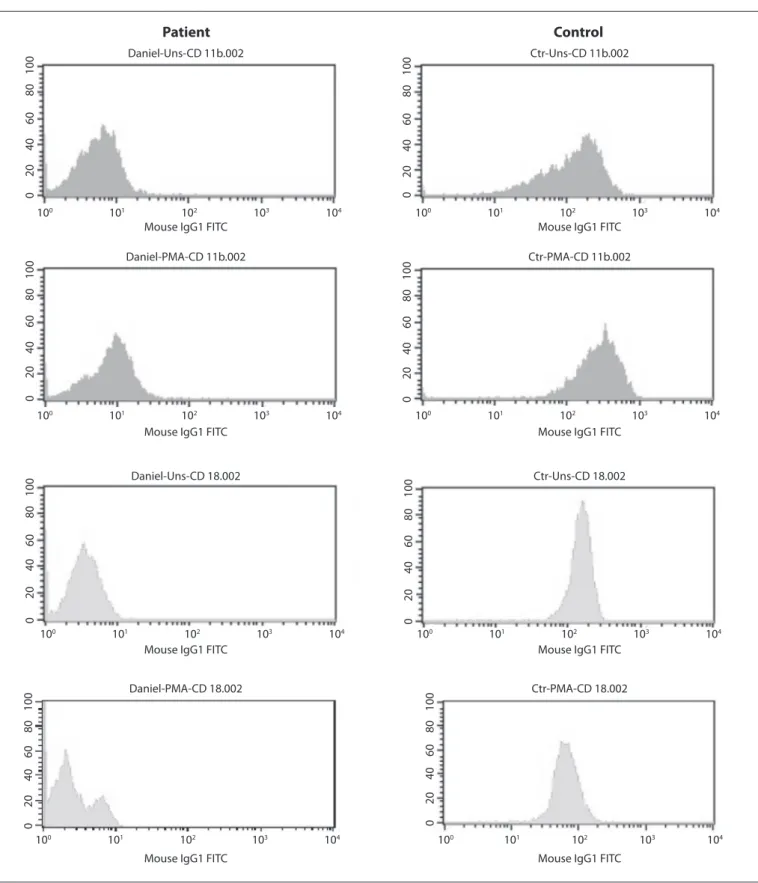
he diagnosis of leukocyte adhesion deiciency (LAD) type 1 was suspected because of the persistent leukocytosis and the his-tory of a delay in umbilical cord detachment. Because of this sus-picion, the patient was started on prophylactic oral therapy with amoxicillin/clavulanate and nystatin, and was discharged. A low cytometry analysis, kindly provided by Louisiana State University Health Sciences Center/Children’s Hospital Immunology Labora-tory, detected that the CD11 and CD18 levels were low, thus con-irming the diagnosis of LAD type 1 (Figure 1). Bone marrow or stem cell transplant was not available, and the patient died at the age of four years at another city hospital because of severe sepsis.
DISCUSSION
Congenital immunodeiciency is generally suspected during early infancy. Such conditions may be classiied into: 1) primary defects of antibody production, which represent approximately 50% of such cases (X-chromosome-linked agammaglobulinemia,
selective deicit of immunoglobulins IgA and IgG, hyper-IgM, common variable hypergammaglobulinemia, speciic antibody deicit and transient hypogammaglobulinemia); 2) combined immunodeiciency, accounting for 20% (combined severe immu-nodeiciency and immuimmu-nodeiciency relating to other defects like Wiskott-Aldrich and ataxia telangiectasia); and 3) congenital dis-eases of phagocytes and other natural immunity cells, accounting for 18%. Of these, primary defects of T lymphocytes are responsi-ble for 10%. Adhesion molecule deiciencies are extremely rare.5
Pathogenically, LAD is characterized by loss of the leuko-cytes’ ability to adhere to the endothelium during the inlam-matory cascade, thus preventing their migration to the infected tissues. In a normal person, leukocytes irst adhere to and roll along the wall of blood vessels through using selectins and gly-coconjugate ligands. hey then adhere irmly and transmigrate using integrins and endothelial ligands. Total or partial absence of these molecules leads to LAD.6
Adhesion molecule deiciencies have been classiied into two types: LAD-1 and LAD-2, depending on the molecule that is defec-tive, i.e. integrins in LAD-1 and selectins in LAD-2. Both forms of LAD have an autosomal recessive transmission pattern.4
Molecularly, integrins are heterodimeric protein receptors composed of α and β polypeptide subunits. hese subunits com-bine in humans to produce at least 24 diferent heterodimers through non-covalent associations between a beta subunit and an alpha subunit.
LAD-1 consists of failure to express the αMβ2 and αLβ2 inte-grins, which serve as the receptor for C3b in myeloid and lym-phoid cells. hese integrins are encoded by the CD18 gene, which is mapped to the long arm of chromosome 21. LAD-1 has a vari-able phenotype and may be classiied as severe, moderate or varivari-able, depending on the leukocytes’ level of CD18 expression. In the severe form, there is almost total absence of CD18 in leukocytes (< 1%), and such conditions usually end in early death. In the moderate form, the CD18 expression level is 2% to 5%, with moderate persis-tent leukocytosis, which results in less frequent infections and a bet-ter survival rate. Finally, in the variable form, normal levels of CD18 are expressed, but they are non-functional.
LAD-2 is less common and was described for the irst time in 1992 in Palestinian children born from unrelated parents.7 Its
symptoms are similar to LAD-1, but children with LAD-2 are usually mentally retarded and present failure to thrive, delayed growth, dysmorphic phenotype characteristics and a Bom-bay blood phenotype.4,7 hese infants are unable to synthesize
fucose from GDP mannose and therefore do not form the sialyl-Lewis x (sLex) ligand for the selectin molecules of the surface of neutrophils.8,9 Cell analysis on these infants shows a change in the
GDP-fucose transporter from the cytoplasm to the Golgi appara-tus.4 his is the reason why cell adherence mediated by E and P
Leukocyte adhesion deiciency syndrome: report on the irst case in Chile and South America | CASE REPORT
Sao Paulo Med J. 2012; 130(4):263-6 265 Figure 1. Flow cytometry analysis. Detection of CD18 expression in peripheral blood neutrophils and lymphocytes, in the LAD-1 patient and a healthy control. The patient had small populations of CD11b/CD18+ cells (9% and 3% respectively). PMA= phorbol myristate acetate.
Control
Patient
100 101 102 103 104
100 101 102 103 104
100 101 102 103 104
100 101 102 103 104
Daniel-Uns-CD 11b.002
Daniel-PMA-CD 11b.002
Daniel-Uns-CD 18.002
Ctr-Uns-CD 11b.002
Ctr-PMA-CD 11b.002
Ctr-Uns-CD 18.002
Daniel-PMA-CD 18.002
0
20
40
60
80
100
0
20
40
60
80
100
0
20
40
60
80
100
0
20
40
60
80
100
0
20
40
60
80
100
0
20
40
60
80
100
0
20
40
60
80
100
0
20
40
60
80
100
Mouse IgG1 FITC Mouse IgG1 FITC
Mouse IgG1 FITC Mouse IgG1 FITC
Mouse IgG1 FITC Mouse IgG1 FITC
Mouse IgG1 FITC Mouse IgG1 FITC
100 101 102 103 104
100 101 102 103 104
100 101 102 103 104
100 101 102 103 104
Ctr-PMA-CD 18.002
Patients with LAD-1 typically present recurrent bacterial and fungal infections of the skin and mucosa, delayed detach-ment of the umbilical cord, rapidly progressive periodontitis, osteomyelitis and, less commonly, hepatosplenomegaly.2,10-12
CASE REPORT | Vásques-De Kartzow R, Jesam C, Nehgme V, Várgas F, Sepúlveda C
266 Sao Paulo Med J. 2012; 130(4):263-6
Bone marrow or stem cell transplant has been shown to improve the survival of LAD-1 patients.13 he prognosis for
patients with the severe form of LAD-1, like the patient presented here, is poor. Most of them will die before reaching 10 years of age if a transplant cannot be performed. Patients with CD18 lev-els between 1 and 10% may live to the age of 40 years or more.7
Use of oral fucose could be a novel alternative for patients with LAD-2.8 Gene therapy studies are evaluating promising
treat-ments for these disorders.2
We reviewed the literature in Medline and PubMed, using the keywords CD11/CD18 - adhesion molecule deiciencies. We found that few cases of the deiciency of CD11/CD18 adhesion molecules presented by our patient had been reported. For this reason, it seems important to contribute through the present paper, towards disseminating greater understanding of this con-dition (Table 1).
CONCLUSIONS
he importance of suspecting and diagnosing this disease lies in the possibility of ofering early treatment for possible infec-tions, and prophylactic measures to improve the prognosis.
REFERENCES
1. Etzioni A, Doerschuk CM, Harlan JM. Of man and mouse:
leukocyte and endothelial adhesion molecule deiciencies. Blood.
1999;94(10):3281-8.
2. Crowley CA, Curnutte JT, Rosin RE, et al. An inherited abnormality of
neutrophil adhesion. Its genetic transmission and its association with
a missing protein. N Engl J Med. 1980;302(21):1163-8.
3. Todd RF 3rd, Freyer DR. The CD11/CD18 leukocyte glycoprotein
deiciency. Hematol Oncol Clin North Am. 1988;2(1):13-31.
4. Bunting M, Harris ES, McIntyre TM, Prescott SM, Zimmerman GA.
Leukocyte adhesion deiciency syndromes: adhesion and tethering
defects involving beta 2 integrins and selectins ligands. Curr Opin
Hematol. 2002;9(1):30-5.
5. International Union of Immunological Societies Expert Committee
on Primary Immunodeiciencies, Notarangelo LD, Fischer A, et al.
Primary immunodeiciencies: 2009 update. J Allergy Clin Immunol.
2009;124(6):1161-78.
6. Netea MG, van der Meer JW. Immunodeiciency and genetic defects
of pattern-recognition receptors. N Engl J Med. 2011;364(1):60-70.
7. Etzioni A, Frydman M, Pollack S, et al. Brief report: recurrent severe
infections caused by a novel leukocyte adhesion deiciency. N Engl J
Med. 1992;327(25):1789-92.
8. Marquardt T, Brune T, Lühn K, et al. Leukocyte adhesion deiciency
II syndrome, a generalized defect in fucose metabolism. J Pediatr.
1999;134(6):681-8.
9. Lekstrom-Himes JA, Gallin JI. Immunodeiciency diseases caused by
defects in phagocytes. N Engl J Med. 2000;343(23):1703-14.
10. Mellouli F, Ksouri H, Barbouche R, et al. Successful treatment of
Fusarium solani ecthyma gangrenosum in a patient afected by
leukocyte adhesion deiciency type 1 with granulocytes transfusions.
BMC Dermatol. 2010;10:10.
11. Jabbari Azad F, Ardalan M, Hoseinpoor Rafati A, Sotoudeh S, Pourpak
Z. Osteomyelitis in leukocyte adhesion deiciency type 1 syndrome. J
Infect Dev Ctries. 2010;4(3):175-8.
12. Cox DP, Weathers DR. Leukocyte adhesion deiciency type 1: an
important consideration in the clinical diferential diagnosis of
prepubertal periodontitis. A case report and review of the literature.
Oral Surg Oral Med Oral Pathol Oral Radiol Endod. 2008;105(1):86-90.
13. Hattori H, Tsuruta S, Horikoshi Y, et al. Successful human leukocyte
antigen one antigen-mismatched related bone marrow
transplantation in a 6-year-old boy with leukocyte adhesion
deiciency syndrome. Pediatr Int. 2001;43(3):306-9.
Sources of funding: None
Conlict of interest: None
Date of irst submission: January 6, 2011
Last received: September 8, 2011
Accepted: December 2, 2011
Address for correspondence:
Rodrigo Vásquez-De Kartzow
El Huinganal 3577 — Casa 3
Lo Barnechea — Santiago — Chile
CEP 7700-141
Tel. 56-9-92323592
E-mail: [email protected]
E-mail: [email protected]
Database Search strategy (descriptors) Results
Lilacs
Adhesion celular (DeCs) 126 articles
Síndrome de Deiciencia de Adhesión del Leucocito (DeCs) 2 articles
Síndrome de Deiciencia de Adhesión del Leucocito E niños (DeCs) 5 articles
PubMed
Leukocyte-Adhesion Deiciency Syndrome (MeSH) 201 articles
Leukocyte-Adhesion Deiciency Syndrome AND Children (MeSH) 36 articles
Cell Adhesion molecules (MeSH) 5 articles