Analysis of the Revised Trauma Score (RTS) in 200 victims of
different trauma mechanisms
Avaliação do Escore de Trauma Revisado (RTS) em 200 vítimas de trauma com
mecanismos diferentes
Bruno Durante alvarez1,2, accBc-Pr; Danilo MarDegaM razente1,2, accBc-Pr; Daniel augusto MauaD lacerDa2,3, accBc-Pr; nicole silveira lother1,2; luiz carlos von-Bahten4, tcBc-Pr; carla Martinez Menini stahlschMiDt4, acBc-Pr.
INTRODUCTION
A
nnually, 5.8 million people of all age groups anddifferent economic strata die from unintentional injuries and violence around the world, trauma receiving
the name of modern society neglected disease1-4. It is
the leading cause of death in the population aged 1-44
years old, mostly men2,4-6. According to the Trauma
American Committee, the estimate for 2020 is that
one in ten people will die from trauma2.
Classically, mortality secondary to trauma is described as having a trimodal distribution. The first peak occurs in the first seconds to minutes following trauma due to fatal injuries. The second one occurs minutes to several hours after, resulting in serious, potentially fatal injuries if there is no intensive care. Finally, the third peak occurs several days to weeks after trauma, due to complications such as sepsis and multiple organ failure2,7.
The trauma first mortality peak is due to serious and often fatal injuries, and only prevention can be ap-plied in its reduction. The second peak is due to potential-ly fatal injuries, such as subdural and epidural hematoma, hemopneumothorax, splenic rupture, liver lacerations, among others. Mortality in these cases can be reduced with early diagnosis of injuries to their rapid resolution2.
This is where the trauma scores should be used for a streamlined and effective approach to the trauma victim.
Many tools for the polytrauma care exist for better management of these patients, as well as to provide predictive factors of morbidity and mortality in order to generate statistical data for the establishment of preventive measures to trauma. Some of these tools are the trauma scores, which are mathematical or sta-tistical values, quantified by numerical scores, which vary according to the severity of injuries resulting from trauma, and help the professional in the care of the
1 - Medical School, Pontifical Catholic University, Curitiba, PR, Brazil. 2 - Trauma League, Cajuru University Hospital, Curitiba, PR, Brazil. 3 - Medical School, Positivo University, Curitiba, PR, Brazil. 4 - General and Trauma Surgery, Cajuru University Hospital, Curitiba, PR, Brazil.
Objective: to analyze the epidemiological profile and mortality associated with the Revised Trauma Score (RTS) in trauma victims treated at a university hospital. Methods: we conducted a descriptive, cross-sectional study of trauma protocols (prospectively collected) from December 2013 to February 2014, including trauma victims admitted in the emergency room of the Cajuru University Hospital. We set up three groups: (G1) penetrating trauma to the abdomen and chest, (G2) blunt trauma to the abdomen and chest, and (G3) traumatic brain injury. The variables we analyzed were: gender, age, day of week, mechanism of injury, type of transportation, RTS, hospitalization time and mortality. Results: we analyzed 200 patients, with a mean age of 36.42 ± 17.63 years, and 73.5% were male. The mean age was significantly lower in G1 than in the other groups (p <0.001). Most (40%) of the visits occurred on weekends and the most com-mon pre-hospital transport service (58%) was the SIATE (Emergency Trauma Care Integrated Service). The hospital stay was significantly higher in G1 compared with the other groups (p <0.01). Regarding mortality, there were 12%, 1.35% and 3.95% of deaths in G1, G2 and G3, respectively. The median RTS among the deaths was 5.49, 7.84 and 1.16, respectively, for the three groups. Conclusion: the majority of patients were young men. RTS was effective in predicting mortality in traumatic brain injury, however failing to predict it in patients suffering from blunt and penetrating trauma.
Keywords: Traumatology. Wounds and injuries/epidemiology. Abdominal injuries. Thoracic injuries. Craniocerebral trauma. Injury Severity Score.
injured, especially in the pre hospital environment and initial treatment in the emergency room5,8,9.
There are several trauma scores, with different levels of complexity for practical implementation. The Revised Trauma Score (RTS) is widely used by emergency services around the world. It is classified as physiological, since it takes into account parameters of the patient’s vital functions. This is an improvement of Trauma Score (TS), created in 1981, but without the assessment of capillary refill and respiratory effort, difficult variables to be analyzed in practice10. RTS assesses three parameters:
neurological evaluation by the Glasgow Coma Scale (GCS); hemodynamic evaluation by systolic blood pressure (SBP); and respiratory rate (RR)8. Depending on
the each parameter’s outcome, there is a corresponding value in the RTS scale, able to evaluate the morbidity and mortality of the polytrauma patient and, depending on the severity, indicate the recruitment of more specialized teams, to improve the approach to this type of patient.
The values of variables must be weighted
and summed by the formula: RTS = 0.9368 x GCSv +
0.7326 x SBPv + 0.2908 x RRv, where v is the value
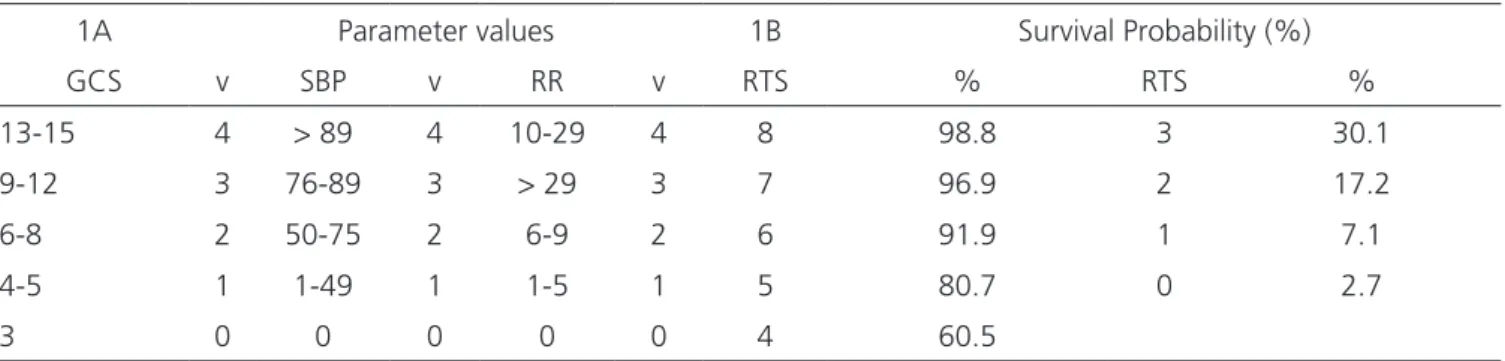
(0-4) corresponding to the variables at the patient’s admission. Thus, the RTS may vary from 0 to about 8, allowing fractions. The higher the final value, the better the prognosis, the survival probability being possibly known8 (Table 1).
On the RTS calculation formula, the greater constant multiplies the Glasgow Coma Scale, the SBP and RR being multiplied by lower constants. From this, victims of neurological trauma, whose GCS values are smaller, will have a lower final RTS result and
be classified as potentially more severe. In contrast, patients with thoracic or abdominal trauma, which at first may not display changes in level of consciousness, may result in an overestimated RTS value, apparently not predicting gravity. This failure in the evaluation of such patients may not correlate well with the actual clinical situation and case seriousness, often not demanding more specialized staff, which may impair the patient’s progress.
This study aims to analyze the epidemiological profile and mortality associated with the Revised Trauma Score (RTS) in trauma victims treated at a trauma reference university hospital.
METHODS
This study was approved by the Ethics in Re-search Committee of the Pontifical Catholic University of Paraná (number 480483 of 04.12.2013).
We prospective collected data from trauma protocols of all trauma victims seen at the Emergency Room of the Cajuru University Hospital (HUC) between December 7, 2013 and February 1, 2014 for a period of 24 hours a day including holidays. For data collection, we used the help of the Medical School undergraduates of the Cajuru University Hospital Trauma League (LATHUC). The researchers trained 35 students, accounting for a total of four hours of training, explaining the research’s importance and the proper way of filling the form.
This is a descriptive, cross-sectional study of trauma protocols (prospectively collected) held in
Curiti-Table 1. RTS Parameters and survival rate.
1A Parameter values 1B Survival Probability (%)
GCS v SBP v RR v RTS % RTS %
13-15 4 > 89 4 10-29 4 8 98.8 3 30.1
9-12 3 76-89 3 > 29 3 7 96.9 2 17.2
6-8 2 50-75 2 6-9 2 6 91.9 1 7.1
4-5 1 1-49 1 1-5 1 5 80.7 0 2.7
3 0 0 0 0 0 4 60.5
ba, a city of great size of the State of Paraná. The survey took place through the data collection of 825 records of trauma patients seen in the HUC emergency room. We randomly selected the first 200 records that had the trauma mechanisms specific of the research. We divided patients into three groups according to their mechanism of injury: Group 1 – penetrating trauma to the chest and abdomen; Group 2 – blunt trauma to the chest and ab-domen; and Group 3 – blunt trauma to the brain.
The group of variables consists of four pa-rameters, trauma mechanism, Glasgow coma scale, systolic blood pressure and respiratory rate, besides epidemiological data, such as gender, age, day of the week, type of transportation, hospitalization time and patients who died.
After tabulating the results of quantitative variables, we described them by means and standard deviations or medians and quartiles. We described qualitative variables as frequencies and percentages. To compare the types of trauma (penetrating, blunt or brain) in relation to age, we used the analysis of variance (ANOVA) with one factor or the nonparametric Kruskal-Wallis test. For comparison regarding death, we used the Fisher’s exact test. We considered p values <0.05 as statistically significant. We analyzed data with the software SPSS Statistics v.20.0.
RESULTS
The study included 200 trauma victims, ranging in age from six to 91 years (mean 36.42 ± 17.63), 73.5% being male. Of the total sample, we found 50 patients who suffered penetrating trauma – gunshot wounds (GW) and stabbing wounds (SW) – to the chest and abdomen, 74 patients sustaining blunt trauma to the chest and abdomen and 76 patients with brain blunt trauma. When comparing the quantitative variables between the groups with penetrating trauma (G1), with blunt trauma (G2) and traumatic brain injury (G3), we noted statistically significant (p <0.001) differences between G1 and G2 – mean age 27.1 ± 11.1 years versus 38.5 ± 15.5,
and between G1 and G3 – 27.1 ± 11.1 years versus 40.6 ± 20.7. We did observe statistical significance (p =0.442) between G2 and G3 – 38.5 ± 15.5 years versus 40.6 ± 20.7 years. The male gender was the most frequent in the three groups: G1 = 46 (92%), G2 = 54 (73%) and G3 = 47 (61.9%).
The main type of pre-hospital transportation was the emergency room was SIATE (Emergency Trau-ma Care Integrated Service – 193), responsible for the transport of 116 (58%) patients, followed by SAMU (Mobile Emergency Service – 192), responsible for for 43 (21.5%), highway concessionaire, for 14 (7%), di-rect search for 14 (7%) and other means of transpor-tation, by 13 (6.5%) patients.
The most common mechanisms of trauma in each group were: G1 – GW, 31 (62%) and SW, 19 (38%); G2 - motorcycle accident, 24 (32.4%), automobile accident, 20 (27%), fall from height, ten (13.5%), assault, six (8.1%), fall from own, height four (5.4%), bike accident, three (4.1%) and running over, 2 (2,7%); G3 – car accident, 14 (18.4%), fall from own height, 14 (18.4%), assault, 14 (18.4%), running over, 13 (17.1%), motorcycle accident, eight (10.5%), fall from height, seven (9.2%) and bike ac-cident, six (8%).
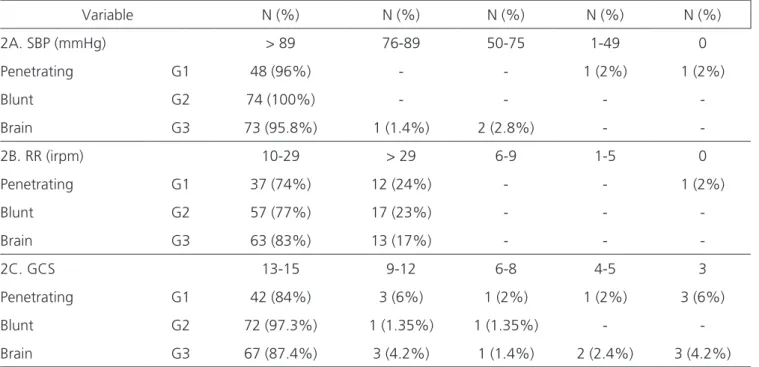
Table 2 shows the distribution of RTS parameters in each study group.
The mean RTS value for the total sample was 7.53. In G1, the average was 7.29 and median 7.84 with 1st and 3rd quartile = 7.84. In G2, the RTS average
was 7.79 and median 7.84 with 1st and 3rd quartiles
with the same value. In G3, the average was 7.44 with
a median of 7.84 and 1st and 3rd quartile = 7.84. We
found statistically significant (p =0.003) when compar-ing the medians between the groups G1 and G2, but not when assessing G1 versus G3 (p =0.207) and G2 versus G3 (p =0.052).
The data regarding the length of stay are shown in Table 3, the overall average being 12.76 ± 32.29 days.
Of the 200 evaluated patients, ten (5%) died, six as a result of penetrating trauma, three due
to brain trauma and one victim by blunt trauma. Mor-tality and comparison between groups are presented in Table 4.
All G1 deaths were male and the median age
was 25.5 years, with the 1st quartile 22.25, and 3rd,
31. The Glasgow Coma Scale presented a median of six, with 1st quartile three, and 3rd, 13.5. The median
length of stay was 0.5 days, with 1st quartile in zero
and 3rd quartile of 2.5 days. In G2, there was one death
of a 78 year old woman, GCS 15, RTS 7.84 and two days of hospitalization. In G3, two (66.6%) were male,
the median age was 81 years, with the 1st quartile 64
and 3rd, 82; median GCS was three, with 1st quartile 3
and 3rd quartile, seven; for RTS the median was 1.16,
with 1st quartile 0.58 and 3rd, 2.62; and a median
hos-pitalization time of six days, with 1st quartile six and
3rd quartile 12.
Table 2. Distribution of the RTS parameters by groups.
Variable N (%) N (%) N (%) N (%) N (%)
2A. SBP (mmHg) > 89 76-89 50-75 1-49 0
Penetrating G1 48 (96%) - - 1 (2%) 1 (2%)
Blunt G2 74 (100%) - - -
-Brain G3 73 (95.8%) 1 (1.4%) 2 (2.8%) -
-2B. RR (irpm) 10-29 > 29 6-9 1-5 0
Penetrating G1 37 (74%) 12 (24%) - - 1 (2%)
Blunt G2 57 (77%) 17 (23%) - -
-Brain G3 63 (83%) 13 (17%) - -
-2C. GCS 13-15 9-12 6-8 4-5 3
Penetrating G1 42 (84%) 3 (6%) 1 (2%) 1 (2%) 3 (6%)
Blunt G2 72 (97.3%) 1 (1.35%) 1 (1.35%) -
-Brain G3 67 (87.4%) 3 (4.2%) 1 (1.4%) 2 (2.4%) 3 (4.2%)
SBP: systolic blood pressure, mmHg: millimeters of mercury, RR: respiratory rate, irpm: respiratory incursions per minute, GCS: Glasgow coma scale.
Table 3. Distribution and comparison by length of hospital stay.
Group Median 1st quartile 3rd quartile Range Comparison p
G1 5 3 7 0-200 G1xG2 < 0.001
G2 0 0 1 0-56 G1xG3 < 0.001
DISCUSSION
One of the problems of the trauma victims approach is that the profile of the people cared differ as to the nature and severity of injuries. The heterogeneity and difficulty in adjusting these variations
have stimulated scientific research8. In the present
study there was a predominance of injuries in males (73.5% of the sample), in the age range considered economically active, ie young adults, as observed in the literature2,4-6,8,11. Penetrating injuries were the ones
affecting younger patients, with a mean age of 27.1 years. The highest overall prevalence of injuries occurred on weekends, 40% of cases.
Regarding the type of transportation to the emergency room, there was a predominance of SIATE – 193 – in all groups, and SAMU – 192 – in blunt and head injuries, 22% of patients suffering from pene-trating wounds having been admitted after arriving through direct search, the second most prevalent type of transportation in the group.
The most prevalent mechanism in the penetrating trauma group was gunshot wound, while in blunt trauma and brain injury groups it was accidents caused by motor vehicles. According to studies by the National Department of Highways (DNER), the average cost per injured person is US$ 13,360.00, this value comprising medical expenses, property damage (vehicles and highways) and the victim’s loss of income during
the period of inactivity16. This confirms the important
role of trauma prevention in improving the economy and reducing public spending, which has been shown by several studies11-13.
Regarding RTS variables, we found that patients who suffered penetrating and blunt trauma
presented, within the physiological parameters, with lower values of respiratory rate, while the systolic blood pressure values did not show significant variations. On the other hand, patients suffering from blunt injury had higher Glasgow Coma Scale values compared with the other groups. RTS values were higher among victims of blunt injury compared with victims of penetrating injury. However, when analyzing the power in predicting mortality, the three groups had similar RTS mean values.
The length of stay proved to be significantly different when comparing the three groups. The vic-tims of penetrating trauma required more in-hospi-tal period, becoming more costly cases to the public health system, a fact corroborated by the literature, showing that individuals victims of gunshot wounds (penetrating) have an average of 7.7 days of hospi-talization, with an average cost of US$ 692.95 to the
hospital4. Another problem related to long hospital
stay of trauma patients is that they contribute to over-crowding, since the lack of beds is a common health problem in the Brazilian system4.
Most patients were admitted with RTS values above seven, predicting good chance of survival. Even with average RTS values similar to other groups, victims of penetrating wounds had a mortality of 12%. Among the cases of blunt trauma, mortality was 1.35%, and in victims of traumatic brain injury, 3.95%. We can therefore see that even being a universally accepted trauma score, RTS is faulty when analyzing patients in groups individualized by trauma mechanism, since it does not account for this variable.
The deficiency observed in the RTS compu-tation between groups can be explained by the fact that the variable Glasgow Coma Scale (GCS) displays Table 4. Mortality and RTS values.
Group Deaths (n) Mortality
rate
Median
RTS 1st quartile 3rd quartile Comparison p
G1 6 12% 5.49 2.44 7.38 P x C 0.017
G2 1 1.35% 7.84 - - P x Cr 0.154
the highest constant in the score calculation. In ad-dition, patients suffering from brain trauma more often enter the emergency room with lower minor GCS values due to local injury, while in patients with trauma to the chest and abdomen (penetrating and blunt) the level of awareness may be maintained during initial evaluation. Thus, the hypothesis arises that the variable “mechanism of injury” is an im-portant predictive factor of mortality, future studies being needed.
When comparing only patients who died, we found statistical significance: while in G2 the
victim had a RTS median value of 7.84 (98.8% survival probability), in G1 and G3 the median values were 5.49 (60.5% to 80.7% probability of survival) and 1.16 (7% survival probability), respectively.
In conclusion, RTS was effective in predicting the sample overall mortality, the majority of cases displaying RTS above seven, which indicates a high probability of survival. However, when compared groups, RTS was more effective in analyzing the survival rate in patients suffering from traumatic brain injury than doing so for patients with penetrating and blunt trauma to the chest and abdomen.
REFERENCES
1. Sociedade Brasileira de Atendimento Integrado ao Traumatizado [Internet]. São Paulo: SBAIT; c1982-2015 [cited 15 Aug c1982-2015]. Available from: http:// www.sbait.org.br/
2. American College of Surgeons ATLS. Advanced Trauma Life Support: Student Course Manual. 9. ed. Chicago: American College of Surgeons; 2012. 3. Von Bahten LC, Alcantra EM, Pimenta APP, Dalla-gnol JC, Yoshizumi KO DM, Dresch MF. O impacto econômico do trauma em um hospital universitário. Rev Col Bras Cir. 2003;30(3):224-9.
4. Broska Jr CA, Folchini AB, Ruediger RR. Estudo comparativo entre o trauma em idosos e não idosos atendido em um Hospital Universitário de Curitiba. Rev Col Bras Cir. 2013;40(4):281-6.
5. Wilson JL, Herbella FAM, Takassi GF, Moreno DG,
Tineli AC. Lesões fatais em trauma numa grande metrópole brasileira: um estudo de autópsias. Rev Col Bras Cir. 2011;38(2):122-6.
6. Gunst M, Ghaemmaghami V, Gruszecki A, Urban J, Frankel H, Shafi S. Changing epidemiology of trauma deaths leads to a bimodal distribution. Proc (Bayl Univ Med Cent). 2010;23(4):349-54.
7. Champion HR, Sacco WJ, Copes WS, Gann DS, Gennarelli TA, Flanagan ME. A revision of the Trau-ma Score. J TrauTrau-ma. 1989;29(5):623-9.
8. Domingues CA, Nogueira LS, Settervall CHC, Souza RMC. Desempenho dos ajustes do Trauma and
In-jury Severity Score (TRISS): revisão integrativa. Rev
Esc Enferm USP. 2015;49(Esp):138-46.
9. Gabbe BJ, Cameron PA, Finch CF. Is the revised trau-ma score still useful? ANZ J Surg. 2003;7(11):944-8. 10. Paixão LMMM, Gontijo ED, Drumond EF, Friche
AAL, Caiaffa WT. Acidentes de trânsito em Belo
Objetivo: analisar o perfil epidemiológico e a mortalidade associada ao escore de trauma revisado (RTS) em vítimas de trauma atendidas em um hospital universitário. Métodos: estudo transversal descritivo de protocolos de trauma (coletados prospectivamente) de dezembro de 2013 a fevereiro de 2014, incluindo vítimas de trauma admitidas na sala de emergência do Hospital Universitário Cajuru. Três grupos foram criados: (G1) trauma penetrante em abdome e tórax, (G2) trauma contuso em abdome e tórax, e (G3) trauma cranioencefálico. As variáveis analisadas foram: sexo, idade, dia da semana, mecanismo de trauma, tipo de transporte, RTS, tempo de internamento e morta-lidade. Resultados: analisou-se 200 pacientes, com média de idade de 36,42 ± 17,63 anos, sendo 73,5% do sexo masculino. A média de idade no G1 foi significativamente menor do que nos demais grupos (p <0,001). A maioria (40%) dos atendimentos ocorreu nos finais de semana e o serviço de transporte pré-hospitalar mais frequente (58%) foi o SIATE (Serviço Integrado de Atendimento ao Trauma em Emergência). O tempo de internamento foi significativamente maior no G1, em comparação aos demais grupos (p <0,01). Quanto à mor-talidade, houve 12%, 1,35% e 3,95% de óbitos nos grupos G1, G2 e G3, respectivamente. A mediana do RTS entre os óbitos foi 5,49, 7,84 e 1,16, respectivamente, para os três grupos. Conclusão: a maioria dos pacientes eram homens jovens. O RTS mostrou-se efetivo na predição de mortalidade no trauma cranioencefálico, entretanto falhou ao analisar pacientes vítimas de trauma contuso e penetrante.
Descritores: Traumatologia. Traumatismos/epidemiologia. Traumatismos abdominais. Traumatismos torácicos. Traumatismos cranioce-rebrais. Escala de Gravidade do Ferimento.
Horizonte: o que revelam três diferentes fontes de informações, 2008 a 2010. Rev Bras Epidemi-ol. 2015;18(1):108-22.
11. Carreiro PRL, Drumond DAF, Starling SV, Mori-tz M, Ladeira RM. Implantação de um registro de trauma em um hospital público brasileiro: os primeiros 1000 pacientes. Rev Col Bras Cir. 2014;41(4):251-5.
12. Dutra VC, Caregnato RCA, Figueiredo MRB, Schneider DS. Traumatismos craniocerebrais em motociclistas: relação do uso de capacete e gravi-dade. Acta Paul Enferm. 2014;27(5):485-91.
Received in: 18/05/2016
Accepted for publication: 18/08/2016 Conflict of interest: none.
Source of funding: none.
Mailing address:
Bruno Durante Alvarez