Thaís Moreira São-JoãoI Roberta Cunha Matheus RodriguesI
Maria Cecília Bueno Jayme GallaniII
Cinthya Tamie de Passos MiuraIII Gabriela de Barros Leite DominguesIII
Gaston GodinII
I Faculdade de Enfermagem. Universidade Estadual de Campinas. Campinas, São Paulo, SP, Brasil
II Faculté des Sciences Infi rmières. Université Laval. Quebec, Canadá
III Programa de Pós-Graduação em Enfermagem. Faculdade de Enfermagem. Universidade Estadual de Campinas. Campinas, SP, Brasil
Correspondence: Thaís Moreira São-João
Faculdade de Enfermagem – Unicamp Rua Tessália Vieira de Camargo, 126 Cidade Universitária “Zeferino Vaz”
13083-887 Campinas, SP, Brasil E-mail: [email protected] Received: 11/11/2011 Approved: 10/14/2012
Article available from: www.scielo.br/rsp
Cultural adaptation of the
Brazilian version of the
Godin-Shephard Leisure-Time Physical
Activity Questionnaire
ABSTRACT
OBJECTIVE: To conduct the cultural adaptationof the Brazilian version of the
Godin-Shephard Leisure-Time PhysicalActivity Questionnaire(GSLTPAQ)
and to assessits content validity, practicability, acceptability and reliability.
METHODS: The stages of translation, synthesis, back translation, expert committeereviewand pre-test were carried out, followedby the evaluation of thepracticability, acceptability and reliability (test-retest). The judges assessed its semantic, idiomatic, conceptual, cultural and metabolic equivalences. The adapted version was submitted to the pre-test (n = 20), and test-retest (n = 80), in healthy individuals and in those suffering from cardiovascular disease in Limeira, SP, Southeastern Brazil, between 2010 and 2011. The proportion of agreement of the committee of judges was assessed using the Content Validity Index. Reliability was assessed by the criterion of stability, with 15 days between applications. Practicability was evaluated by the time spent interviewing and acceptability was estimated as the percentage of unanswered items and the proportion of patients who responded to all items.
RESULTS: The translated version of the questionnaire showed evidence of appropriate semantic-idiomatic, conceptual, cultural and metabolic equivalence, with substitutions of several physical activities more appropriate to the Brazilian population. The practicability analysis showed short time needed for the application of the instrument (mean 3.0 minutes). As for acceptability, all patients answered 100% of the items. The test-retest analysis suggested that stability was good (Intraclass Correlation Coeffi cient value of 0.84).
CONCLUSIONS: The Brazilian version of the questionnaire showed satisfactory measures of the qualities in question. Its application to diverse populations in future studies is recommended in order to provide robust measures of these qualities.
The main measures of the behavior of physical activity (PA) are physiological indicators (oxygen consumption, heart rate) and self-reported measures (questionnaires or diaries, for example).6 Questionnaires have been
widely used due to their applicability, low cost and because they allow accurate information to be collected on the type and context of activities which take place.6
The Godin-Shephard Leisure-Time Physical Activity Questionnaire(GSLTPAQ)13 was developed in Canada in
1985, aimed at measuring leisure-time physical activity (LTPA). The questions in the instrument were drawn up after careful evaluation of items used in other instruments which had proved, in univariate analysis, to successfully discriminate sedentary individuals from active ones.13
The original questionnaire was validated among 306 health individuals, testing its correlation with the predicted maximal oxygen consumption and body fat percentage. This questionnaire has been widely used on a global level among different populations affected by health problems such as colorectal20 and breast
cancer,22 multiple sclerosis16 and sleep apnea.19 When it
was created, its reliability was estimated at 0.94 for the strenuous activities score and 0.74 for the total LTPA score, using the Kappa index.13
It is a short questionnaire, designed to be self-adminis-tered and aimed at evaluating the frequency and inten-sity of PA carried out during one week. The respondent reports the number of times in which he/she performs at least 15 minutes of strenuous, moderate and mild PA in a typical seven-day-period. The frequency reported by the individual is multiplied by the coeffi cient of exertion corresponding to the energy expenditure in metabolic equivalents (MET) of the activity in question, produ-cing a score in arbitrary units. Higher scores indicate a higher level of LTPA, and lower scores, lower levels of LTPA.13
The GSLTPAQ, having been especially validated to recognize the practice of strenuous and moderate PA, may also be used with populations who perform mild activities. Its easy application and validity of estimating PA attracted the interest of researchers, especially after having been included in a special edition of Medicine and Science in Sports and Exercise,5 in 1997, as a valid
tool for measuring PA. In that edition, the tool was named
Godin Leisure-Time Exercise Questionnaire. However, in a 2011 review, Godin renamed it the Godin-Shephard Leisure-Time Physical Activity Questionnaire,12 stating
that, according to Google Scholar, the questionnaire had
INTRODUCTION
been cited around a thousand times. Consulting the elec-tronic database Medline (PubMed version), 83 scientifi c citations of the instrument were found, ratifying its use in the scientifi c community.a
Godin12 proposed categorizing the total GSLTPAQ score as “active”, “moderately active” or “insuffi ciently active”, according to international recommendations,b
with the aim of respecting the dose-response rela-tionship between the volume of physical activity and health benefi ts it provides.
LTPA has received a lot of attention in recent years. Caspersen et al8 state that individuals who report doing
no physical activity in their leisure time had lower levels of physical activity in their daily life, suggesting that LTPA constitutes an important part of physical activity related to being physical inactive.
There are no instruments specifically designed to measure LTPA in Brazil and measuring this construct is important both for those with cardiovascular disease (CVD) and for healthy individuals.
Therefore, the aim of this study was to carry out the cultural adaptation of the Godin-Shephard Leisure-Time Exercise Questionnaire to the Brazilian Portuguese language and evaluate its acceptability, practicability and reliability with regards to temporal stability.
METHODS
The term ‘cultural adaptation’ has been used to cover a process which analyzes language/translation in the process of drawing up a questionnaire to be used in another situation.7 Through this adaptation – bearing
in mind cultural differences in perceptions of health, language, cultural context and the lifestyle of the population in question1 –, it was possible to maintain
linguistic and cultural equivalence of the items in the instrument, as well as its relevance, even with the necessity of occasionally modifying them for the culture in question.7
In our study, the process of cultural adaptation was developed based on the widely used methodology proposed by Beaton et al.7 This methodology delimits
the process to the specifi c stages of initial trans-lation, synthesis of translations, back-transtrans-lation, revision by an expert committee and a test of the pre-fi nal version.7
a US National Library of Medicine. Citations of Godin and Shephard, 1985, in PubMed Central Articles. [cited 2011 Set 2]. Available from: http://www.ncbi.nlm.nih.gov/pubmed?db=pubmed&cmd=link&linkname=pubpub_pubmed_citedin&uid=4053261
After obtaining the author’s permission, the original version of the GSLTPAQ was translated, independently, by two bilingual translators whose native language was Brazilian Portuguese. One of the translators was informed of the conceptual structure and objectives of the scale to be translated and the other carried it out with no knowledge of the objective, as recommended.1,7
To synthesize the translations, the translated versions of the instrument – translation 1 (T1) and translation 2 (T2) – were analyzed and compared by the rese-archers and by a mediator – professional translator – according to international norms.4 Discrepancies
between T1 and T2 were analyzed until consensus was reached, and a single translated version of the GSLTPAQ(T-12) was produced.
This synthesis (T-12) was translated back into English in a process called back-translation. The back-translation was carried out by two other bilingual translators, whose native language was English and who had not participated in the stage of translations. These transla-tors were not informed of the concept and objectives of the instrument and had no academic education in the area of health care. At the end of this stage, two versions of the back-translation were obtained – back-translation 1 (BT1) and back-translation 2 (BT2) – with the aim of revising the translations and avoiding possible ambi-guous interpretations.1,7
A panel of specialists was set up to assess the semantic, idiomatic, conceptual and cultural equivalencies of the items in the original instrument and the translated version of the GSLTPAQ, with the aim of obtaining one single version to be used in the pre-test stage.2
Seven bilingual recognized experts in the area took part in the committee, having fi rst met at least one of the following criteria: recognized knowledge in cultural adaptation, experience or having worked in the area, experience in research involved with applying measu-ring instruments and skill in recognizing expressions in the English language, as well as being at ease in Brazilian Portuguese.
This committee’s instrument contained as annexes the translated versions, the synthesis of the GSLTPAQ, the back-translations and a guide for evaluating the translated version of the GSLTPAQ, according to semantic, idiomatic, cultural and conceptual equiva-lences, properties defi ned as following:
• Semantic-idiomatic equivalence: whether the items translated into Portuguese preserved the meaning of the original version;
• Cultural equivalence: whether the situations described in the items corresponded to situations experienced in the Brazilian cultural context;
• Conceptual equivalence: whether the situations described in the items really evaluate the physical activity that would be carried out by cardiac patients. Bearing in mind that the original version of the GSLTPAQ is mostly composed of physical activities commonly carried out in the Canadian culture, it was decided to substitute the physical activities in the original instrument, which were considered to be incompatible with Brazilian culture, for activities considered common in that culture. Thus, based on the metabolic equivalents provided by the Brazilian version of the Ainsworth Compendium of Physical Activities,10
the physical activities deemed to be incompatible with Brazilian culture were substituted by others, specifi c to the Brazilian context and metabolically equivalent to those originally described.
The committee for evaluating metabolic equivalence was formed of three judges with experience in teaching and research, using objective instruments for measuring and evaluating physical activity and cardiorespiratory
fi tness. The experts were instructed to examine the metabolic equivalence, consisting of analyzing whether the physical activities contained in the items in the original instrument and those which substituted them in the Brazilian version, possessed the same energy expenditure as the activities in the original GSLTPAQ. At the end of the content validation stage, the pre-test was carried out, using the adapted version on 20 indivi-duals (ten with hypertension and ten healthy volunteers) in a university hospital in Campinas, SP, Southeastern Brazil, in October and November 2010. After respon-ding to each item on the scale, the participants were interviewed with the aim of investigating the problems they perceived in understanding each statement, as well as identifying terms that were diffi cult to understand. It was also investigated whether the participants had problems in the scoring scale of the statements. After the content validation the instrument was assessed as to its practicability, acceptability and reliability.1,7
The instrument’s validation stage was carried out in a specialized outpatient clinic in Limeira, in the state of Sao Paulo.
orthopedic or vascular problems and cancer) and who were not taking any medicines such as beta blockers, anti-hypertensives or diuretics.
To verify the inclusion of healthy individuals, a checklist of criteria for inclusion was drawn up. Although the checklist did not ensure the participants’ state of health, it evidenced no CVD diagnosis. Any participants (among those with CVD and the healthy individuals) who had other clinical conditions which made it impossible for them to regularly perform physical activity – such as motor problems of neuro-logical origin, vascular, orthopedic or other conditions as well as those individuals who, on the day of the cardio-pulmonary exercise test, had taken medication capable of altering the heart rate (such as beta-blockers) – were excluded from the sample.
Those whose liberation to engage in physical activity was suspended and/or those who dropped out of the study during the data collecting stage, or who were unable to attend the again were also not included in the study. The sample was composed, sequentially, of individuals who were followed in the abovementioned clinic, accor-ding to the inclusion and exclusion criteria, enrolled in the research in the period set for data collection, October 2010 to July 2011.
Partial correlation coeffi cients between measures of physical activity and cardiorespiratory fi tness were calculated with the respective 95% confi dence intervals (95%CI), with the aim of ensuring adequate sample size, as well as the reliability and reproducibility of the fi ndings.21
The data were gathered individually, in a private environment, in two stages. In the fi rst step (Time 0), formal consent for participating in the study and socio-demographic and clinical data through interviews and medical records were obtained. The measures of psychosocial variables were obtained in structured individual interviews in order to ensure the uniformity of the data, as the majority of the subjects presented low levels of schooling in years of study. At this time, the adapted version of the GSLTPAQ was administered in an interview (test). Later, the Brazilian version was reapplied (retest – Time 1) using a proportion of the
subjects who had participated in the test, in similar conditions, with an interval of 15 days between the fi rst and second application.17 Only those participants who
already had a return appointment in the abovementioned clinic (n = 80) took part in this stage.
To collect the data, previously content validated instru-ments aimed at characterizing socio-demographic and clinical data were used. The GSLTPAQ was adminis-tered as an interview, considering its two questions: the
fi rst approaches the frequency and intensity of LTPA; the second is aimed at other activities that lead to swea-ting and, therefore, present energy expenditure.12,13 To
calculate the total LTPA score, only the answers to the
fi rst question were considered, as recommended. Thus, in this question, the individual reported the number of times in which he/she did at least 15 minutes of physical activity of strenuous, moderate or mild intensity. The response for each type of physical activity is multi-plied by a coeffi cient of exertion (MET) that includes a constant. This coeffi cient is 9 for strenuous physical activity, 5 for moderate physical activity and 3 for mild physical activity, resulting in the following equation:
Total LTPA score = (9 x strenuous physical activity) + (5 x moderate physical activity)
+ (3 x mild physical activity)
In 2011, Godin12 categorized the total LTPA score as
described in Table 1. This paper suggested that only the frequency of strenuous and moderate physical activity should be considered when calculating the total GSLTPAQ score, as the majority of activities classifi ed as “mild” in the original instrument do not provide subs-tantial health benefi ts, apart from walking and golf.12
However, considering that walking plays an important role in the Brazilian range of physical activities,23 it
was decided to maintain the total GSLTPAQ score, also including the mild physical activities. Thus, the results are shown according to both scores, including and excluding mild activities. In contrast to the original questionnaire, in this study it was decided to use an interview format, considering the low socio-economic level of the target population.
The GSLTPAQ’s practicability and acceptability were evaluated in the pre-test stage. Practicability refers to the time needed to apply the instrument, the cost of the method and any specifi cations about the location and
Table 1. Categorization of the Godin-Shephard Leisure-Time Physical Activity Questionnairea score.
Total LTPA score (arbitrary units)
Energy expenditure
(kcal/kg/week) Individual’s classifi cation Benefi ts of the physical activity
< 14 < 7 Insuffi ciently active Less substantial
14-23 7-13,9 Moderately active Some
24 14 Active Substantial
LTPA: Leisure Time Physical Activity
situations in which the questionnaire can be applied. Acceptability is related to the respondent’s understanding of the items which form the questionnaire, demonstrated by the percentile of missing or refusal of the items of a questionnaire.17 The reliability of the Brazilian version
of the GSLTPAQ was evaluated using the test-retest. In order to evaluate the semantic-idiomatic, concep-tual, cultural and metabolic equivalence the Content Validity Index (CVI), which measures the proportion or percentage of judges in agreement about the general items and aspects evaluated was used.2 This calculation
enables each item which composes the instrument to be analyzed individually and as a whole. The relevance and representativeness of the items are evaluated using a Likert-type scale with scoring which varies from 1 up to 4 (1= not relevant or representative; 2 = needs major alterations in order to be representative; 3 = needs minor alterations to be representative; 4 = relevant or representative). The CVI was calculated by summing the total of the items which received scores of 3 or 4, divided by the total number of responses.2 The items
which received scores of 1 or 2 were revised.
In the descriptive analysis, frequency tables were drawn up, measuring position (mean, median, minimum and maximum) and dispersion (standard deviation) for the sociodemographic and clinical data and for the total GSLTPAQ score. In the pre-test stage, the practicability – related to the amount of time spent on interviews, measured in minutes – and the acceptability – estimated by the percentage of items not responded to and the proportion of patients who responded to all of the items – were evaluated.
In the reliability analysis, with regards to the stability of the measure, a concordance between repeated measure-ments (test-retest) was verifi ed using the intra-class correlation coeffi cient (ICC). Stability of the measure was deemed to be ICC > 0.90.11
The level of signifi cance was deemed to be p-value
≤ 0.05.
The Statistical Package for Social Sciences, version 17.0, was used to carry out the statistical analysis. The study was approved by the Ethics Committee of the of the Faculdade de Ciências Médicas of the
Universidade de Campinas, on 24th November 2009
(Document 1.062/2009). All the enrolled participants signed the consent form.
RESULTS
Regarding the content validity, after the GSLTPAQ’s semantic-idiomatic, conceptual and cultural equiva-lence evaluation by judges, small changes related to some translated terms were suggested, such as substitu-ting the word “rapidamente” (Brazilian Portuguese for
rapidly) for the expression “muito rápido” (Brazilian Portuguese for very fast).
The proportion of agreement between the experts on the analysis of the semantic-idiomatic, conceptual and cultural equivalences is shown in Table 2. With the aim of facilitating the specialists’ evaluation, the instrument was divided didactically into 11 sections/items, including the title of the instrument, the instructions, the questions themselves and the instructions for obtaining the score.
Table 2. Scores obtained in the evaluation of semantic-idiomatic. conceptual and cultural equivalence for items from the
Brazilian version of the Godin-Shephard Leisure-Time Physical Activity Questionnaire and respective content validity indexes. Campinas, SP, Southeastern Brazil, 2010.
Item Judge 1 Judge 2 Judge 3 Judge 4 Judge 5 Judge 6 Judge 7 CVI SI CO CUL SI CO CUL SI CO CUL SI CO CUL SI CO CUL SI CO CUL SI CO CUL SI CO CUL
1 4 4 4 3c 4d 4 4 4 1a 3 3 4 4 4 4 4 4 4 4 4 4 1.0 1.0 0.8
2 4 4 4 3 3 3 4 4 1 4 4 4 3 4 3 4 4 4 3 3 4 1.0 1.0 0.8 3 4 4 4 3 3 3 4 4 1 3 4 4 4 4 4 4 4 4 4 4 4 1.0 1.0 0.8 4 3 3 3 3 4 4 4 4 4 3 4 4 4 4 4 4 4 4 4 4 4 1.0 1.0 1.0 5 4 4 4 3 4 4 4 4 4 4 4 4 4 4 4 4 4 4 4 4 4 1.0 1.0 1.0
6 4 4 4 4 4 4 4 4 4 4 4 4 4 4 4 4 4 4 4 4 4 1.0 1.0 1.0 7 3 4 4 3 3 3 4 4 1 3 2b 3 3 3 3 4 4 4 3 4 3 1.0 1.0 0.8
8 4 4 3 3 4 4 4 4 1 4 2 3 3 3 3 4 4 4 4 4 3 1.0 1.0 0.8 9 4 4 4 2 3 3 1 1 1 4 4 4 3 3 3 4 4 4 4 4 4 0.7 0.8 0.8
10 4 4 4 3 4 4 4 4 1 3 4 4 3 3 3 4 4 4 4 4 4 1.0 1.0 0.8 11 4 4 4 4 4 4 4 4 4 3 3 3 4 4 4 4 4 4 3 4 4 1.0 1.0 1.0 SI: Semantic-idiomatic equivalence; CO: Conceptual equivalence; CUL: Cultural equivalence; CVI: Content Validity Index
The results indicated CVI between 0.8 and 1.0 in ten (10) of the eleven (11) items evaluated. Only the item 9 obtained CVI below 0.75, which was then revised to obtain a consensus between the judges.
The judges’ analysis of metabolic equivalence is shown in Table 3. The results showed CVI = 1.0 in eleven (11) of the thirteen (13) items evaluated. Only the items “squash”, substituted in the Brazilian version for “skipping rope”, and the item “baseball”, replaced with “riding a bicycle (without much effort)”, obtained CVI lower than 0.75, and were revised to obtain the judges’ consensus.
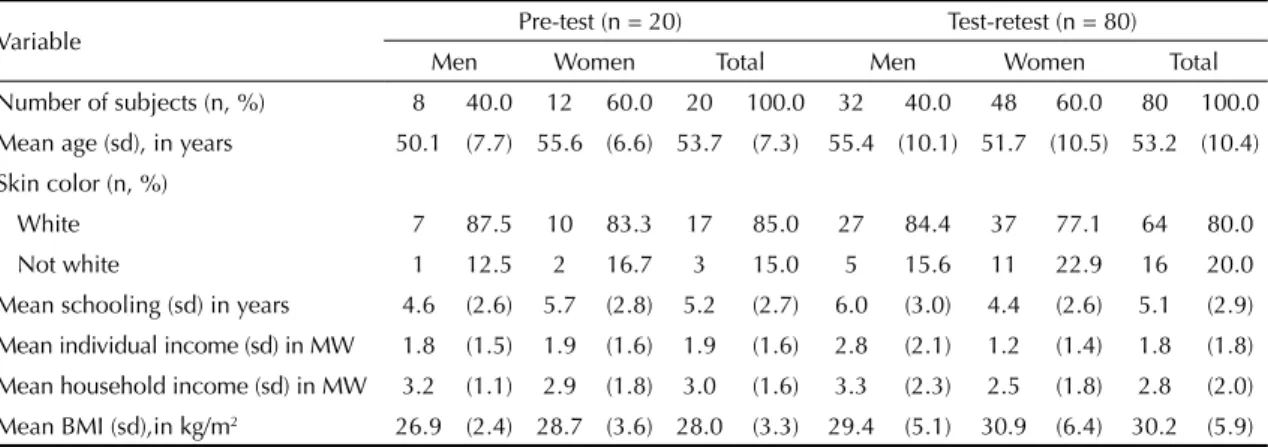
The pre-test sample (n = 20) was composed mainly of women (60.0%), with a mean age of 53.7 (7.3) years old, whites, with 5.2 (2.7) years of schooling, cohabiting; professionally active; with low individual and household income. Of those with CVD, 50.0% had been diagnosed with hypertension, 50.0% with CAD and 20.0% were overweight or obese. The re-test sample (n = 80), distinct from the pre-test sample, was also composed of a majority of women, with a mean age of 53.2 (10.4) years old, whites, with low levels of schooling; cohabiting; professionally active; with low individual and family income (Table 4).
With regards to the practicability of the Brazilian version of the GSLTPAQ evaluated at the pre-test (n = 20), the results suggest that it is an easy-to-apply instrument, with a mean application time of 3.0 (SD = 0.5) minutes.
With regards to the acceptability, the fi ndings indicate that the instrument was simple to understand, as 100% of the patients responded to all of the items. The inter-view carried out with the patients who participated in the pre-test, after the GSLTPAQ had been applied, reve-aled that the patients understood what was being asked. The GSLTPAQ showed reliability with regards to temporal stability, expressed by an intraclass corre-lation coeffi cient (ICC) of 0.84 for the total LTPA score, including mild physical activities and 0.81 for the score not including mild physical activities. As for the weekly frequencies of type of physical activities reported, strenuous physical activities represented the ICC = 0.79, moderate physical activities had an rate of 0.80 and mild activities of 0.82 (Table 5).
DISCUSSION
Through the content validation stage, using two committees of experts to analyze the semantic-idio-matic, conceptual, cultural and metabolic equivalences, the instrument was assessed as being equivalent, having undergone some small adjustments. Some of the exam-ples of physical activities, which illustrate the questions of the original instrument, were substituted to better meet the characteristics of the Brazilian population. Two examples of strenuous physical activities present in the original instrument were excluded as they were assessed as not being equivalent to other similar acti-vities in the Brazilian population.
Table 3. Scores obtained in the evaluation of metabolic equivalence for each of the items in the Brazilian version of the
Godin-Shephard Leisure-Time Physical Activity Questionnaire and respective content validity indexes. Campinas, SP, Southeastern Brazil, 2010.
Activity Judge 1 Judge 2 Judge 3
CVI Original Suggested substitution MET MET MET
Hockey Skating 4c 3b 4 1.0
Squash Skipping rope 1a 3 4 0.7
Skiing Swimming 3 4 4 1.0
Baseball Cycling (without much exertion) 1 4 4 0.7
Badminton Basketball 4 4 4 1.0
Bow and arrow Walking 4 4 4 1.0
Golf Walking 4 4 4 1.0
Skiing Swimming 3 3 4 1.0
Folk dancing Ballroom dancing 4 4 4 1.0
Yoga Stretching 4 4 4 1.0
Bowling Walking the dog 4 4 4 1.0
Pitching horseshoes Non-competitive Volleyball 4 4 4 1.0
Snowmobiling Exercise bike 4 4 4 1.0
MET: Metabolic Equivalent of Task; CVI: Content Validity Index
The Brazilian version of the GSLTPAQ was pre-tested on 20 individuals in order to evaluate its practicability and acceptability, as it takes only a short time to be applied and is easy for the target population to use. To evaluate the reliability, the questionnaire was applied among 80 respondents in a distinct context, obtaining satisfactory results for temporal stability.
The transcultural adaptation required a methodology which aimed to achieve equivalence between the original source and the target languages,3,7 which
requires both linguistic translation and cultural adap-tation to maintain the instrument’s content validity in different cultures. It can therefore more reliably describe the impact of an illness or its treatment in a similar form, with multi-centric and multinational trials.7
LTPA has received a lot of attention due to the fact that there is less physical activity in the workplace in industrialized countries (due to technology and automation present in workplace tasks), meaning that
LTPA more exactly represents the physical activity practiced by the economically active population.18
Thus, studies state that subjects who report not practi-cing LTPA have lower levels of physical activity in their daily activities, suggesting that LTPA is the most robust dimension of the practice of physical activity related to physical inactivity.8 Thus, measuring it properly
becomes relevant in the context of health care in Brazil and in the world.
International studies have also suggested the good validity and reliability of the GSLTPAQ among patients with chronic illness.16,19,20,22 In a revision of ten
ques-tionnaires used to measure physical activity among healthy individuals, the GSLTPAQ stood out for the indicators of reliability.14
Recently, Godin12 suggested that calculating the
instrument’s total score should only consider the frequency of strenuous and moderate activities, as the majority of activities listed as mild in the original instrument did not provide substantial health benefi ts, with the exception of golf and light walking. However, in this study, some activities were substituted and, bearing in mind that light walking plays an important role in the Brazilian range of LTPA, it was decided to present total LTPA scores also taking into account mild physical activities.
This study had limitations with regards to the validity of the self-reported measurements of physical activi-ties. However, the benefi ts of this study for national and international literature should be considered, as it provides a practical tool with good indicator of relia-bility for the study of LTPA, in addition to enabling the results of Brazilian and international studies to be compared. In addition to this limitation, there is also the heterogeneous aspect of the Brazilian population to
Table 4. Distribution and socio-demographic characterization of the participants in the pre-test (n = 20) and test-retest (n = 80)
stages. Campinas and Limeira, SP, Southeastern Brazil, 2010-2011.
Variable Pre-test (n = 20) Test-retest (n = 80) Men Women Total Men Women Total Number of subjects (n, %) 8 40.0 12 60.0 20 100.0 32 40.0 48 60.0 80 100.0 Mean age (sd), in years 50.1 (7.7) 55.6 (6.6) 53.7 (7.3) 55.4 (10.1) 51.7 (10.5) 53.2 (10.4)
Skin color (n, %)
White 7 87.5 10 83.3 17 85.0 27 84.4 37 77.1 64 80.0 Not white 1 12.5 2 16.7 3 15.0 5 15.6 11 22.9 16 20.0 Mean schooling (sd) in years 4.6 (2.6) 5.7 (2.8) 5.2 (2.7) 6.0 (3.0) 4.4 (2.6) 5.1 (2.9) Mean individual income (sd) in MW 1.8 (1.5) 1.9 (1.6) 1.9 (1.6) 2.8 (2.1) 1.2 (1.4) 1.8 (1.8)
Mean household income (sd) in MW 3.2 (1.1) 2.9 (1.8) 3.0 (1.6) 3.3 (2.3) 2.5 (1.8) 2.8 (2.0) Mean BMI (sd),in kg/m2 26.9 (2.4) 28.7 (3.6) 28.0 (3.3) 29.4 (5.1) 30.9 (6.4) 30.2 (5.9)
MS: Minimum wage 6/24/2011 = R$ 545.00 BMI: Body Mass Index
Table 5. Intraclass correlation coefficients (ICC) and
respective 95% confi dence intervals (95%CI) for the Brazilian version of the Godin-Shephard Leisure-Time Physical Activity Questionnaire (n = 80). Campinas and Limeira, SP, Southeastern Brazil, 2011.
Self-reported LTPA ICC 95%CI Type of physical activity
Strenuous 0.79 0.67;0.86 Moderate 0.80 0.69;0.87
Mild 0.82 0.72;0.88 Total LTPA score
Including mild activities 0.84 0.75;0.90 Excluding mild activities 0.81 0.70;0.88 Sweat-inducing activities 0.73 0.58;0.83
consider, as it is a populous country characterized by different cultural aspects. Thus, it is recommended that the questionnaire be applied in different regions of the country, besides the South East, among individuals with diverse socio-demographic and clinical characteristics.
The continuity of studies for validating the Brazilian version of the GSLTPAQ is essential with a view to their use in clinical practice and research, as well as to support its widespread use in the Brazilian context in different populations.
1. Acquadro C, Conway K, Hareendran A, Aaronson N. Literature review of methods to translate health-related quality of life questionnaires for use in multinational clinical trials. Value Health. 2008;11(3):509-21. DOI:10.1111/j.1524-4733.2007.00292.x
2. Alexandre NMC, Coluci MZO. Validade de conteúdo nos processos de construção e adaptação de instrumentos de medidas. Cienc Saude Coletiva. 2011;16(7):3061-8. DOI:10.1590/S1413-81232011000800006
3. Alexandre NMC, Guirardello EB. Adaptación cultural de instrumentos utilizados en salud ocupacional. Rev Panam Salud Publica. 2002;11(2):109-11. DOI:10.1590/S1020-49892002000200007
4. American Academy of Orthopaedic Surgeons; Institute for work and health. Recommendations for the cross-cultural adaptation of health status measures. Toronto; 2002.
5. American College of Sports Medicine. Godin Leisure-Time Exercise Questionnaire. Med Sci Sports Exerc. 1997;29(Suppl 6):S36-8.
6. Barros MVG, Nahas MV. Reprodutibilidade (teste-reteste) do Questionário Internacional de Atividade Física (QIAF-Versão 6): um estudo piloto com adultos no Brasil. Rev Bras Cienc Mov. 2000;8(1):23-6.
7. Beaton D, Bombardier C, Guillemin F, Ferraz MB. Recommendations for the cross-cultural adaptation of the DASH & QuickDASH outcome measures. Toronto: Institute for Work & Health; 2007 [cited 2010 Sept 11]. Available from: http://www.dash.iwh.on.ca/system/ fi les/X-CulturalAdaptation-2007.pdf
8. Caspersen CJ, Merrit RK, Stephens T. International physical activity patterns: a methodological perspective. In: Dishman RK, editor. Advances in exercise adherence. Champaign: Human Kinetics; 1995. p.73-110.
9. Dempsey PA, Dempsey AD. Using nursing research: process, critical, evaluation and utilization. 3.ed. Philadelphia: Lippincott; 2000.
10. Farinatti PTV. Apresentação de uma versão em Português do Compêndio de Atividades Físicas: uma contribuição aos pesquisadores e profi ssionais em Fisiologia do Exercício. Rev Bras Fisiol Exerc. 2003;2(2):177-208.
11. Fayers PM, Machin D. Quality of life: assessment, analysis and interpretation. Chichester: John Wiley & Sons; 2000.
12. Godin G. The Godin-Shephard Leisure-Time Exercise Questionnaire. Health Fitness J Canada. 2011;4(1):18-22.
13. Godin G, Shephard RJ. A simple method to assess exercise behavior in the community. Can J Appl Sport Sci. 1985;10(3):141-6.
14. Jacobs Jr DR, Aisworth BE, Hartman TJ, Leon AS. A simultaneous evaluation of 10 commonly used physical activity questionnaires. Med Sci Sports Exerc. 1993;25(1):81-91.
15. Mendez RDR, Rodrigues RCM, Cornélio ME, Gallani MCBJ, Godin G. Desenvolvimento de instrumento para medida dos fatores psicossociais determinantes do comportamento de atividade física em coronariopatas. Rev Esc Enferm USP. 2010;44(3):584-96.
DOI:10.1590/S0080-62342010000300006
16. Motl RW, Goldman M. Physical inactivity, neurological disability, and cardiorespiratory fi tness in multiple sclerosis. Acta Neurol Scand. 2011;123(2):98-104. DOI:10.1111/j.1600-0404.2010.01361.x
17. Scientific Advisory Committee of the Medical Outcomes Trust. Assessing health status and quality-of-life instruments: attributes and review criteria. Qual Life Res. 2002;11(3):193-205.
18. Seiluri T, Lahti J, Rahkonen O, Lahelma E, Lallukka T. Changes in occupational class differences in leisure-time physical activity: a follow-up study. Int J Behav Nutr Phys Act. 2011;8:14. DOI:10.1186/1479-5868-8-14
19. Smith SS, Doyle G, Pascoe T, Douglas JA, Jorgensen G. Intention to exercise in patients with obstructive sleep apnea. J Clin Sleep Med. 2007;3(7):689-94.
20. Stephenson LE, Bebb DG, Reimer RA, Culos-Reed SN. Physical activity and diet behaviour in colorectal cancer patients receiving chemotherapy: associations with quality of life. BMC Gastroenterol. 2009;9:60. DOI:10.1186/1471-230X-9-60
21. Terwee CB, Mokkink LB, van Poppel MNM, Chinapaw MJM, van Mechelen W, Vet HCW. Qualitative attributes and measurement properties of physical activity questionnaires: a checklist. Sports Med. 2010;40(7):525-37. DOI:10.2165/11531370-000000000-00000
22. Valenti M, Porzio G, Aielli F, Verna L, Cannita K, Manno R, et al. Physical exercise and quality of life in breast cancer survivors. Int J Med Sci. 2008,5(1):24-8. DOI:10.7150/ijms.5.24
23. Zanchetta LM, Barros MBA, César CLG, Carandina L, Goldbaum M, Alves MCGP. Physical inactivity and associated factors in adults, São Paulo, Brazil. Rev Bras Epidemiol. 2010;13(3):387-99. DOI:10.1590/S1415-790X2010000300003 REFERENCES