248
Revista da Sociedade Brasileira de Medicina Tropical 49(2):248-251, Mar-Apr, 2016 http://dx.doi.org/10.1590/0037-8682-0275-2015
Short Communication
Corresponding author: Dr. José Luiz Fernandes Vieira. e-mail: [email protected]
Received 7 August 2015 Accepted 23 December 2015
Factors associated with non-adherence to the treatment of
vivax malaria in a rural community from the
Brazilian Amazon Basin
Eduardo Dias Almeida
[1]and José Luiz Fernandes Vieira
[1][1]. Faculdade de Farmácia, Universidade Federal do Pará, Belém, Pará, Brasil.
ABSTRACT
Introduction: We investigated the association between demographic and behavioral factors and non-adherence to antimalarial therapy. Methods: A demographic questionnaire and 5-item self-reported questionnaire regarding non-adherence were completed by 135 patients after treatment for Plasmodium vivax. Results: Treatment interruption, but not demographic factors,
was signiicantly associated with non-adherence to therapy. The likelihood of non-adherence was 5.16 times higher when the patients felt better than when they felt worse. The relative risk of parasitic resurgence was 3.04 times higher in non-adherent
patients. Conclusions: Treatment interruption is signiicantly associated with treatment adherence. Keywords: Malaria. Resurgence. Adherence.
The failure of chloroquine and primaquine to treat malaria by
Plasmodium vivax has recently increased worldwide, including in the Brazilian Amazon Basin, where the treatment is not
effective for an estimated 4-15% of patients(1) (2) (3). Parasitic resurgence after treatment completion is commonly associated with resistance of P. vivax strains against antimalarial drugs, the relapse of hypnozoites, reinfection in endemic areas, or inadequate exposure to antimalarial drugs, which can be the result of low-quality drugs, incorrect dosage, drug interactions, vomiting or other gastrointestinal disorders, and non-adherence to the prescribed regimen(4) (5) (6).
The latter is a challenge for the control and eradication of the disease, because the exposure of the parasite to sub-therapeutic concentrations of antimalarial drugs can lead to infection recrudescence and the selection of resistant strains. Non-adherence has been associated with demographic and behavioral variables, such as education level, gender, age, level
of knowledge about the disease and its prevention, adverse
effects, poor interaction between patients and their dispensers, loss of drugs, perceived ineffectiveness of the drug, and
dificulty accessing health facilities(4) (5) (6).
In a previous study that aimed to validate a 5-item self-reported questionnaire for the estimation of non-adherence to
antimalarial drugs, 33.2% of the participants in the riverside
community of the Amazon Basin were non-adherent; however, the factors responsible for the non-adherence were not
determined(7). To improve disease control and eradication efforts, it would be helpful to understand the causes of non-adherence(5); therefore, the current study aimed to evaluate the association between non-adherence and demographic and behavioral factors
and to estimate the risk of parasitic resurgence in non-adherent
patients during the follow-up period.
A prospective study was conducted from September to October 2012 at the Basic Unit Health in Anajas, State of Pará, a rural municipality on Marajo Island (0º59’21” S and
49º56’24” W), where the transmission of malaria is intense,
with some seasonal fluctuations throughout the year. We
randomly recruited adults with slide-conirmed infection by P. vivax among those who spontaneously sought care in the health facilities of the municipality. Patients with mixed malaria or
signs and symptoms of severe malaria, parasite density >5%, glucose-6-phospate dehydrogenase deiciency, or previous treatment with antimalarial drugs in the prior 4 weeks were
excluded. The required sample size was estimated at 135
patients, based on the assumption of 13% non-adherence, with a signiicance level of 95% and precision level of 5%.
Each subject was administered multiple oral doses of
chloroquine (10mg/kg on day 0 and 7.5mg/kg on days 1 and 2) co-administered with primaquine (0.50mg/kg/d for 7 days, as
13.2-mg primaquine phosphate tablets)(8). The primaquine dose
was adjusted by body weight. The community health workers
were responsible for prescribing and dispensing the antimalarial drugs under the supervision of the medical staff. Patients
received speciic instructions about daily self-administration
and were strongly advised to complete the course of treatment. Data were collected by two trained research assistants, who conducted the interview and collected the structured 5-item
249 Almeida ED, Vieira JLF - Non-adherence to vivax malaria treatment
questionnaire by Morisky and previously validated by the research
team(7) (9); in formed consent forms; and demographic questionnaire from all patients. Patients were monitored daily, and those who completed the 7-day treatment were visited at their homes for the interview, during which the following information was collected: area of residence, age, parasitemia at admission, gender, and number of days after symptom onset that treatment was sought.
In the current study, adherence was deined as abiding by
the recommended dose and period of antimalarial drugs and was estimated from the responses (yes/no) to the 5-item
self-reported questionnaire: I) Did you ever forget to take your pills? II) Were you ever careless in taking your pills? III) Did you ever miss your pills when you were feeling better? IV) Did you ever miss any of your pills because you were feeling sick? V) Did you taking more than one the dose when you were feeling sick?
A response of no was scored as 1, and a response of yes was scored as 0. Levels of adherence to antimalarial therapy were determined by simply adding the items, with total scores ranging from 0 to 5 points. Patients with scores below the median score
were classiied as non-adherent(7) (9).
Patients were followed up by passive surveillance at the health facility for a period of 180 days, and any further episodes
of malaria were conirmed by microscopy and underwent the
same course of treatment as at enrolment. Also, records from the National Malaria Database [Sistema de Informação de Vigilância Epidemiológica- Malária (SIVEP-Malaria)] were searched to identify episodes of malaria for any of the enrolled patients.
Data are expressed as percentages, median, and 95%
confidence intervals (CIs). Chi-square tests were used to compare the demographic variables as well as variables based on treatment interruption. The frequencies of yes responses to any of the 5 questions were compared. Logistic regression analysis was used to estimate the associations between adherence and demographic or behavioral characteristics as well as the association between adherence behavior and resurgence of parasites. Data were analyzed using Statistical Package for the Social Sciences (SPSS) software, Release 21 (IBM Inc.,
Armonk, NY, USA). The accepted signiicance level was 5%. The mean age of the patients was 29 ± 12 years (range, 18-75 years), and the majority of patients were men (60.7%; 95% CI,
52.6-67.4). Of the 135 patients, 66 lived in rural areas (48.9%; 95% CI, 40.0-56.3).
The parasite density on admission was similar between
adherent (974 ± 7.7) and non-adherent (864 ± 7.6) patients. There were no signiicant associations between adherence
behaviors and gender, age, zone of residence, and the number of days after symptom onset that treatment was sought.
Compared with all of the other questions, yes responses
were given signiicantly more often for the questions related
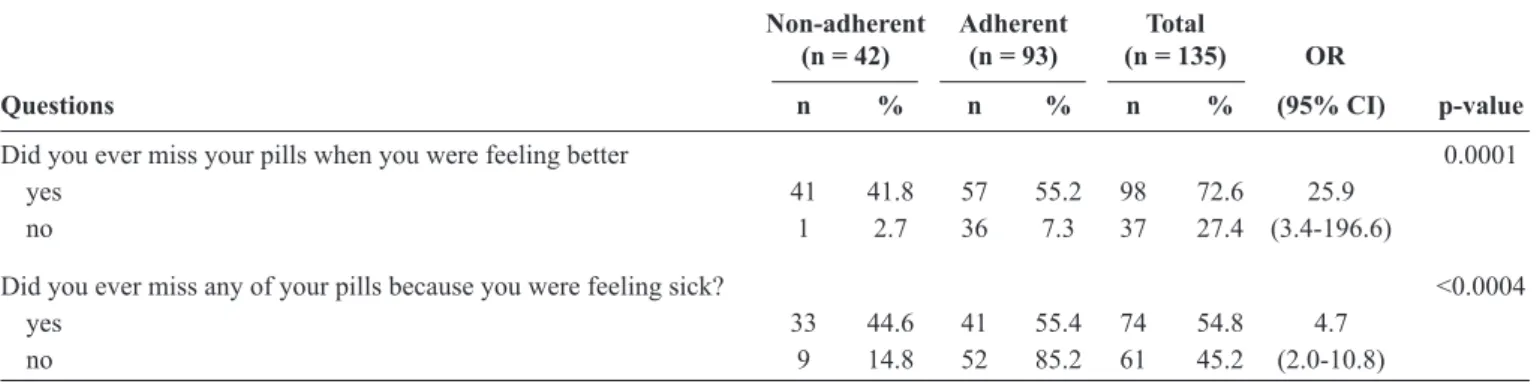
to treatment interruption when patients felt better or worse (Figure 1). There were signiicant associations between
non-adherence behavior and treatment interruption when the patient felt better or worse due to the medication. The odds of
non-adherence was 5.16 times higher for patients who abandoned
treatment when they felt better than for patients who abandoned
treatment when they felt worse due to medication (Table 1).
During the 180-day follow-up period, there were 19 (14.1%)
cases of resurgence of parasites, at 1-2 weeks (8 cases) and
8-19 weeks (11 cases) post-treatment. The relative risk of
parasitic resurgence in non-adherent patients was 3.04 higher than in adherent patients (odds ratio, 3.95; 95% CI, 1.31-11.98;
p = 0.0071) (Table 2).
The rate of non-adherence in the current study corroborates previous reports in other areas of the Amazon Basin, as in
Ecuador, where the rate of non-adherence was 34.1% in
patients under the same therapeutic regimen (10). In Brazil, the
majority of malaria cases occur in the Amazon region, where geographic, economic, and social variables create challenges for disease control and eradication. The native population has
low educational levels and limited knowledge about the disease
and its prevention. Each inhabitant has his/her own perception about the disease based on their experiences with previous episodes of malaria, the frequencies of these episodes, the intensity of signs and symptoms, and the use and effectiveness
of antimalarial drugs (11).
Interestingly, demographic factors, such as age and gender, were not associated with adherence to the antimalarial therapy.
The majority of the patients were of working age, suggesting
a potential association between malaria and occupational
activities in this endemic area. The inluence of age on
non-adherence is inconclusive, although children and elderly patients
are generally more adherent to prescribed regimens(12). Both genders were equally affected by the disease, and a similar proportion of each gender was non-adherent to the prescribed regimen. Conversely, a previous report found a higher rate of non-adherence for men(13), which might be explained by the baseline characteristics of the patients in the current study.
The area of residence, number of days after symptom onset that treatment was sought, and parasitemia at admission did
not inluence adherence to the prescribed regimen. The patients
in the current study were recruited from both rural and urban
29.6% 32.6%
72.6%
54.8%
20.7%
0 10 20 30 40 50 60 70 80 90 100
i ii iii iv v %
250
Rev Soc Bras Med Trop 49(2):248-251, Mar-Apr, 2016
TABLE 1 - Treatment interruption, based on treatment adherence by patients undergoing treatment for Plasmodium vivax.
Non-adherent Adherent Total (n = 42) (n = 93) (n = 135) OR
Questions n % n % n % (95% CI) p-value
Did you ever miss your pills when you were feeling better 0.0001
yes 41 41.8 57 55.2 98 72.6 25.9
no 1 2.7 36 7.3 37 27.4 (3.4-196.6)
Did you ever miss any of your pills because you were feeling sick? <0.0004
yes 33 44.6 41 55.4 74 54.8 4.7
no 9 14.8 52 85.2 61 45.2 (2.0-10.8)
OR: odds ratio; CI: conidence interval.
TABLE 2 - Relative risk of a new episode of disease, according to adherence behavior to the antimalarial treatment. With recurrence Without recurrence
Total
Adherence behavior n % (95% CI) n % (95% CI) n RR 95% CI p-value
Non-adherent 11 26.2 (14.3-35.7) 31 73.8 (57.2-83.3) 42 3.04 1.32-7.01 0.0071
Adherent 8 8.6 (4.3-11.8) 85 91.4 (83.9-95.7) 93
Total 19 14.1 (8.9-18.5) 120 88.9 (83.7-92.6) 135 RR: relative risk; CI: conidence interval.
areas, and the distance from the small rural properties to the
health facilities was approximately 1-2km. New cases of malaria
in rural communities are regularly and actively searched by medical staff of the municipality. Furthermore, the low parasite density in both groups is generally associated with mild signs and symptoms of the disease.
However, human behavior, in terms of decision-making,
was related with non-adherence to the prescribed regimen. The patients responded that they did interrupt their treatment when they felt better or worse with the medication, which supports
the indings of previous studies regarding medication use (4) (5).
Also, the probability of a patient becoming non-adherent due to treatment interruption with improvement was approximately 5 times higher than becoming non-adherent due to treatment interruption because they felt worse. Parasite clearance, which
occurs 48-72 after treatment initiation for Brazilian strains of
P. vivax, is accompanied by the cessation of disease signs and symptoms(2) (3) (11) (13). After this period, patients feel better and do not consider themselves ill, which is usually accompanied
by a prompt return to work and abandonment of the treatment.
This behavior could be considered the major determinant for non-adherence in this municipality. Although the side effects with antimalarial drug use can promote dissatisfaction with the treatment, the probability of a patient becoming non-adherent because they worsened after antimalarial drug use is low, because the side effects with therapeutic doses of chloroquine and primaquine are mild and usually related with the gastrointestinal system, including vomiting and nausea(6) (7) (8).
The main limitations of the current study were that it was conducted at a single health facility over a relatively short period, which may not be representative of other municipalities in the same region or the annual pattern. In addition, participation in a follow-up study could alter adherence behavior. Moreover, there are some shortcomings with using self-reported methods to estimate adherence, because patients might tend to overestimate adherence and underestimate non-adherence(4) (5) (7) (8) (10).
The resurgence of parasites was reported in 19 patients during the follow-up period; however, the causes of resurgence, such as resistance, relapse, a new infection, or incorrect drug exposure, were not assessed. In Brazil, the relapse of P. vivax occurs during the irst
6 months post-treatment, but long-latency forms might coexist with
frequent relapse phenotypes (14). Two patterns of resurgence were found in the current study: short duration (1-2 weeks) and long duration (8-19 weeks). In both, the relative risk of a new episode
of malaria in non-adherent patients was 3.04 times higher than in adherent patients, supporting the indings of a previous study
in which low adherence to treatment was an important predictor of a subsequent episode of malaria in the same individual(15).
Ethical considerations
251 REFERENCES
The authors declare that there is no conlict of interest. CONFLICT OF INTEREST
1. World Health Organization. World Malaria Report. Geneva: 2013. 2. Alecrim MGC, Alecrim W, Macedo V. Plasmodium vivax
resistance to chloroquine (R2) and meloquine (R3) in Brazilian Amazon region. Rev Soc Bras Med Trop 1999; 32:67-68.
3. De Santos Filho FS, Arcanjo AR, Chehuan YM, Costa MR, Martinez-Espinosa FE, Vieira JL, et al. Chloroquine-resistant Plasmodium vivax, Brazilian Amazon. Emerg Infect Dis 2007; 13:1225-1226.
4. Yeung S, White NJ. How do patients use antimalarial drugs? A review of the evidence. Trop Med Int Health 2005; 10:121-138. 5. Bruxvoort K, Goodman C, Kachur SP, Schellenberg D. How
patients take malaria treatment: a systematic review of the literature on adherence to antimalarial drugs. PLoS One 2014; 9:e84555. doi:10.1371/journal.pone.0084555.
6. Hill DR, Baird JK, Parise ME, Lewis LS, Ryan ET, Magill AJ. Primaquine: report from CDC expert meeting on malaria chemoprophylaxis. Am J Trop Med Hyg 2006; 65:402-415.
7. Almeida ED, Rodrigues LCS, Vieira JLF. Estimates of adherence to treatment of vivax malaria. Malar J 2014; 13-321-327.
8. World Health Organization. Guidelines for the treatment of malaria. Geneva: 2015.
9. Morisky DE, Green LW, Levine DM. Concurrent and predictive validity of a self-reported measure of medication adherence. Med Care 1986; 24:67-74.
10. Yépez MC, Zambrano D, Carrasco F, Yépez RF. Factores asociados con el incumplimiento del tratamiento antipalúdico en pacientes ecuatorianos. Rev Cubana Med Trop 2000; 52:81-89.
11. Barreto ML, Teixeira MG, Bastos FI, Ximenes RAA, Barata RB, Rodrigues LC. Successes and failures in the control of infectious diseases in Brazil: social and environmental context, policies, interventions, and research needs. Lancet 2011; 377:1877-1889. 12. Krause G, Sauerborn R. Comprehensive community effectiveness
of health care. A study of malaria treatment in children and adults in rural Burkina Faso. Ann Trop Paediatr 2000; 20:273-282. 13. Pereira EA, Ishikawa EAY, Fontes CJF. Adherence to Plasmodium
vivax malaria treatment in the Brazilian Amazon Region. Malar J 2011; 10:355-361.
14. Tauil PL, Luz FC, Oliveira AP, Deckers FA, Santos JB. Vivax malaria with long incubation period, detected in the Federal District: three case reports. Rev Soc Bras Med Trop 2010; 43:213-214. 15. Duarte EC, Gyorkos TW. Self-reported compliance with last malaria