www.biogeosciences.net/14/131/2017/ doi:10.5194/bg-14-131-2017
© Author(s) 2017. CC Attribution 3.0 License.
The interaction between nitrogen and phosphorous is a strong
predictor of intra-plant variation in nitrogen isotope
composition in a desert species
Jinxin Zhang1,2, Lianhong Gu3, Jingbo Zhang1,4, Rina Wu1, Feng Wang1, Guanghui Lin5, Bo Wu1, Qi Lu1, and Ping Meng6
1Institute of Desertification Studies, Chinese Academy of Forestry, Beijing, China 2Research Institute of Forestry, Chinese Academy of Forestry, Beijing, China
3Environmental Sciences Division and Climate Change Science Institute, Oak Ridge National Laboratory, Oak Ridge, TN 37831, USA
4The Experimental Center of Desert Forestry of the Chinese Academy of Forestry, Dengkou, Inner Mongolia Autonomous Region, China
5Center for Earth System Science, Tsinghua University, Beijing, China 6Headquarters, Chinese Academy of Forestry, Beijing, China
Correspondence to:Lianhong Gu ([email protected])
Received: 28 May 2016 – Published in Biogeosciences Discuss.: 6 June 2016
Revised: 24 November 2016 – Accepted: 10 December 2016 – Published: 11 January 2017
Abstract.Understanding intra-plant variations inδ15N is
es-sential for fully utilizing the potential of δ15N as an
inte-grator of the terrestrial nitrogen (N) cycle and as an indi-cator of the relative limitation of N and phosphorous (P) on plant growth. Studying such variations can also yield in-sights into N metabolism by plant as a whole or by specific organs. However, few researchers have systematically eval-uated intra-plant variations in δ15N and their relationships
with organ nutrient contents. We excavated whole plant ar-chitectures of Nitraria tangutorumBobrov, a C3species of
vital regional ecological importance, in two deserts in north-western China. We systematically and simultaneously mea-sured N isotope ratios and N and P contents of different parts of the excavated plants. We found that intra-plant variations in δ15N ofN. tangutorum were positively correlated with
corresponding organ N and P contents. However, it was the N×P interaction, not N and P individually or their linear combination, that was the strongest predictor of intra-plant
δ15N. Additionally, we showed that rootδ15N increased with
depth into soil, a pattern similar to profiles of soil δ15N
re-ported by previous studies in different ecosystems. We hy-pothesized that the strong positive intra-plantδ15N–N and P
relationships are caused by three processes acting in
conjunc-tion: (1) N and P content-driven fractionating exchanges of ammonia between leaves and the atmosphere (volatilization) during photorespiration, (2) resorption and remobilization of N and P from senescing leaves, and (3) mixture of the re-translocated foliar N and P with existing pools in stems and roots. To test our hypothesis, future studies should investi-gate plant N volatilization and associated isotope fraction-ation and intra-plant varifraction-ations inδ15N in different species
across ecosystems and climates.
1 Introduction
be-cause they subsequently affect plant photosynthesis, growth, and substrate supply for microbial activities (Manzoni et al., 2010; Vitousek et al., 2010). Many physical, biological and chemical processes that control plant N acquisition, transfor-mation, and translocation discriminate against N isotope 15 (15N) in favor of N isotope 14 (14N). As a result, the vari-ations in the relative abundance of 15N to 14N, quantified asδ15N, of plants contain rich information about these
pro-cesses (Högberg, 1997; Robinson, 2001; Evans, 2001; Daw-son et al., 2002). For this reaDaw-son,δ15N is often considered an
integrator of terrestrial N cycling, and numerous studies have analyzed natural variations in plantδ15N across disturbance
and successional stages (e.g., Hobbie et al., 2000; Wang et al., 2007; Resco et al., 2011; Hyodo et al., 2013), climate and topoedaphic gradients (e.g., Austin and Sala, 1999; Schulze et al., 1998; Martinelli et al., 1999; Amundson et al., 2003; Craine et al., 2005, 2009; Bai et al., 2009), species (e.g., Cer-nusak et al., 2009; Gubsch et al., 2011), and types of myc-orrhizal fungi (Hobbie and Hobbie, 2008; Hobbie and Hög-berg, 2012). Other studies have used δ15N as an indicator
of relative N and phosphorus (P) availability and limitation on plant growth (McKee et al., 2002; Wigand et al., 2007; Inglett et al., 2007; Mayor et al., 2014). These studies have demonstrated the power of using natural variations inδ15N
to understand physical and biological processes controlling N cycling in terrestrial ecosystems.
Compared with the prolific studies on variations inδ15N
across ecological and climate gradients and species, fewer studies have systematically evaluated intra-plant variations in
δ15N. Studies that did examine intra-plant variations inδ15N
were often conducted in controlled environments. Most such studies focused on differences between roots and leaves. It has been found that leaves of a plant tended to be enriched in 15N compared with the roots of the same plant (Bergersen et al., 1988; Yoneyama and Kaneko, 1989; Evans et al., 1996; Kolb and Evans, 2002) and the difference can be as high as 7 ‰ which has the same magnitude as variations across eco-logical and climate gradients. Such large intra-plant varia-tions inδ15N, if not accounted for, may confound
interpre-tation of large-scale patterns in variations of δ15N (Evans,
2001) and lead to misguided diagnoses of relative N and P limitation on plant growth. Nevertheless, no foliar enrich-ment or mixed results have also been observed both in con-trolled experiments (Evans et al., 1996; Hobbie et al., 2008) and in natural environments (Dijkstra et al., 2003).
Several mechanisms have been proposed to explain intra-plant variations inδ15N or lack thereof. The most commonly
discussed mechanisms invoke the differences in the assimi-lation and transport of inorganic N of nitrate (NO−
3)and am-monium (NH+
4)within plants. Both the assimilation of NO−3 and NH+
4 discriminate against15N (Yoneyama et al., 2003; Karsh et al., 2012; Table 1 in Johnson and Berry (2013) lists values for various isotope effects) but fundamental differ-ences exist in their metabolism in plants. NO−
3 is assimilated
by nitrate reductase (NR) in a process that involves first the reduction of NO−
3 to nitrite and then to NH+4 and finally to amino acids. This process can take place in roots, stems, and leaves (Masclaux-Daubresse et al., 2010). Consequently or-ganic N compounds originated from NO−
3 may come from assimilation events that take place in different parts of the plant (Evans et al., 1996; Evans, 2001). The discrimination by NR in roots leads to an enriched pool of unassimilated NO−
3, which is then transported to other parts of the plant via the transpiration stream of xylem. Thus leaves and shoots are expected to be enriched in15N compared with roots when NO−
3 is the source of nitrogen. This enrichment has been found to be correlated with the transpiration efficiency of the N acquisition (Cernusak et al., 2009).
The impact of NH+
4 assimilation on intra-plant variations inδ15N was traditionally thought to be minimal but more
re-cent studies indicate that this might not be the case. NH+ 4 is usually the most important source of N available to plant roots in natural terrestrial ecosystems (Schjoerring et al., 2002) although NO−
3 and NH+4 are often available together (Bijlsma et al., 2000). NH+
4 is also produced by plants as a central intermediate in a wide variety of metabolic processes such as NO−
3 assimilation, photorespiration, lignin biosyn-thesis, protein turnover, and degradation of transport amides (Joy, 1988; Massad et al., 2010; Flechard et al., 2013). How-ever, NH+
4 is toxic to plants at high concentration (Britto and Kronzucker, 2002). Because of this, early workers assumed that once absorbed by roots, it is immediately assimilated in roots by the glutamine synthetase/glutamate synthase (GS-GOGAT) pathway. This assumption led to a further hypothe-sis that organic N compounds derived from NH+
4 ultimately result from a single assimilation event which occurred in roots, and therefore no intra-plant variation inδ15N should
occur for plants that have grown with NH+
4 as the sole ni-trogen source (e.g., Evans et al., 1996). However, later stud-ies depict a much more complicated picture of assimilation and transport of NH+
4 within plants. This complication in-volves two aspects. First, it has been found that a significant amount of NH+
4 can be transported in the xylem from roots to shoots and the NH+
4 pools in the apoplast in general and leaf tissues in particular can respond rapidly to the supply of NH+
4 solution to the roots (Mattsson and Schjoerring, 2002; Schjoerring et al., 2002). Second, a recent modeling study suggests that the photorespiration-induced exchange of am-monia (NH3)between leaves and the atmosphere, which has
a large isotope effect (the isotope effect for molecular diffu-sion of NH3is 1.0176 in still air and 1.0117 in leaf bound-ary layer; Farquhar et al., 1983), can substantially influence plant and atmospheric N isotopic compositions (Johnson and Berry, 2013). This process has been mostly ignored in previ-ous studies of terrestrial variations inδ15N. Thus it appears
that the impact of NH+
photorespira-tion on intra-plant variaphotorespira-tions inδ15N, may have been
under-estimated.
Besides the mechanisms discussed above, other fraction-ating processes such as transamination, redistribution of rel-atively enriched or depleted metabolites, differential losses of N from plant organs, and resorption and remobilization of N from senescing leaves have been suggested as poten-tial causes of intra-plant variations in δ15N (Evans, 2001;
Werner and Schmidt, 2002; Cernusak et al., 2009; Tcherkez, 2011; Gauthier et al., 2013). In particular, fractionations in metabolic reactions (e.g., amino acid syntheses) and trans-fers of isotopically different plant metabolites across plant organs have been highlighted as factors contributing to intra-plant heterogeneities inδ15N (Gauthier et al., 2013).
Thus, there is a strong need for systematical evaluation of
δ15N variation across different organs within the same plant.
Such evaluations will provide key guidance for using δ15N
as an integrator of terrestrial N cycling and as an indicator of relative nutrient limitation. They will also offer important in-sights into plant N metabolism. The present study represents a step in this direction. Our objective is to conduct the first measurement-based systematic evaluation of intra-plant vari-ations inδ15N and to shed light on potential mechanisms. We
attempt to achieve this objective by comprehensively and si-multaneously analyzing variations inδ15N with carbon (C),
N, and P contents in different plant organs with excavated whole architectures of a desert species grown in natural con-ditions.
The joint analysis of N and P is important for understand-ing variations inδ15N. These two elements are
stoichiomet-rically coupled in plants (Gusewell, 2004). P availability af-fects plant photosynthesis and growth which may have impli-cation forδ15N variations in plants. For example,
orthophos-phate is a key reactant in photosynthetic carbon assimilation in chloroplasts and its supply directly affects the rates of car-boxylation and photorespiration (Sivak and Walker, 1986; Kondracka and Rychter, 1997). Since fractionation occurs in foliar NH3exchanges with the atmosphere during photores-piration (Johnson and Berry, 2013), an effect of P on plant nitrogen isotope composition can be expected. Another con-sideration is that the relative availability of N vs. P to plants has consequences on N isotope fractionation. This is because of two factors. First, no fractionation can occur if all available N is assimilated, which may happen when N is limiting (Cer-nusak et al., 2009; Gauthier et al., 2013). Second, P availabil-ity affects when and where N limitation occurs (Vitousek et al., 2010). Indeed, previous studies have found that P avail-ability is correlated withδ15N in plant biomass. For example,
Major et al. (2014) showed that long-term additions of both N and P reduced foliarδ15N compared with N or P additions
alone in a lowland tropical rainforest. Studies such as this are the basis for the suggestion that δ15N could be used as
an indicator of ecosystem P limitation (McKee et al., 2002; Wigand et al., 2007; Inglett et al., 2007; Mayor et al., 2014).
The present study builds upon the earlier efforts reviewed above and fills a gap in systematic investigation of intra-plant variations inδ15N. We will demonstrate that the intra-plant
variations inδ15N in our study speciesNitraria tangutorum
Bobrov are closely related to organ N and P contents and their interaction. We will show that the intra-plantδ15N–N
and P relationships found in our study cannot be readily ex-plained with mechanisms thought to be responsible forδ15N
variations across species, ecological, and climate gradients. To stimulate future research in intra-plantδ15N variations,
we will propose a new, testable hypothesis that we believe most logically explains such variations.
2 Materials and methods
2.1 Nitraria tangutorumBobrov and the study sites We previously described in detail the biological and envi-ronmental characteristics of N. tangutorum and the study
sites (Zhang et al., 2015). For convenience and completeness, some of the information presented in Zhang et al. (2015) is repeated here.N. tangutorumis a spiny C3shrub species in
the Nitraria genus of the Zygophyllaceae family. It is
en-demic to northwestern deserts in China with a distribution in-cluding northeastern Tibet, Gansu, Qinghai, Xinjiang, west-ern Inner Mongolia, westwest-ern Ningxia, and northwest-ern Shaanxi. It is a pioneer species of high tolerance to a variety of stresses. N. tangutorumcontrols local landscape evolution,
owing to its exceptional capability of fixing sands and build-ing sand dunes known as nebkhas or coppice dunes around its extensive shoot and root systems (Baas and Nield, 2007; Lang et al., 2013; Li et al., 2013). The formation process of nebkha was described in Zhang et al., (2015). The phy-togenic nebkha dunes formed byN. tangutorumprevent or
slow down sand movement, making it often the most ecolog-ically important species in its environment. The height of aN. tangutorumnebkha typically ranges from 1 to 3 m and some
may reach 5 m. The base of a nebkha often has the shape of an ellipse with the major axis parallel to the local prevailing wind direction (Fig.1). Below the base are dense clay layers that constitute dried-up flat beds of previous rivers or lakes. The nebkha-building characteristic ofN. tangutorummakes
it relatively easy to excavate the whole plant including roots for isotope and nutrient analyses except for a small fraction of roots that have grown into the solid clay layers below the base of nebkha and require some efforts to dig them out. Pre-viously we studied intra-plant variations in carbon isotope composition of this species (Zhang et al., 2015). Wang et al. (2014) studied the variations of its foliar and root nitrogen and phosphorous contents in season and along aridity gradi-ents. To our knowledge, this species has never been investi-gated for intra-plant variation inδ15N, whether in cultures or
Figure 1.Pen drawings of typical nebkha formed byNitraria tangutorumBobrov at the Dengkou(a)and Minqin(b)study sites. The scales shown are for illustrative purposes only and therefore are not very precise.
Our field work was carried out in two desert locations. The first site was in Dengkou County, Inner Mongolia Au-tonomous Region, China. Dengkou County is at the junction between the Hetao Plain and Ulan Buh Desert of the Mon-golian Plateau in the middle reaches of the Yellow River. The mean annual temperature is 8.84◦C and the mean an-nual precipitation is 147 mm with 77.5 % of anan-nual rainfall occurring from June to September (1983–2012 averages). The mean annual potential evaporation is 2381 mm (Li et al., 2013). The sampling was conducted within an experi-mental area (40◦24′N, 106◦43′E) managed by the Experi-mental Center of Desert Forestry of the Chinese Academy of Forestry. The study site has sandy soil and gray-brown desert soil (Cambic Arenosols and Luvic Gypsisols in FAO taxon-omy). The N. tangutorum nebkhas in the area are formed
on clay soils deposited by the Yellow River. Although the plant community is dominated byN. tangutorum, xerophytic
species such as semi-shrub Artemisia ordosica, perennial
grass Psammochloa villosa, and annual species Agriophyl-lum squarrosumandCorispermum mongolicumcan also be
found.
The second study site was in Minqin County, Gansu Province, China. Minqin County is located in the lower reaches of Shiyang River, surrounded by the Badain Jaran Desert in the west and north and the Tengger Desert in the east. The mean annual temperature is 8.87◦C and the mean annual precipitation is 117 mm with 73.1 % of annual rainfall occurring from June to September (1983–2012 averages). The mean annual potential evaporation is 2643 mm (Du et al., 2010). Thus the second study site is somewhat drier than the first site but with similar annual mean temperatures. The
sampling was conducted within the Gansu Minqin Desert Ecosystem Research Station (38◦34′N, 102◦58′E). The soil at the Minqin site is similar to that at the Dengkou site, with sandy soil in the nebkhas and gray-brown desert soil be-tween nebkhas. The native vegetation is usually dominated by shrubs and semi-shrubs, with species such asN. tanguto-rumandCalligonum mongolicum. Experimental plots used
in this study contained semi-fixed nebkha dunes developed by the growth of N. tangutorum. Typically in dry years, N. tangutorumis the only species growing in the nebkhas,
although in wet years annual species such as Agriophyl-lum squarrosumandCorispermum mongolicumcan also be
found. Because the Minqin site is drier than the DengKou site, the nebkhas at the Minqin site are generally smaller and less populated with plants than at the Dengkou site. The root-ing depth is deeper at the Minqin site than at the Dengkou site (see Table 1 in Zhang et al., 2015). Nitrogen cycling at these remote desert sites has rarely been studied. We are not aware of any previous report that indicatesN. tangutorumor
any co-existing species might be a nitrogen fixer. Throughout our investigation, we found no evidence of any nitrogen fixer existing at the two study sites. We did not investigate whether there might be any nitrogen-fixing symbionts inN. tanguto-rum.However, there was a single conference report on the
observation of the presence of endogenous nitrogen-fixing bacteria in a related species N. schoberi (Li et al., 2015).
Therefore it is possible thatN. tangutorummight also have
nitrogen-fixing symbionts. Nevertheless, soil is probably the primary source of nitrogen forN. tangutorumat our study
varia-tions in δ15N, the nature of nitrogen source is not critically
important for our study.
2.2 Excavation ofNitraria tangutorumnebkhas
In August 2012, three nebkhas were excavated at each study site. The geometrical and biometrical characteristics of the six nebkhas were summarized in Table 1 of Zhang et al. (2015). At the Dengkou site, the three nebkhas were exca-vated in a sampling area of 40 m×40 m. At the Minqin site, nebkhas were generally much smaller. To ensure availabil-ity for analyses of sufficient biomass materials at this site, particularly the fine roots (see below), three sampling areas, each with a dimension of 30 m×30 m, were established and three nebkhas from each sampling area were tentatively ex-cavated. Two nebkhas from one sampling area and one from another were deemed to have sufficient amount of fine roots for analyses and were therefore excavated fully. The nebkhas were excavated by carefully teasing away the sands from the mounds to expose the root architecture ofN. tangutorumwith
particular attention paid to preserving its fine roots and to dis-tinguishing any roots from other plant species that may hap-pen to grow in the same nebkhas. The roots of aN. tanguto-rum plant can be found inside the sand mounds as well as
inside the clay layer that generally forms a plain on which the sand mounds rest. We therefore also excavated any roots inside the clay layer to a depth under which no more roots could be found. Only biomass materials fromN. tangutorum
were harvested and any materials from all other species that may be present were excluded to ensure pure intra-plant anal-yses required by this study.
We separated the whole plant biomass into groups of leaves, stems, sand roots, and below-plain roots. The in-sand roots, which were roots found inside the nebkha in-sands but above the plain formed by the underlying clay layer, were further separated into in-sand fine roots (diameter ≤2 mm) and in-sand coarse roots (diameter > 2 mm). The same root diameter threshold was used to separate the below-plain roots, which were found inside the clay layer under the nebkha sands. Furthermore, the below-plain fine and coarse roots were grouped in a 20 cm depth increment from the plain surface. We did not separate the in-sand fine and coarse roots into layers because a nebkha has a cone shape on top, mak-ing a layer hard to define. Also we did not use a simple “below-ground” group because “ground” is not well defined in a nebkha-populated landscape and because there are large physical and chemical differences between sands and clay which may affect the isotope compositions of roots grow-ing in them. Litter was rarely found on the nebkhas, pre-sumably because strong winds at the study sites can easily blow away any litter produced. However, woody debris from dead ramets was present inside the sand mounds and was collected during excavation. Thus for each nebkha, we differ-entiated the following categories ofN. tangutorumbiomass
for intra-plant isotope analyses: leaves, stems, in-sand fine
roots (ISFR), in-sand coarse roots (ISCR), below-plain fine roots (BPFR) in 20 cm depth increments, below-plain coarse roots (BPCR) in 20 cm increments, and woody debris (WD). Nutrient contents and nitrogen isotope compositions were measured separately for each category.
2.3 Measurements of nutrient contents and nitrogen isotope compositions with excavated biomass All categories of N. tangutorum biomass (leaves, stems,
ISFR, ISCR, BPFR in 20 cm increments, BPCR in 20 cm in-crements, and WD) from each excavated nebkha were dried to constant weight (60◦, 48 h). The dry weight of biomass was determined with 0.01 g accuracy on an analytical scale. Dried materials were randomly sampled from each biomass category and ground to 80 mesh in Tyler Standard Sieve Se-ries (0.177 mm opening). The resultant powder was separated into six duplicates. Three duplicates were analyzed for C, N, and P contents and the remaining three for isotope composi-tions. The C, N, and P contents were measured in the Envi-ronmental Chemistry Analysis Laboratory in the Institute of Geographic Sciences and Natural Resources Research, the Chinese Academy of Sciences, Beijing, China. Total sam-ple carbon and N were measured with the vario MACRO cube (Elementar Company, Germany). The analytical preci-sion was better than 0.5 % relative standard deviation (RSD). Total P was measured with the ICP-OES OPTIMA 5300DV (PE, USA). A wet digestions method was applied in the anal-ysis (Webb and Adeloju, 2013). Sample preparation and as-saying followed standard procedures per instrument instruc-tion. The analytical precision was better than 2 % RSD.
The nitrogen isotope compositions were analyzed at the Stable Isotope Ratio Mass Spectrometer Laboratory of the Chinese Academy of Forestry (SIRMSL, CAF), Beijing, China. The instrument used was a Delta V Advantage Mass Spectrometer (Thermo Fisher Scientific, Inc., USA) cou-pled with an elemental analyzer (FlashEA 1112; HT In-struments, Inc., USA) in the continuous flow mode. Isotope compositions were expressed using the delta notation (δ)in
parts per thousand (‰ ):δ15N (‰)=[(Rsample)/(Rstandard)− 1]×1000, where R is the molar ratio of 15N to 14N. The
measurement applied the IAEA-600 standard (Caffeine) rel-ative to atmosphere N2. The analytical precision was better than 0.2 ‰ based on replicate measurements of the reference standard.
2.4 Statistical analyses
Two-way ANOVA analyses (organ by site) were performed with SPSS (Ver.17.0). C, N, and P contents,δ15N, C/N
ra-tios, N/P ratios, and C/P ratios were analyzed for
differ-ences between organs and between study sites. All ratios were mass-based. Tukey post-hoc tests were used to deter-mine pairwise differences for significant effects (P< 0.05).
de-termine the relationships between the organ δ15N and
nu-trient contents. Due to the strong correlation between or-gan contents of different nutrients (Zhang et al., 2015) and therefore the potential presence of multicollinearity, we used stepwise regression to determine the most significant predic-tor(s) (including interaction) of intra-plant variations inδ15N.
Both forward and backward methods were used in the step-wise regression with F-to-enter and F-to-remove set at 4.0 (P =0.05) and 3.9 (P =0.052), respectively. AllP values
for regression slope analyses were computed on a two-tailed basis.
Our regressional analyses were based on fixed effects models. Fixed effects models are appropriate for the present study because we attempt to explain variations in δ15N as
a function of non-random explanatory variables such as C, N, and P contents and their ratios (mixed or random effects models are used more commonly in social sciences, Cameron and Trivedi, 2005). We are only interested in the detection of the existence or absence of any potential correlation be-tween the specific effect (nitrogen isotope composition) and explanatory variables across plant organs, and we are not interested in how any peculiarities of nebkas and locations might or might not affect the specific effect. Nevertheless, we did analyze the data from the two study sites separately and came to similar conclusions. Therefore, to increase the statistic power of our analyses (i.e., to avoid using data from a single nebka at a single location and getting a spurious crelation), we pooled the data together but with sites and or-gans clearly marked in figures so that patterns for individual sites and organs can be seen clearly.
3 Results
3.1 Variations inδ15N among plant organs and between study sites
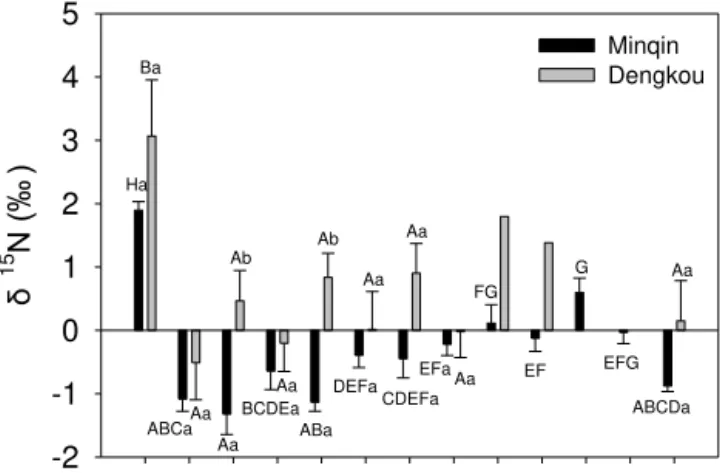
For comparing δ15N among plant organs and between sites
(Fig. 2), we averaged the duplicate mean of each organ across the three nebkhas at each site. Results for comparisons of nu-trient values were already presented in Zhang et al. (2015) and thus not repeated here. There were considerable varia-tions inδ15N values among plant organs and between study
sites. At both the Dengkou and Minqin sites, leaves had pos-itive δ15N and were enriched in 15N compared with
cor-responding stems and roots at the same site. Also, at both sites, the δ15N value of fine root followed the same order:
ISFR < 1FR < 2FR < 3FR < 4FR; i.e., it increased with depth into soil. Here 1FR, 2FR, FR, and 4FR refer to fine roots in 0–20, 20–40, 40–60, and 60–80 cm soil depths, respec-tively. The same pattern was repeated for theδ15N value of
coarse root; the only exception was 2CR (coarse root at a soil depth of 20 to 40 cm) at the Dengkou site which dropped out of the general order. Theδ15N values of fine roots at the
Dengkou site were consistently higher than the correspond-ing coarse roots both inside the nebkha sands and below the
Leaf Stem ISFR ISCR 1FR 1CR 2FR 2CR 3FR 3CR 4FR 4CR WD
δ
15 N
(‰
)
-2 -1 0 1 2 3 4 5
Minqin Dengkou
Ha Ba
ABCaAa
Aa Ab
BCDEa Aa
ABa Ab
DEFa Aa
CDEFa Aa
EFa Aa
FG
EF G
EFG
ABCDa Aa
Figure 2.A comparison ofδ15N among different plant organs of
Nitraria tangutorumBobrov and between the Dengkou and Min-qin study sites. Theδ15N value shown is averaged for each organ
across the nebkhas excavated at the same site (Dengkou or Min-qin). Upper-case letters denote ANOVA results within a study site (i.e., comparingδ15N among different organs at the same site) and
lower-case letters between the two sites (i.e., comparingδ15N of
the same organ between the two sites). ISFR and ISCR stand for fine and coarse roots, respectively, in the sands of nebkhas. 1FR, 2FR, 3FR, and 4FR stand for fine roots at 0–20, 20–40, 40–60, and 60–80 cm depths, respectively, below the plains on which nebkhas rest. Similarly, 1CR, 2CR, 3CR, and 4CR stand for coarse roots within these depth intervals. Fine and coarse roots are differentiated with a diameter threshold of 2 mm. Woody debris (WD) from dead ramets is also included in the figure. No ANOVA results for 3FR and 3CR at the Dengkou site as there was only one nebkha having roots between 40 and 60 cm. No roots were found below 60 cm at the Dengkou site.
plain of the same site. In contrast, at the Minqin site, theδ15N
values of fine roots were consistently less than the corre-sponding coarse roots except for the roots deep into the plain (40–80 cm) where the fine root was more enriched. At the Dengkou site, the stem had the lowestδ15N while at the
Min-qin site, the ISFR had the lowestδ15N. At both sites, theδ15N
value in the woody debris was greater than the correspond-ing stem although the difference was not statistically signif-icant. The foliarδ15N at the Dengkou site was higher than
at the Minqin site. In fact, in all biomass categories investi-gated, theδ15N value at the Dengkou site was greater than its
corresponding counterpart at the Minqin site. Theδ15N
Carbon content (%)
36 38 40 42 44 46 48 50 52 54 56
δ
15 N
( ‰
)
-4 -2 0 2 4 6
Minqin-leaf Dengkou-leaf Minqin-fine root Dengkou-fine root Minqin-organ Dengkou-organ
R2 = 0.25
P < 0.0001
R2 = 0.48
P < 0.0001
Nitrogen content (mg g )
10 20 30 40
δ
15N
( ‰
)
-4 -2 0 2 4 6
R2 = 0.44
P < 0.0001
R2 = 0.53
P < 0.0001
Phosphorous content (mg g ) 0.2 0.4 0.6 0.8 1.0 1.2 1.4 1.6 1.8 2.0
δ
15N
( ‰
)
-4 -2 0 2 4 6
R2 = 0.40
P < 0.0001
R2 = 0.48
P < 0.0001
C / N ratio
5 10 15 20 25 30 35 40
-4 -2 0 2 4 6
R2 = 0.41
P < 0.0001
R2 = 0.53
P < 0.0001
N / P ratio
10 20 30 40 50 60
-4 -2 0 2 4 6
R2 = 0.01
P = 0.6211
R2 = 0.002
P = 0.7362
C / P ratio
0 200 400 600 800 10001200140016001800 -4
-2 0 2 4 6
R2 = 0.25
P < 0.0001
R2 = 0.28
P < 0.0002
–1
–1 (a)
(b)
(c)
(d)
(e)
(f)
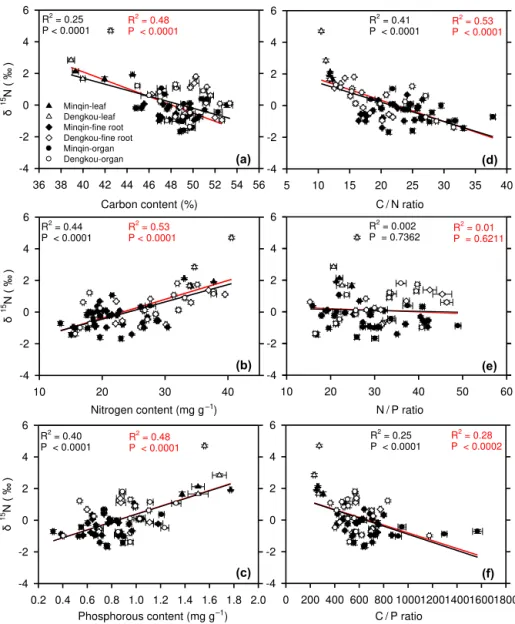
Figure 3.Changes ofδ15N as a function of organ contents of carbon(a), nitrogen(b), and phosphorous(c)and of organ ratios of carbon to nitrogen(d), nitrogen to phosphorous(e), and carbon to phosphorus(f). Filled and unfilled symbols represent organs at the Minqin and Dengkou sites, respectively. Leaves are denoted by filled or unfilled triangles while other organs by filled or unfilled circles. The black regression lines are for all organs while for the red regression lines, data of fine roots are not included.
3.2 Intra-plant relationships betweenδ15N and nutrient concentrations
Even though intra-plant and between-site variations inδ15N
were large, these variations were unified in relationships with organ nutrient contents (Fig. 3). The large intra-plant varia-tions inδ15N (∼7 ‰ at the Dengkou site and 4 ‰ at the
Min-qin site), as well as in organ nitrogen and phosphorous con-tents, facilitated regression analyses between these variables. Because the intra-plant relationships were not significantly different between the two study sites, we pooled the data from the two sites in regression analyses. We found that intra-plant variations inδ15N were significantly correlated with the
organ contents of carbon (Fig. 3a, R2=0.25,P< 0.0001),
nitrogen (Fig. 3b, R2 = 0.44, P < 0.0001), and
phospho-rous (Fig. 3c,R2=0.40,P< 0.0001) and with the organ
ra-tios of carbon to nitrogen (Fig. 3d,R2=0.41,P< 0.0001)
and carbon to phosphorous (Fig. 3f,R2=0.25,P< 0.0001).
The correlations were positive with organ nitrogen and phos-phorous contents but negative with the carbon content and the carbon-to-nitrogen and carbon-to-phosphorous ratios. No correlation with the organ nitrogen-to-phosphorous ratios was found (Fig. 3e).
Although intra-plant variations inδ15N were significantly
vari-N × P contents ( mg g )2 2
0 20 40 60 80
δ
15 N (‰
)
-4 -2 0 2 4 6
Minqin-leaf Dengkou-leaf Minqin-organ Dengkou-organ
R2 = 0.58
P < 0.0001
–
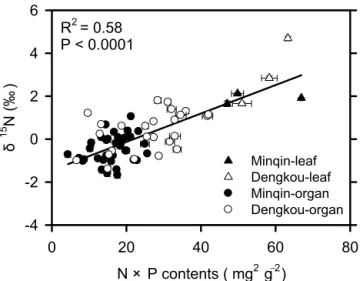
Figure 4.Changes ofδ15N as a function of the product of organ
N×P contents. Filled and unfilled symbols represent organs at the
Minqin and Dengkou site, respectively. Leaves are denoted by filled or unfilled triangles while other organs by filled or unfilled circles.
ation inδ15N (R2=0.58,P< 0.0001, Fig. 4). Adding organ
nitrogen content or phosphorous content, or both, did not significantly improve the predictive ability of resultant equa-tions.
Since fine roots differ from other organs in that fine roots are the primary organs for nitrogen acquisition, we re-calculated the organδ15N–nutrient relationships by
remov-ing all fine roots from the analyses, which are shown as the red regression lines in Fig. 3. We found that all corre-lations became stronger (compare the red with black regres-sion lines in Fig. 3). In addition, because leaves had con-siderably higher δ15N and nutrient contents than other
or-gans, we similarly re-calculated the correlations by remov-ing leaves from the analyses to avoid a foliar domination of the obtained relationships. After the leaves were removed, all correlations were still significant (data not shown, but can be seen from Figs. 3 and 4). Furthermore, the removal of either leaves or fine roots did not alter the finding that the N×P in-teraction was the strongest predictor of intra-plant variations inδ15N. Thus the intra-plantδ15N–nutrient relationships
ap-peared to be generic and independent of specific physiologi-cal or metabolic functions of particular plant organs.
4 Discussion
4.1 Potential mechanisms for the observed intra-plant δ15N–N and P relationships
This study appears to be the first to report that the strongest predictor of intra-plant variation inδ15N is the interaction
be-tween organ N and P contents rather than N or P themselves or their linear combination. To our knowledge, no previous studies have evaluated relationships between intra-plant
vari-Figure 5.Intra-plant nitrogen cycling and flux exchanges with ex-ternal environments.
ations inδ15N and organ N or P contents through
system-atical measurement approaches, although models have been developed to simulate root–shoot differences inδ15N in
re-sponses to overall changes in nitrogen supply and demand (e.g., Kalcsits et al., 2014). What mechanism(s) could be re-sponsible for such close relationships? Clearly this question cannot be answered conclusively with data available in this study or existing data in other published studies. Here we propose a hypothesis based on a synthesis of best available knowledge (Fig. 5). We hope our hypothesis will provide a starting point for follow-up research.
To facilitate our discussion, we group potential mecha-nisms into three categories: external factors only, internal factors only, and external and internal factors together. Po-tential external factors include different sources of nitrogen (e.g., NO−
requires a N and P allocation mechanism that allocates these two key nutrients roughly in proportion toδ15N in plant
or-gans and at the same time keeps the isotopic mass balance for the whole plant. Translocation of nitrogenous solutes (e.g., NO−
3, NH+4, amino acids) is a mass-flow process and mainly takes place from roots to shoots to leaves via xylem and from leaves to shoots to roots via phloem, but lateral transfer between xylem and phloem may also occur (Simp-son, 1986; Bijlsma et al., 2000).δ15N values probably
orig-inate mostly from fractionations in primary assimilation and exchange events and in subsequent metabolic reactions that create15N-enriched or15N-depleted metabolites (Tcherkez, 2011; Gauthier et al., 2013). The translocated nitrogenous compounds mix with existing structural (e.g., nitrogen in cell wall) or functional (e.g., nitrogen in photosynthesis, respi-ration, and storage that can readily mobilize and take part in metabolic reactions) nitrogen of an organ to give a bulk signal in δ15N. It is conceptually difficult to imagine how
these numerous, loosely coupled processes internal to plants collude to produce coordinated variations in N, P, andδ15N
across different plant organs. Therefore the probability that an internal-factors-only mechanism causes the observed pat-terns is likely very small. In the following, we focus on the possibility that external and internal factors work together to create the observed intra-plant variations inδ15N.
Plants can emit a vast number of nitrogenous compounds to the atmosphere, which is known to affect atmospheric secondary aerosol formation and climate (Sintermann and Neftel, 2015). These compounds are formed in metabolic processes such as the decarboxylation and transamination of amino acids (Bagni and Tassoni, 2001; Dudareva et al., 2013). Emissions of these compounds from fruits and flow-ers are readily noticed without needing sensitive measure-ments. In addition to fruits and flowers, leaves and stems can also emit nitrogenous compounds. Like many physical and biochemical processes, it is probably not unreasonable to as-sume that fractionation occurs in the emission of nitrogenous compounds from plants. Unfortunately no isotope fraction-ation measurements have ever been made on the emission of most of these compounds. However, considerable isotopic knowledge exists in the plant–atmosphere exchange of NH3. As shown in Fig. 5, NH3 is a key link between plant metabolism and ambient air (Flechard et al., 2013). As dis-cussed in the Introduction, living plant organs contain liq-uid pools of NH+
4 maintained by nitrogen translocation, nitrate and nitrite reduction, photorespiration, and other metabolic processes. In these pools, the rapid protonation– deprotonation process sustains an equilibrium between NH+ 4 and aqueous NH3. In the apoplast, gaseous NH3is in equili-bration with aqueous NH3across air-liquid interfaces (e.g., in the intercellular airspace), depending on the concentration ra-tio (Ŵ)of NH+4 to H+and therefore apoplastic pH (Flechard et al., 2013; Johnson and Berry et al., 2013). Isotope effects occur when the apoplast is able to exchange NH3with ambi-ent atmosphere. The fractionation has been estimated to be
17.6 ‰ for diffusion through still air and 11.7 ‰ through boundary layer (Farquhar et al., 1983; Johnson and Berry, 2013).
We are not aware of any reports that stems and aerial roots may emit or absorb NH3. However, it is a widely es-tablished fact that leaves exchange NH3 with atmosphere through stomata (Farquhar et al., 1980; Wetselaar and Far-quhar, 1980; Farquhar et al., 1983; Sharpe and Harper, 1997; Johnson and Berry, 2013; Flechard et al., 2013; Sintermann and Neftel, 2015). So for the momentum, let us focus on leaves (Figs. 3 and 4). The exchange can be bi-directional, depending on the gradient in the concentration of NH3across stomata. If the ambient concentration of NH3 is above the stomatal compensation point of NH3 (χ, Farquhar et al.,
1980), absorption occurs; otherwise, emission takes place.
χ is directly related to Ŵ which in turn is a function of
leaf nitrogen content (Flechard et al., 2013). This is because nitrogen-containing proteins (enzymes) are critical to pho-torespiration, which releases NH3 due to the decarboxyla-tion of glycine in mitochondria (Keys, 2006). If leaf nitro-gen is high and therefore the photorespiration rate is high, the re-assimilation by glutamine synthetase may not be fast enough to keep all NH3released from the mitochondria in-ternal to the metabolic cycles, leading to emission of NH3 from leaves. This emission will result in15N-enriched pools in leaves. Conversely, if leaf nitrogen is low and therefore the photorespiration rate is low, ambient NH3may diffuse into leaves, making leaf nitrogen pools more15N depleted. Thus a positive foliarδ15N–N relationship can be predicted. This
prediction is supported by empirical evidence. For example, Gauthier et al. (2013) showed that foliar nitrate content is positively correlated with foliarδ15N inBrassica napusL.
But how can we explain the positive δ15N–P
relation-ship and the even better δ15N–N×P relationship? Again, for the moment, we focus on leaves. We believe the an-swer lies in the role that phosphate (Pi) plays in
photo-synthesis and photorespiration. The photosynthetic reaction in chloroplasts is described by 3CO2+6H2O+Pi→triose phosphate+3H2O+3O2. Chloroplasts import Pi from and export triose phosphate to cytosol to sustain this reaction. Pi deficiency can limit the maximum electron transport rate in thylakoid membranes (Sivak and Walker, 1986) and therefore photorespiration rate and NH3concentration in sub-stomatal cavities under full sunlight. Conversely, increased Pi sup-ply may boost photorespiration and NH3concentration. As a result, foliarδ15N should be positively related to P, just as
it should be positively related to N. Why canδ15N be
pre-dicted even better by N×P? This is because a stoichiometry is needed between N and P to keep an efficient operation of the photosynthetic machinery (Gusewell, 2004), i.e., an over-supply of N cannot compensate for a deficiency in P and vice versa.
metabolism of the whole plant. While roots are the primary gate for outside nitrogen to enter into the internal nitrogen cycle, leaves are the ‘theater’ of nitrogen ‘actions’ within the plant. It is estimated that in C3 species, mesophyll chloro-plasts may contain as much as 75 % of total cellular nitrogen in a plant (Hörtensteiner and Feller, 2002). A major portion of leaf nitrogen is involved in photosynthetic reactions; Ru-BisCO alone, which catalyzes carboxylation and oxygena-tion, accounts for 15 to 30 % of total leaf nitrogen (Evans, 1989). More importantly, the flux of NH3, which is released by photorespiration and subject to either re-assimilation into amino acids or emission into the atmosphere, is 5 to 10 times larger than the primary assimilation rate at roots (Keys, 2006; Masclaux-Daubresse et al., 2010). The fraction of emission to the atmosphere depends on a range of biotic and abiotic factors. In measurements on two rice cultivars, Kumagai et al. (2011) reported that 12 and 21 % respectively of leaf nitro-gen was lost to the atmosphere due to release of NH3in pho-torespiration. Thus it seems possible for the leaf–atmosphere exchange of NH3to fundamentally affect the relationships of foliarδ15N with N, P, and N×P as the model of Johnson and Berry (2013) has suggested.
It is more challenging to include stems and roots in the equation. Clearly a photorespiration-based mechanism alone is not sufficient to explain the observed overall relationships as they hold across leaves, stems, and roots (Figs. 3 and 4). Assuming there are no N-and-P-mediated fractionating pro-cesses that directly exchange nitrogenous compounds be-tween stems (and roots) and the ambient air, is it possible for the leaf–atmosphere exchanges of nitrogen isotopes to af-fectδ15N values in stems and roots such thatδ15N increases
with N, P, and N×P across the whole plant as depicted in Figs. 3 and 4?
We believe it is possible. Mature leaves export nitrogen and phosphorous to other organs of plants (e.g., Aerts, 1996; Killingbeck, 1996; Jeschke et al., 1997; Hörtensteiner and Feller, 2002; Masclaux-Daubresse et al., 2010; Brant and Chen, 2015). In particular, plants resorb and remobilize es-sential nutrients to storage tissues in stems and roots during leaf senescence. In this process, proteins, particularly those involved in photosynthesis, are degraded, providing an enor-mous source of mobile nutrients. Resorption and remobiliza-tion of nutrients from senescing leaves are a vital strategy for plant survival for multiple reasons. First, it requires en-ergy to absorb and assimilate new nutrients from soil solu-tions, and thus recycling extant nutrients makes economic sense. Second, nutrient availability in the soil may be low and the rate of absorption at the root–soil interface may not be able to meet the instantaneous demand by new growth in the next spring. In a survey of published values, Brant and Chen (2015) found that leaf nitrogen and phosphorus resorp-tion efficiencies are generally over 60 % for a wide variety of plant species ranging from grasses and forbs to deciduous and evergreen trees (see Table 1 in that paper). Franklin and Ågren (2002) showed that a 70 % leaf nitrogen resorption
efficiency is needed to predict observed leaf area indices of several plant communities. Because of methodological limi-tations, these estimates do not generally consider volatiliza-tion losses to the atmosphere and thus are considered “appar-ent remobilization” (Masclaux-Daubresse et al., 2010). Nev-ertheless, there is little doubt that foliar nitrogen metabolism can affect stem and root nitrogen status. The foliar nitrogen and phosphorus remobilized to storage organs will support the growth of not only new leaves but also new tissues in stems and roots. Given that large amounts of N and P partic-ipate in reactions in leaves and are processed through leaves, it is reasonable to assume that the relationships ofδ15N with
N, P, and N×P in the stems and roots may bear a similarity to those of the leaves.
To summarize our fairly detailed reasoning above, the ob-served patterns in intra-plant variations in δ15N appear to
be most logically explained by the following three processes working together (Fig. 5):
– leaf–atmosphere exchanges of nitrogenous compounds, particularly NH3released during photorespiration, – nitrogen and phosphorus resorption and remobilization
from senescing leaves, and
– mixture of resorbed and remobilized nitrogen and phos-phorus with existing pools in stems and roots.
Nevertheless, we emphasize that this is a hypothesis only and it remains a research task to ascertain how N, P, and N×P affect the divergence ofδ15N in different organs of plants.
4.2 Comparison with reported inter-plant relationships It is interesting to compare the intra-plant relationships found here with the previously reported correlations of foliarδ15N
with N across species, climate, and ecological gradients. The positive intra-plant correlation between δ15N and N
con-tent reported in the present study is reminiscent of the fo-liar correlations reported in those previous studies. Using a dataset that contained over 11 000 plants worldwide, Craine et al. (2009) found that foliarδ15N was positively correlated
with foliar N. A subset of this dataset containedδ15N, N, and
P measurements. These authors subsequently analyzed this subset with a multilinear model that used N, P, and their inter-action as explanatory variables. It was not clear whether mul-ticollinearity was controlled but they found that after con-trolling for variations in N, foliar δ15N decreased with an
increase in P and in N×P. We used the same model to fit our intra-plant dataset without consideration of multicollinearity and found that foliarδ15N decreased with both N and P but
increased with N×P. Thus controlling multicollinearity is important for ascertaining relationships between δ15N and
nutrient contents due to correlations between contents of dif-ferent nutrients.
Positive foliar correlations ofδ15N with N have been
al., 1999; Hobbie et al., 2000; Craine et al., 2005). In addi-tion, Hobbie et al. (2008) reported a positive correlation for root tips. These positive correlations, which were all inter-rather than intra-plant in nature, are consistent with the re-ported experimental finding that an increase in soil nitrogen availability tends to lead to an increase in δ15N of
non-N-fixing plants (Wigand et al., 2007; Hobbie et al., 2008; Mayor et al., 2014). A hypothesis based on plant–mycorrhizal fun-gus interactions has been advanced to explain this positive relationship (Hobbie et al., 2000; Craine et al., 2009; Hob-bie and Högberg, 2012). Typically mycorrhizal fungi transfer isotopically depleted N to host plants. As soil N supply in-creases, the contribution from mycorrhizal symbionts to the total N budget of host plants may decrease, reducing the my-corrhizal dilution effect on the heavy isotope and resulting in a positive relationship of plant δ15N with soil N supply.
However, this explanation is only valid forδ15N of the plant
as a whole and cannot explain the positive relationship of intra-plantδ15N with N and the interaction between N and P.
In addition to the mycorrhizal hypothesis, a more general ex-planation for the N supply–plantδ15N relationship involves
the openness of the N cycle. This explanation hypothesizes that an increase in N supply promotes the openness of the N cycle and the increased openness results in higher losses of 14N relative to15N from the system, leading to enrichment in 15N in the remaining nitrogen pool. The openness typically refers to processes occurring in soil (e.g., N losses through denitrification via the release of N2O and N2from soil which is a strong fractionating process, Mnich and Houlton, 2016). Clearly a soil-central N openness explanation is also not valid for the intra-plant δ15N–N×P relationship reported in this study.
Another possibility to consider concerns the situation when nitrate is the source of N for plants. If soil supply of ni-trate is low, all nini-trate absorbed by roots may be assimilated in the roots and no enriched nitrate pool is left for transport to other parts of the plant. As soil supply of nitrate increases, the proportion of the nitrate pool that is unassimilated by roots and thus is available for transport to other parts of the plant may not only increase in size but also become more enriched in15N (a system cannot discriminate if all substrates are as-similated; discrimination generally increases with substrate availability, Evans, 2001). However, this possibility can only suggest that the difference inδ15N between roots and the rest
of the plant may increase with soil nitrate supply. It cannot account for the changes ofδ15N with organ N and P contents
and their interaction within the plant.
We are not aware of any previous studies that systemati-cally evaluated variations in rootδ15N with depth into soil.
However, our finding that roots tend to become more en-riched in 15N deeper into soil is reminiscent of the general patterns of increasing soil δ15N with depth, as reported in
previous studies (Hobbie and Ouimette, 2009; Gubsch et al., 2011; Szpak, 2014). Since the present study did not measure
soilδ15N profile, it remains to be determined whether the
profile of rootδ15N reflects that of soilδ15N.
5 Conclusion
A systematical evaluation of nitrogen isotope composition in the desert plant speciesNitraria tangutorumBobrov reveals
that the magnitude of intra-plant variations inδ15N is close
to the highest value reported in previous studies (7 ‰ , Fig. 3 and also Evans, 2001). These variations are positively corre-lated with corresponding organ N and P contents. However, it is the N×P interaction, not N and P individually or their lin-ear combination, that is the strongest predictor of intra-plant
δ15N. While the positive correlation of intra-plantδ15N with
organ N resembles theδ15N–N relationships reported in
pre-vious studies on patterns across ecological and climate gra-dients and across species, explanations developed from these previous studies are not valid for the patterns reported in the present study. We also report that rootδ15N increases with
depth into soil. This pattern in rootδ15N is similar to
pro-files of soilδ15N reported in previous studies, although the
exact relationship between root and soil profiles inδ15N is
not clear. We hypothesize that the strong positive intra-plant
δ15N–N and P relationships are a result of three processes
working together: (1) N-and-P-driven, fractionating ammo-nia exchanges between leaves and the atmosphere (volatiliza-tion) during photorespiration, (2) resorption and remobiliza-tion of N and P from senescing leaves, and (3) mixture of re-translocated foliar N and P with existing pools in stems and roots.
Knowledge of how plants acquire, transport, and transform N is crucial for understanding how plants use this crucial resource for production, growth, and reproduction and how the terrestrial N cycle operates. Intra-plant variations inδ15N
are an important outcome of the N cycle. The findings re-ported in the present study suggest that different mechanisms may operate at different scales to affect plant nitrogen iso-tope compositions and their relationships with nutrient avail-ability. Alternatively, causes of variations inδ15N, whether
they are intra-plant, inter-species, or cross ecological and cli-mate gradients, may differ from those previously considered. Our findings suggest that studies into intra-plant variations in
δ15N and their mechanisms can yield deep insights into the
N cycle of ecosystem and plant nitrogen metabolism. Such studies have not been adequate in the past and are urgently needed.
6 Data availability
Acknowledgements. Field work, data acquisition, and analyses were conducted at the Institute of Desertification Studies with support from the National Key Technology R&D Program of the Ministry of Science and Technology of China (2012BAD16B01), the National Natural Science Foundation of China Youth Fund Project (31400620), the State Forestry Administration of China Forestry Public Welfare Scientific Research Funding (201404304), the Science and Technology Foundation (CAF201202), and the Lecture and Study Program for Outstanding Scholars from Home and Abroad of the Chinese Academy of Forestry (CAFYBB2011007). Data analyses and manuscript writing were partly carried out at Oak Ridge National Laboratory (ORNL) with support from US Department of Energy, Office of Science, Biological and Environmental Research Program, Climate and Environmental Sciences Division. ORNL is managed by UT-Battelle, LLC, for the US Department of Energy under contract DE-AC05-00OR22725.
Edited by: N. Ohte
Reviewed by: three anonymous referees
References
Aerts, R.: Nutrient resorption from senescing leaves of perennials: are there general patterns?, J. Ecol., 84, 597–608, 1996. Amundson, R., Austin, A. T., Schuur, E. A. G., Yoo, K.,
Matzek, V., Kendall, C., Uebersax, A., Brenner, D., and Bais-den, W. T.: Global patterns of the isotopic composition of soil and plant nitrogen, Global Biogeochem. Cy., 17, 1031, doi:10.1029/2002GB001903, 2003.
Austin, A. T. and Sala, O. E.: Foliarδ15N is negatively correlated
with rainfall along the IGBP transect in Australia, Aust. J. Plant Physiol., 26, 293–295, 1999.
Baas, A. C. W. and Nield, J. M.: Modelling vegetated
dune landscapes, Geophys. Res. Lett., 34, L06405,
doi:10.1029/2006GL029152, 2007.
Bagni, N. and Tassoni, A.: Biosynthesis, oxidation and conjugation of aliphatic polyamines in higher plants, Amino Acids, 20, 301– 317, 2001.
Bai, E., Boutton, T. W., Liu, F., Wu, X. B., Archer, S. R., and Hall-mark, C. T.: Spatial variation of the stable nitrogen isotope ratio of woody plants along a topoedaphic gradient in a subtropical savanna, Oecologia, 159, 493–503, 2009.
Bergersen, F. J., Peoples, M. B., and Turner, G. L.: Isotopic discrim-inations during the accumulation of nitrogen by soybeans, Aust. J. Plant Physiol., 15, 407–420, 1988.
Bijlsma, R. J., Lambers, H., and Kooijman, S. A. L. M.: A dynamic whole-plant model of integrated metabolism of nitrogen and carbon. 1. Comparative ecological implications of ammonium-nitrate interactions, Plant Soil, 220, 49–69, 2000.
Brant, A. N. and Chen, Y. H.: Patterns and mechanisms of nutrient resorption in plants, CRC Cr. Rev. Plant Sci., 34, 471–486, 2015. Britto, D. T. and Kronzucker, H. J.: NH+
4 toxicity in higher plants:
a critical review, J. Plant Physiol., 159, 567–584, 2002. Cameron, A. C. and Trivedi, P. K.: Microeconometrics: Methods
and Applications, Cambridge University Press, Cambridge, New York, USA, 717–719, 2005.
Cernusak, L. A., Winter, K., and Turner, B. L.: Plantδ15N
corre-lates with the transpiration efficiency of nitrogen acquisition in tropical trees, Plant Physiol., 151, 1667–1676, 2009.
Craine, J. M., Lee, W. G., Bond, W. J., Williams, R. J., and Johnson, L. C.: Environmental constraints on a global relationship among leaf and root traits of grasses, Ecology, 86, 12–19, 2005. Craine, J. M., Elmore, A. J., Aidar, M. P. M., Bustamante, M.,
Daw-son, T. E., Hobbie, E. A., Kahmen, A., Mack, M.C., McLauchlan, K. K., Michelsen, A., Nardoto, G. B., Pardo, L. H., Peñuelas, J., Reich, P. B., Schuur, E. A. G., Stock, W. D., Templer, P. H., Vir-ginia, R. A., Welker, J. M., and Wright, I. J.: Global patterns of foliar nitrogen isotopes and their relationships with climate, my-corrhizal fungi, foliar nutrient concentrations, and nitrogen avail-ability, New Phytol., 183, 980–992, 2009.
Dawson, T. E., Mambelli, S., Plamboeck, A. H., Templer, P. H., and Tu, K. P.: Stable isotopes in plant ecology, Annu. Rev. Ecol. Syst., 33, 507–559, 2002.
Dijkstra, P., Williamson, C., Menyailo, O., Kocha, G., and Hun-gatea, B. A.: Nitrogen stable isotope composition of leaves and roots of plants growing in a forest and a meadow, Isot. Environ. Health S., 39, 29–39, 2003.
Du, J. H., Yan, P., and Dong, Y. X.: Phenological response of Ni-traria tangutorumto climate change in Minqin County, Gansu Province, northwest China, Int. J. Biometeorol., 54, 583–593, 2010.
Dudareva, N., Klempien, A., Muhlemann, J. K., and Kaplan, I.: Biosynthesis, function and metabolic engineering of plant volatile organic compounds, New Phytol., 198, 16–32, 2013. Evans, J. R.: Photosynthcsis and nitrogen relationships in leaves of
C3 plants, Oecologia, 78, 9–19, 1989.
Evans, R. D.: Physiological mechanisms influencing plant nitrogen isotope composition, Trends Plant Sci., 6, 121–126, 2001. Evans, R. D., Bloom, A. J., Sukrapanna, S. S., and Ehleringer, J. R.:
Nitrogen isotope composition of tomato (Lycopersicon esculen-tumMill. cv. T-5) grown under ammonium or nitrate nutrition, Plant Cell Environ., 19, 1317–1323, 1996.
Farquhar, G. D., Firth, P. M., Wetselaar, R., and Weir B.: On the gaseous exchange of ammonia between leaves and the environ-ment: determination of the ammonia compensation point, Plant Physiol., 66, 710–714, 1980.
Farquhar, G. D., Wetselaar, R., and Weir, B.: Gaseous nitrogen losses from plants, in: Gaseous loss of nitrogen from plant-soil systems, edited by: Freney, J. R. and Simpson, J. R., Berlin, Ger-many, Springer Press, the Netherlands, 159–180, 1983. Flechard, C. R., Massad, R.-S., Loubet, B., Personne, E.,
Simp-son, D., Bash, J. O., Cooter, E. J., Nemitz, E., and Sutton, M. A.: Advances in understanding, models and parameterizations of biosphere-atmosphere ammonia exchange, Biogeosciences, 10, 5183–5225, doi:10.5194/bg-10-5183-2013, 2013.
Franklin, O. and Ågren, G. I.,: Leaf senescence and resorption as mechanisms of maximizing photosynthetic production during canopy development at N limitation, Funct. Ecol., 16, 727–733, 2002.
Gauthier, P. P. G., Lamothe, M., Mahe, A., Molero, G., Nogues, S., Hodges, M., and Tcherkez, G.: Metabolic origin ofδ15N values
in nitrogenous compounds fromBrassicanapus L. leaves, Plant Cell Environ., 36, 128–137, 2013.
N.: Foliar and soilδ15N values reveal increased nitrogen
parti-tioning among species in diverse grassland communities, Plant Cell Environ., 34, 895–908, 2011.
Gusewell, S.: N:P ratios in terrestrial plants: variation and
func-tional significance, New Phytol., 164, 243–266, 2004.
Hobbie, E. A. and Hobbie, J. E.: Natural abundance of 15N in nitrogen-limited forests and tundra can estimate nitrogen cycling through mycorrhizal fungi: a review, Ecosystems, 11, 815–830, 2008.
Hobbie, E. A. and Högberg, P.: Nitrogen isotopes link mycorrhizal fungi and plants to nitrogen dynamics, New Phytol., 196, 367– 382, 2012.
Hobbie, E. A. and Ouimette, A. P.: Controls of nitrogen isotope patterns in soil profiles, Biogeochemistry, 95, 355–371, 2009. Hobbie, E. A., Macko, S. A., and Williams, M.: Correlations
be-tween foliarδ15N and nitrogen concentrations may indicate plant
mycorrhizal interactions, Oecologia, 122, 273–283, 2000. Hobbie, E. A., Colpaert, J. V., White, M. W., Ouimette, A. P., and
Macko, S. A.: Nitrogen form, availability, and mycorrhizal col-onization affect biomass and nitrogen isotope patterns inPinus sylvestris, Plant Soil, 310, 121–136, 2008.
Högberg, P.: Tansley Review No. 9515N natural abundance in soil-plant systems, New Phytol., 137, 179–203, 1997.
Hörtensteiner, S. and Feller, U.: Nitrogen metabolism and remobi-lization during senescence, J. Exp. Bot., 53, 927–937, 2002. Hyodo, F., Kusaka, S., Wardle, D. A., and Nilsson, M. C.: Changes
in stable nitrogen and carbon isotope ratios of plants and soil across a boreal forest fire chronosequence, Plant Soil, 367, 111– 119, 2013.
Inglett, P. W., Reddy, K. R., Newman, S., and Lorenzen, B.: In-creased soil stable nitrogen isotopic ratio following phosphorous enrichment: historical patterns and tests of two hypotheses in a phosphorous wetland, Oecologia, 153, 99–109, 2007.
Jeschke, W. D., Kirkby, E. A., Peuke, A. D., Pate, J. S., and Har-tung, W.: Effects of P deficiency on assimilation and transport of nitrate and phosphate in intact plants of castor bean (Ricinus communisL.), J. Exp. Bot., 48, 75–91, 1997.
Johnson, J. E. and Berry, J. A.: The influence of leaf-atmosphere NH3(g) exchange on the isotopic composition of nitrogen in plants and the atmosphere, Plant Cell Environ., 36, 1783–1801, 2013.
Joy, K. W.: Ammonia, glutamine and asparagine: a carbon-nitrogen interface, Can. J. Botany, 66, 2103–2109, 1988.
Kalcsits, L. A., Buschhaus, H. A., and Guy, R. D.: Nitrogen iso-tope discrimination as an integrated measure of nitrogen fluxes, assimilation and allocation in plants, Physiol. Plantarum, 151, 293–304, 2014.
Karsh, K. L., Granger, J., Kritee, K., and Sigman, D. M.: Eukaryotic assimilatory nitrate reductase fractionates N and O isotopes with a ratio near unity, Environ. Sci. Technol., 46, 5727–5735, 2012. Keys, A. J.: The re-assimilation of ammonia produced by
photores-piration and the nitrogen economy of C3higher plants,
Photo-synth. Res., 87, 165–175, 2006.
Killingbeck, K. T.: Nutrients in senesced leaves: keys to the search for potential resorption and resorption proficiency, Ecology, 77, 1716–1727, 1996
Kolb, K. J. and Evans, R. D.: Implications of leaf nitrogen recycling on the nitrogen isotope composition of deciduous plant tissues, New Phytol., 156, 57–64, 2002.
Kondracka, A. and Rychter, A. M.: The role of Pi recycling pro-cesses during photosynthesis in phosphate-deficient bean plants, J. Exp. Bot., 48, 1461–1468, 1997.
Kumagai, E., Araki, T., Hamaoka, N., and Ueno, O.: Ammo-nia emission from rice leaves in relation to photorespiration and genotypic differences in glutamine synthetase activity, Ann. Bot.-London, 108, 1381–1386, 2011.
Lang, L. L., Wang, X. M., Hasi, E., and Hua, T.: Nebkha (coppice dune) formation and significance to environmental change recon-structions in arid and semiarid areas, J. Geograph. Sci., 23, 344– 358, 2013.
Li, J. F., Du, J. X., and Zhang, S. Q.: The effects of sap of Nitraria plant on the growth of its endogenous nitrogen-fixing microbes under saline-alkaline stress, International Conference on Chem-ical, Material and Food Engineering (CMFE-2015), 25–26 July 2015, Kunming, China, 2015.
Li, Q. H., Xu, J., Li, H. Q., Wang, S. X., Yan, X., Xin, Z. M., Jiang, Z. P., Wang, L. L., and Jia, Z. Q.: Effects of aspect on clonal reproduction and biomass allocation of layering modules ofNitraria tangutorumin Nebkha dunes, PLOS One, 8, e79927, doi:10.1371/journal.pone.0079927, 2013.
Luo, Y., Su, B. O., Currie, W. S., Dukes, J. S., Finzi, A., Hartwig, U., Hungate, B., McMurtrie, R. E., Oren, R., Parton, W. J., Pataki, D. E., Shaw, R. M., Zak, D. R., and Field, C. B.: Progressive nitrogen limitation of ecosystem responses to rising atmospheric carbon dioxide, Bioscience, 54, 731–739, 2004.
Manzoni, S., Trofymow, J. A., Jackson, R. B., Porporato, A.: Stoi-chiometric controls on carbon, nitrogen, and phosphorus dynam-ics in decomposing litter, Ecol. Monogr., 80, 89–106, 2010. Martinelli, L. A., Piccolo, M. C., Townsend, A. R., Vitousek, P.
M., Cuevas, E., Mcdowell, W., Robertson, G. P., Santos, O. C., and Treseder, K.: Nitrogen stable isotopic composition of leaves and soil: tropical versus temperate forests, in: New Perspectives on Nitrogen Cycling in the Temperate and Tropical Americas, edited by: Townsend, A. R., Berlin, Germany, Springer Press, the Netherlands, 45–65, 1999.
Masclaux-Daubresse, C., Daniel-Vedele, F., Dechorgnat, J., Chardon, F., Gaufichon, L., and Suzuki A.: Nitrogen uptake, as-similation and remobilization in plants: challenges for sustain-able and productive agriculture, Ann. Bot.-London, 105, 1141– 1157, 2010.
Massad, R.-S., Nemitz, E., and Sutton, M. A.: Review and param-eterisation of bi-directional ammonia exchange between vegeta-tion and the atmosphere, Atmos. Chem. Phys., 10, 10359–10386, doi:10.5194/acp-10-10359-2010, 2010.
Mattsson, M. and Schjoerring, J. K.: Dynamic and steady-state responses of inorganic nitrogen pools and NH(3) exchange in leaves of Lolium perenne and Bromus erectus to changes in root nitrogen supply, Plant Physiol., 128, 742–750, 2002.
Mayor, J. R., Wright, S. J., Schuur, E. A. G., Brooks, M. E., and Turner, B. L.: Stable nitrogen isotope patterns of trees and soils altered by long-term nitrogen and phosphorus addition to a low-land tropical rainforest, Biogeochemistry, 119, 293–306, 2014. McKee, K. L., Feller, I. C., Popp. M. P., and Wanek, W.: Marianne
Popp and Wolfgang Wanek Mangrove isotopic (δ15N andδ13C)
fractionation across a nitrogen vs. phosphorus limitation gradi-ent, Ecology, 83, 1065–1075, 2002.
ecosystems in seasonally dry climates, Oecologia, 181, 323–333, 2016.
Resco, V., Ferrio, J. P., Carreira, J. A., Calvo, L., Casals, P., Ferrero-Serrano, Á., Marcosd, E., Morenoag, J. M., Ramírezg, D. A., Se-bastiàeh, M. T., Valladaresi, F., and Williamsj, D. G.: The stable isotope ecology of terrestrial plant succession, Plant Ecology & Diversity, 4, 117–130, 2011.
Robinson, D.:δ15N as an integrator of the nitrogen cycle, Trends
Ecol. Evol., 16, 153–62, 2001.
Schjoerring, J. K., Husted, S., Mäck, G., and Mattsson, M.: The regulation of ammonium translocation in plants, J. Exp. Bot., 53, 883–890, 2002.
Schulze, E. D., Williams, J., Farquhar, G. D., Schulze, W., Lan-gridge, J., Miller, J. M., and Walker, B. H.: Carbon and nitro-gen isotope discrimination and nitronitro-gen nutrition of trees along a rainfall gradient in northern Australia, Aust. J. Plant Physiol., 25, 413–425, 1998.
Sharpe, R. R. and Harper, L. A.: Apparent atmospheric nitrogen loss from hydroponically grown corn, Agron. J., 89, 605–609, 1997. Simpson, R. J.: Translocation and metabolism of nitrogen: whole
plant aspects, Dev. Plant Soil Sci., 19, 71–96, 1986.
Sintermann, J. and Neftel, A.: Ideas and perspectives: on the emis-sion of amines from terrestrial vegetation in the context of new atmospheric particle formation, Biogeosciences, 12, 3225–3240, doi:10.5194/bg-12-3225-2015, 2015.
Sivak, M. N. and Walker, D. A.,: Photosynthesis in vivo can be lim-ited by phosphate supply, New Phytol., 102, 499–512, 1986. Sun, Y, Gu, L., Dickinson, R. E., Norby, R. J., Pallardy, S. G.,
and Hoffman, F. M.: Impact of mesophyll diffusion on estimated global land CO2 fertilization, P. Natl. Acad. Sci., 111, 15774– 15779, 2014.
Szpak, P.: Complexities of nitrogen isotope biogeochemistry in plant-soil systems: implications for the study of ancient agricul-tural and animal management practices, Frontiers in Plant Sci-ence, 5, doi:10.3389/fpls.2014.00288, 2014.
Tcherkez, G.: Natural15N/14N isotope composition in C3 leaves: are enzymatic isotope effects informative for predicting the15 N-abundance in key metabolites?, Funct. Plant Biol., 38, 1–12, 2011.
Thornton, P. E., Lamarque, J. F., Rosenbloom, N. A., and Ma-howald, N. M.: Influence of carbon-nitrogen cycle coupling on land model response to CO2fertilization and climate variability, Global Biogeochem. Cy., 21, 1–15, 2007.
Vitousek, P. M.: Beyond global warming: ecology and global change, Ecology, 75, 1861–1876, 1994.
Vitousek, P. M., Porder, S., Houlton, B. Z., and Chadwick, O. A.: Terrestrial phosphorus limitation: mechanisms, implications, and nitrogen-phosphorus interactions, Ecol. Appl., 20, 5–15, 2010. Wang, L., Okin, G. S., Wang, J., Epstein, H., and Macko, S. A.:
Pre-dicting leaf and canopy15N compositions from reflectance spec-tra, Geophys. Res. Lett., 34, doi:10.1029/2006GL028506, 2007. Wang, N., Gao, J., Zhang, S. Q., and Wang, G. X.: Contemporary problems of ecology, Variations in leaf and root stoichiometry of Nitraria tangutorum along aridity gradients in the Hexi Corridor, northwest China, Contemp. Prob. Ecol., 7, 308–314, 2014. Webb, B. and Adeloju, S. B.: Evaluation of some wet digestions
methods for reliable determination of total phosphorus in Aus-tralian soils, Microchem. J., 111, 47–52, 2013.
Werner, R. A. and Schmidt, H. L.: The in vivo nitrogen isotope discrimination among organic plant compounds, Phytochemistry, 61, 465–484, 2002.
Wetselaar, R. and Farquhar, G. D. Losses of nitrogen from the tops of plants, Adv. Agron, 33, 263–302, 1980.
Wigand, C., McKinney, R. A., Cole, M. L., Thursby, G. B., and Cummings, J.: Varying stable nitrogen isotope ratios of differ-ent coastal marsh plants and their relationships with wastewater nitrogen and land use in New England, USA, Environ. Monit. Assess., 131, 71–81, 2007.
Yoneyama, T. and Kaneko, A.: Variations in the natural abundance of15N in nitrogenous fractions of komatsuna plants supplied with nitrate, Plant Cell Physiol., 30, 957–962, 1989.
Yoneyama, T., Ito, O., and Engelaar, W. M. G. H.: Uptake, metabolism and distribution of nitrogen in crop plants traced by enriched and natural15N: progress over the last 30 years, Phy-tochem. Rev., 2, 121–132, 2003.