Rate Maximization in MISO OFDM System
with Per-Subcarrier Antenna Selection and
Power Balancing
K.Rajeswari 1, S.J.Thiruvengadam 2 1,2
Department of Electronics and Communication Engineering, 2
TIFAC CORE in Wireless Technologies, Thiagarajar College of Engineering, Madurai, TamilNadu
1
Abstract— In a multiple input single output orthogonal frequency division multiplexing (MISO
OFDM) system, per-subcarrier antenna selection is employed to improve the data rate over frequency selective fading channels. The antenna selection is based on the channel gain and the power balancing is achieved through allocating equal number of subcarriers to each antenna. This scheme of antenna selection suffers from the possibility of allocating antenna with weaker channel co-efficients and inefficient use of available transmit power. In this paper, an optimal power allocation scheme for each subcarrier to maximize the sum rate is proposed for MISO OFDM system using per-tone antenna selection with power balancing. The numerical results show that the proposed rate adaptation with optimal power allocation increases the data rate over rate adaptation with equal power allocation.
Keyword-OFDM, Per-Subcarrier Antenna selection, Power balancing, Rate maximization
I. INTRODUCTION
Orthogonal frequency-division multiplexing (OFDM) is one of the most promising technologies for high-speed wireless communication systems due to its high spectral efficiency and robustness to frequency selective channels [1]-[3]. Spatial diversity is a technique for overcoming the effects of fading. Conventionally spatial diversity is used at the receiver. For portable receivers where size is a main constraint, use of multiple antenna becomes a challenge. By using multiple spatially separated antennas at the transmitter, diversity gain can be achieved and transmit diversity is an efficient technique to provide robustness to deep fading in wireless OFDM systems [4]-[6].
Antenna selection in the transmitter is a very attractive technique for complexity reduction in MISO OFDM systems with diversity [7]. The transmit antenna selection can be employed in two ways: bulk selection and per-tone selection [8]. In bulk selection, a selected antenna subset is same for all tones. Little channel state information feedback is required in bulk selection. It needs only less number of radio frequency (RF) chains. In per-tone selection, a different antenna is selected for each tone. In MISO OFDM system, when antenna selection is performed on a per-subcarrier basis, it exploits the frequency selectivity of the channel achieving much lower bit-error rate (BER) [9].
In per-tone selection, as there is a possibility of allocating more subcarriers to a single antenna, there exists a power imbalance across the antennas. Power balancing is achieved by allocating equal number of subcarriers to all the antennas while offering substantial diversity gains [10]. However, certain amount of data are to be transmitted through the antennas with weaker channel coefficients making the system spectrally inefficient. To improve the data rate over power balanced per-tone antenna selection system, a sum rate maximization problem is solved [11]. It also suffers from the inefficient use of available transmit power among subcarriers. This paper proposes a rate maximization framework by adopting the transmit power of each subcarrier in MISO OFDM system. Based on channel gain, equal number of subcarriers are allotted to each of the transmit antenna for power balancing. Then, an optimal transmit power allocation is performed such that the sum rate is maximized. This paper is organized as follows. The system model is given in Section II and the two step algorithm for antenna selection and rate maximization is presented in Section III. The performance of the algorithm is analysed through simulations in Section IV. Concluding remarks are presented in section V.
II. SYSTEM MODEL
Consider a multiple-input, single-output (MISO) OFDM system with nttransmit antennas and Nsubcarriers.
, , 1
, 1,...,
t
n
k k j k j k k
j
r h x s w k N
=
=
+ = (1)where hk j, is the channel frequency response between th
j transmitting antenna and the receiver for k th
subcarrier. sk is given by sk = p bk k, where bk is the symbol on each subcarrier which is assumed to be
uniform random variable with zero mean and unit variance and pk is power of the k th
subcarrier. wk is white
Gaussian noise with zero mean and variance σw2 at k
th
subcarrier . Since antenna selection is employed, the
indicator xk j, ∈
{ }
0,1 is 1 if and only if the kth
subcarrier data is transmitted through jth antenna.
It is assumed that the transmitter has knowledge of the channel, which can be obtained by either the reciprocity of the channel or feedback. Each subcarrier data is transmitted through only one antenna. Strict transmit power limits are placed on each subcarrier so that there is no power imbalance across the transmitting antennas.
III. PROPOSED FRAMEWORK FOR RATE MAXIMIZATION WITH POWER BALANCING
A. Antenna Selection For Power Balancing
Consider a MISO OFDM system wherein the total number of subcarriers are distributed equally among the selected antennas. The metric for allocating a particular subcarrier to an antenna is magnitude square of channel
gain hk j, 2. As costs are usually defined to be the minimizing function, let
2
, ,
k j k j
a = −h be the cost for transmitting from antenna j on subcarrier k.
The total cost function across the whole frequency band is thus,
, , 1 1
t
n N
k j k j k j
t x a
= =
=
(2)The cost function can be written in vector form as,
t=a xT (3)
where t
t
T Nn
1,1 N,1 1,2 N,n
a ,...,a ,a ,...,a
= ∈
a R
{ }
0,1 tt
T Nn
1,1 N,1 1,2 N,n
x ,..., x , x ,..., x
= ∈
x
The constraint that each subcarrier is transmitted through only one antenna is mathematically written as
, 1
1, t
n k j j
x k
=
= ∀
(4)The power constraint on the jthantenna for power balancing to have equal number of subcarriers as other antennas in the system can be mathematically represented as,
, 1
,
N k j
k t
N
x j
n =
= ∀
(5)The constraints in (4) and (5) can be written in vector form as
C xeq =1N (6)
where
{ }
0,1 x t tN Nn T
eq≅ n ⊗ N∈
C 1 I .
t
n
1 denotes a ntx1 vector of ones ,IN is the NxNidentity matrix and ⊗ denotes Kronecker product. If Nis
not divisible by nt, (6) can be modified as
, 1
,
N k j
k t
N
x j
n =
= ∀
(7)t n t N n ≤
Cx 1 (8)
where
{ }
0,1 txt tn n N T
n N
≅ ⊗ ∈
C I 1
Then the integer optimization problem for the cost function in (3) becomes,
{ }0,1 min , Nnt T x∈ a x such that t eq N n t N n = ≤
C x 1
Cx 1 (9)
The matrices Ceq andCare totally unimodular as the entries are 1 or 0. If we relax the vector x∈
{ }
0,1Nntas
t t
n N ≤ ≤ n N
0 x 1 , with total modularity of Ceq andC, simplex or interior point method can be used and the solution will be optimum [12]. The relaxed linear programming problem which gives a solution over the polyhedron is given as
t | , ,
t t t
n N
eq N n n N n N
t N E n = ∈ = ≤ ≤ ≤
x R C x 1 Cx 1 0 x 1 (10) This relaxation is only useful if the relaxed solution is feasible i.e., it is integral.
B. Rate Maximization with Power Balancing
Let Kjbe the set with subcarriers transmitted through jth antenna. Instead of transmitting equal power to all the subcarriers in Kj, an optimal power along with adaptive modulation may be allocated to each subcarrier such that the data rate is maximized. The number of bits allotted for the symbol transmitted through each subcarrier is decided based on the required BER which is bounded by [13],
(
,)
, 1.5 1 BER exp5 2 k j 1
k j n γ − ≤ − (11)
where nk j, is the number of bits in each subcarrier symbol. The signal to noise ratio γk j, is given by 2
2
, ,
, 2
k j k j k j
w
s h
γ
σ
= with sk j, as the symbol chosen for k
th
subcarrier through jth transmit antenna. From (11), for
a given BER, nk j, is given by
, log2 1 ,
k j k j n γ ρ = +
(12)
where ρ= −ln 5BER / 1.5
(
)
. The total data rate of the MISO OFDM system is1 t n T j j R R =
=
where Rj is the data rate in jth transmit antenna and is given by, j k j j k n R T ∈ =
K (13)Here, T is the OFDM symbol duration. T is given by T=1 /Bk and Bk =B N/ where Bk and B are subcarrier bandwidth and total bandwidth of one OFDM symbol respectively. Substituting (12) in (13), the rate over jth subcarrier is given by
2 2 , , 2 2 log 1 j
k j k j j
k w
s h
B R
N ∈ σ ρ
= +
K (14)2 , 2 2 , , 2 2
max log 1 k j
j
k j k j j s k w s h B R
N ∈ σ ρ
= +
K, s.t 2, /
j
k j t
k
s P n
∈
=
K
. (15)
where P is the total power available. Using the Lagrangian method, the Lagrangian is written as
(
)
2 2
, ,
2 2
, , log2 1 2 , /
j j
k j k j
k j k j t
k w k
s h
B
L s s P n
N λ λ σ ρ ∈ ∈ = + + −
K K (16)where λ is the Lagrange multiplier. The solution for s2k j, is obtained by differentiating (16) with respect to 2
,
k j
s and equating to zero. Upon solving, it is obtained as
2 2
, 2
0 ,
1 1 ,
k j w j
k j s k h σ ρ λ + = − ∈
K (17)
where
( )
y +=max(
y, 0)
. The constant λ0 is given by 20 N wlog 2 /B
λ = −λ ρσ . λ0is determined from the sum power constraint in (15) and is determined as
1
0 2 2
, 1 j j k t w k j P c n h λ σ ρ − ∈ = +
K K (18) where jcK is the number of subcarriers chosen for optimal power allocation in the set Kj.
IV. NUMERICALRESULTS
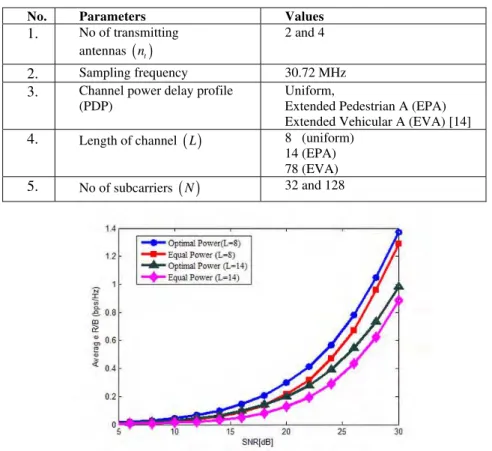
In this section, simulations are carried out to analyse the average data rate normalized by the total bandwidth for the proposed algorithm in MISO-OFDM system with per-subcarrier antenna selection. The parameters used for simulation are given in Table I.
TABLE I Simulation Parameters
No. Parameters Values
1. No of transmitting antennas
( )
nt2 and 4
2. Sampling frequency 30.72 MHz
3. Channel power delay profile (PDP)
Uniform,
Extended Pedestrian A (EPA) Extended Vehicular A (EVA) [14] 4. Length of channel
( )
L 8 (uniform)14 (EPA) 78 (EVA) 5. No of subcarriers
( )
N 32 and 128Figure 1 shows the average rate normalized to total bandwidth obtained for the proposed algorithm for various SNRs (signal to noise ratio) in 2x1 MISO OFDM system at a BER of 3
10− . The simulation is performed considering uniform PDP for the channel with length 8. One OFDM symbol consists of 32 subcarriers. With R/B of 0.3bps/Hz, the proposed algorithm gives 1.5dB improvement over power balancing with equal power allocation for the channel length of 8. Similar improvement is also noticed when the channel length is increased to 14. However the R/B performance for channel length 8 is better than the performance for channel length 14 for both the optimal and equal power allocation. This is due to the fact that the system experiences higher SNR for the channel with length 8 compared to the channel of length 14 for normalized uniform PDP.
Fig. 2 Average R/B of 2x1 MISO OFDM system with extended pedestrian A and extended vehicular A PDP
In order to study the robustness of the proposed algorithm for various channel conditions, simulations are performed considering extended pedestrian A and extended vehicular A channel PDPs. The number of subcarriers in the system is assumed to be 128. With the sampling frequency of 30.72MHz, the channel length of a extended pedestrian A channel is 14 taps as its delay spread is 410 ns. The delay spread of extended
Fig. 3 Average R/B of 2x1 MISO OFDM system with different number of subcarriers
vehicular A channel is 2510 ns and it results in 78 length channel. From figure 2 it is noticed that the performance improvement of the proposed algorithm over equal power allocation after power balancing is 1.3dB at R/B of 0.5 bps/Hz with extended pedestrian A channel. For the extended vehicular A channel, at 0.5 bps/Hz, the proposed algorithm gives 1.5 dB improvement. The performance improvement in extended vehicular A channel is due to the higher channel gain in the taps compared to extended pedestrian A channel.
Figure 3 shows the average rate normalized to total bandwidth in 2x1 MISO OFDM system with per-tone antenna selection to meet the target BER of 3
10− for different number of subcarriers. The optimal power allocation with power balancing gives higher average data rate compared to equal power allocation with power balancing. With 64 subcarriers in the system, optimal power allocation gives average data rate of 0.215 bps/Hz where as equal power allocation with power balancing gives average data rate of 0.163 bps/Hz.
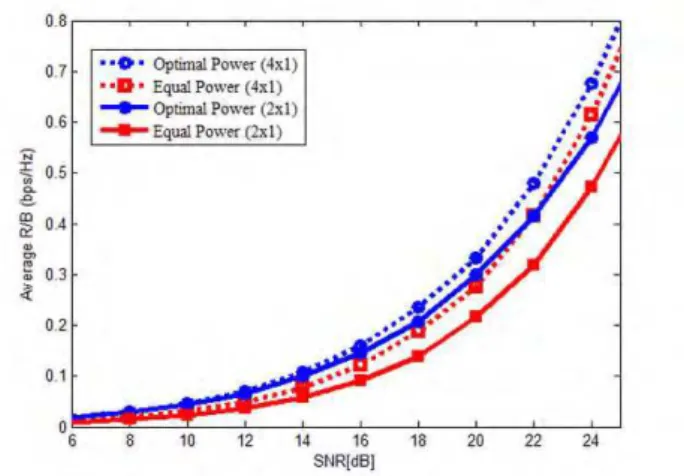
Figure 4 shows the average rate normalized to total bandwidth in 4x1 MISO OFDM system with per-tone antenna selection with equal total transmit power as that of 2x1 system. Uniform PDP with a length of 8 is assumed for simulation. In one OFDM symbol, 32 subcarriers are used. The proposed algorithm allocates optimal power for subcarriers allocated to each antenna, thus improving the spectral efficiency. With R/B of 0.3 bps/Hz, the proposed algorithm gives 1.5dB improvement over power balancing with equal power allocation for the channel length of 8 in 2x1 MISO OFDM system with per-subcarrier antenna selection. In 4x1 MISO OFDM system, 1 dB improvement is achieved with optimal power allocation. This decrease is due to reduced available power to a single antenna in a 4x1 system when compared to 2x1 system.
V. CONCLUSION
The problem of rate maximization with power allocation in MISO OFDM with per-subcarrier transmit antenna selection is considered in this work. Per-subcarrier antenna selection based on channel gain is used to utilize the space diversity of the system and hence to improve the performance. Equal number of subcarriers are allocated to have power balancing. In order to maximize the data rate, an optimization framework with respect to the power allocated to each subcarrier is formulated with sum power constraint. Simulation results confirm that higher average data rate is achieved using proposed algorithm than equal power allocation for the subcarriers selected in each antenna.
REFERENCES
[1] J. Bingham, “Multicarrier modulation for data transmission: an idea whose time has come”, IEEE Communication Magazine, vol.28, pp.5-14, 1990.
[2] W. Y. Zou and Wu.Y, “COFDM: an overview”, IEEE Transaction on. Broadcasting, vol. 41, pp.1-8, 1995.
[3] L. J. Cimini, “Analysis and simulation of a digital mobile channel using orthogonal frequency division multiplexing,” IEEE Transaction
on Communication, vol. COM-33, pp. 665–675, July 1985.
[4] S.M. Alamouti, “A simple transmitter diversity scheme for wireless communications,” IEEE J. Select.Areas Commun.,vol. 16, no. 8, pp. 1451-1458, Oct. 1998.
[5] King F. Lee and Douglas B. Williams “A Space-Frequency Transmitter Diversity Technique for OFDM Systems”, in Global
Telecommunications Conference,GLOBECOM '00, 2000, vol.3, pp.1473-1477.
[6] K.F.Lee, and D.B.Williams, “A space-time coded transmitter diversity technique for frequency selective fading channels”, in Proceeding
of the IEEE Sensor Array and Multichannel Signal Processing Workshop, Mar. 2000, pp.149-152.
[7] Peter Almers, Telmo Santos, Fredrik Tufvesson, Andreas F. Molisch, Johan Karedal and Anders J Johansson, “Measured diversity gains from MIMO antenna selection”, in Vehicular Technology Conference, Sept. 2006, pp.25-28.
[8] Zhang,H. and Nabar, R. U., “Transmit antenna selection in MIMO-OFDM systems: bulk versus per-tone selection”, in Proc. IEEE ICC, May 2008, pp.19-23.
[9] Justin P. Coon and Magnus Sandell, “Combined bulk and per-tone transmit antenna selection in OFDM systems”, IEEE communications letters, vol.14, pp. 426-428, 2010.
[10] Magnus Sandell and Justin P.Coon, “Per-subcarrier antenna selection with power constraints in OFDM systems”, IEEE Transactions on
Wireless Communicatioms, vol.8, 673-677, 2009.
[11] Ki-Hong Park, Young-Chai Ko and Mohamed-Slim Alouini, “On the diversity enhancement and power balancing of per-subcarrier transmit antenna selection in OFDM systems”, IEEE Transactions on Vehicular Technology, vol.60, no.5, pp. 2405-2410, June 2011. [12] R. Fletcher, Pracitcal methods of optimization, 2nd ed., Wiley-Interscience, New York, 1987.
[13] Jiho Jang and Kwang Bok Lee, “Transmit power adaption for multiuser OFDM systems”, IEEE J. Select.Areas Commun., vol.21, pp.171-178, 2003.
[14] User Equipment (UE) Radio Transmission and Reception, 3rd Generation Partnership Project; Technical Specification Group Radio