Submitted1 June 2016
Accepted 1 September 2016
Published27 September 2016
Corresponding author
Vanessa L. Buechner, [email protected]
Academic editor
Stefano Ferraina
Additional Information and Declarations can be found on page 8
DOI10.7717/peerj.2515
Copyright
2016 Buechner and Maier
Distributed under
Creative Commons CC-BY 4.0
OPEN ACCESS
Not always a matter of context:
direct effects of red on arousal but
context-dependent moderations on
valence
Vanessa L. Buechner and Markus A. Maier
Department of Psychology, Ludwig-Maximilians-Universität München, Munich, Germany
ABSTRACT
The arousal theory of color proposes that red is associated with arousal. Research on the color-in-context theory, in turn, states that the context in which red is perceived influences its valence-related meaning and behavioral responses to it. This study faces and integrates these theories by examining the influence of red on both arousal and valence perceptions of test-relevant and neutral stimuli, rendering a color 2 (red vs. blue)×context 2 (test vs. neutral) between-subjects design. Participants rated different pictures regarding their arousal and valence component, respectively. In line with the assumptions of both theories, red increased arousal perceptions of stimuli irrespective of their valence but a context×color interaction was found for valence perceptions: for participants viewing test-relevant pictures, red increased their perceptions of negativity compared to neutral pictures. The present study shows that both theories are actually compatible when differentiating the arousal and valence component.
SubjectsPsychiatry and Psychology
Keywords Color, Red, Arousal, Valence, Context
INTRODUCTION
Research on the meaning and effects of colors has been of interest since the 1940’s. Thereby, two different theories primarily focusing on effects of the color red met approval in the last years—thearousal theory of colorand thecolor-in-context theory.As their names imply, the arousal theory states that the color red per se is arousing, whereas the color-in-context theory states that context in which this color is perceived influences its valence-related meaning and behavioral responses to it. Plenty of research has been done on both theories and will be briefly described in the following paragraph.
blood pressure, respiratory movements, and frequency of eye blink, whereas blue light leads to a decrease of these parameters. Interestingly,Wilson (1966)showed that red, in comparison to green, is not only more arousing from an implicit physiological (i.e., high skin conductance level and response) but also from a more explicit cognitive (i.e., ratings) perspective. Using Likert scales research could show that the color red is associated with terms such as ‘exciting’ and ‘stimulating’ (Wexner, 1954) as well as ‘warmth’ and ‘less calmness’ (Wright & Rainwater, 1962).
Taken together, previous research using both explicit and implicit measurement tools provided evidence that the color red, as a typical long-wavelength color, is correlated with high arousal whereas short-wavelength colors reduce the individual’s arousal level.
The second theory, the color-in-context theory (Elliot & Maier, 2012) focuses on the valence dimension of colors and, by drawing on biology and social learning, claims that the context in which color is perceived influences its affective meaning and responses to it. Context is defined as both the physical structure as well as the psychological situation (Bazire & Brézillon, 2005;Zimmermann, Lorenz & Oppermann, 2007) within which color is embedded. These circumstances frame a color and determine its meaning. More precisely, with regard to the color red in achievement contexts this color becomes associated with both ‘danger’ and ‘caution’ (Moller, Elliot & Maier, 2009) and therefore activates avoidance motivation (Elliot et al., 2009;Maier, Elliot & Lichtenfeld, 2008). In romantic contexts, however, red becomes associated with ‘sex’ and ‘romance’ and consequently triggers approach motivation (Elliot et al., 2010;Kaya & Epps, 2004;Niesta Kayser, Elliot & Feltman, 2010;Meier et al., 2012). Thus, depending on the situational circumstances red seems to take on opposite meanings on the valence dimension (see alsoMaier et al., 2009).
1Someone could argue that the research
question is redundant. The arousal theory and the color-in-context theory are based on very different levels of processing. Specifically, the arousal theory posits that red deserves its meaning from its wavelength characteristics, while the color-in-context theory focuses on the affective meaning of red on a more cognitive level. From this perspective, it seems logical that the associated arousal does not change with context. However, although theoretically convincing, empirical evidence is missing. Red effects on arousal have never been studied within an experimental context manipulation. Hence, although the main effect of color red on arousal was widely accepted potential moderating influences were never empirically ruled out. (We would like to thank reviewer 1 for this suggestion).
2The effect size of a similar study (Buechner
et al, 2015) was small (d=.20). To be
more conservative, we assumed a smaller effect size.
(i.e., an aversive signal of low mate value). To sum up, the updated color-in-context theory claims that red accentuates a stimulus’ affective meaning and subsequently defines or triggers the corresponding valence of this stimulus. Thus, the proposed impact color might exert in the present study is different from previous studies: it slightly intensifies the meaning of the negative test items, but does not change it. Importantly, as predicted, red effects that vary with the context have only been found on the valence dimension of the stimuli used.
In light of both theories, red is expected to increase arousal regardless of contextual variations in which the color is perceived, but red is supposed to trigger the perception of va-lence along with and therefore dependent on the context-related information being present.
Aims and hypotheses of the present research
This study aims to examine both the arousal and the color-in-context hypothesis by exploring the influence of colored stimuli on arousal and valence perceptions. The study described herein is thus a conceptual replication of previous findings documenting the intensifying effect of the color red on valence perceptions (Buechner et al., 2015) with a highly powered sample in another context, that is achievement context instead of romantic. Further, experimental studies often used picture stimuli to create romantic settings, but never to create achievement contexts. Achievement contexts were mostly induced via instructions or specific performance tasks. Here we fill this gap by using test-relevant and neutral pictures to create an achievement context. That is, a set of test-relevant and neutral pictures will be presented together with a red or blue frame. Red should raise arousal perceptions for both picture types thus confirming the arousal theory but it should increase valence perceptions only for test-relevant pictures confirming the color-in-context theory.1
MATERIALS & METHODS
In line withSimmons, Nelson, and Simonsohn’s(2012)proposal for a 21 word solution of disclosure, we report determination of sample size, all data exclusions, all manipulations, and all measures in the study.
Participants
Design and procedure
Participants were randomly assigned to one of the four experimental conditions, rendering a color 2 (red vs. blue) ×context 2 (test vs. neutral) between-subjects design. The experimenters were blind to condition and hypotheses. Participants were instructed to open a folder to view 4 different pictures, around 6.7-in.×4.5-in. in size and printed with an Epson Stylus Photo R800 color printer on a white heavyweight Epson Matte Paper, 8.2-in. ×11.6-in. in size. We handed four pictures to enable enough stimuli variability and to reduce the likelihood of unknown confounds. More precisely, dependent on the experimental group, they either saw four red-primed test-relevant pictures, 4 blue-primed test-relevant pictures, four red-primed neutral pictures, or four blue-primed neutral pictures. Three neutral pictures were taken from the International Affective Picture System (IAPS; Lang, Bradley & Cuthbert, 2008), which provides an experimental set of 1,169 digitized photographs with normative rating scores (using a 9-point rating scale) on valence and arousal. The neutral pictures were selected based on the normative valence ratings and showed scenarios, such as a theater hall (picture #2037), a newspaper (#7061), or a person reading a book (picture #2377). The forth neutral picture showing a stage was retrieved from the internet and judged as neutral by two dependent experts beforehand. Content-matched negative, test-relevant pictures, retrieved from the internet and judged as negative by two dependent experts beforehand, showed scenarios, such as a lecture hall while students writing an exam, a person being frustrated while working on a paper, a person being frustrated while reading a book, or a lecture hall. Color was manipulated by encircling the pictures with a red or blue frame, 0.3-in.×0.3-in. in size. A spectrophotometer was used to determine the precise parameters of the colors: red (LCh[55,5; 52,2; 32,0]) and blue (LCh[55,2; 52,0; 274,7]); lightness and chroma were equated across hue. After participants viewed each of the respective four photos (dependent of condition) for five seconds, they were instructed to complete the questionnaire containing the dependent measures of both arousal and valence, demographic items, as well as some control items (i.e., trait and test anxiety) to test for any moderating effects. Someone could assume that high anxious individuals might exhibit a stronger color×context on valence effect. No specific effects on arousal have been hypothesized.
Measures
Valence and arousal
For each of the 4 pictures 1 item was used to assess valence (i.e., ‘‘Describe how unpleasant do you think this situation is’’) and 1 item to assess arousal (i.e., ‘‘Describe how physiologically arousing do you think this situation is’’). Participants responded on 1 (not at all) to 9 (extremely) scales for both measures, and the scales were labeled only on point 1 and 9. In between no labels were given as this has been shown to be sufficient and an understandable scale labelling for different variables in previous studies (e.g.,Elliot et al., 2010).
Trait anxiety
Test anxiety
Pekrun et al.’s(2004)12-item Test-Emotions Questionnaire (TEQ) was used to assess test anxiety before exam (e.g., ‘‘I worry whether I learned enough’’;α=.75) and during exam (e.g., ‘‘I feel panicky when writing an exam’’;α=.77). Participants responded on 1 (not at all true) to 5 (absolutely true) scales.
Ethics statement
The research reported herein was conducted at the LMU Munich and was approved by the ethics committee of the Department of Psychology, LMU Munich, in accordance with the ethical standards of the American Psychological Association (APA). All participants gave written informed consent and were thoroughly debriefed. The individuals’ consent was obtained after reading the instruction to the experiments. The experimenter asked for the participant’s consent and emphasized that they will receive their credit also if they decided not to participate in this study. Participants were also told that they could stop and leave the experiment at any point of time. Data were stored and analyzed anonymously. This consent procedure has been approved by the ethics committee.
RESULTS
Arousal
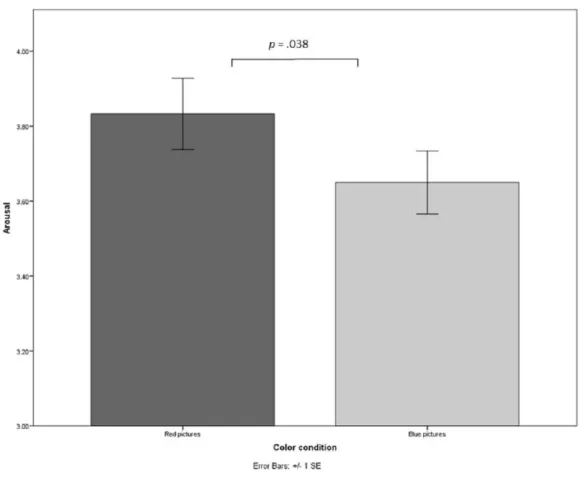
A subjects analysis of variance (ANOVA) with color and context as between-subjects factors was conducted on arousal. Results revealed no significant two-way interaction on arousal, F=1.10,p> .250. However, there was a significant main effect for color (F(1,301)=4.36,p=.038, η2p=.01,d=.20) and a significant main effect for context (F(1,301)=115.64,p< .001, η2p=.28,d=1.23). Participants rated the red pictures (M=3.83,SD=1.16) more arousing than the blue ones (M=3.65,SD=1.06, seeFig. 1) and the test pictures (M=4.32,SD=1.05) more arousing than the neutral ones (M=3.17,SD=.84).
Valence
A further ANOVA with color and context as between-subjects factors was conducted on valence. There was a significant main effect of context (F(1,301)=325.48,p< .001,
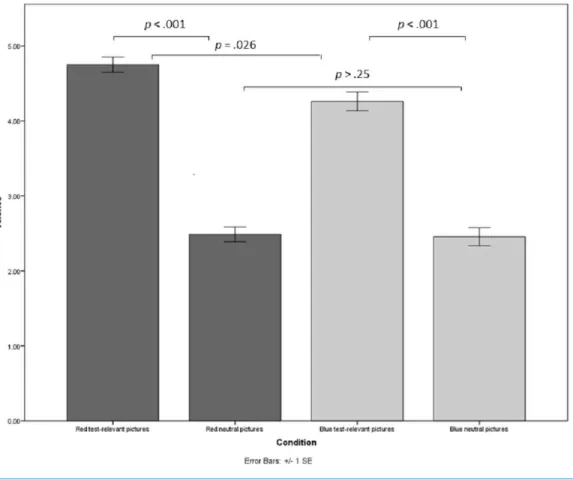
η2p=.52,d=2.05). Participants rated the test pictures (M =4.49,SD=1.03) more negative than the neutral ones (M=2.47,SD=.95). In addition, there was a significant main effect for color (F(1,301)=5.40,p=.021, ηp2=.02). Participants rated the red pictures (M=3.57,SD=1.42) more negative than the blue ones (M=3.39,SD=1.41) and this main effect was moderated by a significant two-way interaction,F(1,301)=4.12,
p=.043,ηp2=.01,d=.16.
3In the demographic section at the end
of the experiment, we asked participants to rate how much their perception was affected by the colored frame on a 1 (not at all) to 9 (completely) scale. Subjective ratings showed that most of participants indicated that their judgement was not affected by color (MDN=2.00,
M=2.33,SD=1.72). This indicates
that the majority of participants in our sample was convinced that color did not affect their behavior in the various tasks they performed. Hence, attributing the observed color effects to an explicit level should be treated with caution. In addition, we also asked our participants to recall the color of the frame. Only 53.77% could correctly remember the color. We speculate that this low recognition rate is another indicator of an incidental, implicit effect of color.
Figure 1 Arousal perceptions of red and blue pictures.
than the neutral ones (M=2.49,SD=.86),p< .001. In the blue condition, participants rated the test pictures (M=4.26,SD=1.12) also more negative than the neutral ones (M=2.45,SD=1.05),p< .001, however to a lesser degree (seeFig. 2).3
Supplementary analyses controlling for both covariates, trait and test anxiety, showed that these measures of individual differences did not substantially moderate the interaction effect on valence reported above.
DISCUSSION
The present study examined the influence of red on both arousal and valence perceptions of test-relevant and neutral stimuli. As mentioned before, arousal theorists, like Wexner (1954) andGoldstein (1942), state that the color red per se is arousing. More precisely, they claim that the perception of red is associated with terms such as ‘stimulating’ as well as produces physiological reactions such as faster speed of movement, increased blood pressure, and frequency of eye blink. Research on the color-in-context theory in contrast, could show that context in which the color red is perceived influences its valence-related meaning and behavioral responses to it (e.g., Elliot & Maier, 2012; Maier et al., 2009).
Figure 2 Valence perceptions of red test-relevant, red neutral, blue test-relevant, and blue neutral pic-tures.
to be arousing independently of a given context (see for instanceCrowley, 1993;Gerard, 1958;Nakshian, 1964;Wilson, 1966). However, with regard to the color-in-context theory red was expected to raise valence perceptions only for test-relevant pictures, as context is said to be the determining factor. Context dependent moderations of red have consistently been shown for valence related variations. As such, Buechner et al. (2015)could show that red increases the perceivers’ valence dependent response tendencies, that is increased approach in case of a positive-appetitive stimulus configuration and increased avoidance in case of a negative-aversive one. Further,Buechner et al. (2014)could show that such context dependent red effects could be explained by attentional bias towards a specific stimulus. More precisely, red has been shown to accentuate the relevance of a goal-related stimulus and correspondingly intensify the perceivers’ attentional reaction to it.
Previous research has shown that the recognition of facial and bodily expressions is influenced by the context (e.g.,De Gelder et al., 2006;Kret & De Gelder, 2010;Righart & de Gelder, 2006). That is, the affective information provided by the surrounding scene in which a face/body appears may influence how it is encoded (Righart & De Gelder, 2006). Congruence between the valence of a facial or bodily expression with the valence of a context enhance the emotion perception. In the study presented herein, we used pictures that present congruent target-context information to make sure that the valence is best perceived.
Our results were in line with previous research on both the arousal theory of color (from a cognitive perspective) and the color-in-context theory, and contribute to the psychological literature by facing both theories within one study. However, the present study is limited in some senses that need to be taken into account for further research. As this study focuses on undergraduates only, further research is needed that concentrates on students or adults. Also, the color manipulation done by a frame raises questions regarding the degree to which the findings would generalize to other types of color presentation. A valuable follow up to this study would be a replication that focuses on another age sample and varies the color manipulation.
As mentioned above, an a priori power analysis was performed based on a small effect size (d=.16). We prefer to refrain from post hoc power analyses, as this procedure is known to be fundamentally flawed (Hoenig & Heisey, 2001). Nevertheless the central effects reported in our paper are indeed very small. Therefore, another preregistered and confirmatory study could help to clarify the robustness of the color effects. We would like to encourage other independent labs to replicate our findings. However, we still think that our results are worth to be reported since many psychological effects have been shown to be very small (30.44% yielding anrof .10 or less;Richard, Bond & Stokes-Zoota, 2003). In addition, the predefined sample size based on high a priori power allowed us to interpret the results on a statistical level. The question about the practical impact is legitimate to ask but was not the primary goal of this study. Rather, we tried to test different theories of effects of the color red on arousal and valence perceptions.
The present research was designed to differentiate two color theories within one study. In our view we successfully managed this research goal with a highly powerful sample and carefully designed control conditions. We hope that the present results are useful for further research to extend this type of work.
ADDITIONAL INFORMATION AND DECLARATIONS
Funding
Grant Disclosures
The following grant information was disclosed by the authors: German Research Foundation: MA 2447/4-1.
Competing Interests
The authors declare there are no competing interests.
Author Contributions
• Vanessa L. Buechner conceived and designed the experiments, performed the experiments, analyzed the data, contributed reagents/materials/analysis tools, wrote the paper, prepared figures and/or tables, reviewed drafts of the paper.
• Markus A. Maier conceived and designed the experiments, analyzed the data, wrote the paper, reviewed drafts of the paper.
Human Ethics
The following information was supplied relating to ethical approvals (i.e., approving body and any reference numbers):
Ethics committee of the Department of Psychology, LMU Munich.
The research reported herein was conducted at the LMU Munich and was approved by the ethics committee of the Department of Psychology, LMU Munich, in accordance with the ethical standards of the American Psychological Association (APA). All participants gave written informed consent and were thoroughly debriefed. The individuals’ consent was obtained after reading the instruction to the experiments. The experimenter asked for the participant’s consent and emphasized that they will receive their credit also if they decided not to participate in this study. Participants were also told that they could stop and leave the experiment at any point of time. Data were stored and analyzed anonymously. This consent procedure has been approved by the ethics committee.
Data Availability
The following information was supplied regarding data availability:
Buechner V. 2016. Data_Not always a matter of context: Direct effects of red on arousal but context-dependent moderations on valence. Open Science Framework. September 2. Available atosf.io/vzw5r.
REFERENCES
Bazire M, Brézillon P. 2005. Understanding context before using it. In: Dey A, Kokinov B, Leake D, Turner R, eds.Context. Berlin: Springer-Verlag, 29–40.
Buechner VL, Maier MA, Lichtenfeld S, Elliot AJ. 2015.Emotion expression and color: their joint influence on attractiveness and social position.Current Psychology
34(2):422–433DOI 10.1007/s12144-014-9266-x.
Buechner VL, Maier MA, Lichtenfeld S, Schwarz S. 2014.Red—take a closer look.PLoS ONE9:e108111DOI 10.1371/journal.pone.0108111.
Crowley AE. 1993.The two dimensional impact of color on shopping.Marketing Letters
De Gelder B, Meeren HK, Righart R, Van den Stock J, Van de Riet WA, Tamietto M. 2006.Beyond the face: exploring rapid influences of context on face processing.
Progress in Brain Research155:37–48DOI 10.1016/S0079-6123(06)55003-4. Elliot AJ, Maier MA. 2012.Color-in-context theory.Advances in Experimental Social
Psychology45:63–125 DOI 10.1016/B978-0-12-394286-9.00002-0.
Elliot AJ, Maier MA, Binser MJ, Friedman R, Pekrun R. 2009.The effect of red on avoidance behavior in achievement contexts.Personality and Social Psychology Bulletin35:365–375DOI 10.1177/0146167208328330.
Elliot AJ, Niesta D, Greitemeyer T, Lichtenfeld S, Gramzow RH, Maier MA, Liu H. 2010.Red, rank and romance in women viewing men.Journal of Experimental Psychology: General139:399–417DOI 10.1037/a0019689.
Faul F, Erdfelder E, Lang A, Buchner A. 2007.G*Power 3: a flexible statistical power analysis program for the social behavioral and biomedical sciences.Behavior Research Methods39:175–191DOI 10.3758/BF03193146.
Gerard RM. 1958.Color and emotional arousal [Abstract from the program of the sixty-sixth annual convention of the American Psychological Association] [Abstract 340].
American Psychologist 13.
Goldstein K. 1942.Some experimental observations concerning the influence of colors on the function of the organism.Occupational Therapy and Rehabilitation
21:147–151DOI 10.1097/00002060-194206000-00002.
Hoenig JM, Heisey DM. 2001.The abuse of power: the pervasive fallacy of power calculations for data analysis.The American Statistician55(1):19–24
DOI 10.1198/000313001300339897.
Kaya N, Epps HH. 2004.Relationship between color and emotion: a study of college students.College Student Journal38:396–405.
Kret ME, De Gelder B. 2010.Social context influences recognition of bodily expressions.
Brain Research203:169–180DOI 10.1007/s00221-010-2220-8.
Lang PJ, Bradley MM, Cuthbert BN. 2008.International affective picture system (IAPS): affective ratings of pictures and instruction manual. Technical report A-8.
Laux L, Glanzmann P, Schaffner P, Spielberger CD. 1981.Das State-Trait-Angstinventar (Testmappe mit Handanweisung, Fragebogen G Form X 1 und Fragebogen STAI-G Form X 2). Weinheim: Beltz.
Maier MA, Barchfeld P, Elliot AJ, Pekrun R. 2009.Context-specificity of implicit preferences: the case of human preference for red.Emotion9:734–738 DOI 10.1037/a0016818.
Maier MA, Elliot AJ, Lichtenfeld S. 2008.Mediation of the negative effect of red on intellectual performance.Personality and Social Psychology Bulletin34:1530–1540 DOI 10.1177/0146167208323104.
Meier BP, D’Agostino PR, Elliot AJ, Maier MA, Wilkowski BM. 2012.Color in context: psychological context moderates the influence of red on approach-and avoidance-motivated behavior.PLoS ONE7(7):e40333DOI 10.1371/journal.pone.0040333. Moller AC, Elliot AJ, Maier MA. 2009.Basic hue-meaning associations.Emotion
Nakshian JS. 1964.The effects of red and green surroundings on behavior.The Journal of General Psychology70:143–161DOI 10.1080/00221309.1964.9920584.
Niesta Kayser D, Elliot AJ, Feltman R. 2010.Red and romantic behavior in men viewing women.European Journal of Social Psychology40:901–908DOI 10.1002/ejsp.757. Pekrun R, Goetz T, Perry RP, Kramer K, Hochstadt M. 2004.Beyond test anxiety:
development and validation of the Test Emotions Questionnaire (TEQ).Anxiety, Stress, & Coping 17:287–316 DOI 10.1080/10615800412331303847.
Richard FD, Bond CF, Stokes-Zoota JJ. 2003.One hundred years of social psy-chology quantitatively described.Review of General Psychology7:331–363 DOI 10.1037/1089-2680.7.4.331.
Righart R, De Gelder B. 2006.Context influences early perceptual analysis of faces. An electrophysiological study.Cerebral Cortex 16:1249–1257
DOI 10.1093/cercor/bhj066.
Simmons JP, Nelson LD, Simonsohn U. 2012.A 21 word solution. Social Science Research Network.Available athttp:// ssrn.com/ abstract=2160588.
Spielberger CD, Gorsuch RL, Lushene R, Vagg PR, Jacobs GA. 1983.Manual for the state-trait anxiety inventory. Palo Alto: Consulting Psychologists Press.
Tracy JL, Robins RW, Schriber RA. 2009.Development of a FACS-verified set of basic and self-conscious emotion expressions.Emotion9:554–559DOI 10.1037/a0015766. Wexner LB. 1954.The degree to which colors (hues) are associated with mood-tones.
Journal of Applied Psychology38(6):432–435 DOI 10.1037/h0062181.
Wilson GD. 1966.Arousal properties of red versus green.Perceptual and Motor Skills
23:947–949DOI 10.2466/pms.1966.23.3.947.
Wright B, Rainwater L. 1962.The meanings of color.The Journal of General Psychology
67:89–99DOI 10.1080/00221309.1962.9711531.