Two-Arm Randomized Pilot Intervention Trial
to Decrease Sitting Time and Increase
Sit-To-Stand Transitions in Working and
Non-Working Older Adults
Jacqueline Kerr1*, Michelle Takemoto1, Khalisa Bolling1, Andrew Atkin2, Jordan Carlson3, Dori Rosenberg4, Katie Crist1, Suneeta Godbole1, Brittany Lewars1, Claudia Pena1, Gina Merchant1
1Department of Family Medicine and Public Health, University of California, San Diego, California, United States of America,2UKCRC Centre for Diet and Activity Research (CEDAR), University of Cambridge School of Clinical Medicine, CB2 0QQ, United Kingdom,3Children's Mercy Hospital, Kansas City, Missouri, United States of America,4Group Health Research Institute, Seattle, Washington, United States of America
Abstract
Background
Excessive sitting has been linked to poor health. It is unknown whether reducing total sitting time or increasing brief sit-to-stand transitions is more beneficial. We conducted a random-ized pilot study to assess whether it is feasible for working and non-working older adults to reduce these two different behavioral targets.
Methods
Thirty adults (15 workers and 15 non-workers) age 50–70 years were randomized to one of two conditions (a 2-hour reduction in daily sitting or accumulating 30 additional brief sit-to-stand transitions per day). Sitting time, sit-to-standing time, sit-to-sit-to-stand transitions and stepping were assessed by a thigh worn inclinometer (activPAL). Participants were assessed for 7 days at baseline and followed while the intervention was delivered (2 weeks). Mixed effects regression analyses adjusted for days within participants, device wear time, and employ-ment status. Time by condition interactions were investigated.
Results
Recruitment, assessments, and intervention delivery were feasible. The‘reduce sitting’
group reduced their sitting by two hours, the‘increase sit-to-stand’group had no change in sitting time (p<.001). The sit-to-stand transition group increased their sit-to-stand transi-tions, the sitting group did not (p<.001).
OPEN ACCESS
Citation:Kerr J, Takemoto M, Bolling K, Atkin A, Carlson J, Rosenberg D, et al. (2016) Two-Arm Randomized Pilot Intervention Trial to Decrease Sitting Time and Increase Sit-To-Stand Transitions in Working and Non-Working Older Adults. PLoS ONE 11(1): e0145427. doi:10.1371/journal.pone.0145427
Editor:Daisuke Nishi, National Center of Neurology and Psychiatry, JAPAN
Received:September 11, 2015
Accepted:December 2, 2015
Published:January 6, 2016
Copyright:© 2016 Kerr et al. This is an open access article distributed under the terms of theCreative Commons Attribution License, which permits unrestricted use, distribution, and reproduction in any medium, provided the original author and source are credited.
Data Availability Statement:All data are from the Sedentary Behavior Pilot study and are within the paper and its Supporting Information files.
Conclusions
This study was the first to demonstrate the feasibility and preliminary efficacy of specific sedentary behavioral goals.
Trial Registration
clinicaltrials.govNCT02544867
Introduction
The study of sedentary behavior as an independent risk factor for chronic disease morbidity and mortality has expanded rapidly in recent years [1]. Although historically sedentary behav-ior has been conceptualized as the absence of physical activity (i.e., physical inactivity) [2], it is now recognized as a distinct behavioral domain, characterized by low energy expenditure (<1.5 METS) and a sitting or reclining posture [3]. An emerging body of epidemiological
evi-dence suggests that sedentary behaviors are associated with all-cause and cardiovascular mor-tality, overweight and obesity, type 2 diabetes, depression and psychological well-being [4–12]. Importantly, many of these associations were observed independent of participation in moder-ate to vigorous intensity physical activity. Further, there is preliminary evidence that the physi-ological mechanisms through which sedentary behavior negatively impacts health are distinct from the pathways linked to physical activity [13,14].
Surveillance data indicates that adults accumulate over 7 hours per day of sedentary time [15], yet the‘dose’of sedentary behavior that most accurately predicts health risk remains uncertain. There are multiple ways of disrupting sedentary time such as through movement, prolonged standing, or brief sit-to-stand transitions. Approaches for disrupting sedentary time likely vary in terms of their acceptability by different populations and may have differential impacts on health outcomes.
A recent review suggests that physical activity interventions do not appreciably alter seden-tary time [16]. Thus, there are an emerging number of interventions that explicitly aim to reduce sedentary behavior. The majority of interventions to date have targeted children or working adults. Among the adult studies, the workplace has been the primary setting and inter-ventions have centered on environmental changes including implementing standing desks to promote less sitting [17,18]. These interventions have shown some efficacy but may not be appropriate in nonworking populations, such as retired older adults. Further, most of the inter-ventions have delivered mixed messages encouraging breaks from sitting, prolonged standing, and movement, making it difficult to determine which types of sedentary behavior are most feasible to improve and which types of intervention most effective. Most studies have observed reductions in sitting time and increases in standing time with little impact on sit-to-stand tran-sitions [17,18]. However, prolonged standing may not be feasible or safe for some populations (e.g., older adults), may not be convenient outside of workplaces, and may be more difficult to maintain long term compared to other approaches such as brief sit-to-stand transitions. Labo-ratory studies suggest that the frequency of disrupting sitting is important, and that sit-to-stand transitions can increase postural blood flow, contract muscles, and stimulate biological processes important in disease formation [19–22].
Therefore, we developed two different intervention approaches for sedentary behavior reduction: 1) reducing overall sitting time and 2) frequent brief sit-to-stand transitions. Work-ing and non-workWork-ing adults aged 50–70 were randomized to each condition to examine the
the Wellcome Trust, under the auspices of the UK Clinical Research Collaboration, is gratefully acknowledged. The funders had no role in study design, data collection and analysis, decision to publish, or preparation of the manuscript.
Competing Interests:The authors have declared that no competing interests exist.
feasibility of each target and preliminary efficacy on objectively measured sedentary behaviors and physical activity. We hypothesized that each intervention would only affect the behavior targeted by the intervention content.
Materials and Methods
S1 CONSORT Checklistoutlines the CONSORT 2010 checklist for randomized trials and where the information is included in the manuscript.
Participants and Recruitment
We conducted a two arm randomized pilot trial with an equal number of workers (employed full time) and non-workers assigned to each condition. This was to ensure variability in work status, not to explore differences by work status. The study was supported through a small departmental grant to determine the acceptability and feasibility of a sedentary behavior inter-vention. Therefore, the sample size and intervention were designed to maximize funds and test the intervention in a small sample of 30 participants, as appropriate for a pilot trial. Increased power to detect differences was also derived from the continuous data collection of the primary outcome across multiple days per participant.
Procedures
Following randomization, participants answered a short written survey, completed an in per-son interview about the feasibility and acceptability of wearing the thigh mounted inclinometer and met with the study health educator for one hour for their first intervention session. Partici-pants then returned to the study office one and two weeks later to have data from their incli-nometer downloaded by staff, have a follow-up session with the health educator, and complete study surveys and interview questions.
Intervention Conditions
Participants were randomized to either reduce their total sitting time or increase sit-to-stand transitions. Each intervention lasted 14 days with three in person health educator sessions dur-ing that time. Both intervention arms drew from behavior change strategies highlighted as effective, including, self-monitoring, goal setting, feedback, problem-solving, and planning [23]. In addition, the intervention was informed by the social ecological model [24,25] that considers the supportiveness of the physical and social environments in which behaviors occur. Information was provided in person, through written materials and by emails and phone calls in both conditions. Both groups received written educational materials on the dan-gers of excessive sitting and reviewed a generic day to illustrate how many sitting opportunities individuals face each day. During each session, the health educator also discussed the benefits of sitting less or increasing sit-to-stand transitions (depending on study condition) and brain-stormed potential barriers to implementing the new behavior as well as strategies to overcome these barriers. At the end of each session, participants completed and signed a behavioral con-tract that outlined the goal for the upcoming week, their motivation to achieve the goal, and a potential barrier and solution to implementing the behavior. Participants created an action plan with the health educator indicating how they would incorporate study tools to accomplish the goal during the upcoming week. At the end of the visit, participants rated their confidence in meeting the goal on a scale from 1 (not at all confident) to 10 (completely confident). If par-ticipants rated their confidence at a 5 or below, the health educator would revisit the action plan to develop different strategies to help the participant feel more confident. Participants selected whether they wanted email or phone call check-ins in the second week of the interven-tion to test whether this mode of communicainterven-tion was also useful.
Reduce sitting condition. Those randomized to this condition focused on reducing their overall sitting time by two hours per day (a goal achieved in similar studies [17,18] that repre-sented approximately a 25% reduction in daily sitting time). Participants were encouraged to reach this goal by standing in bouts of roughly 10 minutes per hour. The purpose of this arm was to investigate whether we could replicate improvements in sitting time achieved in other worksite studies in our cohort of older adults, which included both workers and non-workers.
Increase sit-to-stand transitions condition. Those randomized to the sit-to-stand condi-tion focused on increasing the number of sit-to-stand transicondi-tions they performed throughout the day with a goal of adding 30 additional transitions per day. Previous studies have not suc-ceeded in increasing the number of sit-to-stand transitions in older adults, possibly because they focused on reducing overall sitting time, encouraged longer standing breaks and did not provide a specific goal for sit-to-stand transitions [26–28]. An increase in sit-to-stand transi-tions would not be expected with an increase standing intervention alone, as prolonged stand-ing reduces the opportunity for sit-to-stand transitions.
During each weekly session with the health educator, participants in this group reviewed a feedback chart illustrating the number of sit-to-stand transitions they achieved each day, mea-sured by the thigh worn inclinometer. Participants were told that each standing break could be brief and did not have to interrupt normal activities. Thus, we felt that social or environmental supports were not required but that more frequent cues to remind participants to stand up would be more useful. Participants were provided with the same choice of reminder tools to support their behavior change as the‘reduce sitting group’except they were not given standing desks. Instead, they were offered counters to help them track sit-to-stand transitions through-out the day (e.g., electronic counter, bracelet counter, dry erase board). The intervention mate-rials and protocol are available on request from the authors.
In person interviews. At each visit, participants completed a short semi-structured inter-view with study staff. They were asked about the acceptability of the study device, their satisfac-tion with the intervensatisfac-tion materials, and the feasibility of the intervensatisfac-tion goals. Quessatisfac-tions probed the experience of wearing the device, their success following the action plan, barriers and facilitators to behavior change, the impact on other behaviors, and their goal progress. Responses to these questions were deemed secondary outcomes.
Primary Outcome: Objective Measures of Behavior
The thigh worn inclinometer (the activPAL3, PAL Technologies Limited, Glasgow, UK) was employed as an intervention feedback tool as described above and provided the outcome mea-sures, which included: daily sitting time, daily standing time, daily stepping time and number of sit-to-stand transitions per day. Participants completed a sleep log and daily waking hours were extracted to omit sleep time from the measures. Since sleep time can greatly influence the number of waking hours available for sitting, it was important to analyze sitting time reduc-tions irrespective of sleep time. Participants were shown how to attach the inclinometer to their mid-thigh and to waterproof the device with an adhesive surgical sleeve provided by study staff. Replacement sleeves were provided, but participants were encouraged not to remove the device between study visits as the waterproofing allowed it to be worn during show-ering. At each office visit, the device and covering were replaced.
Analyses
No formal analysis of the secondary interview data was performed. We merely report here information that helps to explain the study findings and provide evidence of feasibility and acceptability.
Results
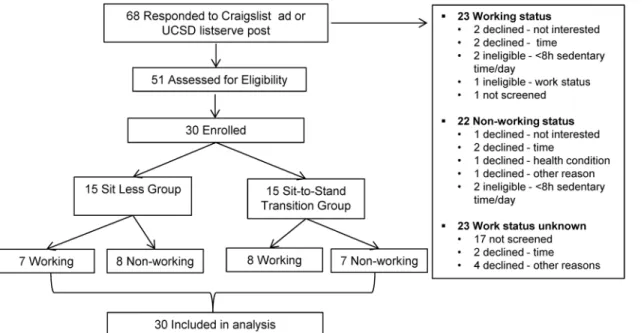
Fig 1provides a CONSORT diagram of recruitment for the pilot intervention. A total of 51 people were screened for participation; 80% were eligible. Four participants were ineligible because they did not meet the minimum average 8 hour/day sitting time criteria during the enrollment week and 2 participants were ineligible based on work status (i.e., full-time
employed after the working group was closed to enrollment). A total of 15 participants declined participation based on a health condition precluding participation, lack of interest in the study, and/or lack of time to attend study visits.Table 1highlights the demographic characteristics of the two intervention groups. The average age was 60.4 years old (SD 5.9), the average body mass index was 27.0 (SD 4.7). By design, half the participants were employed, 80% were white, 57% were married and 27% were male. All participants enrolled into the study completed the study, all health education sessions were delivered as anticipated, and all participants complied with activPAL wear time expectations (24 hours for 21days). No adverse events were reported during the intervention period.
ActivPAL data
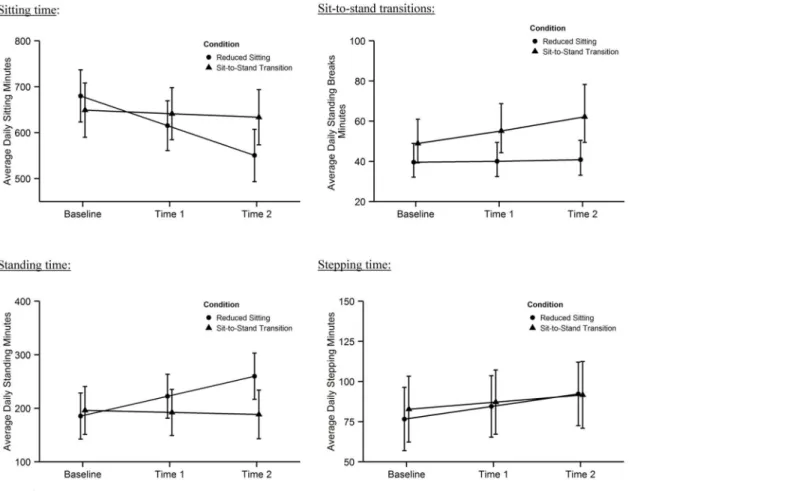
Analyses were performed on 21 days of data for 15 participants in each arm.Fig 2shows the changes over time by condition for all the outcomes, regardless of their significance. There was a significant time x condition interaction for sitting time (Beta 57.0 (SE 12.5): p<.0001),
standing time (Beta -40.9 (SE 9.4): p<.0001), and number of sit-to-stand transitions (0.10
(0.04): p = .006). The interaction term describes the difference in change between groups over time in minutes or transitions per day. Those randomized to reduce their sitting time had a sig-nificant 130 minute decrease in sitting time but no change in sit-to-stand transitions. Those randomized to increase sit-to-stand transitions had a significant increase in sit-to-stand transi-tions by about 13 transitransi-tions per day, but no change in total sitting time. There was no signifi-cant interaction for stepping time; all participants increased their physical activity level by 10 minutes/day.Table 2presents the full results of the statistical models, including 95% confi-dence intervals to inform future interventions.
Data were available for a subset of participants (N = 22) processed with the sit-to-stand transition detection every second. The default setting is that only stands of 10 seconds are recorded. Our participants were not instructed to stand for that long. Data from the subset indicated that the average increase in stands achieved in the sit-to-stand group was 40. This demonstrates that participants met their goal of 30 additional sit-to-stand per day.
Interview data
The in-person interviews revealed that the intervention was acceptable and feasible. Partici-pants were comfortable wearing the thigh worn inclinometer 24 hours a day for 21 days. Partic-ipants understood their behavioral goals and found the information presented to them from the graphical data helpful. They were also satisfied with the modes of intervention delivery and intervention content.
personal situations and day-to-day routines. This suggests that individualized support is required, at least in the early stages of behavior change. Participants found regular cues to behavior change helpful, e.g. a phone alert, but they had to remember to set the reminder. Par-ticipants reported difficulty implementing the behavior on weekends because of the variability in activities they did compared to the weekdays. It was challenging to integrate the targeted behavior change into activities that were outside their daily routines.
Fig 1. Flow diagram of progress through randomized pilot study.
doi:10.1371/journal.pone.0145427.g001
Table 1. Demographic characteristics (N = 30).
Mean (SD)/Frequency (%)
Demographic Variables Reduced Sitting Group (n = 15) Sit-to-Stand Transition Group (n = 15) Total
Age 61.0 (6.0) 60 (6.0) 60.4 (5.9)
Anthropometrics
Body Mass Index (m2/kg) 26.2 (4.7) 27.7 (4.8) 27.0 (4.7)
Work Status
Full-Time Employed 7 (46.7) 8 (53.5) 15 (50)
Not Full-Time Employed 8 (53.5) 7 (46.7) 15 (50)
Gender
Female 11 (73) 11(73) 22 (73)
Male 4 (27) 4 (27) 8 (27)
Race/Ethnicity
White non-Hispanic 14 (93.3) 10 (66.7) 24 (80)
All other 1 (6.7) 5 (33.3) 6 (20)
Marital Status
Married 7 (46.7) 10 (66.7) 17 (57)
Not Married 8 (53.3) 5 (33.3) 13 (43)
SD = standard deviation
During the interviews, participants reported a variety of benefits associated with either sitting less or increasing sit-to-stand transitions. For example, several participants mentioned drinking more water while working towards the goal because standing provided more opportunities to move around the home or office. Other participants mentioned more social interactions at work
Fig 2. Changes in daily sitting, standing, sit-to-stand transitions and stepping over time by condition.
doi:10.1371/journal.pone.0145427.g002
Table 2. Results of statistical models, adjusting for employment status.
Sitting Time Standing Time Stepping Time Sit-to-Stand
Transitions
β 95% CI β 95% CI β 95% CI exp(β) 95% CI
Intercept 679.86 (623.02, 736.7) 185.42 (142.44, 228.39) 76.65 (56.95, 96.35) 39.5 (31.89, 48.93) Sit-to-Stand Transitions Group -30.91 (-99.28, 37.47) 10.6 (-41.09, 62.29) 6.1 (-17.47, 29.67) 1.24 (0.96, 1.6) Reduced Sitting Group (Ref)
Time* -64.76 (-81.79, -47.74) 37.19 (24.34, 50.04) 7.81 (2.95, 12.68) 1.02 (0.97, 1.07)
Sit-to-Stand Transitions Group X Time 57.02 (32.49, 81.55) -40.98 (-59.5, -22.47) -3.38 (-10.39, 3.63) 1.11 (1.03, 1.19) Reduced Sitting Group X Time (Ref)
Full-Time Employed -76.23 (-140.47, -11.99) 71.9 (23.33, 120.48) 24.14 (1.54, 46.74) 1.06 (0.83, 1.35)
*Refers to study time points (baseline, Time1, and Time 2) CI = confidence interval
Ref = reference group
as they would opt to walk to a co-worker’s office to talk, as opposed to sending an email or using the phone. Additionally, participants also indicated that they accomplished more household chores during the study and were more productive in the evenings based on their motivation to achieve the study goals.
Discussion
This was the first randomized control trial of two different strategies to interrupt sitting con-ducted in older adults. Recruitment, measurement and intervention delivery all proved feasible and acceptable. The results showed that each intervention group focused on the behavior goal they were given and only the targeted behavior changed. For example the reduce sitting time group decreased their daily sitting time on average by the recommended two hours (from 644 minutes to 514 per day) and increased their standing time, but their sit-to-stand transitions did not change. The sit-to-stand transition group increased their transitions (on average 10 extra transitions per day), but did not decrease their daily sitting time. These findings support the paradigm that reducing sitting and increasing sit-to-stand transitions are independent behav-iors and require distinct and specific goals. Although there was a significant increase in physical activity over time in both groups, the increase in minutes was small and was not sufficient to meet physical activity recommendations. This lends support to the idea that sedentary behavior is independent of meeting daily physical activity guidelines.
The increase in sit-to-stand transitions, although significant, was smaller than the 30 per day increase encouraged by the health educators. The overall smaller success in this target behavior could have been due to the inclinometer default setting which only registered breaks lasting at least 10 seconds; thus a sit-to-stand transition that involved less than 10 seconds of standing would not have been captured by the measurement device. Part way through the intervention we discovered this default could be changed and analyses in a subsample of partic-ipants indicated average increases of 40 stands per days. The eligibility criterion for the study was at least 8 hours of sitting on average, per day. There was no criterion related to the number of sit-to-stand transitions participants took at baseline. Therefore, some participants already had high numbers of sit-to-stand transitions at baseline, despite also meeting the daily 8 hour per day sitting time criteria. Achieving the goal of 30 extra stands throughout the day was per-haps more difficult in these individuals. In future studies, eligibility criteria should also pre-clude participants with a high number of sit-to-stand transitions.
Previous studies have shown similar reductions in sitting time and increases in standing time as seen in our‘reduce sitting by two hours’condition [17,18]. No previous study has tar-geted sit-to-stand transitions with a specific goal (e.g. 30 additional transitions); although some studies did encourage frequent breaks [17,27] and only one previous study has achieved a significant change in this behavior but only increased transitions by about an additional 4 breaks per day [26,28]. Other studies have shown no change in physical activity [17], or small changes as seen in our study [27]. Our study adds to this body of literature because few previ-ous sedentary behavior intervention pilot studies have utilized a randomized design [29–32]. Furthermore, most studies did not include participants over 65 years of age and were delivered exclusively in worksite settings [17,29]. Three previous studies in older adults used only pre-post designs and did not find as large a reduction in sitting as in our cohort [26–28].
Conclusions
This is the first pilot study in older adult workers and non-workers to attempt to interrupt sit-ting behaviors in two different ways. One strategy was to reduce sitsit-ting time by 2 hours per day; the other was to increase daily sit-to-stand transitions by 30. Both groups changed the tar-geted behavior exclusively without changing the other behavior. Participants were compliant and satisfied with the intervention and measurement procedures. Future studies can build on our intervention procedures by testing the intervention strategies in larger samples for longer periods and adding health outcomes.
Supporting Information
S1 CONSORT Checklist. CONSORT 2010 checklist of information to include when report-ing a randomized trial.
(DOCX)
S1 Protocol. Research protocol and consent documents
(PDF)
Author Contributions
Conceived and designed the experiments: JK MT KB AA JC DR KC BL CP GM. Performed the experiments: MT KB JC KC BL CP GM. Analyzed the data: JK AA JC DR SG GM. Wrote the paper: JK MT KB AA JC DR KC SG BL CP GM.
References
1. Katzmarzyk PT. Physical activity, sedentary behavior, and health: Paradigm paralysis or paradigm shift? Diabetes. 2010. 59 (11) 2717–2725. doi:10.2337/db10-0822PMID:20980470
2. Owen N, Leslie E, Salmon J, Fotheringham MJ. Environmental determinants of physical activity and sedentary behavior. Exerc Sport Sci Rev. 2000; 28: 153–158. PMID:11064848
3. Sedentary Behaviour Research Networ. Letter to the Editor: Standardized use of the terms“sedentary”
and“sedentary behaviours.”Appl Physiol Nutr Metab. 2012; 37: 540–542. doi:10.1139/h2012-024 PMID:22540258
4. Dunstan DW, Barr ELM, Healy GN, Salmon J, Shaw JE, Balkau B, et al. Television viewing time and mortality: The australian diabetes, obesity and lifestyle study (ausdiab). Circulation. 2010; 121: 384–
391. doi:10.1161/CIRCULATIONAHA.109.894824PMID:20065160
5. Dunstan DW, Salmon J, Healy GN, Shaw JE, Jolley D, Zimmet PZ, et al. Association of television view-ing with fastview-ing and 2-h postchallenge plasma glucose levels in adults without diagnosed diabetes. Dia-betes Care. 2007; 30: 516–522. doi:10.2337/dc06-1996PMID:17327314
6. Grøntved A, Hu FB. Television viewing and risk of type 2 diabetes, cardiovascular disease, and all-cause mortality: A meta-analysis. JAMA. 2011; 305: 2448–2455. doi:10.1001/jama.2011.812PMID: 21673296
7. Hamer M, Stamatakis E, Mishra GD. Television- and screen-based activity and mental well-being in adults. Am J Prev Med. 2010; 38: 375–380. doi:10.1016/j.amepre.2009.12.030PMID:20307805
8. Healy GN, Dunstan DW, Salmon J, Shaw JE, Zimmet PZ, Owen N. Television time and continuous metabolic risk in physically active adults. Med Sci Sports Exerc. 2008; 40: 639–645. doi:10.1249/MSS. 0b013e3181607421PMID:18317383
9. Proper KI, Singh AS, Van Mechelen W, Chinapaw MJM. Sedentary behaviors and health outcomes among adults: A systematic review of prospective studies. Am J Prev Med. 2011; 40: 174–182. doi:10. 1016/j.amepre.2010.10.015PMID:21238866
11. Wijndaele K, Lynch BM, Owen N, Dunstan DW, Sharp S, Aitken JF. Television viewing time and weight gain in colorectal cancer survivors: a prospective population-based study. Cancer Causes Control. 2009; 20: 1355–1362. doi:10.1007/s10552-009-9356-5PMID:19449106
12. Biswas A, Oh PI, Faulkner GE, Bajaj RR, Silver MA, Mitchell MS, et al. Sedentary time and its associa-tion with risk for disease incidence, mortality, and hospitalizaassocia-tion in adults a systematic review and meta-analysis. Ann Intern Med. 2015; 162: 123. doi:10.7326/M14-1651PMID:25599350
13. Hamilton MT, Hamilton DG, Zderic TW. Exercise physiology versus inactivity physiology: an essential concept for understanding lipoprotein lipase regulation. Exerc Sport Sci Rev. 2004; 32: 161–166. doi: 10.1097/00003677-200410000-00007PMID:15604935
14. Hamilton MT, Hamilton DG, Zderic TW. Role of low energy expenditure and sitting in obesity, metabolic syndrome, type 2 diabetes, and cardiovascular disease. Diabetes. 2007. pp. 2655–2667. doi:10.2337/ db07-0882PMID:17827399
15. Matthews CE, Chen KY, Freedson PS, Buchowski MS, Beech BM, Pate RR, et al. Amount of time spent in sedentary behaviors in the United States, 2003–2004. Am J Epidemiol. 2008; 167: 875–881. doi:10.1093/aje/kwm390PMID:18303006
16. Prince SA, Saunders TJ, Gresty K, Reid RD. A comparison of the effectiveness of physical activity and sed-entary behaviour interventions in reducing sedsed-entary time in adults: A systematic review and meta-analysis of controlled trials. Obesity Reviews. Nov 2014: 905–19. doi:10.1111/obr.12215PMID:25112481
17. Healy GN, Eakin EG, LaMontagne AD, Owen N, Winkler EAH, Wiesner G, et al. Reducing sitting time in office workers: Short-term efficacy of a multicomponent intervention. Prev Med. 2013; 57: 43–48. doi: 10.1016/j.ypmed.2013.04.004PMID:23597658
18. Alkhajah TA, Reeves MM, Eakin EG, Winkler EAH, Owen N, Healy GN. Sit-stand workstations: A pilot intervention to reduce office sitting time. Am J Prev Med. 2012; 43: 298–303. doi:10.1016/j.amepre. 2012.05.027PMID:22898123
19. Harrington DM, Barreira T V, Staiano AE, Katzmarzyk PT. The descriptive epidemiology of sitting among US adults, NHANES 2009/2010. J Sci Med Sport. Sports Medicine Australia; 2014; 17: 371–
375. doi:10.1016/j.jsams.2013.07.017
20. Healy GN, Matthews CE, Dunstan DW, Winkler EAH, Owen N. Sedentary time and cardio-metabolic biomarkers in US adults: NHANES 200306. Eur Heart J. 2011; 32: 590–597. doi:10.1093/eurheartj/ ehq451PMID:21224291
21. Owen N, Healy GN, Matthews CE, Dunstan DW. Too much sitting: the population health science of sedentary behavior. Exerc Sport Sci Rev. 2010; 38: 105–113. doi:10.1097/JES.0b013e3181e373a2 PMID:20577058
22. Thorp A a, Owen N, Neuhaus M, Dunstan DW. Sedentary behaviors and subsequent health outcomes in adults: A systematic review of longitudinal studies. Am J Prev Med. 2011; 41: 207–215. doi:10.1016/ j.amepre.2011.05.004
23. Michie S, Johnston M, Francis J, Hardeman W, Eccles M. From theory to intervention: Mapping theoret-ically derived behavioural determinants to behaviour change techniques. Appl Psychol Int Rev Appl Int. 2008; 57: 660–680. doi:10.1111/J.1464-0597.2008.00341.X
24. Sallis JF, Bauman A, Pratt M. Environmental and policy interventions to promote physical activity. American Journal of Preventive Medicine. 1998. pp. 379–397. doi:10.1016/S0749-3797(98)00076-2 PMID:9838979
25. Sallis JF, Cervero RB, Ascher W, Henderson KA, Kraft MK, Kerr J. An ecological approach to creating active living communities. Annu Rev Public Health. 2006; 27: 297–322. doi:10.1146/annurev. publhealth.27.021405.102100PMID:16533119
26. Gardiner PA, Eakin EG, Healy GN, Owen N. Feasibility of reducing older adults’sedentary time. Am J Prev Med. 2011; 41: 174–177. doi:10.1016/j.amepre.2011.03.020PMID:21767725
27. Fitzsimons CF, Kirk A, Baker G, Michie F, Kane C, Mutrie N. Using an individualised consultation and activPAL™feedback to reduce sedentary time in older Scottish adults: Results of a feasibility and pilot study. Prev Med. 2013; 57: 718–720. doi:10.1016/j.ypmed.2013.07.017PMID:23891853
28. Rosenberg DE, Gell NM, Jones SMW, Renz A, Kerr J, Gardiner PA, et al. The feasibility of reducing sit-ting time in overweight and obese older adults. Health Educ Behav. 2015; doi:10.1177/
1090198115577378
29. Evans RE, Fawole HO, Sheriff SA, Dall PM, Grant PM, Ryan CG. Point-of-choice prompts to reduce sit-ting time at work: A randomized trial. Am J Prev Med. 2012; 43: 293–297. doi:10.1016/j.amepre.2012. 05.010PMID:22898122
31. Kozey-Keadle S, Libertine A, Staudenmayer J, Freedson P. The feasibility of reducing and measuring sedentary time among overweight, non-exercising office workers. J Obes. 2012;2012. doi:10.1155/ 2012/282303