Dementia & Neuropsychologia 2009 June;3(2):114-117 Original Article
114 N-Back auditory test in normals Gonçalves VT, Mansur LL
N-Back auditory test performance
in normal individuals
Vanessa Tomé Gonçalves
1, Letícia Lessa Mansur
1Abstract – The working memory construct refers to the capacity to maintain information for a limited time.
Objectives: To devise stimuli and adapt the 5-back test and to verify the effect of age in normal Brazilian individuals.
Methods: 31 healthy adults (15 young adults and 16 older adults) were evaluated by batteries of auditory stimuli to verify the inter-group differences (age effect) in working memory span, total correct answers and intrusions, and the intra-group effect of type of stimulus. Results: There was no intra-group stimulus effect. Individuals from both groups processed di and tri-syllables similarly. No difference between groups (no age effect) was observed for any N-Back parameters: total score, span, number of intrusions, in either di or tri-syllable presentation.
Conclusion: the processing capacity of 5 elements in phonological working memory was not affected by age.
Key words: age, working memory, cognition.
Teste N-Back auditivo em indivíduos normais
Resumo – Memória operacional é um construto que se refere à capacidade de manter a informação acessível para uso por tempo limitado. Objetivo: Elaborar estímulos e adaptar o teste N-Back auditivo e verificar o efeito de idade em indivíduos brasileiros normais. Método: 31 sujeitos adultos (15 adultos jovens e 16 idosos) foram avaliados por baterias de estímulos auditivos para verificar diferenças inter-grupos (efeito de idade) na capacidade da memória operacional, número de respostas corretas e intrusões e também examinar o efeito do tipo de estímulo intra-grupos. Resultados: Não houve efeito significante do estímulo intra-grupo. Indivíduos de ambos os grupos processaram de modo similar di e trissílabos. Não houve diferença entre os grupos (efeito de idade) nos parâmetros: escore total, capacidade de memória operacional, número de intrusões tanto na apresentação com dissílabos como trissílabos. Conclusão: A capacidade de processar cinco elementos na memória operacional fonológica não foi afetada pela idade.
Palavras-chave: memória operacional, normalidade, idosos.
1Speech pathologist, PhD in Neurogeriatrics. Laboratory of Neurolinguistics. Department of Physiotherapy, Speech Therapy and Occupational Therapy
of the University of São Paulo School of Medicine, São Paulo SP, Brazil.
Vanessa Tomé Gonçalves – Rua Cipotânea, 51- 05360-000 São Paulo SP - Brazil. E-mail: [email protected]
Disclosure: The authors report no conflicts of interest.
Received April 30, 2009. Accepted in final form May 20, 2009.
“Working memory (WM) is assumed to be a temporary storage system under attentional control that underpins our capacity for complex thought” (p.1).1 The Baddeley
and Hitch WM model is based on three components: a main component, central executive and two subsystems: the phonological loop which deals with verbal material (sequences), and the visual sketchpad that handles visu-ospatial information. The central executive is responsible for relating information from support subsystems”.1
Varia-tions may occur in any WM component. However, studies in healthy adults indicate an association between cogni-tive abilities and the execucogni-tive attention component of WM. There is substantial evidence of decline in studies on
normal older adults.2,3 Other sources of variation in WM
include pathological conditions such as thalamic lesions,4
aphasia,5 dementia6 and traumatic brain injury.7
There are many approaches to WM, most of which have common features. An interesting proposal supports the specialized WM system for language, arguing that lan-guage needs WM applied to the construction of all levels – segmental and lexical phonological representations, mor-phology, intonational structure, syntax and discourse.8
N-Back
Gonçalves VT, Mansur LL N-Back auditory test in normals 115 Dement Neuropsychol 2009 June;3(2):114-117
response, as it is necessary for the individual to update and maintain information continuously in the WM to readily access it. The stimuli, usually 2 or 3 back-digits, which are either visual (N-Back visual) or auditory (N-Back audito-ry) presentations.5 Variants of N-Back have been proposed
and include presentation of one or two syllable digits or objects.4 The measures of performance include reaction
time, availability of target item, interference and decay or facilitation, increase in memory load and switch costs.9,10
The participant is instructed to answer when the cur-rent item is the same as that which was back presented, varying the position in each series.
This test is valuable because it does not solicit a verbal response and thus can be applied in individuals with oral language alterations. The examination of aphasic patients indicated that significant differences in relation to a control group occurred in the presentation of stimuli in 2-back conditions.11
The performance of normal individuals is important not only to study socio-demographic effects such as age, but also to be used as a parameter to compare normal and brain damaged behavior.
This study aimed to devise material (list of words) to test N-Back working memory in a Brazilian sample and to verify any age effect on performance of the N-Back audi-tory task.
Methods
ParticipantsThirty-four adults, members of an elderly group facility seeking to stimulate social, leisure and physical activities, were evaluated.
Thirty-one participants fulfilled inclusion criteria: there was no prior neurologic or psychiatric disease, alcoholism, depressive symptoms or auditory dysfunction. The Mini-mental state examination (MMSE)12,13 and Geriatric
De-pression Scale (GDS)14 were used to screen the subjects.
Two individuals who presented below cut-off MMSE scores were excluded. One subject with a higher than expected GDS score also was excluded.
Two groups were formed according to age: Group 1 (G1), between 30–60 years and Group 2 (G2), between 60–75 years.
The study was approved by the Ethics Committee – CAPEPesq (Proc n.701/06). The participants signed the Terms of Consent to take part in the study.
Material
The instrument used was the adapted version of the N-Backauditory,11 consisting of 5 items to be processed in WM.
A list of words drawn from different categories was
used (foods, animals, man-made things, office objects, furniture, geometric forms, and clothing), and randomly distributed15 based on frequency and familiarity according
to Brazilian Portuguese criteria.16 Syllabic structure (di and
tri-syllables) was considered when selecting the target item to be recognized.
Two lists were created to form a total of 60 stimuli. The stimuli were digitally recorded in stereo at 44.1 kHz.
Procedures and analysis
The evaluation was performed individually and dur-ing a sdur-ingle session within a silent isolated environment at the elderly group facilities. Sessions lasted a maximum of one hour.
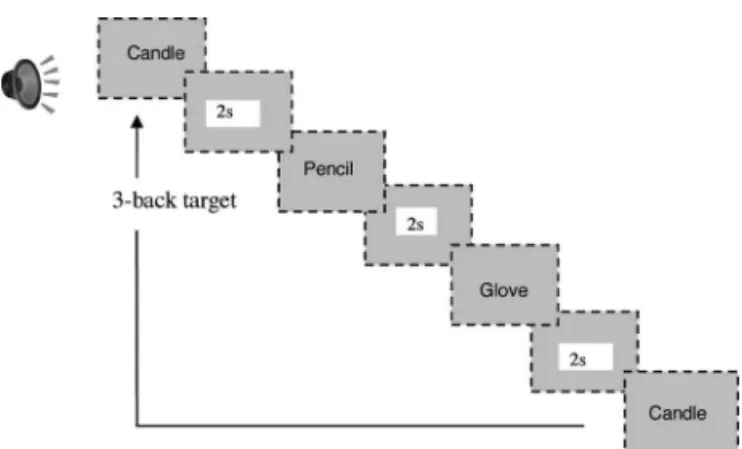
The sequences of one-second auditory stimuli, with two second intervals, were presented on binaural headphones. After listening to the sequence, the individuals were shown the items presented, for recognition of the 1-back … 5-back target (Figure 1).
The subjects were observed by the examiner during the presentation of the sequence, to guarantee their sustained attention. Participants were told to use a gesture to indicate the point at which the stimulus was repeated.
The participant was deemed correct when they ap-propriately indicated the target-word, and incorrect in the absence of an answer or intrusion of a non-presented item. The intruded items were noted for each sequence. The total number of correct answers and the time span were considered. The latter was scored in accordance with the n of the series. For example, when presenting a 5-item series (5-back), the individual could err on one item in a sequence of 4, and in the last presentation get the target correct in a sequence of five items; in this case, the total score of correct answers would be less than the span, which corresponds to the total of correct answers in the N-Back block.
116 N-Back auditory test in normals Gonçalves VT, Mansur LL
Dement Neuropsychol 2009 June;3(2):114-117
Table 1. Sociodemographic description*.
Participants Mean age (SD) Mean schooling (SD) Mean GDS (SD) Mean MMSE (SD)
G1 39.4(4.9) 10.2 (2.8) 6 (1.2) 28.2 (2.4) G2 63.3 (5.0) 8.6 (3.8) 6.5 (2.1) 27.12 (1.1) p value < 0.001 0.20 0.55 0.01
*Student’s t Test; MMSE: Mini-Mental State Examination; GDS: Geriatric Depression Scale; SD: standard deviation.
Table 2. Group and stimuli effect*. Inter and intra-groups comparison on N-Back performance
Stimuli
Parameters of performance G1 × G2
Total
p value
Span
p value
Intrusions
p value
G1 G2 G1 G2 G1 G2
Dissyllables 4.6 (0.5) 4.4 (0.8) 0.67 4.9 (0.2) 4.5 (0.8) 0.22 0.8 (1.0) 0.5 (0.6) 0.45 Trissyllables 4.8 (0.41) 4.5 (0.6) 0.37 4.8 (0.41) 4.6 (0.6) 0.37 0.7 (0.96) 0.6 (0.9) 0.70 p value* 0.35 0.67 0.53 0.70 0.75 1.0
*Mann-Whitney test.
Results
The two groups included subjects aged from 30-45 yrs (G1) and 60-74 yrs (G2). The socio-demographic data are presented in Table 1.
The groups differed on the statistical analysis by age and MMSE. G2 presented lower scores on the MMSE, although values were within the normal range expected for schooling according to Brazilian criteria. There was no difference in years of schooling or depressive symptom scores (GDS).
The performance on the N-Back test is presented in Table 2. There was no intra-group stimulus effect. Indi-viduals from both the G1 and G2 groups processed di and tri-syllables similarly.
There was no difference between groups on any N-Back parameters: total score, span, number of intrusions, for either di or tri-syllable presentations. No age effect was found on this task.
Discussion
The N-Back test requires storage-plus processing op-erations. Series of single items are presented. For each item the participant must decide whether it matches what had appeared two items back in the series. The task also in-volves rehearsal in that the participant must rehearse the set of items held in memory. Successful performance in the task further requires that the participant drop items that are no-longer relevant from memory (e.g. the item that is three items back), add new items as each is presented, and assign the proper back tag to the items in memory. This task involves more than recognition and, according to well documented studies, minor variations of a “storage-only”
task can recruit executive processing cerebral regions, typi-cally sensitive to aging decline.17,18
Our expectation was to find an ageing effect but no effect was observed. This result should be discussed con-sidering the following points.
Firstly, the adopted N-Back procedure consisted of a string of words, a different set of digits or letters, in which meaning was not present. A study conducted by Van Ger-ven et al.19 found significant differences between older and
younger participants on a two digit N-Back task. It is possible that our subjects used a semantic strategy to achieve string storage and attention focus to obtain the correct answer. Considering that a 5-item span is the minimum capac-ity expected to be stored in short-term memory, we pre-sented strings containing 5 elements, a number larger than other studies.4 Even under this load condition, meaning
could have compensated for the memory load.
A second point is that decline due to aging did not com-promise performance on the WM in “all” older people. The aging process is characteristically heterogeneous. Some el-ders are equal to the young while a sub-group is even better than the young at cognitive tasks. Our sample represented a sub-group which matched the young group for performance.
A third point is that our sample did not include elderly older than 75-years, but constituted younger-older subjects. It is plausible to consider that at this age limit, preservation of cognitive capacities will prevail over decline.
Gonçalves VT, Mansur LL N-Back auditory test in normals 117 Dement Neuropsychol 2009 June;3(2):114-117
Finally, although the auditory presentation (phonologi-cal) could have posed an additional difficulty, since ageing encompasses a number of difficulties in auditory process-ing, many studies reviewed by Reuter-Lorenz and Jonides have indicated that spatial and not phonological WM were compromised in older groups. Our results are in agreement with these studies.20
The N-Back task is a valuable WM measure as it reflects ecological abilities such as comprehension of sentences. We envisage several avenues for future N-Back research, for instance, by increasing the number of participants and in-cluding language activities that demand monitoring and executive function, verifying the semantic effect of stimulus in accuracy of answer and span; verifying intrusion effects, reaction time in identifying target items. If the absence of an age effect is consistently verified in larger samples then the task could be useful for cognitive diagnostic purposes.
The age effect on the N-Back task is not always present in elderly subjects. Even with increased back-phonological-de-mand a number of elderly can successfully complete the task.
References
1. Baddeley A. Introduction and overview. In: Baddeley A (Ed). Working memory, thought, and action. New York: Oxford University Press; 2007:1-13.
2. Kane MJ, Conway AFA, Hambrick DZ, Engle RW. Variation in working memory capacity as variation in executive attention and control. In: Conway AFA, Jarrold C, Kane MJ, Miyake A, Towse JN (Eds). Variation in working memory. New York: Oxford University Press; 2007:21-48.
3. Waters FS, Caplan D. The relationship between age, process-ing speed, workprocess-ing memory capacity, and language compre-hension. Memory 2005;13:403-413.
4. Kubat-Silman AK, Dagenbach D, Absher JR. Patterns of im-paired verbal, spatial and object working memory after thal-amic lesions. Brain Cogn 2002;50:178-193.
5. Wright HH, Shisler RJ. Working memory in aphasia: theory, measures and clinical implications. Am J Speech-Lang Pathol 2005;14:107-118.
6. Germano C, Kinsella GJ. Working memory and learning in early Alzheimer´s disease. Neuropsychol Rev 2005;15:1-10. 7. Vakil E. The effect of moderate to severe traumatic brain
in-jury (TBI) on different aspects of memory: a selective review. J Clin Exp Neuropsychol 2005;27:977-1021.
8. Caplan D, Waters F, Dede G. Specialized verbal working mem-ory for language comprehension. In: Conway AFA, Jarrold C, Kane MJ, Miyake A, Towse JN (Eds). Variation in working memory. New York: Oxford University Press; 2007:21-48. 9. Schmiedek F, Li S-C, Lindenberger U. Interference and
fa-cilitation in spatial working memory: age associated differ-ences in lure effects in the N-Back paradigm. Psychol Aging 2009;24:203-210.
10. McCabe J, Hartman M. Working memory for item and tem-poral information in younger and older adults. Aging Neu-ropsychol Cogn 2008;15:574-600.
11. Friedmann N, Gvion A. Sentence comprehension and work-ing memory limitation in aphasia: a dissociation between semantic-syntactic and phonological reactivation. Brain Lang 2003;86:23-39.
12. Bertolucci PHF, Brucki SMD, Campacci SR, Juliano Y. O Mini-Exame do Estado Mental em uma população geral: impacto da escolaridade. Arq Neuropsiquiatr 1992;52:1-7.
13. Bertolucci PHF, Mathias SC, Brucki SMD, Carrilho PEM, Okamoto IH, Nitrini R. Proposta de padronização do Mini-Exame do Estado Mental (MEEM): estudo piloto cooperativo (FMUSP/EPM). Arq Neuropsiquiatr 1994;52:225.
14. Yesavage JA, Brink TL, Rose TL, et al. Development and vali-dation of a geriatric depression screening scale: a preliminary report. J Psychiatr Res 1983;17:37-49.
15. Bussad WO, Pereira JSC. Tábuas de Estatística. São Paulo: Harper & Raw do Brasil, 1985.
16. Lopes M, Seixas B. Lista de Freqüência para o português do Brasil. Manuscrito não publicado. 2008.
17. Dobbs AR, Rule BG. Adult age differences in working mem-ory. Psychol Aging 1989; 4:500-503.
18. Hartley AA, Speer NK, Jonides J, Reuter-Lorenz PA, Smith EE. Is the dissociability of working memory systems for name identity, visual-object identity and spatial location maintained in old age. Neuropsychology 2001;15:3:17.
19. Van Gerven PWM, Meijer WA, Prickaerts JHM, Van der Veen FM. Aging and focus switching in working memory: excluding the potential role of memory load. Exp Aging Res 2008;34:367-378.