iWEDS-An Intelligent Explosive Detection and
Terrorist Tracking System Using Wireless
Sensor Network
Balaji Hariharan and Arjun Sasidharan
Amrita Center for Wireless Networks and Applications, Amrita Vishwa Vidyapeetham (Amrita University),
Kollam, Kerala, India.
Amrita Center for Wireless Networks and Applications, Amrita Vishwa Vidyapeetham (Amrita University),
Kollam, Kerala, India.
Abstract
Terrorism is one of the greatest threats to national security nowadays. Military or police forces are not sufficient to prevent these activities. In the year 2009 India faced one of the biggest terrorist attacks in Mumbai. According to the report published by Times of India, more than 600 people have been killed and several hundreds of people ravaged in various terrorist attacks in India in the last 6 years. The main problem behind this massacre is the group which is acting behind this who already know the ineffectiveness of our security systems. Even now we are following traditional metal detection doors and hand held metal detectors. No autonomous system is being used by any security forces in India till now. The main problem with the traditional systems is their bulkiness so that the intruder can easily bypass the security mechanism by following an alternate path. Here we are proposing a h ighly effective wireless sensor network solution; intelligent Wireless Explosive Detection System (iWEDS) to tackle this problem. The sensors are organized in such a manner that it has been embedded with the road reflectors, so that nobody even knows about the security system and no one can bypass it. Other key advantages are: these systems are low powered, fully automated and can support real-time tracking. Though iWEDS can perform automated operation we are proposing it only for assisting the police and military forces.
Keywords: — Explosive detection, wireless explosive
detectionnetwork, intrusion detection, gaseous explosive sensor, explosive particle detection, wireless sensor network.
1. Introduction
The main reason behind this concept is the increased rate of terrorist attacks in India in recent years. There are several reasons for this and one of the main reasons is terrorists utilizing the advantage of the lack of a full proof
security system. Traditional explosive detection systems are bulkier in size, expensive, and always require manual attention. Because of its public visibility intruder can easily bypass the system using another route. Our work is mainly based on explosive detection using wireless sensor networks.
A wireless sensor network consists of several types of autonomous sensors to co-coordinately monitor a particular activity. A typical single sensor system is termed as ‘mote’ throughout this paper. A mote consists of a processor, a sensor and wireless transceiver equipment. A mote can collect the sensor data, perform local processing and transmit the required information to a base station or cluster head. We are concentrating on Crossbow’s MicaZ mote. This mote can support various types of sensors including both passive and active sensors. In a t ypical wireless sensor network there are hundreds of nodes spread across a particular geographical area for collective monitoring. The main functionalities of these nodes are detection, classification and tracking of both static and moving objects. Some of the main advantages of these micro sensors are their miniature size, low power consumption and support to distributed operation.
1. Always requires manual operation
2. Decision making will be much more complex 3. Bulkier in size so that intruder can easily bypass
the system
4. Traditional systems are power hungry ones.
Section II describes the related work. Section III explains the current systems. Section IV describes the proposed system and Section V gives the Conclusion and Future work.
2. Related Work
One of the promising work done in this filed was UGS (unattended Ground sensors). UGS can support several types of sensors such as acoustics, seismic, opto-electrical, magnetic and infra red break beam devices. This system takes large amount of time for analyzing this whole bunch of data because of their limited signal processing capability. At this point L-3 communications developed a new type of remotely monitored Battle field sensor system (REMBASS). This system over comes most of the drawbacks of traditional UGS. [2].
Another novel work done was ‘explosive detection using thermal neutron activation’ [3]. This was done by three major organizations in USA, Science Applications International Corporation, Department of Transportation FAA Technical Center, and Los Alamos National Laboratory. In this work they have screened every luggage through a highly penetrating radiation (energetic gamma radiations). When subjected to these high radiations gamma rays are produced depending upon the characteristics of the particular elements. These gamma rays are detected using an array of detectors placed near the object and analyzed using a computer. The computer program will study the nature of the radiation and gives you the subject type.
In paper [4], Explosive traces were detected using MEMS based resonant structures. Gravimetric MEMS Sensors were being used for trace detection of chemical substances such as explosives, chemical warfare agents and toxic industrial chemicals. In paper [5] authors explains about the collaborative signal and information processing (CSIP). This concept is very much important when characterizing a heterogeneous network with a very big energy constrain. Target tracking is one of the essential problems to be addressed using a sensor network. CSIP solves this problem to a large extent by dynamically designing and grouping sensor nodes based on task requirement and resource availability. So we are considering this work also as an essential relative work in the field of explosive detection.
3. Current Systems
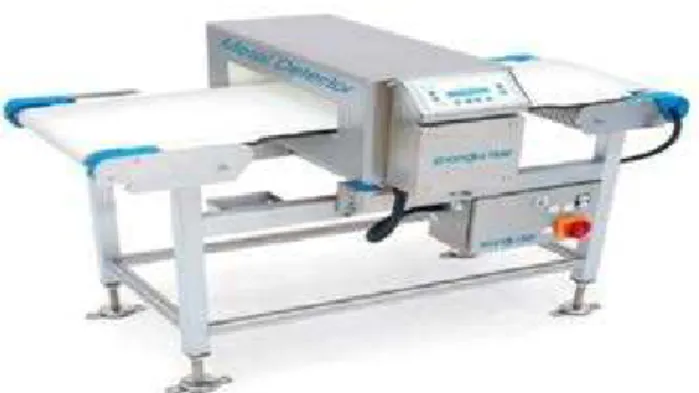
The current systems for explosive detection are bulkier in size. All most all of them required manual operation. It is easy for the target to bypass these systems due to its size and visibility. In recent attacks terrorists utilized the drawbacks of current systems. The main disadvantage is their size. These systems are visible to everyone so that the intruder can bypass it easily by employing a different route to reach the destination. In figure [1] we can see a metal detector door. This system always requires manual operation. In Figure [2] we can see s traditional metal detector for baggage checking. This device is common in almost all the airports, military bases and other high security areas. Power consumption of these devices is very high. Another disadvantage is their size. It requires to be kept switched on always, so it is not an energy efficient one.
The other main disadvantage of traditional systems is their limited operational area. In the case of a metal detector door, we cannot determine the explosive unless and until explosive material pass through the door. This makes the system less efficient. But we cannot fully discard these traditional systems. We can use these systems as a secondary detection mechanism which needs more accurate decision. Hand held explosive detector is shown in Figure [3]. We can see this hand held metal detector in most of the police men’s. This is a compactable deice with highest accuracy in explosive detection, but still requires manual operation for proper working. In this work we are suggesting that, our intelligent Wireless Explosive Detection System (iWEDS) can be used as the Preliminary detection mechanism and for more accurate decisions we can use traditional systems.
Fig. 2 Huge metal detector used for baggage checking
Fig. 3 Hand held metal detector
Fig .3 Solar powered road side reflector
4. Proposed Systems
As we have already seen the drawbacks of traditional as well as current systems. We can now look through our intelligent explosive detection system.
A wireless sensor network consists of thousands of nodes distributed in a random nature. The nodes have the ability to communicate with each other and can take decisions based on the sensor data. We are also focusing on the same technique here. iWEDS consists of several hundreds of nodes depending upon the geographical area we are going to cover. Each node should be able to communicate with the other node and update the information if necessary. Tracking of the target can be done in an easier and faster way because all the nodes are synchronized. iWEDS is a power efficient explosive detection system. Most of the times nodes will be in the idle state, unless and until positive presence of an explosive is found.
iWEDS concentrates more on passive sensor based operation, which take less power or rather no power at all. This makes our system more power efficient. Another key factor is its compact design. As we have already discussed the bypassing of intruders due to its public visibility and huge size. iWEDS solve this problem by adopting a miniature design. The proposed system is built on the shield of a road side reflector. This device is solar powered and can be fixed anywhere very easily. Though this device is common in almost all roads and public places for traffic aid nobody will suspect its operation. A typical solar powered reflector is shown in figure [4].
4.1 System Architecture
Proposed system architecture is shown in Figure 4. The system consists of a solar powered road side reflector, a gas sensor, a chemical sensor, a TWT Doppler radar unit, a trigger control unit (TCU), and Mica mote. Functionalities of each and every device are explained in the following subsections.
4.2 Operational Principle
This section explains the working principle behind intelligent Wireless Explosive Detection System (iWEDS). iWEDS uses Advanced Explosive Detection Algorithm (AEDA). Algorithm is explained in subsection 4.3. Now we can go through the functionality of each and every module in the system.
Solar road reflector: We have a solar road side reflector module. This device is a normal reflector which has an inbuilt small scale solar panel and an illuminated reflector on the outer surface of the board. This device also has a battery for storing the solar energy. No other tasks are performed by this module.
TWT Doppler radar: We have an onboard radar device-TWR-ISM-002 pulse Doppler sensor [6].This device can easily sense the movement up to 30 ft radius. Tracking of the target is being done by this module. When a target is found, the radar will track the intruder till the object moves out of its range. Radar will give periodic updates about the position of the target. TWR-ISM -002 radar is shown in Figure 5.
Chemical sensor: This module determines the chemical signature of the explosive. Different chemicals have different chemical signature. We already have a database of chemical signatures of most of the explosives. Whenever a chemical compound is found with a v alue equal to the value in the database, that particular compound is marked as an explosive. In this way iWEDS classifies the chemical explosives. Once a positive match is found next operation is performed by gas sensor.
Gas sensor: Gas sensor will capture the air particles and checks for the presence of explosives in that particular area.
Fig .5 TWR-ISM-002 pulse Doppler radar
Already we have a p ositive match from the chemical sensor and hence it is easy for the gas sensor to identify
the explosive. Still there is another problem to be tackled if the chemical sensor is not giving any positive match then gas sensor has to perform some more complex task. It has to filter the air for 2 to 3 minutes and check for all possible matches. We assume that explosive particles will be present in air for at least 5 minutes after the target moved out from the test field. Once one node identifies the presence of the explosive and marks it as a target remaining nodes will not perform any explosive detection at all but they will start to track the position of the target.
Trigger Unit: This module is the heart of the system. TCU classifies the explosives based on their chemical signature and particle concentration. These two data are given by gas sensor and chemical sensor. Once chemical sensor gives the data to the TCU it will store the data in a buffer and waits for gas sensor to feed its values. The very next task is data fusion. TCU will combine both the data and search for a match in the data base. If a match is found it takes the info regarding the particular explosive and passes the information to the cluster head. In the mean time TCU also alert the immediate neighbors about the presence of the target and also provides the position coordinates. Once the target is moved out of the range of a p articular node, immediate neighbor will start tracking the target. Trigger unit consists of a dedicated processor and buffer unit. If the target is not of our interest iWEDS network will be in the power down mode. Chemical sensor is a passive device so latterly it consumes no power for its operation.
Mica mote: This is our communication module. Mica motes supports ZigBee communication standard. Mica motes are low powered devices so it is easy for us to integrate this module with our system.
These devices can perform data fusion and synchronization is very easy. When no target is present in the field Mica motes will be in the sleep state. The execution flow is explained in figure [6].
4.3 Algorithms
This section explains the algorithms followed in the system. The main algorithm followed is Advanced Explosive Detection Algorithm (AEDA). This algorithm is designed in such a manner that it a voids ambiguity in detecting and classifying the targets. One of the main problems faced by automated explosive detection systems is its reliability. We have to make sure that the false alarm rate of the system should be less than 10%. By keeping all this design constraints in mind we have developed AEDA.
AEDA Algorithm
1. Initialize all the nodes in the network 2. Go to sleep mode after synchronization
3. Positive presence of explosive detected by chemical sensor (CS)
4. CS triggers the Gas sensor
5. CS triggers the Trigger Control Unit (TCU) from sleep mode to active
6. TCU stores the data from CS and wait for Gas Sensor (GS) value
7. TCU triggers the TWT radar and starts tracking the object
8. GS detects the particle concentration and passes the data to the TCU
9. TCU combines the data and matches with the data base for identifying the explosive
10. If the chemical compound is known TCU will mark the target with the name of the explosive and pass the information to the cluster head. 11. If an unknown chemical compound is found ,
TCU will make a d ata base entry and pass the information to the cluster head
12. Parallel TCU will invoke the mica mote from sleep mode
13. TCU will inform the presence of the target to the nearest neighbors and also feeds the current position coordinates of the target
14. The entire network gets alerted about the presence of the target and starts tracking.
15. Cluster heads will calculate the approximate amount of explosive present based on the data provided by the leaf node and informs the base station. Along with this base station will also get the current position of the target with node ID
5. Conclusion and Future Work
In this work we have proposed an efficient autonomous system for standoff explosive detection. While comparing with traditional systems our iWEDS have lot of advantages. The main advantages are its miniature size, low power consumption, distributed operation, and easy implementation. iWEDS is organized in such a manner that only security officials know about the presence of the system. For common public it is visible only as a solar road reflector. So we overcome the problem of bypassing the security mechanism by intruders. Currently we are trying for a simulation of iWEDS using Qualnet 5.0. We are also focusing on the security aspects of iWEDS while transmitting the data to the base station. This includes avoiding data theft, multiple black hole attack problems, unauthorized access and digital identity.
References
[1] Wikipedia explosive categories
url: http://en.wikipedia.org/wiki/Explosive_material [2] Reformatting fighter tactics; Article reprinted from jane’s
international defense review june 2001
[3] Explosive Detection System Based on T hermal Neutron Activation Tsahi Gozani, Peter Ryge and Patrick Shea; Science Applications International Corporation; 2950 Patrick Henry Drive
[4] MEMS-Based Gravimetric Sensors for Explosives Detection; Richard Mlcak*, Dharanipal Doppalapudi, Paul Pyzowski, Patrick Gwynne, Scott Purchase,Jeffrey Bridgham, Gerald Schultz, Martin Skelton, David Pelletier, Harry Tuller; Boston Microsystems, Inc.IEEE 2010. [5] Collaborative Signal and Information Processing: An
Information Directed Approach; Feng Zhao, Jie Liu, Juan Liu, Leonidas Guibas, and James Reich;PROCEEDINGS OF THE IEEE, 2003
[6] A Line in the Sand: A Wireless Sensor Network for Target Detection, Classi¯cation, and Tracking; A. Arora, P. Dutta, S. Bapat, V. Kulathumani, H. Zhang, V. Naik, V. Mittal, H. Cao, M. Demirbas1 M. Gouda, Y. Choi ,T. Herman3, S. Kulkarni, U. Arumugam,M. Nesterenko, A. Vora, and M. Miyashita Department of Computer Science and Engineering, The Ohio State University; ACM 2003 [7] Polymer Sensors for Nitroaromatic Explosives Detection,
Sarah 1 Toal andWilliam C. Trogler, 2007
[8] Prabal K. Dutta and Anish K. Arora, Sensing civilians, soldiers, and cars," The Ohio State University Department of Computer and Information Science Technical Report OSU-CISRC-12/03-TR66, 2003.