The use and misuse of the “impact
factor” as a parameter for evaluation of
scientific publication quality: a proposal
to rationalize its application
*
1Centro de Pesquisas René Rachou, FIOCUZ, Belo Horizonte, MG, Brasil
Departamentos de 2Parasitologia and 3Microbiologia, and 4Biblioteca Setorial, Instituto de Ciências Biológicas,
Universidade Federal de Minas Gerais, Belo Horizonte, MG, Brasil
5Santa Casa de Misericórdia de Belo Horizonte, Belo Horizonte, MG, Brasil
P.M.Z. Coelho1,5,
C.M.F. Antunes2,5,
H.M.A. Costa2†,
E.G. Kroon3,
M.C. Sousa Lima4
and P.M. Linardi2
Abstract
We present a critical analysis of the generalized use of the “impact factor”. By means of the Kruskal-Wallis test, it was shown that it is not possible to compare distinct disciplines using the “impact factor” without adjustments. After assigning the median journal the value of one (1.000), the “impact factor” value for each journal was calculated by the rule of three. The adjusted values were homogeneous, thus permitting comparison among distinct disciplines.
Correspondence
P.M.Z. Coelho
Centro de Pesquisas René Rachou FIOCRUZ
Av. Augusto de Lima, 1715 30190-002 Belo Horizonte, MG Brasil
E-mail: [email protected] Research supported by CNPq, FAPEMIG, and Pronex. P.M.Z. Coelho, C.M.F. Antunes, E.G. Kroon and P.M. Linardi are recipients of CNPq Productivity fellowships.
†In memoriam of Helio Martins
de Araújo Costa, Professor of Parasitology deceased in January, 1999, dear colleague and friend, a great scientist.
Received July 17, 2003 Accepted September 19, 2003
Key words
•Impact factor
•Multidisciplinary adjustment •Citation index
•Bibliometric evaluation
Introduction
The use of the “impact factor” Journal Citation Reports (JCR) from the Science Ci-tation Index (SCI) published by the Institute of Scientific Information (ISI) (1) as an indi-cator of scientific journal excellence is be-coming increasingly generalized. In Brazil, this index is being used as a parameter in judgments carried out by financing agencies supporting scientific research and evaluating graduate programs and by educational and research institutions when selecting their sci-entific personnel (2).
Recently, some aspects related to the in-discriminate use of the “impact factor” have been discussed elsewhere, such as its use without the evaluation of its reach, as well as its limitations for comparing scientific pro-duction among the various areas of knowl-edge (3,4). As a practical result of the sug-gestions presented in the cited papers, a well-known international journal introduced changes in its editorial policy for improving its “impact factor” (5).
As the need for further discussions about essential points of the “impact factor” still exists, issues meriting considerations are
ad-*The calculation of the 2001 “impact factor” for a journal is as follows: number of citations in 2001 to papers published in 1999 plus
dressed in the present article. A new pro-posal with the objective of establishing a more practical and rational use for this index is presented in order to prevent distortions in judgments where its use is appropriate.
The source publications
The SCI, as per its own definition, is a calendar-year index to scientific literature published by the ISI. The source publica-tions are only the journals processed for the SCI. The first aspect to be considered is the fact that a private commercial enterprise is the most important organ for assessing the quality of scientific production. Only a small number (57) of Latin-American scientific journals are cited by ISI: Brazil (15), Mexico (14), Chile (9), Argentina (7), Venezuela (4), Colombia, Costa-Rica, Cuba, Ecuador, Jamaica, Uruguay and Trinidad-Tobago (1 each), from a universe of nearly 16,000 jour-nals within 160 areas of knowledge pub-lished by 46 countries. The second aspect is that there is a large body of scientists and of scientific institutions that do not participate in the process of establishing criteria for judging scientific production. Our sugges-tion would be to create an organ with this objective, supported by the United Nations, with the participation of agencies financing scientific research and of scientific socie-ties.
Policy of support and encouragement of Brazilian scientific journals
The present tendency, due to the reasons discussed above, is for Brazilian scientists to publish their papers only in journals with higher “impact factor” values. This tendency could lead Brazilian scientific journals to ostracism within a short period of time. It is common knowledge that, in general, scien-tists send their papers to different interna-tional journals and, only after running out of all the possibilities for publication abroad,
will send an article to an indexed Brazilian journal. This fact prevents Brazilian journals from reaching the desired excellence level. It is important to consider publications in our journals indexed by SCI or in our journals with possibilities to attain this indexing sta-tus. This would be taken into account in judgments carried out by financing agencies and educational/research institutions, acting as a stimulus to scientists to send first hand their qualified articles or at least a propor-tion of their papers to these journals. For the areas of Biology, Medicine and Public Health, the “impact factor” of SciELO (Scientific Electronic Library on Line), which includes 106 Brazilian scientific journals (about 21% of all Brazilian journals), could be used to-gether with the SCI. SciELO follows criteria similar to those of SCI and uses a continuous evaluation process. The SciELO program is coordinated by the Biblioteca Regional de Medicina (BIREME) and Fundação de Amparo à Pesquisa do Estado de São Paulo (FAPESP).
Proposal for a more rational use of the “impact factor” as an instrument for intra- and inter-area comparison of scientific knowledge
extant citable literature. Rapid obsolescence may characterize one field but not another. Thus, for example, it would be foolish to conclude merely on the basis of citation counts that the journal of the American Chem-ical Society is a “better” journal than Annals of Mathematics, or to hypothesize, without a great deal of study, which serves its own field “better”. To enable the JCR user to analyze more carefully these data within subject groupings, a breakdown of journals by subject categories with “impact factors” and cited half-life indicators is provided in the “Subject Category Listing” (6).
To overcome these limitations, an adjust-ment is proposed in order to harmonize dis-crepancies. The adjustment is not an ideal solution, but may prevent distortions, errors or injustices in judgments in which scientific production - evaluated by the “impact fac-tor” - constitutes the principal element in the decision process.
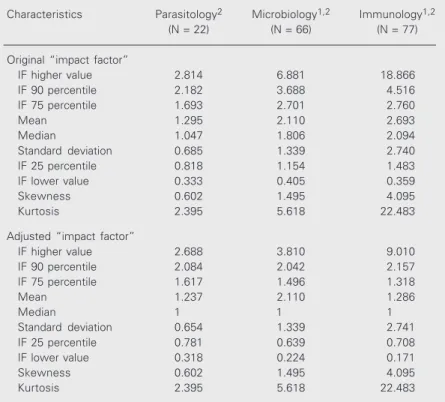
To illustrate, characteristics of the distri-bution of the “impact factor” of scientific journals from three areas, Parasitology, Mi-crobiology and Immunology, are presented in Table 1. These areas are considered jointly (Biology 3) during the process of evaluation of Graduate Programs conducted by the Co-ordenação do Aperfeiçoamento de Pessoal de Nível Superior - CAPES (Brazilian Min-istry of Education). The analysis of these distributions (Shapiro-Francia H test for nor-mality) has revealed that, with the exception of Parasitology journals, they are not nor-mal. In these situations, if the data are not transformed, the median should be the meas-ure of central tendency (or location) to be used to characterize or compare distribu-tions. The Kruskal-Wallis test for equality of populations showed a highly significant dif-ference (P = 0.0006) between their medians. In other words, these distributions are not comparable. By transforming the value of the median to 1.000, adjusted “impact fac-tors” can be generated by a simple calcula-tion. For example, in the area of
Parasitol-ogy/Tropical Medicine, the adjusted value for the Parasitology “impact factor” would be:
if x 1 if 2.114
aif = = = = 2.019
m m 1.047
where aif = adjusted “impact factor”; m = median, and if = “impact factor” (for values, see Table 2).
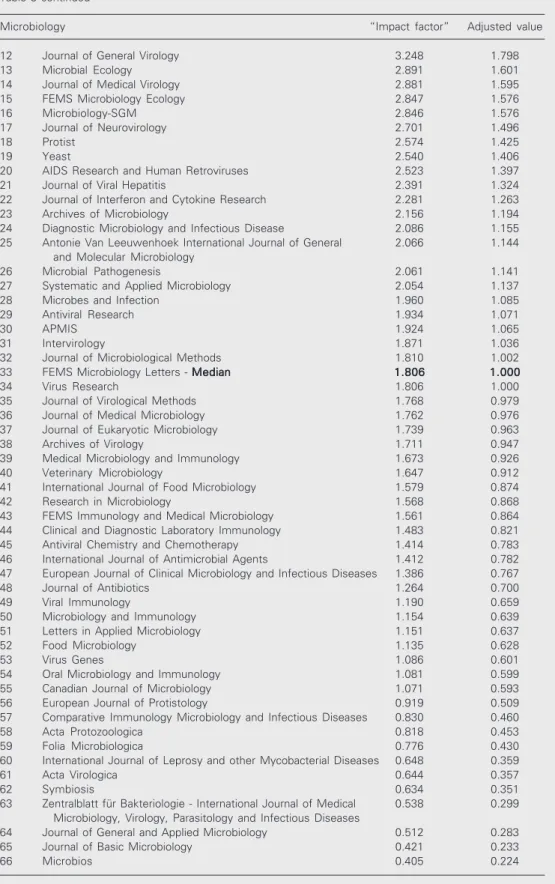
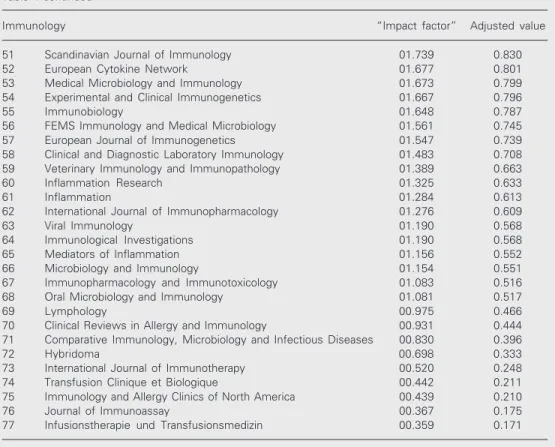
The original (from JCR) and adjusted “impact factor” values can be seen in Tables 2 to 4. Comparison of the distribution of the adjusted values showed that 1) they are not normal (Shapiro-Francia H test for normal-ity) and 2) their medians do not differ signifi-cantly (Kruskal-Wallis test, P = 0.772).
Since review journals do not publish ori-ginal data, we suggest that these journals be
Table 1. Characteristics of the distribution of original and adjusted “impact fator” (from JCR, SCI, ISI).
Characteristics Parasitology2 Microbiology1,2 Immunology1,2
(N = 22) (N = 66) (N = 77)
Original “impact factor”
IF higher value 2.814 6.881 18.866
IF 90 percentile 2.182 3.688 4.516
IF 75 percentile 1.693 2.701 2.760
Mean 1.295 2.110 2.693
Median 1.047 1.806 2.094
Standard deviation 0.685 1.339 2.740
IF 25 percentile 0.818 1.154 1.483
IF lower value 0.333 0.405 0.359
Skewness 0.602 1.495 4.095
Kurtosis 2.395 5.618 22.483
Adjusted “impact factor”
IF higher value 2.688 3.810 9.010
IF 90 percentile 2.084 2.042 2.157
IF 75 percentile 1.617 1.496 1.318
Mean 1.237 2.110 1.286
Median 1 1 1
Standard deviation 0.654 1.339 2.741
IF 25 percentile 0.781 0.639 0.708
IF lower value 0.318 0.224 0.171
Skewness 0.602 1.495 4.095
Kurtosis 2.395 5.618 22.483
1Significant skewness/kurtosis test for normality. 2Significant Bartelet’s test for equal
Table 2. “Impact factors” in decreasing order of periodics in the areas of Parasitology and Tropical Medicine and respective adjusted values.
Parasitology and Tropical Medicine “Impact factor” Adjusted value
* Parasitology Today 6.134 5.859
* Advances in Parasitology 4.097 3.913
1 International Journal for Parasitology 2.814 2.688
2 Molecular and Biochemical Parasitology 2.397 2.289
3 Parasite Immunology 2.182 2.086
4 American Journal of Tropical Medicine and Hygiene 2.126 2.031
5 Parasitology 2.114 2.019
6 Transactions of the Royal Society of Tropical Medicine and Hygiene 1.693 1.617
7 Journal of Parasitology 1.521 1.453
8 Tropical Medicine and International Health 1.500 1.433
9 Experimental Parasitology 1.434 1.370
10 Veterinary Parasitology 1.401 1.338
Median Median Median Median
Median 1.0471.0471.0471.0471.047 1.0001.0001.0001.0001.000
11 Annals of Tropical Medicine and Parasitology 1.049 1.002
12 Acta Tropica 1.045 0.998
13 Parasitology Research 1.025 0.979
14 Journal of Medical Entomology 0.949 0.906
15 Systematic Parasitology 0.919 0.878
16 Parasite-Journal de la Societé Française de Parasitologie 0.853 0.815
17 Acta Protozoologica 0.818 0.781
18 Journal of Helminthology 0.698 0.667
19 Memórias do Instituto Oswaldo Cruz 0.643 0.614
20 Folia Parasitologica 0.557 0.532
21 Journal of Tropical Pediatrics 0.425 0.406
22 Journal of the Helminthological Society of Washington 0.333 0.318
*Review (not considered for median determination).
Table 3. “Impact factors” in decreasing order of periodics in the area of Microbiology and respective adjusted values.
Microbiology “Impact factor” Adjusted value
* Annual Review of Microbiology 11.447 6.338
* Clinical Microbiology Reviews 10.652 5.898
* FEMS Microbiology Reviews 9.000 4.983
* Current Topics in Microbiology and Immunology 3.554 3.272
* Advances in Microbial Physiology 5.867 3.249
* Reviews in Medical Virology 5.050 2.796
* Advances in Virus Research 4.074 2.241
* Critical Reviews in Microbiology 2.291 1.611
* Current Microbiology 1.059 0.586
1 AIDS 6.881 3.180
2 Molecular Microbiology 6.398 3.543
3 Journal of Virology 5.622 3.113
4 Antimicrobial Agents and Chemotherapy 4.562 2.526
5 Journal of Bacteriology 3.984 2.206
6 Journal of Clinical Microbiology 3.965 1.900
7 Applied and Environmental Microbiology 3.688 2.042
8 Journal of Acquired Immune Deficiency Syndromes 3.586 1.986
9 International Journal of Systematic Bacteriology 3.558 1.970
10 Journal of Antimicrobial Chemotherapy 3.490 1.932
11 Virology 3.270 1.811
Table 3 continued
Microbiology “Impact factor” Adjusted value
12 Journal of General Virology 3.248 1.798
13 Microbial Ecology 2.891 1.601
14 Journal of Medical Virology 2.881 1.595
15 FEMS Microbiology Ecology 2.847 1.576
16 Microbiology-SGM 2.846 1.576
17 Journal of Neurovirology 2.701 1.496
18 Protist 2.574 1.425
19 Yeast 2.540 1.406
20 AIDS Research and Human Retroviruses 2.523 1.397
21 Journal of Viral Hepatitis 2.391 1.324
22 Journal of Interferon and Cytokine Research 2.281 1.263
23 Archives of Microbiology 2.156 1.194
24 Diagnostic Microbiology and Infectious Disease 2.086 1.155
25 Antonie Van Leeuwenhoek International Journal of General 2.066 1.144
and Molecular Microbiology
26 Microbial Pathogenesis 2.061 1.141
27 Systematic and Applied Microbiology 2.054 1.137
28 Microbes and Infection 1.960 1.085
29 Antiviral Research 1.934 1.071
30 APMIS 1.924 1.065
31 Intervirology 1.871 1.036
32 Journal of Microbiological Methods 1.810 1.002
33 FEMS Microbiology Letters - MedianMedianMedianMedianMedian 1.8061.8061.8061.8061.806 1.0001.0001.0001.0001.000
34 Virus Research 1.806 1.000
35 Journal of Virological Methods 1.768 0.979
36 Journal of Medical Microbiology 1.762 0.976
37 Journal of Eukaryotic Microbiology 1.739 0.963
38 Archives of Virology 1.711 0.947
39 Medical Microbiology and Immunology 1.673 0.926
40 Veterinary Microbiology 1.647 0.912
41 International Journal of Food Microbiology 1.579 0.874
42 Research in Microbiology 1.568 0.868
43 FEMS Immunology and Medical Microbiology 1.561 0.864
44 Clinical and Diagnostic Laboratory Immunology 1.483 0.821
45 Antiviral Chemistry and Chemotherapy 1.414 0.783
46 International Journal of Antimicrobial Agents 1.412 0.782
47 European Journal of Clinical Microbiology and Infectious Diseases 1.386 0.767
48 Journal of Antibiotics 1.264 0.700
49 Viral Immunology 1.190 0.659
50 Microbiology and Immunology 1.154 0.639
51 Letters in Applied Microbiology 1.151 0.637
52 Food Microbiology 1.135 0.628
53 Virus Genes 1.086 0.601
54 Oral Microbiology and Immunology 1.081 0.599
55 Canadian Journal of Microbiology 1.071 0.593
56 European Journal of Protistology 0.919 0.509
57 Comparative Immunology Microbiology and Infectious Diseases 0.830 0.460
58 Acta Protozoologica 0.818 0.453
59 Folia Microbiologica 0.776 0.430
60 International Journal of Leprosy and other Mycobacterial Diseases 0.648 0.359
61 Acta Virologica 0.644 0.357
62 Symbiosis 0.634 0.351
63 Zentralblatt für Bakteriologie - International Journal of Medical 0.538 0.299
Microbiology, Virology, Parasitology and Infectious Diseases
64 Journal of General and Applied Microbiology 0.512 0.283
65 Journal of Basic Microbiology 0.421 0.233
66 Microbios 0.405 0.224
Table 4. “Impact factors” in decreasing order of periodics in the area of Immunology and respective adjusted values.
Immunology “Impact factor” Adjusted value
* Annual Review of Immunology 46.233 22.078
* Advances in Immunology 23.083 11.023
* Current Opinion in Immunology 13.724 6.554
* Immunology Today 12.157 5.806
* Immunological Reviews 07.000 3.343
1 Immunity 18.866 9.010
2 Journal of Experimental Medicine 15.340 7.326
3 Journal of Immunology 07.065 3.374
4 AIDS 06.881 3.286
5 Critical Reviews in Immunology 06.070 2.899
6 Journal of Allergy and Clinical Immunology 05.506 2.629
7 European Journal of Immunology 04.990 2.383
8 Journal of Leukocyte Biology 04.516 2.157
9 Infection and Immunity 04.212 2.011
10 International Immunology 03.611 1.718
11 Journal of Acquired Immune Deficiency Syndromes 03.586 1.712
12 Current Topics in Microbiology and Immunology 03.554 1.697
13 Clinical Infectious Diseases 03.545 1.693
14 Journal of Clinical Immunology 03.442 1.644
15 Journal of Neuroimmunology 03.342 1.596
16 Vaccine 02.943 1.405
17 Developmental and Comparative Immunology 02.909 1.389
18 Tissue Antigens 02.864 1.368
19 Immunologic Research 02.853 1.362
20 Clinical Immunology 02.760 1.318
21 Journal of Autoimmunity 02.745 1.311
22 Clinical and Experimental Immunology 02.716 1.297
23 Immunology and Cell Biology 02.665 1.273
24 Immunology 02.656 1.268
25 Journal of Immunotherapy 02.604 1.244
26 Cellular Immunology 02.604 1.244
27 Bone Marrow Transplantation 02.554 1.222
28 AIDS Research and Human Retroviruses 02.523 1.205
29 Infectious Disease Clinics of North America 02.460 1.175
30 Cancer Immunology Immunotherapy 02.389 1.141
31 Human Immunology 02.373 1.133
32 Pediatric Infectious Disease Journal 02.289 1.093
33 Journal of Immunological Methods 02.283 1.090
34 Journal of Interferon and Cytokine Research 02.281 1.089
35 Immunogenetics 02.268 1.083
36 Immunopharmacology 02.249 1.074
37 Parasite Immunology 02.182 1.042
38 International Archives of Allergy and Immunology 02.164 1.033
39 Annals of Allergy, Asthma, and Immunology - MedianMedianMedianMedianMedian 02.09402.09402.09402.09402.094 1.0001.0001.0001.0001.000
40 Microbial Pathogenesis 02.061 0.984
41 Brain, Behavior, and Immunity 02.023 0.966
42 American Journal of Reproductive Immunology 02.020 0.965
43 Immunology Letters 02.009 0.959
44 Cytokine 01.992 0.951
45 Chemical Immunology 01.977 0.944
46 Molecular Immunology 01.973 0.942
47 Microbes and Infection 01.960 0.936
48 Journal of Reproductive Immunology 01.924 0.919
49 APMIS 01.924 0.919
50 Springer Seminars in Immunopathology 01.883 0.899
Table 4 continued
Immunology “Impact factor” Adjusted value
51 Scandinavian Journal of Immunology 01.739 0.830
52 European Cytokine Network 01.677 0.801
53 Medical Microbiology and Immunology 01.673 0.799
54 Experimental and Clinical Immunogenetics 01.667 0.796
55 Immunobiology 01.648 0.787
56 FEMS Immunology and Medical Microbiology 01.561 0.745
57 European Journal of Immunogenetics 01.547 0.739
58 Clinical and Diagnostic Laboratory Immunology 01.483 0.708
59 Veterinary Immunology and Immunopathology 01.389 0.663
60 Inflammation Research 01.325 0.633
61 Inflammation 01.284 0.613
62 International Journal of Immunopharmacology 01.276 0.609
63 Viral Immunology 01.190 0.568
64 Immunological Investigations 01.190 0.568
65 Mediators of Inflammation 01.156 0.552
66 Microbiology and Immunology 01.154 0.551
67 Immunopharmacology and Immunotoxicology 01.083 0.516
68 Oral Microbiology and Immunology 01.081 0.517
69 Lymphology 00.975 0.466
70 Clinical Reviews in Allergy and Immunology 00.931 0.444
71 Comparative Immunology, Microbiology and Infectious Diseases 00.830 0.396
72 Hybridoma 00.698 0.333
73 International Journal of Immunotherapy 00.520 0.248
74 Transfusion Clinique et Biologique 00.442 0.211
75 Immunology and Allergy Clinics of North America 00.439 0.210
76 Journal of Immunoassay 00.367 0.175
77 Infusionstherapie und Transfusionsmedizin 00.359 0.171
*Review (not considered for median determination).
not included in the calculation of the me-dian. However, because they publish invited articles, they should be considered in the judgments, attesting to the investigator’s qualification and prestige.
The procedure to be used for evaluation of the merit of papers belonging to the same area would be straightforward: the propor-tion of publicapropor-tions above or below the me-dian (original “impact factor”), taken as the reference value. To compare scientific pro-duction among different areas of knowledge, the adjusted “impact factor” should be used. Since they are proportionally adjusted, the bias which would be introduced when areas with a smaller number of journals (and con-sequently a smaller number of citers) are compared is prevented.
A more stringent criterion could be used for classifying Graduate Programs: as a
sug-gestion, to be considered as level 6 and 7 (national and international excellence), a specified proportion of the scientific pro-duction of these programs would have to be published in journals with an adjusted “im-pact factor” above the 75th and the 90th percentiles, respectively (above 1.500 and 2.000, Table 1). The criterion currently adopted by the Biology 3 CAPES Commit-tee, to publish a specified proportion of sci-entific articles in journals with an original “impact factor” above 4.000, introduces dis-tortions, as pointed out earlier.
References
1. Science Citation Index (1997). Annual Guide and List of Source Publications. ISI (Institute for Scientific Information), Philadelphia, PA, USA, 1-149.
2. Conselho Nacional de Pesquisa (1997). Brasil: Indicadores Nacionais de Ciência e Tecnologia 1990-1996. Ministério da Ciência e Tecno-logia, Brasília, DF, Brazil.
3. Linardi PM, Coelho PMZ & Costa HMA (1996). The “impact factor” as a criterion for the quality of scientific production is a relative, not absolute, measure. Brazilian Journal of Medical and Biological Re-search, 29: 555-561.
journals maintain higher “impact factors” compared to other fields. This would com-pensate for the apparent handicap that the adjustment might have caused to the median level values. Exceptions to this procedure would be journals included in more than one area with different “impact factors”; in these cases, the higher value would be the choice, acknowledging the journal’s capacity of be-ing included in more than one area.
Final considerations
The judgment of scientific production quality is a difficult process and controver-sies regarding its limitations and applica-tions will always be present. In addition to the “impact factor”, other indexes, such as the half-life of scientific papers, can also be used to evaluate publications (3).
Presently, an initiative, under the leader-ship of Drs. Varmus, Brown and Eisen, aiming at creating a “new system based on-line peer review pre-print publishing” is being implemented. It is named Public Li-brary of Science (PLOS); additional infor-mation can be obtained through the Internet (www.publiclibraryofsciencemag.org). The Science Now, a subsidiary journal of Sci-ence, published an interview with Dr. Eisen,
who announced the publication of “PLOS Biology”, discussing the policy of “free-of-charge access for readers”. This system is intended to be faster compared to the tradi-tional printed journals. However, the finan-cial dependence of scientific societies on their journals led their Editorial Boards to oppose the idea. Scientists, even those who endorsed this initiative, are still publishing their papers in the traditional scientific jour-nals, probably afraid of losing prestige with the absence of publications in these journals. An additional problem, especially for devel-oping countries, is the publication costs (ca. US$ 1,500/article) (7).
It is expected that this article can contri-bute to the discussion of the “impact factor”, raising questions and motivating different viewpoints to be expressed with the inten-tion of rainten-tionalizing its use in the complex process of evaluating scientific production quality.
Acknowledgments
We wish to thank Jane Rodrigues Gui-rado, librarian at the Central Library/UFMG, for the data related to the titles of national journals processed by IBICT.
4. Coura JR & Willcox LCB (2003). Impact factor, scientific production and quality of Brazilian medical journals. Memórias do Instituto Oswaldo Cruz, 98: 293-297.
5. Forrest MC (1997). Impact factor abuse. Journal of Chemotherapy, 9: 3-4.
6. SCI Journal Citation Reports (1988). Journal Ranking. ISI (Institute for Scientific Information), Philadelphia, PA, USA, 1633.