Lo w pH and calcium e ffe cts o n ne t
Na
+
and K
+
fluxe s in two catfish spe cie s
fro m the Am azo n Rive r (
Coryd oras
:
Callichthyidae )
Laboratório de Ecofisiologia e Evolução Molecular,
Instituto Nacional de Pesquisa da Amazônia, Manaus, AM, Brasil A.Y. Matsuo
and A.L. Val
Abstract
The present study analyzes Na+ and K+ disturbances caused by low pH in two catfish species from the Amazon River. Corydoras adolfoi inhabits ion-poor, black-stained, low pH (3.5-4.0) waters, while C. schwartzi is native to ion-rich waters at circumneutral pH. Fish were exposed to pH 3.5 Ca2+-free, and Ca2+-enriched (~500 µmol/l) water to determine the protective effects of calcium. Net Na+ and K+ fluxes were measured in the water collected from the fish experimental chambers. C. adolfoi was unable to control the Na+ efflux at low pH, exhibiting Na+ loss up to -594 ± 84 nmol g-1 h-1 during the first hour. After 3 and 6 h, net Na+ flux increased by 7- and 23-fold, respectively. In C. schwartzi, at pH 3.5, the initial high Na+ loss (-1,063 ± 73 nmol g-1 h-1) was gradually attenuated. A K+ loss occurred in both species, but remained relatively constant throughout exposure. High [Ca2+] affected ion losses in both species. C. adolfoi had 70% loss attenua-tion, indicating incapacity to control Na+ efflux. In C. schwartzi, elevated [Ca2+] completely prevented the Na+ losses caused by expo-sure to low pH. Rather different patterns were seen for K+ fluxes, with C. adolfoi showing no K+ disruption when exposed to low pH/high [Ca2+]. Thus, C. adolfoi loses Na+ during acid exposure, but has the ability to control K+ loss, while C. schwartzi controls diffusive Na+ loss but exhibits a slightly higher K+ loss. Ion balance was influenced by [Ca2+] at low pH in C. schwartzi but not in C. adolfoi.
Co rre spo nde nce
A.L. Val INPA
Alameda Cosme Ferreira, 1756 69083-000 Manaus, AM Brasil
Fax: + 55-92-643-3186 E-mail: dalval@ inpa.gov.br Research supported by CNPq and INPA. A.L. Val is the recipient of a research fellowship from CNPq, and A.Y. Matsuo was the recipient of a MSc fellowship from CAPES.
Received April 11, 2001 Accepted January 21, 2002
Ke y wo rds
·Low pH ·Calcium ·Blackwater
·Net Na+ and K+ flux ·Amazon
·Catfish
Intro ductio n
The Amazon blackwaters are known by their singular physicochemical features, which are unusual relative to the world aver-age values for freshwater (1). The two most noticeable parameters are low pH and low ion concentration. The Rio Negro River, for instance, presents pH levels around 4.5-6.0, which are as low as 3.0 in restricted flooded
forest areas (the igapós) (2). The Amazon
nutrient-rich waters, also called whitewaters,
drain from the Andean and pAndean re-gions, and their pH is usually around circum-neutral values (1). In spite of such extremely adverse features for aquatic living organ-isms, blackwater habitats are not as inhospi-table as one would expect. Fish diversity for the Rio Negro River was estimated at more than 1000 species (3). How these specimens can thrive in such conditions and what the adaptive strategies developed by them are still poorly understood.
such as found in blackwaters may induce
severe ion disruption in fish, including K+
losses from the epithelial cells themselves
due to the toxic effects triggered by high [H+
] (4). These effects can be summarized as the inhibition of ion uptake and an elevation of ion efflux (5). Calcium has long been known to reduce the toxicity of acid waters to fish
(6-10). Apparently, there is a Ca2+
versus H+
competition for sites on tight junctions that maintain epithelial integrity, as well as
evi-dence that bound Ca2+
shields access to Na+
-binding sites on the apical transporters (5).
Thus, high [H+
] displaces Ca2+
from the binding sites and diffusive losses take place (4).
Corydoras adolfoi Burgess, 1982, is a catfish commonly inhabiting blackwaters in the flooded forests of the middle Rio Negro River, withstanding pHs around 3.5~4.0
(11). C. schwartzi Rössel, 1963, was used
for comparison because it is a species en-demic to whitewaters of the Purus River, living at circumneutral pH. The aim of the present study was to evaluate the
distur-bances in the net Na+
and K+
fluxes in these catfish from the Amazon region exposed to acute low pH, in an attempt to assess how they can deal with low pH. The possible
protective influence of Ca2+
was also ana-lyzed.
Mate rial and Me tho ds
Expe rim e ntal fish
Fish collected from their native environ-ments were obtained from ornamental fish exporters (Corydoras Tetra Aquarium and Turkys Aquarium) in the municipality of Manaus, Amazon, Brazil. They were accli-mated for at least 14 days before the begin-ning of the experiments at the Laboratory of Ecophysiology and Molecular Evolution of INPA. Fish were held in 60-liter aquaria, provided with pump aerators, carbon-zeolite filters, and supplied with INPA ground
wa-ter (average concentrations: 15 µmol/l Na+
,
16 µmol/l Cl
-, 9 µmol/l K+, 9 µmol/l Ca2+,
and 2.05 mg/l dissolved organic carbon; see Ref. 12). Ground water pH was 6.0 ± 0.5 after two days of aeration to eliminate excess CO2 before use. Water temperature was 27 ± 2ºC. All fish weighed 1.5 to 3.5 g. The specimens were fed commercial dried pel-lets daily, and food was withdrawn 24 h prior to experimentation.
Expe rime ntal pro to co l
Ten fish were used in each treatment, including a control group. Aerated ground water was used as the standard water. Ex-perimental chambers consisted of 200-ml polyethylene darkened chambers; small holes on the lid were used to supply water (recircu-lating system) and aeration, and for pH ad-justments. The fish were placed in these chambers 12 h before starting the experi-ments. At the beginning of the experiment, the flow was stopped, and water in the cham-bers was totally replaced with fresh standard water. A 10-ml water sample was taken and a second sample was taken from each cham-ber 1 h later (control, pH 6.0). This proce-dure was performed for all fish of all treat-ments to confirm fish homeostasis and any possible disturbance due to the transfer to chambers. Water samples were stored in plastic vials and refrigerated until
subse-quent analysis for Na+
and K+
concentra-tions.
Lo w pH tre atm e nt
After sampling during the control period, standard water in the chamber was com-pletely changed by emptying it manually and replacing with experimental solution. Acid solution (pH 3.5 ± 0.2) was previously pre-pared by the addition of 1 N H2SO4 to stan-dard water, and kept aerated in a plastic box for 12 h before use. Calcium concentration
from the ground water). The pH inside the chambers was periodically checked using a portable pH meter and adjusted as necessary by the addition of diluted H2SO4. Water samples (10 ml) were taken 1, 3, and 6 h after the water was changed. Acid solution was then replaced with standard water again, and the recovery period was started. Samples in the recovery series were taken after 1 and 3 h. Fish were weighed and then released into a holding aquarium. An identical control series was performed for each species with the same water changeovers, but using pH 6.0 throughout.
Effe cts o f calcium at lo w pH
The experimental protocol for this treat-ment was similar to that described before, except that CaCl2 was added to obtain a ~500 µmol/l solution. The standard water was re-placed with this solution after first sampling, which in turn was replaced with standard water after 6 h. Water samples were taken as previously described.
Ne t Na+ and K+ flux m e asure m e nts
A flame photometer (CELM FC-180 model) calibrated with known standards was
used to obtain Na+
and K+
readings in the
water. Net Na+
and K+
flux measurements were made according to the following equa-tion (13):
Jnet = ([ion1] - [ion2]) . V . (M . t)-1
,
where [ion1] and [ion2] are the ion concen-trations (nmol/l) at the beginning and at the end of the flux period, respectively; V is the water volume in the chamber (liters); M is the fish weight (g), and t is the duration of the flux period (h).
Statistical analysis
All data are reported as means ± SEM. Mean values of net ion fluxes in the
treat-ments were compared to the control groups
by one-way ANOVA (P<0.05). When
sig-nificant differences were detected, Dunnetts multiple comparison test was applied.
Re sults
All fish were in approximate homeosta-sis during the control pretreatment phase, with very small net ion losses to the water.
Jnet values for Na+
and K+
were not signifi-cantly different between the two species at the beginning of the treatments. Net ion fluxes
were about -189 ± 22 (Na+
) and -56 ± 14
nmol g-1
h-1
(K+
) for C. adolfoi during the
pretreatment period. The control values for C. schwartzi net fluxes were -252 ± 50 (Na+
)
and -264 ± 52 nmol g-1 h-1 (K+). Fish had
acclimated to the chambers and had recov-ered from handling procedures during the transfer.
Ne t fluxe s at pH 3.5
C. adolfoi, the blackwater species, had
an overall Na+
loss about 10-fold higher than
that of C. schwartzi, the whitewater species,
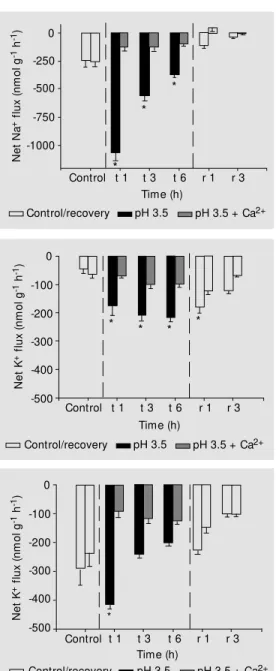
at pH 3.5, showing large and significant differences relative to the control treatment (Figure 1). In the first hour of exposure to pH
3.5, C. adolfoi exhibited a 2-fold increase in
Na+
loss (to -594 ± 84 nmol g-1
h-1
). After 3
and 6 h, Jnet Na+ increased significantly by as
much as 7- and 23-fold (to -4,670 ± 371 and
-14,171 ± 1,053 nmol g-1
h-1
), respectively,
indicating that C. adolfoi was unable to
con-trol Na+
efflux under acute low pH. No deaths occurred during this treatment, and efflux was quickly reduced during the recov-ery period.
C. schwartzi showed the capacity to with-stand pH 3.5 fairly well (Figure 2). Although there was an initially high efflux during the
first hour, when Jnet Na+
was about 3 times
higher (-1,063 ± 73 nmol g-1 h-1) than
g-1
h-1
, respectively), exactly the opposite
pattern to that seen in C. adolfoi. In the
recovery series, net Na+
flux decreased sig-nificantly as well (-112 ± 26 and -35 ± 13
nmol g-1 h-1, respectively).
Significant K+
loss occurred in both
spe-cies (Figures 3 and 4). For C. adolfoi, the
average loss was about 3 times higher than
the control treatment (-200 ± 22 nmol g-1
h-1
), and remained constant throughout ex-posure. This feature suggests that the fish
were able to control diffusive efflux. C.
schwartzi exhibited a pronounced K+ loss in the first hour of treatment (-419 ± 11 nmol
g-1
h-1
), with some later attenuation. After
continued exposure, these K+
effluxes were
-241 ± 13 and -201 ± 9 nmol g-1 h-1, at 3 and
6 h, respectively.
Effe ct o f calcium at pH 3.5
High [Ca2+
] greatly affected ion losses in
both species at pH 3.5. However, C. adolfoi
was not able to control the Na+
efflux rate
even in the presence of Ca2+
(Figure 1). Net
Na+
flux was not significantly different in the first hour of treatment for this blackwater
species (-235 ± 33 nmol g-1
h-1
). During the
subsequent sampling periods, Na+ loss was
progressively higher, as much as 5 times and 18 times greater (-1,452 ± 176 and -4,591 ±
531 nmol g-1 h-1, respectively). These losses
represent about a 70% attenuation of the
losses at low [Ca2+
], but were still
substan-tially above those seen in C. schwartzi even
at low [Ca2+
]. For C. schwartzi, elevated
[Ca2+
] completely prevented the Na+
losses
caused by low pH exposure. Indeed, Na+
losses were reduced by about 50% even compared to the control series at pH 6.0
(average losses were -118 ± 28 nmol g-1 h-1),
indicating a positive effect of Ca2+
in the presence of acute low pH (Figure 2).
Rather different patterns were seen for
K+
fluxes. C. adolfoi did not show K+
disrup-tion when exposed to low pH under high
[Ca2+] (Figure 3). The average loss in the
Figure 1. Net Na+ flux of
Corydo-ras adolfoi exposed to pH 3.5
and pH 3.5 plus Ca2+. Values are
reported as means ± SEM (N =
10). * P<0.05 comparedto a
con-trol measurement performed at pH 6.0 (Dunnett test). Water w as changed to circumneutral pH for recovery (r) after 6 h of treat-ment (t).
N
e
t
K
+ f
lu x ( n m o l g
-1 h -1) 0 -100 -200 -300 -400 -500
Control t 1 t 3 t 6 r 1 r 3
Control/recovery pH 3.5 pH 3.5 + Ca2+
Time (h)
Figure 4. Net K+ flux of
Corydo-ras schw artzi exposed to pH 3.5
and pH 3.5 plus Ca2+. Values are
reported as means ± SEM (N =
10). * P<0.05 comparedto a
con-trol measurement performed at pH 6.0 (Dunnett test). Water w as changed to circumneutral pH for recovery (r) after 6 h of
treat-ment (t). *
Figure 3. Net K+ flux of
Corydo-ras adolfoi exposed to pH 3.5
and pH 3.5 plus Ca2+. Values are
reported as means ± SEM (N =
10). * P<0.05 comparedto a
con-trol measurement performed at pH 6.0 (Dunnett test). Water w as changed to circumneutral pH for recovery (r) after 6 h of
treat-ment (t). Net
K
+ f
lu x ( n m o l g
-1 h -1) 0 -100 -200 -300 -400
Control t 1 t 3 t 6 r 1 r 3
Time (h)
Control/recovery pH 3.5 pH 3.5 + Ca2+
-500 * * * * N e t N a
+ f
lu x ( n m o l g
-1 h
-1) 0
-250
-500
-750
-1000
Control t 1 t 3 t 6 r 1 r 3
Time (h)
Control/recovery pH 3.5 pH 3.5 + Ca2+
Figure 2. Net Na+ flux of
Corydo-ras schw artzi exposed to pH 3.5
and pH 3.5 plus Ca2+. Values are
reported as means ± SEM (N =
10). * P<0.05 comparedto a
con-trol measurement performed at pH 6.0 (Dunnett test). Water w as changed to circumneutral pH for recovery (r) after 6 h of treat-ment (t). * * * N e t N a
+ f
lu x ( n m o l g
-1 h -1) 0 -3000 -6000 -9000 -12000 -15000 * * * *
Control t 1 t 3 t 6 r 1 r 3
Time (h)
Control/recovery pH 3.5 pH 3.5 + Ca2+
treatment was 91 ± 10 nmol g-1
h-1
,
repre-senting a net K+ flux 38% higher than the
control, although not statistically different. C. schwartzi exhibited a ~50% reduction in
K+ loss when exposed to low pH under high
[Ca2+
], accounting for an average 112 ± 16
nmol g-1
h-1
loss (Figure 4), slightly higher
than that observed for C. adolfoi.
D iscussio n
Ne t Na+ and K+ fluxe s in Coryd oras
Differences in the acid tolerance were evident between the two species tested in the
present study. C. schwartzi showed high acid
tolerance, being very adept at dealing with
rapid changes in water pH. C. adolfoi, the
blackwater species, showed a marked Na+
disturbance at pH 3.5, developing massive
and progressive losses. Such massive Na+
loss demonstrated for C. adolfoi does not
necessarily imply that the species is
acid-intolerant. The sunfish (Enneacanthus
obe-sus), living in peat bogs at pH 3.7 in North
America, also developed massive Na+
loss when submitted experimentally to pH 3.5
(14). Body Na+
levels declined by 30% after two weeks but remained stable over the fol-lowing three weeks at pH 3.5. Moreover, the
high Na+
disruption demonstrated for C.
adolfoi is very similar to that found for other
blackwater species, namely the tetra
Gym-nocorymbus ternetzi (15), and for the neon
tetra Paracheirodon innesi (16). Like the
neon tetra, C. schwartzi developed a control
mechanism over subsequent periods so as to
adapt to low pH. C. adolfoi did not show Na+
efflux control during the 6-h treatment
pe-riod, indicating that it may take longer for C.
adolfoi to adjust to the acid conditions of the transfer from pH 6.0.
It is still not clear why some predicted acid tolerant species that thrive and repro-duce at extremely low pHs do not show high tolerance under experimental conditions.
Blackwater fish species inhabiting the igapó
areas are exposed to natural acidity due to humic and fulvic acids, that make up the dissolved organic carbon fraction. Dissolved organic carbon concentration in the flooded forest is about 35 mg/l (2). The carboxylic and phenolic hydroxyl groups of these or-ganic acids are the main source of blackwa-ter acidity (17). Weak acids (such as humic and fulvic types) are not completely ionized in aqueous solution, and typically have a high pKa. Conversely, inorganic acids (HNO3, H2SO4, and so forth) such as those used in the present study are almost completely ion-ized in solution. These conditions do not represent the same type of acidity that fish experience in the wild, even though they
have the same [H+
] in the water.
Given its normal circumneutral habitat in
whitewater, the high tolerance of C. schwartzi
under low pH conditions is quite
remark-able. This species controlled both Na+
and
K+
losses well at pH 3.5. In contrast to the
characiform matrincha (Brycon sp) and
tambaqui (Colossoma macropomum) (18),
C. schwartzi seems to be much more adapted to rapid changes in water pH. The efflux rate of matrincha was reduced by 40% after 18 h,
but the losses were still significant. C.
schwartzi showed a 90% decrease in Na+ loss after 6 h at pH 3.5, indicating the ability
to limit Na+ losses faster than matrincha.
In spite of Na+
disruption, K+
losses were
under control for both species. C. schwartzi
had a slightly higher K+
loss than C. adolfoi,
which decreased over time for both, indicat-ing that they were able to control the
distur-bance generated by low pH. Jnet K+ was
closely similar to that found in a previous study for other Amazonian fish at pH 3.5
(19). It is worth mentioning that K+ efflux is
an indicator of intracellular osmotic imbal-ance, being lost primarily from intracellular
media. The fact that K+ loss remained under
control may indicate that C. adolfoi was not
Effe cts o f calcium
Na+ loss in C. schwartzi was strongly
influenced by [Ca2+
], but this effect was less
pronounced in C. adolfoi. Although the Na+
loss decreased significantly (about 70%) in
relation to the pH 3.5 treatment, C. adolfoi
was not able to control Na+
loss, which still increased progressively throughout exposure.
Gonzalez et al. (15,19) pointed out that Ca2+
should not be involved to a greater extent in the regulation of branchial permeability at
low pH. A high [Ca2+
] (100-500 µmol/l) had almost no effect on ion loss in blackwater
species compared to 10 µmol/l [Ca2+
]. It is still unclear whether the acclimation period out of the wild conditions would induce
different ionoregulatory patterns in C.
adol-foi. It is reasonable to propose that Ca2+
does not play any special role in blackwater fish acid tolerance since this element is almost unavailable in the ion-poor waters of the Amazon region. This supports the idea that ion regulation in blackwater systems is modu-lated by different mechanisms, as previously suggested by others (15,16,18,19). Gonzalez et al. (19) suggested that humic compounds might interact directly with the branchial tight junctions and influence permeability.
In contrast, ionoregulatory control in C.
schwartzi is clearly Ca2+ dependent, as shown
for the tambaqui (C. macropomum), a
black-water-whitewater migratory species (12,18,
20,21). This indicates that C. schwartzi has a
high branchial affinity for Ca2+
, particularly at the paracellular tight junctions, thus pre-senting diffusive ion losses.
The adaptive strategies involved in acid tolerance in the blackwaters are still a topic of discussion. The physiological adjustments that allow fish to inhabit low pH waters with low ion concentrations seem to be their abil-ity to maintain an ionic balance by a combi-nation of adjustments to enhance transport and limit permeability. Most reports seem to emphasize the idea that ion loss control is the key factor for species survival in acid waters, rather than maintenance of the ion uptake rates. Naturally adapted fish from soft ion-poor waters such as the Amazon blackwaters
did not show branchial affinity for Ca2+
, indicating modulation by other still unknown physiological mechanisms. The investiga-tion of the effect of dissolved organic carbon compounds on ion regulation should be a fruitful field for additional research con-cerning the natural adaptations of fish to naturally acidic waters.
Ackno wle dgm e nts
We thank the ornamental fish exporters in Manaus for supplying the fish, and C.M. Wood for revising the manuscript.
Re fe re nce s
1. Furch K (1984). Water chemistry of the Amazon basin: The distribution of chemi-cal elements among freshw aters. In: Sioli
H (Editor), The Amazon. Limnology and
Landscape Ecology of a M ighty Tropical River and its Basin. Dr. W. Junk Publish-ers, Dordrecht, The Netherlands, 167-199. 2. Walker I (1995). Amazonian streams and small rivers. In: Tundisi JG, M
atsumura-Tundisi T & Bicudo C (Editors), Limnology
in Brazil. Academia Brasileira de Ciências/ Sociedade Brasileira de Limnologia, São
Carlos,SP, Brazil, 167-193.
3. Val AL & Almeida-Val V (1995). Fishes of
t he Am azon and Their Environm ent .
Springer-Verlag, Berlin, Germany.
4. M cDonald DG (1983). The effects of H+
upon the gills of freshw ater fish.
Cana-dian Journal of Zoology, 61: 691-703. 5. Wood CM (1989). The physiological
prob-lems of fish in acid w aters. In: M orris R, Taylor EW, Brow n DJA & Brow n JA
(Edi-tors), Acid Toxicity and Aquatic Animals.
Cambridge University Press, Cambridge, UK, 125-152.
6. M cDonald DG, Hobe H & Wood CM (1980). The influence of calcium on the physiological responses of the rainbow
trout, Salmo gairdneri, to low
environmen-tal pH. Journal of Experimental Biology,
88: 109-131.
7. Brow n DJA (1982). The effect of pH and
calcium on fish and fisheries. Water, Air
and Soil Pollution, 18: 343-351.
8. M cWilliams PG (1982). The effects of cal-cium on sodium fluxes in the brow n trout,
Salmo trutta, in neutral and acid w ater.
Journal of Experimental Biology, 96: 439-442.
9. Hunn JB (1985). Role of calcium in gill
function in freshw ater fishes.
543-547.
10. Grizzle JM , M auldin AC, Young D & Hen-derson E (1985). Survival of the juvenile
striped bass (M orone saxatilis) and M
o-rone hybrid bass (M orone chrysops x M
o-rone saxatilis) increased by addition of
cal-cium to soft w ater. Aquaculture, 46:
167-171.
11. Burgess WE (1987). A Complete Guide to
Corydoras. T.F.H. Publications, Inc., Nep-tune City, NJ, USA.
12. W ood CM , W ilson RD, Gonzalez RJ, Patrick M L, Bergman HJ, Narahara A & Val AL (1998). Responses of an
Amazo-nian teleost, the tambaqui (Colossoma
macropomum), to low pH in extremely
soft w ater. Physiological Zoology, 71:
658-670.
13. Wood CM (1992). Flux measurements as
indices of H+ and metal effects on
fresh-w ater fish. Aquatic Toxicology, 22:
239-264.
14. Gonzalez RJ & Dunson WA (1987).
Adap-tations of sodium balance to low pH in a
sunfish (Enneacanthus obesus) from
natu-rally acidic w aters. Journal of
Compara-tive Physiology,157: 555-566.
15. Gonzalez RJ, Dalton V & Patrick M L (1998). Ion regulation in ion-poor acidic
w ater by the blackskirt tetra (
Gymno-corymbus ternetzi), a fish native to the
Amazon River. Physiological Zoology, 70:
428-435.
16. Gonzalez RJ & Preest M R (1999). Iono-regulat ory specializat ions f or excep-tional tolerance of ion poor acidic w aters
in the neon tetra (Paracheirodon innesi).
Physiological and Biochemical Zoology, 72: 156-163.
17. Thurman EM (1985). Aquatic humic
sub-stances. In: Thurman EM (Editor), Organic
Geochemistry of Natural Waters. M arti-nus Nijhoff/Dr. W. Junk Publishers, Dor-drecht, The Netherlands, 273-361. 18. Wilson RW, Wood CM , Gonzalez RJ,
Patrick M L, Bergman HL, Narahara A &
Val AL (1999). Ion and acid-base balance in three species of Amazonian fish during gradual acidification of extremely soft w
a-ter. Physiological and Biochemical
Zool-ogy, 72: 277-285.
19. Gonzalez RJ, Wood CM , Wilson RW, Patrick M L, Val AL, Bergman HL & Nara-hara A (1998). Effects of w ater pH and calcium concentration on ion balance in
fish of the Rio Negro, Amazon.
Physiologi-cal Zoology, 71: 15-22.
20. Aride PHR (1998). Efeito do pH da água
nos parâmetros hematológicos de
Colos-soma macropomum (Cuvier, 1818) man-tido sob alimentação artificial. M aster’s thesis, INPA, M anaus, AM , Brazil. 21. Portela JM (1998). Efeitos do pH, cálcio e
temperatura sobre a homeostase iônica
de alevinos de tam baqui, Colossom a