Heart rate variability in athletes
and nonathletes at rest and during
head-up tilt
1Laboratório de Fisiologia do Exercício, 2Departamento de Ciências do Esporte,
Faculdade de Educação Física,
3Departamento de Fisiologia e Biofísica, Instituto de Biologia,
Universidade Estadual de Campinas, Campinas, SP, Brasil
4Divisão de Cardiologia, Departamento de Clínica Médica, Hospital das Clínicas,
Faculdade de Medicina de Ribeirão Preto, Universidade de São Paulo, Ribeirão Preto, SP, Brasil
5Departamento de Fisioterapia Cardiorespiratória, Faculdade de Fisioterapia,
Pontifícia Universidade Católica de Campinas, Campinas, SP, Brasil F.S. Martinelli1,3,
M.P.T. Chacon-Mikahil2,
L.E.B. Martins1,
E.C. Lima-Filho1†, R. Golfetti1, M.A. Paschoal1,5
and L. Gallo-Junior4
Abstract
The purpose of the present study was to determine if autonomic heart rate modulation, indicated by heart rate variability (HRV), differs during supine rest and head-up tilt (HUT) when sedentary and endur-ance-trained cyclists are compared. Eleven sedentary young men (S) and 10 trained cyclists (C) were studied. The volunteers were submit-ted to a dynamic ECG Holter to calculate HRV at rest and during a 70º HUT. The major aerobic capacity of athletes was expressed by higher values of V. O2 at anaerobic threshold and peak conditions (P < 0.05). At rest the athletes had lower heart rates (P < 0.05) and higher values in the time domain of HRV compared with controls (SD of normal RR interval, SDNN, medians): 59.1 ms (S) vs 89.9 ms (C), P < 0.05. During tilt athletes also had higher values in the time domain of HRV compared with controls (SDNN, medians): 55.7 ms (S) vs 69.7 ms (C), P < 0.05. No differences in power spectral components of HRV at rest or during HUT were detected between groups. Based on the analysis of data by the frequency domain method, we conclude that in athletes the resting bradycardia seems to be much more related to changes in intrinsic mechanisms than to modifications in autonomic control. Also, HUT caused comparable changes in sympathetic and parasym-pathetic modulation of the sinus node in both groups.
Correspondence
F.S. Martinelli
Laboratório de Fisiologia do Exercício
Faculdade de Educação Física UNICAMP
Av. Érico Veríssimo, 701 13083-970 Campinas, SP Brasil
E-mail: [email protected]
Research supported by FAPESP (No. 96/09945-0) and CNPq (No. 300528/85-0).
Received July 14, 2003 Accepted January 24, 2005
Key words
•Endurance
•Power spectral analysis •Heart rate variability •Autonomic heart rate
modulation
•Training bradycardia •Orthostatic stress
Introduction
Several studies have reported that aero-bic physical training changes the sympatho-vagal balance of the sinus node and may contribute in part to the resting bradycardia observed in endurance athletes. However, it
alterations are responsible for endurance-trained bradycardia (7-12).
In addition to the possible role of vagal and sympathetic adaptations in resting brady-cardia induced by aerobic training, different autonomic cardiovascular responses may be activated during exercise itself and in pos-tural and respiratory tests when trained and untrained subjects are compared (11,13). Some studies have reported that during ortosthatic stress, trained and untrained sub-jects present different cardiovascular re-sponses, which have been associated with alterations in autonomic cardiovascular con-trol (5,14,15). However, other studies failed to show these differences when comparing trained and untrained subjects (16,17).
In order to evaluate the cardiac auto-nomic activity non-invasively, many studies have used the measurement of the heart rate variability (HRV) that is obtained by calcu-lating the variations between the RR inter-vals of the ECG signal. These variations are calculated in the time and frequency do-mains; in this last condition they are ex-pressed as sine wave power values (power spectrum). High HRV is usually caused by an increase in vagal tone associated with a decrease in sympathetic tone (18,19).
There is substantial controversy concern-ing the absolute and relative changes of power spectral components related to sympathetic and parasympathetic modulation, induced by aerobic training (1,4,6,14,20-23).
Thus, the aim of this study was to evalu-ate HRV in the time and frequency domains in athletes and sedentary subjects in the su-pine position and after head-up tilt (HUT), when there is a change in sympathetic and parasympathetic balance in the sinus node.
Material and Methods
Subjects
Two groups of young men, nonsmoking healthy volunteers, were studied: 11
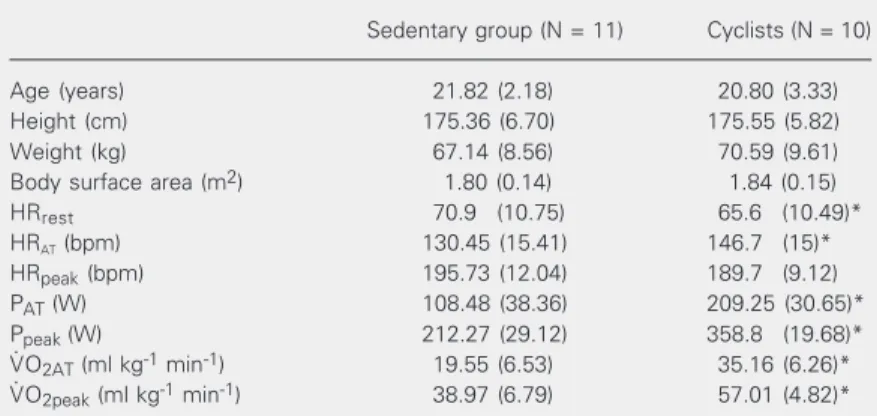
seden-tary controls, who had not engaged in regu-lar physical activity for at least 6 months, and 10 trained cyclists of competitive level, who had been participating in an endurance training program for at least one year. They trained 90 min to 5 h/session, 6 days a week and all participated in official national and/ or international championships in this ath-letic modality. Their anthropometric charac-teristics are presented in Table 1.
The study was approved by the Ethics Committee of the State University of Campi-nas, CampiCampi-nas, SP, Brazil, and each subject was informed about the nature of the experi-ment and gave their informed written con-sent.
Protocols
The protocols were conducted in two sepa-rate sessions. In the first all subjects performed a dynamic physical exercise test on a cycloer-gometer (Quinton Instrument Company, Se-attle, WA, USA), using a progressive continu-ous protocol (ramp) up to physical exhaustion. The initial workload was 4 watts for 2 min for both groups. The workload increases were 15 W per min for the sedentary group and 30 W per min for the trained group. The subjects pedaled at a frequency of 60 rpm. The ventila-tory and metabolic variables were obtained by direct measurement using a gas analyzer tem (metabolic measuring chart-horizon
sys-tems; Sensormedics Corporation, Yorba Linda,
CA, USA). The ECG was recorded continu-ously starting one minute before the beginning of the exercise and up to the end of the recov-ery period. The ventilatory anaerobic thresh-old was obtained by analyzing the loss of
linearity of CO2 production and pulmonary
ventilation responses at submaximal power values (as averaged at 15-s intervals) (24).
peaks of an ECG signal. After the supine resting period, a passive 70º HUT was per-formed without foot support using a seat at-tached to the table to support body weight. The subjects were tilted and remained in this posi-tion for up to 60 min.
The ECG, the instantaneous heart rate, the pulse pressure, and the respiratory rhythm were recorded continuously with an eight-channel recording system (RS 3800; Gould Instruments Systems, Valley View, OH, USA). Tests were performed in a quiet air-con-ditioned (22-24ºC) room. The subjects were instructed to perform no exercise training 40 h before the day of the experiment and to avoid drugs and caffeine 12 h before the test.
Heart rate variability
The short-term HRV in the time and fre-quency domains was obtained using 24-h dynamic electrocardiography (Holter for Windows, v. 3.6-F, Rozinn Electronics,
Glen-dale, NY, USA). Two or more 5-min
wdows that presented stationarity (visual in-spection) were selected from the RR interval series during rest and HUT.
During HUT, HRV was analyzed after the initial transient response of this variable, always during periods of stationarity of the signal. Since autonomic heart rate control cannot be the same at the beginning and at the end of HUT, linear regression analysis was performed to determine if the time of tilting was correlated with the HRV re-sponses. This analysis showed that all 5-min stationary windows during this maneuver could be used. Then, each subject had a different number (average = 3) of 5-min intervals for calculating the HRV, with the first interval being analyzed at least 6 min after tilting. When these intervals were con-secutive for the subject, their arithmetic mean was used. The non-consecutive intervals were considered separately as repetitions.
The following HRV variables were
ana-lyzed: for the time domain - standard devia-tion of normal RR interval (SDNN, ms); for the frequency domain - low frequency power in normalized units (LFnu, 0.04-0.15 Hz), high frequency power in normalized units (HFnu, 0.15-0.4 Hz), and LF/HF - ratio of absolute LF power to HF power.
The spectral analysis was calculated by the MK5 Spectral Analysis Package, H4W
-Rozinn Electronics, using the Fast Fourier
Transform algorithm. The sampling rate was 128 samples per second and all data were analyzed in blocks of 100 s, with a frequency of resolution of 0.01 Hz. The spectra of six successive 100-s blocks were averaged to-gether.
Visual inspection of ECG signal record-ings in the computer monitor showed ab-sence of artifacts or cardiac arrhythmias that could interfere with the HRV analysis per-formed by the system analyzer (Holter for Windows, v.3-6-F Rozinn Electronics).
Statistical analysis
Results
Cardiorespiratory variables at rest and during exercise
Table 1 shows the higher aerobic capac-ity of the athletes compared to control group, expressed by higher (P < 0.05) oxygen up-take and power values at anaerobic
thresh-old (V. O2AT) and at peak condition (V
. O2peak). The heart rate in the resting condition was significantly (P < 0.05) lower in athletes than in nonathletes (Table 1).
Heart rate variability at rest
Table 2 and Figure 1 show that the RR mean (medians) in the supine position was higher (P < 0.05) in athletes than in nonath-letes. Figures 2 to 5 show that, despite the significantly (P < 0.05) lower values of SDNN in the sedentary group, the spectral power components, LFnu, HFnu and LF/HF, were similar for the two groups.
Heart rate variability during head-up tilt
During HUT (Table 2 and Figures 1 to 5) both groups presented reduction in RR mean
values (P < 0.05). Athletes also presented
reductions in SDNN (P < 0.05). In both
groups, spectral components showed the fol-lowing results: higher LFnu and LF/HF ratio
(P< 0.05) and lower HFnu (P< 0.05). Higher
values (P< 0.05) of mean RR and SDNN
were found in athletes, but no differences in power spectral variables were found between groups.
Discussion
The higher aerobic capacity of the
ath-letes was reflected in greater V. O2 and power
values (cycloergometer) at both anaerobic threshold and peak effort (Table 1). Also, the resting heart rate was significantly lower in cyclists than in nonathletes. Several
inves-Table 1. Anthropometric and cardiorespiratory parameters of the sedentary and endur-ance-trained subjects at rest and during exercise.
Sedentary group (N = 11) Cyclists (N = 10)
Age (years) 21.82 (2.18) 20.80 (3.33)
Height (cm) 175.36 (6.70) 175.55 (5.82)
Weight (kg) 67.14 (8.56) 70.59 (9.61)
Body surface area (m2) 1.80 (0.14) 1.84 (0.15)
HRrest 70.9 (10.75) 65.6 (10.49)*
HRAT (bpm) 130.45 (15.41) 146.7 (15)*
HRpeak (bpm) 195.73 (12.04) 189.7 (9.12)
PAT (W) 108.48 (38.36) 209.25 (30.65)*
Ppeak (W) 212.27 (29.12) 358.8 (19.68)*
V.O2AT (ml kg-1 min-1) 19.55 (6.53) 35.16 (6.26)*
V.O2peak (ml kg-1 min-1) 38.97 (6.79) 57.01 (4.82)*
Data are reported as means (SD). HRrest = heart rate at supine rest; HRAT = heart rate
at anaerobic threshold; HRpeak = heart rate at peak effort; PAT = power at anaerobic
threshold; Ppeak = power at peak effort; V
.
O2AT = oxygen uptake at anaerobic
thresh-old; V.O2peak =oxygen uptake at peak effort.
*P < 0.05 compared to sedentary group (Wilcoxon rank sum test).
Table 2. Comparison of heart rate variability parameters in time and frequency do-mains in the supine and tilting position.
Supine position Tilting position
Sedentary group Cyclists Sedentary group Cyclists
(N = 11) (N = 10) (N = 11) (N = 10)
RR mean (ms) 854.3 (105.7) 1076 (115.6)* 625.8 (188.5)+ 794.2 (148)*+
SDNN (ms) 59.1 (36.5) 89.9 (24.8)* 55.7 (8.8) 69.7 (18.9)*+
LF (ms2/Hz) 3500 (2900) 8400 (3300) 4700 (1050) 8000 (7400)
HF (ms2/Hz) 1500 (800) 2400 (900) 770 (550) 880 (975)
LFnu (%) 71 (6) 68 (20) 85 (4.5)+ 88 (8)+
HFnu (%) 29 (6) 33 (18) 15 (4.8)+ 12 (8.2)+
LF/HF 2.47 (1.01) 2.08 (1.29) 5.56 (2.48)+ 7.24 (6.83)+
Data are reported as medians and interquartile range. SDNN = standard deviation of normal RR interval; LF, HF = low and high frequency power, respectively; LFnu = LF power in normalized units; HFnu = HF power in normalized units; LF/HF = ratio of absolute LF power to HF power values. Frequency ranges: LF: 0.04-0.15 Hz and HF: 0.15-0.4 Hz.
*P < 0.05 compared to the sedentary group; +P < 0.05 between the supine and tilting
position (Wilcoxon rank sum test and Wilcoxon signed rank test, respectively).
Figure 1. Mean RR in the supine and head-up tilt (HUT) position for the sedentary group and cyclists. The boxplots show the minimum values, 1st quartile, medians (bold black line), 3rd quartile, maxi-mum, and confidence interval of the medians (hatched area). S = sedentary group (N = 11); C = cyclists (N = 10). *P < 0.05 for comparisons indicated by brack-ets (confidence interval of the median test).
RR mean (ms)
1200 1234
1234 1234 1234 1234
12345 12345 12345 12345 12345 12345 12345 12345 12345 12345 12345 12345 12345 12345 12345
12345 12345 12345 12345 12345 12345 12345 12345
12345 12345 12345 12345 12345 12345 12345 12345 12345
*
* *
*
1100
1000
900
800
700
600
500
S C S C
Figure 2. Standard deviation of normal RR interval in the supine and head-up tilt position for the sedentary sub-jects and cyclists. The boxplots show the minimum values, 1st quartile, medians (bold black line), 3rd quartile, maximum, and confidence interval of the medi-ans (hatched area). S = sedentary group (N = 11); C = cyclists (N = 10); HUT = head-up tilt; SDNN = standard deviation of normal RR interval. *P < 0.05 for compari-sons indicated by brackets (confidence interval of the median test and Wilcoxon rank sum test).
SDNN (ms) 120 123456 123456 123456 123456 123456 123456 123456 123456 12345 12345 12345 12345 12345 12345 12345 12345 12345 12345 12345 12345 12345 12345 12345 12345 12345 12345 12345 12345 12345 12345 12345 12345 100 80 60 40 20 * * *
S C S C
Supine HUT
Figure 5. Low frequency-high frequency ratio (absolute values) in the supine and head-up tilt position for the sedentary subjects and cyclists. The boxplots show the minimum values, 1st quartile, medians (bold black line), 3rd quartile, maximum, and confidence interval of the medians (hatched area). S = sedentary group (N = 11); C = cyclists (N = 10); HUT = head-up tilt; LH/HF = low frequency-high frequency ratio. *P < 0.05 for com-parisons indicated by brackets (confidence interval of the median test).
123456 123456 123456 123456 123456 123456 123456 12345 12345 12345 12345 12345 12345 12345 12345 12345 12345
S C S C
LF/HF 25 20 15 10 5 0 Supine HUT * * 12345 12345 12345 12345 12345 123456 123456 123456 12345 12345 12345 12345 12345 12345 12345 12345 123456 123456 123456 123456 123456 123456 123456
S C S C
HFnu (%) 60 50 40 30 20 10 0 Supine HUT
Figure 4. High frequency in normalized units at supine and tilting position in the sedentary subjects and cy-clists. The boxplots show the minimum values, 1st quartile, medians (bold black line), 3rd quartile, maxi-mum, and confidence interval of the medians (hatched area). S = sedentary group (N = 11); C = cyclists (N = 10); HUT = head-up tilt; HFnu = high frequency in normalized units. *P < 0.05 for comparions indicated by brackets (confidence interval of the median test).
*
*
Figure 3. Low frequency in normalized units in the su-pine and head-up tilt position for the sedentary subjects and cyclists. The boxplots show the minimum values, 1st quartile, medians (bold black line), 3rd quartile, maxi-mum, and confidence interval of the medians (hatched area). S = sedentary group (N = 11); C = cyclists (N = 10); HUT = head-up tilt; LFnu = low frequency in normal-ized units. *P < 0.05 for comparisons indicated by brack-ets (confidence interval of the median test).
12345 12345 12345 12345 12345 12345 12345 12345 123456 123456 123456 123456 123456 123456 123456 123456 12345 12345 12345 12345 12345 12345 12345 12345 * *
S C S C
ponent of HRV, which has been associated with vagal efferent activity (7,31,32), did not differ between athletes and nonathletes. The LFnu component also did not differ between groups. However, this component may not express the separate modulation of the sym-pathetic system; the parasymsym-pathetic system may contribute to the LF component in physi-ological conditions (7,31). Finally, the LF/ HF ratio, which indicates the sympatho-va-gal balance (32), also did not differ between athletes and nonathletes.
These results show that endurance-trained athletes present indications of increased HRV in the time domain but not in the frequency domain. To explain these findings one must consider the following possibilities. First, mean RR values were very different be-tween athletes and nonathletes and it was previously shown that time domain vari-ables are strongly influenced by mean RR values (4,10). Second, in the case of athletes, if the RR interval length is close to the maximally attainable value, the correspond-ing changes in RR cycle length can only change in one direction, potentially limiting the amplitude of the power spectrum (23). Third, the cumulative effect of heavy train-ing (cyclism traintrain-ing) performed by the ath-letes may have contributed to higher LFnu and lower HFnu values in this group (14, 22,29). Fourth, some investigators have pro-posed that frequency domain methods are more indicated than time domain methods for short-term assessment of HRV, as was the case in the present study (7). Finally, an alternative explanation for the lack of differ-ences in the power spectral components be-tween athletes and nonathletes could be the inaccuracy of power spectral analysis to as-sess autonomic tone in a highly trained popu-lation (23), or even the occurrence of non-linearity components in autonomic control systems.
Despite these possible methodological problems, the absence of differences in the spectral variables between athletes and tigations have been conducted regarding the
mechanisms responsible for the resting brady-cardia in trained subjects. Changes in the intrinsic mechanisms acting on the sinus node and alterations in the autonomic ner-vous system control of the heart have been reported to contribute to this phenomenon. In this context, some studies using different tests like pharmacological blockade, respi-ratory sinus arrhythmia and HRV have re-ported that enhanced vagal tone and/or di-minished sympathetic activity might contri-bute in part to the resting bradycardia (1-4,6). In contrast, studies conducted on ani-mals and men using the same methodology have related the training resting bradycardia to reduced intrinsic HR (8-12,27).
Several cross-sectional and longitudinal studies have compared resting HRV between endurance-trained and untrained subjects. Some have shown that endurance-trained subjects present higher values of power spec-tral HRV, indicating increasing vagal activ-ity (1,3,4,6,28); others have reported higher values of the LF component of HRV sug-gesting higher sympathetic activity (4,14,29). Lower levels of sympathetic activation (1) and vagal activation (29) and, finally, no differences have been found between trained and untrained subjects (10). The results re-garding time domain HRV are also contro-versial, and some studies have shown differ-ences in time domain that were not accom-panied by corresponding differences in power spectral HRV (23). Migliaro et al. (30) failed to show a relationship between fitness and HRV in the time and frequency domains and supported the idea that age and heart rate are the main determinants of HRV.
In the present study, time domain analy-sis of HRV in the supine position showed
higher valuesin athletes, but it is important
com-nonathletes suggests that a non-autonomic mechanism plays a major role in the resting bradycardia of cyclists. In agreement with this hypothesis, Yamamoto et al. (28), in a longitudinal study, detected cardiac auto-nomic adaptation up to the 28th day of en-durance training, with no further changes being detected thereafter despite a continued decrease in heart rate. Bonaduce et al. (33) also observed that decreased intrinsic heart rate plays an important role in the resting bradycardia induced by endurance training. They reported that detrained athletes showed a higher cardiac parasympathetic modula-tion with lower heart rate than controls, but after vigorous training no further increase in parasympathetic modulation was detectable despite further decreases in heart rate.
The present study also investigated if differences in autonomic cardiovascular con-trol could appear between athletes and nonathletes during a situation of orthostatic stress, which is a natural stimulus leading to sympathetic excitation and vagal withdraw-al in the heart. During HUT the initiwithdraw-al in-crease in the heart rate response is mediated by a decrease in vagal activity, followed by an enhanced sympathetic activity that main-tains higher values of heart rate during the test (34). Our results agree with previous observations showing an increase in heart rate (reduced RR mean) and enhanced sym-pathetic activity (expressed by higher LFnu values) associated with a decreased vagal activity (expressed by lower HFnu values) during HUT in both groups.
There are few HRV studies concerning
the responses of sedentary and endurance-trained athletes to maneuvers that reduce blood return to the heart, such as active standing, passive HUT and lower body nega-tive pressure. Dixon et al. (1) compared
sed-entary subjects and long distance runners during active standing and did not find dif-ferences in power spectral HRV between them. However, Furlan et al. (14) compared sedentary subjects and endurance-trained athletes during tilt and found indications of higher sympathetic activity in athletes, ex-pressed by higher values of LF and LF/HF ratio. When comparing athletes before and after a training period of 7 months, Hedelin et al. (35) showed that improved measures of aerobic capacity were associated with re-duction of LF HRV in the tilted position, while HF and total HRV did not change. They also suggested that high levels of HF and total HRV seem to constitute a favorable
condition for an increase in V. O2 max rather
than being a result of increased aerobic fit-ness. Most recently, Lee (36) showed that 8 endurance training sessions reduced LF and LF/HF during 5-min tilt and paced breath-ing, but not during spontaneous breathing. In the present study, vagal and sympathetic activity during HUT performed with sponta-neous breathing did not seem to differ be-tween the cyclists and sedentary group, con-sidering the power spectral components. SDNN was higher in athletes than in seden-tary subjects during HUT, but the same meth-odological limitations mentioned above have to be considered.
References
1. Dixon EM, Kamath MV, McCartney N & Fallen EL (1992). Neural regulation of heart rate variability in endurance athletes and seden-tary controls. Cardiovascular Research, 26: 713-719.
2. Ekblom B, Kilbom A & Soltysiak J (1973). Physical training, bradycar-dia, and autonomic nervous system. Scandinavian Journal of Clini-cal and Laboratory Investigation, 32: 251-256.
3. Goldsmith RL, Bigger Jr JT, Steinman RC & Fleiss JL (1992). Com-parison of 24-hour parasympathetic activity in endurance-trained and untrained young men. Journal of the American College of Cardiology, 20: 552-558.
4. Puig J, Freitas J, Carvalho MJ, Puga N, Ramos J, Fernandes P, Costa O & de Freitas AF (1993). Spectral analysis of heart rate variability in athletes. Journal of Sports Medicine and Physical Fit-ness, 33: 44-48.
5. Shi X, Stevens GH, Foresman BH, Stern SA & Raven PB (1995). Autonomic nervous system control of the heart: endurance exer-cise training. Medicine and Science in Sports and Exercise, 27: 1406-1413.
6. Shin K, Minamitani H, Onishi S, Yamazaki H & Lee M (1997). Autonomic differences between athletes and nonathletes: spectral analysis approach. Medicine and Science in Sports and Exercise, 29: 1482-1490.
7. Hartikainen JEK, Tahvannainen KUO & Kuusela TA (1998). Short-term measurement of heart rate variability. In: Malik M (Editor), Clinical Guide to Cardiac Autonomic Tests. Kluwer Academic Pub-lishers, Norwell, MA, USA.
8. Hatfield BD, Spalding TW, Santa Maria DL, Porges SW, Potts JT, Byrne EA, Brody EB & Mahon AD (1998). Respiratory sinus arrhyth-mia during exercise in aerobically trained and untrained men. Medi-cine and Science in Sports and Exercise, 30: 206-214.
9. Katona PG, McLean M, Dighton DH & Guz A (1982). Sympathetic and parasympathetic cardiac control in athletes and nonathletes at rest. Journal of Applied Physiology, 52: 1652-1657.
10. Loimaala A, Huikuri H, Oja P, Pasanen M & Vuori I (2000). Controlled 5-mo aerobic training improves heart rate but not heart rate variabil-ity or baroreflex sensitivvariabil-ity. Journal of Applied Physiology, 89: 1825-1829.
11. Maciel BC, Gallo Junior L, Marin Neto JA, Lima Filho EC, Terra Filho J & Manco JC (1985). Parasympathetic contribution to bradycardia induced by endurance training in man. Cardiovascular Research, 19: 642-648.
12. Stein RMC, Rosito GA, Zimerman LI & Ribeiro J (2002). Intrinsic sinus and atrioventricular node electrophysiologic adaptations in endurance athletes. Journal of the American College of Cardiology, 39: 1033-1038.
13. Gallo Jr L, Maciel BC, Marin-Neto JA, Martins LE, Lima-Filho EC, Golfetti R, Chacon MP & Forti VA (1995). Control of heart rate during exercise in health and disease. Brazilian Journal of Medical and Biological Research, 28: 1179-1184.
14. Furlan R, Piazza S, Dell’Orto S, Gentile E, Cerutti S, Pagani M & Malliani A (1993). Early and late effects of exercise and athletic training on neural mechanisms controlling heart rate. Cardiovascu-lar Research, 27: 482-488.
15. Zhang LF, Zheng J, Wang SY, Zhang ZY & Liu C (1999). Effect of aerobic training on orthostatic tolerance, circulatory response, and heart rate dynamics. Aviation, Space, and Environmental Medicine, 70: 975-982.
16. Lansimies EA & Rauhala E (1986). Orthostatic tolerance and aerobic
capacity. Aviation, Space, and Environmental Medicine, 57 (Part 1): 1158-1164.
17. Lightfoot JT, Claytor RP, Torok DJ, Journell TW & Fortney SM (1989). Ten weeks of aerobic training do not affect lower body negative pressure responses. Journal of Applied Physiology, 67: 894-901.
18. Akselrod S, Gordon D, Ubel FA, Shannon DC, Berger AC & Cohen RJ (1981). Power spectrum analysis of heart rate fluctuation: a quantitative probe of beat-to-beat cardiovascular control. Science, 213: 220-222.
19. Anonymous (1996). Heart rate variability: standards of measure-ment, physiological interpretation and clinical use. Task Force of the European Society of Cardiology and the North American Society of Pacing and Electrophysiology. Circulation, 93: 1043-1065. 20. De Meersman RE (1993). Heart rate variability and aerobic fitness.
American Heart Journal, 125: 726-731.
21. Goldsmith RL, Bigger Jr JT, Bloomfield DM & Steinman RC (1997). Physical fitness as a determinant of vagal modulation. Medicine and Science in Sports and Exercise, 29: 812-817.
22. Melanson EL (2000). Resting heart rate variability in men varying in habitual physical activity. Medicine and Science in Sports and Exer-cise, 32: 1894-1901.
23. Sacknoff DM, Gleim GW, Stachenfeld N & Coplan NL (1994). Effect of athletic training on heart rate variability. American Heart Journal, 127: 1275-1278.
24. Wasserman K, Whipp BJ, Koyl SN & Beaver WL (1973). Anaerobic threshold and respiratory gas exchange during exercise. Journal of Applied Physiology, 35: 236-243.
25. McGill R, Tukey JW & Larsen WA (1978). Variations of Box plots. American Statistician, 32: 12-16.
26. Pratt JW & Gibbons JD (1981). Concepts of Nonparametric Theory. 2nd edn. Springer-Verlag, New York.
27. Negrão CE, Moreira ED, Santos MC, Farah VM & Krieger EM (1992). Vagal function impairment after exercise training. Journal of Applied Physiology, 72: 1749-1753.
28. Yamamoto K, Miyachi M, Saitoh T, Yoshioka A & Onodera S (2001). Effects of endurance training on resting and post-exercise cardiac autonomic control. Medicine and Science in Sports and Exercise, 33: 1496-1502.
29. Pichot V, Roche F, Gaspoz JM, Enjolras F, Antoniadis A, Minini P, Costes F, Busso T, Lacour JR & Barthelemy JC (2000). Relation between heart rate variability and training load in middle-distance runners. Medicine and Science in Sports and Exercise, 32: 1729-1736.
30. Migliaro ER, Contreras P, Bech S, Etxagibel A, Castro M, Ricca R & Vicente K (2001). Relative influence of age, resting heart rate and sedentary life style in short-term analysis of heart rate variability. Brazilian Journal of Medical and Biological Research, 34: 493-500. 31. Malliani A, Pagani M, Lombardi F & Cerutti S (1991). Cardiovascular
neural regulation explored in the frequency domain. Circulation, 84: 482-492.
32. Pagani M, Lombardi F, Guzzetti S, Rimoldi O, Furlan R, Pizzinelli P, Sandrone G, Malfatto G, Dell’Orto S & Piccaluga E (1986). Power spectral analysis of heart rate and arterial pressure variabilities as a marker of sympatho-vagal interaction in man and conscious dog. Circulation Research, 59: 178-193.
cardiac autonomic control in high level athletes. Medicine and Sci-ence in Sports and Exercise, 30: 691-696.
34. Furlan R, Porta A, Costa F, Tank J, Baker L, Schiavi R, Robertson D, Malliani A & Mosqueda-Garcia R (2000). Oscillatory patterns in sympathetic neural discharge and cardiovascular variables during orthostatic stimulus. Circulation, 101: 886-892.
35. Hedelin R, Bjerle P & Henriksson-Larsen K (2001). Heart rate
varia-bility in athletes: relationship with central and peripheral perfor-mance. Medicine and Science in Sports and Exercise, 33: 1394-1398.