The effect of breastfeeding on spontan resolution of
monosymptomatic enuresis
_______________________________________________
Eyup Burak Sancak
1, Ural Oguz
2, Aykut Aykac
3, Erhan Demirelli
2, Omer Faruk Bozkurt
4, Sertac Cimen
51 Department of Urology, Canakkale Onsekiz Mart University, Faculty of Medicine, Canakkale, Turkey; 2 Department of Urology, Giresun University, School of Medicine, Giresun, Turkey; 3 Department of Urology, Bursa Orhangazi State Hospital, Bursa, Turkey; 4 Department of Urology, Kecioren Training and Research Hospital, Ankara, Turkey; 5 Diskapi Yildirim Beyazit Training and Research Hospital, Department of Urology, Ankara, Turkey
ABSTRACT
ARTICLE
INFO
______________________________________________________________ ______________________
Purpose: The aim of this study was to examine whether the duration of breastfeeding during infancy was associated with the time of spontaneous resolution of monosymp-tomatic enuresis (SRME).
Materials and Methods: A total of 1500 people were surveyed at four centers. One hundred and eighty-one people with a history of monosymptomatic enuresis (ME) who received no treatment and had no day time symptoms were included in the study. The relationship between the duration of breastfeeding and SRME was assessed by consi-dering the duration of breastfeeding as both continuous and categorical (cut-off value 5 months) variable. The multivariate general linear model was used to identify inde-pendent predictors such as gender, family history, and educational status of parents. Results: Pearson correlation analysis of the age of SRME and duration of breastfeeding found no statistically significant relationship. However, there was a significant diffe-rence in the age of SRME of those who were breastfed for 5 months or less compared to those who were breastfed for more than 5 months. According to the multivariate analysis, gender and educational status of parents were not effective on the age of SRME. Stepwise linear regression model showed that breastfeeding for five months or less and family history could affect the age of SRME. The regression formula was: age of SRME=9.599 + (3.807×five months or less of breastfeeding) + (1.258×positive family history).
Conclusions: It was found that when breastfeeding lasted for more than 5 months, there was a positive contribution to SRME.
Keywords:
Breast Feeding; Breast Milk Expression; Enuresis
Int Braz J Urol. 2016; 42: 550-7
_____________________
Submitted for publication: September 03, 2015
_____________________
Accepted after revision: December 22, 2015
INTRODUCTION
Enuresis is an important and frequently seen health problem during childhood throughout the world and it is predicted that there are over 50 million children with enuresis worldwide (1). Accor-ding to the definition of the International Children’s Continence Society, in the absence of attendant
common-ly seen after the age of 7 years, 1-2% of adults are still enuretic (3, 5, 6).
ME has been accepted as a common bio--behavioral problem in early childhood (4). The etiology seems to be multifactorial and several etiologies have been asserted for ME, including developmental delay, immature bladder function, immature sleep pattern and insufficient nocturnal antidiuretic hormone (7, 8). Most of these etiologies for ME are related to delayed development because they are normally seen in younger children and in-fants. The developmental theory is supported by cli-nical studies that report more developmental delays in children with ME compared with controls (8, 9). Other causes of ME include psychosocial and fami-lial factors. The effects of psychosocial factors such as stress are ambiguous but have been stated to be associated with ME (7, 10, 11). Also, genetic factors have been recognized in ME and familial clustering has been observed in several studies (7-9, 12).
Although the high rate of spontaneous re-solution is obvious, there are no articles investiga-ting the effect of the factors that contribute to the time of spontaneous resolution of monosymptoma-tic enuresis (SRME). We examined the relationship between ME and breastfeeding because both have been reported to be strongly associated with chil-dhood development. For example, there is a lot of clinical evidence that breastfeeding may provide neurodevelopmental advantages to children (13-16). Neurodevelopmental delays have been iden-tified in children with ME (9, 12). In addition to this, it was determined that psychogenic factors similar to stress play a role in the etiology of ME, but breastfeeding has been shown to have positive contributions to self-esteem and some psychologi-cal diseases (17). According to numerous studies, it is clear that both breastfeeding and ME are as-sociated with child development, so the objective of this study was to examine whether duration of breastfeeding during infancy was associated with the time of SRME.
MATERIALS AND METHODS
Patient Population
After receiving permission from the ins-titutional ethics committee, about 1500 people
were surveyed. The questionnaires were obtained by talking to individuals face to face in four refer-ral hospitals which were located in different cities in Turkey. Only patient relatives, not the patients, were asked to answer the questionnaire in different out-patient clinics of the centers (outpatient clinics of urology, dermatology and family medicine). If the answer to the question of whether there was bed-wetting after the age of five (the 60th month after birth) was yes, the other questions were asked. To evaluate the spontaneous resolution correctly, patients who were given any treatment for bed--wetting were excluded. In those whose bed-wet-ting resolved spontaneously, the duration of breas-tfeeding, educational status of parents and family history of enuresis were questioned. The presence of ME in first degree relative was evaluated as posi-tive family history. We excluded patients with diur-nal enuresis or with any day-time symptoms such as pollakiuria, frequency, and urgency during any part of their life. Patients with illnesses which could affect micturition habits such as diabetes mellitus or neurological diseases were also excluded. Be-cause the basis of the study is information about infancy, those over the age of 35 were excluded from the study. If the participating children were aged 16 and below, information provided by the parents of children were taken into consideration. The information given by participants who were ol-der than 16 was confirmed by another member of the family. At the end of the questionnaire, patients and parents were all asked if they were extreme-ly sure about the information they provided. If the answer was no, they were excluded from the study. If the double checks were inconsistent, participants were also excluded from the study. As a result, the clinical data from 181 people were evaluated.
Statistical analysis
family history and five months and less or longer duration of breastfeeding were evaluated with the Mann-Whitney U test. The Kruskal-Wallis tests were conducted to compare the age of SRME and the educational status of mother and father (each had 3 subgroups). The multivariate general linear model and stepwise linear regression were used to identify independent predictors such as gender, fa-mily history, educational status of parents, and five months or less duration of breastfeeding. The mo-del fit was assessed using appropriate residual and goodness-of-fit statistics. A p value of <0.05 was accepted as significant.
RESULTS
The study consisted of 103 male patients (56.9%) and 78 female patients (43.1%); 181
pa-tients in total. The average age was 25.7±6.2 (between 7-35 years), 90% were over the age of 14. The average age of SRME was 11.0±3.5 ye-ars (range 5-30 yeye-ars) and the average duration of breastfeeding was 16.5±9.8 months (range 0-60 months) (Table-1).
Pearson correlation analysis of the age of SRME and duration of breastfeeding found no sta-tistically significant relationship (p=0.250) (Figu-re-1). However, there was a significant difference in the age of SRME of those who were breastfed for 5 months or less compared to those who were breastfed for more than 5 months (average age of resolution for those breastfed ≤5 months 14.35±5.0 years; for those breastfed >5 months 10.58±2.9; p<0.001). There were no statistically significant re-lationships between the age of SRME and gender or presence of family history (Table-2). There was no
Table 1 - The demographic characteristics of patients.
n Mean ± ss Median Minimum Maximum
Age 181 25.7 ± 6.2 27.0 7.0 35.0
Age of spontan resolution of MNE 181 11.0 ± 3.5 11.0 5.0 30.0 Duration of breatfeeding (month) 181 16.5 ± 9.8 13.0 0.0 60.0
Figure 1 - The relationship between breastfeeding and mean age of spontaneous resolution of monosymptomatic enuresis is demonstrated.
Mean age of spontaneous resolution of MNE (Year) 15
14,5 14 13,5 13 12,5 12 11,5 11 10,5 10
13,69
3 4 5 6 12 18 24 36 >36
13,64 14,35
12
11,08 11,04
Breastfeeding period (month)
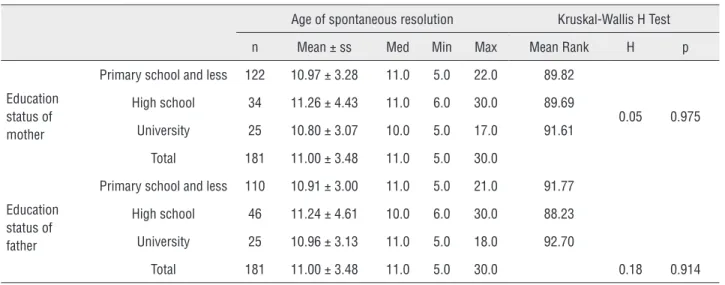
significant correlation found between the age of SRME and educational status of parents (Ta-ble-3). A multivariate linear model was used to evaluate the independent predictors for the age of SRME. According to this analysis, the age of SRME was not affected by gender, or the edu-cational status of mother and father (p=0.483, p=0.488, p=0.396, respectively). Stepwise linear regression showed that breastfeeding for five months or less and family history could affect
the age of SRME (Table-4). The regression for-mula was: age of SRME=9.599 + (3.807×five months or less of breastfeeding) + (1.258×posi-tive family history).
DISCUSSION
This is the first study to investigate the relationship between the age of SRME in chil-dren and breastfeeding. ME is regarded as a
Table 2 - Gender, breastfeeding, family history and SRMNE.
Age of spontaneous resolution Mann-Whitney U Test
n Mean ± ss Med Min Max Mean Rank U p
Gender
Female 78 10.99 ± 3.80 10.0 6.0 30.0 88.00
3783 0.501 Male 103 11.01 ± 3.23 11.0 5.0 18.0 93.27
All 181 11.00 ± 3.48 11.0 5.0 30.0
Duration of breastfeeding
≤ 5 month 20 14.35 ± 5.08 13.0 8.0 30.0 129.63
837.5 0.0001 > 5 month 161 10.58 ± 2.99 10.0 5.0 22.0 86.20
All 181 11.00 ± 3.48 11.0 5.0 30.0
MNE in family history
Apsent 40 10.08 ± 3.16 10.0 5.0 17.0 77.80
2292 0.07 Existent 141 11.26 ± 3.53 11.0 5.0 30.0 94.74
All 181 11.00 ± 3.48 11.0 5.0 30.0
Table 3 - Education status of parents and SRMNE.
Age of spontaneous resolution Kruskal-Wallis H Test
n Mean ± ss Med Min Max Mean Rank H p
Education status of mother
Primary school and less 122 10.97 ± 3.28 11.0 5.0 22.0 89.82
0.05 0.975 High school 34 11.26 ± 4.43 11.0 6.0 30.0 89.69
University 25 10.80 ± 3.07 10.0 5.0 17.0 91.61
Total 181 11.00 ± 3.48 11.0 5.0 30.0
Education status of father
Primary school and less 110 10.91 ± 3.00 11.0 5.0 21.0 91.77
High school 46 11.24 ± 4.61 10.0 6.0 30.0 88.23
University 25 10.96 ± 3.13 11.0 5.0 18.0 92.70
self-limiting condition and expected to resol-ve spontaneously at a rate of 15% per year (5, 19, 20). Alarm therapy and desmopressin, whi-ch are evidence-based first-line treatments, are recommended for current treatment of ME (3, 21). Some parents who have children with ME choose an observational approach instead of the treatment option. However, in spite of this high rate of spontaneous resolution, there is no study researching the factors that could affect this rate found in the literature.
There may be various factors, such as severity of symptoms, which influence the age of spontaneous resolution. Although many fac-tors such as behavior abnormalities, immature bladder function, imamture sleep pattern, insu-fficient nocturnal antidiuretic hormone and he-reditary factors can be coupled with ME, there is a traditional opinion that developmental im-maturity of voiding control is the main reason (7, 8). The role of stress and psychological fac-tors in the pathogenesis of ME has been shown in a variety of studies (7, 10, 11, 21). Recently many studies have identified a delay in neu-romotor development in children with ME (8, 9, 12, 22). These studies assert a maturational deficit of the brainstem as the possible central dysfunction of the disorder.
It is known that breastfeeding has a po-sitive effect on behavior problems. Breastfee-ding forms a bond between mother and baby and a variety of studies have shown many po-sitive psychological effects like increasing self--esteem and preventing depression (17, 23, 24). According to a study by Kwok et al. durations of breastfeeding of less than 3 months were linked
to worse behavior and lower self-esteem (17). Additionally, a range of studies have investiga-ted the effects of breastfeeding on cognitive de-velopment and neurodede-velopment (13, 15, 16, 25). The central nervous system has the second highest concentration of lipids in the body after adipose tissue, which contains predominantly triglycerides. The lipids in the brain are present as the structural phospholipid components of cell membranes (25). Docosahexaenoic acid and arachidonic acid, which are present in breast milk, are examples of the most important and basic long chain polyunsaturated fatty acids. Babies only have a limited capability to synthe-size such fats from precursors (14). It has been shown that especially the higher n-3 and n-6 long-chain polyunsaturated fatty acids in bre-ast milk have important effects on neural and visual development (14, 16, 25). Vestergaard et al. determined that the duration of breastfee-ding was a specific milestone for motor skills and early language development (16).
In the literature there were few studies investigating the relationship between breastfe-eding and ME; however, none investigated the relationship between spontaneous resolution and breastfeeding. In a cross-sectional study by Gumus et al., different clinical factors in chil-dhood bed-wetting were evaluated and, taking rates of breastfeeding in the first four months after birth as reference, there was no differen-ce found between cases with enuresis and tho-se without (26). Singh et al. investigated the relationship between bed-wetting and several different clinical features of 100 children. Al-though there was no control group in the study,
Table 4 - Results of the multivariate general linear model analysis.
B Beta p CI 95%
Constant 9.599 0.0001 8.568-10.630
Duration of breatfeeding
(0: five month or less 1: longer than five month) 3.807 0.344 0.0001 2.288-5.327 Family history
the authors found higher enuresis prevalence in children fed using a bottle compared with those who were breastfeed (27).
A study by Barone et al. compared enure-tic children with a control group and showed that duration of breastfeeding longer than 3 months had a protective effect against bed-wetting (28). In a recent observational case-control study in-volving 200 children and adolescents from 6 to 14 years old, Oliviera et al. indicated that the duration of breastfeeding of less than 4 months is strongly associated with primary enuresis (29). In our study while there was no significant di-fference found between the age of spontaneous resolution and breastfeeding of children with ME, comparing the group who were breastfed for 5 months or less with those fed for longer, breastfeeding had a significant positive contri-bution to age of SRME (p<0.001). With regard to multivariate analysis, gender and educational status of mother and father were not effective on the age of SRME. Stepwise linear regression model showed that five months or less of bre-astfeeding and family history could affect the age of SRME. There was very weak correlation between the family history and the age of SRME. Accordingly, breastfeeding for at least 5 months can be expected to provide a contribution to the age of SRME in children. This conclusion corre-lates with the results of previous studies and is in accordance with our expectations due to the positive contribution on neurodevelopment and childhood psychology of breastfeeding.
None of the patients included in the study after the survey had treatment of ME in their history. However, due to the psychological effects of bed-wetting on the child and family, especially in school-going children, treatment is recommended (30). As a result, when designing prospective studies about SRME in children, it may not be ethical not to give treatment. As a result, a survey questionnaire was used for the study design. It may be considered that a case control approach would have been more ap-propriate. However, we investigated the factors affecting the time of SRME and it is impossible to evaluate the time of SRME in patients who
were not bedwetting which is why we did not design a case control study.
The major limitation of the current study was the long time between breastfeeding, enuresis and application of the questionnaire. Neverthe-less, in order to increase the reliability of data, those over the age of 35 were excluded from the study, information given only by the family in children under the age of 16 were taken into con-sideration, and information given by participants over the age of 16 were double-checked. Another limitation of the study was that enuresis-related diseases such as adenoid hyperplasia and obstruc-tive sleep apnea-hypopnea syndrome were not considered in the study design.
CONCLUSIONS
One of the frequently observed disor-ders in childhood is ME, generally evaluated as a benign situation due to the high rate of spontaneous resolution. If it continues into the school-going period, treatment is recommended due to negative effects on the child and family, but this topic is still debated. In our study leng-thening the duration of breastfeeding to more than 5 months was found to have an effect on spontaneous resolution. Before planning medi-cation or other treatments for children with ME, the factors that can affect spontaneous resolu-tion should be evaluated to reduce the cost of medications or other treatments and to protect children from the side effects of medication treatment. Breastfeeding, with no costs, has a positive effect on the age of SRME, similar to its effects on many aspects of childhood deve-lopment. This under-researched topic requires more prospective randomized studies.
ACKNOWLEDGEMENTS
We thank Coskun Bakar, MD for contribution in statistics and critical reading of the manuscript.
CONFLICT OF INTEREST
REFERENCES
1. Kahraman A, Dursun H, Hatipoglu S, Kural B, Sahin M, Birgul K, et al. Non-dipping phenomenon in children with monosymptomatic nocturnal enuresis. Pediatr Nephrol. 2013;28:1099-103.
2. Austin PF, Bauer SB, Bower W, Chase J, Franco I, Hoebeke P, et al. The standardization of terminology of lower urinary tract function in children and adolescents: update report from the Standardization Committee of the International Children’s Continence Society. J Urol. 2014;191:1863-1865.e13.
3. Tekgul S, Dogan H, Hoebeke P, Kocvara R, Nijman J. Monosymptomatic Enuresis. Guidelines on Paediatric Urology. 2014; pp. 51-3.
4. Üçer O, Gümüş B. Quantifying subjective assessment of sleep quality, quality of life and depressed mood in children with enuresis. World J Urol. 2014;32:239-43.
5. Charalampous S, Printza N, Hashim H, Bantouraki M, Rompis V, Ioannidis E, et al. Bladder wall thickness and urodynamic correlation in children with primary nocturnal enuresis. J Pediatr Urol. 2013;9:334-8.
6. Ferrara P, Del Volgo V, Romano V, Scarpelli V, De Gara L, Miggiano GA. Combined Dietary Recommendations, Desmopressin, and Behavioral Interventions May Be Effective First-Line Treatment in Resolution of Enuresis. Urol J. 2015;12:2228-32.
7. Mammen AA, Ferrer FA. Nocturnal enuresis: medical management. Urol Clin North Am. 2004;31:491-8.
8. Yakinci C, Müngen B, Durmaz Y, Balbay D, Karabiber H. Autonomic nervous system functions in children with nocturnal enuresis. Brain Dev. 1997;19:485-7.
9. Von Gontard A, Schmelzer D, Seifen S, Pukrop R. Central nervous system involvement in nocturnal enuresis: evidence of general neuromotor delay and specific brainstem dysfunction. J Urol. 2001;166:2448-51.
10. Lottmann HB, Alova I. Primary monosymptomatic nocturnal enuresis in children and adolescents. Int J Clin Pract Suppl. 2007;155:8-16.
11. Okur M, Ruzgar H, Erbey F, Kaya A. The evaluation of children with monosymptomatic nocturnal enuresis for attention deficit and hyperactivity disorder. Int J Psychiatry Clin Pract. 2012;16:229-32.
12. von Gontard A, Freitag CM, Seifen S, Pukrop R, Röhling D. Neuromotor development in nocturnal enuresis. Dev Med Child Neurol. 2006;48:744-50.
13. Auestad N, Scott DT, Janowsky JS, Jacobsen C, Carroll RE, Montalto MB, et al. Visual, cognitive, and language assessments at 39 months: a follow-up study of children fed formulas containing long-chain polyunsaturated fatty acids to 1 year of age. Pediatrics. 2003;112:e177-83.
14. Iranpour R, Kelishadi R, Babaie S, Khosravi-Darani K, Farajian S. Comparison of long chain polyunsaturated fatty acid content in human milk in preterm and term deliveries and its correlation with mothers’ diet. J Res Med Sci. 2013;18:1-5.
15. Morrow-Tlucak M, Haude RH, Ernhart CB. Breastfeeding and cognitive development in the first 2 years of life. Soc Sci Med. 1988;26:635-9.
16. Vestergaard M, Obel C, Henriksen TB, Sørensen HT, Skajaa E, Ostergaard J. Duration of breastfeeding and developmental milestones during the latter half of infancy. Acta Paediatr. 1999;88:1327-32.
17. Kwok MK, Leung GM, Schooling CM. Breast feeding and early adolescente behaviour, self-esteem and depression: Hong Kong’s ‘Children of 1997’ birth cohort. Arch Dis Child. 2013;98:887-94.
18. Shapiro SS, Wilk MB. An analysis of variance test for normality (complete samples). Biometrika. 1965;52:3/4:591-611.
19. Oguz U, Aykac A, Demirelli E, Sancak EB, Resorlu B, Sarikaya S, et al. The Time of Spontaneous Resolution of Monosymptomatic Nocturnal Enuresis (MNE) Is Familial. Urol Int. 2015;94:459-63.
20. Tauris LH, Kamperis K, Hagstroem S, Bower WF, Rittig S. Tailoring treatment of monosymptomatic nocturnal enuresis: the role of maximum voided capacity. J Urol. 2012;187:664-9.
21. Van Herzeele C, Evans J, Eggert P, Lottmann H, Norgaard JP, Vande Walle J. Predictive parameters of response to desmopressin in primary nocturnal enuresis. J Pediatr Urol. 2015;11:200.e1-8.
22. Schulz-Juergensen S, Bolte L, Gebhardt J, Eggert P. Intensive playing leads to non-monosymptomatic enuresis in children with low prepulse inhibition. Acta Paediatr. 2013;102:e79-83.
23. Sinn N, Milte C, Howe PR. Oiling the brain: a review of randomized controlled trials of omega-3 fatty acids in psychopathology across the lifespan. Nutrients. 2010;2:128-70.
24. Tharner A, Luijk MP, Raat H, Ijzendoorn MH, Bakermans-Kranenburg MJ, Moll HA, et al. Breastfeeding and its relation to maternal sensitivity and infant attachment. J Dev Behav Pediatr. 2012;33:396-404.
25. Innis SM, Gilley J, Werker J. Are human milk long-chain polyunsaturated fatty acids related to visual and neural development in breast-fed term infants? J Pediatr. 2001;139:532-8.
27. Singh H, Kaur L, Kataria SP. Enuresis: analysis of 100 cases. Indian Pediatr. 1991;28:375-80.
28. Barone JG, Ramasamy R, Farkas A, Lerner E, Creenan E, Salmon D, et al. Breastfeeding during infancy may protect against bed-wetting during childhood. Pediatrics. 2006;118:254-9.
29. de Oliveira DM, Dahan P, Ferreira DF, de Oliveira LF, de Paula LI, de Figueiredo AA, et al. Association between exclusive maternal breastfeeding during the first 4 months of life and primary enuresis. J Pediatr Urol. 2016;12:95.e1-6.
30. Naitoh Y, Kawauchi A, Soh J, Kamoi K, Miki T. Health related quality of life for monosymptomatic enuretic children and their mothers. J Urol. 2012;188:1910-4.