Effectiveness and durability of solifenacin versus
percutaneous tibial nerve stimulation versus their
combination for the treatment of women with
overactive bladder syndrome: a randomized controlled
study with a follow-up of ten months
_______________________________________________
Carlo Vecchioli-Scaldazza
1, Carolina Morosetti
21 Division of Urogynecology, ASUR, Jesi, Italy; 2 Clinical Pathology, ASUR, Jesi, Italy
ABSTRACT
ARTICLE
INFO
______________________________________________________________ ______________________
Purpose: To assess effectiveness and durability of Solifenacin (SS) versus tibial nerve stimulation (PTNS) versus combination therapy (PTNS + SS) in women with overactive bladder syndrome (OAB).
Materials and Methods: 105 women with OAB were divided randomly into three groups of 35 patients each. In group A women received SS, in group B women under-went PTNS, in group C women underunder-went combination of PTNS + SS. Improvements in OAB symptoms were assessed with OABSS questionnaire; patients’ quality of life was assessed with OAB-q SF questionnaire. Evaluation of effectiveness of treatments was performed with PGI-I questionnaire. OABSS and PGI-I were also assessed monthly for ten months.
Results: All treatments were effective on symptoms. PTNS showed a greater effective-ness than SS, but PTNS + SS was more effective than SS and PTNS. Furthermore, PTNS + SS showed a greater duration of effectiveness than PTNS and SS.
Conclusions: Combination of PTNS with SS showed more effectiveness and more du-rability than PTNS and SS alone.
INTRODUCTION
Overactive bladder syndrome (OAB) is a chronic disease characterized by urinary urgency with or without urge incontinence, frequency and nocturia (1) with huge economic burden and detri-mental effects on the quality of life of patients (2). The prevalence of OAB in women increases with age and is present in approximately 30% of wo-men over the age of 65 years (3) and in the general population it is estimated at 11.8% (4). Antimus-carinic agents represent the therapy of choice for the management of OAB, when the conservative
treatment is ineffective, but although a long-las-ting therapy is required to obtain better control of symptoms, a high percentage of patients dis-continue the treatment after a few months (5, 6). After failure of a single drug, most practitioners try a different pharmacological treatment and if this second option also fails, more invasive op-tions are considered (7). In recent years several studies have shown that a combination of two different anticholinergic or one anticholinergic combined with the β3-adrenoceptor agonist Mi-rabegron may improve efficacy in the treatment of OAB symptoms while also reducing the side
Keywords:
Urinary Bladder, Overactive; Combined Modality Therapy; Solifenacin Succinate
Int Braz J Urol. 2018; 44: 102-8
_____________________
Submitted for publication: November 30, 2016
_____________________
Accepted after revision: June 21, 2017
_____________________
effects (8). Furthermore, although the available data does not allow definitive evaluation (9), promising results were observed with an an-ticholinergic combined with bladder training, electric stimulation or percutaneous tibial nerve stimulation (10-12). The aim of this study was to assess the efficacy and the long term durabi-lity of Solifenacin (SS) and percutaneous tibial nerve stimulation (PTNS) administered alone or in combination in the treatment of women with OAB syndrome.
MATERIALS AND METHODS
From May 2015 to December 2015, 105 consecutive women (mean age 61 years, range 41–73) with symptoms of overactive bladder (urgency, urinary frequency, with or without urge incontinence) were enrolled in this pros-pective, randomized, controlled study. Women were divided randomly into three groups of 35 patients each using online randomization (Graph Pad Quick Calcs software: http://www. graphad.com/quickcalcs/randomize1) by an in-dependent biostatistician who was unaware of treatments performed by patients and was not involved in the study. In group-A, women recei-ved Solifenacin Succinate (SS) 5mg once a day for 12 weeks. In Group-B, women underwent PTNS once a week for 30 min each for a to-tal of 12 weeks. In Group-C, patients underwent PTNS once a week for 30 min each for a total of 8 weeks and SS 5mg on alternate days also for 8 weeks (short-low dose therapy). The tre-atment was performed with a 34-gauge need-le eneed-lectrode inserted 6-8 centimeters cephalad to the medial malleolus and slightly posterior to the tibia. The electrode was connected to the Urgent PC stimulator and a current level of 0.5 to 9mA at 20Hz was selected based on patient sensory and motor response. Patients with uri-nary tract infection, neurological disease, blad-der lithiasis, genital prolapse higher than stage II on POP-Q system, uncontrolled narrow angle glaucoma, pelvic tumours, post void residual urine ≥100mL, previously treated with radiation therapy, antimuscarinic agents, antidepressants and antianxiety agents, were excluded.
Endpoints
Improvements in OAB symptoms, including day time frequency, night time frequency, urgency and urge incontinence were considered the primary efficacy end point. The impact of OAB symptoms on patient’s quality of life (QoL) and the patient impres-sion of improvement were considered the seconda-ry end point. The primaseconda-ry efficacy end point was evaluated with Overactive Bladder Symptom Score (OABSS) questionnaire. It consists of 4 items related to OAB syndrome symptoms. The score of the first item (day time frequency) ranges from 0 to 2; the score of the second item (night time frequency) ran-ges from 0 to 3; the scores of the third and fourth items (urgency and urge incontinence respectively) range from 0 to 5. A greater score represents wor-sening of symptoms. The secondary end point was assessed with the Overactive Bladder questionnaire Short Form (OAB-q SF). The questionnaire consists of 6 items related to symptoms with 6 possible op-tions ranging from “not at all” (score 1) to “a very great deal” (score 6), and a health-related quality of life scale with 13 items, with 6 response options ranging from “none of the time” (score 1) to “all of the time” (score 6). Improvement was evaluated with the Patient Global Impression of Improvement questionnaire (PGI-I). The PGI-I is a validated gene-ric tool for assessment of the overall improvement or deterioration that patients experience following the treatment. It is a 7-point scale from “very much improved” (score 1), to “very much worse” (score 7). OABSS and PGI-I were performed before, at the end of each treatment and thereafter every month with a maximum follow-up of 10 months. OAB-q SF was performed before and after treatment. The study was conducted in accordance with the ethical principles of the Declaration of Helsinki and the protocol was approved by the local ethics committee. All patients signed informed consent before starting treatment. The results were assessed by a researcher blinded to treatment performed by patients.
Statistical analysis
was processed using parametric tests: paired sam-ple t test or independent samsam-ple t test. If normality was rejected, data was processed using non-para-metric tests: Wilcoxon test for paired sample and Mann-Whitney for independent sample. Data was expressed as means±SD. A p value <0.05 was con-sidered significant.
RESULTS
Of the 35 women initially enrolled in group A, 8 patients suspended therapy because of side ef-fects (dry mouth, constipation); therefore, 27 pa-tients (mean age 62 years, range 41-70) were
evalu-able for the study. In Group-B, only one woman suspended therapy before the end of treatment without a specific reason; therefore. 34 patients (mean age 60 years, range 45-73) were evaluable for the study. In Group-C, two women suspended therapy: one because of side effects and one with-out a specific reason; therefore, 33 patients (mean age 63 years, range 43-72) were evaluable. Im-provements with statistically significant differences were found in all the items assessed with OABSS questionnaire in the three groups of patients: day time frequency, night time frequency, urgency and urge incontinence (Table-1). No statistical differ-ence was found between SS versus PTNS in daily
Table 1 - OAB symptoms assessed with OABSS questionnaire in patients treated with Solifenacin (SS), Percutaneous Tibial Nerve Stimulation (PTNS) and Solifenacin + Percutaneous Tibial Nerve Stimulation (SS + PTNS) at the end of treatment.
SS PTNS SS + PTNS
Patients Nº 27 34 33
Age 62 (41-70) 60 (45-73) 63 (43-72)
before after p value before after p value before after p value OABSS 1.19±0.39 0.71±0.45 0.0020* 1.24±0.42 0.47±0.50 <0.0001** 1.22±0.42 0.33±0.47 <0.0001* Day-time
frequency
SS after vs PTNS after 0.1334*** SS after vs SS + PTNS after 0.0167*** PTNS after vs SS + PTNS after 0.4224***
Night-time frequency (score 0-3)
2.62±0.79 1.76±1.31 0.0078* 2.71±0.67 1.41±1.19 0.0010* 2.89±0.31 0.89±0.87 <0.0001* SS after vs PTNS after 0.4110***
SS after vs SS + PTNS after 0.0243*** PTNS after vs SS + PTNS after 0.1585***
Urgency (score 0-5)
4.29±0.63 3.43±1.09 0.0002* 4.35±0.59 3.00±1.14 <0.0001** 4.44±0.68 2.11±0.99 <0.0001** SS after vs PTNS after 0.2586***
SS after vs SS + PTNS after 0.0005*** PTNS after vs SS + PTNS after 0.0225***
Urge incontinence (score 0-5)
3.71±1.12 2.67±1.49 0.0005* 4.00±0.69 2.24±1.35 0.0001* 3.44±1.5 0.56±1.26 <0.0001* SS after vs PTNS after 0.3742***
SS after vs SS + PTNS after 0.0003****
PTNS after vs SS + PTNS after 0.0015****
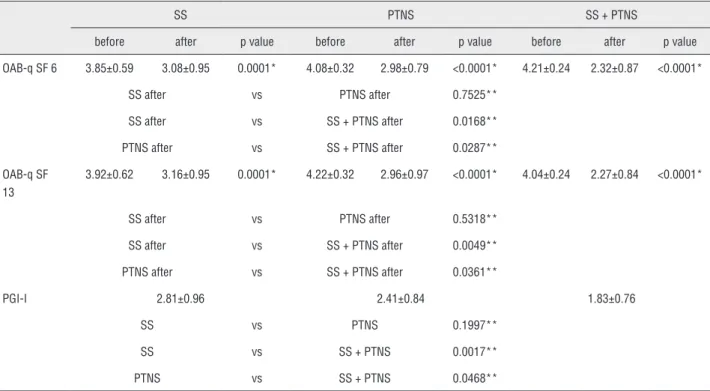
and night time micturition, whereas a significant difference was found between combination thera-py versus SS (P value: 0.0167). No significant dif-ference was found between SS versus PTNS in ur-gency and urge incontinence, whereas significant differences were found in those items between the group of patients who underwent combination therapy and women treated with SS and women treated with PTNS (P values: 0.0005; 0.0225 and 0.0003; 0.0015 respectively) (Table-1). Significant improvements in quality of life of patients (OAB-q SF, 6 and 13 items) were found after treatment in all groups evaluated. However, no significant dif-ference was found between SS versus PTNS, but combination therapy showed statistically signifi-cant differences both versus SS and versus PTNS (P values: 0.0168; 0.0287 and 0.0049; 0.0561 re-spectively) (Table-2). Improvements in PGI-I as-sessed at the end of treatment were found in all groups of patients. In any case, no significance was found between SS versus PTNS, whereas combi-nation therapy showed significant improvements both versus SS and versus PTNS (P values: 0.0017;
0.0468 respectively). Evaluation of long term du-rability showed persistence of improvements of SS, PTNS and combination therapy assessed with OABSS questionnaire, respectively for 0.9, 2.5 and 5.9 months; the persistence of the improvements assessed with PGI-I questionnaire was respectively 0.7, 2.1, 5.6 months (Table-3). Statistical analy-sis showed a significant difference respectively in PTNS versus SS, in combination therapy versus SS and versus PTNS (p values: 0.0039; <0.0001; 0.0009 respectively) (Table-3).
DISCUSSION
The study showed a significant effective-ness with improvement in all parameters evaluated with OABSS questionnaire at the end of treatment, with all the treatments performed. Combination therapy was always statistically more effective than SS and it showed a significant improvement in urgency and urge incontinence, also when com-pared to PTNS. Improvement in women’ quality of life was observed in all groups assessed. However,
Table 2 - Improvements assessed with Quality of Life questionnaire (6 and 13 items) (OAB-q SF 6 and 13) and Patient Global Impression of Improvement questionnaire (PGI-I) at the end of treatment.
SS PTNS SS + PTNS
before after p value before after p value before after p value
OAB-q SF 6 3.85±0.59 3.08±0.95 0.0001* 4.08±0.32 2.98±0.79 <0.0001* 4.21±0.24 2.32±0.87 <0.0001*
SS after vs PTNS after 0.7525**
SS after vs SS + PTNS after 0.0168**
PTNS after vs SS + PTNS after 0.0287**
OAB-q SF 13
3.92±0.62 3.16±0.95 0.0001* 4.22±0.32 2.96±0.97 <0.0001* 4.04±0.24 2.27±0.84 <0.0001*
SS after vs PTNS after 0.5318**
SS after vs SS + PTNS after 0.0049**
PTNS after vs SS + PTNS after 0.0361**
PGI-I 2.81±0.96 2.41±0.84 1.83±0.76
SS vs PTNS 0.1997**
SS vs SS + PTNS 0.0017**
PTNS vs SS + PTNS 0.0468**
combination therapy was statistically more effec-tive than SS and PTNS. PGI-I evaluated at the end of the treatments showed an increase in perception of improvement in all groups of women. However, combination therapy was statistically more effec-tive compared to SS and PTNS. We considered this PTNS + SS combination therapy, a short low dose treatment. The therapy was short due to the num-ber of PTNS treatments performed (8 treatments instead of the usual 12) and the therapy was low dose due to the administration of SS on alternate days for 8 weeks. In addition to its effectiveness, this therapeutic scheme was developed to obtain a greater adherence especially in regard to a reduc-tion in side effects and cost.
Studies performed on combination thera-py in patients with OAB showed its effectiveness without demonstrating an increase in side effects: Bolduc et al., Kosilov et al. (7, 13), assessed combi-nation of two anticholinergic drugs; Abrams et al. (8) assessed the combination of an anticholiner-gic with the β3-adrenoceptor agonist Mirabegron. Mattiasson et al. (10) combined tolterodine with simplified bladder training with an improvement on voiding frequency and voided volume; Curran et al. (14) achieved better results by combining anticholinergic with behavioural modifications; Souto et al., Kikilyel et al. (11, 12), assessed com-bination of electrical stimulations of the posterior tibial nerve versus respectively, oxybutinin and
tolterodine. Amend et al. (15) and Abrams et al. (8) explained the success respectively of the com-bination of two anticholinergic drugs and of an anticholinergic with the β3-adrenoceptor ago-nist Mirabegron, by different receptor selectivity and by receptor interaction on different bladder wall regions. Improvements observed with the combination of PTNS with SS in this study can be explained by the blocking of muscarinic re-ceptors that are responsible for vesical contrac-tions caused by Solifenacine and by the effect of neuromodulation. The mechanism of bladder neuromodulation, although not completely clear, is different from that of drugs: its effect is pos-sibly mediated through a combination of increas-ing cerebral endorphins, stimulation of somatic sacral and lumbar afferent fibers, and activation of efferent fibers to the striated urethral sphinc-ter. The result of this possible mechanism is the inhibition of detrusor activity (16). The synergic effect of the combination therapy makes it pos-sible to decrease the dose of each drug deliver-ing an improved tolerability profile compared with monotherapy without compromising efficacy (13-8) with a greater adherence by the patient to therapy allowing its use even in elderly patients (8). In this study, we assessed with particular at-tention the duration of effectiveness of treatments performed. SS showed a short therapeutic efficacy with a mean of improvement after
discontinua-Table 3 - Persistence of improvements in months, assessed with Overactive Bladder Symptoms Score (OAB-SS) and Patient Global Impression of Improvement (PGI-I) questionnaire (follow-up of 10 months).
SS PTNS SS + PTNS
OAB-SS 0.93±1.44 2.50±2.38 5.88±2.20
Solifenacin vs PTNS p 0.0039*
Solifenacin vs Solifenacin + PTNS p <0.0001*
PTNS vs Solifenacin + PTNS p 0.0009*
PGI-I 0.71±1.13 2.10±1.92 5.63±2.00
Solifenacin vs PTNS p 0.0017*
Solifenacin vs Solifenacin + PTNS p <0.0001*
PTNS vs Solifenacin + PTNS p 0.0002*
tion of therapy of 0.9 months. A meta-analysis conducted by Rai et al. (9) of 23 trials of anticho-linergic drugs versus non-drug active therapies for non-neurogenic overactive bladder syndrome, about the permanence of the therapeutic effect of anticholinergic drugs, emphasized how “it is un-likely that the effects of anticholinergics persist after stopping treatment”. PTNS administered in monotherapy or in combination with SS showed a longer duration of effectiveness with a mean of improvement after discontinuation respectively of 2.5 and 5.8 months. A longer duration of effec-tiveness of PTNS was described by MacDiarmid et al. (17). Therefore, combination therapy showed the longest therapeutic efficacy. Souto et al. as-sessed the effectiveness of TENS and oxybutynin alone or in combination therapy, underlining that TENS alone or in association presented longer lasting results than oxybutynin monotherapy. The choice of therapy should be based on several fac-tors including co-morbidities, mental status, age, education and motivation (11). However, in clini-cal practice, antimuscarinic agents are considered the first-line pharmacotherapy for OAB, although a high percentage of patients discontinue the treatment after a few months especially for poor efficacy, side effects and costs (5, 6). Therefore, the search for a therapeutic strategy that improves adherence of patients to treatment depends on its efficacy and the reduction of side effects and cost.
CONCLUSIONS
The combination of SS and PTNS in the treatment of OAB symptoms was an effective and well-tolerated therapy with greater improvements and longer lasting effects than single treatments. It allowed the use of lower amounts of drug with a smaller number of PTNS treatments. The low sample size of patients and the follow-up of ten months represent biases that do not allow defini-tive conclusions to be drawn. Further studies on a greater number of patients would be desirable to confirm this data.
CONFLICT OF INTEREST
None declared.
REFERENCES
1. Abrams P, Cardozo L, Fall M, Griffiths D, Rosier P, Ulmsten U, et al. The standardisation of terminology of lower urinary tract function: report from the Standardisation Sub-committee of the International Continence Society. Neurourol Urodyn. 2002;21:167-78.
2. Irwin DE, Milsom I, Hunskaar S, Reilly K, Kopp Z, Herschorn S, et al. Population-based survey of urinary incontinence, overactive bladder, and other lower urinary tract symptoms in five countries: results of the EPIC study. Eur Urol. 2006;50:1306-14.
3. Stewart WF, Van Rooyen JB, Cundiff GW, Abrams P, Herzog AR, Corey R, et al. Prevalence and burden of overactive bladder in the United States. World J Urol. 2003;20:327-36. 4. Irwin DE, Abrams P, Milsom I, Kopp Z, Reilly K; EPIC Study
Group. Understanding the elements of overactive bladder: questions raised by the EPIC study. BJU Int. 2008;101:1381-7. 5. Andersson KE, Chapple CR, Cardozo L, Cruz F, Hashim H,
Michel MC, et al. Pharmacological treatment of overactive bladder: report from the International Consultation on Incontinence. Curr Opin Urol. 2009;19:380-94.
6. Yu YF, Nichol MB, Yu AP, Ahn J. Persistence and adherence of medications for chronic overactive bladder/urinary incontinence in the california medicaid program. Value Health. 2005;8:495-505.
7. Bolduc S, Moore K, Lebel S, Lamontagne P, Hamel M. Double anticholinergic therapy for refractory overactive bladder. J Urol. 2009;182(4 Suppl):2033-8.
8. Abrams P, Kelleher C, Staskin D, Rechberger T, Kay R, Martina R, et al. Combination treatment with mirabegron and solifenacin in patients with overactive bladder: efficacy and safety results from a randomised, double-blind, dose-ranging, phase 2 study (Symphony). Eur Urol. 2015;67:577-88. 9. Rai BP, Cody JD, Alhasso A, Stewart L. Anticholinergic
drugs versus non-drug active therapies for non-neurogenic overactive bladder syndrome in adults. Cochrane Database Syst Rev. 2012, 12;12:CD003193.
10. Mattiasson A, Blaakaer J, Høye K, Wein AJ; Tolterodine Scandinavian Study Group. Simplified bladder training augments the effectiveness of tolterodine in patients with an overactive bladder. BJU Int. 2003;91:54-60.
11. Souto SC, Reis LO, Palma T, Palma P, Denardi F. Prospective and randomized comparison of electrical stimulation of the posterior tibial nerve versus oxybutynin versus their combination for treatment of women with overactive bladder syndrome. World J Urol. 2014;32:179-84.
13. Kosilov KV, Loparev SA, Ivanovskaya MA, Kosilova LV. Comparative effectiveness of combined low- and standard-dose trospium and solifenacin for moderate overactive bladder symptoms in elderly men and women. Urol Int. 2014;93:470-3.
14. Curran MJ, Kaefer M, Peters C, Logigian E, Bauer SB. The overactive bladder in childhood: long-term results with conservative management. J Urol. 2000;163:574-7. 15. Amend B, Hennenlotter J, Schäfer T, Horstmann M, Stenzl
A, Sievert KD. Effective treatment of neurogenic detrusor dysfunction by combined high-dosed antimuscarinics without increased side-effects. Eur Urol. 2008;53:1021-8. 16. Groen J, Bosch JL. Neuromodulation techniques in the
treatment of the overactive bladder. BJU Int. 2001;87:723-31.
17. MacDiarmid SA, Peters KM, Shobeiri SA, Wooldridge LS, Rovner ES, Leong FC, et al. Long-term durability of percutaneous tibial nerve stimulation for the treatment of overactive bladder. J Urol. 2010;183:234-40.
_______________________ Correspondence address: