DOI: 10.5935/2359-4802.20170032
Mailing Address: Luiz Rodrigo Augustemak de Lima
Campus Reitor João David Ferreira Lima, Centro de Desportos. Postal Code: 88040-900, Trindade, Florianópolis, SC – Brazil E-mail: [email protected], [email protected]
Exercise Improves Cardiovascular Risk Factors, Fitness, and Quality Of Life in Hiv+
Children and Adolescents: Pilot Study
Luiz Rodrigo Augustemak de Lima,1,3 Isabela de Carlos Back,1 Carmem Cristina Beck,1 Bruno Caramelli2 Universidade Federal de Santa Catarina (UFSC);1 Instituto do Coração (Incor) – Faculdade de Medicina da Universidade de São Paulo,2 São Paulo, SP;
Núcleo de Pesquisa em Cineantropometria e Desempenho Humano (NuCiDH),3 UFSC, Florianópolis, SC – Brazil
Manuscript received September 27, 2016, revised mansucript November 30, 2016, accepted February 01, 2017. Cardiovascular Diseases / physiopathology; Exercise;
Physical Fitness; Life Style; Child; Adolescent; Atherosclerosis; Carotid Intima-Media Thickness.
Keywords
Abstract
Children and adolescents infected by HIV through mother-to-child transmission are at high risk of developing premature cardiovascular diseases due to dyslipidemia, insulin resistance and low-grade chronic
inlammation. The aim of the pilot study was to verify
the effect of a playful exercise program on cardiovascular,
morphological, metabolic, itness, and quality of life
outcomes. A non-randomized clinical trial consisting of 24 sessions of playful aerobic and resistive exercises was applied to 10 children and adolescents living with HIV from Florianopolis, Brazil. The following variables were obtained before and after the program: fasting total cholesterol, HDL-c, LDL-c, triglycerides, glucose, C-reactive protein, blood pressure, common carotid
artery intima-media thickness (CCA-IMT), lexibility, muscular endurance, aerobic itness, anthropometry, and measured quality of life. After the intervention, a
decrease in systolic blood pressure (-6.8 mmHg, 6.6%; p = 0.019) and CCA-IMT (-60.0 µm, 12.2%; p = 0.002) was observed after 24 sessions. There was an increase in upper-limb muscular endurance (+3.3 rep.min-1, 63.5%; p = 0.002), lexibility (+5.7 cm, 26.0%; p = 0.001), and quality of life (+10.4 points, 27.5%; p = 0.003). In our sample
of children and adolescents living with HIV, a short-term exercise program was associated with improvement in
cardiovascular risk, itness, and quality of life.
Introduction
Exercise is a non-pharmacological treatment for adults living with human immunodeficiency virus (HIV), because it can reduce HIV-associated symptoms, cardiovascular, morphological, metabolic abnormalities
and improve itness, anxiety and depression.1 In children and adolescents living with HIV, only one study has demonstrated the feasibility, safety and efficacy of aerobic and resistive exercises to improve muscle
strength and endurance, aerobic itness and fat free
mass.2 This is important, since fitness is reduced in several pediatric pathological conditions and might be associated with premature mortality..3 However, no effect on lipids was observed and cardiovascular variables were not analyzed.2
Although the effect of exercise on the health of children and adolescents is evident, the magnitude of the effect depends on the intervention characteristics (e.g. intensity and volume of sessions) and health status at the baseline intervention (e.g. normal values of cardiovascular
and lipid proiles).4 Since the long-term exposure to HIV infection and highly-active antiretroviral therapy (HAART) are associated with dyslipidemia, insulin
resistance and low-grade inlammation that increase
the risk of cardiovascular diseases,5-7exercise could mitigate unfavorable conditions of HIV-infected children. This study reports preliminary data on the effect of a short-term playful exercise program on cardiometabolic
risk factors, our primary outcome. Fitness and quality of
Methods
Study design and patient population
This was a non-randomized clinical trial that evaluated a sample of children and adolescents before and after 8 weeks of aerobic and resistive exercises, conducted in the second half of 2008 at the Rehabilitation Center in Florianopolis, Brazil. This pilot study was carried out with 10 children and adolescents infected by HIV-through mother-to-child transmission and follow at a reference hospital for the treatment of pediatric HIV infection. Before inclusion, the patients were evaluated regarding the risk of exercise. The study was approved
by the Ethics Committee of the Hospital (063/2007).
Intervention
The program consisted of 24 exercise sessions, with each session lasting 90 minutes. There was a gradual increase in the duration of aerobic and muscle resistive exercises from 40 to 60 minutes (every two weeks). A 48-hour interval was used between sessions for recovery. Each session consisted of warm-up/stretching (15 min), playful aerobic and muscle-resistance activities, such as dancing, and recreational and pre-sports games (40-60 minutes), and cool-down (10 min). Playful activities appropriate for the patients’ ages were selected. Most activities were organized in a circuit system to permit the session to be more dynamic. The intensity of each session was monitored with a heart rate monitor, thus permitting to determine the exercise time in the previously calculated target zone as 50-85% of the heart rate reserve.8
Outcomes
Fasting serum total cholesterol, triglycerides, high-density (HDL-c) and low-high-density (LDL-c) lipoprotein cholesterol, glucose and ultrasensitive C-reactive protein were assayed using standard procedures.5 Blood pressure and resting heart rate were measured as previously described.5 Intima-media thickness of the right common carotid artery (CCA-IMT) was measured using the Vivid i system (GE, Horten, Norway) with a 12.5-MHz linear transducer. The three best images of the carotid bulb segment close to the bifurcation were analyzed.5
Fitness was assessed by the Fitnessgram®.9 Flexibility was evaluated by the sit-and-reach test. Muscular endurance
was assessed by the abdominal curl-up test and lexed
arm hang test. Aerobic fitness was measured in a submaximal exercise test performed on a treadmill and the peak oxygen consumption was estimated.10 Anthropometric measurements were performed using standard procedures.11 Body mass index, trunk-extremity skinfold ratio, and upper arm muscle area were calculated. Quality of life was evaluated using the
“Autoquestionnaire Qualité de vie Enfant Imagé”.12
Statistical analysis
The Shapiro-Wilk test was used to verify Gaussian distribution. Descriptive analyses were presented as mean and standard deviation for data before and after the intervention. The after – before intervention
differences (Δº) were calculated to describe effects.
Paired Student t-test and Mann–Whitney U test were
performed, adopting a p-value ≤ 0.05 in two-tailed analyses. Statistical analyses were performed using the STATA 11.0 (Stata Corporation, College Station, TX, USA) and GraphPad Prism 5.0 (GraphPad Software, Inc., San Diego, CA, USA) packages.
Results
The sample included nine girls and one boy aged
13.0 years (interquartile range [IQR]= 11.5 to 15.5 years);
4/10 participants were white and 6/10 were in moderate to severe stages of HIV infection. Half the participants used protease inhibitors, 8/10 used nucleoside reverse transcriptase inhibitors (NRTIs) and non-nucleoside reverse transcriptase inhibitors (NNRTIs), and 2/10 were undergoing HAART. The median CD4+ T-lymphocyte
count was 722.0 cells.ml-1 (IQR= 647.5 and 914.2)
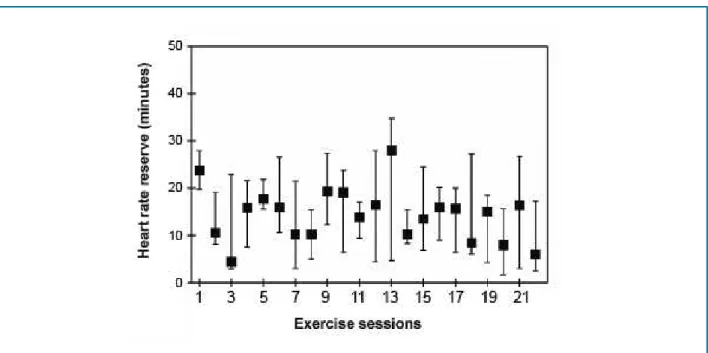
and the median viral load was 17,750 copies.ml-1 (IQR= 368 and 26.000). Eight of the 10 subjects were pubertal, one was prepubertal, and the other was post-pubertal. Figure 1 shows the time spent in the target heart rate zone (50-85%) during each session.
Table 1 shows the changes in outcomes after the exercise program. A decrease was observed in systolic blood pressure (6.6%) and CCA-IMT (12.2%), as well as an increase in muscular endurance
(63.5%), lexibility (26.0%) and quality of life (27.5%).
Figure 1 – Median time in the target heart rate zone during the exercise sessions.
Discussion
This study demonstrated a positive effect of 24 sessions of a playful exercise program on systolic blood pressure, CCA-IMT, upper limb muscular
endurance, lexibility, and quality of life in children
and adolescents living with HIV. To the best of our
knowledge, this is the irst study demonstrating changes
in endothelial structure after an exercise intervention program. Although preliminary, these results highlight the importance of exercise as a non-pharmacological therapy for children and adolescents living with HIV.
CCA-IMT is a surrogate endpoint measure of atherosclerosis and has been shown to be increased in several studies on pediatric HIV. 5-7 Increased CCA-IMT has been associated with elevated high blood pressure and C-reactive protein,7 insulin and glycosylated hemoglobin levels,6 severe symptoms of HIV infection and use of protease inhibitors,13 long-term exposure to HAART,14-16 increased suprailiac skinfold, stavudine use, and low CD4+ T-lymphocyte count.5,15,17 Although we found no changes in traditional cardiovascular risk factors after the intervention, except for a reduction in systolic blood pressure, the decrease in
CCA-IMT suggests regression of atherosclerotic plaque
formation. Prospective observational studies have
demonstrated an association between reduced carotid and aortic IMT and increased leisure physical activity18
and aerobic itness,19 respectively, in healthy Finnish
adolescents. Our data corroborate the indings of an
intervention study involving obese children, in which a reduction in CCA-IMT was observed after 12 weeks
of exercise, even in the absence of signiicant changes in
C-reactive protein or triglyceride levels.20
The reduction in CCA-IMT after exercise may be explained by hemodynamic, antioxidant and antiatherogenic mechanisms (e.g., altered physical strength, upregulation of vascular eNOS and superoxide dismutase expression, downregulation of P-selectin, V-CAM and MCP-1 expression), as most of these changes occur after 4 weeks of training.21 Likewise, we hypothesize that regression of IMT occurred rapidly due to the plasticity of the cardiovascular tissue during the pubertal period, to hypoactivity as seen in chronic diseases,3 or to a “less favorable scenario” such as pediatric HIV infection. Moreover, the decrease in systolic blood pressure observed in our sample represents the attenuation of a cardiovascular risk factor associated with CCA-IMT.18 We observed a decrease of 13% of HDL-cholesterol; however, the time of observation in the study was very short to verify a
Table 1 – Cardiometabolic, fitness and quality of life outcomes in children and adolescents living with HIV submitted to the exercise program (n = 10)
Outcomes Pre- Intervention Post- Intervention Δ° p value
Mean (standard deviation)
Morphological
Weight (kg) 43.8 (12.9) 44.3 (12.8) +0.5 0.070 a
BMI (kg.est-2) 18.9 (3.2) 19.0 (3.2) +0.1 0.267 a
Tricipital SF (mm) 11.6 (4.7) 12.2 (5.6) +0.7 0.142 a
Subscapular SF (mm) 11.2 (10.6) 11.3 (10.3) +0.1 0.918 b
Bicipital SF (mm) 4.8 (2.4) 5.5 (3.5) +0.7 0.307 a
Suprailiac SF (mm) 20.8 (12.3) 20.9 (11.3) +0.9 0.933 a
ΣSF (mm) 48.4 (26.4) 50.0 (27.3) +1.6 0.292 a
Abdominal circumference (cm) 62.0 (21.4) 68.2 (9.9) +6.2 0.878 b
TER (s/u) 1.84 (0.7) 1.78 (0.7) -0.06 0.646 b
UAMA (cm2) 28.3 (9.4) 28.2 (8.0) -0.1 0.910 a
Metabolic and inflammatory
Total cholesterol (mg.dL-1) 164.1 (22.1) 162.3 (28.8) -1.8 0.822 a
Triglycerides (mg.dL-1) 137.3 (46.7) 141.5 (45.3) +4.2 0.641 a
HDL-c (mg.dL-1) 53.6 (9.3) 46.6 (9.7) -7.0 0.019 a
LDL-c (mg.dL-1) 83.0 (13.7) 87.6 (22.8) +4.6 0.445 a
VLDL (mg.dL-1) 27.5 (9.3) 28.3 (9.0) +0.8 0.641 a
Glucose (mg.dL-1) 80.4 (8.5) 83.9 (8.9) +3.5 0.260 b
C-reactive protein (mg.L-1) 3.5 (6.9) 2.7 (3.2) -0.8 0.444 b
Cardiovascular
Systolic BP (mmHg) 102.6 (10.8) 95.8 (10.8) -6.8 0.002 b
Diastolic BP (mmHg) 62.2 (8.9) 58.8 (6.7) -3.4 0.120 a
HRresting (bpm) 77.2 (15.1) 72.1 (19.6) -5.1 0.427 a
CCA-IMT (µm) 493.2 (20.8) 432.3 (60.5) -60.0 0.005 b
Fitness
MEupper limbs (rep.min-1) 5.2 (3.4) 8.5 (3.6) +3.3 0.002 a
MEabdomen (rep.min-1) 21.4 (10.8) 25.8 (9.6) +4.4 0.137 a
Flexibility (cm) 21.9 (9.8) 27.6 (11.7) +5.7 0.001 a
Estimated VO2 peak (ml.kg-1.min-1) 41.9 (11.3) 41.2 (12.5) +0.3 0.508 b
Quality of Life
Quality of life score (score) 37.80 (14.2) 48.20 (11.4) +10.4 0.003 a
1. O'Brien KK, Tynan AM, Nixon SA, Glazier RH. Effectiveness of aerobic exercise for adults living with HIV: systematic review and meta-analysis using the Cochrane Collaboration protocol. BMC Infect Dis. 2016;16:182.
2. Miller TL, Somarriba G, Kinnamon DD, Weinberg GA, Friedman LB, Scott GB. The effect of a structured exercise program on nutrition and fitness outcomes in human immunodeficiency virus-infected children. AIDS Res Hum Retroviruses. 2010 Mar;26(3):313-9
3. van Brussel M, van der Net J, Hulzebos E, Helders PJ, Takken T. The Utrecht approach to exercise in chronic childhood conditions: the decade in review. Pediatr Phys Ther. 2011;23(1):2-14.
4. Janssen I, Leblanc AG. Systematic review of the health benefits of physical activity and fitness in school-aged children and youth. Int J Behav Nutr
Phys Act. 2010;7:40.
5. Giuliano Ide C, de Freitas SF, de Souza M, Caramelli B. Subclinic atherosclerosis and cardiovascular risk factors in HIV-infected children:
PERI study. Coron Artery Dis. 2008;19(3):167-72.
6. Di Biagio A, Rosso R, Maggi P, Mazzei D, Bernardini C, Nulvesu L, et al. Inflammation markers correlate with common carotid intima-media thickness in patients perinatally infected with human immunodeficiency
virus 1. J Ultrasound Med. 2013;32(5):763-8.
7. Ross AC, O'Riordan MA, Storer N, Dogra V, McComsey GA. Heightened
inflammation is linked to carotid intima-media thickness and endothelial activation in HIV-infected children. Atherosclerosis. 2010;211(2):492-8.
8. Pescatello L; American College of Sports Medicine. ACSM's guidelines for exercise testing and prescription. 9th ed. Philadelphia: Wolters Kluwer / Lippincott Williams & Wilkins; 2014.
9. Plowman SA, Meredith MD. Fitnessgram®/Activitygram: reference guide. 4th ed. Dallas (Texas): The Cooper Institute; 2013.
10. Golding LA, Myers CR, Sinning WE. Y’s way to physical fitness: the complete guide to fitness testing and instruction. 3rd ed. chicago (IL). YMCA of the USA by Human Kinetics publishers; 1989.
11. Lohman TG, Roche AF, Martorell R. Anthropometric standardization reference manual. Champaign (IL): Human Kinetics Books; 1991.
12. Assumpção Jr FB, Kuczynski E, Sprovieri MH, Aranha EMG. Escala de
avaliação de qualidade de vida: (AUQEI - Autoquestionnaire Qualité de Vie Enfant Imagé) validade e confiabilidade de uma escala para qualidade de vida em crianças de 4 a 12 anos. Arq Neuropsiquiatr. 2000;58(1):119-27.
References
Satisfactory levels of muscular endurance and
lexibility are important because they relect the functional capacity of the organism. In contrast, low levels of itness
may restrict the participation in sports and daily physical activities, as a result of real or perceived limitations and are even predictive of morbidity and mortality.3 Thus, the pathological state may cause hypoactivity,
which reduces itness and functional capacity, leading
to further hypoactivity.3 In agreement with Miller et al.,2 our data showed that exercises are effective in increasing the levels of upper limb muscular endurance and flexibility of the lumbar spine and hamstring muscles. In the context of pediatric HIV, there is a need
for interventions designed to improve itness due to
poor aerobic capacity,22,23 lexibility,23 anaerobic power,24 agility and lower limb strength.23
Exercise interventions can also improve quality of life
in HIV-infected individuals. This was evidenced in our study and corroborates other investigations involving adults living with HIV.1 Interventions should include playful and fun activities and satisfy the priorities of childhood and adolescence. For example, children need to focus on the development of motor skills, while
adolescents can explore health, itness, and physical
activity behavioral components.
Conclusions
Based on our preliminarily data, we conclude that 24 sessions of aerobic and resistive exercises were
successful to reduce blood pressure and CCA-IMT and
to improve muscular endurance, lexibility and quality
of life in children and adolescents living with HIV.
Subsequent studies with larger samples using long-term interventions are necessary to support our indings and
could also explore the effects of exercise on metabolic
and inlammatory biomarkers.
Author contributions
Conception and design of the research: Back IC, Beck
CC; Acquisition of data: Lima LRA, Back IC, Beck CC;
Analysis and interpretation of the data: Lima LRA, Caramelli B; Statistical analysis: Lima LRA; Writing of the manuscript: Lima LRA, Back IC, Caramelli B; Critical revision of the manuscript for intellectual contente: Lima LRA, Back IC, Beck CC, Caramelli B.
Potential Conflict of Interest
No potential conlict of interest relevant to this article
was reported.
Sources of Funding
There were no external funding sources for this study.
Study Association
13. Charakida M, Donald AE, Green H, Storry C, Clapson M, Caslake M, et al. Early structural and functional changes of the vasculature in HIV-infected children: impact of disease and antiretroviral therapy. Circulation. 2005;112(1):103-9.
14. Vigano A, Bedogni G, Cerini C, Meroni L, Giacomet V, Stucchi S, et al. Both HIV-infection and long-term antiretroviral therapy are associated with increased common carotid intima-media thickness in HIV-infected
adolescents and young adults. Curr HIV Res. 2010;8(5):411-7.
15. Ross AC, Storer N, O'Riordan MA, Dogra V, McComsey GA. Longitudinal changes in carotid intima-media thickness and cardiovascular risk factors in human immunodeficiency virus-infected children and young adults
compared with healthy controls. Pediatr Infect Dis J. 2010;29(7):634-8.
16. McComsey GA, O'Riordan M, Hazen SL, El-Bejjani D, Bhatt S, Brennan ML, et al. Increased carotid intima media thickness and cardiac biomarkers
in HIV infected children. AIDS. 2007;21(8):921-7.
17. Sainz T, Alvarez-Fuente M, Navarro ML, Diaz L, Rojo P, Blazquez D,
et al; Madrid Cohort of HIV-infected children and adolescents integrated in the Pediatric branch of the Spanish National AIDS Network (CoRISPE). Subclinical atherosclerosis and markers of immune activation in
HIV-infected children and adolescents: the CaroVIH Study. J Acquir Immune
Defic Syndr. 2014;65(1):42-9.
18. Pahkala K, Heinonen OJ, Simell O, Viikari JS, Ronnemaa T, Niinikoski H, et al. Association of physical activity with vascular endothelial function and intima-media thickness. Circulation. 2011;124(18):1956-63.
19. Pahkala K, Laitinen TT, Heinonen OJ, Viikari JS, Ronnemaa T, Niinikoski H, et al. Association of fitness with vascular intima-media
thickness and elasticity in adolescence. Pediatrics. 2013;132(1):e77-84.
20. Poeta LS, Duarte MF, Caramelli B, Jorge M, Giuliano IC. Efeitos do exercício físico e da orientação nutricional no perfil de risco cardiovascular de crianças obesas. Rev Assoc Med Bras. 2013;59:56-63.
21. Kojda G, Hambrecht R. Molecular mechanisms of vascular adaptations to exercise. Physical activity as an effective antioxidant therapy? Cardiovasc
Res. 2005;67(2):187-97.
22. Cade WT, Peralta L, Keyser RE. Aerobic capacity in late adolescents infected with HIV and controls. Pediatr Rehabil. 2002;5(3):161-9.
23. Somarriba G, Lopez-Mitnik G, Ludwig DA, Neri D, Schaefer N, Lipshultz SE, et al. Physical fitness in children infected with the human immunodeficiency virus: associations with highly active antiretroviral therapy. AIDS Res Hum Retroviruses. 2012;29(1):112-20.
24. Ramos E, Guttierrez-Teissoonniere S, Conde JG, Baez-Cordova JA, Guzman-Villar B, Lopategui-Corsino E, et al. Anaerobic power and muscle strength in human immunodeficiency virus-positive