Fisioter. Mov., Curitiba, v. , n. , p. - , Jan./Mar. Licenciado sob uma Licença Creative Commons DO): http://dx.doi.org/ . / - . . .AO
[T]
Factors associated with mobility of the oldest old
Fatores associados à mobilidade de idosos longevos
Vanessa Ribeiro dos Santos[a], Diego Giulliano Destro Christofaro[b], Igor Conterato Gomes[c],
Ismael Forte Freitas Júnior[b], Luís Alberto Gobbo[b]*
[a] Universidade Estadual Paulista UNESP , Rio Claro, SP, Brazil
[b] Universidade Estadual Paulista UNESP , Presidente Prudente, SP, Brazil [c] Universidade de São Paulo USP , São Paulo, SP, Brazil
Abstract
Introduction: Several factors can be associated to the reduction of mobility among the elderly. Early iden-ti icaiden-tion of these factors is crucial, since it may lead to preveniden-tion of funciden-tional dependencies. Objective: To analyze the association between mobility, sociodemographic factors and the prevalence of noncom-municable chronic diseases NCDs in oldest old. Methods: The sample consisted of elderly persons aged and years , with of them being women ± years and of them men ± years . Sociodemographic factors and NCDs which we studied were: age, gender, marital status, education, nutri-tional status, ethnicity, hypertension, diabetes and osteoarticular diseases. Mobility was analyzed using a battery of Physical Performance Tests. For statistical analysis we used the chi-square test and binary logistic regression to examine the relationship between sociodemographic factors, NCDs and mobility. SPSS . software was used for this and the signi icance level was set at %. Results: Level of education p ≤ . and age p = . are the two factors related to low mobility. (owever, the model built by multiple logistic regression analysis revealed that age is independently related to limited mobility in oldest old people OR . ; % C) . to . . Conclusion: Thus, oldest old > years are at a greater risk of decreased mobility independent of their education, marital and nutritional statuses and gender. We encourage further studies in this area. Studies which will not only address those facts considered in this study but that also examine family-related aspects, especially using longitudinal studies.
Keywords: Mobility Limitation. Demographic )ndicators. Chronic Disease. Aged and over.
* VRS: Doctoral Student, e-mail: [email protected] DGDC: PhD, e-mail: [email protected]
)CG: Doctoral Student, e-mail: [email protected] )FFJ: PhD, e-mail: [email protected]
70
Resumo
Introdução: A redução da mobilidade pode estar relacionada a vários fatores e a identi icação precoce desses fatores torna-se fundamental, uma vez que pode auxiliar na prevenção da dependência funcional de idosos. Objetivo: analisar a relação entre mobilidade, fatores sociodemográ icos e prevalência de doenças crônicas não transmissíveis (DCNT) em idosos longevos. Métodos: A amostra foi constituída por 120 idosos com idade entre 80 e 95 anos (83 ± 3 anos), sendo 76 mulheres (83 ± 3 anos) e 44 homens (83 ± 3 anos). Os fatores sociodemográ icos e DCNT investigados foram: idade, sexo, estado civil, escolaridade, etnia, estado nutricio-nal, hipertensão, diabetes e doenças osteoarticulares. A mobilidade foi analisada por meio da bateria Physical Perfomance Tests. Para tratamento estatístico foram empregados os testes qui-quadrado e regressão logística binária para analisar a associação entre fatores sociodemográ icos, DCNT e a mobilidade. O software utilizado foi o SPSS (17.0) e o nível de signi icância estabelecido foi de 5%. Resultados: Os fatores relacionados à baixa mobilidade foram a escolaridade (p ≤ 0,001) e idade (p = 0,034). Contudo, o modelo múltiplo construído pela análise de regressão logística revelou que a idade está independentemente relacionada à limitação da mobi-lidade em idosos longevos (OR 3,29; IC95% 1,09-9,87). Conclusão: Dessa forma, idosos longevos com idade >85 anos apresentam mais chance de risco para limitação da mobilidade independente da escolaridade, dos estados civil e nutricional, e do sexo. Incentiva-se a futuros estudos além de abordar os aspectos trabalhados no presente estudo, averiguar também aspectos familiares, e principalmente, em estudos longitudinais.
Palavras-chave: Limitação da Mobilidade. Indicadores Demográ icos. Doença Crônica. Idoso de 80 Anos ou mais.
Introduction
Populational aging is a phenomenon observed throughout the world. )t can be seen especially well among individuals who are years old or older, also known as the oldest old. According to the latest cen-sus, the Brazilians in this age group accounted for
. % of the total population .
As this segment of the population increases, con-cern about processes inherent to aging, such as physi-cal and morphologiphysi-cal changes and especially their in luence on mobility, also grows - . Mobility refers to movement in all its forms, including basic ambulation, moving from a bed to a chair, walking for leisure and everyday activities, such as climbing a light of stairs and sweeping the sidewalk, among many others. Mobility also includes work-related ac-tivities and physical exercise, for instance driving a car and using various forms of public transportation .
)t is fundamental that the mobility of older people be assessed based on their performance of physical abilities tests, since most individuals need high walk-ing speed and muscle function strength and power , as well as good balance to maintain mobility . This assessment procedure is widely used and recom-mended in the ield of aging .
Besides these physical aspects, there are several other factors which can be related to decreased mo-bility , , - . Early detection of these factors is important to prevent falls, fractures, functional de-pendency and, consequently, to maintain health and quality of life for the elderly . (owever, published studies do not clearly show if variables, such as eco-nomic status, education level and some risk factors for noncommunicable chronic diseases NCDs , could impair mobility just as much as physical factors do in those who are eighty years old or older.
Thus, the purpose of this study was to analyze the relationship between mobility, socio-demo-graphic factors and prevalence of NCDs in the oldest old people.
Methods
This study deals with a cross-sectional study that was conducted between October and May in the city of Presidente Prudente Population , , approximately . Presidente Prudente is located west of São Paulo-Brazil and has a (D) of
71
Mobility
Adapted Physical Performance Tests determined mobility according to the individual’s performance in tests for: a static equilibrium; b usual walking speed; and, c lower limb strength.
The static balance test has four stages, performed in sequence seconds each : i standing up with feet together, one next to the other; ii placing the instep of one foot so that it touches the big toe of the other foot; iii balancing on one foot, irst with one foot and then the other; iv standing, with one foot in front of the other.
Each stage was considered to be successfully in-ished when the individual could hold the position de-scribed for seconds. Possible scores for this test are as follows: = disability, unable to hold any of the positions for the stipulated time; = bad, held one po-sition for the stipulated time; = average, successfully held two positions; = good, successfully held three or four positions. The scores of the four stages were added together to compute the inal score.
A meter walking test was used to evaluate each individual’s walking speed. The elderly were instruct-ed to walk naturally, as if they were walking at home. The shortest time obtained from two walks was re-corded and they were given a score according to their time. These are the scores that were assigned: = could not perform the test; = longer than . sec.; = between . and . sec.; = between . and . sec.; = less than . sec.
Lower limb strength was evaluated using the chair stand test. The elderly subjects kept their arms crossed over their chests, and at the evaluator's signal stood up and sat down in a chair ive times as quickly as they could without a pause. Those who could not perform the task described in less than seconds were classi ied as unable to perform the test. The scores on this test were: = unable to perform the test; = time above or equal to . sec.; = time between . and . sec.; = time between . and . sec.; = time below or equal to . sec.
Mobility was classi ied in the individual tests as: low for those seniors who scored - points and high for those with - points. When considering the combined scores from all three tests - points , the elderly who scored - points were considered to have low mobility and those with - points high mobility.
We invited elderly people who were years old or older, of both genders who were residents of the municipality to participate in the study. The municipal health department provided us with the names, ad-dresses and telephone numbers of individuals who used the city’s public health service. These were in-vited by way of a phone call. The research being done was also publicized in the local media. Any partici-pants who were unable to walk, bedridden, residents of rural areas, institutionalized, or had a pacemaker were disquali ied, as well as those who had incom-plete information in the database. Thus, the sample consisted of individuals.
The objectives of the study and the methods to be used for data collection were explained to the participants and they were told that they could stop participating at any time. Only those who signed the ")nformed Consent Form" were part of the sam-ple. All protocols were reviewed and approved by the Research Ethics Committee of São Paulo State University Case no. / .
Sociodemographic Factors and Noncommunicable Chronic Diseases
The sociodemographic factors and NCDs inves-tigated were: age, gender, marital status, education level, NCDs and ethnicity, all of which were self-reported by the elderly, and nutritional status ob-tained through the Body Mass )ndex BM) [weight
kg / height m ]. Subjects were classi ied as un-derweight, normal weight or obese, using the clas-si ication suggested by Troiano et al. .
To identify the prevalence of NCDs, a morbid-ity questionnaire was used. This questionnaire is a summary of the Standard (ealth Questionnaire for Washington State , and consists of closed ques-tions that address the presence/absence of chronic diseases, which are divided into three groups: meta-bolic, cardiovascular and osteoarticular. The main diseases investigated are hypertension, diabetes, dys-lipidemia, thyroid disorders, osteoporosis, arthritis/ osteoarthritis and degeneration of the spine.
72
Table 1 - Relationship between sociodemographic factors, NCDs and mobility of the oldest old
Variables Total (n)
Mobility
p Low High
Gender Male 44 52.3% 47.7%
0.205
Female 76 65.8% 34.2%
Age 80-84 94 55.3% 44.7%
0.034
> 85 26 80.8% 19.2%
Nutritional Underweight 33 72.7% 27.3%
0.150
Status Normal 50 56% 44%
Obese 37 56.8% 43.2%
Education None 36 75% 25%
≤ 0.001
Primary 70 62.9% 37.1%
Secondary/Higher 14 14.3% 85.7%
Marital Status Single/Separated 09 44.4% 55.6%
0.064
Married/Cohabiting 46 52.2% 47.8%
Widowed 65 69.2% 30.8%
Ethnicity White 70 58.6% 41.4%
0.350
Black 06 33.3% 66.7%
Yellow 17 70.6% 29.4%
Brown 27 66.7% 33.3%
Diseases Hypertension yes 77 58.7% 41.3%
0.689
no 43 64.3% 35.7%
Diabetes yes 23 63.6% 36.4%
0.942
no 97 60% 40%
Osteoarticular yes 62 56.7% 43.3%
0.469
no 58 64.9% 35.1%
Statistical Analysis
The chi-square test crosstabs was used to analyze the relationship between sociodemographic factors, NCDs and mobility. Binary logistic regression analy-sis was used to express the magnitude of the relation-ships in Odds Ratio OR values with % con idence intervals. All variables with p < . were selected and included in the construction of a binary multiple logistic regression model using the forward stepwise modeling strategy. Statistical analysis was conducted using SPSS software SPSS inc. Chicago, )L , version . . The level of signi icance was set at %.
Results
The majority of the oldest old investigated in this study were Caucasian women who were between and years of age, had low education levels and were widowed. Regarding their nutritional status and the presence of chronic diseases, most were of normal weight and had high blood pressure and osteoarticu-lar diseases. Elderly people aged years or older with a low education level demonstrated less mobility when compared with those between to years old p = . and a high education level p = .
73 Table shows the multiple regression model con-taining sociodemographic factors related to limited mo-bility. Age is related to limited mobility independent of other variables, such as education, marital and nutri-tional statuses, and gender.
Table 3 - Multiple logistic regression model with
sociode-mographic factors related to mobility limitation in the oldest old
Variables AOR CI (95%) P
Education
Educated 1.00
---Uneducated 2.27 0.91 - 5.66 0.078
Age
80 - 84 years 1.00
---> 85 years 3.29 1.09 - 9.87 0.034
Marital Status
Married/Cohabiting 1.00
---Single/Separated/
Widowed 0.75 0.31 - 1.86 0.537
Nutritional Status
Normal 1.00
---Underweight 1.14 0.46 - 2.84 0.772
Obese 1.77 0.64 - 4.85 0.268
Gender
Male 1.00
---0.279
Female 1.64 0.67 - 4.04
Note: CI = confi dence interval; AOR= adjusted odds ratio; Hosmer-Lemeshow test = 0,71.
Discussion
)n this study, we decided to analyze which sociode-mographic factors and NCDs affect the mobility of the oldest old. Balance, walking speed and lower limb strength of these seniors were evaluated by a battery of tests. )t was observed that education and age are as-sociated with decreased mobility in this age group.
There is an inverse relationship between age and mo-bility. This relationship was also observed in São Paulo
, and all regions of Brazil. )n the aforementioned studies which considered the young elderly, age strati i-cation was done in decades. )n this study of the oldest old, age strati ication was done in ive year periods. Thus, our Table shows the odds ratio value obtained through
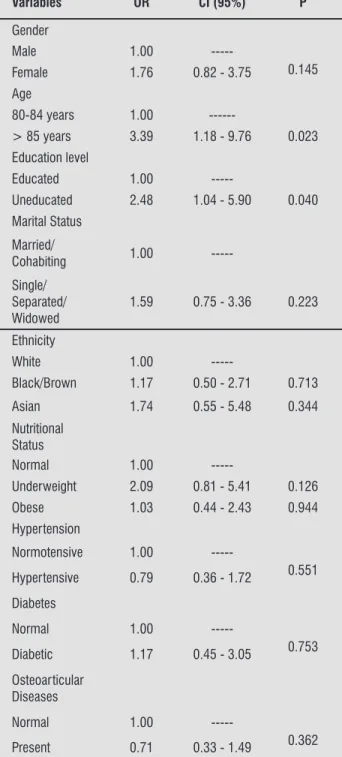
binary logistic regression analysis, together with their respective % con idence intervals. Only age and edu-cation appear to be associated with mobility, with se-niors aged years or older and no education at higher risk for limited mobility p < . .
Table 2 - Odds ratio for limited mobility according to
so-ciodemographic factors and NCDs
Variables OR CI (95%) P
Gender
Male 1.00
---0.145
Female 1.76 0.82 - 3.75
Age
80-84 years 1.00
---> 85 years 3.39 1.18 - 9.76 0.023
Education level
Educated 1.00
---Uneducated 2.48 1.04 - 5.90 0.040
Marital Status
Married/
Cohabiting 1.00
---Single/ Separated/ Widowed
1.59 0.75 - 3.36 0.223
Ethnicity
White 1.00
---Black/Brown 1.17 0.50 - 2.71 0.713
Asian 1.74 0.55 - 5.48 0.344
Nutritional Status
Normal 1.00
---Underweight 2.09 0.81 - 5.41 0.126
Obese 1.03 0.44 - 2.43 0.944
Hypertension
Normotensive 1.00
---Hypertensive 0.79 0.36 - 1.72 0.551
Diabetes
Normal 1.00
---Diabetic 1.17 0.45 - 3.05 0.753
Osteoarticular Diseases
Normal 1.00
---Present 0.71 0.33 - 1.49 0.362
74
signi icance between gender and mobility p = . . There are other studies, though, which point out dif-ferences between the genders in relation to mobility, with females being at a greater risk of decreased mobil-ity , . One explanation for this may be the higher incidence of vascular and osteoarticular diseases, as well as obesity in women . )n the study by Barbosa et al. , it was observed that men in all age groups demonstrated greater mobility than women, which is similar to recent results .
Nutritional status may also be used to indicate mo-bility, since a low weight and obesity can be associated with decreased mobility. One study established that elderly patients who lost % of their weight over a year period were at a . % greater risk of decreased mobility. Excess body fat can also limit mo-bility. The higher proportion of body fat accentuates the risk of disability in overweight older people by increas-ing body burden, limitincreas-ing movements and increasincreas-ing stress on joints and muscles . Other authors have also observed that excess body fat limits mobility among the elderly. There are other studies which have shown that the relationship between body fat and mobility is more signi icant for seniors who are between and years old. These same studies indicate that this association is not as clear among the older elderly. These indings contradict the results of this study which establishes a clear association between nutritional sta-tus and mobility among the oldest old.
Marital status, ethnicity and the presence of NCDs are other variables which we studied that did not show statistical signi icance. Even though there are a greater number of widowed seniors with reduced mobility, marital status has no statistical signi icance. )n general, different studies have found that people living alone single, divorced or widowed , especially elderly men, have a higher risk of functional limitations and decreased mobility .
)n a similar way, this study indicates that ethnicity is not associated with mobility, but there was another study done which shows that this variable can in-deed be associated with mobility among seniors. This study observed that elderly black people between and years old were less mobile than their white counterparts. (owever, this may not be the result of ethnicity itself but rather complicating factors, such as lower socioeconomic status and education and poorer health of the majority of individuals within this ethnic group .
results indicate that there is a relationship between age and mobility. Elderly people who are years old or older have less mobility when compared to those between and years old. The oldest old are three times more likely to have limited mobility than the younger elderly. This relationship remained constant when the multiple regression model was built and it was observed that age is related to limited mobility independent of other vari-ables, such as education, marital and nutritional statuses, and gender.
This result is alarming considering that reduced mobility is a risk factor for functional dependence and the elderly who are over years old are three times more likely to be functionally dependent than those who are younger than . One of the most plau-sible explanations for this phenomenon is the higher incidence of sarcopenia in this segment of the popu-lation as it ages . Sarcopenia results in the loss of muscle mass and strength and consequently the reduction in mobility as the elderly age.
)n reference to education, it was determined that there is a relationship between reduced mobility and a low level of education among both genders of the old-est old. Elderly people with little or no education were approximately two times more likely to have limited mobility than those with a higher level of education. There are other reports about mobility and education in individuals over the age of . The authors of these reports also found that those with a poor educa-tion had less mobility when compared to those with a higher level of education. Gregory et al. reached the same conclusion when studying the association be-tween limited mobility and a low level of education in seniors aged between and . This relationship can be attributed to a decreased capacity for understand-ing preventive measures, less investment in health and disability prevention , , as well as the possibility of poorly educated elderly people coming from pre-carious home and family environments . )t is also worth noting that the understanding the elderly have regarding the importance of physical activity may also factor in due to the close association between physical activity and functional capacity .
75 . Klijs B, Nusselder WJ, Looman CW, Mackenbach JP.
Con-tribution of chronic disease to the burden of disability.
PloS One. ; :e .
. Bouchard DR, Choquette S, Dionne )J, Brochu M. )s fat mass distribution related to impaired mobility in older men and women? Nutrition as a determinant of success-ful aging: the Quebec longitudinal study. Exp Aging Res.
; : - .
. (ung WW, Ross JS, Boockvar KS, Siu AL. Association of chronic diseases and impairments with disability in older adults: a decade of change? Med Care. ; : - . . Satariano WA, Guralnik JM, Jackson RJ, Marottoli
RA, Phelan EA, Prohaska TR. Mobility and aging: new directions for public health action. Am J Public
(ealth. ; : - .
. Guralnik JM, Simonsick EM, Ferrucci L, Glynn RJ, Berk-man LF, Blazer DG, et al. A short physical perforBerk-mance battery assessing lower extremity function: asso-ciation with self-reported disability and prediction of mortality and nursing home admission. J Gerontol.
; :M - .
. Sainio P, Martelin T, Koskinen S, (eliovaara M. Education-al differences in mobility: the contribution of physicEducation-al workload, obesity, smoking and chronic conditions. J
Epi-demiol Community (ealth. ; : - .
. Parahyba M), Veras R. Diferenciais sociodemográ icos no declínio funcional em mobilidade ísica entre os idosos
no Brasil. Cien Saude Coletiva. ; : - .
. Gregory PC,Szanton SL,Xue QL,Tian J,Thorpe RJ,Fried LP. Education predicts incidence of preclinical mobility disability in initially high-functioning older women. The Women's (ealth and Aging Study )).J Gerontol A Biol Sci
Med Sci. ; : - .
. Thorpe Jr RJ,Koster A,Kritchevsky SB,Newman AB, (ar-ris T,Ayonayon (N, et al. Race, socioeconomic resources, and late-life mobility and decline: indings from the (ealth, Aging, and Body Composition study.J Gerontol
A Biol Sci Med Sci. ; : - .
. Miszkurka M, Zunzuneguia MV, Langloisa EV, Freemanb EE, Kouandac S, (addada S. Gender differences in mobil-ity disabilmobil-ity during young, middle and older age in West African adults. Glob Public (ealth. ; : - . Finally, the contribution of NCDs to functional
dis-ability is higher among the oldest old . Recent studies found that the relationship between disability and NCDs in the elderly has hardly changed in the last de-cade. This same study af irms that diabetes has a greater in luence on disability than hypertension. Winter et al. observed that individuals with osteoarticular dis-eases have less mobility than their healthy peers. )n this study none of the investigated diseases hypertension, diabetes and osteoarticular diseases were associated with the mobility of the oldest old. This result may be related to the fact that despite the high prevalence of these diseases among the oldest old, early detection and improvements in treatment may be preventing them from affecting their mobility. )n addition to this, other factors that are closely related to mobility, such as age, can independently cause reduced mobility in this age group.
)t is important to remember that the cross-sectional design of this study does not allow for the establishment of a causal relationship. Other factors which may be related to decreased mobility, such as the physical and professional activities engaged in during the majority of their economically active life, were not investigated. (owever, it is worth emphasizing that there are only a limited number of studies which seek to analyze these aspects in the elderly who are over the age of eighty.
Conclusion
This study concludes that the oldest old aged or older are at a greater risk of reduced mobility, indepen-dent of their education level, marital and nutritional statuses and gender. We encourage others to study not only aspects addressed in this study, but to also examine aspects related to family life, especially using longitu-dinal studies.
References
. )nstituto Brasileiro de Geogra ia e Estatística/)BGE. Censo Demográ ico e Contagem da População: Popu-lação residente por gênero, situação e grupos de idade.
76
. Bannermann E, Miller MD, Daniels LA, Cobiac L, Giles LC, Whitehead C, et al. Anthropometric indices predict physical function and mobility in older Australians: the Australian Longitudinal Study of Ageing. Public (ealth
Nutr. ; : - .
. Stenholm S, Rantanen T, Alanen E, Reunanen A, Sainio P, Koskinen S. Obesity history as a predictor of walking limitation at old age. Obesity. ; : - . . Barbosa AR, Souza JMP, Lebrão ML, Marucci MFN.
Es-tado nutricional e desempenho motor de idosos de São
Paulo. Rev Assoc Med Bras. ; : - .
. Sallinen J, Stenholm S, Rantanen T, (elioaara M, Sainio P, Koskinen S. Effect of age on the association between body fat percentage and maximal walking speed. J Nutr
(ealth Aging. ; : - .
. Altmets K,Puur A,Uusküla A,Saava A,Sakkeus L,Katus K. Self-reported activity limitations among the popula-tion aged - in Estonia: a cross-secpopula-tional study. Eur J Public Health. 2011;21(1):49-55.
. Nilsson CJ,Avlund K,Lund R. Onset of mobility limitations in old age: the combined effect of socioeconomic position and social relations. Age Ageing. ; : - . . Williams DR, Sternthal M. Understanding racial-ethnic
disparities in health: sociological contributions. J (ealth
Soc Behav. ; Suppl:S - .
. Winter CC, Brandes M, Muller C, Schubert T, Ringling M, (illmann A, et al. Walking ability during daily life in patients with osteoarthritis of the knee or the hip and lumbar spinal stenosis: a cross sectional study. BMC Musculoskelet Disord. ; : .
Received in / / Recebido em 14/10/2013
Approved in / / Aprovado em 08/03/2016 . Troiano RP, Frongillo EAJR, Sobal J, Levitsky DA. The
re-lationship between body weight and mortality: a quan-titative analysis of combined information from existing studies. )nt J Obes Relat Metab Disord. ; : - . . Washington State (ealth )nsurance Pool. Standard
(ealth Questionnaire for Washington State.
Washing-ton; .
. Freitas Jr )F, Castoldi RC, Moreti DG, Pereira ML, Cardoso ML, Codogno JS, et al. Aptidão ísica, historia familiar e ocorrência de hipertensão arterial, osteoporose, doenças metabólicas e cardíacas entre mulheres. Rev SOCERJ.
; : - .
. Barbosa AR, Souza JMP, Lebrão ML, LaurentiR, Marucci MFN. Functional limitations of Brazilian elderly by age and gender differences: data from SABE Survey. Cad
Saude Publica. ; : - .
. Nogueira SL, Ribeiro RCL, Rosado LEFPL, Franceschini SCC, Ribeiro AQ, Pereira ET. Fatores determinantes da capacidade funcional em idosos longevos. Rev Bras
Fi-sioter. ; : - .
. Baumgartner RN, Koehler KM, Gallagher D, Romero L, (eyms ield SB, Ross RR, et al. Epidemiology of sarcope-nia among the elderly in New Mexico. Am J Epidemiol.
; : - .
. Sudore RL, Yaffe K, Satter ield S, (arris TB,Mehta KM,Simonsick EM, et al. Limited literacy and mortality in the elderly: the health, aging, and body composition
study. J Gen )ntern Med. ; : - .
. Baker DW, Wolf MS, Feinglass J, Thompson BA, Gazma-rarian JA, (uang J. (ealth literacy and mortality among
elderly persons. Arch )ntern Med. ; : - .
. Petersen KL, Marsland AL, Flory J, Vortruba-Drzal E, Muldoon MF, Manuck SB. Community socioeconomic status is associated with cir culating interleukin- and C-reactive protein. Psychosom Med. ; : - . . Cipriani NCS, Meurer ST, Benedetti TRB, Lopes MA.
Aptidão funcional de idosas praticantes de atividades ísicas. Rev. bras. cineantropom. desempenho (um.
; : - .
. Whitson (E, Landerman LR, Newman AB, Fried LP, Pieper CF, Cohen (J. Chronic medical conditions and the gender-based disparity in disability: the car-diovascular health study. J Gerontol A Biol Sci Med