DOI: 10.5935/2359-4802.20170056
ORIGINAL ARTICLE
Mailing Address: Jorgileia Braga de Melo
Rua Miragem do Sol, Ed. Dom Carlos, apto 102. Postal Code: 65075-760, Renascença II, São Luís, MA – Brazil E-mail: [email protected]; [email protected]
Cardiovascular Risk Factors in Climacteric Women with Coronary Artery Disease
Jorgileia Braga de Melo, Roberta Cristina Almeida Campos, Philippe Costa Carvalho, Mariana Ferreira Meireles, Maria Valneide Gomes Andrade, Tânia Pavão Oliveira Rocha, Wilma Karlla dos Santos Farias, Maria Jozelia Diniz Moraes, Josete Costa dos Santos, José Albuquerque de Figueiredo Neto
Universidade Federal do Maranhão, MA – Brazil
Manuscript received on December 15, 2016; revised on January 31, 2017; accepted on April 17, 2017.
Abstract
Background: The increased incidence of cardiovascular disease in women occurs during the climacteric period, especially after menopause.
Objective: The aim of this study was to identify risk factors among climacteric women with and without coronary artery disease (CAD).
Method: This cross-sectional study was performed in the Catheterization Laboratory at the Federal University Hospital of Maranhão, in the Northeast region of Brazil, between March 2012 and July 2013. We included 31 climacteric women who went to the care center for cardiac catheterization. They were divided into groups after catheterization results: Group I (with DAC) and Group II (without CAD). Statistical analysis: Categorical variables were described by means of frequencies and percentages, numerical variables by mean ± standard deviation or median (Quartile.3 - Quartile.1); the Shapiro-Wilk test was used to verify the normality of quantitative data. Fisher’s exact test was used for categorical data comparisons. For continuous data, we used Student’s test or the Mann-Whitney for unpaired samples; statistical significance was set at p < 0.05.
Results: We evaluated groups with CAD (n = 13) and without CAD (n = 18). The results showed a mean age between the groups of 57.92 ± 5.15 and 51.72 ± 4.63 years, respectively. Among the cardiovascular risk factors, the most prevalent among women with CAD were menopause (84.62%), systemic arterial hypertension (SAH) (69.23%) and sedentary life style (69.23%).
Conclusion: We concluded that, in addition to menopause itself, SAH and sedentary lifestyle were the most prevalent cardiovascular risk factors among women with CAD. (Int J Cardiovasc Sci. 2018;31(1)4-11)
Keywords: Cardiovascular Diseases; Coronary Artery Disease; Risk Factors; Women; Climacteric; Hypertension; Sedentary Lifestyle.
Introduction
The increase of Coronary Artery Disease (CAD) incidence in females, especially in the climacteric period, is related to hormonal, circulatory, and blood alterations that occur in women. These alterations are notoriously implicated in the genesis and progression of cardiovascular disease, which, in turn, constitutes the main cause of mortality among the middle-age population.1 In the female aging process, alterations occur
in the metabolic profile which modify adipose tissue
composition and distribution, thus favoring weight gain and the progression of possible atherosclerotic processes.2
Among the main risk factors for cardiovascular diseases are: age, obesity, smoking, systemic arterial hypertension (SAH), dyslipidemia, diabetes mellitus (DM), family history, stress, and a sedentary lifestyle.3 The body’s
exposure to these cardiovascular risk factors favors the development of the endothelial dysfunction process.4
in this group. Thus, the objective of the present study was to identify cardiovascular risk factors among climacteric women with or without CAD.
Methods
This was a cross-sectional analytical study carried out in the Catheterization Laboratory of the University Hospital Presidente Dutra (HUPD), from the Federal University Universidade Federal do Maranhão, in Brazil. It is an intervention and imaging diagnosis unit that is linked to the Cardiovascular Surgical Service of HUPD. Data were collected between March 2012 and July 2013, starting from the moment the patients checked in for cardiac catheterization. These exams had been previously booked by the patients who had a referral, as is required by the Catheterization Lab.
The selection took place consecutively, from the moment the patients checked in for their elective cardiac catheterization.
We included all climacteric patients, between 40 and 65 years of age (period of menopausal manifestation),3 who
underwent cardiac catheterization at the catheterization lab. All patients received information about the research and signed a free consent form approved by the Research Ethics Committee of the University Hospital of The Federal University of Maranhão (HUUFMA). Exclusion criteria included: patients on statins; those who underwent coronary angioplasty or myocardial revascularization; and previous history of acute myocardial infarction. We also excluded patients who refused to participate in the research, and those who, for different reasons, withdrew from the research protocol. Once the sample was defined, the patients were divided into groups according to cardiac catheterization results: Group I – with CAD; and Group II – without CAD. CAD was defined as the presence of obstruction in the coronary arteries demonstrated by cardiac catheterization. Patients were considered menopausal when their last period had occurred 12 months or longer before the procedure.5 None of the patients included in
this study were on hormone therapy. Socio-demographic variables were: age; self-declared skin color; level of education; and household income.
We analysed the following variables, which are considered cardiovascular risk factors according to the I Brazilian Guideline for the Prevention of Cardiovascular Diseases in Climacteric Women:3 SAH, dyslipidemia, and
DM (based on previous medical diagnosis); and blood pressure (BP), physical activity; smoking; alcoholism; weight, height; body mass index (BMI), and waist circumference (WC) (data from the Protocol-Chart).
For biochemical exams, we adopted the following reference values, considered within normality for the lipid profile: total cholesterol below 200 mg/dl; high-density lipoprotein (HDL-c) above 50 mg/dl; low-high-density lipoprotein (LDL-c) below 130 mg/dl; triglycerides below 150 mg/dl; and fasting blood sugar levels below 100 mg/dl.6
On the same day catheterization was performed, we measured the patients’ BP, took anthropometric measurements, and collected blood at a 12-hour fasting period, all at the same time, in this sequence, between 7 a.m. and 9 a.m.
Processing of blood samples for serum extraction was performed with samples kept at room temperature for 20 minutes (between 18 and 24° C, mean of 22° C) and later centrifuged for 10 minutes at 3000 rpm. All exams were analysed at the laboratory at HUUFMA.
Statistical analysis
Categorical variables were described through frequencies and percentages, and numeric ones through mean ± standard deviation or median (Quartile.3 – Quartile.1), depending on normality. The Shapiro-Wilk test was chosen to verify the normality of quantitative data. To compare categorical data, we used Fisher’s Exact test, and for continuous data, we used Student’s t-test or the Mann-Whitney for unpaired samples, depending on normality.
Statistical significance was set at p < 0.05, and statistical analyses were performed with the software Data Analysis and Statistical Software (STATA®) version 12.0.
The present study represents a substudy of a more comprehensive research called “Endothelial Dysfunction and Cardiovascular Risk Assessment in Climacteric Women”, which has the approval of the Research Ethics Committee from Hospital Universitário da Universidade Federal do Maranhão, under protocol number 182/11, in accordance with Resolution 196/96 and its complementary from The National Health Council of Brazil (CNS/MS).
Results
Table 1 – Sociodemographic characteristics of climacteric women with or without CAD – HUUFMA, São Luís, Brazil, 2013
Sociodemographic characteristics General
CAD
p-value
Present Absent
Age (Mean ± Standard deviation) 54.32 ± 5.7 57.92 ± 5.17 51.72±4.63 0.001⃰⃰
Level of education (%)
≤ 8 years 15 48.39 6 46.15 9 50.00
0.833†
> 8 years 16 51.61 7 53.85 9 50.00
Self-declared skin color (%)
White 6 19.35 3 23.08 3 16.67
0.443‡
Black 3 9.68 0 - 3 16.66
Brown 22 70.97 10 76.92 12 66.67
Household income (%)
≤ 2 Monthly minimum wage 18 58.06 10 76.92 8 44.44
0.074‡
> 2 Monthly minimum wage 13 41.94 3 23.08 10 55.56
* Student’s t test; † Chi-square test; ‡ Fisher’s exact test; CAD: coronary artery disease; HUUFMA: Hospital Universitário da Universidade Federal do Maranhão.
respectively, varying between 44 and 63 years of age, with statistical significance (p = 0.001). Socio-demographic data in the general group showed a higher frequency
of brown women (70.97%); with > 8 years of education
(51.61%); with a household income ≤ two monthly
minimum wages (58.06%) (Table 1).
Regarding the presence of cardiovascular risk factors with a medical diagnosis established before data collection for the study, results showed, in Group I, a higher prevalence of SAH (69.23%), followed by DM (23.08%), and high cholesterol (15.38%). We observed elevated percentages of women who claimed they did not consume alcohol or smoke in both groups. We also saw that 69.23% of women with CAD and 61.11% of women without CAD did not practice daily physical activities (Table 2).
Regarding the climacteric period in women with and without CAD, menopause was present among both groups, with 84.62% and 66.67%, respectively (Table 2).
Patients with CAD presented higher BMI and WC in comparison to those without CAD; in general, the women presented alterations of these measurements, with means of 27.57% ± 4.55 kg/m2 and 91.00 ± 10.28 cm,
respectively. Systolic blood pressure (SBP) was altered in both groups (Table 2).
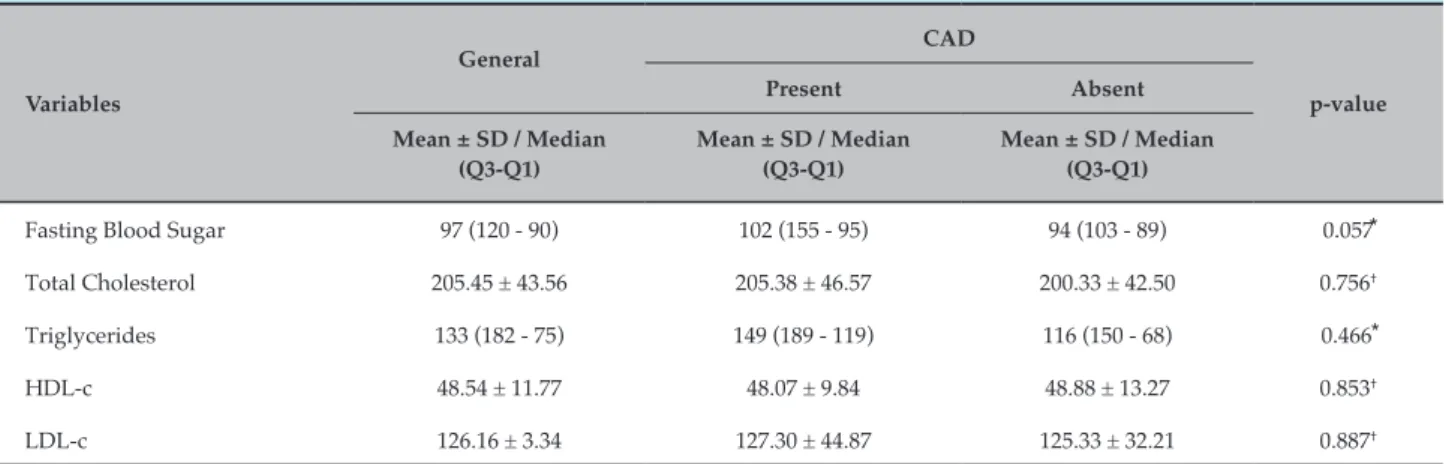
With regards to values of lab variables, among women with and without CAD, the means of fasting
blood sugar levels, total cholesterol and triglycerides were higher in Group I. However, HDL-c and LDL-c results were similar in both groups, with HDL-c below normality (Table 3).
Discussion
In the present study, the golden standard was the identification of climacteric women diagnosed with CAD during the data collection period of the study, after cardiac catheterization.
In addition to menopause, other cardiovascular risk factors were present among women with and without CAD, the most prevalent of which were sedentary life-styles and SAH. Studies that included women suggest an association between endothelial dysfunction and several cardiovascular risk factors.7-9
Table 2 – Climacteric women with and without CAD regarding cardiovascular risk factors – HUUFMA. São Luís, Brazil, 2013
Variables
General
CAD
p-value
Present Absent
n % n % n %
SAH
Absent 10 32.26 4 30.77 6 33.33
0.880⃰
Present 21 67.74 9 69.23 12 66.67
Diabetes Mellitus
Absent 27 87.10 10 76.92 17 94.44
0.151⃰
Present 4 12.90 3 23.08 1 5.56
High Cholesterol
Absent 22 70.97 11 84.63 11 61.11
0.155⃰
Present 9 29.03 2 15.38 7 38.89
Alcoholism
Absent 27 87.10 12 92.31 15 83.33
0.621⃰
Present 4 12.90 1 7.69 3 16.67
Current smoking
Absent 30 96.77 12 92.31 18 100
0.232⃰
Present 1 3.23 1 7.69 0 0
Physical activity
Absent 20 64.52 9 69.23 11 61.11
0.641⃰
Present 11 35.48 4 30.77 7 38.89
Menopause
Absent 8 25.81 2 15.38 6 33.33
0.260⃰ ⃰
Present 23 74.19 11 84.62 12 66.67
BMI (Mean ± Standard Deviation) 27.57 ± 4.55 28.04 ± 4.31 27.24 ± 4.81 0.636†
WC (Median; Q3 - Q1) 88 (101 - 86) 88 (101 - 88) 88 (92 - 85) 0.348‡
SBP (Median; Q3 - Q1) 135 (170 - 120) 135 (180 - 125) 135 (160 - 120) 0.400‡
DBP (Mean ± Standard Deviation) 84.74 ± 11.27 84.23 ± 11.87 85.11 ± 11.15 0.834†
* Fisher’s exact test; † Student’s t test; ‡ Mann-Whitney; CAD: coronary artery disease; HUUFMA: Hospital Universitário da Universidade Federal do Maranhão; SAH: systemic arterial hypertension; BMI: body mass index; WC: waist circumference; SBP: systolic blood pressure; DBP: diastolic blood pressure.
A sedentary life-style, reported by the patients themselves, was quite evident among the women of both groups. Studies suggest that regular daily physical activity has a positive effect on the endothelium and can attenuate vasodilatation, thus preserving nitric oxide (NO) bioavailability, which results in a healthier natural aging process for women.10-12 Physical exercise
can also attenuate the appearance of comorbidities such as diabetes and hypertension.13,14 Diabetic women
are 3 to 7 times more likely to develop CAD than those without diabetes.3
Table 3 – Climacteric women with and without CAD regarding laboratory variables – HUUFMA. São Luís, Brazil, 2013
Variables
General CAD
p-value
Present Absent
Mean ± SD / Median (Q3-Q1)
Mean ± SD / Median (Q3-Q1)
Mean ± SD / Median (Q3-Q1)
Fasting Blood Sugar 97 (120 - 90) 102 (155 - 95) 94 (103 - 89) 0.057⃰
Total Cholesterol 205.45 ± 43.56 205.38 ± 46.57 200.33 ± 42.50 0.756†
Triglycerides 133 (182 - 75) 149 (189 - 119) 116 (150 - 68) 0.466⃰
HDL-c 48.54 ± 11.77 48.07 ± 9.84 48.88 ± 13.27 0.853†
LDL-c 126.16 ± 3.34 127.30 ± 44.87 125.33 ± 32.21 0.887†
* Mann-Whitney; † Student’s t test. All values expressed in mg /dl; CAD: coronary artery disease; HUUFMA: Hospital Universitário da Universidade Federal do Maranhão; HDL-c: high-density lipoprotein; LDL-c: low-density lipoprotein.
As time goes by, structural alterations take place in the vessels, and those lesions will facilitate thromboembolic phenomena, clinically presented as myocardial infarction, stroke, and other ischemic events.15
Regarding the climacteric period, most women who participated in this study were already post-menopausal (Groups I and II), and had been for over five years (late menopause), which suggests that among these women, the menopausal state may indicate an independent cardiovascular risk. During the climacteric period, women go through a gradual transition process of physiological changes, probably due to a decrease in estrogen, which leads to more long-lasting changes in the post-menopausal period.16 This hormonal
change seems to present a direct effect on vasculature, considering estrogens protect the endothelium against atheromatous plaque.17
We found that, in women with CAD, alterations in the levels of fasting blood sugar, total cholesterol, triglycerides, and HDL-c were more evident; however, mean levels of LDL-c remained within normality. Menopause by itself seems to cause an increase in total cholesterol, LDL-c and triglyceride levels, which also happens throughout the aging process, especially in women.18 These factors also highlight the importance of
LDL-c as a cardiovascular risk factor.19
Studies consider that total cholesterol and LDL-c continue to increase in women until the age of 70.20
Gonadal failure in the post-menopausal climacteric may be related to the elevation of total cholesterol and LDL-c levels, due to a decrease in the hepatic activity of
7-α-hydroxylase, with a reduction of biliary acid synthesis and, therefore, a decrease in cholesterol excretion.21
Galvão et al.22 found an association between
triglycerides and endothelial dysfunction, suggesting that triglycerides play an important role in endothelial dysfunction: they found that elevated levels of triglycerides cause an increase in lipolysis with a consequent increase of inflammatory markers, such as ultra-sensitive C-reactive protein (us-CRP) and interleukin 6, which leads to endothelial dysfunction.23
It is interesting to highlight that HDL-c levels, in general, were altered among climacteric women, with values below 50 mg/dl. Such results corroborate other studies that also found reduced values of HDL-c in women in the same age group as those in our study.24,25 Studies suggest that the protective effect of
HDL-c may be decreasing in women in menopausal transition. Thus, it is possible that increased levels of HDL-c have a cardioprotective effect, while increased levels of LDL-c are associated to cardiovascular diseases (CVD).26
In general, the women presented a slightly altered SBP. This finding is acceptable for the stage in which those patients are, considering an increased BP in climacteric women may be related to weight gain and/or hormonal alterations, especially after menopausal transtions.27
1. De Lorenzi DR, Basso E, Fagundes PO, Saciloto B. Prevalence of overweight and obesity among climacteric women. Rev Bras Ginecol Obstet. 2005;27(8):479-84.
2. Must A, Spadano J, Coakley EH, Field AE, Colditz G, Dietz WH. The disease burden associated with overweight and obesity. JAMA. 1999;282(16):1523-9.
3. Sociedade Brasileira de Cardiologia. I Diretriz brasileira sobre prevenção de doenças cardiovasculares em mulheres climatéricas e a influência da terapia de reposição hormonal (TRH) da Sociedade Brasileira de Cardiologia (SBC) e da Associação Brasileira do Climatério (SOBRAC). Arq Bras Cardiol. 2008;91(1):1-23.
4. Rabelo LM, Viana RM, Schimith MA, Patin RV, Valverde MA, Denadai RC, et al. Risk factors for atherosclerosis in students of a private university in São Paulo-Brazil. Arq Bras Cardiol. 1999; 72(5): 569-74.
5. Burger HG, Dudley EC, Robertson DM, Dennerstein L. Hormonal changes in the menopause transition. Recent Prog Horm Res. 2002;57:257-75.
6. Sociedade Brasileira de Cardiologia; Sociedade Brasileira de Hipertensão; Sociedade Brasileira de Nefrologia. [VI Brazilian Guidelines on Hypertension]. Arq Bras Cardiol. 2010;95(1 Suppl):1-51. Erratum in: Arq Bras Cardiol. 2010;95(4):553.
References
Post-menopausal women, in addition to a weight gaining tendency, are also susceptible to lipid metabolism alterations, which may be related to the reduction of estrogen and consequent elevation of total cholesterol, lipoprotein, and triglyceride levels, which results in a lipid profile that is highly favorable to atherogenesis, especially when associated to DM and hypertension.28
In both groups of climacteric women, alterations were found in the WC and BMI. Both measurements represent the distribution of body fat deposition, especially abdominal fat. The increase of fat among women is expected, and it is more present in post-menopausal individuals.29 That increases the risk for
cardiovascular events, especially in women with central obesity. Metabolic effects on menopausal women can also contribute to the development of atherosclerosis favored by endothelial dysfunction.30
This accumulation of fat, also known as central, visceral, or android obesity, has been recognized as a cardiovascular risk factor and it is more important than total body fat – that may be justified by the higher production of cytokines by visceral fat, when compared to its production by peripheral fat.31
Suwaid et al.32 have demonstrated that obesity may be
independently associated to endothelial dysfunction in patients with normal coronary angiography or in those with mild CAD.
The limitations of our study include the identification of several women already medically diagnosed with CAD and on statins before the beginning of data collection for this study. We propose further studies in this area, especially multicenter studies with larger samples.
Conclusion
We have concluded that, in addition to menopause itself, SAH and a sedentary life-style were the most
prevalent cardiovascular risk factors among women with CAD.
Author contributions
Conception and design of the research: Melo JB, Figueiredo Neto JA. Acquisition of data: Melo JB, Campos RCA, Carvalho PC, Andrade MVG, Rocha TPO, Farias WKS, Moraes MJD, Santos JC, Meireles MF. Analysis and interpretation of the data: Melo JB, Figueiredo Neto JA. Statistical analysis: Melo JB. Obtaining financing: Campos RCA. Writing of the manuscript: Melo JB, Carvalho PC, Meireles MF. Critical revision of the manuscript for intellectual content: Melo JB, Campos RCA, Carvalho PC, Figueiredo Neto JA.
Potential Conflict of Interest
No potential conflict of interest relevant to this article was reported.
Sources of Funding
There were no external funding sources for this study.
Study Association
This article is part of the thesis of master submitted by Jorgileia Braga de Melo, from Universidade Federal do Maranhão.
Ethics approval and consent to participate
7. Fernandes JB, Soares GM, Martins WP, Silva de Sá MF, Reis RM, Vieira CS. Obesity and altered arterial structure in young women with micropolycystic ovary syndrome. Rev Bras Ginecol Obstet. 2009;31(7):342-8.
8. Cooper DC, Milic MS, Tafur JR, Mills PJ, Bardwell WA, Ziegler MG, et al. Adverse Impact of mood on flow-mediated dilation. Psychosom Med. 2010;72(2):122-7.
9. Filho EV, Mohr C, Filho BJ, Gadonski G, Paula LG, Antonello IC, et al. [Flow-mediated dilatation in the differential diagnosis of preeclampsia syndrome]. Arq Bras Cardiol. 2010;94(2):182-6, 189-9.
10. Taddei S, Galetta F, Virdis A, Ghiadoni L, Salvetti G, Franzosi F, et al. Physical activity prevents age-related impairment in nitric oxide availability in elderly athletes. Circulation. 2000;101(25):2896-901.
11. Moore DJ, Gonzales JU, Tucker SH, Elavsky S, Proctor DN. Exercise-induced vasodilation is associated with menopause stage in healthy middle-aged women. Appl Physiol Nutr Metab. 2012;37(3):418-24.
12. Di Blasio A, Ripari P, Bucci I, Di Donato F, Izzicupo P, D’Angelo E, et al. Walking training in postmenopause: effects on both spontaneous physical activity and training-induced body adaptations. Menopause. 2012;19(1):23-32.
13. Ponsonby AL, Sun C, Ukoumunne OC, Pezic A, Venn A, Shaw JE, et al. Objectively measured physical activity and the subsequent risk of incident dysglycemia. Diabetes Care. 2011;34(7):1497-502.
14. Swift DL, Earnest CP, Katzmarzyk PT, Rankinen T, Blair SN, Church TN. The effect of different dose of aerobic exercise training on exercise blood pressure in overweight and obese postmenopausal women. Menopause. 2012;19(5):503-9.
15. De Sá MF. [Editorial]. A integridade do endotélio e a terapia de reposição hormonal. Rev Bras Ginecol Obstet. 2009;31(6):267-72.
16. Van der Leeuw J, Wassink AM, Van der Graaf Y, Westerveld HE, Visseren FL; Second Manifestations of ARTerial Disease (SMART) Study Group. Age-related differences in abdominal fat distribution in premenopausal and postmenopausal women with cardiovascular disease. Menopause. 2013;20(4):409-17.
17. Wildman RP, Schott LL, Brockwell S, Kuller LH, Sutton-Tyrrell K. A dietary and exercise intervention slows menopause- associated progression of subclinical atherosclerosis as measured by intima-media thickness of the carotid arteries. J Am Coll Cardiol. 2004;44(3):579-85.
18. Oliveira Ad, Mancini Filho J. [Nutritional status and lipid profile of postmenopausal women with coronary heart disease]. Arq Bras Cardiol. 2005;84(4):325-9.
19. Lamarche B, Tchernof A, Mauriege P, Cantin B, Dagenais GR, Lupien PJ, et al. Fasting insulin and apolipoprotein B levels and low-density lipoprotein particle size as risk factors for ischemic heart disease. JAMA. 1998;279(24):1955-61.
20. Hagey AR, Warren MP. Role of exercise and nutrition in menopause. Clin Obstet Gynecol. 2008;51(3):627-41.
21. Faludi A, Bertolami MC, Aldrighi JM. Tratamento das dislipidemias em mulheres após a menopausa. São Paulo: Moreira Jr.; 2000. p. 79-81.
22. Galvão R, Plavnik FL, Ribeiro FF, Ajzen SA, Christofalo DM, Kohlmann O Jr. Effects of different degrees of insulin sensitivity on endothelial function in obese patients. Arq Bras Cardiol. 2012;98(1):45-51. Erratum in: Arq Bras Cardiol. 2012;98(1):1.
23. Lurdman P, Eriksson MJ, Silveira A, Hannsson LA, Pernow J, Ericsson CG, et al. Relation of hypertriglyceridemia to plasma concentrations of biochemical markers of inflammation and endothelial activations (C-reative protein, interleukin 6, soluble adhesion moleculares, von Willebrand factor, and endothelin-1). Am J Cardiol. 2003;91(9):1128-31.
24. Figueiredo Neto JA, Figuerêdo ED, Barbosa JB, Barbosa Fde F, Costa GR, Nina VJ, et al. Metabolic syndrome and menopause: cross-sectional study in gynecology clinic. Arq Bras Cardiol. 2010;95(3):339-45.
25. Woodard GA, Brooks MM, Barinas-Mitchell E, Mackey RH, Matthews KA, Sutton-Tyrrel K. Lipids, menopause and early atherosclerosis is SWAN Heart Women: menopausal transition and lipids. Menopause. 2011;18(4):376-84.
26. Derby CA, Crawford SL, Pasternak RC, Sowers M, Sternfeld B, Matthews KA. Lipid changes during the menopause transition in relation to age and weight: the study of Women’s Health Across the Nation. Am J Epidemiol. 2009;169(11):1352-61.
27. Porto CC. Hipertensão arterial sistêmica-hábitos de vida e fatores correlatos. JBM. 1999;76:35-45.
28. O’Brien T, Nguyen TT. Lipids and lipoproteins in women. Mayo Clin Proc. 1997;72(3):235-44.
29. Douchi T, Yonehara Y, Kawamura Y, Kuwahata A, Kuwahata T, Iwamoto I. Difference in segmental lean and fat mass components between pre- and postmenopausal women. Menopause. 2007;14(5):875-8.
30. Nabel EG, Selker HP, Califf RM, Canto JG, Cao JJ, Desvigne-Nikkens P, et al; National Heart, Lung and Blood Institute; American College of Cardiology Foundation. AHA/NHLBI Conference Proceedings. Women's Ischemic Syndrome Evaluation - Current status and future research directions: report of the National Heart, Lung and Blood Institute Workshop: October 2-4, 2002: section 3: diagnosis and treatment of acute cardiac ischemia: gender issues. Circulation. 2004;109(6):e50-2.
31. Klein S, Burke LE, Bray GA, Blair S, Allison DB, Pi-Sunyer X, et al. Clinical implications of obesity with specific focus on cardiovascular disease. A statement for professionals from the American Heart Association council on nutrition, physical activity, and metabolism. Circulation. 2004;110:2952-67.