Licenciado sob uma Licença Creative Commons DO): http://dx.doi.org. . / - . . .AO
[T]
Relationship among perceived stress, anxiety, depression and
craniocervical pain in nursing professionals under stress at work
[)]
Relação entre o estresse percebido, ansiedade,
depressão e a dor craniocervical em proi ssionais
de enfermagem sob estresse no trabalho
[A]
Daniela Pozzebon, Chaiane Facco Piccin, Ana Maria Toniolo da Silva, Eliane Castilhos Rodrigues Corrêa*
Universidade Federal de Santa Maria UFSM , Santa Maria, RS, Brazil
[R] Abstract
Introduction: The appearance and evolution of some clinical pain conditions may be influenced by
stress and other psychosocial factors. Face, head and cervical muscles may increase their activity and tension in the presence of stress, leading to craniocervicomandibular pain in individuals exposed to stress. Objective: To assess the relationship among perceived stress, anxiety, depression and
cra-niocervicomandibular pain in nursing professionals under stress at work. Materials and Methods:
Forty-three women under stress at work, according to the Job Stress Scale JSS , were assessed by the Perceived Stress Scale PSS , the (ospital Anxiety and Depression Scale (ADS , pressure pain threshold, measured by algometry, and muscle sensitivity to hand palpation of the masticatory and cervical muscles. Results: A low moderate level of perceived stress was found in . % of the
sam-ple, anxiety in . % and depression in . %. The psychosocial scales correlated with each other. No correlation was found between pressure pain threshold and perceived stress, anxiety and depres-sion. The level of pain to hand palpation correlated with the perceived stress scores. Conclusion:
Pressure pain threshold was not influenced by the psychosocial factors assessed. Pain intensity to hand palpation, however, was higher as the perception of stress increased.
Keywords: Anxiety. Depression. Psychological stress. Pain measurement.
Resumo
Introdução: O aparecimento e evolução de algumas condições clínicas de dor podem ser inϔluenciados pelo estresse e outros fatores psicossociais. A musculatura da face, cabeça e cervical podem aumentar sua atividade e tensão na presença do estresse, podendo provocar dor craniocervicomandibular nos indivíduos a ele expostos. Objetivo: Avaliar a relação entre estresse percebido, ansiedade, depressão e a dor craniocervicomandibular em proϔissionais da enfermagem sob estresse no trabalho. Materiais e Métodos: 43 mulheres sob estresse no trabalho, de acordo com a Escala de Estresse no Trabalho (JSS), foram avaliadas pelas Escalas de Estresse Percebido (PSS), Escala Hospitalar de Ansiedade e Depressão (HADS), limiar de dor à pressão, por algometria, e a sensibilidade muscular por palpação manual dos músculos mastigatórios e cervicais. Resultados: Nível moderado baixo de estresse percebido foi encontrado em 62,79% da amostra, ansiedade em 11,63% e depres-são em 9,30%. As escalas psicossociais se correlacionaram entre si. Não houve correlação entre limiar de dor à pressão e estresse percebido, ansiedade e depressão. O nível de dor à palpação manual se correlacionou com os escores de estresse percebido. Conclusão: Os fatores psicossociais avaliados não inϔluenciaram o limiar de dor à pressão. Entretanto, a intensidade da dor à palpação manual foi mais alta à medida que aumentou a percepção do estresse.
Palavras-chave: Ansiedade. Depressão. Estresse psicológico. Medição da dor.
Introduction
The appearance and evolution of some clinical pain conditions may be in luenced by stress and other psychosocial factors . Moreover, psychosocial fac-tors have been pointed out as a predictor of disability in several musculoskeletal conditions .
Stress may increase pain sensitivity and in luence pain processing in the central nervous system, thus al-tering its dimension . Psychosocial factors have also been mentioned as contributors to individual differ-ences in pain processing . As such, the perception of a painful condition may be strongly altered, according to the value assigned to the situation experienced . Some studies have correlated psychosocial factors and the presence of musculoskeletal pain in workers exposed to stress at work , . )n those instances, depression and anxiety symptoms produced by stress might result in muscular hyperactivity and, as a re-sult, lead to muscle pain .
Stress at work is the stress caused or exacerbated by work . )t is de ined as negative emotional and physical responses occurring when work require-ments do not correspond to the workers’ abilities, resources or needs .
Coping strategies employed by individuals when exposed to stressing conditions include physiological and behavioral responses . Thus, high levels of occupational stress may cause anxiety, depression, and physical disease, among others .
Nursing is a profession identi ied as a highly stressful occupation , . Thus, it may represent a predisposing factor for the appearance of occupa-tional diseases linked to stress.
Considering that face, head and cervical muscles may increase their activity and tension in the pres-ence of stress, it is believed that exposure to stress at work, and its consequent psychological changes anxiety, depression , may cause craniocervicoman-dibular pain in individuals exposed to stress. Painful symptoms in this segment may cause oral myofunc-tional changes, thus affecting important stomato-gnathic functions such as mastication and swallow-ing . (owever, studies related to the presence of pain speci ically in the craniocervical area and its relationship with stress or psychosocial factors were not found.
warranted, aiming to avoid the onset of chronic condi-tions that may lead to decreased productive capacity and/or disability and, as a consequence, work leave. Therefore, this study aimed to assess the existence of a relationship between perceived stress, anxiety, depression and craniocervicomandibular pain in nursing professionals under stress at work.
Materials and methods
The presente study is part of the Craniocervico-mandibular System: assessment and multimodal therapeutic intervention project, approved by the Research Ethics Committee of the Federal University of Santa Maria UFSM , under protocol number . . . , according to resolution / of the National (ealth Council.
The research was carried out with a group of fe-male nursing professionals from a hospital institution in the town of Santa Maria/RS, recruited by means of oral divulgation of this research. Those interested in taking part in the study completed an anamnesis form and the Job Stress Scale JSS .
The anamnesis form included data related to socio-demographic age, marital status, number of children and occupational function, length of time working in the current function, other employment bond characterization, and additional data that made it possible the selection of volunteers according to the inclusion and exclusion criteria of this study.
)n order to be included in the research, the partici-pants had to be women, nursing professionals nurs-ing technicians and nurses , aged between and years old, to be at least for three months performing the same function, at the same institution, as well as being exposed to stress at work, according to the JSS. )n addition, they should agree on the procedures to be performed, which were previously explained, and sign a Free and )nformed Consent Term.
The exclusion criteria were: signs of neuropsy-chomotor involvement, to be under the effect of pain-killer, anti-in lammatory, myorelaxant or anxiolytic drugs, previous cervical spine and/or facial surgery, previous treatment for orofacial or cervical spine pain in the past six months, and previous treatment for cancerous disease in the last ive years.
The JSS scale assesses stress based on three di-mensions: psychological demands, control and so-cial support. )n this study, the JSS scale was adapted,
and the social support dimension was not assessed. Workers exposed to a combination of high demands and low control were deemed as the group of higher exposure to stress at work; those exposed to high demands, but with high control, or exposed to low demands and low control, were deemed as the group of intermediate exposition to stress at work, and the group with high control and low demands was clas-si ied as not exposed to stress at work .
Of the professionals screened, three were ex-cluded from the research because they did not it into the established age group, and seven of them for not being exposed to stress at work according to JSS.
This research was conducted in the Orofacial Laboratory of Motricity of the Federal University of Santa Maria, including women aged between and years old. All participants were informed on the procedures to be performed.
Once selected, the volunteers were assessed by means of speci ic scales for perception of stress and for the presence of anxiety and depression. )n ad-dition, pressure and hand palpation pain threshold was assessed.
The Perceived Stress Scale PSS was used for as-sessing the participants’ perception of stress. The result is a value between and , where the highest scores denote the highest stress perceived . )n order to be analyzed, the scores for this scale were divided into strati ied quartiles: - low level , - moderate level , - high moderate level , and - high level .
Aiming to assess the presence of anxiety and de-pression, the (ospital Anxiety and Depression Scale
middle and anterior bundles , masseter upper, mid-dle and lower parts , posterior mandibular region, submandibular region, lateral pole and posterior ATM ligament. Palpations were always performed by the same examiner, who was previously trained and pre-pared to apply the systematized RDC/TMD protocol. Still, for calibration of the hand pressure applied by the examiner, an algometer was used, enabling the visualization of the intensity of pressure applied .
Cervical muscles sensitivity was not assessed through hand palpation, as these sites are not in-cluded in the RDC/TMD protocol.
Pressure pain threshold PPT was assessed with a pressure algometer – Force DialTM Dynamometer FDK/FDN (Wagner Instruments). The algometer was positioned perpendicular to the site assessed, while the examiner’s hand supported the participant head. The volunteers were told to verbally express the mo-ment when pressure caused a painful sensation , as the pressure increased over the analyzed area. PPT was veri ied in the same sites assessed by hand palpa-tion. Additionally, the cervical muscles PPT anterior scalene, sternocleidomastoid, suboccipital, and up-per and middle trapezius , were bilaterally veri ied. Every spot was pressed twice, with a three-minute interval between each repetition and the mean values were calculated . The minimum pressure value considered for registration was . kg/cm , and kg/cm was the maximum pressure applied by the algometer, in case the volunteer did not report pain when assessing these muscles.
Statistical Analysis
The Spearman Correlation Coef icient was used to verify the correlation among the variables stud-ied. P-value < . was considered as statistical-ly signi icant.
The statistical analysis was performed using STAT)ST)CA . software.
Results
The sample comprised women with mean age of . ± . years old, exposed to stress at work. Among them, . % showed intermediate level and . % high level of exposure to stress accord-ing to JSS. The sample comprised nursaccord-ing technicians
. % and nurses . % , and the average length of time performing the function in the same institution was . ± . years. From the totality, . % were married and . % had children. Most of them practiced neither physical activity . % nor leisure activities . % .
The results obtained through JSS, PSS e (ADS (ADS-A e (ADS-D scales are showed in Table .
Table 1 - Distribution of the sample regarding the
classi-fication in the Perceived Stress Scale (PSS) and Hospital Anxiety and Depression Scale (HADS)
SCORE n %
PSS 0-10 3 6.98
11-20 27 62.79
21-30 12 27.91
31-40 1 2.33
HAD-A Normal 25 58.14
Probable 13 30.23
Presence 5 11.63
HAD-D Normal 35 81.40
Probable 4 9.30
Presence 4 9.30
Note: Legend: PSS = Perceived Stress Scale; HADS-A = Hospital Anxiety and Depression Scale (anxiety); HADS-D = Hospital Anxiety and Depression Scale (depression)
The mean values obtained in the evaluations of the pain threshold to pressure and hand palpation are presented in Table .
Table 2 - Mean values obtained in the evaluations of the
pain threshold to pressure and hand palpation
Muscle Pressure pain threshold
(cm2)
Hand palpation
Mean ± Standard deviation
Mean ± Standard deviation
AT 2.49± 0.79 0.47± 0.85
MT 2.74± 0.97 0.58± 0.90
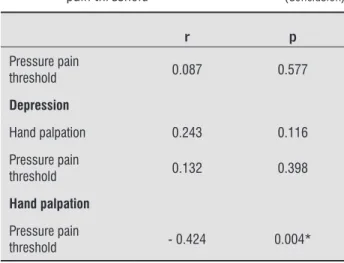
The results of correlations between anxiety, de-pression, perceived stress, pain threshold and hand palpation are as shown in Table .
Discussion
The present study selected professional women from nursing area aiming to assess the relationship between craniocervicomandibular pain and anxiety, depression and perceived stress. This choice was based on the fact that nursing is deemed to be a highly stressing profession . )t was decided to limit the research to women, as nursing is a pro-fession where there is a prevalence of the female gender , . Still, it was taken into account that disorders such as depression and anxiety are more common in women .
The majority of individuals in this study showed intermediate levels of stress, as well as other studies using the same assessment tool as this research, and other instruments conceived to assess nurses , . The presence of high level of occupational stress in only one participant in the study may be explained by the workload hours. Most of these individuals have only one employment bond. As detected previously, multiemployment and excessive workload hours are sources of stress among workers , . )n the in-termediate level, however, stress at work was found among the individuals in this sample. The study con-cluded that the more experience and identi ication with the workplace, the lesser will be the negative impact of stress . )n the present research, the bond with the institution was less than ive years for the majority of workers.
Table 2 - Mean values obtained in the evaluations of the
pain threshold to pressure and hand palpation
Muscle Pressure pain threshold
(cm2)
Hand palpation
PT 3.06 ±0.91 0;86± 1.04
UM 1.97± 0.58 0.57± 0.82
MM 1.72± 0.52 1.26 ±1.10
LM 1.73 ±0.49 1.30 ±1.11
PMR 1.24± 0.49 0.88 ±1.09
SMR 1.67 ±0.65 0.23 ±0.60
SCM 1.00 ±0.44
-SC 2.08 ±0.70
-UT 2.92± 0.81
-MT 3.20± 0.84
-SO 2.06± 0.82
-Note: Legend: AT = anterior temporal; MT = middle temporal; PT = posterior temporal; UM = upper masseter; MM: = middle masseter; LM = lower masseter; PMR = posteromandibular region; SMR = submandibular region; SCM = sternocleidomastoid; SC = scalene; UT = upper trapezius; MT = middle trapezius; SO = suboccipital
Table 3 - Correlations between perceived stress,
anxi-ety, depression, hand palpation and pressure pain threshold
r p
Perceived stress
Anxiety 0.579 0.000*
Depression 0.601 0.000*
Hand palpation 0.430 0.004*
Pressure pain
threshold 0.137 0.381
Anxiety
Depression 0.618 0.000*
Hand palpation 0.213 0.171
Table 3 - Correlations between perceived stress,
anxi-ety, depression, hand palpation and pressure pain threshold
r p
Pressure pain
threshold 0.087 0.577
Depression
Hand palpation 0.243 0.116
Pressure pain
threshold 0.132 0.398
Hand palpation
Pressure pain
threshold - 0.424 0.004*
Note: r: Spearman Correlation Coeffi cient *: statistically signifi cant difference (p<0.05)
(To be continued) (Conclusion)
)n the present study, the values obtained by as-sessing PPT for masseter muscle UM = . kg/cm , MM = . kg/cm and LM = . kg/cm and tempo-ral muscle AT = . kg/cm , MT = . kg/cm and PT = . kg/cm were similar to those determined, like the cutting point for asymptomatic patients, and patients with signs and symptoms of TMD . kg/cm for the masseter, . kg/ cm for the anterior tempo-ral, . kg/cm for the middle tempotempo-ral, and . kg/ cm for the posterior temporal muscles . Research found mean values of . kg/ cm and . kg/ cm for masseter and temporal muscles, assessed bilaterally, in healthy individuals . PPT of . kg/ cm on tra-pezius muscle was found when assessing individuals without myofascial dysfunctions , similar to the value found . kg/ cm in the present research.
As expected, among the exams performed by hand palpation and pressure algometry, there was a signi i-cant negative association, i.e., lower levels of pressure pain threshold denote higher levels of pain.
Pressure pain threshold does not correlate with any psychosocial variables studied. The values ob-tained through hand palpation do not correlate with anxiety and depression. (owever, hand palpation of the assessed muscles correlated with the level of per-ceived stress. People have different fatigue thresholds due to stress and their responses may vary, and this becomes a highly relevant factor for the appearance of illnesses or not . )t is believed that the same might happen with other psychological disturbances, such as anxiety and depression, and may be expressed by the individual in different ways.
The lack of statistical association between the val-ues obtained through algometry and the psychosocial factors assessed can be attributed to the fact that the values found through the participant’s algometry were similar to those found in studies assessing healthy and asymptomatic individuals - . Although it has been shown that the algometry ability to symp-tomatic from asympsymp-tomatic individuals was compa-rable to hand palpation , a few studies combining hand palpation and algometry have been performed. Pressure algometry, although regarded as an easy-to-apply technique and superior to the hand palpation technique, has some limitations: the patient response, pain localization and magnitude, muscle contraction level and the rate of pressure applied . Research performed showed that masticatory muscles PPT, both in symptomatic and asymptomatic individuals, was lower during a stressing event academic exam , Most women in this sample do not practice
physi-cal activity regularly . % or leisure activities . % . The absence of such activities hinders the dissipation of physical and emotional tensions stemming from the workplace. The bene icial effect of physical activity on anxiety and depression was demonstrated . Furthermore, strategies for adap-tation to stress can be promoted through the practice of relaxation exercises .
This research results have revealed a low moder-ate level of perception of stress. This can be relmoder-ated to the intermediate level of exposure to occupational stress referred by most participants . % . Also, the perception of stress may vary depending on the moment of assessment, e.g., the individual’s working days. (igher levels of perceived stress are found when the individual works on the weekends . Although the participants worked on weekends, no assessment was performed on these days.
)n this study, . % of professionals showed anxi-ety, and . % showed depression, veri ied through (ADS. )n a similar way, % and . % anxiety and de-pression, respectively, were found in clinical nurses in a hospital . By using the (ADS clinical cutoff, where individuals are rated as with or without anxiety and/ or depression, . % of sample show anxiety, and
References
. Fillingim RB, Ohrbach R, Greenspan JD, Knott C, Dub-ner R, Bair E, et al. Potential psychosocial risk factors for chronic TMD: descriptive data and empirically identi ied domains from the OPPERA case-control study. J Pain. ; :T -T .
. Christensen J, Knardahl S. Work and neck pain: a pro-spective study of psychological, social, and mechanical risk factors. Pain. ; : - .
. Cathcart S, Wine ield A(, Lushington K, Rolan P. Stress and tension-type headache mechanisms. Cephalalgia.
; : - .
. Schreiber KL, Martel MO, Shnol (, Shaffer JR, Greco C, Viray N, et al. Persistent pain in postmastectomy pa-tients: comparison of psychophysical, medical, surgi-cal, and psychosocial characteristics between patients with and without pain. Pain. ; : - . . Pinheiro RC, Uchida RR, Mathias LADST, Perez MV,
Cordeiro Q. Prevalence of depressive and anxi-ety symptoms in patients with chronic pain. J Bras Psiquiatr. ; : - .
. (abibi E, Taheri MR, (asanzadeh A. Relationship be-tween mental workload and musculoskeletal disor-ders among Alzahra (ospital nurses. )ran J Nurs Mid-wifery Res. ; : - .
. Magnago TSBS, Lisboa MTL, Griep R(, Kirchhof ALC, Guido LA. Aspectos psicossociais do trabalho e distúrbio musculoesquelético em trabalhadores de enfermagem. Rev Lat Am Enfermagem. ;
: - .
. Kindler S, Samietz S, (oushmand M, Grabe (J, Bern-hardt O, Biffar R, et al. Depressive and anxiety symp-toms as risk factors for temporomandibular joint pain: a prospective cohort study in the general popula-tion. J Pain. ; : - .
. Al-Makhaita (M, Sabra AA, (afez AS. Predictors of work-related stress among nurses working in pri-mary and secondary health care levels in Dammam, Eastern Saudi Arabia. J Family Community Med. ;
: - .
. Najimi A, Goudarzi AM, Shari irad G. Causes of job stress in nurses: A cross-sectional study. )ran J Nurs Midwifery Res. ; : - .
showing a relationship between stress and anxiety levels and muscular sensitivity level . Perhaps, different results could be found if the sample was as-sessed at other times. (ealthy individuals asas-sessed consecutively and after six months, showed different pressure pain thresholds in each assessment .
Accordingly, it is believed that this study sample has shown more psychological than physical reper-cussions related to occupational stress. Also, physical symptoms may be present in other sites in the body, not in the craniocervical region, as assessed in this study. Signi icant correlations between back pain and psychosocial factors have been found.
Of note, the present study had some constraints, such as the reduced sample size and the fact that it was constituted mainly by professionals working for a short time in the institution, and with intermediate levels of occupational stress. Moreover, just one as-sessment tool was used for each psychosocial variable.
Subsequent research is recommended that as-sesses the overall effect of stress on pain in different body sites as well as in individuals with high levels of exposure to stress at work.
This study made it possible to ind psychologi-cal changes caused by exposure to stress at work. Symptoms of anxiety and depression may not only negatively affect an individual well-being, but also gen-erate a decrease in labor productivity among these individuals. The chronicity of exposure to stress at work added to psychological manifestations may be expressed in the long term under the form of pain, thus generating additional personal and labor damage.
Therefore, it becomes evident the need for the ap-plication of awareness measures and stress control, thus preventing future damage to health.
Conclusion
. Gomes MB, Guimarães FC, Guimarães SMR, Neves ACC. Limiar de dor à pressão em pacientes com cefaléia tensional e disfunção temporomandibular. Braz Dent Sci. ; : - .
. Guido LA, Linch GFC, Pithan LO, Umann J. Estresse, coping e estado de saúde entre enfermeiros hospitala-res. Rev Esc Enferm USP. ; : - . . Liu WW, Pan FC, Wen PC, Chen SJ, Lin S(. Job Stressors
and Coping Mechanisms among Emergency Depart-ment Nurses in the Armed Force (ospitals of Tai-wan. )nt J (uman Soc Scis. ; : - . . Cavalheiro AM, Moura Junior DF, Lopes AC. Estresse
de enfermeiros com atuação em unidade de terapia in-tensiva. Rev Lat Am Enfermagem. ; : - . . Lindwall M, Gerber M, Jonsdottir )(, Börjesson M,
Ahlborg Jr G. The relationships of change in physi-cal activity with change in depression, anxiety, and burnout: A longitudinal study of Swedish healthcare workers. (ealth Psychol. ; : - . . Purcell SR, Kutash M, Cobb S. The relationship
be-tween nurses' stress and nurse staf ing factors in a hospital setting. J Nurs Manag. ; : - . . Taghinejad (, Suhrabi Z, Kikhavani S, Jaafarpour M,
Azadi A. Occupational mental health: A study of work-related mental health among clinical nurses. J Clin Diagn Res. ; : - .
. Schmidt DRC, Dantas RAS, Marziale M(. Anxi-ety and depression among nursing professionals who work in surgical units. Rev Esc Enferm USP.
; : - .
. Flo E, Pallesen S, Magerøy N, Moen BE, Grønli J, Nor-dhus )(, et al. Shift work disorder in nurses–assess-ment, prevalence and related health problems. PloS One. ; :e .
. Medeiros Neto CF, Almeida GA, Ramos BC, Costa SKP, Silva (PAD, Sousa MBC. Análise da percepção da fadiga, estresse e ansiedade em trabalhadores de uma indústria de calçados. J Bras Psiquiatr.
; : - .
. Moreira DP, Furegato ARF. Estresse e depressão entre alunos do último período de dois cursos de enferma-gem. Rev Lat Am Enfermaenferma-gem. ; spe : - . . Mehrabi T, Azadi F, Pahlavanzadeh S, Meghdadi, N. The
effect of yoga on coping strategies among intensive care unit nurses. )ran J Nurs Midwifery Res. ;
: - .
. Dalri RCMB, Silva LA, Mendes AMOC, Robazzi MLCC. Nurses' workload and its relation with physiological stress reactions. Nurses' workload and its relation with physiological stress reactions. Rev Lat Am En-fermagem. ; : - .
. Sharma P, Davey A, Davey S, Shukla A, Shrivastava K, Bansal, R. Occupational stress among staff nurses: Controlling the risk to health. )ndian J Occup Environ Med. ; : - .
. Yu J, Ren X, Wang Q, (e L, Wang J, Jin Y, et al. The role of social support on occupational stress among hospital nurses. )nt J Clin Exp Med. ; : - . . Weber P, Corrêa ECR, Bolzan GP, Ferreira FS, Soares
JC, Silva AMT. Mastigação e deglutição em mulheres jovens com desordem temporomandibular. CoDAS.
; : - .
. Schmidt DRC, Dantas RAS, Marziale M(P, Laus AM. Estresse ocupacional entre pro issionais de enferma-gem do bloco cirúrgico. Texto Contexto Enferm. ;
: - .
. Cohen S, Karmack T, Mermelsteinm R. A global mea-sure of perceived stress. J (ealth Soc Behav. ;
: - .
. Botega NJ, Bio MR, Zomignani MA, Garcia C Jr, Pereira WA. Mood disorders among inpatients in ambulatory and validation of the anxiety and depression scale (AD. Rev Saude Publica. ; : - . . Dworkin SF, LeResche L. Research diagnostic criteria
for temporomandibular disorders: review, criteria, examinations and speci ications, critique. J Cranio-mandib Disord. ; : - .
. Conti PCR, Silva RS, Araujo CRP, Rosseti LMN, Yassuda S, Silva ROFD, et al. Effect of experimental chewing on masticatory muscle pain onset. J Appl Oral Sci.
; : - .
. Vedolin GM, Lobato VV, Conti PCR, Lauris JRP. The impact of stress and anxiety on the pressure pain threshold of myofascial pain patients. J Oral Rehabil.
. Gomes RK, Oliveira VB. Depressão, ansiedade e su-porte social em pro issionais de enfermagem. Bol Psicol. ; : - .
. Silva RS, Conto PCR, Lauris JRP, Silva RO, Pegoraro LF. Pressure pain threshold in the detection of mastiga-tory myofascial pain: an algometer-based study. J Oro-fac Pain. ; : - .
. Fredriksson L, Alstergren P, Kopp S. Absolute and relative facial pressure-pain thresholds in healthy individuals. J Pain. ; : - .
. Fischer AA. Pressure algometry over normal muscles. Standart values, validity and reproducibility of pres-sure threshold. Pain. ; : - .
. Gomes MB, Guimarães JP, Guimarães FC, Neves ACC. Palpation and pressure pain threshold: reliability and validity in patients with temporomandibular disor-ders. Cranio. ; : - .
. Jensen R, Rasmussen BK, Pedersen B, Lous ), Olesen J. Cephalic muscle tenderness and pressure pain thresh-old in a general population. Pain. ; : - .
Received: / / Recebido: 06/07/2014