Effectiveness of a Vestibular Rehabilitation Protocol
to Improve the Health-Related Quality of Life and
Postural Balance in Patients with Vertigo
Heloísa Freiria Tsukamoto
1Viviane de Souza Pinho Costa
2Rubens Alexandre da Silva Junior
2Gislaine Garcia Pelosi
3Luciana Lozza de Moraes Marchiori
2Cláudia Regina Sanches Vaz
4Karen Barros Parron Fernandes
2,51Department of Physical Therapy, Universidade Norte do Paraná (UNOPAR), Centro Universitário Filadélfia, Londrina, Paraná, Brazil 2Biological and Health Sciences Research Center, Universidade Norte
do Paraná (UNOPAR), Londrina, Paraná, Brazil
3Department of Physiological Sciences, Universidade Estadual de Londrina (UEL), Londrina, Paraná, Brazil
4Otorhinolaryngology Clinic, Londrina, Paraná, Brazil
5School of Medicine, Pontifícia Universidade Católica do Paraná (PUC-PR), Londrina, Paraná, Brazil
Int Arch Otorhinolaryngol 2015;19:238–247.
Address for correspondence Karen Barros Parron Fernandes, PhD, Centro de Pesquisa em Ciências da Saúde, Universidade Norte do Paraná, Rua Marselha, 591, Jd. Piza, Londrina, Paraná, 86041-140, Brazil (e-mail: [email protected]).
Keywords
►
dizziness
►
rehabilitation
►
quality of life
►
postural balance
►
medicines
Abstract
Introduction
Dizziness can be characterized as a balance disorder that causes
discomfort, leading to several functional limitations. Currently, vestibular rehabilitation
has been highlighted as a possible treatment.
Objective
Analyze the effects of completing a vestibular rehabilitation treatment
proto-col on quality of life and postural balance in patients with vestibular complaints, as well as to
compare these effects between the patients taking or not taking antivertigo drugs.
Methods
A nonrandomized controlled trial was performed with 20 patients previously
diagnosed with vestibular diseases. Information regarding vertigo symptoms, quality of
life as assessed through the Dizziness Handicap Inventory, visual analog scale of
dizziness, and stabilometry using force platform was collected. Patients were treated
for 12 weeks by a custom protocol. The sample was divided into two groups according to
the use (medicated group,
n
¼
9) or not (control group,
n
¼
11) of antivertigo drugs.
Results
There was improvement in quality of life (
p
<
0.001) and intensity of dizziness
(
p
¼
0.003) with the intervention. An improvement of postural balance was observed
through functional tests. However, no statistically signi
fi
cant difference was noted in
stabilometry. When both groups were compared, no statistically signi
fi
cant differences
between the variations of the variables analyzed were found in the re-evaluation session.
Conclusion
Quality of life and postural balance are improved with intervention.
However, this improvement is not associated with pharmacologic treatment.
received
September 17, 2014 accepted
January 10, 2015 published online May 6, 2015
DOI http://dx.doi.org/ 10.1055/s-0035-1547523. ISSN 1809-9777.
Copyright © 2015 by Thieme Publicações Ltda, Rio de Janeiro, Brazil
Introduction
Defined as an illusion of movement of either the individual or his or her surrounding environment, dizziness can be characterized as a sensation of loss of balance in the body, due to the conflict of information between the sensory information originating in the vestibular, visual, and proprioceptive systems.1Such a symptom can negatively influence the well-being of individuals of both genders in different ages.2,3
According to Ganança et al,4dizziness is considered the second most prevalent symptom until the age of 65 years. After that age, it is the most common one, present in 80% of individuals over 75 years old. Hanley et al noted that the vertiginous syndromes represent 10.7 in every 1,000 medical consultations in the morbidity statistics for general practice in England.5 Neuhauser et al affirm that although these symptoms are more frequent in health primary care settings, they are often underestimated by professionals, who do not further investigate the symptoms.6
Together, discomfort, reduced motor capacity, and psy-chological suffering lead to functional limitations in personal care, tasks, and daily life activities, especially during the performance of tasks that require some postural balance, quick cephalic rotations, and good dynamic visual acuity.7–9 In such a context, frequent vestibular dysfunction affects life in family, professional, and social activities, causing losses in the individual's quality of life (QOL).10
Agus et al reported that there was still little agreement on the treatment and control of those symptoms.11 Depending on their etiology, vestibular dysfunctions may be treated with pharmacotherapy, physiotherapy, psycho-therapy, and, rarely, surgery.12For a long time, prescribing drugs for every person with vertiginous complaints, with no discrimination of the presented signs and symptoms, was common practice. Ganança et al stated that these monotherapeutic strategies may not be enough to solve vestibular complaints completely, in addition to predispos-ing the individual to the occurrence of side effects and addiction when use is prolonged.13
Currently, among the described forms of treatment to manage those dysfunctions, both in the acute and chronic stages, is a physiotherapeutic approach through vestibular rehabilitation (VR),5,7,14–19which aims at reducing dizziness and body instability. VR is a low-cost and effective strategy in the treatment of vestibular disorder.
VR wasfirst used in Brazil approximately two decades ago, with accounts of complete cure in 30% of cases and different levels of progress for 85% of the individuals. Therefore, according to Ricci et al,20VR is not an etiologic treatment. Yet, these exercises allow new rearrangements of peripheral sensory information to happen.4,21
Through neuroplasticity, this therapy aids in obtaining the so-called vestibular compensation, aiming at mitigation or elimination of unpleasant symptoms im-posed by vestibular pathologies. Its proim-posed action is based on known mechanisms of adaptation, habituation, and substitution. Compensation is characterized by the
sequence of plastic peripheral and central phenomena that occur after a vestibular lesion, with the purpose of re-establishing the system's function (i.e., the maintenance of the body balance).20
In the adaptation, the vestibular system learns to receive and process information—though distorted and incomplete—suiting it to the stimuli presented, promoting neural modifications. Habituation consists of a reduction of sensorial responses, due to the repetition of stimuli that, once becoming automatic, decreases vestibular response failures. Substitution occurs when sensory afferents are replaced. Through the visual and proprioceptive systems, information that is absent or that con-flicts with the control of balance is substituted.22–24
VR attempts to improve the competence and well-being of the individual who has a vestibular pathology in the perfor-mance of daily life activities. It also aims at restoring spatial orientation as much as possible. It stimulates visual stabiliza-tion, reduces discomfort during head movements, and leads to greater stability in body posture, both when moving and while resting.9,25,26
Standardized VR protocols may not meet all functional ne-cessities of patients with vestibular complaints. Thus, accord-ing to Morozetti et al,9 the combination of different therapeutic resources produces superior results, with less chance of recurrence. Therefore, to verify the contribution in the treatment of vestibular complaints, an adapted VR proto-col was used in this study. This protoproto-col involves activities aimed at assuring that the adaptation, habituation, and substitution mechanisms are facilitated, promoting the nec-essary neural plasticity for the individual’s recovery.
In this context, the objectives to this study were: (1) analyzing the effectiveness in applying an adapted protocol for VR in QOL and postural balance of individuals who reported vestibular complaints, and (2) comparing these effects in individuals who were and who were not medicated with antivertigo drugs.
Methods
The study was characterized as a nonrandomized clinical study, developed within the facilities of the Physiotherapy Clinic in the City of Londrina, State of Paraná, Brazil, from March 2012 to December 2013. The research was approved by Ethics Commit-tee for Research with Humans (report no. 177.276/12), and all participants signed an informed consent statement.
An intentional, convenient, and nonrandom sample was selected for the study, composed of individuals presenting with vestibular diseases who were referred to different medical services in the city of Londrina-PR, and who fall within the following eligibility criteria:
points or more in the Dizziness Handicap Inventory (DHI) questionnaire.
2. Exclusion criteria: individuals with severe visual and/or hearing impairment, orthopedic disorders that limited the performance of proposed activities, nervous system inju-ries that resulted in additional motor and/or sensitive damages, and/or peripheral vestibular diseases of the benign paroxysmal positional vertigo type or Meniere disease.
In total, 44 individuals who reported vestibular com-plaints were evaluated. Twenty of those participants did not complete the 12 proposed treatment sessions for sev-eral reasons: moving to another town/city, personal and/or family-related reasons, unavailability of time due to work, among other reasons. Thus, 24 individuals completed the VR protocol proposed in the study. However, two partic-ipants were excluded because they were absent more than three times and two other patients were excluded for using flunarizine, considering that its sedative effect could be a bias as it may impair the rehabilitation process. Finally, 20 participants constituted the two groups for the analysis: (1) the medicated group (MG), formed by individuals taking antivertiginous drugs (prescribed by doctors who referred them to physiotherapy service), and (2) control group (CG), formed by individuals who did not take anti-vertiginous drugs in the period they participated in the study (►Fig. 1).
Study Proceedings
The selected participants were initially evaluated with the following instruments:
• Participant's identification record, collecting personal data, anamnesis, data from complementary otological examinations, personal background, and main complaint. • Evaluation record of vertigo symptoms, obtained through interview with the patient, with the objective of question-ing individuals on the followquestion-ing variables: time of clinical evolution, characteristics, duration and periodicity of diz-ziness, and associated neurovegetativesymptoms.22,25 • DHI questionnaire, to evaluate the self-perception of the
disabling effects imposed by dizziness on QOL. The minimal score is 0 and the maximum possible is 100 points. The greater the score, the worse the vestibular patient's percep-tion of QOL. Classification of the dysfunction was established by Yorke et al in the following way: slight dysfunction (16 to 34 points), moderate dysfunction (36 to 52 points), and severe dysfunction (over 54 points).26Aquaroni Ricci et al reported that reduction in the total score of 18 or more points is considered a significant improvement in the QOL.27 • VAS to assess dizziness and to measure the intensity of
vertigo symptoms, ranging in a numerical scale from 0 to 10, in which 0 indicates the absence of dizziness and 10 the worst intensity of dizziness.28
• Timed Up and Go test (TUG), which evaluates risk of falling. Beginning at a seated position, the progress from sitting to
standing position is analyzed, including the stability and change of course, without making use of compensatory strategies. With the performance measured through the time (in seconds) necessary to take the test, the examiner asks the individual to stand up unassisted from a chair that he or she was totally supporting him- or herself and walk 3 m, turn, return onto the same path, and sit again on the chair with his or her back upheld. The average from the three attempts in the test was adopted.
• Functional Reach test (FRT), a mobility test with emphasis on the evaluation of balance. The individual is asked to stand, sideward to a wall, with shoulder in 90-degreeflexion and upper limbs in extension. Afterward, the individual is asked to make an anterior trunkflexion, so that his or her heels do not lose contact with the ground. Performance is measured by the distance of body displacement (in centimeters), consid-ering the average of the three attempts in the test.
• Single leg stance test, to evaluate the static and functional balance, in which the individual is asked to stand on a single foot based on the ground (the side is chosen by the patient). Proof is considered negative when the individual can remain in this position for 30 seconds without chang-ing the supportchang-ing base. If case proof is positive, the time in seconds that the individual could keep in the test position is recorded.
• Postural control, with a force platform named BIOMEC400 (EMG System do Brazil, SP Ltda.), with data sampled at 100 Hz.29The variables used were pressure center area (COP area, in cm2), average speed of COP (in cm/s), amplitude (in
cm) and average frequency of COP (in Hz) in both motion directions: anteroposterior (A/P) and medial-lateral.
Participants were evaluated in the orthostatic position, in four distinct conditions: (1) bipedal support, with feet aligned, eyes open; (2) bipedal support, with feet aligned, with head rotation to the right and to the left, following audible feedback, using a metronome; (3) bipedal support, in semi-tandem position (right foot forward the left foot or the contrary, according to the participant's preference), eyes open (EC) and (4) eyes closed (EC). For each posture, the patient should remain on the force platform for 30 seconds. Two collecting procedures were made for tests 2 and 3, with a 30-second interval between them. Only one attempt was made for test 1. The order of postures was obtained by means of simple randomization (raffle), done by the patient him- or herself before the tests began.
The subjects were evaluated barefoot, with upper limbs relaxed beside the body, head positioned horizontally to the ground plane, eyes staring a targetfixed on the wall at the same level of the eyes, in frontal distance of 2.5 m (8.2 ft) for tests with open eyes.29
Intervention
Patients were treated for 12 weeks, with more than one adapted protocol for VR, idealized by the authors of the study, based upon the following activities: cervical manual therapy exercises and shoulder girdle exercises, Cawthorne-Cooksey protocol exercises, and proprioceptive and balance training.
Guidelines were also given on the performance of daily home exercises to complement the proposed treatment.
Cervical manual therapy and shoulder girdle exercises were introduced due to the osteoarticular pathophysiological mechanisms of the upper cervical spine (as osteophytes and atlanto-occipital instability), which may cause dizziness as a result of cervical proprioception changes.25It is important to highlight that the cervical region is one of the most important sources of proprioceptive information from the vestibular nuclei,30 and the introduction of exercises for this body segment aims at promoting vestibular adaptation in addition to muscle relaxation.
The cervical manual therapy and shoulder girdle therapy were applied in all treatment sessions, as an initial exercise. In thefirst four sessions of 30 minutes, activities were done in lateral decubitus and dorsal decubitus positions. Among the exercises were passive mobilization of the scapula; massage therapy in trapezius, rhomboids, scalenes, sternocleidomas-toid, and pectoralis major muscles; passive stretching of neck and upper limb muscles; and pompages. From thefifth to the eighth session, manual therapy was reduced to 20 minutes. Form the ninth to the twelfth session, to 10 minutes.
The Cawthorne-Cooksey protocol consists of exercises that involve head movements, eye coordination tasks, overall body movements, and balance tasks,31which are important to pro-mote habituation and adaptation. These exercises were intro-duced in the adapted protocol and performed in the dorsal and lateral decubitus positions for thefirst treatment sessions and, posteriorly, in sitting position. In thefinal treatment sessions, these exercises were associated with the proprioception and balance activities in the orthostatic posture.
Finally, proprioceptive and balance trainings were per-formed in different environmental conditions as of the sev-enth session. These exercises involve substitution mechanisms, because in vestibular disorders, the normal abilities may be recovered through the increase in activities of other systems, such as the visual and proprioceptive systems.15 Therefore, to do these activities, therapeutic resources such as mats, foam of density 30, trampoline, equalizer, and square board were used, associating tasks with open and closed eyes, bipedal and one foot support, walking forward and in reverse.
Treatment sessions were individual, lasted 60 minutes once per week, and were performed for 12 consecutive weeks by a specialist professional physiotherapist.
Reassessment
At the end of the 12 sessions, patients were reassessed using the following evaluation tools: DHI questionnaire, VAS to assess dizziness, TUG, FRT, one-foot support test, and stabilometry.
Besides these tests, all patients answered the question:“Do you consider that today, at the end of 12 treatment sessions, your symptoms . . .”to which three answers were possible: (1)“got better”; (2)“remained unchanged”; or (3)“got worse.”
Data Analysis
Social Sciences (SPSS, Chicago, IL, USA) version 20.0 and Microsoft Office Excel for Windows 2007(Microsoft Corp., Redmond, Washington, United States).
To verify normality of the data, the Shapiro Wilk test for the numerical variables was used. To analyze the differences between the parameters assessed before and after the inter-vention for the total sample, the Wilcoxon test was used, once the assumption of normality was not met.
The comparison between the groups was made by analysis of variation in data, measured in the initial andfinal assess-ments (variation¼final value initial value). Once that was done, if the assumption of normality was not met for all varieties, the Mann-Whitney test was used. The chi-square test was used to verify the existence of association among the categorical variables.
Finally, to verify the effect size (d), the following formula was used:d¼(x1 x2)/averages of the standard deviations (SDs), wherex1is the average of the analyzed variable in the initial
assessment, andx2is the average of the analyzed variable in the
final assessment. The average to the SDs was calculated through the arithmetic mean of the standard deviations related to the initial and final assessment: (SD1þSD2)/2. A confidence
interval of 95% was established and significance level of 5% (p<0.05) applied to all tests.
Results
Twenty participants completed the 12 study protocol treat-ment sessions, 19 women (95%) and 1 man (5%). Participants’ average age was 59.6 years old (SD 13.9). The time of referred symptoms ranged from 3 to 36 years, with median of 3.5 (range 1.0 to 10.0) years. The other clinical and functional data are shown in►Table 1.
Quality of Life
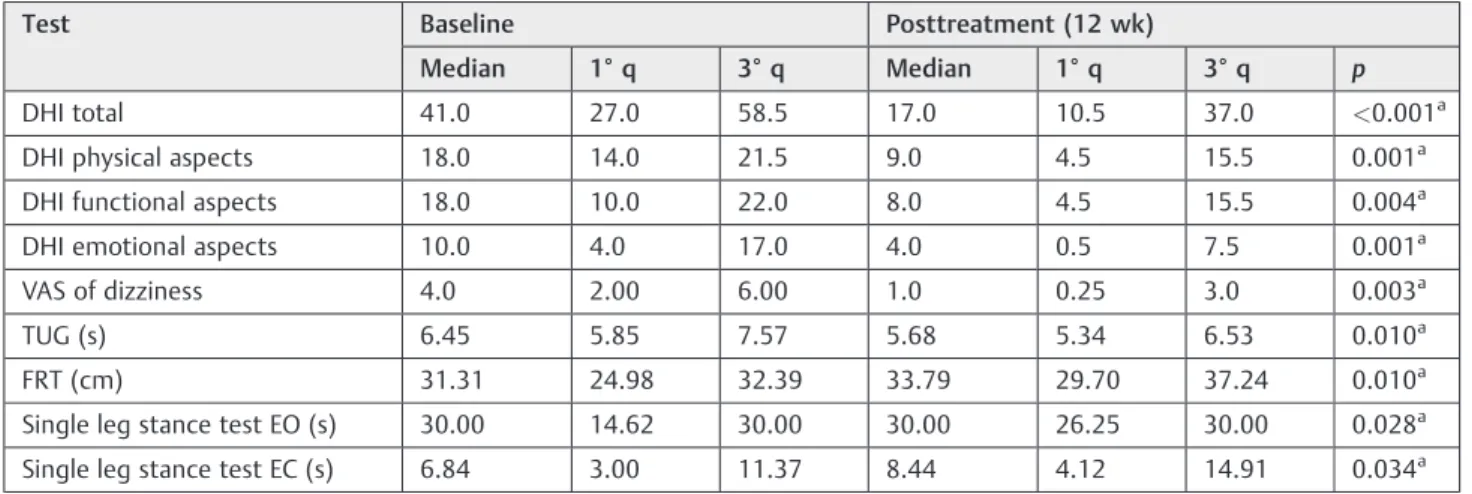
There was a reduction in the DHI questionnaire values after the treatment, not only for the total but also for the three-domain score (physical, functional, and emotional), with a statistically significant difference (►Table 2).
No participant had a score of 0 in thefinal assessment. However, there was a reduction the scores of 19 patients (95%), with maintenance of score in 1 woman (5%). Never-theless, only 8 participants (40%) obtained a reduction greater than 18 points. Four of those (20%) initially had a disorder classified as severe. Thus, 8 individuals (40%) changed from a moderate or severe condition to a better classification by the end of the intervention (►Table 3).
Intensity of Dizziness
A statistically significant difference was observed in the evaluation of the dizziness intensity, measured through VAS to assess dizziness before and after the intervention. In the initial assessment, 3 individuals (15%) reported intense dizziness; 12 (60%), moderate dizziness; and 5 (25%), slight dizziness. In the reassessment, 5 individuals (25%) presented score equals to 0 in the VAS to assess dizziness, and the 3 participants who initially reported intense dizziness showed an important reduction in values: 1 was reclassified as slight
dysfunction and 1 as moderate dysfunction.►Table 2shows a comparison of clinical and functional parameters evaluated before and after the intervention (n¼20).
Physical and Functional Assessments
There was a statistically significant difference in the assess-ment of the functional capacity favoring the intervention in the tests TUG, FRT, EO, and EC when compared with the values in the initial andfinal assessments (►Table 2).
Postural Balance
In the assessment of postural balance by analysis of COP, the residence time in the reassessment was 30 seconds for every test in all participants. One notes that the statistically signifi -cant differences favoring the intervention were found only for two analyzed parameters, especially regarding the movement A/P (►Table 4).
Effect Size
In the analysis of the effect size, the following values for the study variables were found: DHI total (d¼1.24); physical aspects (d¼1.34); functional aspects (d¼1.00); emotional aspects (d¼1.04); VAS to assess dizziness (d¼1.10); TUG (d¼0.31); FRT (d¼0.59); EO (d¼0.18); and EC (d¼0.52).
Use of Antivertigo Medications
Nine participants used antivertigo medications (group MG) under medical prescription, and the other 11 participants did not use any class of drugs for that purpose (group CG). The most commonly used medication was betahistine dihydro-chloride by 8 participants (88.9%).
Comparison between Groups
Finally, in the comparison between groups MG and CG at the end of the intervention, there was no statistically significant differ-ence in the analysis of DHI, VAS to assess dizziness, the physical-functional tests of balance, and the stabilometry (p>0.05).
There was no association between use of medication and the categorical variables of the study: main complaint (p¼0.86), period of crisis (p¼0.34), periodicity of crisis (p¼0.74), char-acterization of crisis (p¼0.17), duration of crisis (p¼0.40), and associated neurovegetative symptoms (p¼0.36).
When questioned on the symptoms after completing the 12 individual treatment procedures, 18 participants (90%) reported improvement. Symptoms remained unchanged for 2 participants (10%) after the treatment. Both participants belonged to the CG group.
Discussion
dizziness (assessed by dizziness VAS) in 20 individuals sub-jected to two different VR protocols.9 That same study highlighted that the group treated with a personalized pro-tocol presented significant improvements in comparison with the group treated only with ocular exercises.9Thesefindings emphasize the importance of proposing a differentiated exercise protocol for the treatment of vestibular complaints, with activities that are complementary to those recom-mended by the standard protocols provided by literature, as was implemented in this research.
Ricci et al explained in their systematic review that VR helps in obtaining the vestibular compensation by means of central mechanisms of neuroplasticity, with the objective to soften or eliminate the vestibular symptoms.20Therefore, VR has been considered a safe option once it does not present risks of side effects. Besides being cost-effective and effi -cient,18,21,27,32,33it obtains positive results through training composed of exercises that stimulate repetitive movements of eye, head, and trunk, combined with conventional
phys-iotherapeutic resources, such as cervical manual therapy, proprioception and balance exercises, and postural care.
Ganança et al reported that although there are several options to relieve or eliminate dizziness and its associated symptoms, the therapeutic regimen must be designed based on the individual’s specific vestibular trouble, taking into account the elimination of the underlying diseases, control of vertigo and related neurovegetative and psychoaffective symptoms, improvement in the vestibular compensation, and prevention of the aggravating factors.13 A rapid onset of therapeutic action is essential for the patient’s well-being, and the treatment must be well tolerated by the individuals, with a low incidence of adverse effects.
Regarding the ideal number of VR sessions, Rossi-Izquierdo et al reported improvement (using DHI and dynam-ic posturography) afterfive intervention sessions.34Bayat et al also made use of DHI in the assessment of elderly individu-als subjected to a VR protocol based on Cawthorne and Cooksey exercises for 2 months.35They found that VR is an
Table 1 Baseline clinical data (n¼20)
Measure Categories Absolute frequency (n) Relative frequency (%)
Gender Female 19 95
Male 1 5
Age (y) 20–40 2 10
41–60 7 35
61–80 9 45
>80 2 10
Time of clinical evolution (y) <1 7 35
1–10 10 50
10–20 1 5
>20 2 10
Main complaint Dizziness 10 50
Dizziness and tinnitus 4 20
Dizziness and heavy head 6 30
Period of dizziness Anytime 12 60
Morning/afternoon 5 25
Evening/dawn 3 15
Periodicity of dizziness Daily 12 60
Weekly 4 20
Monthly/sporadic 4 20
Duration of dizziness Seconds/minutes 9 45
Hours/days 11 55
Characteristics of dizziness Unbalance 7 35
Vertigo 5 25
Unbalance and vertigo 5 25
Unbalance and obscured vision 3 15
Associated symptoms Yes 19 95
effective therapeutic method in the treatment of the elderly with chronic vestibular dysfunction. Considering that a great-er pgreat-eriod of intgreat-ervention could increase the clinical results, in this study we chose 12 treatment sessions. However, a greater frequency of weekly sessions might increase the results obtained in the final assessment of the sample or might promote gains in a shorter time period of intervention. Besides the benefits of VR on QOL, a positive impact on the results of the physical-functional assessments was also ob-served, in accordance with Giray et al and Jung et al.36,37 McGibbon et al reported the use of tai chi as a therapeutic option to increase the gain over the postural balance and, consequently, improve these individuals' QOL.38Meldrum et al studied the use of virtual reality, with Nintendo Wii Fit Plus (USA) games, as a low-cost and playful intervention that may help the individuals' adherence to the proposed VR treat-ment.16 Aquaroni Ricci et al incremented Cawthorne and Cooksey's standardized protocol with activities that include exercise offlexibility, muscle strength, cognition, and senso-rial interaction.27
However, in the analysis of postural control on the force platform, only six evaluated parameters presented statisti-cally significant differences favoring the intervention. Still, some parameters had afinal median greater than the initial value—for instance, the COP variable in the bipedal support with head rotation (BHR) test. At the end of the treatment,
those individuals who presented greater amplitude in cervi-cal rotation (effect of the manual cervicervi-cal therapy and scapu-lar waist) may have greater body displacement during the test on the force platform.
It is also convenient to mention that four different statisti-cally significant forces were verified in the A/P direction variable, which might have occurred because the propriocep-tive and balance training exercises were performed mainly with body displacements in the A/P direction, such as walking forward and backward. So, special attention must be paid to exercises focusing lateral motions.
According to Horak,8the most important role to postural control in the vestibular formation is the control of head and trunk orientation in space in relation to the gravitational force, because vestibular sensorial references are extremely important in the postural control for high frequencies and velocities of body motion. At the end of the study, among the conditions to the tests performed on the force platform—with the exception of bipedal support with head rotation—all involved the maintenance of an elastic position, which did little to assess the contribution of the vestibular system in the maintenance of the postural balance. Thus, the introduction of dynamic conditions in the assessment made on a force platform, involving situations of body movement or the exterior environment, may enable the verification of gains in vestibular compensation.
Table 2 Comparison of clinical and functional parameters evaluated before and after the intervention (n¼20)
Test Baseline Posttreatment (12 wk)
Median 1° q 3° q Median 1° q 3° q p
DHI total 41.0 27.0 58.5 17.0 10.5 37.0 <0.001a
DHI physical aspects 18.0 14.0 21.5 9.0 4.5 15.5 0.001a
DHI functional aspects 18.0 10.0 22.0 8.0 4.5 15.5 0.004a
DHI emotional aspects 10.0 4.0 17.0 4.0 0.5 7.5 0.001a
VAS of dizziness 4.0 2.00 6.00 1.0 0.25 3.0 0.003a
TUG (s) 6.45 5.85 7.57 5.68 5.34 6.53 0.010a
FRT (cm) 31.31 24.98 32.39 33.79 29.70 37.24 0.010a
Single leg stance test EO (s) 30.00 14.62 30.00 30.00 26.25 30.00 0.028a
Single leg stance test EC (s) 6.84 3.00 11.37 8.44 4.12 14.91 0.034a
Abbreviations: 1° q,first quartile (25%); 3° q, third quartile (75%); DHI, Dizziness Handicap Inventory; EC, eyes closed; EO, eyes open; FRT, Functional Reach test; TUG, Timed Up and Go test; VAS, visual analog scale.
a p<0.05.
Table 3 Classification of vestibular dysfunction by DHI in baseline and posttreatment
Baseline Posttreatment (12 wk)
Slight Moderate Severe Total
Slight 7 0 0 7
Moderate 4 3 0 7
Severe 4 1 1 6
Total 15 4 1 20
Despite this fact, the residence time on the force platform was 30 seconds for all participants in all reassessment tests. This condition was not verified in the initial assessment. Still, the individuals provided positive reports in relation to the performance of tests, once they demonstrated they felt more comfortable to perform the tasks.
In this study, when groups MG and CG were compared, it was possible to notice the improvement in vestibular symp-toms regardless of the pharmacological treatment with
anti-vertigo drugs. According to Fabiani et al,39antivertigo drugs must be reasonably used for the shortest time possible, due to the side effects arising from their prolonged use (i.e., the risk of Parkinsonism). One must be careful due to the interference these symptomatic drugs promote over the compensation that naturally occurs by the central nervous system, especial-ly in vertigo cases that last for more than a couple of days.16 According to Santos et al,22in their study with the elderly who complained about dizziness, the use of antivertigo drugs
Table 4 Comparison of stabilometric parameters evaluated before and after intervention (n¼20)
Test Baseline Posttreatment (12 wk)
Median 1°q 3° q Median 1° q 3° q p
BEO
COP (cm2) 1.30 0.80 3.83 1.21 0.91 2.10 0.41
VEL A/P (cm/s) 0.83 0.64 1.20 0.76 0.66 0.95 0.36
VEL M/L (cm/s) 0.61 0.50 0.75 0.58 0.51 0.72 0.51
AMP A/P (cm) 1.97 1.40 2.98 1.78 1.29 2.08 0.03a
AMP M/L (cm) 1.09 0.77 2.10 1.18 0.82 1.45 0.94
FM A/P (Hz) 0.34 0.24 0.51 0.32 0.24 0.49 0.92
FM M/L (Hz) 0.38 0.27 0.60 0.50 0.33 0.53 0.39
BHR
COP (cm2) 2.90 1.73 5.47 3.10 1.70 4.60 0.85
VEL A/P (cm/s) 1.16 0.96 1.49 1.10 0.91 1.32 0.26
VEL M/L (cm/s) 0.90 0.69 1.13 0.86 0.75 0.98 0.52
AMP A/P (cm) 2.17 1.99 3.38 2.39 1.96 2.80 0.43
AMP M/L (cm) 1.95 1.17 2.17 1.87 1.51 2.39 0.88
FM A/P (Hz) 0.43 0.33 0.51 0.48 0.35 0.57 0.12
FM M/L (Hz) 0.44 0.32 0.54 0.41 0.36 0.49 0.50
STEO
COP (cm2) 4.24 3.11 7.13 3.07 2.21 5.42 0.13
VEL A/P (cm/s) 1.43 1.19 1.84 1.31 1.14 1.52 0.76
VEL M/L (cm/s) 1.26 1.14 1.48 1.22 1.11 1.37 0.95
AMP A/P (cm) 2.53 2.26 3.52 2.24 1.84 2.73 0.04a
AMP M/L (cm) 2.90 2.36 3.52 2.78 2.28 3.04 0.38
FM A/P (Hz) 0.55 0.46 0.67 0.61 0.57 0.68 0.07
FM M/L (Hz) 0.40 0.37 0.46 0.42 0.38 0.50 0.46
STEC
COP (cm2) 6.99 3.80 13.10 4.99 3.69 8.16 0.23
VEL A/P (cm/s) 2.00 1.62 2.80 1.79 1.51 2.58 >0.99
VEL M/L (cm/s) 1.80 1.54 2.52 1.88 1.70 2.38 0.21
AMP A/P (cm) 3.40 2.42 4.67 2.70 2.32 3.81 0.11
AMP M/L (cm) 3.84 3.01 4.74 3.42 2.89 4.45 0.26
FM A/P (Hz) 0.63 0.45 0.75 0.60 0.52 0.79 0.62
FM M/L (Hz) 0.48 0.39 0.52 0.48 0.41 0.60 0.06
Abbreviations: 1° q,first quartile (25%); 3° q, third quartile (75%); A/P, anteroposterior; AMP, amplitude; BEO, bipedal support with eyes open; BHR, bipedal support with head rotation; COP, pressure center area; FM, average frequency; M/L, medial-lateral; STEC, semi-tandem position with eyes closed; STEO, semi-tandem position with eyes open; VEL, average speed.
was not associated with a worse or better QOL in relation to the elderly who did not make use of them, probably because the pharmacotherapy did not have much effect in the chronic stage of uncompensated vestibular diseases. Therefore, to avoid additional harm to vestibular patients, it is necessary to performfield research that allows establishing strategies and protocols in the management of dizziness.40
One limitation of this study is the nonperformance of follow-up of participants during the posttreatment period to verify if the VR effects are maintained long term. Additionally, consider-ing the diversity of the pharmacologic treatment used, it is not possible to establish a relation between the class, dose, or type of treatment in relation to the study variables.
Future studies might compare these results to the results of individuals who are subjected to a protocol with shorter inter-vention time or greater frequency of weekly sessions, aiming at establishing an ideal and sufficient number of treatment ses-sions. Still, it is important to assess individuals with vestibular diseases, using a distinct protocol on the force platform to propose dynamic activities to better analyze the role of the vestibular information in the control of body balance.
Conclusion
QOL and postural balance improve with intervention. Yet, such improvement depends on the pharmacologic treatment. The data have clinical applicability in the sense of stressing the importance of VR for the individual with vestibular disease. Finally, this technique must be applied by a special-ized physiotherapist to promote elimination of the unpleas-ant symptoms related to this dysfunction.
References
1 Takano NA, Cavalli SS, Ganança MM, et al. Quality of life in elderly with dizziness. Braz J Otorhinolaryngol 2010;76(6):769–775
2 Bittar RS, Oiticica J, Bottino MA, Ganança FF, Dimitrov R. Popula-tion epidemiological study on the prevalence of dizziness in the city of São Paulo. Braz J Otorhinolaryngol 2013;79(6):688–698
3 Gazzola JM, Perracini MR, Ganança MM, Ganança FF. Functional balance associated factors in the elderly with chronic vestibular disorder. Braz J Otorhinolaryngol 2006;72(5):683–690
4 Ganança FF, Castro ASO, Branco FC, Natour J. Interferência da tontura na qualidade de vida de pacientes com síndrome vestibu-lar periférica. Rev Bras Otorrinovestibu-laringol 2004;70(1):94–101 Avail-able at: http://www.scielo.br/pdf/rboto/v70n1/a16v70n1.pdf
5 Hanley K, O’Dowd T, Considine N. A systematic review of vertigo in primary care. Br J Gen Pract 2001;51(469):666–671
6 Neuhauser HK, Radtke A, von Brevern M, Lezius F, Feldmann M, Lempert T. Burden of dizziness and vertigo in the community. Arch Intern Med 2008;168(19):2118–2124
7 Morettin M, Mariotto LD, Filho OAC. Evaluation of the effectiveness of rehabilitation vestibular in patients with vestibular dysfunction. Int Arch Otorhinolaryngol 2007;11(3):284–292 Available at: http:// www.internationalarchivesent.org/conteudo/pdfForl/441_eng.pdf
8 Horak FB. Postural compensation for vestibular loss and implica-tions for rehabilitation. Restor Neurol Neurosci 2010;28(1):57–68
9 Morozetti PG, Ganança CF, Chiari BM. Comparison of different protocols for vestibular rehabilitation in patients with peripheral vestibular disorders. J Soc Bras Fonoaudiol 2011;23(1):44–50
10 Funabashi M, Santos-Pontelli TEG, Colafemina JF, Grossi DB. Pro-posta de avaliaçãofisioterapêutica para pacientes com distúrbio do equilíbrio postural. Fisioter Mov 2009;23(1):509–517 Available at: http://www2.pucpr.br/reol/pb/index.php/rfm?dd1¼3386&dd99¼
view&dd98¼pb
11 Agus S, Benecke H, Thum C, Strupp M. Clinical and demographic features of vertigo: findings from the REVERT registry. Front Neurol 2013;4:48
12 Singh KR, Singh M. Current perspectives in the pharmacotherapy of vertigo. Otorhinolaryngol Clin Int J 2012;4(2):81–85 Available at: http://www.jaypeejournals.com/eJournals/ShowText.aspx?ID
¼3632&Type¼FREE&TYP¼TOP&IN¼_eJournals/images/JPLOGO.
gif&IID¼286&isPDF¼YES
13 Ganança MM, Caovilla HH, Munhoz MSL, et al. Optimizing the pharmacological component of integrated balance therapy. Braz J Otorhinolaryngol 2007;73(1):12–18
14 Soto E, Vega R. Neuropharmacology of vestibular system disorders. Curr Neuropharmacol 2010;8(1):26–40
15 Marioni G, Fermo S, Zanon D, Broi N, Staffieri A. Early rehabilita-tion for unilateral peripheral vestibular disorders: a prospective, randomized investigation using computerized posturography. Eur Arch Otorhinolaryngol 2013;270(2):425–435
16 Meldrum D, Herdman S, Moloney R, et al. Effectiveness of conven-tional versus virtual reality based vestibular rehabilitation in the treatment of dizziness, gait and balance impairment in adults with unilateral peripheral vestibular loss: a randomised controlled trial. BMC Ear Nose Throat Disord 2012;12:3
17 Strupp M, Brandt T. Current treatment of vestibular, ocular motor disorders and nystagmus. Ther Adv Neurol Disord 2009;2(4): 223–239
18 Han BI, Song HS, Kim JS. Vestibular rehabilitation therapy: review of indications, mechanisms, and key exercises. J Clin Neurol 2011; 7(4):184–196
19 Moreira Bittar RS, Simoceli L, Bovino Pedalini ME, Bottino MA. The treatment of diseases related to balance disorders in the elderly and the effectiveness of vestibular rehabilitation. Braz J Otorhi-nolaryngol 2007;73(3):295–298
20 Ricci NA, Aratani MC, Doná F, Macedo C, Caovilla HH, Ganança FF. A systematic review about the effects of the vestibular rehabilitation in middle-age and older adults. Rev Bras Fisioter 2010;14(5): 361–371
21 Hillier SL, McDonnell M. Vestibular rehabilitation for unilateral peripheral vestibular dysfunction. Cochrane Database Syst Rev 2011;3(2):CD005397
22 Santos EM, Gazzola JM, Ganança CF, Caovilla HH, Ganança FF. Impacto da tontura na qualidade de vida de idosos com vestibu-lopatia crônica. Pró-fono R Atual Cient 2010;22(4):427–432 Avail-able at: http://www.scielo.br/pdf/pfono/v22n4/en_11.pdf
23 Patatas OHG, Ganança CF, Ganança FF. Quality of life of individuals submitted to vestibular rehabilitation. Braz J Otorhinolaryngol 2009;75(3):387–394
24 Tavares FdaS, Santos MF, Knobel KA. Vestibular rehabilitation in a university hospital. Braz J Otorhinolaryngol 2008;74(2):241–247
25 Gazzola JM, Ganança FF, Aratani MC, Perracini MR, Ganança MM. Clinical evaluation of elderly people with chronic vestibular disorder. Braz Otorhinolaryngol 2006;72(4):515–522
26 Yorke A, Ward I, Vora S, Combs S, Keller-Johnson T. Measurement characteristics and clinical utility of the Dizziness Handicap Inventory among individuals with vestibular disorders. Arch Phys Med Rehabil 2013;94(11):2313–2314 Available at: http:// www.archives-pmr.org/article/S0003-9993(13)00538-8/pdf
28 Bittar RS, Pedalini ME, Ramalho JO, Yoshimura R. Critical analysis of vestibular rehabilitation outcome according to dizziness etiology. Braz J Otorhinolaryngol 2007;73(6):760–764
29 da Silva RA, Bilodeau M, Parreira RB, Teixeira DC, Amorim CF. Age-related differences in time-limit performance and force platform-based balance measures during one-leg stance. J Electromyogr Kinesiol 2013;23(3):634–639
30 Souza GS, Gonçalves DF, Pastre CM. Propriocepção cervical e equilíbrio: uma revisão. Fisioter Mov 2006;19(4):33–40 Available at: http://www2.pucpr.br/reol/public/7/archive/0007-00001813-ARTIGO_4.PDF
31 Rogatto ARD, Pedroso L, Almeida SRM, Oberg TD. Proposta de um protocolo para reabilitação vestibular em vestibulopatias perifér-icas. Fisioter Mov 2010;23(1):83–91 Available at: http://www. scielo.br/pdf/fm/v23n1/08.pdf
32 Eleftheriadou A, Skalidi N, Velegrakis GA. Vestibular rehabilitation strategies and factors that affect the outcome. Eur Arch Otorhino-laryngol 2012;269(11):2309–2316
33 Rossi-Izquierdo M, Santos-Pérez S, Soto-Varela A. What is the most effective vestibular rehabilitation technique in patients with unilateral peripheral vestibular disorders? Eur Arch Otorhinolar-yngol 2011;268(11):1569–1574
34 Rossi-Izquierdo M, Santos-Pérez S, Rubio-Rodríguez JP, et al. What is the optimal number of treatment sessions of vestibular
rehabilitation? Eur Arch Otorhinolaryngol 2014;271(2):
275–280
35 Bayat A, Pourbakht A, Saki N, Zainun Z, Nikakhlagh S, Mirmomeni G. Vestibular rehabilitation outcomes in the elderly with chronic vestibular dysfunction. Iran Red Crescent Med J 2012;14(11): 705–708
36 Giray M, Kirazli Y, Karapolat H, Celebisoy N, Bilgen C, Kirazli T. Short-term effects of vestibular rehabilitation in patients with chronic unilateral vestibular dysfunction: a randomized
controlled study. Arch Phys Med Rehabil 2009;90(8):
1325–1331
37 Jung JY, Kim JS, Chung PS, Woo SH, Rhee CK. Effect of vestibular rehabilitation on dizziness in the elderly. Am J Otolaryngol 2009; 30(5):295–299
38 McGibbon CA, Krebs DE, Parker SW, Scarborough DM, Wayne PM, Wolf SL. Tai Chi and vestibular rehabilitation improve vestibulo-pathic gait via different neuromuscular mechanisms: preliminary report. BMC Neurol 2005;5(1):3
39 Fabiani G, Pastro PC, Froehner C. Parkinsonism and other move-ment disorders in outpatients in chronic use of cinnarizine and
flunarizine. Arq Neuropsiquiatr 2004;62(3B):784–788