PRINT ISSN 2284-7995 , E-ISSN 2285-3952
CALCULATION AND USE OF THE PEDOCLIMATIC INDEX (PCI) IN
THE ESTIMATION AND MODELLING OF WHEAT PRODUCTION
DEPENDING ON THE TECHNOLOGICAL PROCESSES INTENSITY
(TPI) IN ROMANIA
Mihai BERCA 1,ăRoxanaăHOROIAŞă2
1
University of Agronomic Sciences and Veterinary Medicine of Bucharest, 59 Marasti Blvd, District 1, 011464, Bucharest, Romania, phone: +4021/3182564, fax: +4021/3080310; email: [email protected]
2
University of Agronomic Sciences and Veterinary Medicine of Bucharest, 59 Marasti Blvd, District 1, 011464, Bucharest, Romania, phone: +40746224204; email: [email protected]
Corresponding author: [email protected]
Abstract
The Pedoclimatic Index (PCI) calculated by us is the product between the Aridity Index (AR) and the soil fertility
status expressed through number of creditworthiness points (CWS – Creditworthiness of Soil): PCI = AR x CWS .
Was used AR calculated after UNEP (United Nations Environment Programme) instead of the older De Martonne index. Determinations were performed in 6 different pedoclimatic areas, in which PCI has varied from 12 to 47.
Taking into account that AR varies between 0,20 and 1,00 in Romania, while CWS is between 0 and 100,
theoretically PCI can range in the interval 0-100 and practically from 10 to 50. For each PCI was calculated the
wheat production according to the Technological Processes Intensity (TPI), Creditworthiness (CWS), them also with
marks from 1 to 10, and the wheat production pattern was made based on the two parameters. It appears that at a very reduced and reduced index of the technological processes (TPI between 1-4) the wheat yields level is very slightly influenced by the pedoclimatic quality of the culture area. In the areals of culture with PCI below 15 the production can’t reach 30 q/ha, irrespective of the qualitв of technological processes. At PCI of over 40 the production achieves 60 q/ha if there are applied superior technologies and if the working capital is optimum used. At PCI between 30 and 40 the maximum yield that can be reached in conditions of highest technical and qualitative value of production slightly exceeds 50 q/ha. All these models and nomograms are useful to agricultural management in order to estimate the production, but also for her optimization.
Key words: indicators, modulation, pedoclimatic index, technological processes, wheat production
INTRODUCTION
There is a whole range of indicators that, taken separately, are influencing either the climate, either the relations between the climate and other activities. In tourism, for example, there is a touristic climatic index [4], which characterizes the extent to which the climate is favorable for tourism.
According to the National Institute of Meteorology and Hydrology there are many indicators that characterize the climate, namely:
values of temperature for the heat factor;
values of precipitations for water factor;
Potential Evapotranspiration (PET) for
tСО plКnt’s аКtОr МonsumptТon;
Aridity Index (AR) that expresses the
rКtТo ЛОtаООn tОmpОrКturО КnН plКnt’s
water consumption etc.
University of Bucharest [12], but also ENEA [6] and Gherghina [7], provide us the Standardized Precipitations Index (SPI). It was conceived as an identification and characterization instrument of drought, but in the same time it was designed for analyzing the excess of rainfall from a certain areal [10]. Other indices used are those of aridity. Most frequently are used two of them, namely:
PRINT ISSN 2284-7995 , E-ISSN 2285-3952
DMAI =
10 *
T P
, where:
P = precipitations T = temperature values
b. UNEP Aridity Index (AR), expressed by the formula
AR =
PET P
To calculate PET, although there are many methods, most famous being the one of lysimeter, today is widely used the Penman-Monteith method which, using a very large number of parameters, offer estimations extremely similar to the direct ones (lysimeter) [2] [6] [8].
All indicators presented above influence the wheat plant culture and the achievement of
tСОТr вТОlНs. HoаОvОrĽ tСОв НoОsn’t rОprОsОnt МomplОtО moНОls ЛОМКusО КrОn’t tКФОn Тnto
consideration the plants-soil relations [1]. To be able to assess the soil quality, researchers turn to the creditworthiness soil index (CWS), which ranges from 0 to 100
points. The indicator is internationally recognized. It is noticed, therefore, that the plants get their harvests at the interference between the main meteorological parameters and the soil quality indicator [11] [9].
As a consequence, we proposed ourselves (through simplification) to calculate such an indicator that could express in a single figure the pedoclimatic characteristics in which the crop carries out its cycle and achieves its production.
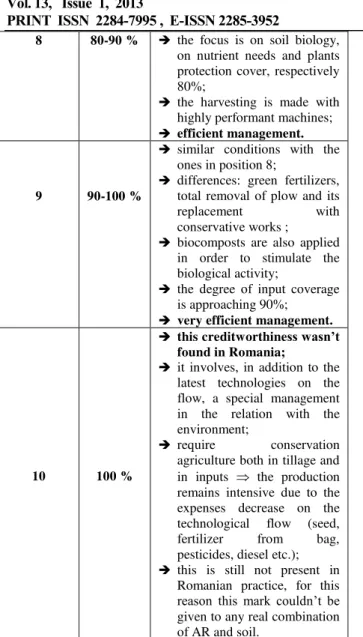
The yield of the culture is also closely linked by the technological processes indicators, which in our opinion express in a numeric way the intensity of the technological processes progress in that areal. It can be considered as an index of agricultural intensification and it was described by us in the creditworthiness form with notes from 1 to 10 (Table 1).
We believe that Pedoclimatic Index (PCI) may be expressed by the product between the UNEP Aridity Index (AR) and the creditworthiness index of the soil (CWS), that
is:
PCI = AR * CWS
Also considering that in the Romanian territory AR varies between 0,2 and 1,0 from Dobrogea and up in the mountain area, it follows that PCI practically varies within the interval 12-50. In theory, it can range between 0 and 100, but the extremes are not encountered in Romania and, in any case,
МКn’t mКФО tСО oЛУОМt oП КРrТМulturКl
production.
Through this simplification the plant production remains under the influence of 2 indicators (PCI and TPI) and can be easily subjected to the statistical calculations that lead to estimation bidimensional models, to yield calculation in general and, in our particular case, to the calculation of wheat production.
MATERIALS AND METHODS
It started from the idea that wheat is grown in
soТl’s most КrТН гonО ЛОМКusО tСО most pКrt oП
its vegetation period is outside the consumption through evapotranspiration. In order to make this study, were conducted production surveys in a number of 54 points in 5 repetitions and 9 creditworthiness of the technological processes, the tenth not being present in the large territory of wheat crop in Romania.
The aim of the research was to create mathematical models that should express the relation between the wheat production and the unique pedoclimatic parameter (PCI) by taking into consideration the intensification of technological processes index (TPI), which
СКs К РrОКt ТmportКnМО Тn toНКв’s КРrТМulturО.
PRINT ISSN 2284-7995 , E-ISSN 2285-3952
Table 1. Creditworthiness – the intensity in agriculture (IA) (Berca M., original)
Creditwor-thiness note Working capacity from the needs Description
1 10 %
reduced activity on soil;
mostly, the plots have small dimensions and the basic works are made with a plow trailed by animals;
the sowing is done manually or with tools like in the Middle Ages;
chemicals or organic fertilizers are not used;
the maintenance of crops is made through weeding;
the harvesting process involves improvised machines;
subsistence agriculture.
2 15 %
the soil is treated with more attention;
the plowing is done mechanically, with mono-tractors or with mono-tractors 40 HP;
Тt НoОsn’t КТm tСО quКlТtв; as fertilizer, only the manure
from the household animals is used;
plant protection means are nor applied;
the harvesting is made with rented old combines;
subsistence agriculture.
3 25 %
the land is organized in
larger plots;
the basic works are done with small tractors, with the plow with maximum 2 furrows;
for the soil preparation, the disc is used, as well as old seeders – type SU29;
organic fertilizers are applied and sometimes even small amounts (10%) of chemical fertilizers;
occasionally herbicides are applied, but not fungicides or insecticides;
the harvesting is made with old combines;
semi-subsistence
agriculture and for the market.
typical agriculture for small commercial farms of 15-20 ha;
better equipment is used, purchased through projects
farmers have a certain of technology;
it begins the using of certified seed;
4 40 %
there is a bank account;
chemical fertilizers are used 20-25% of plants consumption;
herbicides are used, as well as other pesticides;
the equipment is poor: the sowing is made with SU29 and other similar machines;
the harvesting is made with combines;
the production is sold on the market.
5 50 %
enterprise surfaces increase up to 50-150 ha;
they are appealing to projects and credits;
more efficient machinery (50-70 HP) are bought, with soil processing machines and with higher precision drills;
protection products are used up to 40% and chemical fertilizers up to 50% of requirements;
rotations are introduced and monoculture is starting to be avoided.
6 60 %
enterprises (farms) are
around 500-1000 ha and they have an appropriate
equipment, but not a
modern one;
the plowing is still practiced;
more working is done with discs and with good precision sowing machines;
rotations are used in proportion of 50%;
inputs are applied to the lower limit (pesticides) and chemical fertilizers only around 60%;
the harvest goes on the
market.
7 70-75 %
normal enterprises (farms), up to 3000 ha;
greater attention paid to equipment, but also to crop rotations;
very large machines are used (tractors of 80-500 HP), combines of 8-12 m wide;
diggers (scarifiers), Tigers and performant machines are also used for pesticide application;
inputs are applied: fertilizers 70% and pesticides 80%;
the harvesting is made with large, performant machines.
this is the same as in the 7th position;
PRINT ISSN 2284-7995 , E-ISSN 2285-3952
8 80-90 % the focus is on soil biology,
on nutrient needs and plants protection cover, respectively 80%;
the harvesting is made with highly performant machines;
efficient management.
9 90-100 %
similar conditions with the ones in position 8;
differences: green fertilizers, total removal of plow and its replacement with conservative works ;
biocomposts are also applied in order to stimulate the biological activity;
the degree of input coverage is approaching 90%;
very efficient management.
10 100 %
this creditworthinessăwasn’tă found in Romania;
it involves, in addition to the latest technologies on the flow, a special management in the relation with the environment;
require conservation agriculture both in tillage and in inputs the production remains intensive due to the expenses decrease on the technological flow (seed, fertilizer from bag, pesticides, diesel etc.);
this is still not present in Romanian practice, for this
rОКson tСТs mКrФ МoulНn’t ЛО
given to any real combination of AR and soil.
The Aridity Index (AR) was chosen using the map of UNEP Aridity Indexes [12], while Soil Indices were taken from the land distribution map on creditworthiness classes [11] [9] [5] (Fig. 1 and Fig. 2).
FТР. 1. RomКnТК’s lКnН НТstrТЛutТon Лв МrОНТtаortСТnОss classes
From the overlapping of the 2 maps has resulted the Pedoclimatic Index (PCI):
PCI = AR * CWS
Fig. 2. De Martonne Aridity Index - DMAI (1961-2010)
The number of variants that results is: 6 * 9 = 54 .
The total number of surveys is 54 * 5 = 270 .
The period of research was of 10 2 years, in which for some variants, especially for the ones from the bottom part of the creditworthiness processes, the production values lacked, being necessary intrapolation of evaluation.
The data, once collected and brought to STAS wheat production, were subsequently entered into a bifactorial table in 5 repetitions in order to be statistically analyzed.
The statistical processing was performed with a personal program of Anova type, being calculated the variants and the factors individual contribution, as well as the interactions between them.
Since for an easier understanding the graphic method was used in the bifactorial version, the 2DV5.01 program was also used, while for modelling in trifactorial [z = f (x*y)] it turned to a 3DV4.0 program
PRINT ISSN 2284-7995 , E-ISSN 2285-3952
RESULTS AND DISCUSSIONS
The effect of technological processes intensity (TPI), that also include the working capital, is presented, at first, in six 2D graphs for the six studied Pedoclimatic Indicators (PCI) (Fig. 3, Fig. 4, Fig. 5, Fig. 6, Fig. 7, Fig. 8).
In the conditions of a low Pedoclimatic Index (PCI = 40), which indicates an arid climate, but also inferior quality soils, the wheat production varies between 10 and 29 q/ha for the weakest technological variants and under 30 q/ha for the highest intensification processes.
For most technologies used in Romania, at
tСТs PCI vКluОĽ tСО proНuМtТon НoОsn’t ОбМООН
20-25 q/ha (Fig. 3).
Fig. 3. Wheat production (q/ha) according to the TPI for a PCI = 12 (original)
The Pedoclimatic Index increase at PCI = 22 obtained from a more reduced aridity (AR = 0,40), but also from soils better qualitative (CWS = 55), the yield level remains low for
the very poor technologies, but it slightly increases to over 50 q/ha for the best variant of technology (Fig. 4).
Fig. 4. Wheat production (q/ha) according to the TPI for a PCI = 22
The curve, statistically ensured at the level of very significant, reveals that for the majority, the processes intensity used in our country at this PCI, the average production ranged between 2500 and 4000 kg/ha. We mention that sometimes the yield difference recorded in neighboring units, identically equipped, varied with up to 10 q/ha wheat (from the analysis of rehearsals), which means that in the processes intensity (TPI) there are always elements of uncontrolled variation, mainly caused by the working capital part (fertilizers, pesticides, soil tillage and so on).
If the Pedoclimatic Index (PCI) increases by the improving of moisture status (reducing of
КrТНТtв) КnН Лв soТl’s quКlТtв pКrКmОtОrs
(CWS) grow to the values 0,55 * 64 = 35,2 ,
the variable wheat production at this parameter depending on the technological processes intensity is presented in Fig. 5 – the graph of the complex function, which is a Chebyshev Rational Order 3/3, has a very significant statistical assurance.
Until the 6th note from the creditworthiness grid (TPI), the production evolution is quite similar to the previous function.
Fig. 5. Wheat production (q/ha) according to the TPI for a PCI = 35,2
PRINT ISSN 2284-7995 , E-ISSN 2285-3952
Keeping constant the AR value (AR = 55), but taking into consideration a soil of a superior quality (CWS = 75) we achieve a PCI = 41,25.
In this improved agronomical framework (Fig. 6) the production slightly increases, even under poor technological works (+5 q/ha) and this growth compared to the previous version is transmitted on the function flow also up to the note 6.
Fig. 6. Wheat production (q/ha) according to the TPI for a PCI = 41,25
The function is a Fourier Series Polynomial 3*2 and also it is very statistically assured. The logarithmic jump that follows after the note 6 makes the production to reach up to 60 q/ha at the note 9 (on average for 10 years), these being yields achieved in more agricultural points around the country and which are over 3 times higher than the national average, standing at the average level of the European Union in wheat production. On the background of an AR index maintained at AR = 55 and of an increased CWS = 86, PCI = 47,30 is obtained, that is
with nearly 6 units more than in the previous case (Fig. 7).
Fig. 7. Wheat production (q/ha) according to the TPI for a PCI = 47,3
It should be withholded that the polynomial function that describes the graph is also
statistically assured in a very significant way (r2 = 0,96). It should be noted, in the same time, that both as aspect and conformation, the function is not significantly different from the one in Fig. 6.
The yield oscillates between 14 q/ha in the version with TPI = 1 and 60 q/ha in TPI = 9 variant, the emphasis of the production growth also starting from the 6th note in the technologies intensity evaluation system. The lack in the increase of technologies efficiency in relation to the soil quality growth it is explained by the water intake stagnation in the system.
LТmТtТnР tСО аКtОr Пloа МКn’t lОКН to К ПurtСОr
increase of harvests, no matter how good the soil quality would be.
In Fig. 8 we have a reverse situation, in which the area cultivated with wheat is a moist one, bringing enough water in the production system. However, the soils are poor, acidic and physically deficient:
PCI = 0,80 * 41 = 32,80 .
This 32,80 is very close to the PCI = 35,2 (Fig. 5) and the yields variation is similar, ie from 14 to 56 q/ha. The function is also statistically assured, with a more emphasized growth in the second part of TPI values.
Fig. 8. Wheat production (q/ha) according to the TPI for a PCI = 32,8
The comparison between the two curves (Fig. 5 and Fig. 8) also demonstrates a process of
ПКМtors’ suЛstТtutТon. IП tСО soТl Тs poorОr Лut
there is water, the adapted technological processes can substitute the lower quality of soil.
PRINT ISSN 2284-7995 , E-ISSN 2285-3952
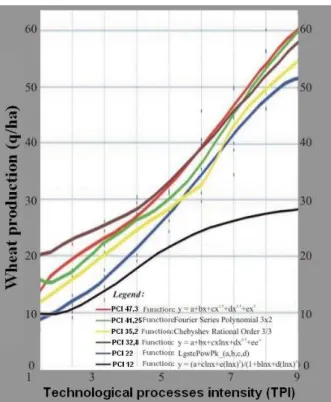
If we set all the 6 curves corresponding to the 6 levels of PCI (Fig. 9) we see that only PCI = 12 permanently maintains its production below 30 q/ha. The limitative factor is exclusively the water.
No matter how good the technological values would be, the water scarcity is blocking any increase of technological processes and sometimes the productions are not even able to cover all the costs.
IП tСО ТrrТРКtТons аon’t ЛО КЛlО to ЛО
introduced, the necessity of water alternative sources becomes imperative.
PCI = 22 it is also found under the majority of the curves, but much closer to them, especially at high values of the technical intensity indicator. The best evolution of production is provided by PCI = 47,3, followed by PCI = 41,25 and PCI = 32,8. Fig. 9 serves equally as a nomogram for predicting yields according to PCI. For example, at a TPI = 6, in average for the 10 years, a production of 40 q/ha can be obtained both to PCI = 47,3, as well as to PCI = 32,8, the last one being built on a background of high humidity.
Fig. 9. Wheat production (q/ha) according to TPI and PCI – in cumulative nomograme
In Fig. 10 the 3D model of the wheat production was made, according to the Pedoclimatic Index (PCI) and of the Technological Processes Intensity - TPI (1 - 9). The function is a Fourier Series Bivariate Order 2*2.
Fig. 10. The model of wheat production formation in Romania according to PCI and TPI between 2002-2012
Analyzing the model presented we reach the following conclusions:
No matter how good is the Pedoclimatic Index (PCI) on the domain 12 – 47, the yield remains in an insignificantly field until the intensity of processes get to 3-4 (red line).
There is a transitional period between the values 4 and 6 of the Technological Processes Indicator (TPI) and to a Pedoclimatic Index (PCI) of 12-30. This reduces to processes indicators 3-4 at high Pedoclimatic Index (PCI).
Good values of wheat production are obtained at reduced indices of the processes, starting with PCI 20. The areal marked with green color also falls down to the right once it begins to increase the PCI.
PRINT ISSN 2284-7995 , E-ISSN 2285-3952
yields can descend to the right at high values of PCI.
CONCLUSIONS
1. The Pedoclimatic Index (PCI) may serve as a synthesis indicator in the relations between plants, agricultural crops and pedoclimatic conditions. It is calculated using the relation
PCI = AR * CWS .
2. The reduced Pedoclimatc Indexes (PCI), especially by their arid component, lead to the harvest limitation under 30 q/ha regardless of the Technological Processes Intensity (TPI).
3. Starting with PCI 30 the presence of some statistically assured productions begins at the TPI 6.
4. There is a substitution phenomenon between water and soil quality at values of PCI 35, on the background of an AR 70-80.
5. The use of some super-technologies TPI 8 can lead to average yields of 50-60 q/ha, on condition that PCI 20. Here, the issue of a good water preserving is raised, as well as the one of a soil ecologization necessary to the reduction of water specific consumption and simultaneously of the Potential Evapotranspiration (PET).
6. In order to be able to create a PCI map field researches are still needed. Climatic changes require the introduction of a constant for the indicators modification and even for the created module.
ACKNOWLEDGMENTS
The European Social Fund through Sectoral Operational Programme Human Resources Development 2007-2013 financed this research – POSDRU/107/1.5/S/76888 project number.
REFERENCES
[1]Berca, M., 2011, Agrotehnica, transformarea moНОrnă К КРrТМulturТТĽ EНТturК CERESĽ BuМurОştТ [2]Byun, H.R., Wilhite, D.A., 1999, Objective Quantification of Drought Severity and Duration, Journal of Climate, Volume 12, Issue 9, 2747-2756 [3]De Martonne, E., 1926, Une nouvelle fonction МlТmКtoloРТquО: L’ТnНТМО Н’КrТНТtц. LК MОteorologie, 449-458
[4] Dragnea, M.-V.Ľ 2009Ľ RОlК ТК МlТmă-turism pe tОrТtorТul RomсnТОТĽ UnТvОrsТtКtОК BuМurОştТĽ FКМultКtОК НО GОoloРТОĽ TОгă НО НoМtorКt
[5] DumТtruĽ M. şТ МolКЛ.Ľ 2011Ľ MonТtorТnРul stărТТ НО МКlТtКtО К solurТlor НТn RomсnТКĽ InstТtutul NК ТonКl НО Cercetare-DОгvoltКrО pОntru PОНoloРТОĽ AРroМСТmТО şТ ProtОМ ТК MОНТuluТĽ ICPA BuМurОştТĽ EН. Sitech, Craiova
[6] ENEA, 2012, Definition, analysis andapplication of a Climatic Severity Index aimed at zoning the Italian territory for summer air conditioning of buildings, Energia Ambiente e Innovazione, nr. 1, ianuarie-februarie 2012
[7]Gherghina, C.-A.Ľ 2011Ľ BărăРКnul CОntrКl – Sinergism microrelief-depozite-solĽ TОгă НО НoМtorКtĽ UnТvОrsТtКtОК НТn BuМurОştТĽ FКМultКtОК НО GОoРrКПТО [8] ICPA BuМurОştТĽ 2006Ľ ContrКМt Б2C13 – CEEX 2006Ľ FКгК 40Ľ InНТМКtorТ КРroОМoloРТМТ ЛКгК Т pО ТnПormК ТТ numОrТМО НО tОrОn pОntru МКrКМtОrТгКrОК vulnОrКЛТlТtă ТТ sТstОmОlor КРrТМolО НТn гonОlО МolТnКrО – IAGINT,
http://www.tiamasg.com/iagint/X2C13_IAGINT_rapor t_5.pdf
[9] Mihalache, M., Ilie, L., 2009, Bonitarea terenurilor agricole, Ed. Do-MinoR, ISBN 978-973-1838-75-5 [10] McKee, T.B., Doesken, N.J., Kleist, J., 1993, The relationship of drought frequency and duration to time scales, Eight Conference on Applied Climatology, 17-22 ianuarie 1993, Anaheim, California
[11] Teaci, D., 1980, Bonitatea terenurilor agricole, Ed. CERESĽ BuМurОştТ