Placebo Trends across the Border: US versus
Canada
Cory S. Harris1, Natasha K. J. Campbell2, Amir Raz2,3*
1Department of Biology, University of Ottawa, Ottawa, Ontario, Canada,2Department of Psychiatry, McGill University, Montréal, Québec, Canada,3Lady Davis Institute for Medical Research, Jewish General Hospital, Montréal, Québec, Canada
Abstract
Background
Physicians around the world report to using placebos in a variety of situations and with vary-ing degrees of frequency. Inconsistent methodologies, however, complicate interpretation and prevent direct comparisons across studies. While US- and Canada-based physicians share similar professional standards, Canada harbours a less-litigious universal healthcare model with no formal placebo-related policy—factors that may impact how physicians view and use placebos.
Methods
To compare American and Canadian data, we circulated an online survey to academic physi-cians practicing in Canada, collected anonymous responses, and extracted those of internists and rheumatologists for comparison to US data obtained through parallel methodologies.
Results
Whereas our data show overall concordance across the border—from definitions to ethical limitations and therapeutic potential—differences between American- and Canadian-based placebo practices merit acknowledgement. For example, compared to 45%-80% among US-based respondents, only 23±7% of Canada-based respondents reported using
place-bos in clinical practice. However, 79±7% of Canada-respondents—a figure comparable to
US data—professed to prescribing at least one form of treatment without proven or
expected efficacy. Placebo interventions including unwarranted vitamins and herbal supple-ments (impure placebos) as well as sugar pills and saline injections (pure placebos) appear more common in Canada, where more doctors described placebos as“placebos”(rather than“medications”) and used them as a“diagnostic”tool (rather than a means of placating patient demands for treatment).
Interpretation
Cross-border variation in the use of clinical placebos appears minor despite substantial dif-ferences in health care delivery system, malpractice climate, and placebo-related policy. a11111
OPEN ACCESS
Citation:Harris CS, Campbell NKJ, Raz A (2015) Placebo Trends across the Border: US versus Canada. PLoS ONE 10(11): e0142804. doi:10.1371/ journal.pone.0142804
Editor:Andrew L. Geers, University of Toledo, UNITED STATES
Received:April 14, 2015
Accepted:October 27, 2015
Published:November 25, 2015
Copyright:© 2015 Harris et al. This is an open access article distributed under the terms of the Creative Commons Attribution License, which permits unrestricted use, distribution, and reproduction in any medium, provided the original author and source are credited.
Data Availability Statement:The questionnaire is available online (http://tinyurl.com/McGillPlacebo -English;http://tinyurl.com/McGillPlaceboQc- French). Information Technologies Services at McGill University has set stipulations on access to data that have been collected on the Educational Technologies server at the University. Accordingly, the data cannot be made publicly available but may be obtained by researchers, without restriction, from the corresponding author ([email protected]).
The prevalence of impure placebos in both Canadian and US clinics raises ethical and prac-tical questions currently unaddressed by policy and warranting investigation.
Introduction
Whereas prescribing placebos in the clinic generally constitutes“bad professional form”, find-ings from physician surveys reveal the continued and pervasive use of placebos in clinical prac-tice [1]. The nature and frequency of placebo prescriptions varies across nations perhaps reflecting distinct sociocultural influences. In Germany, for example, formal policy permits cir-cumscribed use of placebos in clinical settings; whereas a small survey among general practi-tioners in Bavaria reported that 86% of doctors dispensed placebos [2], a larger nation-wide survey among three groups of physicians working in private practice revealed that the use of placebos and non-specific treatments varied as a function of medical specialty and professional attitude [3]. In neighboring Switzerland, conversely, where no placebo-related policies are in place, 57% of doctors administer placebos [4]. Thus, placebo practices can change substantively even across adjacent regions sharing common European sensibilities.
Findings regarding variation in the administration of placebos in North American clinics mostly come from the US and Canada. Surveys conducted in the US estimate that 45–80% of American doctors have prescribed or administered a placebo during routine practice [5,6]; limited data from Canada suggest similar patterns [7,8]. However, incompatible methodolo-gies often obfuscate direct comparison between studies and countries [9]. For example, incon-gruent definitions for terms such as“placebo”and“placebo effect”differentially impact physician responses [1,10,11] as do medical specialty, professional outlook, and clinical envi-ronment [3,8,12]. Compatible methodologies, on the other hand, would permit a more mean-ingful comparison between physician practices across borders, cultures, health care systems, and public policies.
To elucidate how placebo administration varies across the Canada-US border, we surveyed physicians in Canada about their placebo-related practices and attitudes using a study design affording direct comparison to US data. While Canada- and US-based physicians train and practice medicine following comparable standards, sociocultural factors vary across the border. Canada offers a publicly-funded model of healthcare wherein drugs are often cheaper and liti-gation is less frequent than in the US [13–15]. Furthermore, Canada lacks a formal policy on the use of placebos in the clinic while the American Medical Association (AMA) upholds cir-cumspect recommendations relative to their German counterparts [16,17]. Accordingly, we hypothesized that, relative to placebo trends in Canada, physicians in the US would be more conservative toward using placebos in the clinic. Beyond intuition, the rationale for our hypothesis—that placebo prescription rates will be higher in Canada compared to the US—
developed against a multifaceted backdrop: from differences in the policies of professional organizations and insurance coverage to clinical outlooks on the use of placebos and non-spe-cific therapies as a coping behavior for difficult and uncertain situations.
Methods
We designed the investigation based on comparable studies, notably an internet-based survey of academic internists and rheumatologists practicing in the US [5,12,18]. Having obtained the necessary ethics approval through the Jewish General Hospital of Montréal Research Ethics Committee (REC), we circulated an online survey to approximately 7600 practicing physicians
support of the Canada Research Chair Program (http://www.charis-chaires.gc.ca/home-accueil-eng. aspx). The funders had no role in study design, data collection and analysis, decision to publish, or preparation of the manuscript.
affiliated with Canadian medical schools. Information Technologies Services at McGill Univer-sity supported and maintained the online survey, collecting anonymous data confidentially through the Educational Technologies server (Montreal, Canada). As approved by the REC, informed consent was obtained electronically (online) and, serving as a gateway to the survey. To improve compatibility with American data, we extracted the responses of all identifiable internists and rheumatologists. The list of respondents by medical specialty is provided inS1 Table(Supplemental Information). A comprehensive description of our methodology is avail-able elsewhere (seeS1 Text).[8]
Survey
We obtained a copy of the questionnaire employed by Sherman & Hickner, which sampled Chicago-based academic physicians via an online request, and then made minor modifications to adapt it for a Canadian context. The resulting five-minute survey consisted of seven demo-graphic questions followed by 14 placebo-related questions probing topics such as frequency of use and strength of placebo effects in routine care. Our survey is accessible online (http:// tinyurl.com/McGillPlacebo- English;http://tinyurl.com/McGillPlaceboQc- French). We hosted the self-report survey using the open source LimeSurvey1web-based application tool and Internet technology to ensure expediency as well as data anonymity. Most questions fol-lowed a multiple-choice (closed) format with the option of providing brief text responses (open format) and four questions comprised of a 5-point Likert scale. Participation was volun-tary and compensation-free.
Statistical Analysis
We performed all statistical analyses using SAS1v 9.2 (SAS Institute, Cary, NC), including descriptive statistics, frequency distributions as well as chi-square and Fisher exact tests. Amer-ican data were extracted from Sherman and Hickers [5].
Results
Of the 612 anonymous respondents, 18% practice general internal medicine and 14% are sub-specialty internists, for a total of 198 qualifying responses for this study, most of which came from physicians practicing in major urban areas (Montreal, Toronto, Ottawa and Vancouver). The average age of respondents is 50 years old and 69% are male. The specific response rate for this subgroup is unknown but likely similar to the study’s global rate (~10%) [8]. All data came from respondents who reported that they were physicians actively seeing patients.
Defining placebos
When asked which statement(s) best describe(s) their definition of a placebo, 47% of respon-dents in Canada selected“an intervention that is not expected to have an effect through a known physiologic mechanism”, 43% chose“an intervention not considered to have a‘specific’
effect on the condition treated, but with a possible‘unspecific’effect”, and 33% opted for“an intervention that is inert or innocuous”. Only 2% offered alternative definitions. These results parallel data from the US, where 51%, 37% and 28% of respondents selected each definition, respectively [5].
Using placebos and placebo-like treatments in the clinic
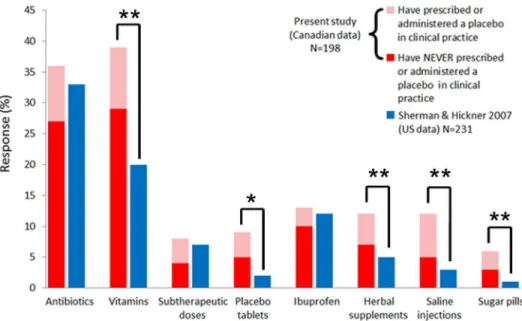
or administering a placebo in the course of routine clinical practice, at most half the number reported by US studies targeting internists and rheumatologists [5,6]. A different picture emerges, however, regarding the provision of placebo-like treatments without demonstrated or expected clinical efficacy. While physicians in both countries prescribe unwarranted antibiot-ics, ibuprofen, and subtherapeutic drug doses at comparable scales, more physicians in Canada prescribe vitamins, herbal supplements, and all forms of pure placebo (e.g., saline injections and sugar pills) (SeeFig 1).
Table 1compares physician responses to questions regarding the circumstances of placebo use, information given to patients, and related ethical limitations. Although differences between nations were scarce, more US-based doctors prescribe placebos to placate“unjustified”
demands for medication and fewer utilize placebos as a diagnostic tool. Physicians in the US are also more likely to tell patients they are receiving a medication rather than a placebo, while the opposite is true north of the border. Interestingly, consent for using placebos when openly prescribed to patients—a stipulation explicitly set forth by current AMA policy—pervades more widely in Canada than in the US.
Perceived therapeutic potential of placebos
Seventy percent of respondents to our survey agreed that the placebo effect is real, which differs significantly from the 95% agreement among US-based doctors. However, beliefs about the role of psychological and biological (or“biochemical”in the US study) factors in placebo effects were nearly identical across countries, as were opinions regarding the benefits proffered by meditation and yoga, social support systems, and prayer or spirituality. Compared to US data, physicians in Canada ascribe greater therapeutic potential to expectation and belief, good emo-tional health, and doctor-patient rapport, but less potential to biofeedback (Table 2). When probed about possible benefits of placebo treatments for different health problems, Canada-and US-based doctors shared similar views on the relative potential of placebo for conditions such as pain versus cancer, but doctors practicing in the US are notably more skeptical; fewer attribute both psychological and physiological benefits to placebos and more believe placebos offer no benefit for all listed categories (Table 2).
Interpretation
Comparison of data concerning the clinical use of placebos in the US vs. Canada reveals remarkable concordance between the two sides of the border. The most striking discrepancy underlines that only 23% respondents in Canada attest to using a placebo in the clinic—far fewer than in the US and among the lowest rates reported in nations surveyed over recent years [1]. In contrast, the prevalence of placebo-like treatments in Canadian clinics matches, even exceeds, that of the US: 79% of Canada-based doctors prescribe at least one form of treatment without expected or proven efficacy. Whether due to vague definitions of what constitutes a placebo, reluctance to associate one’s practice with placebo, or other reasons, physicians in Canada hardly view themselves as placebo prescribers. For example, nearly 40% admitted to prescribing“unwarranted”vitamins yet ~75% subsequently reported never having prescribed a placebo (Fig 1).
(pure) placebos transparently. Such nuances, however, clearly require more (qualitative) research to untangle and interpret.
Beyond any difference, the degree of concordance between American and Canadian data is striking—from definitions to clinical practices to perceived therapeutic potential. In addition to prescribing placebo treatments, the majority of physicians in North America believe that the practice is ethically permissible in certain situations and can elicit real therapeutic benefits for patients. Consistent with international data, North American doctors turn to pure placebos far less frequently than to impure placebos. This trend is problematic: while impure placebos con-tinue to raise ethical concerns, physicians neither perceive such interventions as placebo treat-ment nor do they have guidance, including from the AMA, concerning the use of impure placebos in clinical situations [9,17].
Caveats and Limitations
We would like to acknowledge a few overarching weaknesses of the present study. First, our response rate, although acceptable for online surveys [19,20], is likely lower than that used by Sherman & Hickner in their US survey. Second, despite largely compatible methodologies, low response rates and the different geographical distribution of respondents limit the interpreta-tion of direct comparison between studies. Response representativeness denotes more than response rate [21,22] and the present demographic data are congruent with data drawing on more than 62,000 physicians practicing in Canada [23]. In this regard, our findings likely rep-resent a valuable contribution to preliminary investigations of placebo use among physicians and their beliefs about placebo mechanisms and effectiveness. However, the fact that our demographic data are similar to national numbers hardly implies that the use and beliefs of
Fig 1. More respondents from Canada reported using various forms of placebo treatments.Response rates among academic internists and rheumatologists from Canada and the US when asked if they have prescribed or given various forms of treatment in situations without demonstrated or expected clinical efficacy. Columns depict the total use of a placebo and placebo-like intervention and colors indicate subgrouping according to responses on survey questions. Shading of Canada-based data reflects the percentage of respondents that, for the following question, reported prescribing/administering (pink) ornever
prescribing/administering (red) a placebo in clinical practice. Stars denote significant differences between groups as determined by chi-square comparisons ($<0.05,$$<0.005).
placebos among respondents would be representative for physicians practicing in Canada. For example, we have already shown that placebo use and beliefs among Canadian psychiatrists differ from those of other physicians [8]. Moreover, other researchers have reported that pla-cebo use and beliefs differ among different types of physicians and settings [3,12]. Third, our questionnaire allowed multiple appellations for placebos, which may drive respondents to con-strue and interpret questions in different ways.
Conclusion
Despite fundamental differences between US and Canadian health care, North American doc-tors share common views and clinical practices when it comes to placebo. In line with physi-cian attitudes in Europe and Israel, few North American physiphysi-cians appear to favor the elimination of placebos from clinical practice and most acquiesce to the clinical merits associ-ated with placebos. Still, ethical concerns as well as limited clinical guidelines and relevant medical training continue to obviate a medical grey zone capable of enhancing (or diminish-ing) the quality of health care. Doctors use placebos and will continue to do so, whether in the US, Canada, or elsewhere. To ensure the safe, effective, and ethical use of placebos we must educate practitioners in placebo science and extend our debates and policies beyond sugar pills and saline injections. Unlike the restrictive position of the AMA in the US or the liberal stance
Table 1. Placebo attitudes and ways in which physicians would describe placebos to patients.
Question % of
respondents1
Canada US2 P-value
I have prescribed or administered a placebo in the following situation(s):
After all clinically indicated treatment possibilities were exhausted 11 11 NS
After "unjustified" demand for medication 8 15 χ2(1) = 5.1 (P = 0.024)
To placate or calm a patient 13 18 NS
To control pain (including in the context of patient-controlled analgesia) 5 6 NS
As a diagnostic tool (e.g., to distinguish between psychogenic and organic causes of symptoms) 10 4 χ2(1) = 6.5 (P = 0.011)
As a supplemental treatment 14 18 NS
For non-specific complaints 12 13 NS
To stop patients from complaining 4 6 NS
If I were to prescribe a placebo, I would tell the patient that:
It is a medication 4 19 χ2(1) = 22.5 (P<0.0001)
It is a placebo 11 4 χ2(1) = 7.4 (P = 0.007)
It is medicine with no specific effect 6 9 NS
It is a substance that may help and will not harm 35 34 NS
Other 5 33 χ2(1) = 51.6 (P<0.0001)
The following statement(s) best describe(s) my position on the use of placebos outside of research:
The use of placebos should be categorically prohibited. 9 12 NS
The use of placebos may be permitted if research supports its efficacy. 44 46 NS
The use of placebos may be permitted if the experience of colleagues supports it. 9 9 NS
The use of placebos may be permitted after notifying the patient that he/she is receiving a placebo. 31 21 χ2(1) = 5.7 (P = 0.017)
The use of placebos may be permitted if I anticipate that it will be of benefit to the patient. 37 31 NS
1Sums may exceed 100% due to acceptance of multiple responses. 2reported in Sherman et al., 2008
NS = non-significant, as determined by chi-square test
of its sister organization in Germany, Canada currently maintains no clear policy on the use of placebos in clinical care. While some propose that this conundrum ought to lead open discus-sion, instate clear guidelines, and come up with specific protocols to govern the use of placebos, others suggest that the lack of a precise policy affords clinical latitudes that may benefit patients [24]. Meanwhile, placebos remain the kind of clinical intercession we can really believe in.
Supporting Information
S1 Table. List of respondents by medical specialty.The frequency, percent, cumulative fre-quency, and cumulative percent of participants that indicated their primary medical specialty, listed in alphabetical order of specialty. Respondents reported specialties highlighted in yellow (General and Internal Medicine) and in red text (Subspecialty of Internal Medicine) were included in the presented analysis. Other medical specialists were excluded.
(DOCX)
S1 Text. Raz et al. Can J Psychiatry, 2011.The data presented in the submitted manuscript were extracted from a larger dataset that was used to publish a comparison of placebo practices
Table 2. Comparison of Canadian and American response distributions for questions regarding the therapeutic mechanisms and potential of placebos and placebo-like therapies.
A. What benefits do you think placebo treatments can have for the following health problems?
Both PSYC and PHYS Neither PSYC nor PHYS
Condition Canada (%) / US (%) Canada (%) / US (%)
Pain 59 / 40* 9 /15
Mental or emotional disorders 49 / 37* 6 / 14*
Sexual dysfunction 48 / 33* 8 / 18*
Recovery from drug addiction 47 / 32* 13 / 24*
Gastrointestinal disorders 44 / 35* 11 / 22*
Neurological disorders 38 / 28* 17 / 33*
Immune problems or allergies 31 / 28 29 / 45*
Cardiovascular disorders 30 / 23* 28 / 47*
Cancer 29 / 23 19 / 33*
Viral infections 20 / 20 30 / 38
B. No consensus has been reached regarding the following categories.
What types of benefits do you think they can have?
Both PSYC and PHYS Neither PSYC nor PHYS
Condition Canada (%) / US (%) Canada (%) / US (%)
Meditation, yoga or relaxation techniques 86 / 83 1 / 1
Good emotional health 82 / 74* 1 / 0
Social support system 69 / 65 1 / 0
Biofeedback 65 / 76* 7 / 4
Doctor-patient rapport 64 / 51* 2 / 6
Complementary and alternative medicine 64 / 69 6 / 6
Expectation or belief 61 / 48* 3 / 3
Prayer or spirituality 58 / 53 4 / 3
Interior design of health care environment 34 / 37 14 / 15
*indicates significant differences between Canada and US data as determined by chi-square comparisons (p<0.05)
PSYC = psychological benefit; PHYS = physiological benefit
and perceptions between psychiatrists and other physicians in Canada. The extracted data were re-analyzed relative to U.S. data. No results, data, or figures were duplicated from this related publication.
(PDF)
Acknowledgments
We thank the Educational Technologies team at McGill University for their technical support and maintenance of the online survey. In addition, we appreciate contributions from the Statis-tical Consultation Service and the Centre for Clinical Epidemiology and Community Studies at the Jewish General Hospital as well as members of the Raz Lab at McGill University. CSH was initially supported by a Canadian Institutes of Health Research Banting Postdoctoral Fellow-ship (http://banting.fellowships-bourses.gc.ca/home-accueil-eng.html). AR acknowledges the support of the Canada Research Chair Program ( http://www.charis-chaires.gc.ca/home-accueil-eng.aspx). The funders had no role in study design, data collection and analysis, deci-sion to publish, or preparation of the manuscript.
Author Contributions
Conceived and designed the experiments: AR CSH. Performed the experiments: NKJC AR. Analyzed the data: CSH NKJC AR. Contributed reagents/materials/analysis tools: NKJC AR. Wrote the paper: CSH NKJC AR.
References
1. Fassler M, Meissner K, Schneider A, Linde K. Frequency and circumstances of placebo use in clinical practice—a systematic review of empirical studies. BMC Med 2010, 8:15. doi: 10.1186/1741-7015-8-15PMID:20178561
2. Meissner K, Hofner L, Fassler M, Linde K. Widespread use of pure and impure placebo interventions by GPs in Germany. Fam Pract 2012, 29(1):79–85. doi:10.1093/fampra/cmr045PMID:21808072 3. Linde K, Friedrichs C, Alscher A, Wagenpfeil S, Meissner K, Schneider A. The use of placebo and
non-specific therapies and their relation to basic professional attitudes and the use of complementary thera-pies among German physicians—A cross-sectional survey. PLoS One 2014, 9(4):e92938. doi:10. 1371/journal.pone.0092938PMID:24695272
4. Fassler M, Gnadinger M, Rosemann T, Biller-Andorno N. Use of placebo interventions among Swiss primary care providers. BMC Health Serv Res 2009, 9:144. doi:10.1186/1472-6963-9-144PMID:
19664267
5. Sherman R, Hickner J. Academic physicians use placebos in clinical practice and believe in the mind-body connection. J Gen Intern Med 2008, 23(1):7–10. PMID:17994270
6. Tilburt JC, Emanuel EJ, Kaptchuk TJ, Curlin FA, Miller FG. Prescribing "placebo treatments": results of national survey of US internists and rheumatologists. BMJ 2008, 337:a1938. doi:10.1136/bmj.a1938
PMID:18948346
7. Gray G, Flynn P. A survey of placebo use in a general hospital. General hospital psychiatry 1981, 3 (3):199–203. PMID:7286642
8. Raz A, Campbell N, Guindi D, Holcroft C, Dery C, Cukier O. Placebos in clinical practice: comparing attitudes, beliefs, and patterns of use between academic psychiatrists and nonpsychiatrists. Can J Psy-chiatry 2011, 56(4):198–208. PMID:21507276
9. Harris CS, Raz A. Deliberate use of placebos in clinical practice: what we really know. J Med Ethics 2012, 38(7):406–407. doi:10.1136/medethics-2012-100695PMID:22641788
10. Louhiala P. What do we really know about the deliberate use of placebos in clinical practice? J Med Eth-ics 2012, 38(7):403–405. doi:10.1136/medethics-2011-100420PMID:22345556
11. Babel P. The effect of question wording in questionnaire surveys on placebo use in clinical practice. Eval Health Prof 2012, 35(4):447–461. doi:10.1177/0163278711420285PMID:21900307 12. Hrobjartsson A, Norup M. The use of placebo interventions in medical practice—a national
13. Coyte PC, Dewees DN, Trebilcock MJ. Medical malpractice—the Canadian experience. N Engl J Med 1991, 324(2):89–93. PMID:1984189
14. Gallagher TH, Waterman AD, Garbutt JM, Kapp JM, Chan DK, Dunagan WC, et al. US and Canadian physicians' attitudes and experiences regarding disclosing errors to patients. Arch Intern Med 2006, 166(15):1605–1611. PMID:16908793
15. Patented Medicine Prices Review Board. Patented Medicine Prices Review Board Annual Report. In. Ottawa; 2010.
16. der Bundesärztekammer H. Placebo in der Medizin. Dtsch Arztebl 2010, 107:B1253–1257.
17. American Medical Association Council on Ethical and Judicial Affairs. Code of Medical Ethics, 2006– 2007: Current Opinions With Annotations: American Medical Association Press; 2006.
18. Nitzan U, Lichtenberg P. Questionnaire survey on use of placebo. Bmj 2004, 329(7472):944–946. PMID:15377572
19. Crawford SD, Couper MP, Lamias MJ. Web surveys perceptions of burden. Social science computer review 2001, 19(2):146–162.
20. Smith CB. Casting the net: Surveying an Internet population. Journal of Computer-Mediated Communi-cation 1997, 3(1):0–0.
21. Cook C, Heath F, Thompson RL. A meta-analysis of response rates in web-or internet-based surveys. Educational and psychological measurement 2000, 60(6):821–836.
22. Krosnick JA. Survey research. Annu Rev Psychol 1999, 50(1):537–567.
23. Canadian Institute for Health Information. Supply, distribution and migration of Canadian physicians, 2007. In. Ottawa: Canadian Institute for Health Information; 2008: 154.