ANALYSIS
OF
CORRELATION
BETWEEN
INDICATORS
OF
ASSET
MANAGEMENT
AND
PROFITABILITY
FOR
COMPANIES
IN
THE
FOOD
INDUSTRY
SPANISH
Prof. Marian SIMINICA Ph. D University of Craiova Faculty of Economics Craiova, Romania
Assist. Silviu CARSTINA Ph. D University of Craiova
Faculty of Economics and Business Administration Craiova, Romania
Lect. Mirela SICHIGEA (GANEA) Ph. D University of Craiova
Faculty of Economics Craiova, Romania
Abstract: : The research paper aims at presenting the correlation between indicators of asset management and enterprise results, results reflected through the two rates of return: the return on assets and return on equity rate. In terms of industry chosen we can say that the food industry because of perishability specific production, is of great importance in terms of more efficient asset management. In terms of the chosen research area we can say that the starting point it took research methodology itself. Thus, given that the correlation analysis is performed using the research platform SABI Neo platform found in heritage University of Rioja - Spain, we used the financial data of the companies in the food industry Spanish, namely companies found in Rioja - Spain . The number of companies of the region Rioja - Spain having as object of activity is but the 219 companies that we have included in our study of 115 companies. SABI correlation analysis performed by Neo platform was performed using Pearson correlation index, the period under review is 2011-2014.
JEL classification: C15, D22, G23
Key words: profitability, management assets, correlation, food industry
1.INTRODUCTION
There are a number of branches of the food industry the time has proved to be a decisive factor in the results. For example if we consider the agricultural sector where work done is seasonal, we realize that here, the speed with which we manage our resources of any kind is very important.
A first important feature quite found at the level of companies in the food industry is therefore given time. This is identified as indicators reflecting the speed with which a company operates, how it manages its material resources, financial and course and assets.
An example of such indicators management of the assets were given in the previous chapters, but I would point out a number of indicators such as: the speed of rotation of assets; during the days of rotation; and so on These indicators reflect the efficiency with which assets are used in an enterprise as well as the speed with which the activities of that undertaking.
Another feature of the food industry, unlike other industries is therefore time through these management indicator. Thus the level of companies in the food industry should record, if I were to mention an increase in asset utilization efficiency, a rotation speed increasing and decreasing the duration of the rotation. An increase in the length of rotations and a decrease in velocity in the food industry often reflects a decrease in the activity of production, marketing, and also served as a signal regarding the profitability of the company.
The profit margin is another feature item for the food industry. Generally if it unlike other industries, the profit margin is low, profitability yielding particularly the speed with which companies in this industry operate, exactly how quickly produce and sell what they produce.
Structural analysis of the assets of companies in this industry would be another factor that would make the difference between this industry and other industries. If other industries share of assets is well above that of current assets, generally in the food industry the difference between the two groups is not very active. These characteristic features have resulted from the analysis conducted on the basis of balance in the companies of Rioja - Spain.
In this research paper I conducted a study in which we highlighted trends in profitability for companies in the food industry indicators Riojana and assets under management of their assets and the level of correlation exists between management and profitability indicators.
2.CONCEPTS AND TERMS USED
To accomplish this work, we resorted to a number of terms and concepts aimed at the primary objective of the work. One of the important concepts is profitability.
If we refer to the Anglo-Saxon profitability is defined simply as being synonymous with profitability in parallel but if we look at the French system but notice that here things are a little different in this system profitability and profitability are two different terms.
A first definition conceptual addressed in terms of return is the author Lucian Buşe it stating that "profitability is a synthetic form of expression of economic efficiency, which reflects the ability of firms to realize profit"1.
The author believes that the main objective of the company is making a profit, and thus increasing its profitability is an objective necessity, vital to its existence.
Vasile Robu and Nicolae Georgescu define profitability as "the ability of an enterprise to profit by using inputs and capital regardless of its origin"2. Level of profitability depends on "so the company's activity (volume and quality of supply, low unit cost, the Performance marketing, performance management, etc.) and exogenous factors, independent of the Company (the price level formats market volume and demand dynamics, consumer preferences intensity of competition, etc.)"3.
If the profitability indicators used by us herein are the return on assets and return on equity rate. Analysis of economic profitability analysis is that we reflect how the company's resources were used, how the company has performed work but globally. The expression we refer to the economic returns generated good profitability of an enterprise asset management results are expressed both in absolute and relative. When discussing the relative value return is necessary to compare the result, ie, the absolute result, the enterprise funds used for its production. These funds are materialized either by active or by capital.
As calculation relation in "Direccion Financiera de empresa" the authors Antonio Urena hand, Fernando Moreno Bonilla, Manuel Cano Rodriguez and Pilar Gomez-Fernandez Aguado, presents a possibility for determining economic viability so4:
Re = Groth Result/Total fund used = (Q*Pv – Q*Cv – Cf)/Total fund used (1) Where: Q - physical quantity sold; Pv - unit selling price; CVM - unit variable cost; Cf - fixed costs.
Taking to the general equation attention should focus on how the economic returns may vary depending on the individual variables.
Thus increasing economic return can take place while the physical quantity sold increases or the unit selling price also increases. When the fixed cost decreases and the funds used to obtain the same result or a result of a decrease in growth, economic profitability tends to increase.
Enterprise financial profitability analysis involves tracking how the company manages its funding sources propyl so they produce a motivational effect for current and potential investors of the company.
A definition of financial return is given by Daniel Cîrciumaru this being "indicator expressing the effectiveness of using propyl capital of the company (shareholder remuneration relative size)"5.
1Bușe Lucian, Analiză economico
-financiară, Ed. Economică, București, 2005, pp. 244 2
V. Robu, N. Georgescu, Analiza economico-financiară, Ed. Omnia Uni, Brașov, 2000, pp. 190
3
I. Lala-Popa, M.E. Miculeac, Analiză economico-financiară. Elemente teoretice și studii de
caz. Ed. Mirton, Timișoara, 2009, pp. 120
4 Antonio Partal Urena, Fernando Moreno Bonilla, Manuel Cano Rodriguez și Pilar Gomez Fernandez-Aguado, Direccion financiera de la empresa, Ediciones Piramide, Madrid, 2012, pp. 326
5
Cîrciumaru Daniel, Analiza performanțelor economico-financiare ale întreprinderii, suport de
The authors Aurel Işfănescu, Vasile Robu, Anca Maria Hristea Camelia Vasilescu presents in his "Economic and financial analysis" a definition of the rate of financial return "indicator that expresses the relative value, pay equity shareholders contributed or net profit left to the company to finance itself "6.
Another definition of financial return we find the authors Antonio parts Urena, Fernando Moreno Bonilla, Manuel Cano Rodriguez and Pilar Gomez Fernandez Aguado in "Direccion Financiera de empresa": "The financial return generated by investment firm investments that have based financing of shareholders, express or benefit per share net benefit resulting at the end of the financial year"7.
Another concept found in the theme of this research work is aimed at asset management of company.
Wealth Management can be seen both in the short- and long-term elapsed. When we talk about long-term management we refer to those activities that are usually carried out over several years, depending on the specifics and scope of activity of the company. In general activities carried out on a longer time interval is called investment. Usually active elements that are addressed in the long term management are assets.
Management is considering short-term daily operation of the company and are concerned here as part of the general assets current assets. It is clear that to discuss a profitable activity is very important how these assets, be they fixed assets are managed in the current activity.
The authors Antonio Urena hand, Fernando Moreno Bonilla, Manuel Cano Rodriguez and Pilar Gomez-Fernandez Aguado in the work of the Direccion Financiera empresa, make reference when discussing the management of current assets, the balance that should exist between return and risk. Basically they see as a balance profitability and risk, as asset management is carried out as efficiently balance tilts in favor of profitability, where contrary company assets are not used properly the risk before gaining profitability.
Given the linkage existing legally theoretically between profitability and asset management we hereby research paper to highlight the correlation existing in the companies of Rioja - Spain of profitability especially in the light of the two indicators (rate of return economic and financial rate of return) and a number of indicators of asset management.
3.METHODOLOGY
To demonstrate the theoretical aspects presented in most theories on profitability and asset management as part of profitability, we used the financial statements of related companies in the food industry Spanish Rioja region.
The time period for which we have achieved profitability ratio analysis and management of assets is 2011 - 2014, and to have a proper analysis we removed depending on the level of turnover extremes.
6Aurel Ișfănescu, Vasile Robu, Anca Maria Hristea și Camelia Vasilescu, Analiza economico
-financiară, material descărcat cu ajutorul linkului:
http://www.biblioteca-digitala.ase.ro/biblioteca/carte2.asp?id=75&idb=6
7 Antonio Partal Urena, Fernando Moreno Bonilla, Manuel Cano Rodriguez și Pilar Gomez
Before proceeding to the actual correlation analysis, we determined average value profitability indicators so using them to track developments at sector level and also in the Spanish region to form an idea of the level of profitability of this region.
Analysis of correlation between indicators of profitability and management of the assets was carried out by a research platform that belongs to the University of Rioja this platform is recognized as the SABI Neo using Pearson index.
A first step in using this platform was to create a username and password with which we logged then to the database, then we selected the industry that we wanted to analyze the period under review and indicators that we to use.
4. CASE STUDY
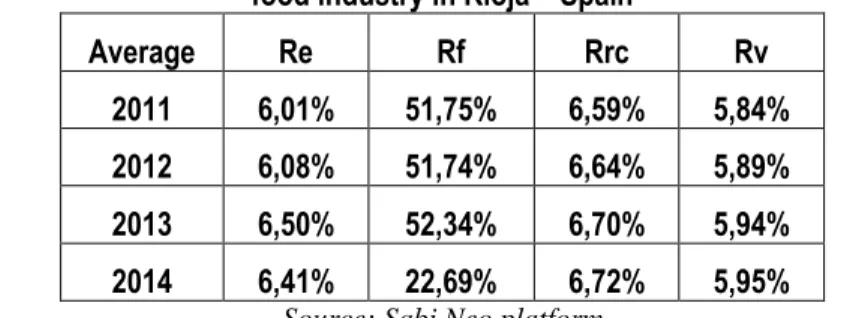
To analyze profitability at companies of Rioja we used the electronic platform SABI Neo University of Rioja, Faculty of Economics. In this platform using a user ID and password data I entered the business section where, depending on the scope of activity and region in which it is undertaking, we selected those businesses related to food industry Rioja. The individual companies we selected balance sheet and profit and loss account, financial and accounting documents with which we calculated and analyzed the profitability indicators that we chose to work. For a quick analysis of profitability we determined for each indicator averaged over Rioja food industry. Mean results for each indicator are shown in table immediately below:
Table no. 1 - The average level of relative indicators of profitability for companies in the food industry in Rioja – Spain
Average Re Rf Rrc Rv
2011 6,01% 51,75% 6,59% 5,84%
2012 6,08% 51,74% 6,64% 5,89%
2013 6,50% 52,34% 6,70% 5,94%
2014 6,41% 22,69% 6,72% 5,95%
Source: Sabi Neo platform
Where: Re – economic rate of assets; Rf – financial rate; Rrc – economic rate of expenditure: Rv – return on sales.
Economic rate of return of the asset records, as I considered the average sector growth until 2013. In 2014 there was a slight decline in the indicator, drop could be justified by reference to data from us and Table 4.2 where the average total profit is increasing by an increase in the companies the average value of total assets.
The rate of return on equity is a decrease in average at a very high level in 2014 compared to other years. This, as I considered the data from the balance sheet and income statement eprofit d can be explained by a decrease in average net profit from the food industry at a pace much faster than the average equity.
In terms of efficiency in the use of spending is an increase in the average rate of return on expenditure, this meaning that to achieve the same result companies have managed to reduce the level of spending from one year to another.
The number of variables taken into account to achieve correlation analysis from the Rioja region is 115 variables, namely by eliminating the extremes of the approximately 219 existing companies have remained only 115 firms.
After completing these steps we made in the companies in the food industry in Rioja - Spain, econometric modeling correlations that exist between indicators and the management of the assets of return.
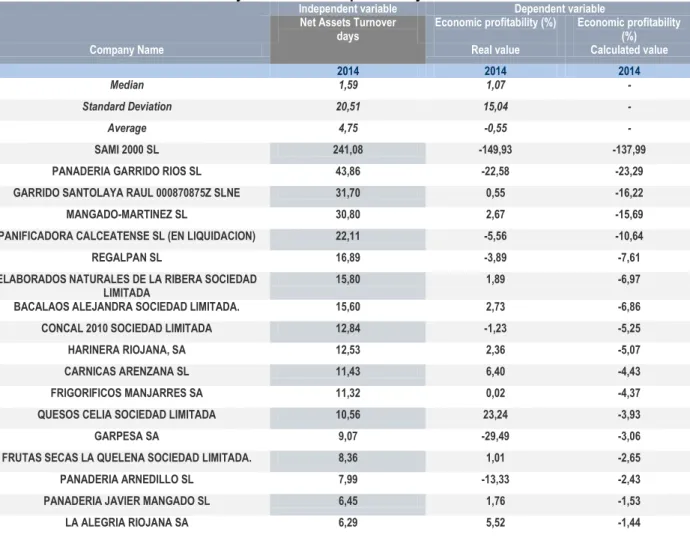
Analysis of the correlation between economic profitability as the dependent variable and the speed of rotation of net assets as independent variable is reflected in Table 2 in Annex work.
After analyzing the correlation between asset management indicator, the speed of rotation of assets, and economic profitability was established a strong inverse correlation, the correlation coefficient being -0.793.
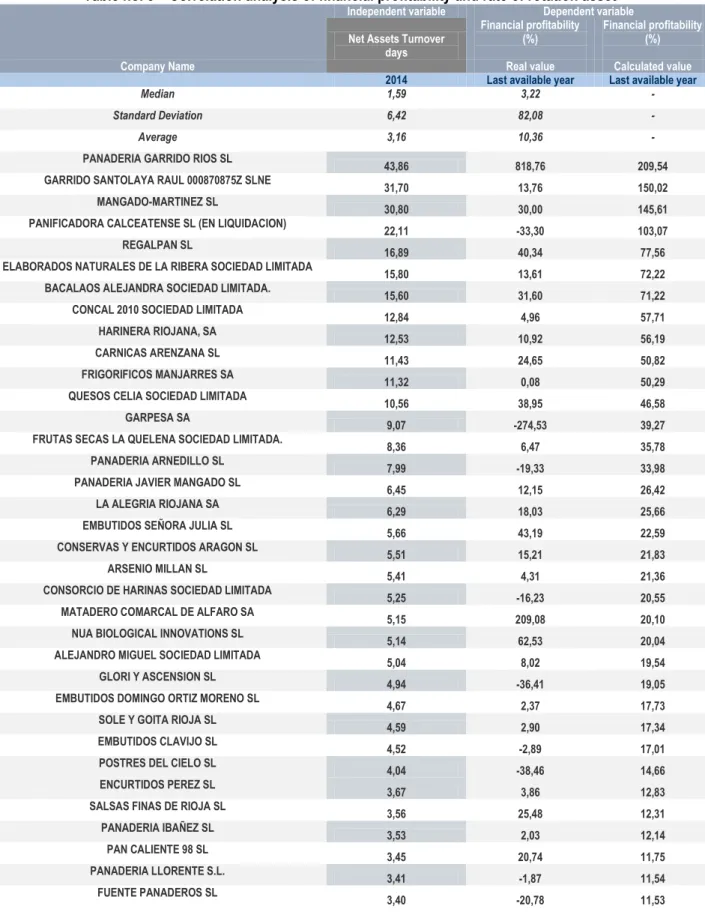
Such an analysis we conducted and the indicators rotation speed as the independent variable assets and financial return as a dependent variable. The results are also reflected in the annex of the work (Table 3).
In this case, however, unlike the analysis of the correlation between the economic viability and the rotational speed, there is a low correlation, the correlation coefficient of 0.383 with. In this region Rioja - Spain, seen from the results that we have a significant level of correlation, the correlation is straightforward in most cases presented.
5.CONCLUSIONS
Analysis of profitability in the companies of Rioja - Spain has shown us that the economic crisis of late 2008 were felt in their level even if we speak of a particular industry ie food industry.
Even if the level of rates of return that has not felt much of a different analysis from us at the absolute indicators can say that they have demonstrated above issues.
Platform SABI Neo has demonstrated that it plays an important role in terms of research at the faculty of economics and beyond, this allowing us to carry out further analyzes from the simplest to the most complex at both micro and macroeconomic.
Analysis of correlation between profitability indicators of asset management, our main research topic, it demonstrated that the level of companies in the food industry there is a significant correlation Rioja, where financial profitability and direct opposite of the economic profitability.
So as asset management increase profitability regardless of its form of expression also recorded significant increases.
Efficient management of assets thus represented, and the case study we demonstrated that there must be a permanent concern for managers of an enterprise. Wealth creation both in terms of overall company and for its shareholders is due in particular efficiency of the company, or when we say we refer heritage both in the capital and on the assets side.
R
EFERENCES1. Antonio Partal
Urena, Fernando Moreno
Bonilla, Manuel
Cano
Rodriguez and
Pilar Gomez
Fernandez-Aguado
2. Bușe Lucian Analiză economico-financiară, Ed. Economică, București, 2005
3. Cîrciumaru
Daniel
Analiza performanțelor economico-financiare ale întreprinderii, suport de curs în format electronic, Craiova, 2012
4. Ișfănescu
Aurel, Vasile
Robu, Anca
Maria Hristea
and Camelia
Vasilescu
Analiza economico-financiară, material descărcat cu ajutorul
linkului:
http://www.biblioteca-digitala.ase.ro/biblioteca/carte2.asp?id=75&idb=6
5. Lala-Popa I,
M.E. Miculeac
Analiză economico-financiară. Elemente teoretice și studii de caz.
Ed. Mirton, Timișoara, 2009
6. Robu V.,
Georgescu N.
Analiza economico-financiară, Ed. Omnia Uni, Brașov, 2000
Annexes
Table no. 2 – Corelation analysis of economic profitability rate and rotation rate of assets
Independent variable Dependent variable Net Assets Turnover
days
Economic profitability (%) Economic profitability (%)
Company Name Real value Calculated value
2014 2014 2014
Median 1,59 1,07 -
Standard Deviation 20,51 15,04 -
Average 4,75 -0,55 -
SAMI 2000 SL 241,08 -149,93 -137,99
PANADERIA GARRIDO RIOS SL 43,86 -22,58 -23,29
GARRIDO SANTOLAYA RAUL 000870875Z SLNE 31,70 0,55 -16,22
MANGADO-MARTINEZ SL 30,80 2,67 -15,69
PANIFICADORA CALCEATENSE SL (EN LIQUIDACION) 22,11 -5,56 -10,64
REGALPAN SL 16,89 -3,89 -7,61
ELABORADOS NATURALES DE LA RIBERA SOCIEDAD LIMITADA
15,80 1,89 -6,97
BACALAOS ALEJANDRA SOCIEDAD LIMITADA. 15,60 2,73 -6,86
CONCAL 2010 SOCIEDAD LIMITADA 12,84 -1,23 -5,25
HARINERA RIOJANA, SA 12,53 2,36 -5,07
CARNICAS ARENZANA SL 11,43 6,40 -4,43
FRIGORIFICOS MANJARRES SA 11,32 0,02 -4,37
QUESOS CELIA SOCIEDAD LIMITADA 10,56 23,24 -3,93
GARPESA SA 9,07 -29,49 -3,06
FRUTAS SECAS LA QUELENA SOCIEDAD LIMITADA. 8,36 1,01 -2,65
PANADERIA ARNEDILLO SL 7,99 -13,33 -2,43
PANADERIA JAVIER MANGADO SL 6,45 1,76 -1,53
Independent variable Dependent variable Net Assets Turnover
days
Economic profitability (%) Economic profitability (%)
Company Name Real value Calculated value
2014 2014 2014
EMBUTIDOS SEÑORA JULIA SL 5,66 14,70 -1,08
CONSERVAS Y ENCURTIDOS ARAGON SL 5,51 3,79 -0,99
ARSENIO MILLAN SL 5,41 1,19 -0,93
CONSORCIO DE HARINAS SOCIEDAD LIMITADA 5,25 -8,11 -0,84
MATADERO COMARCAL DE ALFARO SA 5,15 -6,16 -0,78
NUA BIOLOGICAL INNOVATIONS SL 5,14 18,88 -0,78
ALEJANDRO MIGUEL SOCIEDAD LIMITADA 5,04 1,89 -0,72
GLORI Y ASCENSION SL 4,94 -23,60 -0,66
EMBUTIDOS DOMINGO ORTIZ MORENO SL 4,67 0,70 -0,50
SOLE Y GOITA RIOJA SL 4,59 1,76 -0,45
EMBUTIDOS CLAVIJO SL 4,52 -1,01 -0,42
POSTRES DEL CIELO SL 4,04 -13,24 -0,14
BALBIERO SL 3,93 0,05 -0,07
ENCURTIDOS PEREZ SL 3,67 1,23 0,08
SALSAS FINAS DE RIOJA SL 3,56 9,66 0,14
PANADERIA IBAÑEZ SL 3,53 1,72 0,16
PAN CALIENTE 98 SL 3,45 12,41 0,21
PANADERIA LLORENTE S.L. 3,41 -1,28 0,23
FUENTE PANADEROS SL 3,40 -8,70 0,24
PANADERIAS YANGUAS SL 3,40 12,30 0,24
CONSERVAS FERBA SA 3,35 6,63 0,27
FONCASAL TRADING SOCIEDAD LIMITADA 3,28 -48,41 0,31
CONSERVAS CABEZON SL 3,18 2,34 0,37
SALSA RICA SL 3,08 2,12 0,42
ENOA FOODS SA 3,03 3,21 0,45
AGROALIMENTARIOS GARU SL 2,95 2,67 0,50
HARINAS VAZQUEZ SA 2,87 0,97 0,55
EMBUTIDOS GARMAN SA 2,83 1,12 0,57
PANADERIA CAMARA S.L. 2,78 0,13 0,60
CARNICAS EMCISO SL 2,74 0,94 0,62
PANADERIA Y REPOSTERIA CONDE DE CASALARREINA SL
2,73 4,17 0,63
HARINAS AZOFRA SL 2,71 0,87 0,64
BARRIOBERO HERMANOS SL 2,67 1,07 0,66
ARTESANA PEÑASOMO SOCIEDAD DE RESPONSABILIDAD LIMITADA
2,67 -9,11 0,67
ALBERTO DE MIGUEL SA 2,66 0,34 0,67
Table no. 3 – Correlation analysis of financial profitability and rate of rotation asset
Independent variable Dependent variable
Net Assets Turnover days
Financial profitability (%)
Financial profitability (%)
Company Name Real value Calculated value
2014 Last available year Last available year
Median 1,59 3,22 -
Standard Deviation 6,42 82,08 -
Average 3,16 10,36 -
PANADERIA GARRIDO RIOS SL
43,86 818,76 209,54
GARRIDO SANTOLAYA RAUL 000870875Z SLNE
31,70 13,76 150,02
MANGADO-MARTINEZ SL
30,80 30,00 145,61
PANIFICADORA CALCEATENSE SL (EN LIQUIDACION)
22,11 -33,30 103,07
REGALPAN SL
16,89 40,34 77,56
ELABORADOS NATURALES DE LA RIBERA SOCIEDAD LIMITADA
15,80 13,61 72,22
BACALAOS ALEJANDRA SOCIEDAD LIMITADA.
15,60 31,60 71,22
CONCAL 2010 SOCIEDAD LIMITADA
12,84 4,96 57,71
HARINERA RIOJANA, SA
12,53 10,92 56,19
CARNICAS ARENZANA SL
11,43 24,65 50,82
FRIGORIFICOS MANJARRES SA
11,32 0,08 50,29
QUESOS CELIA SOCIEDAD LIMITADA
10,56 38,95 46,58
GARPESA SA
9,07 -274,53 39,27
FRUTAS SECAS LA QUELENA SOCIEDAD LIMITADA.
8,36 6,47 35,78
PANADERIA ARNEDILLO SL
7,99 -19,33 33,98
PANADERIA JAVIER MANGADO SL
6,45 12,15 26,42
LA ALEGRIA RIOJANA SA
6,29 18,03 25,66
EMBUTIDOS SEÑORA JULIA SL
5,66 43,19 22,59
CONSERVAS Y ENCURTIDOS ARAGON SL
5,51 15,21 21,83
ARSENIO MILLAN SL
5,41 4,31 21,36
CONSORCIO DE HARINAS SOCIEDAD LIMITADA
5,25 -16,23 20,55
MATADERO COMARCAL DE ALFARO SA
5,15 209,08 20,10
NUA BIOLOGICAL INNOVATIONS SL
5,14 62,53 20,04
ALEJANDRO MIGUEL SOCIEDAD LIMITADA
5,04 8,02 19,54
GLORI Y ASCENSION SL
4,94 -36,41 19,05
EMBUTIDOS DOMINGO ORTIZ MORENO SL
4,67 2,37 17,73
SOLE Y GOITA RIOJA SL
4,59 2,90 17,34
EMBUTIDOS CLAVIJO SL
4,52 -2,89 17,01
POSTRES DEL CIELO SL
4,04 -38,46 14,66
ENCURTIDOS PEREZ SL
3,67 3,86 12,83
SALSAS FINAS DE RIOJA SL
3,56 25,48 12,31
PANADERIA IBAÑEZ SL
3,53 2,03 12,14
PAN CALIENTE 98 SL
3,45 20,74 11,75
PANADERIA LLORENTE S.L.
3,41 -1,87 11,54
FUENTE PANADEROS SL
Independent variable Dependent variable
Net Assets Turnover days
Financial profitability (%)
Financial profitability (%)
Company Name Real value Calculated value
2014 Last available year Last available year
PANADERIAS YANGUAS SL
3,40 17,62 11,52
CONSERVAS FERBA SA
3,35 36,17 11,24
FONCASAL TRADING SOCIEDAD LIMITADA
3,28 -198,83 10,93
CONSERVAS CABEZON SL
3,18 5,35 10,41
SALSA RICA SL
3,08 3,99 9,94
ENOA FOODS SA
3,03 9,98 9,70
AGROALIMENTARIOS GARU SL
2,95 7,88 9,30
HARINAS VAZQUEZ SA
2,87 1,42 8,90
EMBUTIDOS GARMAN SA
2,83 2,52 8,72
PANADERIA CAMARA S.L.
2,78 0,18 8,47
CARNICAS EMCISO SL
2,74 1,62 8,27
PANADERIA Y REPOSTERIA CONDE DE CASALARREINA SL
2,73 7,21 8,22
HARINAS AZOFRA SL
2,71 6,63 8,14
BARRIOBERO HERMANOS SL
2,67 1,83 7,96
ARTESANA PEÑASOMO SOCIEDAD DE RESPONSABILIDAD
LIMITADA 2,67 205,57 7,91
ALBERTO DE MIGUEL SA
2,66 0,90 7,88
PANADERIA VILLAREJA S.L.
2,54 0,99 7,28
CARNICAS CAMERANAS SL
2,42 -3,89 6,72
MATADERO JOSE CALATAYUD E HIJOS SA
2,42 12,27 6,72
PANADERIA EL CRUCERO SLL
2,37 19,09 6,45
PANIFICADORA SAN FELICES SA
2,26 -11,39 5,91
ARLUY SL
2,25 16,55 5,89
GRANDERROBLE DESSERTS SOCIEDAD LIMITADA.
2,23 -110,94 5,79
ZUMOS UBIS SA
2,14 -43,88 5,36
EMBUTIDOS GAMBOA SL
2,09 3,00 5,09
HIJOS DE ARTURO CHICOTE SL
2,02 11,84 4,73
LACTEOS MARTINEZ SL
2,01 13,90 4,72
CHAMPIÑONES AUTOL SL
1,99 8,59 4,59
H.J. HEINZ MANUFACTURING SPAIN SOCIEDAD LIMITADA.
1,98 10,20 4,54
CONSERVAS EL CIDACOS SA
1,97 22,29 4,50
CONSERVAS VALERIO SL
1,90 30,53 4,18
AMANDO LOZA ALONSO SA
1,74 1,67 3,41
EMBUTIDOS ALVIC SL
1,74 12,14 3,37