NOTE ON THE EFFECT OF HIGH NITRATE CONCENTRATION AND LIGHT INTENSITY
ON THE GROWTH AND UPTAI<E RATES OF
PHAEOVACTY LUMTR I
CORNUTUM(BOHLI N)
CULTURE
Gilda SCHMIDT
Instituto Oceanográfico da Universidade de são Paulo
Synopsis
The effect of high nitrate concentration and light intensity on chlorophyll-a
synthesis, cell number and nitrate assimilation on
P.
tni~o~nuturnculture, was
determined. Growth and uptake rateswere determined as a function of nitrate
concentration ranging from 0.40
to35.40
~g/l.The Ks showed high. values, when
compared with those obtained with lower nitrate concentration. The percentual
variation of Ks was greater than that of Vmax.
Descriptors: Nitrates, Chlorophylls, Phaf.!..odactyl.um Vt..tc.on.tU.Ltum, Growth, Culture med ia, Nutrients (mineral), Light intensity, Cell.
Descritores: Nitratos, Clorofilas, Pltaeodactyium t4ico~nutum, Crescimento, Meio de cultura, Nutrientes minerais, Intensidade luminosa, Célula~
In trod uction
The growth and uptake rates of marine phytoplankton are known to be under the influence of nitrogenous nutrients, light intensity and temperature
Teixeira
&
Vieira (1976) showed thatP.
tni~o~nuturn growth could be limited by
low nitrogenous nutrient concentration. Morris
et
alo
(1974) related thatP.
tni~o~nuturn increases photosynthesis
rate with decreasing light intensity, higher at 0.5 KLUX than at 9 KLUX. The constants Ks and Vmax are important ecological parameters (MacIsaac & Dugdale, 1969; Thomas & Dodson, 1974). The
purpose of this work was to test the influence of high nitrate concentration and light intensity on these two parame-ters on
P.
tni~o~nuturn culture.Material and xnethods
The clone of
P.
tni~o~nuturn was isolated from Ubatuba (Sp) region and maintained in medium "f" (Guillard, & Ryther, 1962), non-axenic culture, 3 KLUX intensity given by fluorescent day-light type lamps, continuous regime, in a BOD type incubator, at 22°C temperature. The culture medium for the experiment was prepared with surface water from the same region. Table 1 shows hydrographic parameters and initial cell number, chlorophyll-a and nitrate concentration. Depleted nitrate cells were grown in Erlenmeyers flasks containing medium "f"Publ.
n.
588do
I~t. o~~anog~.da
U~p.without nitrogenous nutrient, until they reached the stationary phase. The~ the orEanisms in a concentration of 6.9 x 10 ml were put in a series of 7 Erlenmeyers flasks of 300 ml capacity, containing 200 ml of medium "f" to which crescent nitrate amounts were added, from 0.00 to 35.00 ~g-at/l. The flasks were
transferred to a BOD type incubator, 22 ± 0.5 °c and 12 KLUX light intensity, given by 6 fluorescent day-light lamps~
20 W each, continuous regime. Sampling was done every 24 hours, until the 5th day of the experimento The active chlorophyll-a was determined according to Strickland
&
Parsons (1968). The cell number was counted with a Fucks-Rosenthal chamber. Nitrate concen-tration was determined according to Mullin & Riley (1955)'s hydrazine sulphate reduction technique, as de-scribed by Strickland&
Par sons(op.
cit.).
The growth and uptake rates andthe constants Ks and Vmax were calculatcd according to Thomas (1970). The slope of the straight line on the
semi-logarithmic pape r (Fig. la,b,~) was utilized to calculate the generation
time (8), that is, the time required for the population of
P.
tni~o~nuturn to double as cell number, synthesized chlorophyll-a and assimilated nitrate, according to Fairchild & Sheridan (1974).Results
92 Bolm Inst. oceanogr., S Paulo, 32(1), 1983
1500
,,' 1000
o
~
"
o
';
~ 10O
.a E
" "
100
o 80
-I 60
::
"-" <>", "- 40 o
"--o
" o
<: o
<:
"
o
20
20 1 8 16 -
1412
-~::/o
u ~ S
'" 6
<.
4
-2
5 4 1'9- 01 / 1
'0 4
)J 9 - 01 / I
r r
i f3 5 3 5
3 5 3 5
15 4
1'9 -01 /1
3 5
3 5
20 4
)Jg-01l1
3 5
3 5
1 (doys)
3 5
3 5 3
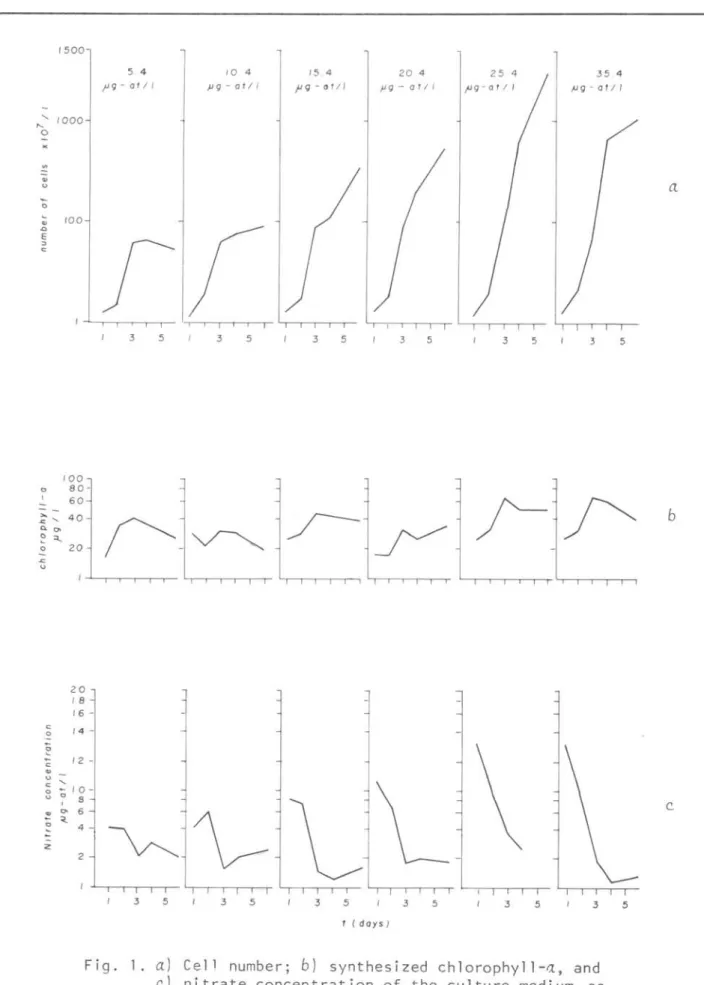
Fig. 1. a) Cell number; b) synthesized chlorophyll-a, and c.) nitrate concentration of the culture medi um, as a function of time, for each nitrate concen-tratiol1; the initial nitrate conc"!ntration is showl1 at the top.
a
5
b
c.
concentration in the P. ~connutum
culture medium, plotted in the abscissa and time in the ordinate for each nitrate concentration. The plotting of the cell number appeared as an almost perfect straight line, while synthesized chloro-phyll-a and nitrate uptake lines
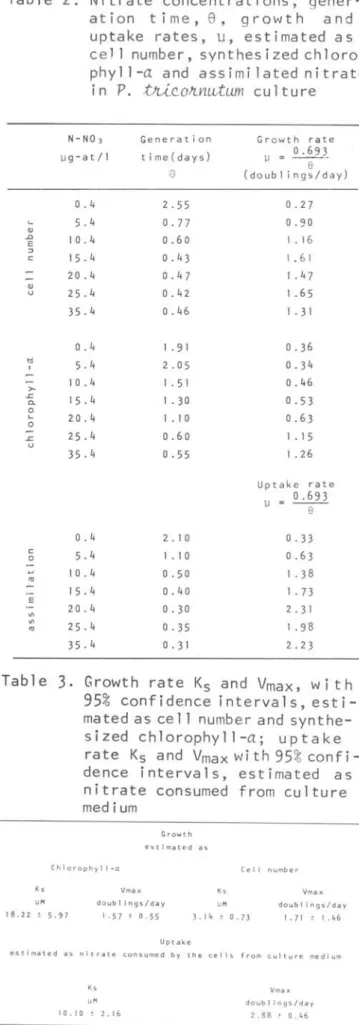
increased and decreased with time. These variations will be commented later. The initial nitrate concentratio~ in culture medium, generation time (8), growth and uptake rate, ~, are listed in Table 2. Null hypothesis between growth rate estimated as synthesized chlorophyll-a and cell number medium values, that
ii,
HO:~1=U2, was t = -0.73, for N =
12.
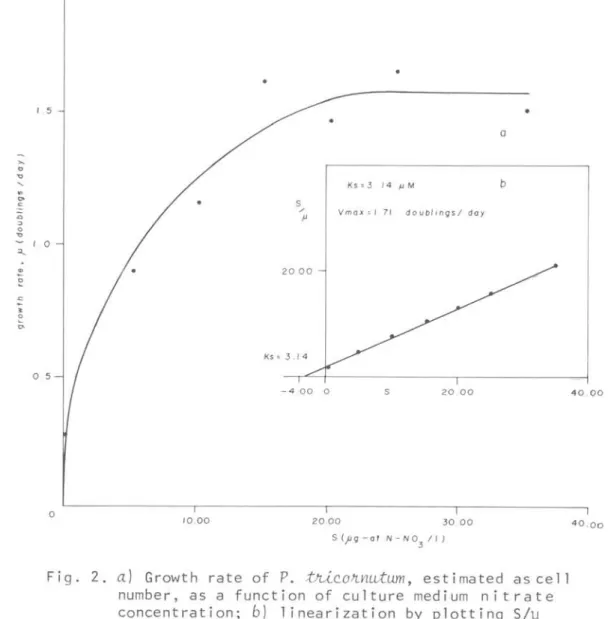
The medium value differences were random, at 1 and 5% significance leveI. Fi~ure
2a shows growth rate estimated as
p,
tJúconnutumcul ture synthes ized chlot'o-phyll-a in the abscissa and nitrate concentrations in the ordinate. Th~ data did not present a_ perfectretangular hyperbole. The linear plot of S/~ versus S values is shown in Figure
2b,
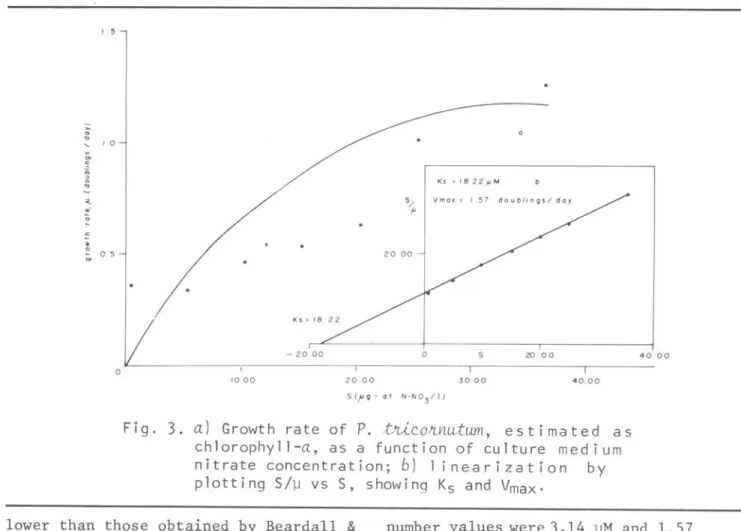
the Ks is in the negativ@ intercept and Vmax in the slope of the regression equation. Figure 3 shows the growth rate of P •.tJúconnutum
culture, estimated as cell number
in
the culture medium, as a function of nitrate concentration. The S/~ vs S plot shows Ks and Vmax values. The nitrate uptake rate, as a function of the nitrat@ concentrations, is shown in Figtu"e 4. The linearization plot shows Ks and Vmax values. Table 3 shows the Ks and Vmax values with 95% confidence intervalo Ks and Vmax were estimated from growth and uptake rate values (Table2).
Ks and Vmax obtained with the synthesized chlorophy ll-a vaI ues, 18. 22 ~M and 1. 57 doublings/day, respectively, inílicated that chlorophyll-a synthesis se~med to be the most sensible variable to the experimental conditions. Growth rate Ks and Vrnax estimated as cell nurnb~r were 3.14 ~M and 1.71 doublings/day, andTable 1. Hydrographic parameters,
5 eawa t e r n i t r a te, 'n i t i a 1
ch 1 orcphy 11 -a and ce'
1
numberPosition 5°;00 S,,"'pling Loc,,1 Chlorophyl' - a
23°45'5 depth depth ( .. ql1) I , 10 1 / l ) 4So01'IJ Im) ("9-a t / l )
33.98 0.0 50.00 0. 40 27 . 11 6 . 90
Table 2. Nitrate concentrations, gener-ation time, 8 , growth and uptake rates, u, estimated as cel1 number, synthesized chloro-phyll-a and assimilatednitrate in P.
tniconnutum
culture'-OJ .o E :J c: OJ U <:! I
-
>-~ a. o '-o c: o .-~ '" E.-'" '"
'"
N-N03
11 9- at / l
o .4 5.4
10 . 4
15 . 4
2 o . 4
25 . 4
35.4
0.4
5 . 4
10 . 4
15.4
20.4
25.4
35 . 4
0.4
5.4
10 . 4
1 5 . 4
20.4
25 . 4
35.4
Ge n e rati on ti me( da y s)
0
2 . 55
0.77
0 . 60
0.43 o .47
o . 42
0.46
1 .91
2.05
1 .51
1 . 30
1 . 10
0 . 60
0 . 55
2.10
1 .10
o . 50
0 . 40
0.30 o .35
o . 31
Gr ow th rat e
0.693
11 = -
--e
(d o ub 1 i n gs/ d ay )
0 . 27
0.90
1 . 16
1 .6 1
1 . 47
1 .65 1 .31
0 . 36 o .34 0 . 46 o .53
o . 63
1 . 15
1 .26
Up t a ke ra te
0 . 69 3
11 =
-8
o .33 o .63 1 . 3 8
1 . 73
2 .31
1 .9 8
2 . 23
Table
3.
Growth rate Ks andv
max , w i t h95% confidence intervals, esti-mated as ce 11 number and synthe-sized chlorophyll-a; uptake rate Ks and Vmax wi th 95 % confi-dence intervals, estimated as nitrate consumed from culture medium
G r owt h
estimated as
Chlorophyl1 - a
Ks
""
18.22 ± 5 . 97Vmax
d o ub l i n gs/d a y
1.57 :!: 0 .55
Uptake
Ce l l number
Ks Vmax
UM do u b l ings/d a y
).14 ± 073 1. 7 1 ± 1.46
est i mated as nitrate censumed by the cel l s fre m cu l ture medium
Ks
""
10.10 :!: 2 .1 6
Vma x doubl in g s/day
94
these values are rather in agreement with the expected values for Ks and Vmax
for
P.
tni~o~nutum ce lls growing withnitrate as nitrogen source (MacIsaac
&
Dugdale, 1969; Collos & Slawyk, 1979). The Ks and Vmax for the uptake rate of nitrate were 10.10 j.lM and 2.88doublings/ day, respectively. The Ks and Vmax values obtained in this work, presented percentual of Ks gre a ter than those of Vmax.Discussion
Chlorophyll-a concentrations of
P.
tni~o~nutum culture a re shown in Figure
lb. At the 3rd day of the experiment the chlorophyll-a présent ed a max imum value, followed by a decrea s e. Only at the concentration 20.40 j.l g/at/l N-N03, the
2 o
, 5
5
/
.Q
~
o
""
)J
Bolm Inst. oceanogr., S Paulo, 32(1), 1983
chlorophyll-a increased, on the 5th day. According to Sournia (1974) and Meeks
(1974) light is the main influence on the cellular chlorophyll concentration and high light intensity could inhibit synthesis and promote pigment bleaching. The relatively low chlorophyll-a content
of
P.
tni~o~nutum culture showed inFigure lb and, consequently, the low growth rates (Tab le 2) could, probably, be explained by the high light intensity
(12 KLUX) used in the experimento The cells had been cultured at 3 KLUX light intensity and, according to Beardall
&
Morris (1976),P.
tni~o~utum cells growing at 0.7 KLUX presented a decrease in chlorophyll-a contents when exposed to a 12 KLUX light intensity source. In this work, the cellular chlorophyll-a concentration values were ten times•
a
b
Vmax:.1 7 1 d ou b / , n gs / do y
2000
;:
•
o '"Ks ~ 3. I 4
0 . 5
- 4 00 o s 20 00
o 10 .00 20.00
30 . 00
Fig. 2.
a)
Growth rate ofP.
tni ~ o ~ nutum, estimated as cell number, as a function of culture medium nitrate concentration; b) linearization by plottinq S/j.l v s S, s how i n g K s a n d V ma x .4 0 00
1 . 5
~
" I O
"-
.-o
o 5
K s~' B 22
- 2000
o
1000
Ks", rB 22J.1 M
s/ ' VmoJ(::' 57 d o u bl rngs l dc y
I'
20 00
o 20 00 4 0 00
20 00 30.00 4 0.00
$( 1'9 - . ' N-N0 3 / 11
Fig. 3.
a)
Growth rate of P.búC.OfLf1u:twn,
estimated as chlorophyll-a, as a function of culture medium nitrate concentration; b) 1 inearization by plotting S/~ vs S, showing Ks and Vmax .lower than those obtained by Beardall
&
Morris(op.
cit.).
The high Ks growth rate value, 18.22 ~M, and low Vmax 1.57 doublings/day (Table 3; Fig. 2) presented byP.
tfLiC.OfLf1utum
culture could beattributed to the low cellular chloro-phyll-a contents . According to Dugdale
(1967) low Ks and high Vmax values are conditions of maximum production. Figure lc. shows the nitrate uptake by
P.
búc.OfLf1utum
during the experimentoNitrate uptake was considered as the nitrate consumed from the culture medium every day, during the experimento The concentration increase on the last day can be an irregularity that could be attributed to nitrite releases to the medium by
P.
tfLiC.OfLf1u:twn
cells (Collos &Slawyck, 1979; Co11os, 1982). Co11os
(op.
cit.),
working withP.
tfLiC.OfLf1u:twn,
reported that nitrite appeared in the medium after a few hours of nitrate addition. The increase of cell number during the experiment is shown in Figure
la. The cell division rate did not seem to be affected by the light intensity. Paasche (1968), working with N~zc.hia
tufLg~du.ta, related that this diatom did
not have the cell division rate affected by 24 KLUX li ght intensi t y. The Ks and Vmax for growth rate estimated as cell
number values were 3.14 ~M and 1.57 doublings/day, respectively (Table 3; Fig. 3). MacIsaac
&
Dugdale (1969) observed that Ks and Vmax obtained for eutrophic regions, are comparable to those for laboratory cultures. These authors found 4.21 ~M for N03 Ks of an eutrophic region population and 2.83 ~M for N0 3 growth rate of I~oc.httlj~~gaR-baf1a
growing in a chemostat culture.The nitrate concentrations utilized in this work (Table 2) can be considered as of nutrient rich water, since Thomas
(1970) listed a mean value of 5. 6 ~g-at/l
96
Bolm Inst. oceanogr., S Paulo, 32(1), 19832 . 5
-2 o
o
•
>,
o I 5
...
~
~
.Q
~
o
'O
KS~IO 10j.JM b
~
~ Vmox ~ 2 88 dobllngs doy
..
~
~ 1. 0
C>.
~
10 .0 0
Ks~IO . IO
0.5
- 2 0 . 00 o 5 20 00 40 00
o
10 00 20 O O 30 00 40 . 00
5(/,g-01 N-NO I)
Fig.
4.
a) Uptake rate ofP.
:tJL.[C.OfLvlU.:tum estimated as nitrate assimilated, as a function of culture medlum concentration; b) 1 inearization byplotting S/~ vs 5, showing Ks and Vmax .
number, and Ks of 2.30 ~M and Vmax of 1.07 doublings/day for nitrate uptake rate, nitrate concentrations ranging from 0.90 to 10.00 ~g-at/l, 5 KLUX light· intensity (Schmidt, 1982), The
P.
W .c.otmutum kinectics values presented
here could be explained by: a) insta-bility of chlorophyll-a synthesis
(Sournia, 1974); b) physiological stress of cells, due to the large starvation period (Collos, 1980); c) high light intensity, near to the saturation point and self-shading (Vieira, 1975). Other
factors would influence these results and new experiments must be carried on so as to confirm or not these data.
ReSUIllO
Foi determinado o efeito de uma alta
concentraç~o de nitrato e alta intensi~
dade luminosa na sintese de clorofila-a, número de celulas e assimilaç~o de ni-trato em uma cultura de ~ :tnic.OfLnutum.
As velocidades de crescimento e de
concentrações de nitrato variando de 0,40 a 35,40 ~g-at/l e intensidade lumi-nosa de 12 KLUX. A Ks e a Vmax apresen-taram valores altos, comparativamente com valores obtidos em concentrações mais baixas de nitrato e menor intensi-dade luminosa. A variação porcentual da Ks foi maior que a variação porcen-tual da Vmax.
References
BEARDALL, J.
&
MORRIS, I. 1976. The concept of ligth intensity adaptation in marine phytoplankton: someexperiments with
Phaeoda.ctytwn
thi-~o~nutum. Mar. Biol., 37:377-387.
COLLOS, Y. 1980. Transient situations in nitrate assimilation by marine diatoms. 1. Changes in uptake
parameters during nitrogen starvation. Limnol. Oceanogr., 25(6):1075-1081.
1982. Transient ~ituations
in nitrate assimilation by marine diatoms. 2. Changes in nitrate and nitrite following a nitrat~ pertur-bation. Limnol. Oceanogr., 27(3):
528-535. .
& SLAWYK, G. 1979. 13C and
15N uptake by marine phytoplankton.
I. Influence of nitrogen ªº~rce and concentration in laboratqry culture of diatoms. J. Phycol., 1;:186-190. DUGDALE, E. 1967. Nutrient limitation
in the sea: dynamics, identific:ation and significance. Limnol. Oceanogr., 12:685-695.
EPPLEY, R. W. & THOMAS, W. H. 1969. Comparison of ha1f-sat~ration
constants for growth and nitrate uptake of marine phytgp1ankton. J. Phyco1., 5(4):375-379
FAIRCHILD, E. & SHERIDAN. R. P. 1974. A physio1ogica1 investigation of the hot spring diatom, A~hnanth~
exigua
Grün. J. Phycol.,
10:1-4.
GUILLARD, R. R. L. & RYTHER, J. H.1962. Studies of marine planktonic diatoms.
r.
Cyuotel..ta nana
(Hustedt)and
Detonuta
~on6~vacea (C1eve).Gram. Cano J. Microbio1., 8:229-239.
MacISAAC,J. J.
&
DUGDALE, R. C. 1969. The kinetics of nitrate and ammonia uptake by natural population ofmarine phytoplankton. Deep-sea Res., 16:45-57.
MEEKS, J. C. 1974. Ch1orophyl1s. In: Stewart, W. D. P., ed. - A1ga1 physio1ogy and biochemistry. London.
MORRIS, I.; GLOVER, H. E.
&
YENTSCH, C.s.
1974. Products of photosynthesis by marine phytoplankton: the effect of environrnenta1 factors on the relative rates of protein synthesis. Mar. Biol., 27:1-9.MULLIN, J. B. & RILEY, J. P. 1955. The spectrophotometric determination of nitrate in natural waters, with particular reference to sea-water. Analytica chem. Acta, 12:64-90.
PAASCHE, E. 1968. Marine plankton algae with 1ight-dark cyc1es. 11.
Dilyfum bJÚgthwe1LU.
and NilZ.6~YU.atungiduta.
Physiologia P1.,21:66-77.
SCHHIDT, G. 1982. Algumas observações sobre a cinética do fitoplâncton ma-rinho. 1. Influência da concentração de nitrato e amônia na velocidade de crescimento e de assimilação desses nutrientes na diatomãcea
Phaeodacty-fum
thi~o~nutum (Bohlin). BolmInst. oceanogr., S Paulo, 31(2):13-27.
SOURNIA, A. 1974. ties in natural phytop1ankton. 325-389.
Circadian periodici-popu1ations of marine Adv. mar. Bio1., 12:
STRICKLAND, J. D. H. & PARSONS, T. R. 1968. A practica1 handbook of seawater ana1ysis. BulI. Fish. Res. Bd Can., (167) :1-311.
TEIXEIRA, C. & VIEIRA, A. A. H. 1976. Nutrient experiment using
98
THOMAS, H. W. 1970. Effect of ammonium and nitrate concentration on
ch1orophy11 increases in natural tropical Pacific phytoplankton popu1ations. Limnol. Oceanogr., 15:386-394.
- - - & DODSON, A. N. 1974.
Effect of interactions between temperature and nitrate supply on the cel1-division rates of two marine phytoflagellates. Mar. Bio1., 24:213-217.
Bolm Inst. oceanogr., S Paulo, 32(1), 1983
VIEIRA, A. A. H. 1975. Estudos expe-rimentais em fitoplâncton marinho. Dissertação de mestrado. Universi-dade de são Paulo, Instituto Oceano-gráfico, 115p.