Breastfeeding self-efficacy and interrelated factors
Autoeficácia em amamentação e fatores interligados
Maria de Fátima Fernandes Santos Silva1, Luciana Barbosa Pereira1, Tadeu Nunes Ferreira1, Ana Augusta Maciel
de Souza1
Objective: to verify maternal self-efficacy related to breastfeeding among postpartum women. Methods:
analytical and cross-sectional research with 385 puerperal women. The Short Form of the Breastfeeding Self-Efficacy Scale and a questionnaire with obstetric and socioeconomic variables were used. The data were analyzed by the student t-test in the Minitab Windows program version 17. Results: the factors with statistical significance were planned pregnancy (p=0.003), guidelines received during prenatal care (p=0.003), vaginal delivery (p=0.021), suckling in the first hour of life (p=0.003), income greater than a minimum wage (p=0.029) and non-use of illicit drugs (p=0.023). Conclusion: the participants had a high score for self-efficacy in breastfeeding related to planned pregnancy, guidelines received during prenatal care, vaginal delivery, first suction before the first hour of life, not offering to the child other milks prior to the letdown, mother’s knowledge about the minimum time of exclusive breastfeeding and the non-use of illicit drugs.
Descriptors: Self Efficacy; Breast Feeding; Weaning; Rooming-in Care; Risk Factors.
Objetivo: verificar a apresentação da autoeficácia materna relacionada à amamentação entre puérperas.
Métodos: pesquisa analítica e transversal com 385 puérperas. Utilizou-se a Escala de Autoeficácia na Amamentação - Forma Abreviada e questionário autoral com variáveis obstétricas e socioeconômicas. Os dados
foram analisados pelo teste t de student no programa Minitab versão Windows 17. Resultados: os fatores com significação estatística foram: gestação planejada (p=0,003), orientações recebidas no pré-natal (p=0,003), parto vaginal (p=0,021), sucção na primeira hora de vida (p=0,003), renda maior que um salário mínimo (p=0,029) e não uso de drogas ilícitas (p=0,023). Conclusão: as participantes apresentaram escore alto para autoeficácia em amamentar relacionado a planejamento da gravidez, orientações recebidas durante o pré-natal, via de parto vaginal, tempo para a primeira sucção antes da primeira hora de vida, não oferecer à criança outros leites antes da apojadura, conhecimento da mãe sobre tempo mínimo de aleitamento materno exclusivo e o não uso de drogas ilícitas.
Descritores: Autoeficácia; Aleitamento Materno; Desmame; Alojamento Conjunto; Fatores de Risco.
1Universidade Estadual de Montes Claros. Montes Claros, MG, Brazil.
Corresponding author: Maria de Fátima Fernandes Santos Silva
Introduction
In the last decades there has been an increase in the global prevalence of breastfeeding; however, there are few regions in the world in which half of children under six months are exclusively breastfed(1).
Accor-ding to the Pan American Health Organization, althou-gh almost all newborns are breastfed, the percentage of children under six months on exclusive breastfee-ding ranges from 7.7% to 60.4% and the median dura-tion of breastfeeding is 6.3 to 21.7 months. Countries that have made greater progress are showing signs of stagnation while there has been lacking progress or even regression in other countries(2).
The worst rates are in developing countries, in which the introduction of other foods occurs ear-ly(3). In Brazil, a study showed that only 57.3% of the
children are breastfed for 24 months and only 42.9% received exclusive breast milk until the sixth month of life(4).
In this context, it is observed that breastfeeding periods recommended by the World Health Organiza-tion are still a challenge and it is necessary to rethink and improve breastfeeding promotion, protection and support practices and to associate them with the avai-lable theoretical and scientific basis, considering the singularity of each person, the established institutio-nal policies and the qualification of practitioners, thus creating strategies that can fill gaps that interfere in the achievement of established goals(5).
One of the strategies for greater adherence to the practice of breastfeeding is to provide the mo-ther with the knowledge and attitudes necessary for the development of her breastfeeding self-efficacy(6).
When the person feels self-efficacious, they acqui-re motivation, which helps in the modification of the behavior towards the therapeutic aspect, taking into account the perception of the individual and their re-lations with the environment. Thus, if the woman per-ceives herself to be self-efficacious in the practice of
Self-efficacy contributes to the interaction between mother and child, maternal safety in baby care, and increases the possibility of breastfeeding for longer period. Therefore, it is necessary to consi-der the existence of mothers who, although wishing to breastfeed exclusively, do not feel self-efficacious in doing so and choose to supplement or replace breastfeeding with other foods before the child rea-ches six months of age(8).
In this sense, professional support may favor the development of maternal self-efficacy in breastfeeding through actions at all moments of the puerperal-pregnancy cycle, since successful breastfeeding depends on a self-efficacious attitude. In addition, it is necessary to carry out research that contemplates self-efficacy, encompassing the woman and the family, assuming that this concept should support the incentive to breastfeeding(9). Thus, this
study aims to verify maternal self-efficacy related to breastfeeding among postpartum women.
Methods
This is an analytical research with a cross--sectional design developed at a maternity hospital accredited to the Child-Friendly Hospital program and located in a School Hospital in the state of Minas Ge-rais, Brazil. The study was conducted from January to July 2016.
In order to determinate the sample size, the formula (n=Z2.pq.N/E2(N-1)+ Z2.p.q) was used. The
Participants were selected considering the in-clusion criteria: women in the postpartum period (1st to 10th day); six hours after delivery; being aged 12 years or older; and being hospitalized in the rooming--in during the collection period, accompanied by their newborn, who should be healthy and with effective sucking capacity. The exclusion criteria were women who presented clinical events at the time of data col-lection or in the puerperal period; maternal/neonatal condition that contraindicates breastfeeding; puerpe-ral women with some difficulty of comprehension and verbal expression; and postpartum women with cog-nitive and mental impairment.
The data were collected by the researchers, directly with the puerperal women, during hospitali-zation. The instrument used for information on self--efficacy was the Short Form of the Breastfeeding Self-Efficacy Scale, composed of 14 items, validated and adapted to the Brazilian culture. This scale favors the detection of mothers who are prone to success in breastfeeding, as well as those who may present need for interventions before discharge. It addresses cate-gories of mastery of the breastfeeding technique and intrapersonal thoughts, and each item is evaluated according to a Likert-type agreement scale with the following score: 1. I totally disagree, 2. I disagree, 3. I partially agree, 4. I agree and 5. I totally agree. In this way, the total score can range from 14 to 70 points. The identification of self-efficacy occurred through the sum of points obtained in each item, considering low (14 to 32 points); medium (33 to 51 points); and high efficacy (52 to 70 points)(10).
For the collection of complementary data re-garding the obstetric, sociodemographic, economic and knowledge profile of the pregnant woman, the questionnaire was developed by the researchers with the following variables: age, marital status, having paid activity, income, smoking, alcohol consumption, use of alcohol, use of other drugs, planned pregnancy, number of prenatal visits, guidelines received during
the prenatal and puerperal periods, parity, delivery route, time until first contact with the newborn, time until first suction, use of milk supplementation before the letdown and pregnant woman’s knowledge about the exclusive breastfeeding period. For this purpose, a pre-test was performed with 40 puerperal women randomly chosen to evaluate the time spent and the degree of understanding of the questions, aiming to improve the consistency of the questions and to adjust the instrument to the proposed objectives. The puer-peral women who participated in the pre-test were not included in the statistical calculation of the study, thus totaling 425 participants.
The data was organized in the Microsoft Excel/ Windows program (Office 2007) and exported to the Minitab program Windows 17 version for performing descriptive and associative analysis. The variables were presented in absolute numbers and percenta-ges. The Self-efficacy score variable was tested for the normal distribution, finding p<0.005, which led to the definition of the student t-test to verify the alternative hypotheses. The significance level was established for p-value <0.05.
The study complied with the formal require-ments contained in the national and international regulatory standards for research involving human beings.
Results
Table 1 – Distribution of puerperal women according
to sociodemographic variables, life habits, score relat-ed to the feeling of self-efficacy in breastferelat-eding
Variable n (%) p
Age (years)
≥ 21 298 (77.4) 0.240
≤ 20 87 (22.6)
Marital status
Single 115 (29.9) 0.000
Married/Stable union 270 (70.1) Performing paid activity
No 223 (57.9) 0.090
Yes 162 (42.1)
Income (minimum wage)
≤788 190 (49.3) 0.029*
≥788 195 (50.7)
Smoking
Yes 24 (6.2) 0.444
No 361 (93.8)
Alcohol consumption
Yes 57 (14.8) 0.424
No 358 (85.2)
Other drugs
Yes 13 (3.3) 0.023*
No 372 (96.7)
*p with statistical significance
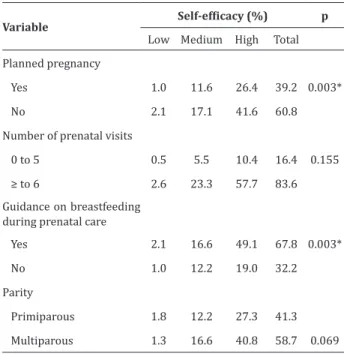
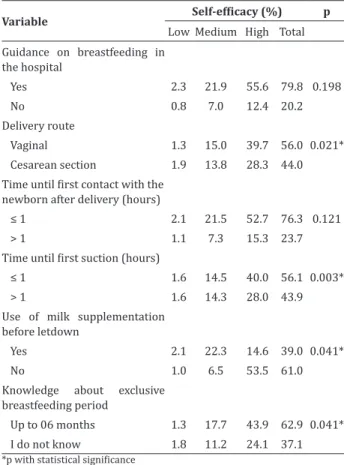
It was evidenced the predominance of agree-ment of the puerperal women in relation to the affir-matives of the Short Form of the Breastfeeding Self-Ef-ficacy Scale, since 68.0% (262) presented high efSelf-Ef-ficacy in breastfeeding, 28.9% (111) medium efficacy and 3.1 % (12) low efficacy. Associative analysis found a statistically significant relationship between the high-er self-efficacy score and the factors: being married/ in stable union; income greater than a minimum wage and non-use of illicit drugs; planned pregnancy; hav-ing received guidance on breastfeedhav-ing durhav-ing
prena-tal care; vaginal delivery; less than one hour until the first suction; no use of milk supplementation prior to letdown; and the knowledge about the period recom-mended by the World Health Organization for exclu-sive breastfeeding, according to Tables 2 and 3.
Table 2 – Distribution of puerperal women according
to prenatal obstetric variables and association with the self-efficacy score in breastfeeding
Variable Self-efficacy (%) p
Low Medium High Total Planned pregnancy
Yes 1.0 11.6 26.4 39.2 0.003*
No 2.1 17.1 41.6 60.8
Number of prenatal visits
0 to 5 0.5 5.5 10.4 16.4 0.155
≥ to 6 2.6 23.3 57.7 83.6
Guidance on breastfeeding during prenatal care
Yes 2.1 16.6 49.1 67.8 0.003*
No 1.0 12.2 19.0 32.2
Parity
Primiparous 1.8 12.2 27.3 41.3
Multiparous 1.3 16.6 40.8 58.7 0.069
*p with statistical significance
Table 3 – Care routines linked to the practice of
breastfeeding, referred to by the puerperal women researched
Variable Self-efficacy (%) p
Low Medium High Total Guidance on breastfeeding in
the hospital
Yes 2.3 21.9 55.6 79.8 0.198
No 0.8 7.0 12.4 20.2
Delivery route
Vaginal 1.3 15.0 39.7 56.0 0.021*
Cesarean section 1.9 13.8 28.3 44.0 Time until first contact with the
newborn after delivery (hours)
≤ 1 2.1 21.5 52.7 76.3 0.121
> 1 1.1 7.3 15.3 23.7
Time until first suction (hours)
≤ 1 1.6 14.5 40.0 56.1 0.003*
> 1 1.6 14.3 28.0 43.9
Use of milk supplementation before letdown
Yes 2.1 22.3 14.6 39.0 0.041*
No 1.0 6.5 53.5 61.0
Knowledge about exclusive breastfeeding period
Up to 06 months 1.3 17.7 43.9 62.9 0.041*
I do not know 1.8 11.2 24.1 37.1
*p with statistical significance
Discussion
The fact that the data had been collected only at the Child-Friendly Hospital, not allowing effective comparisons with other groups regarding breastfee-ding time, was set up as a limitation of this study. In addition, since it was not a longitudinal study, it was not possible to know the impact of the self-efficacy score on the continuity of breastfeeding after hospital discharge.
Studies conducted to assess the accuracy of the Short Form of the Breastfeeding Self-Efficacy Scale scores and to determine a cutoff point as a predictor for early weaning have shown that this scale has mo-derate accuracy to differentiate women who will not breastfeed exclusively after discharge from hospital, as mothers who have a score less than or equal to 50
points on the scale have high chances of early wea-ning. Thereafter, they should receive interventions that support exclusive breastfeeding(11).
Higher self-efficacy scores were also observed, similarly to this study, in women who had planned pregnancy(12). Regarding prenatal consultations, the
Prenatal Care and Delivery Humanization Program recommends that at least six consultations be held, in which laboratory and clinical-obstetric tests as well as breastfeeding guidelines should be provided(13). In
the sample from this study, a higher efficacy score was found among those who had attended six or more vi-sits.
Significant difference was found for those who knew the time recommended for exclusive breastfee-ding and who had received guidance on breastfeebreastfee-ding during prenatal care. In this context, exclusive breas-tfeeding incentive programs could be used to welco-me, accompany and guide the mothers, especially tho-se who had not make family planning(14), combining
quantity and quality of information.
Although it seems obvious that the multiparous group had greater experience and, therefore, better adaptation to exclusive breastfeeding, it was not ob-served in the sample that the number of deliveries is related to higher self-efficacy score in breastfeeding. In addition, infants who were born in hospitals accre-dited as a Child-Friendly Hospital have been breastfed for longer than those born in other hospital institu-tions(15). In this sense, the fact that the collection took
place in an institution that holds the title of Child--Friendly Hospital may have influenced the outcome.
Mothers who had had a natural delivery and started breastfeeding in the first hour of the baby’s life had a higher score in this study. A similar result was found in a study in which cesarean delivery was indi-cated as a factor that predisposes to low self-efficacy score in breastfeeding, since in the postpartum period the mother experiences pains and discomforts of the surgery that make it difficult to position the baby pro-perly(15). In addition, cesarean delivery is a risk factor
emphasize that early stimulation and suckling of the breast by the newborn are important to increase milk production(16).
Other researchers have also shown higher ma-ternal self-efficacy scores among mothers who had breastfed the first hour of life and concluded that putting the newborn to breastfeed early should be a routine in maternity wards. They recognized the im-portance of the institution holding the title of Child--Friendly Hospital as a protective factor against de-laying the initiation of breastfeeding. On the other hand, cesarean delivery and lack of knowledge about the results of the Human Immunodeficiency Virus test were identified as contributing factors for the late start of this practice.
Therefore, increasing the accreditation of insti-tutions as Child-Friendly Hospitals, reducing cesarean rates, adhering to prenatal care protocols, following recommendations that encourage breastfeeding in the first hour after birth and enabling professionals to perform appropriate interventions are important actions to promote breastfeeding in the first hour of life(14).
In contrast, this study demonstrated a high rate of use of milk supplementation, as opposed to the re-commendations of the Child-Friendly Hospital Initia-tive, considering that the babies were healthy and pre-sented effective sucking. Other negative aspects were the mothers’ lack of knowledge about the recommen-ded time for exclusive breastfeeding and the fact that almost one third of the puerperal women reported having received no guidance on breastfeeding during prenatal care. These findings expose the fragility of the care, the inconsistency of the health team and the lack of interaction or inadequacy of the counseling, serving as an alert for the restructuring in the quality of care(17).
Regarding the social aspects of this study, the family income greater than a minimum wage showed a positive association with the perception of self-effi-cacy, whereas the use of drugs and illicit substances
was obtained in an exploratory study with a quanti-tative approach conducted with 21 mothers, which suggests that the success of breastfeeding also depen-ds on social factors related to the living conditions. Therefore, it is necessary for professionals to consider self-efficacy in their sociocultural context, since it is necessary to establish interactions with the characte-ristics, knowledge, beliefs and behaviors of puerperal women(17).
This study allowed elucidating which aspects or factors contribute or interfere with the process of maternal self-efficacy for breastfeeding and, therefo-re, should be supported and reinforced by the health team. However, it is important to consider that a high self-efficacy score identified soon after childbirth faci-litates adherence to breastfeeding, but does not gua-rantee its continuity for the period recommended by the World Health Organization. It is, therefore, neces-sary to create a continuous support network, conside-ring the specificities of women and their families. We suggest further studies investigating this relationship and its influence on the process of self-efficacy.
Conclusion
The participants had a high score for self-effi-cacy in breastfeeding related to planned pregnancy, having received guidelines during prenatal care, va-ginal delivery, suckling before the first hour of life, not offering the child other milks before letdown, mother’s knowledge about the minimum time of ex-clusive breastfeeding and the non-use of illicit drugs.
Collaborations
References
1. Ducci AL, Vannuchi TO, Tacla MTGM, Souza SNDH, Reis TB. The prevalence and factors associated with exclusive breastfeeding in babies younger than six months in the city of Rolandia–PR. Rev Min Enferm. 2013; 17(2):381-9. doi: http:// dx.doi.org/10.5935/1415-2762.20130029 2. Organização Pan-Americana de Saúde.
Amamen-tação: uma questão contemporânea em um mun-do globalizamun-do [Internet]. 2014 [citamun-do 2016 out 30]. Disponível: http://www.paho.org/bra/ima-ges/stories/Documentos2/brief%20report%20 2014%20portugues.pdf
3. Silva D, Nóbrega L, Valente A, Dias C, Almeida F, Cruz JL, et al. Aleitamento materno e caracteriza-ção dos hábitos alimentares na primeira infância: experiência de São Tomé e Príncipe. Rev Bras Saúde Mater Infant. 2014; 14(3):269-77. doi: https://dx. doi.org/10.1590/S1519-38292014000300008 4. Rieth NFA, Coimbra LC. Caracterização do
aleitamento materno em São Luís, Maranhão. Rev Pesq Saúde [Internet]. 2016 [citado 2017 Out 17] 17(1):7-12. Disponível em: http:// www.periodicoseletronicos.ufma.br/index.php/ revistahuufma/article/view/5487/3360
5. D’artibale EF, Bercini LO. The practice of the fourth step of the baby friendly hospital initiative. Esc Anna Nery. 2014; 18(2):356-8. doi: http://dx.doi. org/10.5935/1414-8145.20140052
6. Santos FCS, Cyrino ACT, Santos FS, Santos NM, Abrahão FNA. Practice of the nurses in breastfeeding-friendly units of basic health. Rev Rene. 2014; 15(1):70-7. doi: http://dx.doi. org/10.15253/2175-6783.2014000100010 7. Mariano LMB, Monteiro JCS, Stefanello J,
Gomes SFA, Oriá MOB, Nakano AMS. Exclusive breastfeeding and maternal self-efficacy among women of intimate partner violence situations. Texto Contexto Enferm. 2016; 25(4):e2910015. d o i : h t t p : / / d x . d o i . o r g / 1 0 . 1 5 9 0 / 0 1 0 4 -07072016002910015
8. Spehar MC, Seidl EMF. Percepções maternas no Método Canguru: contato pele a pele, amamentação e autoeficácia. Psicol Estud. 2013; 18(4):647-56. doi: http://dx.doi.org/10.1590/ S1413-73722013000400007
9. Dodt RCM, Ferreira AMV, Nascimento LA, Macêdo AC, Joventino ES, Ximenes LB. Influence of health education strategy mediated by a self-efficacy breastfeeding serial album. Texto Contexto Enferm. 2013; 22(3):610-8. doi: http://dx.doi. org/10.1590/S0104-07072013000300006 10. Souza EFC, Fernandes RAQ. Breastfeeding
self-efficacy: a cohort study. Acta Paul En-ferm. 2014; 27(5):465-70. doi: http://dx.doi. org/10.1590/1982-0194201400076
11. Nanishi K, Green J, Taguri M, Jimba M. Determining a cut-off point for scores of the Breastfeeding Self-Efficacy Scale–Short Form: secondary data analysis of an intervention study in Japan. Plos One. 2015; 10(6):1-12. doi: https://doi.org/10.1371/journal. pone.0129698
12. Uchoa JL, Rodrigues AP, Joventino ES, Almeida PC, Oriá MOB, Ximenes LB. Autoeficácia em amamentar de mulheres no pré-natal e no pós-parto: estudo longitudinal. Rev Enferm UFSM. 2016; 6(1):10-20. doi: http://dx.doi.org/10.5902/2179769217687 13. Domingues RMSM, Viellas EF, Dias MAB, Torres
JA, Theme FMM, Gama SGN, et al. Adequação da assistência pré-natal segundo as características maternas no Brasil. Rev Panam Salud Públ. 2015; 37(3):140-7. Disponível em: https://scielosp.org/ pdf/rpsp/v37n3/v37n3a03.pdf
14. Rodrigues AP, Padoin SMM, Guido LA, Lopes LFD. Pre-natal and puerperium factors that interfere on self-efficacy in breastfeeding. Esc Anna Nery. 2014; 18(2):257-5. doi: http://dx.doi. org/10.5935/1414-8145.20140037
15. Margotti E, Epifanio M. Exclusive maternal breast-feeding and the Breastbreast-feeding Self-efficacy Scale. Rev Rene. 2014; 15(5):771-9. doi: http://dx.doi. org/10.15253/2175-6783.2014000500006 16. Yuksel I, Zeynep OD, Ozlem BT, Eren P. Early
postpartum lactation effects of cesarean and vaginal birth. Ginekol Pol. 2016; 87(6):426-30. doi: http://dx.doi.org/10.5603/gp.2016.0020 17. Lopes AM, Silva GRF, Rocha SS, Avelino FVSD,