*e-mail: [email protected]
Trabalho apresentado no XX° CBECIMAT, Águas de São Pedro, Dezembro de 2000
Evaluation of the Influence of Microwaves in the Structure of Silica Gels
Gisele M. Neves, Rubia F.S. Lenza*, Wander L. Vasconcelos
Laboratory of Ceramic Materials - LMC Dept. of Metallurgical and Materials Eng. - UFMG
Rua Espírito Santo 35, 2º andar - Centro, Belo Horizonte - MG, Brazil
Received: November 16, 2001; Revised: July 14, 2002
In this work we studied the influence of microwaves in the pore structure of silica gels ob-tained via sol-gel polymerization process. We analised the feasibility of replacing conventional heating by microwave heating during drying. Structural parameters such as specific volume of pores (Vp), specific surface area (Sp), average pore size (rp) and the bulk and true densities were measured. X-ray diffraction confirmed the obtention of a completely amorphous structure for the gels. Some characteristics of silica gels were evaluated by thermogravimetric analyses (TGA), differential thermal analyses (DTA) and Fourier transform infrared spectroscopy (FTIR). We ob-served that microwave drying is a feasible process to yield controlled pore nanostructures. The gels obtained via microwave heating presented average pore size of 1.2 nm, specific surface area of 112 m2/g and specific volume of pores of 0.06 cm3/g. The gels obtained via conventional heat-ing presented average pore size of 1.3 nm, specific surface area of 748 m2/g and specific volume of pores of 0.49 cm3/g.
Keyswords: structure, sol-gel and microwave
1. Introduction
The microwave processing makes possible to heat both small and large pieces very rapidly and uniformly, to effi-ciently remove volatile constituents (binders, moisture, etc) from thick sections. The absorption of microwave energy varies with the composition and structure of different phases, being possible the selective heating1-3.
Microwave heating is fundamentally different from con-ventional heating processes. In the microwave process, heat is generated internally within the material, instead of origi-nating from external heating sources. As a result of this in-ternal and volumetric heating, smaller thermal gradients are created in microwave-processed materials than in materials processed by conventional heating, reducing cracking dur-ing drydur-ing4.
Another advantage of microwave heating is that the treat-ment time can be considerably reduced, which in many cases represents a reduction in the energy consumption as well4.
Sol-gel is a low temperature method using chemical pre-cursors that produces ceramics and glasses with better pu-rity and homogeneity than high temperature conventional process. One major characteristic of sol-gel process is a large
variety of pore structures (average pore size, pore size dis-tribution, surface area, porosity, etc) that occur during processing and in the final product. The control of pore struc-tures in every stage of the process is of great interest, since controlling the pore structure is very important in order to achieve specific physical properties of products, such as index of refraction and capacity of adsorption5,6.
A major concern in the production of monolithic dried gels is the prevention of cracks during aging and drying steps. As the solvent escapes from within the gel or as the pore size changes during these processes, stresses are intro-duced into the silica network which may cause fracturing7,8.
Microwave processing has promising results when used for drying and densification of sol-gel silica4,9,10. The liquid
precursor is removed by means of the electromagnetic field associated to the microwaves. It was observed that micro-waves affect not only the surface area and porosity but also adsorption isotherms10.
syn-The exact way in which the microwave radiation affect the structural parameters of sol-gel materials are still un-clear. It is important that the effect of microwaves in mate-rials properties becomes well understood in order to make this process a reliable and practical technology for indus-trial applications. Thus, the goal of this work is to study the influence of microwaves in the structure of silica obtained by sol-gel method during drying.
2. Experimental Procedure
The chemical precursor used in the fabrication of silica gels was tetramethyl ortosilicate (TMOS, Aldrich Corp.). Nitric acid was used as catalyser. Porous silica obtained via conventional heating was aged and dried inside conventional open to air oven (model 315SE, FANEN). Porous silica obtained via sol-gel polymerization process was aged and dried using open to air microwave oven (MDS 2100, CEM). Structural characteristics of silica gels were obtained using nitrogen adsorption-desorption analyses. The equip-ment used was an Autosorb-1 (Quantachrome). The aver-age pore radius (rp) was estimated from rp = 2 Vp/ SP, were Vp is the specific pore volume and Sp is the specific surface area13. The data on true density (ρ
t) were obtained from
helium pycnometry experiments, using Pycnometer Multivolume (model 1305, Quantachrome). Bulk density measurements were carried out using two different meth-ods: mercury pycnometry and nitrogen adsorption-desorption analyses. The metric properties used for geo-metric description were volume fraction of pores (Vv) and the surface area density (Sv). These properties were obtained by nitrogen adsorption-desoption analyses. The connectiv-ity of pores per unit volume (Gv) was evaluated using a cy-lindrical model developed by Vasconcelos6,14. In that model,
the expression used to evaluate the genus is obtained through correlating of the metric properties Sv and Vv, as follows6:
(
32 (1 ))
1.3
+ − =
v v
v v
V V
S G
π (A)
The thermal behavior of the gels was evaluated using thermogravimetric analyses (TGA– 50, Shimadzu) and dif-ferential thermal analyses (DTA–50, Shimadzu). Fourier transform infrared spectroscopy (DRFTIR) was carried out using an equipment FTIR Paragon – 1000 (Perkin – Elmer) with the software Spectrum for Windows 1.0.
The data on bulk density obtained for conventionally heated samples by nitrogen adsorption-desorption analyses and helium pycnometry were smaller than the values ob-tained using mercury pycnometry. This difference can be a result of the errors associated with the determination of true density through helium pycnometry due to the difficulty to evaluate the real weight of samples, since can occur the pres-ence of water molecules adsorved in their surfaces e into their pores. The difference is only 8%, thus we used the estimated bulk density values to compare the samples prop-erties. We observed that the bulk density is bigger for po-rous silica made via microwave heating.
The nitrogen adsorption-desorption isotherms for po-rous silica obtained via conventional and microwave heat-ing are shown in Figs. 1 and 2, respectively. Accordheat-ing to de Boer definition15, the isotherm obtained via conventional
heating is type I isotherm, being characteristic of a microporous solid (pore radii ≤1.5 nm) and represent cy-lindrical pores opened in both extremities, in agreement with
Table 1. Values of bulk density (rv) and true density (rt) for porous
silica obtained via conventional heating and microwave heating.
Material rt rv (Hg) rv (N2)
(g/cm3) (g/cm3) (g/cm3)
conventional 1.41 ± 0.05 1.22 ± 0.01 1.12 ± 0.02
microwave 1.82 ± 0.05 — 1.62 ± 0.06
(Hg): mercury pycnometry
(N2): estimated from N2 adsorption-desorption
Figure 1. Isotherm of N2 adsorption-desorption obtained for the
BET theory16. The isotherm obtained with microwave
heat-ing exhibited unsual shape4. This isotherm have an histeresis
in the region of low relative pressure. Analysing only the adsorption branch of the isotherm, we can observe that the microwave-processed gel also present a microporous struc-ture. The presence of the pronounced histeresis can be a result of a high proportion of mesoporous and porous with complex geometries15.
Figure 3 shows the pore size distributions for silica gels obtained via conventional and microwave heating. The nar-row pore size distribution observed is appropriate for using the silica gels in separation processes. For the porous silica obtained via microwave heating we observed a slightly broader pore size distribution, confirming the coexistence of micro and mesopores.
Table 2 shows the data obtained for specific surface area of pores (Sp), specific volume of pores (Vp) and average pore radius (rp) for porous silica fabricated via conventional and microwave heating. The silica gels obtained via micro-wave heating present specific surface area of pores and spe-cific volume of pores quite smaller than for silica gels ob-tained via conventional heating. The microwave radiation has strong influence on silica gels structure. Silica gel proc-essed by microwave heating have different pore structure, with smaller microporous area and high bulk density than the conventional-processed gel. This difference can be a result of radiation action on the sol-gel reactions kinetics, leading to a more condensed network.
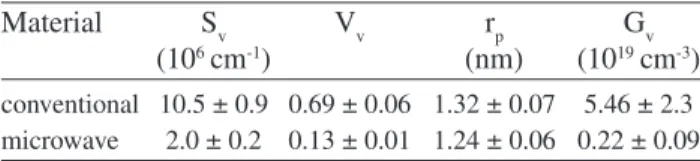
Table 3 presents the data on volume fraction (Vv), sur-face area density (Sv) and genus (Gv) for the porous silica gels. We observed that Gv presented high values, in the or-der of magnitude of 1019, for gel made via conventional
heating, and Gv in the order of 1018 for gel obtained via
microwave heating. The high pores connectivity of silica
gels show the feasibility of using these materials in separa-tion or adsorpsepara-tion processes13.
The thermogravimetric analyses show that the porous silica obtained via conventional heating presented higher water content when compared with the water content of the porous silica obtained via microwave heating. The water content was approximately 36% for gel obtained via con-ventional heating and 15% for gel made via microwave heat-ing. This result is related to the high specific surface area of pores for gel obtained via conventional heating when com-pared with the specific surface area of pores for gel ob-tained via microwave heating. Those high values favor the presence of silanol groups in that gel. Figure 4 exhibits the thermogrametric curves for the porous silica obtained. We observed two different regions of weight loss for the gel obtained via conventional heating. The first region corre-sponds to temperatures below 150 °C and is associated to loss of structural water. The second region occurs at tem-peratures above 300 °C. For the gel obtained via
micro-Figure 2. Isotherm of N2 adsorption-desorption obtained for
po-rous silica via microwave heating.
Figure 3. Pore size distribution for porous silica obtained via
con-ventional (C) heating and via microwave (M) heating.
Table 3. Metric and topological parameters of silica gels.
Material Sv Vv rp Gv
(106 cm-1) (nm) (1019 cm-3)
conventional 10.5 ± 0.9 0.69 ± 0.06 1.32 ± 0.07 5.46 ± 2.3 microwave 2.0 ± 0.2 0.13 ± 0.01 1.24 ± 0.06 0.22 ± 0.09
Table 2. Structural parameters of silica gels.
Material Sp (m2/g) V
p (cm3/g) rp (nm)
wave heating, Fig. 4 shows three different regions of weight loss: at temperatures below 180 °C and at temperatures be-tween 230 °C and 300 °C, which corresponds the loss of structural water; and above 300 °C, which corresponds to simultaneous loss of carbon residues and also to the loss of structural water in the form of silanol groups.
Figure 5 shows curves of differential thermal analyses (DTA) for gels obtained via conventional and microwave heating. We observed an endothermic peak, which can be attributed to evaporation of molecular water adsorbed on gels surface. We noted that the endothermic peak intensity is bigger for the curve of gel obtained via conventional heat-ing. The information obtained with differential thermal analyses (DTA) confirmed the results obtained by TGA. The porous silica obtained via conventional heating present higher water content when compared with the water con-tent of the porous silica obtained via microwave heating.
With infrared spectroscopy it was possible to analise the interactions involved and the structure of silica fabricated by sol-gel processing. The use of FTIR intended to verify the difference resulting from the variation of processing parameters for materials fabricated via conventional heat-ing and microwave heatheat-ing.
Figure 6 shows the spectra obtained for FTIR analyses of the porous silica fabricated via conventional heating and using microwave heating. In the region between 3700 cm-1
and 2700 cm-1 occurs the absorption corresponding to the
presence of silanol groups (Si-OH) and water. In this re-gion occurs a variety of absorption frequencies, due to the variety of structures and interactions involved.
The peaks located around 1970 cm-1, 1860 cm-1 and
800 cm-1 are characteristics of Si-O-Si bonds of the silica
network and these bonds appear in the spectrum of fused silica17. The peak at around 1630 cm-1 corresponds to the
Figure 6. FTIR spectra of silica gels obtained via conventional
(C) heating and via microwave (M) heating.
Figure 5. Differential thermal analyses of silica gels obtained via
conventional (C) heating and via microwave (M) heating.
Figure 4. Thermogravimetric analyses of silica gels obtained via
conventional (C) heating e via microwave (M) heating.
absorption for molecular water incorporated in the struc-ture and tends to disappear after heat treatment at high tem-peratures. Differences in magnitude observed for peaks corresponding to molecular water and silanol groups (1630 cm-1, 2700 – 3700 cm-1) confirm the high proportion
of water incorporated into the porous silica obtained via conventional heating, as determined by TGA analyses.
The absorption band between 1200 cm-1 and 1000 cm-1
corresponds to Si-O-(Si) stretching vibration associated to linear structures of glass network18. We observed that the
spectrum of silica gels obtained via microwave heating pre-sented this band at larger wavelengths. This represents a more branched network, with a larger proportion of Si-O-(Si) bonds associated to cyclic structures18. The peak
at about 960 cm-1 corresponds to stretching vibration of
con-firms that microwave radiation acts towards the increasing in the extension of polymerization reactions, leading to a more condensed network, with a higher bulk density, smaller surface area and pore volume, and a higher number of cross link than the conventional-treated gel.
4. Conclusions
Microwave radiation affects sol-gel materials structure, as was demonstred by N2 adsorption-desorption isotherms and density measurements. The gel obtained via microwave radiation presents higher density and smaller surface area than the gel obtained via conventional heating. Through the analyses of TGA, DTA and FTIR we observed that porous silica obtained via conventional heating presents higher water content than the gel obtained via microwave heating. According to FTIR analyses we observed that the silica obtained via microwave heating presents a more branched pore network than the pore structure of silica obtained with conventional heating.
Acknowledgments
The authors thank CNPq, CAPES and FAPEMIG for financial support.
References
1. Sutton, W.H. Bulletin of the American Ceramic Society, v.68, n.2, p.376, 1989.
2. Clark, D.E.; Folz, D.C. Ceramic Engineering and Sci-ence Proceedings, v.18, n.4, p.531, 1997.
3. Mingos, D.M.P.; Baghurst, D.R. Chemical Society Re-views, v.20, n.1, p.1, 1991.
4. Ferreira, M.P. Uso da Radiação Eletromagnética (Microondas, Ultravioleta e Raios Gama) e do Campo Magnético no Processamento Sol-gel da Sílica,
Universidade Federal de Minas Gerais, 2000, 177p. (Ph.D Thesis).
5. Schmidt, H. Journal of Non-Crystalline Solids, v. 100, p. 51, 1988.
6. Hench, L.L.; Vasconcelos, W.L. Annual Review of Mate-rials Science, Palo Alto, v. 20, p. 269, 1990.
7. Lenza, R.F.S.; Vasconcelos, W.L. Mat. Res., v.4, n.3, p. 189, 2001.
8. Lenza, R.F.S.; Vasconcelos, W.L. Mat. Res., v.4, n.3, p. 175, 2001.
9. Di Fiori, R.R.; Clark, D.E. Ceramic Engineering and Science Proceedings, v.16, p. 1089, 1995.
10. Rajeshkumar, S.; Anilkumar, G.M.; Ananthakumar, S.; Warrier, K.G.K. Journal of Porous Materials, v.5, p.59, 1998.
11. Park, S.; Kim, D.S.; Chang, J.; Kim, W.Y. Catalysis Today, v.44, p.301, 1998.
12. Zhong, J.P.; Fathi, Z.; La Torre, G.P.; Folz, D.C.; Clark, D.E.; Ceramic Engineering and Science Proceedings, v.15, p.1003, 1994.
13. Lenza, R.F.S.; Vasconcelos, W.L. Journal of Non-Crys-talline Solids, v.263, n.1-3, p.164, 2000.
14. Vasconcelos, W.L.; DeHoff, R.T.; Hench, L.L. Journal of Non-Crystalline Solids, v.121, n.3, p.124, 1990. 15. DeBoer, J.H. The Structure and Proprieties of Porous
Materials, Butterworths, London, p. 68, 1958.
16. Brinker, C.J.; Scherer, G.W. Sol-Gel Science: The Phys-ics and Chemistry of Sol-Gel Processing, Academic Press, inc. San Diego, CA. p. 907, 1990.
17.Orcel, G.; Phalippou, J.; Hench, L.L. Journal of Non-Crustalline Solids, v.88, p.114, 1986.