Structural study of aged saturated silica gels obtained from tetramethoxysilane sonohydrolysis
with different water
Õ
tetramethoxysilane molar ratio
D. R. Vollet, D. A. Donatti, A. Iban˜ez Ruiz, and W. C. de Castro Department of Physics, IGCE-UNESP, POB 178 CEP 13500-970 Rio Claro (SP), Brazil
~Received 28 November 2002; published 30 May 2003!
The structural characteristics of saturated silica sonogels were studied by means of small-angle x-ray scat-tering ~SAXS! and thermogravimetric analysis~TG!, after a long time of aging in saturated conditions. The sonogels were obtained by a sol-gel routine from ultrasound stimulated tetramethoxysilane~TMOS!hydrolysis carried out with the initial water/TMOS molar ratio~r!ranging from 2 to 10. The saturated sonogel structure can be described as composed by mass fractal-like aggregates~clusters!of primary silica particles, all imbibed in a liquid phase. The values of the mass fractal dimension~D!of the clusters was found all around 2.5, while the characteristic size of the clusters (j) was found generally increasing withr, going from approximately 2.3 nm (r52) to 4.5 nm (r510). The volume fraction of the clusters was estimated from the SAXS data. The results were compared to the values of weight loss fraction at the inflection point that has been found in the derivative of the TG curve, which should accounts for the instant in which the meniscus of the liquid phase penetrates into the clusters under a rapid evaporation process as in a TG test.
DOI: 10.1103/PhysRevB.67.184207 PACS number~s!: 61.10.Eq, 61.43.Hv, 81.20.Fw, 82.70.Gg
I. INTRODUCTION
A large variety of glass and glass ceramic has been ob-tained by sol-gel process from the hydrolysis of tetraalkoxysilanes.1 Since water and alkoxide frequently ex-hibit an immiscibility gap, a co-solvent such as alcohol is used as a homogenizing medium for the hydrolysis process ~conventional method!. Ultrasound is an alternative method to promote hydrolysis of alkoxide without using alcoholic co-solvent for homogenization ~sonohydrolysis!.2 However, there is no simple criterion to be established for the equiva-lence in the sample preparation to allow a direct comparative study between the both methods. For instance, starting with a fixed quantity of alkoxide and fixing the total volume of the mixture, we could not find an adequate relation between wa-ter and co-solvent in the conventional method which matches the same water/alkoxide molar ratio necessary to the solvent-less sonohydrolysis.
It has been generally accepted that fractal structures are formed in the sol-gel process.3 However, different fractal structures have been reported depending on the conditions of preparation, such as the base or acid-catalyzed hydrolysis, the aging time before the supercritical treatment~in the case of aerogels!and the initial alkoxide/water molar ratio.4Since the structure and properties of the final product have been found to be strongly dependent of the initial conditions of preparation, thus the structural properties of sonogels have been subject to some speculation. Some studies on the time evolution about the aggregation process5 and the aging process6 have been carried out in sonogels. Indeed, the lit-erature is not too plentiful of data concerning to the struc-tural properties of sonogels, mainly about saturated sonogels. In this work, the structural characteristics of tetramethox-ysilane~TMOS!-derived sonogels, after a long time of aging in saturated conditions, are studied as a function of the start-ing water/TMOS molar ratio used in the sonohydrolysis. The saturated sonogels were analyzed by small-angle x-ray
scat-tering ~SAXS! and thermogravimetry ~TG!. An interesting structural correlation obtained from SAXS and TG data for the volume fraction of the clusters composing the saturated gels is presented.
II. EXPERIMENT
A. Sample preparation
Tetramethoxysilane ~TMOS!, distilled and deionized wa-ter, and oxalic acid as a catalyst were used to prepare acidu-lated TMOS-water mixtures of constant volume~31 ml!with 0.116 mol/l oxalic acid and water/TMOS molar ratio ~r! ranging from 2 to 10. The samples were submitted to a con-stant power ~60 W! of ultrasonic radiation using a 20-kHz 600-W apparatus, with a 13-mm-diameter titanium trans-ducer driven by an electrostrictive device. As described elsewhere,7a stainless-steel reaction cell is held under a ther-mostatic temperature (25 °C) by means of high flux water circulation from an external bath. The acid action is mainly associated to the hydrolysis process, which occurs rapidly and completely at the first instants of the sonication process.8 The resulting sols were held at room temperature in perfectly sealed containers to gelation and aging under completely saturated conditions for about a year. A long time of aging is desired since we aim to study the structure after practically complete polycondensation reactions, when no more struc-tural evolution is expected to occur and the effect of the initial water quantity on the final structure can be probed. We could accelerate the polycondensation process by the addi-tion of NH4OH, for instance. However, the use of a two-step process would bring a new variable to be considered and the effect of the water content under probe could be influenced. The aged monolithic sonogels were studied by SAXS, bulk density, and termogravimetry analysis.
B. SAXS measurements
was monochromatized by a silicon monochromator and col-limated by a set of slits defining a pin-hole geometry. A one-dimensional ~1D! position sensitive x-ray detector was used to record the SAXS intensity as function of the modulus of the scattering vector q5(4p/l)sin(u/2), where u is the scattering angle. The experimental set allowed us to obtain SAXS data from q050.1 nm21 to qm53.5 nm21 with a
resolution of Dq54.9831023 nm21. Samples of about 1
mm thick were cut from the saturated sonogels for the SAXS experiments. The samples were never allowed to dry during the SAXS measurements. The SAXS data were corrected by the parasitic scattering and the sample attenuation, and nor-malized by incident beam intensity and the logarithm of the attenuation, which is fairly proportional to the thickness of the sample, if we neglect the variations of composition due to the different water contents.
C. Interpretation of SAXS data
An approach suggested by Freltoftet al.9which has been used10to describe the SAXS intensityI(q) from a system of mass fractal-like aggregates ~clusters! of primary particles can be expressed by
I~q!5A P~q!S~q!, ~1!
whereAis a parameter describing the independent scattering from all primary particles, P(q) the form factor of a single particle, and S(q) the structure factor of the clusters. The parameter A is proportional to the number of primary par-ticles in irradiated volume,P(q) is often well approximated by the Debye-Bueche form
P~q!51/~11a12q2!2, ~2!
wherea1 is the characteristic length of the primary particle
andS(q) is determined by
S~q!511Bsin@~D21!arctan~qj!#/
~11q2j2!(D21)/2~D
21!qj, ~3!
wherej is the characteristic length of the cluster with mass fractal dimensionDandBis a constant, so that 11B repre-sents an average number of primary particles per cluster.
For small values ofq so thatqj!1 the cluster seems to be homogeneous ~nonfractal! to SAXS and the system should scatter at smallq values as Guinier’s law as
I~q!5I~0!exp
S
213RG2q2
D
, ~4!where RG is the gyration radius of the clusters, which is
proportional toj. Very elongated clusters or a linear arrange-ment of minor globular clusters, which can be described as a cylindrical particle with a very long dimension L compared to the cross-section dimensions, so that qL@1 in Guinier’s law region, should scatter at smallq as
I~q!q5Ic~0!exp
S
21 2Rc
2
q2
D
, ~5!where Rc is the gyration radius of the cross section of the
particle and Ic(q) the exclusive scattering of the cross
sec-tion of the particle.
For high values of q so that qa1@1, we expected the
intensity going to a Porod’s law behavior I(q);q24.11
Pa-rametera1 was found to be very small for Porod’s law to be
observed in the length scale probed by SAXS in this study. As a conservative estimative we assume that a1;1/qm
;0.3 nm.
III. RESULTS
Figure 1 shows the experimental SAXS intensity as a function of the modulus of the scattering vector q for satu-rated gels obtained from the sonohydrolysis of TMOS car-ried out with different water/TMOS molar ratio (r). Freltoft et al.’s approach@Eqs.~1!–~3!#fits very well with the experi-mental SAXS data in all cases, except at lowqvalues for the sonogel prepared withr52, in which case the fitting process was carried out in the rangeq.0.35 nm21. The fitting
pro-cess was carried out by an iterative least-square routine with restriction in the parameter a1 @Eq. ~2!# so that a1
;0.3 nm, as pointed out in Sec. II C. Parameters D, j, B, andAof the fitting process are shown in Fig. 2 as a function of water/TMOS molar ratio.
The values of the mass fractal dimensionDwere found all around ;2.5, mainly for large r values. The average value for Din the wholerrange was found to be 2.5160.04. The characteristic length of the clustersjincreases with the water quantity going from approximately 2.3 nm for r52 to 4.5 nm forr510, in agreement with the increase of the number of particle per cluster,B11. It is apparent that there is some
discontinuity in the progress of the number of particles per cluster at around r;4.
Figure 3 shows Guinier’s plots as stated by Eqs.~4!and ~5!at smallqvalues for some sonogels. From Fig. 4~top!we can infer that Eq. ~4! is not obeyed by the system at the
extremes of water content r52 and r510, but is fairly obeyed for r54. This means that the size distribution of clusters is more homogenous for r54 when compared to that ofr510. The departure from Eq.~4!of the system with r52 is due to another cause. From Fig. 3~bottom!we can infer that Eq. ~5! is well obeyed by the system withr52. This means that probably the clusters are in a linear align-ment so that they scatter, at this resolution scale, as a long cylindrical particle with a cross section with dimensions of the same order of the individual globular clusters to give a SAXS contribution as predicted by Eq. ~5!. The gyration radius of the cross section Rcfor the sample with r52, as
determined by the linear fitting shown in Fig. 3 ~bottom!, was found to be (1.5360.02) nm. A cylinder with Rc
51.53 nm has a cross-section radius equal to 2.16 nm, which is in good agreement with the valuej52.26 nm that was found by fitting the Freltoft et al.approach @Eqs. ~1!– ~3!#to the sample withr52.
Figure 4 ~top!shows the weight loss percentage Dm/m0
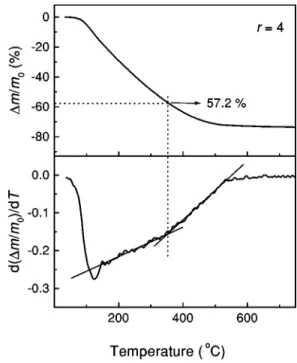
as determined by thermogravimetric analysis carried out un-der a heating rate of 12.5 °C/min up to 900 °C, for saturated sonogels as a function of the initial water/TMOS molar ratio. Figure 4 ~bottom! shows numerical first derivatives of the weight loss curves with respect to temperature T, d(Dm/m0)/dT.
The total accumulative weight loss up to 900 °C, (Dm/m0)T, was found increasing with the water content and
the results are shown in Fig. 5 ~bottom!. For example, (Dm/m0)T was found to be about 69% forr52 and about
84% for r510. These results are in good agreement with those theoretical values ~68% and 82%, respectively! esti-mated under the assumption of 100% hydrolysis followed ~after a long time of aging!by 100 % polycondensation
re-FIG. 2. Structural parameters as obtained by fitting Freltoft
et al.approach@Eqs.~1!–~3!#to the experimental SAXS data as a function of the initial water/TMOS molar ratio.
FIG. 3. Guinier’s law plots as stated by Eqs.~4! ~top!and ~5! ~bottom!for smallqvalues for several values of the initial water/ TMOS molar ratio (r).
actions, under the condition of no liquid evaporation ~since the containers are sealed!, yielding exclusively SiO2, metha-nol and water ~the latter when in excess in the case of r .2). Under these conditions, the stoichiometry of the final sonogel could be cast as a mixture of SiO214 CH3OH1(r
22) H2O, the liquid phase being a mixture of 4 CH3OH
1(r22) H2O. The bulk density of the samplesr were
de-termined from mass and volume measurements and the re-sults are shown in Fig. 5~top!. The liquid phase densityrL
was evaluated from the total weight loss (Dm/m0)T and r
assuming that
r5fLrL1~12fL!ra, ~6!
wherefLis the volume fraction of the liquid phase in the gel
andrais the density of primary particle composing the solid
phase of the gel. Then
rL5~ Dm/m0!Tra/$~ra/r!2@12~ Dm/m0!T#%. ~7!
Figure 5~top!shows the evaluated values forrLassumingra
equal to the density of the fused silica 2.25 g/cm3. The val-ues ofrLwere found all about 6% less than those theoretical
evaluated from an ideal liquid mixture with composition 4 CH3OH1(r22) H2O.
IV. DISCUSSION
The structure of the TMOS-derived sonogels after a long period of aging in perfectly sealed containers can be de-scribed as formed by mass fractal-like aggregates ~clusters! of primary particles of silica, all imbibed in a liquid phase.
The mass fractal dimension of the clusters was found to be about 2.5. A value ofD;2.5~together with an exponent of polydispersityt;2.2) would be compatible with a aggrega-tion process according to the percolaaggrega-tion theory.12
The characteristic length of the clusters and their struc-tural arrangement seem to be a function of the initial water/ TMOS molar ratio used in the sonohydrolysis process. For instance, for r52 the clusters are strongly aligned forming long chains with a sharp distribution of size in the character-istic cross-section dimension, while for r510 the distribu-tion of size of the globular clusters is wider.
The density rj of a cluster with characteristic length j and mass fractal D, composed by particles of characteristic length a1 and densityra, all imbibed in a liquid phase with
density rL, can be evaluated from the following equation:13
Drj/Dra5~j/a1!D23, ~8!
whereDrj5rj2rLandDra5ra2rL. Figure 5~top!shows
the values of the density of the clusters rj as a function of the initial water/TMOS molar ratio, as evaluated from Eq. ~8!withra52.25 g/cm3 and the data ofrL shown in Fig. 5
and the SAXS parameters j and D shown in Fig. 2. The volume fraction of the clusters in the sonogels, fj, can be evaluated from an analogy to Eq.~6!by writing
r5fjrj1~12fj!rL. ~9!
Then
fj5~r2rL!/~rj2rL!. ~10!
For instance, the evaluation of Eq.~10!for the sample with r54 yieldsfj50.329. Thus we presume that about 0.671 of the volume fraction of the sonogel is associated to a macroporosity occupied by the liquid phase. The remaining
FIG. 6. Illustration of the obtaining of the parameter (Dm/m0)j
by the inflection point of the derivative of the TG curve showed for the sample withr54.
FIG. 5. Top: Densities associated to the saturated sonogels as a function of the initial water/TMOS molar ratio.r: bulk density;rL: density of the liquid phase of the sonogel;rj: cluster density.
Bot-tom: (Dm/m0)T: total weight loss fraction as determined by TG; (Dm/m0)j: weight loss fraction associated to the volume fraction
of the liquid phase is in the structure of the saturated clusters in such way to form a structure compatible with the corre-sponding mass fractal dimensionality.
The liquid phase outside of the clusters should evaporate with more facility in a thermogravimetric test than that inside of the clusters. Let (Dm/m0)j be the mass loss fraction in which the liquid phase penetrates the clusters occupying a volume fraction fj. Then
~ Dm/m0!j5~12fj!rL/r. ~11!
Figure 5 ~bottom! shows the evaluation of (Dm/m0)j as a function of the initial water/TMOS molar ratio. For instance, the evaluation of Eq. ~11! for the sample with r54 yields (Dm/m0)j50.563.
Since the water phase within the clusters should present a greater resistance to evaporate than that outside the clusters, we expected a change in the evaporation rate at the instant in which the liquid phase penetrates the cluster, in a rapid evaporation process as in a TG test. Figure 6 detaches an inflection point in the first derivative of the weight loss curve for the sample with r54. This inflection point occurs at (Dm/m0)j50.572 in good agreement with the value 0.563
as obtained by SAXS. Figure 5~bottom!shows the reason-able concordance between the values of (Dm/m0)j as ob-tained by TG and by SAXS in all the studied range of the initial water/TMOS molar ratio.
V. CONCLUSIONS
The structure of the TMOS-derived sonogels, after about one year of aging in a hermetically sealed container, can be described as formed by mass fractal-like aggregates ~ clus-ters! of primary particles of silica, all imbibed in a liquid phase, a mixture of water and methanol resulting after a practically complete hydrolysis and polycondensation reac-tion. The mass fractal dimension of the clusters was found to be about 2.5, a value approximately independent of initial water/TMOS molar ratio. The characteristic length of the clusters increases with the initial water/TMOS molar ratio~r! going from approximately 2.3 nm for r52 to 4.5 nm for r 510. The clusters are strongly aligned forming long chains of clusters in the case ofr52, while the distribution of size of the clusters becomes more wider for high water content.
Under a rapid evaporation process as in a thermogravi-metric test, it is apparent that a change in the evaporation rate at the instant in which the liquid phase penetrates the cluster. In all cases of the studied range of the initial water/TMOS molar ratio, the values of weight loss fraction up to the liquid phase penetrates into the clusters as determined by TG are in reasonable agreement with the values of the volume fraction of the clusters as determined by SAXS.
ACKNOWLEDGMENTS
Research was partially supported by LNLS-National Syn-chrotron Light Laboratory~Brazil!, and FAPESP~Brazil!.
1C. J. Brinker and G. W. Scherer,
Sol-Gel Science: The Physics and Chemistry of Sol-Gel Processing ~Academic, San Diego, 1990!.
2M. Tarasevich, Am. Ceram. Soc. Bull.63, 500~1984!.
3C. Marlie`re, F. Despetis, P. Etienne, T. Woignier, P. Dieudonne´,
and J. Phalippou, J. Non-Cryst. Solids285, 148~2001!. 4T. Woignier, J. Phalippou, R. Vacher, J. Pelous, and E. Courtens,
J. Non-Cryst. Solids121, 198~1990!.
5D. R. Vollet, D. A. Donatti, and A. Iban˜ez Ruiz, J. Non-Cryst.
Solids288, 81~2001!.
6D. A. Donatti, A. Iban˜ez Ruiz, and D. R. Vollet, J. Non-Cryst.
Solids292, 44~2001!.
7D. A. Donatti, A. Iban˜ez Ruiz, and D. R. Vollet, Ultrason.
Sonochem.9, 133~2002!.
8D. A. Donatti, D. R. Vollet, and A. Iban˜ez Ruiz, J. Sol-Gel Sci.
Technol.18, 5~2000!.
9T. Freltoft, J. K. Kjems, and S. K. Sinha, Phys. Rev. B
33, 269 ~1986!.
10I. Krokovsky´, H. Urakawa, K. Kajiwara, and S. Kohjiya, J.
Non-Cryst. Solids231, 31~1998!.
11G. Porod, inSmall Angle X-ray Scattering, edited by O. Glatter
and O. Kratky~Academic, London, 1982!.
12J. E. Martin and K. D. Keefer, Phys. Rev. A34, 4988~1986!. 13R. Vacher, T. Woignier, J. Pelous, and E. Courtens, Phys. Rev. B