
Article
J. Braz. Chem. Soc., Vol. 22, No. 3, 511-516, 2011. Printed in Brazil - ©2011 Sociedade Brasileira de Química
0103 - 5053 $6.00+0.00
A
*e-mail: [email protected]
A Convenient and Eficient Protocol for the One Pot Synthesis of
3,4-Dihydropyrimidin-2-(1H)-ones Catalyzed by Ionic Liquids
under Ultrasound Irradiation
Abhishek N. Dadhania, Vaibhav K. Patel and Dipak K. Raval*
Department of Chemistry, Sardar Patel University, Vallabh Vidyanagar, 388 120, Gujarat, India
Derivados de 3,4-dihidropirimidin-2-(1H)-onas foram sintetizados via uma reação one-pot
de três componentes, com excelentes rendimentos em curtos tempos reacionais, usando aldeídos, acetoacetato de etila e uréia (ou tiouréia) em líquidos iônicos à temperatura ambiente (RTILs) sob radiação de ultrassom, sem adição de catalisador. Um mecanismo sintético plausível foi postulado levando em consideração o papel catalítico dos líquidos iônicos em promover a reação. Os líquidos iônicos puderam ser reciclados no mínimo seis vezes com boa retenção de atividade.
Derivatives of 3,4-dihydropyrimidin-2-(1H)-ones were synthesized in excellent yields in short reaction time by one pot, three component reaction of aldehydes, ethyl acetoacetate and urea (or thiourea) in room temperature ionic liquids (RTILs) under ultrasound irradiation without any added catalyst. A plausible mechanistic pathway has been postulated based on the catalytic role of the ionic liquid in promoting the reaction. The ionic liquids could be recycled at least six times with retention of their activity.
Keywords: one pot synthesis, 3,4-dihydropyrimidin-2-(1H)-ones, ionic liquid, ultrasound
Introduction
3,4-Dihydropyrimidin-2-(1H)-ones (DHPMs) and their derivatives have attracted global interest because of their pharmacological and therapeutic properties.1,2 They have
emerged as integral backbones of several calcium channel blockers, antihypertensive agents, alpha-1a adrenergic receptor antagonists.3 Several marine alkaloids containing
the DHPM unit have shown interesting biological properties.4
Synthetic strategies towards the dihydropyrimidine nucleus involve one-pot to multistep approaches. The classical synthesis of DHPM nucleus, condensation of ethyl acetoacetate, benzaldehyde and urea under strong acidic condition was low yielding (20-50%).1 Subsequent multistep
synthesis producedsomewhat higher yields but lacked the simplicity of one-pot, one-step procedure.5 Consequently,
for the synthesis of DHPMs many improved procedures have been reported. Many of these procedures effectively employed catalyst such as BF3·Et2O6 in combination
with transition metal salts and a proper proton source. Polyphosphate ester7 was claimed to greatly improve the
yield. Recently, the use of various catalysts8 like polystyrene
sulphonic acid (PSSA), Bi(NO3)3, PhB(OH)2, TaBr5,
acidic clay montmorillonite KSF, zeolites, FeCl3·6H2O, LaCl3·7H2O, Yb(OTf)3, InCl3 have been reported. In
addition, microwave9 and ultrasound10 are also reported to
promote the Biginelli three component cyclocondensation reaction. Most of the reported methods employ strong acidic conditions, high temperature and require long reaction times, or use expensive catalysts. From a literature survey, emerged the need to carry out this reaction with higher atom utilization and shorter reaction times under milder reaction conditions.
Ionic liquids (ILs) have attracted extensive research interest as environmental benign solvents due to their negligible vapour pressure, solvating ability, reusability and high thermal stability.11 Apart from this, some ILs
possess inherent Lewis/Bronsted acidity;12 by combining
these unique properties they have emerged as a ‘‘green reaction media’’. The use of ILs as reactions media may offer a convenient solution to both the solvent emission and catalytic recycling problem with high eficiency.13 The use
of ultrasound is now well known to enhance the reaction rates and yields of reactions under milder conditions.14
The considerable energy for transformation is liberated by formation and collapse of bubbles. The reaction media such as ILs, having negligible vapour pressure,15 should
substrates to undergo the cavitational activation. From this fact, we planned for further innovations in this multi component reaction (MCR) by practising sonochemistry in ILs. Proceeding on the same lines, we opted to evolve an eficient and ecofriendly process for the preparation of ionic liquid 1-carboxymethyl-3-methylimidazolium tetraluoroborate [cmmim][BF4] by ultrasound irradiation.
Herein we disclose the preparation of [cmmim][BF4] via
ultrasound and report the synthesis of DHPMs promoted by the combined use of ultrasound and the mixture of carboxy functionalized ionic liquid [cmmim][BF4]and
1-butyl-3-methylimidazolium tetraluoroborate [bmim][BF4]at
30 oC in excellent isolated yields. The mixture of ILs can
be eficiently recovered and reused at least six times. The process holds well without any added catalyst.
Results and Discussion
Song and co-workers16 have reported the synthesis
of [cmmim][BF4] under conventional conditions at
70 oC. Herein we have successfully carried out the same
transformation under sonication at ambient temperature in comparatively shorter duration.
A variety of aldehydes were condensed with ethyl acetoacetate and urea (or thiourea) as shown in Scheme 1. Typical ultrasound assisted MCR of benzaldehyde, ethyl acetoacetate and urea was chosen as a model reaction for optimization. The results are shown in Table 1. Using [cmmim] [BF4]as the sole solvent, the reaction system became non
homogeneous and proceeded with comparatively low yield over a long reaction time, due to the low solvation capacity of IL (entry 1). Consequently, another ionic liquid was added as
a co-solvent to increase the solvation capacity of the medium. With carboxyl-functionalized ionic liquid [cmmim][BF4] in
hand, various proportions with [bmim][BF4] were screened
for the model reaction to afford 5-ethoxycarbonyl-4-phenyl-6-methyl-3,4-dihydropyrimidin-2-(1H)-one (Table 1). When the voluminal ratio of [bmim][BF4]was increased
(entry 2, 3 and 4) a ramp in the yields with shorter reaction time was observed. Based on that evidence the optimal ratio of [cmmim][BF4] to [bmim][BF4] was chosen to be 2:1 (v/v).
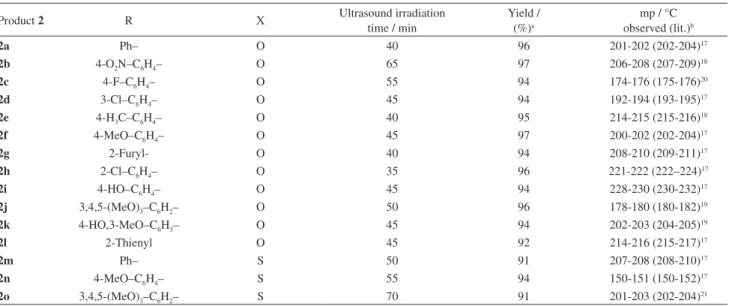
Based on this investigation, a number of DHPMs (Table 2, a-o) were successfully synthesized using the same proportion for IL mixture from variety of aldehydes. The reaction proceeded with low yield over a long reaction time when [bmim][BF4]
sole was employed as the reaction medium (Table 1, entry 5). From this observation, it becomes evident that the role of [bmim][BF4] is as a co-solvent, the reaction does
not get accelerated by its presence. A series of successful experiments were run by using molecular solvents like methanol and ethyl acetate as the co-solvents in lieu of [bmim][BF4]. To avoid the use of molecular solvents, we
opted for [bmim][BF4] as the co-solvent for the reaction.
Table 1. The effects of ratio between [cmmim][BF4] and [bmim][BF4] on the synthesis of 2a under ultrasound irradiation
entry [cmmim][BF4]:
[bmim][BF4] (v/v)
time / min
Yield / (%)a
1 1:0 60 83
2 3:1 55 90
3 2:1 40 96
4 1:1 50 92
5 0:1 60 81
aIsolated yield of 2a.
Table 2. Different DHPMs synthesized by Condensation of aldehydes 1a-o with EAA and urea-thiourea in ionic liquid under ultrasonic irradiation
Product 2 R X Ultrasound irradiation
time / min
Yield / (%)a
mp / °C observed (lit.)b
2a Ph– O 40 96 201-202 (202-204)17
2b 4-O2N–C6H4– O 65 97 206-208 (207-209)18
2c 4-F–C6H4– O 55 94 174-176 (175-176)20
2d 3-Cl–C6H4– O 45 94 192-194 (193-195)17
2e 4-H3C–C6H4– O 40 95 214-215 (215-216)18
2f 4-MeO–C6H4– O 45 97 200-202 (202-204)17
2g 2-Furyl- O 40 94 208-210 (209-211)17
2h 2-Cl–C6H4– O 35 96 221-222 (222–224)17
2i 4-HO–C6H4– O 45 94 228-230 (230-232)17
2j 3,4,5-(MeO)3–C6H2– O 50 96 178-180 (180-182)19
2k 4-HO,3-MeO–C6H3– O 45 94 202-203 (204-205)19
2l 2-Thienyl O 45 92 214-216 (215-217)17
2m Ph– S 50 91 207-208 (208-210)17
2n 4-MeO–C6H4– S 55 94 150-151 (150-152)17
2o 3,4,5-(MeO)3–C6H2– S 70 91 201-203 (202-204)21
All the reactions were monitored by TLC and carried forward to maximum atom utilization. All the compounds were characterized by melting point, IR, 1H NMR, 13C NMR and mass spectral techniques. All the data were
in agreement with the cited literature. It was noticed that the aldehydes having electron donating/withdrawing substituent reacted in short reaction time to afford the DHPMs in very good to excellent isolated yields.
From the experimental observations, it was noticed that the reactions did not proceed even after minutes of ultrasound irradiation in molecular solvents such as ethanol and ethyl acetate in place of the ILs. Similarly, formation of DHPMs was not observed when the reactions were conducted in the ILs under simple stirring at 30 °C without ultrasonic irradiation. Thus the combined use of ultrasound irradiation and the ionic liquid as reaction medium has promoted Biginelli reaction in absence of any added catalyst.
The IL [cmmim][BF4]promotes the reaction due to
its inherent Brønsted acidity. The −COOH proton of
[cmmim][BF4] is capable of bonding with the aldehydic
carbonyl oxygen of aldehyde as well as ketonic carbonyl oxygen of ethylacetoacetate as shown in Scheme 2. Evidence for this was obtained by recording 13C NMR
spectra of p-tolualdehyde (neat) and EAA (neat) with an external lock of D2O. The results are shown in Table
3. When 13C NMR spectra of neat p-tolualdehyde and
EAA were recorded, the chemical shift for aldehydic and ketonic carbonyl carbon was observed respectively at 190.6 and 200.4 ppm. When 13C NMR spectra of both the
substrates were recorded with one equivalent of [cmmim] [BF4] under similar conditions, no signiicant change was
observed in the chemical shifts of carbonyl carbon (only
ca. 0.2 ppm), possibly due to the low solvation capacity of the IL. However, when the 13C NMR spectra of both the
substrates when recorded in a 2:1 mixture of [cmmim][BF4]
and [bmim][BF4] under similar conditions, signiicant
change in the chemical shifts were observed for aldehydic and ketonic carbonyl carbons (ca. 5 ppm) for both due to their interaction with IL. A plausible mechanistic pathway has been postulated based on this evidence (Scheme 3).
Scheme 1. Synthesis of 3,4-dihydropyrimidin–2(1H)–ones.
Me O O
OEt R
O
H H2N
X NH2 N H NH Me O EtO R X 30 oC, u.s.
30-70 min
R = 1a-o EAA X = O, S
2a-o
Table 3. 13C NMR chemical shifts for the formyl and ketonic carbonyl
carbons of p-tolualdehyde and EAA
entry Substrate Chemical Shifta,
d / ppm
1
O
H 190.6
2
O
H + [cmmim][BF4] 190.8
3
O H
+ [cmmim][BF4]
+ [bmim][BF4]
196.0 4 O O OEt 200.4 5 O O
OEt + [cmmim][BF4] 200.7
6
O O
OEt
+ [cmmim][BF4]
+ [bmim][BF4] 205.10
aRecorded neat with D
2O as external lock.
Scheme 2. Bonding of –COOH proton of [cmmim][BF4] with aldehydic
carbonyl oxygen of aldehyde and ketonic carbonyl oxygen of EAA. H O H O O N N BF4 O O O H O O N N BF4 H H H O O N N BF4 O O O H H
Scheme 3. Plausible mechanistic pathway for the reaction.
O
R H
H2N
O NH2 R OH N O NH2 H
–H2O
H2N
O
N R O
H O OEt EtO O R NH O HN O EtO O NH O N H HO R H
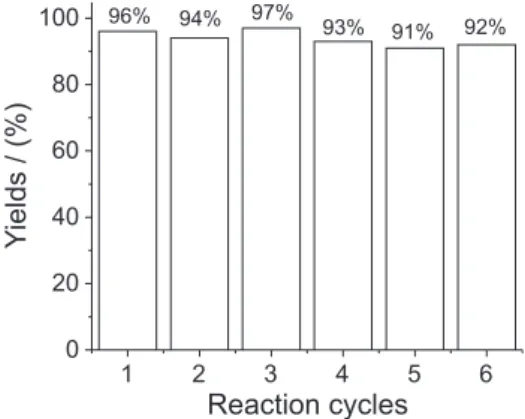
The activity of recycled ionic liquid was studied in the synthesis of 2a.After product separation, the aqueous iltrate was subjected to vacuum for 4h, to leave behind the mixture of ionic liquids. This mixture was reused in the next run without any further puriication. As shown in Figure 1 the reaction medium can be reused for at least six times without signiicant decrease in the yields.
Experimental
Materials
All chemicals were of research grade and were used as obtained. The reactions were performed in D-compact ultrasonic cleaner with a frequency of 50 kHz and power 250 W. IR spectra were recorded on a FT IR Perkin Elmer Spectrum GX spectrometer, mass spectra on a Shimadzu GCMS QP 2010 instrument, elemental analysis on Perkin Elmer PE 2400 elemental analyzer and 1H NMR
and 13C NMR spectra were recorded on Bruker Avance
400 MHz spectrometer in CDCl3/DMSO-d6 with TMS as
an internal standard. The melting points are uncorrected and are compared with the reported literature values.
Preparation of carboxyl-functionalized ionic liquid [cmmim][BF4]
Aliquots of chloroacetic acid (1 equiv.) was added over a period of 60 min to 1-methyl-imidazole (1 equiv.) at room temperature under stirring, and then the reaction mixture was exposed to ultrasound for an additional period of 120 min at ambient temperature. The solid thus obtained was washed with acetonitrile, and dried under vacuum. The intermediate, 1-carboxymethyl-3-methylimidazolium chloride was obtained as a white solid (mp 172-174 °C). The [cmmim][Cl] (1 equiv.) and NaBF4 (1 equiv.) were dissolved in H2O and exposed to
ultrasound at 70 oC for 2.5 h. Water was removed from
the reaction mixture by subjecting it to evaporation for 4 h at 80 °C under reduced pressure (10 mm Hg) to give the product [cmmim][BF4] as a slight yellowish oil. This
was characterized by 1H NMR and 13C NMR. All the
data were in good agreement with the reported method.
1H NMR (400 MHz, D
2O): d 8.38 (s, 1H), 7.11-7.12 (d, J 1.6 Hz, 2H), 4.73 (s, 2H), 3.55 (s, 3H).
General procedure for the synthesis of DHPMs
A mixture containing aldehyde 1 (10 mmol), ethyl acetoacetate (EAA, 10 mmol) and urea or thiourea (11 mmol) in the mixture of [cmmim][BF4] and
[bmim][BF4](2:1, 2 g) was exposed to ultrasound at 30 oC.
The reactions were carried out in a 25 mL capacity round bottom lask. Reactant mixture was suspended at the center of the bath, slight below the water surface. At completion of the reaction (as indicated by TLC), a solid product gradually formed was poured into crushed ice (20 g) and stirred for 15-20 min. The solid separated was iltered through a sintered funnel under suction, washed with ice-cold water (15 mL) and then recrystalliszed from hot ethanol or ethyl acetate to afford pure DHPMs, 2a-o. The combined aqueous iltrate was heated at 80 °C under reduced pressure (10 mm Hg) for 4 h to leave behind the mixture of ILs in near complete recovery, pure enough to recycle. The recovered ionic liquid mixture was found to be equally effective for at least six recycles in the synthesis of 2a.
Spectral data for some selected DHPMs
5-Ethoxycarbonyl-6-methyl-4-phenyl-3,4-dihydro-pyrimidin-2(1H)-one (2a)
IR (KBr) ν
max/cm-1: 3233, 2954, 1730, 1690, 1206,
698; 1H NMR:d 9.21 (s, 1H), 7.74 (s, 1H), 7.25 (m, 5H),
5.14 (s, 1H), 3.98 (q, J 7.1 Hz, 2H), 2.25 (s, 3H), 1.09 (t,
J 7.1 Hz, 3H); 13C NMR: d 13.9, 17.7, 53.9, 59.1, 99.2,
126.1, 127.1, 128.3, 144.7, 148.2, 152.0, 165.2. Calc. for C14H16N2O3: C, 64.60; H, 6.20; N, 10.76. Found: C, 64.61;
H, 6.18; N, 10.74. MS: 261 (M+1).
5-Ethoxycarbonyl-6-methyl-4-(4-fluorophenyl)-3,4-dihydro pyrimidin-2(1H)-one (2c)
IR (KBr) ν
max/cm-1: 3240, 2980, 1730, 1640, 1230,
1150, 790; 1H NMR: d 9.25 (s, 1H), 7.77 (s, 1H), 7.21
(m, 4H), 5.15 (s, 1H), 3.99 (q, J 7.1 Hz, 2H), 2.26 (s, 3H), 1.09 (t, J 7.1 Hz, 3H); 13C NMR: d 13.9, 17.8, 53.6, 59.5,
123.4, 127.5, 145.2, 149.3, 151.6, 152.1, 164.8. Calc. for C14H15FN2O3: C, 60.42; H, 5.43; N, 10.07. Found: C, 60.44;
H, 5.42; N, 10.10.
5-Ethoxycarbonyl-6-methyl-4-(4-methoxyphenyl)-3,4-dihydropyrimidin-2(1H)-one (2f)
IR (KBr) ν
max/cm-1: 3206, 2956, 1740, 1679, 1245,
1180, 1040, 875; 1H NMR: d 9.14 (s,1H), 7.66 (s, 1H),
6.99 (m, 4H), 5.07 (s, 1H), 3.96 (q, J 6.8 Hz, 2H), 3.70 (s, 3H), 2.23 (s, 3H), 1.09 (t, J 6.8 Hz, 3H); 13C NMR: d 14.5,
18.2, 53.78, 55.47, 59.60, 99.9, 114.1, 127.8, 136.4, 148.3, 158.8, 165.8. Calc. for C15H18N2O4: C, 62.06; H, 6.25;
N, 9.65. Found: C, 62.04; H, 6.28; N, 9.67. MS: 291 (M+1).
5-Ethoxycarbonyl-6-methyl-4-(3,4,5-trimethoxyphenyl)-3,4-dihydropyrimidin-2(1H)-thione(2o)
IR (KBr) ν
max/cm-1: 3284, 2967, 1720, 1632, 1234,
1140, 780; 1H NMR: d 10.21 (s,1H), 9.49 (s, 1H), 7.29
(m, 2H), 5.02 (s, 1H), 6.40 (s, 2H), 3.94 (q, J 6.6 Hz, 2H), 3.57 (s, 9H) 2.13 (s, 3H), 1.04 (t, J 7.0 Hz, 3H); 13C NMR: d 14.9, 17.7, 54.2, 56.1, 60.1, 60.4, 101.2, 103.5, 137.1, 139.4, 145.7, 153.3, 165.4, 174.5. Calc. for C17H22N2O5S:
C, 55.72; H, 6.05; N, 7.64. Found: C, 55.69; H, 6.03; N, 7.62.
Conclusions
The synergistic effect of ILs and ultrasound has been successfully demonstrated to offer an easy way for the synthesis of DHPMs in excellent yields in a single pot reaction. The milder conditions, absence of additional catalyst, high reaction rates, excellent yields, easy work up and combined use of ionic liquids and ultrasound make this procedure an improved alternative to the conventional acid/base catalyzed thermal processes and is environment friendly with minimal or no waste.
Supplementary Information
Spectral data for all synthesized DHPMs and 13C NMR
spectra in evidence for bonding of IL with p-tolualdehyde are available free of charge at http://jbcs.sbq.org.br, as PDF ile.
Acknowledgments
Authors thank Dr. H. S. Patel (Sardar Patel University) for providing infrastructural and other facilities and Vaibhav Analytical Laboratory-Ahmadabad for IR facilities. A. N. Dadhania also thanks University Grant Commission, New Delhi for the award of Meritorious Student Fellowship-2008.
References
1. Biginelli, P.; Gazz. Chim. Ital.1893, 23, 360. 2. Kappe, C. O.; Tetrahedron1993, 49, 6937.
3. Baldwin, J. J.; Claremon, D. A.; McClure, D. E.; U.S. Patent 4 609 494, 1986; Baldwin, J. J.; Ptizenberger, S. M.; McClure, D. E.; U.S. Patent 675 321, 1987; Atwal, K. S.; U.S. Patent 4 684 655, 1987;Atwal, K. S.; U.S. Patent 4 684 656, 1987; Cho, H.; Ueda, M.; Shima, K.; Mizuno, A.; Hayashimatsu, M.; Ohnaka, Y.; Takeuchi, Y.; Hamaguchi, M.; Aisaka, K.; Hidaka, T.; Kawai, M.; Takeda, M.; Ishihara, T.; Funahashi, K.; Sato, F.; Morita, M.; Noguchi, T.; J. Med. Chem.1989, 32, 2399; Atwal, K. S.; Rovnyak, G. C.; Kimball, S. D.; Floyd, D. M.; Moreland, S.; Swanson, B. N.; Gougoutas, J. Z.; Schwartz, J.; Smillie, K. M.; Malley, M. F.; J. Med. Chem.1990,33, 2629; Atwal, K. S.; Swanson, B. N.; Unger, S. E.; Floyd, D. M.; Moreland, S.; Hedberg, A.; O’Reilly, B. C.; J. Med. Chem.1991, 34, 806; Nagarathnam, D.; Chiu, G.; Dhar, T.; Wong, W.; Marzabadi, M.; Gluchowski, C.; Lagu, B.; Miao, S.; PCT Int. Appl. WO 96/14846. 4. Overman, L. E.; Rabinowitz M. H.; Renhowe, P. A.; J. Am.
Chem. Soc.1995, 117, 2657; Snider, B. B.; Shi, Z.; J. Org. Chem.1993, 58, 3828.
5. Atwal, K. S.; O’Reilly, B. C.; Gougoutas, J. Z.; Malley, M. F.; Heterocycles1987,26, 1189; Atwal, K. S.; Rovnyak, G. C.; O’Reilly, B. C.; Schwartz, J.; J. Org. Chem.1989, 54, 5898; Barluenga, J.; Tomas, M.; Rubio, V.; Gotor, V.; J. Chem. Soc., Chem. Commun.1979, 16, 675; Barluenga, J.; Tomas, M.; Ballesteros, A.; Lopez, L. A.; Tetrahedron Lett.1989, 30, 4573; Wipf, P.; Cunningham, A.; Tetrahedron Lett.1995, 36, 7819. 6. Hu, E. H.; Sidler, D. R.; Dolling, U.; J. Org. Chem.1998, 63,
3454.
7. Kappe, C. O.; Falsone, S. F.; Synlett 1998, 7, 718.
8. Polshettiwar, V.; Varma, R. S.; Tetrahedron Lett.2007,48, 7343; Banik, B. K.; Reddy, A. T.; Datta, A.; Mukhopadhyay, C.; Tetrahedron Lett.2007, 48, 7392; Debache, A.; Boumoud, B.; Amimour, M.; Belfaitah, A.; Rhouati, S.; Carboni, B.; Tetrahedron Lett.2006, 47, 5697; Ahmed, N.; van Lier J. E. Tetrahedron Lett.2007, 48, 5407; Bigi, F.; Carloni, S.; Frullanti, B.; Maggi, R.; Sartori, G.; Tetrahedron Lett.1999, 40, 3465; Radha Rani, V.; Srinivas, N.; Radha Krishnan, M.; Kulkarni, S. J.; Raghavan, K. V.; Green Chem.2001, 3, 305; Lu, J.; Ma, H.; Synlett2000, 1, 63; Lu, J.; Bai, Y.; Wang, Z.; Yang, B.; Ma, H.; Tetrahedron Lett.2000, 41, 9075; Ma, Y.; Qian, C.; Wang, L.; Yang, M.; J. Org. Chem.2000, 65, 3864; Ranu, B. C.; Hajra, A.; Jana, U.; J. Org. Chem.2000, 65, 6270.
9. Gupta, R.; Gupta, A. K.; Paul, S.; Kachroo, P. L.; Indian J. Chem. B 1995, 34, 151; Kappe, C. O.; Kumar, D.; Varma, R. S.; Synthesis1999, 10, 1799; Yadav, J. S.; Reddy, B. V. S.; Reddy, E. J.; Ramalingam, T.; J. Chem. Res. (S)2000, 354; Stefani, H. A.; Gatti, P. M.; Synth. Commun.2000, 30, 2165; Kidwai, M.; Saxena, S.; Mohan, R.; Venkataramanan, R.; J. Chem. Soc., Perkin Trans. 12002, 1939.
11. Welton, T.; Chem. Rev.1999, 99, 2071; Wasserscheid, P.; Keim, W.; Angew. Chem., Int.Ed.2000, 39, 377.
12. Palimkar, S. S.; Siddiqui S. A.; Daniel T.; Lahoti R. J.; Srinivasan K. V.; J. Org. Chem. 2003, 68, 9371.
13. Earle, M. J.; Mccormac, P. B.; Seddon, K. R.; Chem. Commun. 1998, 20, 2245; Yang, S. D.; Wu, L. Y.; Liang, Y. M.; J. Mol. Catal. A: Chem.2007, 268, 107.
14. Luche, J. L.; Synthetic Organic Sonochemistry, Plenum: New York, 1998; Mason, T. J.; Peer, D.; Practical Sonochemistry, 2nd ed., Ellis Horwood; London, 2002.
15. Cravotto G.; Cintas P.; Chem. Soc. Rev.2006, 35, 180.
16. Li, J.; Peng, Y.; Song, G.; Catal. Lett.2005, 102, 3.
17. Fu, N.; Yuan, Y.; Cao, Z.; Wang, S.; Wang, J.; Peppe, C.; Tetrahedron 2002, 58, 4801.
18. Chari, M. A.; Shobha, D.; Kumar, T. K.; Dubey, P. K.; Arkivoc 2005, xv, 74.
19. Paraskar, S.; Dewkar, G. K.; Sudalai, A.; Tetrahedron lett.2003, 44, 3305.
20. Reddy, C. V.; Mahesh, M.; Raju, P. V. K.; Babu, T. R.; Reddy, V. V. N.; Tetrahedron Lett.2002, 43, 2657.
21. Gholap, R.; Venkatesan, K.; Daniel, T.; Lahoti, R. J.; Srinivasan, K. V.; Green Chem. 2004, 6, 147.
Submitted: July 16, 2010
Supplementary Information
J. Braz. Chem. Soc., Vol. 22, No. 3, S1-S3, 2011. Printed in Brazil - ©2011 Sociedade Brasileira de Química
0103 - 5053 $6.00+0.00
S
I
*e-mail: [email protected]
A Convenient and Eficient Protocol for the One Pot Synthesis of
3,4-Dihydropyrimidin-2-(1H)-ones Catalyzed by Ionic Liquids
under Ultrasound Irradiation
Abhishek N. Dadhania, Vaibhav K. Patel and Dipak K. Raval*
Department of Chemistry, Sardar Patel University, Vallabh Vidyanagar, 388 120, Gujarat, India
Spectral data for all synthesized DHPMs
5-Ethoxycarbonyl-6-methyl-4-(4-nitrophenyl)-3,4-dihydropyrimidin-2(1H)-one (2b)
IR (KBr) ν
max/cm
-1: 3224, 2950, 1745, 1670, 1510,
1340, 1125, 780; 1H NMR: d 9.37 (s,1H), 8.20 (d, 2H),
7.91 (s, 1H), 7.50 (d, 2H), 5.27 (s, 1H), 3.98 (q, J 7.1 Hz, 2H), 2.27 (s, 3H), 1.09 (t, J 7.1 Hz, 3H); 13C NMR: d
13.9, 17.8, 53.6, 59.3, 123.7, 127.5, 146.6, 149.3, 151.7, 151.9, 164.9. Calc. for C14H15N3O5: C, 55.08; H, 4.95; N, 13.76. Found: C, 55.05; H, 4.97; N, 13.74.
5-Ethoxycarbonyl-6-methyl-4-(3-chlorophenyl)-3,4-dihydro pyrimidin-2(1H)-one(2d)
IR (KBr) ν
max/cm
-1: 3254, 2966, 1738, 1669, 1170, 1096,
759; 1H NMR: d 9.24 (s,1H), 7.77 (s, 1H), 7.26 (m, 4H),
5.14 (s, 1H), 3.98 (q, J 7.1 Hz, 2H), 2.25 (s, 3H), 1.09 (t,
J 7.1 Hz, 3H); 13C NMR: d 14.0, 17.8, 53.6, 59.3, 98.7, 124.9,
126.2, 127.2, 130.4, 132.9, 147.2, 148.9, 151.9, 165.2. Calc. for C14H15ClN2O3: C, 57.05; H, 5.13; N, 9.50. Found: C, 57.08; H, 5.16; N, 9.48.
5-Ethoxycarbonyl-6-methyl-4-(4-methylphenyl)-3,4-dihydropyrimidin-2(1H)-one(2e)
IR (KBr) ν
max/cm
-1: 3260, 2980, 1720, 1635, 1248, 1120,
775; 1H NMR: d 9.15 (s,1H), 7.80 (s, 1H), 7.10 (s, 4H),
5.09 (s, 1H), 3.96 (q, J 7.1 Hz, 2H), 2.23 (s, 3H), 1.08 (t,
J 7.1 Hz, 3H); 13C NMR: d 14.1, 17.7, 20.6, 53.7, 59.1, 99.4,
126.1, 128.8, 136.3, 141.7, 148.2, 152.2, 165.2. Calc. for C15H18N2O3: C, 65.68; H, 6.61; N, 10.21. Found: C, 65.64; H, 6.59; N, 10.23.
5-Ethoxycarbonyl-6-methyl-4-(2-furyl)-3,4-dihydro-pyrimidin-2(1H)-one(2g)
IR (KBr) ν
max/cm
-1: 3234, 2918, 1727, 1648, 1234,
1113; 1H NMR: d 9.24 (s,1H), 7.75 (s, 1H), 7.54 (s, 1H),
6.34 (s, 1H), 6.08 (s, 1H), 5.19 (s, 1H), 4.01 (q, J 6.9 Hz, 2H), 2.22 (s, 3H), 1.12 (t, J 6.9 Hz, 3H); 13C NMR: d 14.1,
17.7, 47.8, 59.1, 96.8, 105.2, 110.3, 142.3, 149.2, 152.2, 155.9, 165.2. Calc. for C12H14N2O4: C, 57.59; H, 5.64; N, 11.19. Found: C, 57.55; H, 5.62; N, 11.21.
5-Ethoxycarbonyl-6-methyl-4-(2-chlorophenyl)-3,4-dihydropyrimidin-2(1H)-one(2h)
IR (KBr) ν
max/cm
-1: 3109, 2948, 1725, 1698, 1177, 1089,
750; 1H NMR: d 9.25 (s,1H), 7.70 (s, 1H), 7.33 (m, 4H),
5.61 (s, 1H), 3.87 (q, J 6.9 Hz, 2H), 2.28 (s, 3H), 0.98 (t,
J 6.9 Hz, 3H); 13C NMR: d 13.9, 17.7, 51.6, 59.1, 98.2, 127.7,
128.8, 129.1, 129.4, 131.8, 141.7, 149.2, 151.4, 165.0. Calc. for C14H15ClN2O3: C, 57.05; H, 5.13; N, 9.50. Found: C, 57.08; H, 5.15; N, 9.53.
5-Ethoxycarbonyl-6-methyl-4-(4-hydroxyphenyl)-3,4-dihydropyrimidin-2(1H)-one(2i)
IR (KBr) ν
max/cm
-1: 3358, 3219, 2930, 1731, 1678, 1171,
819; 1H NMR: d 9.34 (s,1H), 9.10 (s, 1H), 7.64 (s, 1H),
6.84 (m, 4H), 5.02 (s, 1H), 3.96 (q, J 7.0 Hz, 2H), 2.21 (s, 3H), 1.08 (t, J 7.0 Hz, 3H); 13C NMR: d 13.7, 17.45, 54.4,
59.2, 101.1, 115.0, 127.7, 133.8, 146.9, 153.0, 156.8, 165.4. Calc. for C14H16N2O4: C, 60.86; H, 5.84; N, 10.14. Found: C, 60.84; H, 5.86; N, 10.16.
5-Ethoxycarbonyl-6-methyl-4-(3,4,5-trimethoxyphenyl)-3,4-dihydropyrimidin-2(1H)-one (2j)
IR (KBr) ν
max/cm
-1: 3215, 2922, 1732, 1676, 1248, 1126,
5.13 (s, 1H), 4.02 (q, J 6.6 Hz, 2H), 3.72 (s, 9H), 2.25 (s, 3H), 1.13 (t, J 7.0 Hz, 3H); 13C NMR: d 14.2, 17.8, 54.1,
56.0, 59.4, 60.1, 99.3, 104.3, 140.6, 148.5, 152.5, 152.9, 165.4. Calc. for C17H22N2O6: C, 58.28; H, 6.33; N, 8.00.
Found: C, 58.24; H, 6.30; N, 8.03.
5-Ethoxycarbonyl-6-methyl-4-(4-hydroxy-3-methoxy-phenyl)-3,4-dihydropyrimidin-2(1H)-one(2k)
IR (KBr) ν
max/cm-1: 3384, 3238, 2994, 1726, 1642, 1210,
1140, 756; 1H NMR: d 9.35 (s,1H), 9.10 (s, 1H), 7.68 (s,
1H), 7.32 (m,3H), 6.10 (s, 1H), 4.12 (q, J 7.2 Hz, 2H), 3.45 (s, 3H), 2.32 (s, 3H), 1.10 (t, J 7.2 Hz, 3H); 13C NMR: d
13.6, 18.8, 54.4, 61.7, 101.7, 113.54, 127.8, 128.9, 139.6, 141.8, 146.4, 148.3, 158.8, 165.8. Calc. for C15H18N2O5:
C, 58.82; H, 5.92; N, 9.15. Found: C, 58.79; H, 5.93; N, 9.12.
5-Ethoxycarbonyl-6-methyl-4-(2-thienyl)-3,4-dihydro-pyrimidin-2(1H)-one(2l)
IR (KBr) ν
max/cm
-1: 3228, 2954, 1734, 1664, 1242, 1127,
786; 1H NMR: d 9.31 (s,1H), 7.88 (s, 1H), 7.35 (d, 1H),
6.90 (m, 2H), 5.39 (s, 1H), 4.05 (q, J 7.1 Hz, 2H), 2.20 (s, 3H), 1.15 (t, J 7.1 Hz, 3H); 13C NMR: d 14.2, 17.7, 49.9,
59.3, 99.8, 124.1, 124.9, 126.3, 148.7, 148.9, 152.3, 165.0. Calc. for C12H14N2O3S: C, 54.12; H, 5.30; N, 10.52. Found:
C, 54.15; H, 5.34; N, 10.54.
5-Ethoxycarbonyl-6-methyl-4-phenyl-3,4-dihydro-pyrimidin-2(1H)-thione(2m)
IR (KBr) ν
max/cm-1: 3200, 2956, 1720, 1678, 1180, 1097,
694; 1H NMR: d 10.32 (s,1H), 9.64 (s, 1H), 7.27 (m, 5H),
5.15 (d, 1H), 4.01 (q, J 7.0 Hz, 2H), 2.27 (s, 3H), 1.09 (t,
J 7.0 Hz, 3H); 13C NMR: d 14.4, 17.6, 54.4, 60.0, 101.1,
126.8, 128.1, 129.2, 140.4, 143.9, 153.7, 165.5. Calc. for C14H16N2O2S: C, 60.85; H, 5.84; N, 10.14. Found: C, 60.84;
H, 5.80; N, 10.16.
5-Ethoxycarbonyl-6-methyl-4-(4-methoxyphenyl)-3,4-dihydropyrimidin-2(1H)-thione(2n)
IR (KBr) ν
max/cm-1: 3088, 2933, 1730, 1687, 1247, 1175,
944; 1H NMR: d 10.28 (s,1H), 9.59 (s, 1H), 7.01 (m, 4H),
5.10 (s, 1H), 3.98 (q, J 7.0 Hz, 2H), 3.70 (s, 3H), 2.27 (s, 3H), 1.09 (t, J 7.0 Hz, 3H); 13C NMR: d 14.1, 17.6, 53.9,
55.2, 59.6, 101.2, 113.7, 127.5, 135.3, 144.7, 158.2, 165.2, 174.2. Calc. for C15H18N2O3S: C, 58.80; H, 5.92; N, 9.14.
Found: C, 58.78; H, 5.95; N, 9.11.
Copies of 13C NMR spectra in evidence for bonding of IL with p-tolualdehyde
Figure S2.13C NMR spectrum of p-tolualdehyde + [cmmim][BF 4].
Figure S3.13C NMR spectrum of p-tolualdehyde + [cmmim][BF


![Figure S3. 13 C NMR spectrum of p-tolualdehyde + [cmmim][BF 4 ] + [bmim][BF 4 ].](https://thumb-eu.123doks.com/thumbv2/123dok_br/18995699.462125/9.892.193.720.105.534/figure-nmr-spectrum-tolualdehyde-cmmim-bf-bmim-bf.webp)
