Article
J. Braz. Chem. Soc., Vol. 22, No. 11, 2036-2039, 2011.Printed in Brazil - ©2011 Sociedade Brasileira de Química 0103 - 5053 $6.00+0.00
A
*e-mail: [email protected]
Microwave-Assisted Synthesis of Indole-2-Carboxylic Acid Esters in Ionic Liquid
Lijun Gu*,a and Xiangguang Lib
aKey Laboratory of Ethnic Medicine Resource Chemistry, Yunnan University of Nationalities,
State Ethnic Affairs Commission & Ministry of Education of P. R. China, Kunming, 650031, China
bDepartment of Chemistry, Northwest University, Xi’an, China
Um procedimento melhorado para a síntese de ésteres ácido indol-2-acético em rendimentos excelentes foi obtido pela condensação de 2-halo aril aldeídos ou cetonas e isocianoacetato de etila usando líquido iônico sob irradiação de microondas controlada (100 W) a 50 oC. Este método
oferece um número de vantagens em termos de metodologia simples, com rendimento elevado num tempo de reação curto e em condições de reação amenas.
An improved procedure for the synthesis of indole-2-carboxylic acid esters in excellent yields has been achieved by the condensation of 2-halo aryl aldehydes or ketones and ethyl isocyanoacetate using ionic liquid under controlled microwave irradiation (100 W) at 50 °C. This method offers a number of advantages in terms of methodology, high-product yield, short period of conversion, mild reaction conditions and easy workup.
Keywords: indole, synthesis, ionic liquid, microwave irradiation
Introduction
The indole moiety is a vital structural unit found in a large array of natural products and pharmaceuticals. Consequently, synthetic approaches toward indoles have attracted significant attention.1-3 In many cases, the well-studied Fischer indole synthesis is the method of choice, but this approach suffers from problems such as low yield and formation of side products.4 In our design of new inhibitors of aspartyl protease,5,6 we were interested in differently substituted indole-2-carboxylic acid esters. Owing to their structural diversity and remarkable biological functions, a multitude of methods exist for the synthesis of these compounds. The conventional method is the Hemetsberger-Knittel indole synthesis.7 This method involves the condensation between an arylaldehyde and an azidoacetate to provide a-azidocinnamates which upon heating give indoles. One problem is associated with employing high boiling solvents such as mesitylene, xylene and toluene.8,9 In addition, the yield of the reaction is low.10 Cai and co-workers11 developed a copper-catalyzed cascade process from 2-halo aryl aldehydes/ketones with isocyanoacetate for synthesis of these derivatives. However, the procedure has some drawbacks such as long reaction
time and moderate yields. For the cyclization of 2-chloro aryl aldehydes/ketones with isocyanoacetate, the yield of the reaction is unsatisfactory and the temperature of the reaction is high. Therefore, it is necessary to develop a more practical method for synthesis of such a significant scaffold.
The research and application of green chemistry principles have led to the development of cleaner processes. Since the start of this century an ever-growing number of studies has been published describing the use of ionic liquids.12-17 Microwave-assisted organic synthesis has shown to be a valuable tool for reducing reaction times, getting cleaner reactions, improving yields, simplifying workup and designing energy-saving protocols.18,19
Due to their ionic nature, ionic liquids allow highly effective interactions with microwave energy for the rapid generation of products with generally high yields.20 Herein, we developed a fast and practical method for the synthesis of indole-2-carboxylic acid esters in the presence of 1-methyl-3-butylimidazolium hydroxide ( [bmim]OH ) under controlled microwave irradiation (100 W) at 50 °C. The synthetic sequence is depicted in Scheme 1.
Results and Discussion
Gu and Li 2037 Vol. 22, No. 11, 2011
the nitrogen source in [bmim]OH under the catalysis of CuI (12 mol%) for 8 h, the desired product ethyl 1H -indole-2-carboxylate was obtained in moderate yield (57%). When the reaction was irradiated under controlled microwave (100 W) for 10 min at 50 oC, 91% of the desired product was reached. Encouraged by the result, other Cu reagents, such as CuBr or CuCl, were investigated in the presence of [bmim]OH under microwave irradiation. The results showed that replacement of CuI with CuBr slightly affected the outcome of this reaction (entry 1 and entry 9, Table 1). CuCl was less active (entries 9-10, Table 1). When other copper sources such as Cu2O and Cu(OAc)2 were used, no desired product was detected.
Next, the reaction time and the temperature were investigated in order to find the optimal reaction conditions. It was found that 10 min was long enough to run the reaction. Raising the reaction temperature did not obviously improve the reaction yield (entries 11-12, Table 1). Also an extended reaction time has no effect on the conversion. Finally, the optimal conditions for parallel synthesis were determined to be 12 mol% CuI at 50 oC for 10 min. The substrate variation was then investigated. To our satisfaction, the reaction shows a wide scope for the structural variations of aryl aldehydes or ketones under the optimized reaction conditions. Both electron-donating and electron-withdrawing groups allowed smooth transformation of aryl aldehydes or ketones into the corresponding products with high yields. Performing the reaction with 2-chloro aryl aldehydes or ketones gave good yields (entries 13-16, Table 1). It was noteworthy that hetero-aryl aldehydes or ketones with varied substitutions were found to undergo the reaction (entries 17-20, Table 1). It was found that DMSO-free condition gave the corresponding product in excellent yield (entries 21-24, Table 1). To illustrate the preparative utility, our procedure was performed on a large scale (entry 25, Table 1). A 60-mmol-scale synthesis gave the desired product in 88% yield.
Conclusions
In summary, in this study we have successfully extended the use of ionic liquid [bmim]OH under microwave
irradiation for assembly of indole-2-carboxylic acid esters in high yields. The experimental procedure is very simple and the reaction time is short. The synthetic protocols described above have proven amenable to scale-up to over 10-g quantities.
Experimental
General
Reagents were obtained commercially and used as received. Solvents were purified and dried by standard methods. [bmim]OH was synthesized according to the method described in the literature.21 Microwave reactions were performed on a CEM Explorer Hybrid 12 Discover, with built in temperature/pressure probes and associated software. The melting points (mp) were determined on an XT-4 micro melting point apparatus and uncorrected. Infrared (IR) spectra were recorded on an EQUINOX-55 spectrometer on a KBr matrix. 1H nuclear magnetic resonance (NMR) spectra were recorded on an INOVA-400 NMR spectrometer using TMS as an internal standard. Chemical shift values (d) are given in ppm. Elemental analyses were performed on a Vario EL III CHNS analyzer. Electrospray mass spectra were obtained with an MALDI-TOF Mass spectrometer. 200-300 mesh silica gel was used for column chromatography.
Representative procedure for the synthesis of 2
An oven-dried 10-mL microwave vial was charged with copper(I) iodide (0.24 mmol), [bmim]OH (2 mL), aldehydes or ketones (1 mmol), ethyl isocyanoacetate (1.1 mmol), DMSO (1 mL), or DMSO-free with the addition of a stirred bar. The reaction vessel was sealed, evacuated and flushed with argon three times. The mixture was irradiated by 100 W microwave at 50 oC for 10 min. The reaction mixture was partitioned between ethyl acetate and water. The organic layers were washed with water and brine, dried over anhydrous MgSO4 and concentrated under vacuum to yield the crude product. The crude product
Scheme 1. Sequence for the synthesis of indole-2-carboxylic acid esters in the presence of 1-methyl-3-butylimidazolium hydroxide ([bmim]OH ) under controlled microwave irradiation.
1 2
X
+ CNCH2CO2Et
Ar or Het Ar or Het N H R1
CO2Et
CuI, [bmim]OH
DMSO-free, MW
R1 = H or Me X = I, Br or Cl
O
Microwave-Assisted Synthesis of Indole-2-Carboxylic Acid Esters in Ionic Liquid J. Braz. Chem. Soc.
2038
Table 1. Reactions of 2-halo aryl aldehydes or ketones with ethyl isocyanoacetatea
aReaction conditions: CuI (0.24 mmol), [bmim]OH (2 mL), aryl bromides (1 mmol), ethyl isocyanoacetate (1.1 mmol), DMSO (1 mL), Ar atmosphere,
microwave irradiation, 50 oC, 10 min; bisolated yields; cCuBr as catalyst; dCuCl as catalyst; ereaction temperature of 60 oC; freaction temperature of 70 oC; greaction temperature of 60 oC; hwithout DMSO; iCuI (15 mmol), [bmim]OH (35 mL), aryl bromides (60 mmol), ethyl isocyanoacetate (66 mmol), Ar
atmosphere, microwave irradiation, 50 oC.
entry Substrate Product Yield / %b
1
CHO
Br NH CO2Et
91 2 Br O N H
CO2Et
95
3
CHO Br O2N
N H
CO2Et
O2N
93 4 Br O O N H
CO2Et
O 92 5 CHO I Cl N H CO2Et Cl
91
6 CHO
Br NH CO2Et
95 7 Br Cl O N H CO2Et
Cl 93 8 CHO Br O N H
CO2Et
O
91
9c
CHO
Br NH CO2Et
90
10d
CHO
Br NH CO2Et
58 11e Br O N H
CO2Et
95 12f Br O N H
CO2Et 97
13g
CHO
Cl NH CO2Et
71
entry Substrate Product Yield / %b
14 g
Cl O
N H
CO2Et 74
15g N CHO Cl N N H
CO2Et 78
16g S
Cl O
S N
H CO2Et
81 17 N CHO Br N N
H CO2Et
88 18 S Br CHO S N H
CO2Et 90
19 S Br O S N H
CO2Et
93
20
S Br CHO
O2N S
N H
CO2Et O2N
91
21h
CHO
Br NH CO2Et
90 22h Br O N H
CO2Et
93 23h N CHO Br N N
H CO2Et
90 24h S Br O S N
H CO2Et
89
25i
CHO
Br NH CO2Et
Gu and Li 2039 Vol. 22, No. 11, 2011
was purified by flash chromatography with ethyl acetate/ petroleum ether as eluent on silica gel to afford the desired product.
Supplementary Information
Supplementary data are available free of charge at http://jbcs.sbq.org.br as PDF file.
Acknowledgments
The authors thank the Youth Fund of Yunnan University of Nationalities (No. 09QN04) for finacial support. We thank Mr. Ahmad for reproducing the results presented in entries 1 and 19 of Table 1.
References
1. Humphrey, G. R.; Kuethe, J. T.; Chem. Rev. 2006, 106, 2875. 2. Bandini, M.; Eichholzer, A.; Angew. Chem., Int. Ed. 2009, 48,
9608.
3. Sharma, V.; Kumar, P.; Pathak, D.; J. Heterocycl. Chem. 2010,
47, 491.
4. Miyata, O.; Kimura, Y.; Muroya, K.; Hiramatsu, H.; Naito, T.;
Tetrahedron Lett. 1999, 40, 3601.
5. Gu, L. J.; Liu, F. L.; Li, X. G.; Gao, B.; Yang, B. Q.; Synth.
Commun. 2010, 40, 242.
6. Gu, L. J.; Yang, B. Q.; Liu, F. L.; J. Braz. Chem. Soc. 2010, 21, 58.
7. Knittel, D.; Synthesis1985, 2, 186.
8. Hickey, D. M. B.; MacKenzie, A. R.; Moody, C. J.; Rees, C. W.;
J. Chem. Soc., PerkinTrans. 11987, 921.
9. Secchi, M.; Derudas, M.; Dallochio, R.; Dessi, A.; Bacchi, A.; Sannia, L.; Carta, F.; Palomba, M.; Ragab, O.; Chan, C.; Shoemaker, R.; Sei, S.; Dayam, R.; Neamati, N.; J. Med. Chem.
2004, 47, 5298.
10. Venable, J. D.; Cai, H.; Chai, W.; Dvorak, C. A.; Grice, C. A.; Jablonowski, J. A.; Shah, C. R.; Kwok, A. K.; Ly, K. S.; Pio, B.; Wei, J.; Desai, P. J.; Jiang, W.; Nguyen, S.; Ling, P.; Wilson, S. J.; Dunford, P. J.; Thurmond, R. L.; Lovenberg, T. W.; Karlsson, L.; Carruthers, N. I.; Edwards, J. P.; J. Med. Chem. 2004, 48, 8289. 11. Cai, Q.; Li, Z. Q.; Wei, J. J.; Ha, C. Y.; Pei, D. Q.; Ding, K.;
Chem. Commun. 2009, 46, 7581.
12. Lovelock, K. R.; Villar-Garcia, I. J.; Maier, F.; Steinrück, H.; Licence, P.; Chem. Rev. 2010, 111, 5158.
13. Pilissão, C.; Carvalho, P. O.; Nascimento, M. G.; J. Braz. Chem.
Soc. 2010, 21, 973.
14. Polshettiwar, V.; Varma, R. S.; Acc. Chem. Res. 2008, 41, 629. 15. Pastre, J. C.; Génisson, Y.; Saffon, N.; Dandurand, J.; Correia,
C. R. D.; J. Braz. Chem. Soc. 2010, 21, 821. 16. Dupont, J.; J. Braz. Chem. Soc. 2004, 15, 341.
17. Lenardão, E. J.; Gonçalves, L. C. C.; Mendes, S. R.; Saraiva, M. T.; Alves, D.; Jacob, R. J.; Perin, G.; J. Braz. Chem. Soc.
2010, 21, 2093.
18. Souza, R. O. M. A.; Quim. Nova2011, 34, 497.
19. Wang, X. Q.; Zhao, Z. G.; Li, W. J.; Liu, X. L.; Han, T.; Chin. J. Org. Chem.2010, 30, 764.
20. Hoffmann, H.; Nuchter, M.; Ondruschka, B.; Wasserscheid, P.;
Green Chem. 2003, 5, 296.
21. Ranu, B. C.; Banerjee, S.; Org. Lett. 2005, 7, 3049.
Supplementary Information
S
I
J. Braz. Chem. Soc., Vol. 22, No. 11, S1-S14, 2011.Printed in Brazil - ©2011 Sociedade Brasileira de Química 0103 - 5053 $6.00+0.00
*e-mail: [email protected]
Microwave-Assisted Synthesis of Indole-2-Carboxylic Acid Esters in Ionic Liquid
Lijun Gu*,a and Xiangguang Lib
aKey Laboratory of Ethnic Medicine Resource Chemistry, Yunnan University of Nationalities,
State Ethnic Affairs Commission & Ministry of Education of P. R. China, Kunming, 650031, China
bDepartment of Chemistry, Northwest University, Xi’an, China
Ethyl 1H-indole-2-carboxylate
White solid; mp 120-122 oC (lit.1 mp 121-123 oC); IR
(KBr) ν
max/cm
-1 3463, 3431, 2929, 1711 and 1695; 1H NMR
(CDCl3, 400 MHz) d1.41 (t, 3H, J 6.8 Hz), 4.39 (q, 2H, J 6.8 Hz), 7.23-7.16 (m, 1H), 7.29-7.33 (m, 2H), 7.49-7.56 (m, 1H), 7.69 (d, 1H, J 9.6 Hz), 9.41 (br s, 1H); 13C NMR
(CDCl3, 75 MHz) d 161.7, 135.4, 128.2, 126.5, 122.6,
121.7, 121.1, 110.6, 109.2, 62.3, 14.7; MALDI-TOF MS m/z 189 (M+); Anal. calcd. for C
11H11NO2: C 69.83, H 5.86,
N 7.40; found: C 70.01, H 5.69, N 7.21.
Ethyl 3-methyl-1H-indole-2-carboxylate
White solid; mp 132-134 oC (lit.2 mp 134-136 oC);
IR (KBr) ν
max/cm
-1 3466, 3429, 2928, 1716 and 1691; 1H NMR (CDCl
3, 400 MHz) d1.43 (t, 3H, J 9.6 Hz), 2.61
(s, 3H), 4.33 (q, 2H, J 9.6 Hz), 7.21-7.25 (m, 1H), 7.31-7.39 (m, 2H), 7.61 (d, 1H, J 8.0 Hz), 9.01 (br s, 1H); 13C NMR
(CDCl3, 75 MHz) d162.3, 136.1, 128.7, 125.6, 123.7, 121.3, 120.4, 119.2, 110.5, 61.2, 14.8, 10.3; MALDI-TOF MS m/z 203 (M+); Anal. calcd. for C
12H13NO2: C 70.92, H 6.45,
N 6.89; found: C 71.14, H 6.49, N 6.92.
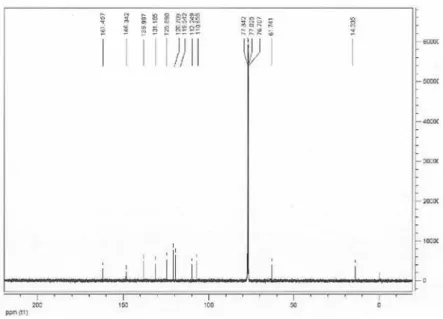
Ethyl 5-nitrol-1H-indole-2-carboxylate
Yellow solid; mp 221-223 oC (lit.3 mp 220-222 oC);
IR (KBr) ν
max/cm
-1 3460, 3431, 2931, 1506 and 1341; 1H NMR (CDCl
3, 400 MHz) d1.39 (t, 3H, J 4.0 Hz), 4.38
(q, 2H, J 4.0 Hz), 7.41 (s, 1H), 7.59 (d, 1H, J 4.0 Hz), 8.11 (d, 1H, J 8.0 Hz), 8.63 (s, 1H), 10.11 (br s, 1H); 13C NMR
(CDCl3, 75 MHz) d 161.4, 146.3, 138.9, 131.1, 125.8,
120.7, 119.5, 112.2, 110.6, 61.7, 14.3; MALDI-TOF MS m/z 234 (M+); Anal. calcd. for C
11H10N2O4: C 56.41, H 4.30,
N 11.96; found: C 56.53, H 4.39, N 11.74.
Ethyl 6-methoxyl-3-methyl-1H-indole-2-carboxylate Brown solid; mp 121-123 oC (lit.4 mp 122-124 oC);
IR (KBr) ν
max/cm
-1 3467, 3336, 2990, 1706 and 1681;
1H NMR (CDCl
3, 400 MHz) d1.40 (t, 3H, J 7.2 Hz), 2.59
(s, 3H), 3.81 (s, 3H), 4.42 (q, 2H, J 7.2 Hz), 6.83 (d, 1H, J 2.4 Hz), 6.91-7.03 (m, 1H), 7.49 (d, 1H, J 8.0 Hz), 9.06 (br s, 1H); 13C NMR (CDCl
3, 75 MHz) d160.8, 144.1,
130.6, 128.4, 127.0, 121.3, 118.5 109.7, 105.2, 61.7, 56.2, 14.1, 11.6; MALDI-TOF MS m/z 233 (M+); Anal. calcd.
for C13H15NO3: C 66.94, H 6.48, N 6.00; found: C 66.81,
H 6.44, N 6.03.
Ethyl 5-chloro-1H-indole-2-carboxylate
White solid; mp 169-171 oC (lit.1 mp 167-169 oC);
IR (KBr) ν
max/cm
-1 3461, 3343, 2928, 1715 and 1693; 1H NMR (CDCl
3, 400 MHz) d1.39 (t, 3H, J 4.8 Hz), 4.41
(q, 2H, J 4.8 Hz), 7.31 (s, 1H), 7.41-7.44 (m, 1H), 7.53 (d, 1H, J 3.2 Hz), 7.67 (s, 1H), 9.89 (br s, 1H); 13C NMR
(CDCl3, 75 MHz) d 160.9, 137.1, 129.4, 128.6, 127.2, 122.8, 120.7, 111.5, 109.3, 62.4, 14.5; MALDI-TOF MS m/z 223 (M+); Anal. calcd. for C
11H10ClNO2: C 59.07,
H 4.51, N 6.26; found: C 59.16, H 4.57, N 6.32.
Ethyl 3H-benz[e]indole-2-carboxylate
Brown solid; mp 164-166 oC (lit.5 mp 164-165 oC);
IR (KBr) ν
max/cm
-1 3464, 3340, 2929, 1710 and 1691; 1H NMR (CDCl
3, 400 MHz) d 1.42 (t, 3H, J 6.0 Hz),
4.43 (q, 2H, J 6.0 Hz), 7.33-7.51 (m, 4H), 7.66-7.79 (m, 2H), 8.03 (d, 1H, J 8.0 Hz), 9.92 (br s, 1H); 13C NMR
(CDCl3, 75 MHz) d 161.4, 135.2, 130.1, 129.0, 128.6,
127.7, 126.5, 124.8,124.1, 122.9, 121.6, 112.3, 109.1, 61.8, 14.2; MALDI-TOF MS m/z 239 (M+); Anal. calcd.
for C15H13NO2: C 75.30, H 5.48, N 5.85; found: C 75.42, H 5.51, N 5.83.
Ethyl 6-chloro-3-methyl-1H-indole-2-carboxylate White solid; mp 159-161 oC (lit.6 mp 159-160 oC);
IR (KBr) ν
max/cm
-1 3460, 3339, 2929, 1710 and 1691; 1H NMR (CDCl
3, 400 MHz) d 1.41 (t, 3H, J 8.0 Hz),
Microwave-Assisted Synthesis of Indole-2-Carboxylic Acid Esters in Ionic Liquid J. Braz. Chem. Soc.
S2
(br s, 1H); 13C NMR (CDCl
3, 75 MHz) d 161.7, 137.2,
130.1, 128.4, 125.6, 122.5, 121.3, 120.5, 110.2, 61.3, 14.9, 9.7; MALDI-TOF MS m/z 237 (M+); Anal. calcd.
for C12H12ClNO2: C 60.64, H 5.09, N 5.89; found: C 60.33,
H 5.02, N 5.97.
Ethyl 7-methoxyl-1H-indole-2-carboxylate
White solid; mp 159-161 oC (lit.1 mp 160-162 oC);
IR (KBr) ν
max/cm-1 3465, 3335, 2930, 1711 and 1695; 1H NMR (CDCl
3, 400 MHz) d1.39 (t, J 6.0 Hz, 3H), 3.83
(s, 3H), 4.41 (q, 2H, J 6.0 Hz), 6.87 (s, 1H), 7.01-7.09 (m, 1H), 7.25 (d, 1H, J 2.0 Hz), 7.29 (d, 1H, J 7.2 Hz), 9.11 (br s, 1H); 13C NMR (CDCl
3, 75 MHz) d 160.9, 145.2,
130.2, 129.1, 128.8, 122.3, 118.6, 111.0, 105.4, 61.7, 56.2, 14.4; MALDI-TOF MS m/z 219 (M+); Anal. calcd.
for C12H13NO3: C 65.74, H 5.98, N 6.39; found: C 65.69,
H 5.91, N 6.44.
Ethyl 1H-pyrrolo[3,2-b]pyridine-2-carboxylate
Brown solid; mp 179-181 oC (lit.7 mp 179 oC);
IR (KBr) ν
max/cm-1 3405, 3300, 2887 and 1685; 1H NMR
(CDCl3, 400 MHz) d1.31 (t, 3H, J 7.2 Hz), 4.35 (q, 2H,
J 7.2 Hz), 7.19 (d, 1H, J 7.2 Hz), 7.27 (dd, 1H, J 4.8, 8.1 Hz), 7.79 (d, 1H, J 7.2 Hz), 8.37-8.41 (m, 1H), 9.23 (br s, 1H); 13C NMR (CDCl
3, 75 MHz) d162.3, 142.5, 141.7,
131.2, 130.1, 121.4, 120.6, 108.5, 61.1, 14.8; MALDI-TOF MS m/z 190 (M+); Anal. calcd. for C
10H10N2O2: C 63.15, H
5.30, N 14.73; found: C 63.01, H 5.37, N 14.81.
Ethyl thieno[3,2-b]pyrrole-5-carboxylate
White solid; mp 132-134 oC (lit.8 mp 132.5-133 oC);
IR (KBr) ν
max/cm
-1 3400, 3315, 2893 and 1693; 1H NMR
(CDCl3, 400 MHz) d1.33 (t, 3H, J 7.1 Hz), 4.30 (q, 2H,
J 7.1 Hz), 7.0 (d, 1H, J 2.4 Hz), 7.18 (d, 1H, J 2.4 Hz), 7.26 (d, 1H, J 3.2 Hz), 9.31 (br s, 1H); 13C NMR (CDCl
3,
75 MHz) d162.1, 131.7, 130.0, 125.1, 122.4, 118.3, 109.2, 61.7, 14.1; MALDI-TOF MS m/z 195 (M+); Anal. calcd.
for C9H9NO2S: C 55.37, H 4.65, N 7.17, S 16.42; found:
C 55.41, H 4.57, N 7.21, S 16.33.
Ethyl 6-methyl-thieno[3,2-b]pyrrole-5-carboxylate White solid; mp 144-146 oC (lit.8 mp 144-145 oC);
IR (KBr) ν
max/cm-1 3430, 3300, 2993 and 1687; 1H NMR
(CDCl3, 400 MHz) d1.35 (t, 3H, J 7.2 Hz), 2.43 (s, 3H),
4.31 (q, 2H, J 7.2 Hz), 6.69 (d, 1H, J 5.4 Hz), 7.31 (d, 1H, J 5.4 Hz), 9.42 (br s, 1H); 13C NMR (CDCl
3, 75 MHz)
d161.8, 140.4, 130.6, 127.2, 122.9, 121.3, 109.6, 61.5, 14.8, 11.7; MALDI-TOF MS m/z 209 (M+); Anal. calcd.
for C10H11NO2S: C 57.39, H 5.30, N 6.69, S 15.32; found:
C 57.27, H 5.38, N 6.57, S 15.26.
Ethyl 2-nitrothieno[3,2-b]pyrrole-5-carboxylate
Yellow solid; mp 187-189 oC (lit.9 mp 188-189 oC);
IR (KBr) ν
max/cm
-1 3410, 3303, 1689, 1490 and 1370; 1H NMR (CDCl
3, 400 MHz) d1.40 (t, 3H, J 7.0 Hz), 4.33 (q,
2H, J 7.0 Hz), 7.11 (m, 1H), 7.76 (d, 1H, J 4.8 Hz), 9.39 (br s, 1H); 13C NMR (CDCl
3, 75 MHz) d162.7, 151.3, 137.4,
131.6, 128.1, 122.2, 108.5, 60.6, 14.1; MALDI-TOF MS m/z 240 (M+); Anal. calcd. for C
9H8N2O4S: C 45.00, H 3.36,
N 11.66, S 13.35; found: C 45.06, H 3.38, N 11.59, S 13.29.
References
1. Sanz, R.; Escribano, J.; Pedrosa, M. R.; Aguado, R.; Arnáiz, F. J.; Adv. Synth. Catal. 2007, 349, 713.
2. Acheson, R. M.; Prince, R. J.; Procter, G.; J. Chem. Soc.,Perkin Trans. 11979, 3, 595.
3. Ning, Z. L.; Yang, F. L.; He, L. P.; Guo, Y.; Wang, W.; Li, G. Y.; Wang, X.; Wang, E. S.; Jilin Daxue Xuebao, Lixueban2006, 1, 118; CA 2006, 146: 295872.
4. Gan, T.; Liu, R.; Yu, P.; Zhao, S.; Cook, J. M.; J. Org. Chem.
1997, 62, 9298.
5. Goldsmith, E. A.; Lindwall, H. G.; J. Org. Chem. 1953, 18, 507. 6. Kim, Y. A.; Han, S. Y.; Synth. Commun. 2004, 34, 2931.
7. Frydman, B.; Reil, S. J.; Boned, J.; Rapoport, H.; J. Org. Chem.
1968, 33, 3762.
8. Gale, W. W.; Scott, A. N.; Snyder, H. R.; J. Org. Chem. 1964,
29, 2160.
Gu and Li S3 Vol. 22, No. 11, 2011
Figure S1.1H NMR spectrum (CDCl
3, 400 MHz) of ethyl 1H-indole-2-carboxylate.
Figure S2.1H NMR spectrum (CDCl
Microwave-Assisted Synthesis of Indole-2-Carboxylic Acid Esters in Ionic Liquid J. Braz. Chem. Soc.
S4
Figure S3.1H NMR spectrum (CDCl
3, 400 MHz) of ethyl 5-nitrol-1H-indole-2-carboxylate.
Figure S4.1H NMR spectrum (CDCl
Gu and Li S5 Vol. 22, No. 11, 2011
Figure S5.1H NMR spectrum (CDCl
3, 400 MHz) of ethyl 5-chloro-1H-indole-2-carboxylate.
Figure S6.1H NMR spectrum (CDCl
Microwave-Assisted Synthesis of Indole-2-Carboxylic Acid Esters in Ionic Liquid J. Braz. Chem. Soc.
S6
Figure S7.1H NMR spectrum (CDCl
3, 400 MHz) of ethyl 6-chloro-3-methyl-1H-indole-2-carboxylate.
Figure S8.1H NMR spectrum (CDCl
Gu and Li S7 Vol. 22, No. 11, 2011
Figure S9.1H NMR spectrum (CDCl
3, 400 MHz) of ethyl 1H-pyrrolo[3,2-b]pyridine-2-carboxylate.
Figure S10.1H NMR spectrum (CDCl
Microwave-Assisted Synthesis of Indole-2-Carboxylic Acid Esters in Ionic Liquid J. Braz. Chem. Soc.
S8
Figure S11.1H NMR spectrum (CDCl
3, 400 MHz) of ethyl 6-methyl-thieno[3,2-b]pyrrole-5-carboxylate.
Figure S12.1H NMR spectrum (CDCl
Gu and Li S9 Vol. 22, No. 11, 2011
Figure S13.13C NMR spectrum (CDCl
3, 75 MHz) of ethyl 1H-indole-2-carboxylate.
Figure S14.13C NMR spectrum (CDCl
Microwave-Assisted Synthesis of Indole-2-Carboxylic Acid Esters in Ionic Liquid J. Braz. Chem. Soc.
S10
Figure S15.13C NMR spectrum (CDCl
3, 75 MHz) of ethyl 5-nitrol-1H-indole-2-carboxylate.
Figure S16.13C NMR spectrum (CDCl
Gu and Li S11 Vol. 22, No. 11, 2011
Figure S17.13C NMR spectrum (CDCl
3, 75 MHz) of ethyl 5-chloro-1H-indole-2-carboxylate.
Figure S18.13C NMR spectrum (CDCl
Microwave-Assisted Synthesis of Indole-2-Carboxylic Acid Esters in Ionic Liquid J. Braz. Chem. Soc.
S12
Figure S19.13C NMR spectrum (CDCl
3, 75 MHz) of ethyl 6 chloro-3-methyl-1H-indole-2-carboxylate.
Figure S20.13C NMR spectrum (CDCl
Gu and Li S13 Vol. 22, No. 11, 2011
Figure S21.13C NMR spectrum (CDCl
3, 75 MHz) of ethyl 1H-pyrrolo[3,2-b]pyridine-2-carboxylate.
Figure S22.13C NMR spectrum (CDCl
Microwave-Assisted Synthesis of Indole-2-Carboxylic Acid Esters in Ionic Liquid J. Braz. Chem. Soc.
S14
Figure S23.13C NMR spectrum (CDCl
3, 75 MHz) of ethyl 6-methyl-thieno[3,2-b]pyrrole-5-carboxylate.
Figure S24.13C NMR spectrum (CDCl


![Figure S9. 1 H NMR spectrum (CDCl 3 , 400 MHz) of ethyl 1H-pyrrolo[3,2-b]pyridine-2-carboxylate.](https://thumb-eu.123doks.com/thumbv2/123dok_br/18994799.461856/11.892.239.671.113.440/figure-nmr-spectrum-cdcl-ethyl-pyrrolo-pyridine-carboxylate.webp)
![Figure S11. 1 H NMR spectrum (CDCl 3 , 400 MHz) of ethyl 6-methyl-thieno[3,2-b]pyrrole-5-carboxylate.](https://thumb-eu.123doks.com/thumbv2/123dok_br/18994799.461856/12.892.216.637.113.445/figure-spectrum-cdcl-ethyl-methyl-thieno-pyrrole-carboxylate.webp)