The article was published by Academy of Chemistry of Globe Publications www.acgpubs.org/OC/index.htm © Published 06/19/2014 EISSN:1307-6175
Org. Commun. 7:2 (2014) 53-59
A facile one-pot synthesis of
3-(1-Benzyl-2-phenyl-1H-imidazol-4-yl)-4-hydroxy-6-methyl-2H-pyran-2-one derivatives via
multi-component approach
Thirupaiah Bade
and Rajeswar Rao Vedula
*Department of Chemistry, National Institute of Technology, Warangal-506004, A.P., India
(Received June 25, 2013; Revised April 29, 2014; Accepted June 9, 2014 )
Abstract: A one pot, four component synthesis of 1, 2, 4-trisubstituted imidazoles is described by reacting a mixture of bromo dehydroacetic acid, aromatic aldehyde, benzyl amine, and ammonium acetate in dry alcohol. All the synthesized compounds were characterized by their analytical and spectral data.
Keywords: bromo dehydroacetic acid; aromatic aldehyde; benzyl amine; ammonium acetate; imidazole; one-pot; multi component reactions. © 2014 ACG Publications. All rights reserved.
1. Introduction
Multi Component Reactions (MCRs) are well known to be selective, efficient, and easy to perform requiring readily available starting materials1. Multi component reactions involve sequential transformations between three or more compounds existing simultaneously within a reaction mixture, resulting in a product that contains all or segments of each participant2. 3-Acetyl-4-hydroxy-6-methyl-2H-pyran-2-one (dehydroacetic acid), is an important starting material, and its derivatives find wider applications in the synthesis of heterocyclic compounds. Dehydroacetic acid can be readily converted into the other heterocyclic systems, e.g., pyrazoles3, 4.It possesses interesting biological properties such as fungicidal and antibacterial activities. It can also act as a complexing ligand5, 6.Imidazole is the constituent of several natural compounds like histamine, histidine, biotin, alkaloids and nucleic acids. It is very important substance among the medicinal compounds7. Several imidazole derivatives have been reported to possess anti-inflammatory8, analgesic9, and antipyretic10, activities. Imidazole derivatives are used for the treatment of denture stomatitis11. Appropriately substituted imidazoles are extensively used as glucagon receptors12, and CB1 cannabinoid receptor antagonists13. 2-Substituted imidazolines are important due to their use as synthetic intermediates14, catalysts15, chiral auxiliaries16, chiral catalysts17 and ligands for asymmetric catalysis18, in various synthetic reactions.
A number of methods have been reported for the synthesis of imidazoles involving a variety of conditions. In this article, as a part of our ongoing studies on the multi component reaction and on the synthesis of novel heterocyclic systems19–22 , we present herein our results in the synthesis of
imidazole derivatives, using commercially available starting materials in excellent yields. We have developed a facile one-pot multi component synthesis of 1, 2, 4-tri substituted imidazole derivatives via a four-component reaction.
2. Results and discussion
Condensation of equimolar mixture of 3-(2-bromo acetyl)-4-hydroxy-6-methyl-2H -pyran-2-one (1), various aromatic aldehydes (2), benzyl amine (3) and ammonium acetate resulted in the formation of 3-(1-benzyl-2-phenyl-1H-imidazol-4-yl)-4-hydroxy-6-methyl-2H-pyran-2-one derivatives (4a-l) in good yields.
a: R1=R2=H, R3= OCH3; b: R1=H, R2=R3= OCH3; c: R1=R2=R3= H;
d: R1=R2=H, R3= OH; e: R1=OH, R2=OCH3, R3= H; f: R1=OH, R2=R3=H;
g: R1=R2=H, R3= Cl; h: R1=R2=H, R3= N(CH3)2;
i: R1=R2=H, R3= Br;
j: R1=H, R2= NO2, R3= H; k: R1=H, R2= OCH3, R3=OH; l: R1=OH, R2=H, R3= OH.
Figure 1. Synthesis of imidazole derivatives
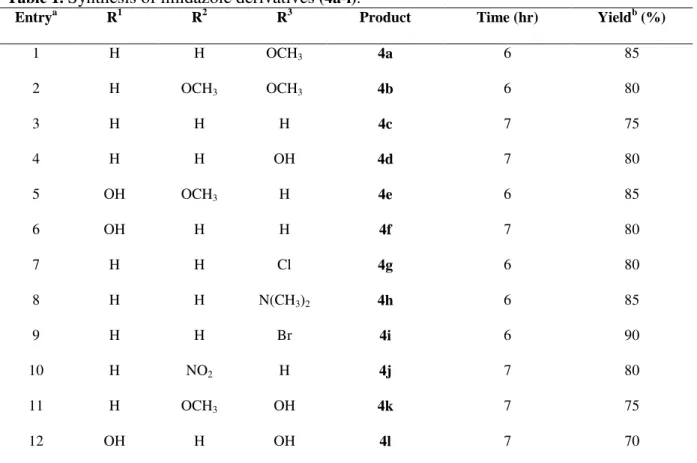
Table 1. Synthesis of imidazole derivatives (4a-l).
Entrya R1 R2 R3 Product Time (hr) Yieldb (%)
1 H H OCH3 4a 6 85
2 H OCH3 OCH3 4b 6 80
3 H H H 4c 7 75
4 H H OH 4d 7 80
5 OH OCH3 H 4e 6 85
6 OH H H 4f 7 80
7 H H Cl 4g 6 80
8 H H N(CH3)2 4h 6 85
9 H H Br 4i 6 90
10 H NO2 H 4j 7 80
11 H OCH3 OH 4k 7 75
12 OH H OH 4l 7 70
a
Reaction conditions: 3-(2-bromo acetyl)-4-hydroxy-6-methyl-2H-pyran-2-one (1 mmol), aromatic aldehydes (1 mmol), benzyl amine (1 mmol), ammonium acetate(1.5 mmol), Absolute alcohol (5 mL), reflux.bIsolated yields.
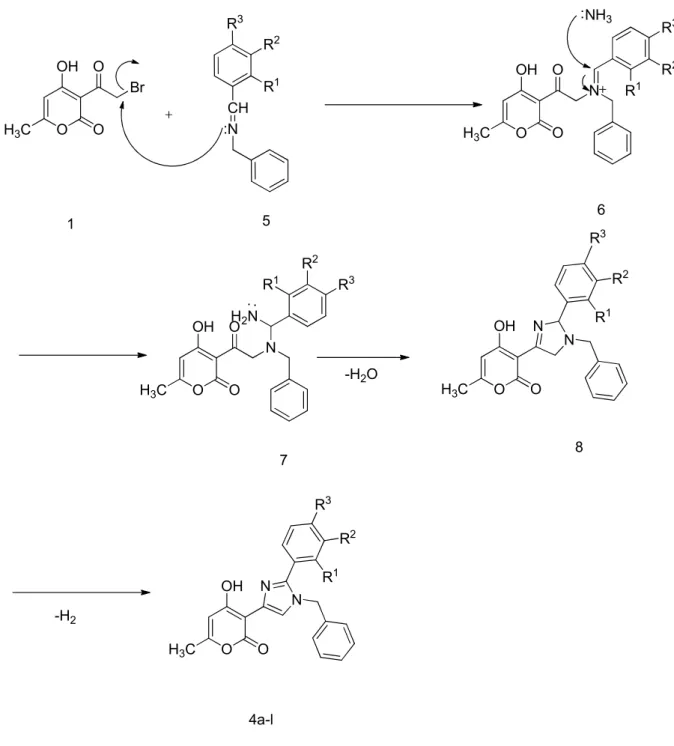
formation of imine (5). Nucleophilic addition of the imine to the bromo dehydroacetic acid leads to the formation of the iminium intermediate (6), which may undergo addition of ammonia resulting in the another intermediate (7). Intramolecular condensation of amino functionality of (7) with the adjacent carbonyl would give dihydroimidazole intermediate (8), which could undergo aerial oxidation under the reaction conditions to yield the imidazole derivatives (4a-l).
Figure 2. Proposed reaction mechanism
The infrared (IR) spectrum of compound (4a) showed prominent peaks at 1740 cm-1 for –C=O of
lactone, 3464 cm-1 for –OH, whereas the 1H NMR spectrum of compound (
4a) showed characteristic
singlets for -CH3 of pyran proton at δ 2.27, -CH2 of benzyl proton at δ 4.53, -CH of imidazole proton
at δ 8.09 ppm. The 13C NMR spectrum of compound (
3. Experimental Section
All the chemicals used in this work were purchased from commercial sources, and were used without further purification. Melting points were determined an Electrothermal-9100 apparatus. The purity of the compounds was checked by TLC plates (E. Merck Mumbai, India). CHNS analysis was done by Carlo Erba EA 1108 automatic elemental analyser. IR spectra (KBr) were recorded on a Bruker WM4(X) spectrometer (577 model). 1H NMR spectra were recorded on a Bruker WM-400
spectrometer in δ ppm using TMS as the standard. 1H, and 13C NMR spectra were obtained for
solutions in DMSO using TMS as external standard.; δ in parts per million, J in hertz. Electron
ionization mass spectra (EI-MS) were determined on Perkin Elmer (SCIEX API-2000, ESI) at 12.5 eV.
3.1. General procedure for the preparation of title compounds (4a-l):
A mixture of aromatic aldehydes (1 mmol), benzyl amine (1 mmol), 3-(2-bromo acetyl)-4-hydroxy-6-methyl-2H-pyran-2-one (1 mmol)and ammonium acetate (1.5 mmol) was taken in anhydrous ethanol
(4-6 ml), stirred at 110°C for 6-7h. After completion of the reaction mixture (as indicated by TLC ethyl acetate/n-hexane, 3:7) the reaction mixture was cooled to r.t. and the product precipitated from water and then recrystallised from ethanol.
3.1.1.3-(1-Benzyl-2-(4-methoxyphenyl)-1H-imidazol-4-yl)-4-hydroxy-6-methyl-2H-pyran-2-one (4a):
Light yellow solid; mp. 211-213 ºC; IR (KBr, cm-1) υmax: 3464, 1740; 1H NMR (400 MHz,DMSO-d6): δ 2.27 (s, 3H), 3.81 (s, 3H), 4.53 (s, 2H), 6.22 (s, 1H), 7.05 (d, J = 8.8 Hz, 2H), 7.42 (d, J = 8.5 Hz, 5H), 7.81 (d, J = 8.8 Hz, 2H), 8.09 (s, 1H), 12.30 (s, 1H); 13C NMR (100 MHz, DMSO-d6): δ 22.5, 47.5, 55.3, 83.4, 97.7, 114.5, 124.2, 127.5, 127.7, 127.9, 128.1, 128.6, 128.7, 132.2, 135.7, 163.1, 165.7, 175.2, 181.0; MS (ESI) m/z: 388 (M+1); Anal. Calcd. for C23H20N2O4: C, 71.15, H,
05.20, N, 07.21. Found: C, 71.10; H, 05.13; N, 07.16.
3.1.2.3-(1-Benzyl-2-(3,4-dimethoxyphenyl)-1H-imidazol-4-yl)-4-hydroxy-6-methyl-2H-pyran-2-one (4b):
Light yellow solid; mp. 215-217 ºC; IR (KBr, cm-1) υmax: 3463, 1738; 1H NMR (400
MHz, DMSO-d6): δ 2.21 (s, 3H), 3.79 (s, 3H), 3.81 (s, 3H), 4.53 (s, 2H), 6.14 (s, 1H), 7.07 (d, J = 8.8 Hz, 1H), 7.39-7.42 (m, 8H), 12.38 (s, 1H); 13C NMR (100 MHz,
DMSO-d6): δ 22.6, 47.4, 55.2, 55.5,
83.4, 95.0, 109.5, 111.9, 119.7, 124.8, 127.7, 128.0, 128.6, 135.7, 137.5, 146.8, 150.3, 153.6, 162.9, 163.1, 170.9, 171.7; Anal. Calcd. for C24H22N2O5: C, 68.90, H, 05.32, N, 06.70. Found: C, 68.85; H,
05.38; N, 06.75.
3.1.3.3-(1-Benzyl-2-phenyl-1H-imidazol-4-yl)-4-hydroxy-6-methyl-2H-pyran-2-one (4c):
Light yellow solid; mp. 117-119 ºC; IR (KBr, cm-1) υmax: 3233, 1707; 1H NMR (400 MHz, DMSO-d6): δ 2.25 (s, 3H), 4.55 (s, 2H), 6.14 (s, 1H), 7.42-7.59 (m, 6H), 7.90-7.93(m, 5H), 12.27 (s, 1H); 13C NMR(100 MHz, DMSO-d6): δ 22.5, 47.6, 83.6, 105.4, 112.0, 117.5, 127.7, 128.1, 128.6, 128.9, 129.3,
130.3, 131.8, 135.7, 153.3, 163.0, 166.2, 180.8; Anal. Calcd. for C22H18N2O3: C, 73.70, H, 05.06, N,
07.84. Found: C, 73.75; H, 05.12; N, 07.88.
3.1.4.3-(1-Benzyl-2-(4-hydroxyphenyl)-1H-imidazol-4-yl)-4-hydroxy-6-methyl-2H-pyran-2-one (4d):
Light yellow solid; mp. 118-120 ºC; IR (KBr, cm-1) υmax: 3434, 1738; 1H NMR (400 MHz,DMSO-d6): δ 2.27 (s, 3H), 4.51 (s, 2H), 6.18 (s, 1H), 6.92 (d, J = 8.4 Hz, 2H), 7.31-7.44 (m, 6H), 7.76 (d, J = 8.8 Hz, 2H), 11.70 (s, 1H); 13C NMR (100 MHz, DMSO-d6): δ 20.2, 47.0, 94.4, 106.1, 114.6,
115.4, 115.8, 127.6, 128.2, 128.3, 128.6, 128.7, 129.6, 132.0, 159.8, 161.5, 176.2, 176.9; Anal. Calcd. for C22H18N2O4: C, 70.65, H, 04.89, N, 07.43. Found: C, 70.60; H, 04.85; N, 07.48.
3.1.5.3-(1-Benzyl-2-(2-hydroxy-3-methoxyphenyl)-1H-imidazol-4-yl)-4-hydroxy-6-methyl-2H-pyran-2-one (4e):
Light yellow solid; mp. 204-206 ºC; IR (KBr, cm-1) υmax: 3490, 1741; 1H NMR
(400 MHz, DMSO-d6): δ 2.24 (s, 3H), 3.83 (m, 3H), 4.53 (s, 2H), 6.13 (s, 1H), 6.87-7.00 (m, 2H), 7.41-7.53 (m, 7H), 12.30 (s, 1H); 13C NMR (100 MHz,
103.1, 112.9, 118.9, 119.2, 121.5, 127.7, 128.0, 128.6, 135.7, 139.5, 146.1, 147.7, 163.0, 165.9, 175.3, 181.0; Anal. Calcd. for C23H20N2O5: C, 68.31, H, 05.00, N, 06.95. Found: C, 68.37; H, 05.10; N,
06.89.
3.1.6.3-(1-Benzyl-2-(2-hydroxyphenyl)-1H-imidazol-4-yl)-4-hydroxy-6-methyl-2H-pyran-2-one (4f):
Light yellow solid; mp. 116-118 ºC; IR (KBr, cm-1) υmax: 3272, 1740; 1H NMR (400 MHz,DMSO-d6): δ 2.22 (s, 3H), 4.42 (s, 2H), 6.18 (s, 1H), 6.86-6.93 (m, 4H), 7.29-7.49 (m, 6H), 12.32 (s, 1H), 12.85 (s, 1H); Anal. Calcd. for C22H18N2O4: C, 70.58, H, 04.85, N, 07.48. Found: C, 70.53; H,
04.89; N, 07.42.
3.1.7.3-(1-Benzyl-2-(4-chlorophenyl)-1H-imidazol-4-yl)-4-hydroxy-6-methyl-2H-pyran-2-one
(4g):
Light yellow solid; mp. 212-214 ºC; IR (KBr, cm-1) υmax: 3490, 1741; 1H NMR (400 MHz,
DMSO-d6): δ 2.23 (s, 3H), 4.52 (s, 2H), 6.12 (s, 1H), 7.36-7.42(m, 6H), 8.00 (d, J = 8.4 Hz, 2H), 8.52 (d, J = 8.4 Hz, 2H), 12.64 (s, 1H); MS (ESI) m/z:392 (M)+; Anal. Calcd. for C22H17ClN2O3: C, 67.26,
H, 04.36, N, 07.13. Found: C, 67.22; H, 04.39; N, 07.17.
3.1.8.3-(1-Benzyl-2-(4-(dimethylamino)phenyl)-1H-imidazol-4-yl)-4-hydroxy-6-methyl-2H-pyran-2-one (4h):
Light yellow solid; mp. 222-224 ºC; IR (KBr, cm-1)υmax: 3464, 1741; 1H NMR
(400 MHz, DMSO-d6): δ 2.23 (s, 3H), 3.00 (s, 3H), 3.04 (s, 3H), 4.51 (s, 2H), 6.15 (s, 1H), 7.31-7.43 (m, 8H), 7.78 (d, J = 8.8 Hz, 2H), 12.41 (s, 1H); Anal. Calcd. for C24H23N3O3: C, 71.80, H, 05.77, N,
10.47. Found: C, 71.85; H, 05.72; N, 10.42.
3.1.9.3-(1-Benzyl-2-(4-bromophenyl)-1H-imidazol-4-yl)-4-hydroxy-6-methyl-2H-pyran-2-one
(4i):
Light yellow solid; mp. 221-223 ºC; IR (KBr, cm-1) υmax: 3434, 1739; 1H NMR (400 MHz,DMSO-d6): δ 2.22 (s, 3H), 4.55 (s, 2H), 6.15 (s, 1H), 7.32-7.41 (m, 6H), 7.66 (d, J = 8.0 Hz, 2H), 7.83 (d, J = 12.0 Hz, 2H), 12.43 (s, 1H); Anal. Calcd. for C22H17BrN2O3: C, 66.43, H, 03.92, N, 06.40.
Found: C, 66.48; H, 03.97; N, 06.44.
3.1.10.3-(1-Benzyl-2-(3-nitrophenyl)-1H-imidazol-4-yl)-4-hydroxy-6-methyl-2H-pyran-2-one
(4j):
Light yellow solid; mp. 115-117 ºC; IR (KBr, cm-1) υmax: 3435, 1740; 1H NMR (400 MHz,DMSO-d6): δ 2.24 (s, 3H), 4.43 (s, 2H), 6.18 (s, 1H), 7.32-7.53 (m, 5H), 7.55-7.67 (m, 4H) 7.97 (s, 1H), 12.36 (s, 1H); Anal. Calcd. for C22H17N3O5: C, 65.50, H, 04.25, N, 10.42. Found: C, 65.57; H,
04.29; N, 10.48.
3.1.11.3-(1-Benzyl-2-(4-hydroxy-3-methoxyphenyl)-1H-imidazol-4-yl)-4-hydroxy-6-methyl-2H-pyran-2-one (4k):
Light yellow solid; mp. 111-113 ºC; IR (KBr, cm-1) υmax: 3690, 1738; 1H
NMR (400 MHz, DMSO-d6): δ 2.22 (s, 3H), 3.83 (s, 3H), 4.43 (s, 2H) 6.18 (s, 1H), 6.82 (d, J = 8.0 Hz, 1H), 6.95 (d, J = 8.0 Hz, 1H), 7.14-7.16 (m, 1H), 7.25-7.31 (m, 2H), 7.32-7.38 (m, 4H), 12.76 (s, 1H); Anal. Calcd. for C23H20N2O5: C, 68.31, H, 05.00, N, 06.95. Found: C, 68.27; H, 05.21; N, 06.99.
3.1.12.3-(1-Benzyl-2-(2,4-dihydroxyphenyl)-1H-imidazol-4-yl)-4-hydroxy-6-methyl-2H-pyran-2-one (4l):
Light yellow solid; mp. 110-112 ºC; IR (KBr, cm-1)υmax: 3468, 1738; 1H NMR
(400 MHz, DMSO-d6): δ 2.22 (s, 3H), 4.44 (s, 2H), 6.12 (s, 1H), 7.32-7.40 (m, 8H), 7.95 (s, 1H), 12.33 (s, 1H); Anal. Calcd. for C22H18N2O5: C, 67.69, H, 04.65, N, 07.18. Found: C, 67.62; H, 04.61;
N, 07.23.
4. Conclusion
Acknowledgement
The authors are thankful to the Director of the National Institute of Technology, Warangal, A. P., India, for providing financial support and facilities.
References
[1] Wender, P. A.; Miller, B. L. Synthesis at the Molecular Frontier. Nature2009, 460, 197–201.
[2] (a) Ugi, I.; Dömling, A.; Hörl, W. Multicomponent reactions in organic chemistry. Endeavor. 1994, 18, 115-122. (b) Ugi, I. Multikomponentenreaktionen (MCR). I. Perspektiven von multikomponentenreaktionen und deren Bibliotheken. J. Prakt. Chem. 1997, 339, 499-516. (c) Bienaymé, H.; Hulme, C.; Oddon, G.; Schmitt, P. Maximizing synthetic efficiency: Multi-Component transformations Lead the way. Chem. Eur. J. 2000, 6, 3321-3329. (d) Dömling, A.; Ugi, I.
Multicomponent reactions with isocyanides. Angew. Chem. Int. Ed. 2000, 39, 3168-3210. (e) Ugi, I.
Recent progress in the chemistry of multicomponent reactions. Pure. Appl. Chem. 2001, 73, 187-191. (f) Orru, R. V. A.; De Greef, M. Recent advances in solution-phase multicomponent methodology for the synthesis of heterocyclic compounds. Synthesis 2003, 10, 1471-1499. (g) Zhu, J. Recent Developments in the isonitrile-based multicomponent synthesis of heterocycles. Eur. J. Org. Chem.
2003, 2003,1133–1144. (h) Zhu, J.; Bienaymé, H. Multicomponent reactions. Wiley-VCH: Weinheim. 2005, 44, 1602–1634. (i) Dömling, A. Recent developments in isocyanide based multicomponent reactions in applied chemistry. Chem. Rev. 2006, 106, 17-89.
[3] (a) Gantos, A.; De March, P.; Moreno-Manas, M.; Pla, A.; Sanchez-Ferrando, F.; Virgili, A. Synthesis of pyrano[4,3-c]pyrazol-4(1H)-ones and -4(2H)-ones from dehydroacetic acid. Homo-and eteronuclear selective NOE measurements for unambiguous structure assignment. Bull. Chem.Soc. Jpn. 1987, 60, 4425-4431. (b) Gellin, S.; Chantegrel, B.; Nadi, A . I. Synthesis of 4-(acylacetyl)-1-phenyl-2-pyrazolin-5-ones from 3-acyl-2H-pyran-2,4(3H)-diones. Their synthetic applications to functionalized
4-oxopyrano[2,3-c]pyrazole derivatives. J. Org. Chem. 1983, 48, 4078-4082. (c) Bendaas, A.; Hamdi, M.; Sellier, N. Acylation, cyanoethylation and alkylation of methyl and phenyl indolylmagnesium salts: Influence of the substituents on the c- and N-reaction products. J. Heter. Chem. 1999, 36, 129-135. (d) Rachedi, Y.; Hamdi, M.; Sakellariou, R.; Spesiale, V. Reaction of 4-hydroxy-6-methyl-3-β
-arylpropionyl-2-pyrones with phenylhydrazine-synthesis of a new pyrazole series. Synth. Comm. 1991,
21, 1189 -1199.
[4] Ait Baziz, N.; Rach edi, Y.; Hamdi, M.; Silva, A. M. S.; Belegroune, F.; Thierry, R.; Sellier, N. 4-Hydroxy-6-methyl-3-(5-phenyl-2E,4E-pentadien-1-oyl)-2H-pyran-2-one: Synthesis and reactivity with
amines. J. Het. Chem. 2004, 41, 587-591.
[5] Fouad, D. M.; Ismail, N. M.; El-Gahami, M. A.; Ibrahim, S. A. Kinetics of the substitution of dehydroacetic acid in tris (dehydroacetato) Fe(III) complex by 8-hydroxyquinoline, di- and tetra-hydroxyquinone. Spectrochim. Acta. Part A2007, 67, 564-567.
[6] Mikami, E.; Goto, T.; Ohno, T.; Matsumoto, H.; Nishida, M. Simultaneous analysis of dehydroacetic acid, benzoic acid, sorbic acid and salicylic acid in cosmetic products by solid-phase extraction and high-performance liquid chromatography. J. Pharmaceut. Biomed. Anal.2002, 28, 261-267.
[7] Anshul, C.; Ashu, S. A. K. S. A convenient approach for the synthesis of imidazole derivatives using microwave. Der Pharma Chemica2012, 4, 116-140.
[8] Puratchikodya, A.; Doble, M. Antinociceptive and antiinflammatory activities and QSAR studies on 2-substituted-4,5-diphenyl-1H-imidazoles. Bioorg. Med. Chem. 2007, 15, 1083–1090.
[9] Achar, K. C. S.; Hosamani, K. M.; Seetharamareddy, H. R. In-vivo analgesic and anti-inflammatory
activities of newly synthesized benzimidazole derivatives. Eur. J. Med. Chem. 2010, 45, 2048–2054. [10] Dandale, S. G.; Sonar, A. S.; Solanki, P. R. Microwave assisted synthesis of biologically active
arylidene derivative of imidazole. Inter. J. Res. Phar. Biomed. Sci. 2012, 3, 780-783.
[11] Uçucu, Ü.; Gündoğdu, N.; Işikadağ, I. Synthesis and analgesic activity of some 1-benzyl-2-substituted-4,5-diphenyl-1H-imidazole derivatives. IL Pharmaco2001, 56, 285-290.
[12] De Laszlo, S. E.; Hacker, C.; Li, B.; Kim, D.; MacCoss, M.; Mantlo, N.; Pivnichny, J. V.; Colwell, L.; Koch, G. E.; Cascieri, M. A.; Hagmann, W. K. Potent, orally absorbed glucagon receptor antagonists.
Bioorg. Med. Chem. Lett. 1999, 9, 641-646.
[13] Eyers, P. A.; Craxton, M.; Morrice, N.; Cohen, P.; Goedert, M. Conversion of SB 203580-insensitive MAP kinase family members to drug-sensitive forms by a single amino-acid substitution. Chem. Biol. 1998, 5, 321-328.
Renard, P.; Guardiola-Lemaitre, B.; Manechez, D.; Penicaud, L.; Ktorza, A.; Godfroid, J. J. Design and synthesis of imidazoline derivatives active on glucose homeostasis in a rat model of type II diabetes. 1. Synthesis and biological activities of N-benzyl-N ‘-(arylalkyl)-2-(4‘,5‘-dihydro-1‘H -imidazol-2‘-yl)piperazines. J. Med. Chem. 1997, 40, 3793-3803.
[15] Bousquet, P.; Feldman. J. Drugs acting on imidazoline receptors. Drugs1999, 58, 799-812.
[16] Ueno, M.; Imaizumi, K.; Sugita, T.; Takata, I.; Takeshita, M. Effect of a novel anti-rheumatic drug, TA-383, on type II collagen-induced arthritis. Inter. J. Immunopharmac. 1995, 17, 597-603.
[17] (a) Hayashi, T.; Kishi, E.; Soloshonok, V. A.; Uozumi, Y. Erythro-selective aldol-type reaction of N -sulfonylaldimines with methyl isocyanoacetate catalyzed by gold(I). Tetrahedron Lett. 1996, 37, 4969-4972. (b) Jung, M. E.; Huang, A. Use of Optically Active Cyclic N,N-Dialkyl Aminals in Asymmetric Induction. Org. Lett. 2000, 2, 2659-2661.
[18] (a) Corey, E. J.; Grogan, M.. Enantioselective Synthesis of α-Amino Nitriles from N-Benzhydryl Imines and HCN with a Chiral Bicyclic Guanidine as Catalyst. J. Org. Lett. 1999, 1, 157-160. (b) Isobe, T.; Fukuda, K.; Araki, Y.; Ishikawa, T. Modified guanidines as chiral superbases: the first example of asymmetric silylation of secondary alcohols. Chem. Commun. 2001, 24, 243-244.
[19] Rajeswar Rao, V.; Reddy, M. M. M.A facile one step synthesis of 3-(2-hydroxy benzalhydrazino-4-thiazolyl)coumarins under solvent free conditions and their biological activity. Indian. J. Het. Chem. 2003, 13, 69-72.
[20] Rajeswar Rao, V.; Vijaya Kumar, P.; Reddy, V. R.; Reddy, K. M. synthesis and evaluation of anticancer and antiviral activity of some 2-aryl-3-(4-(2H
-1-benzopyran-2-one-3-yl)-2-thiazolyl)-5-methyl-4-thiazolidinones. Heterocycl. Commun. 2005, 11, 273- 284.
[21] Rajeswar Rao, V.; Ravinder Reddy, V. Heterocyclic systems containing a bridge head nitrogen atom: Reaction of 5-pyrimidine carboxylic acid 1,2,3,4-tetrahydro-6-methyl-4-aryl-2-thioxoethyl ester with 3-(2-bromoacetyl)coumarins. Phosporus, Sulfur Silicon Relat. Elem. 2006, 181, 147-158.
[22] Rajeswar Rao, V.; Vijaya Kumar, P.; Manoher Reddy, K. Zinc chloride-catalyzed one-pot synthesis of 3-[2-(3-methyl-4,5-dihydro-furo[2,3-c]pyrazol-1-yl)thiazol-4-yl]-chromen-2-ones viaa three component reaction. Indian. J. Chem. 2010, 49B, 836-839.