REV. HOSP. CLÍN. FAC. MED. S. PAULO 57(2):73-76, 2002 MARCH-APRIL
From the Department of Radiology, State University of Campinas, School of Medicine (FCM-UNICAMP).
AGENESIS OF THE POSTERIOR ARCH OF THE
ATLAS
Martin Torriani and José Leonardo Goes Lourenço
RHCFAP/3072
TORRIANI M. et al. - Agenesis of the posterior arch of the atlas. Rev. Hosp. Clín. Fac. Med. S. Paulo 57(2):73-76, 2002.
PURPOSE: To illustrate the radiological findings and review the current literature concerning a rare congenital abnormality of the posterior arch of the atlas.
CASE REPORT: An adult female without neurological symptoms presented with an absent posterior arch of the atlas, examined with plain films and helical computerized tomography.
Complete agenesis of the posterior arch of the atlas is a rare entity that can be easily identified by means of plain films. Although it is generally asymptomatic, atlantoaxial instability and neurological deficits may occur because of structural instability. Computerized tomography provides a means of assessing the extent of this abnormality and can help evaluate the integrity of neural structures.
Although considered to be rare entities, defects of the posterior arch of the atlas may be discovered as incidental asymptomatic findings in routine cervical radiographs. Familiarity with this abnormality may aid medical professionals in the correct management of these cases.
DESCRIPTORS: Atlas. C1. Abnormalities. Computerized tomography. X-ray.
Structural defects of the posterior arch of the atlas are rare, comprising abnormalities that may present as clefts with variable location and size, rang-ing to more extensive defects such as complete agenesis. In general, such ab-normalities are asymptomatic; how-ever, they may be associated with atlantoaxial instability and neurologi-cal deficits1.
In this report, we describe a patient with an absent posterior arch of the at-las, as diagnosed with the radiological findings from plain films and compu-terized tomography (CT).
CASE REPORT
A 24-year-old white woman pre-sented with nonspecific neck pain and
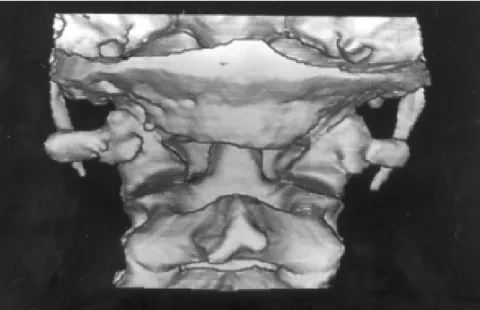
was referred for radiographic examina-tion of the cervical spine. There was no previous history of cervical trauma, and neurological examination was negative. Cervical spine radiographs demonstrated complete absence of the posterior arch of the atlas and a hyper-trophic downward projection of the posterior border of the foramen mag-num (Fig. 1). There was no evidence of atlantoaxial instability in flexion and extension views. A helical-CT exami-nation with 2.7 mm-thick sections of the cervico-occipital region was per-formed and confirmed the absence of ossification throughout the posterior
arch of C1 (Fig. 2). Using appropriate window settings, we found no evidence of involvement of neural structures. A 3-dimensional reconstruction provided an additional perspective of this anomaly (Fig. 3). Magnetic resonance imaging was not performed because of the absence of neurological symptoms.
DISCUSSION
Com-REV. HOSP. CLÍN. FAC. MED. S. PAULO 57(2):73-76, 2002 MARCH-APRIL
(Type C), absence of posterior tubercle (Type D), and total agenesis of the pos-terior arch (Type E). Type A clefts oc-cur in about 4% of the population and represent 97% of all posterior defects. Type B through E defects have been reported to occur in 0.69% of the population1. These disturbances have
been attributed to anomalies in the cartilaginous preformation of the pos-terior arch rather than to disturbances of ossification1,3,5. In addition, stenosis
at C1 caused by a hypoplastic but com-plete posterior arch has been reported as a congenital abnormality1 and in
as-sociation with other chromosomal dis-eases, such as gonadal dysgenesis and Down and Turner syndromes7.
Hypo-plasia of the atlas could be caused by a failure in dorsal expansion of the two lateral chondrification centers, result-ing in premature fusion and a congeni-tally narrowed spinal canal1.
Total or partial aplasia of the pos-terior atlas arch is rare2,4,5,8. The true
incidence is not known, and only a few articles report on this particular malfor-mation3,6,9,10. Absence of ossification of
the posterior arch of the atlas is asymp-tomatic and is generally detected as an incidental finding, although it may cause neck pain2,3. Although autopsies
and surgical explorations have shown that dense fibrous bands bridge the bony gaps and account for a good sta-bility of the upper cervical spine, this defect can be associated with atlanto-axial instability and neurological defi-cits1,4.
Congenital absence or hypoplasia of the posterior arch of C1 may be as-sociated with several diseases, such as the Arnold-Chiari malformation, go-nadal dysgenesis, Klippel-Feil drome, and Turner and Down syn-dromes2,3. In the latter, hypoplasia of
the posterior arch of C1, which may increase the risk of atlantoaxial sub-luxation, was seen in 26% of 38 chil-dren (aged 2-3 years)7. Compensatory
hypertrophy of the anterior arch of C1 Figure 1 - Lateral view of the cervical spine.
Complete absence of the posterior arch of the atlas and a hypertrophic downward projection of the posterior border of the foramen magnum (arrow).
Figure 2 - CT section obtained at the C1 level. The posterior arch of C1 is missing. The relation between the odontoid and the anterior arch of C1 is normal.
plete fusion of the posterior arch is ex-pected to occur between 3 and 5 years of age. In about 2% of the population, an additional center may be present posteriorly in the midline, forming the posterior tubercle of the atlas during the second year of life1-6.
At least two different anomalies
can develop during the ossification process: 1) median clefts of the poste-rior arch of C1, and 2) varying degrees of posterior arch dysplasia1,5. These
REV. HOSP. CLÍN. FAC. MED. S. PAULO 57(2):73-76, 2002 MARCH-APRIL
and of the spinous process of C2 is usually found3; however, it was not
ob-served in our case. On the other hand, we observed a hypertrophic downward projection of the posterior border of the foramen magnum, which has not yet been described (Figs. 1 and 3). Never-theless, this finding can also be inter-preted as a coincidental anatomic vari-ation of this region. Other coexisting abnormalities, including clefts of the anterior arch, atlantoaxial rotatory sub-luxation, anterior atlantoaxial subluxa-tion, and cervical myelopathy, are re-ported in the literature1-4,7. This
anomaly can also simulate basilar in-vagination, Jefferson’s fracture, and occipitalization of the atlas3,8.
Although a familial incidence is un-certain, a report describing the same dis-order in a mother and daughter indicates an autosomal dominant inheritance3.
Fur-thermore, it is suggested that myelopa-thy associated with hypoplasia of the posterior arch of C1 may have an ethnic association, since 5 of the few cases re-ported involved oriental individuals1.
Because of its inherent imaging characteristics, CT provides excellent contrast between the nonossified and ossified portions of the posterior arch of the atlas (Fig. 2), which can enable precise determination of the extent of the abnormality. CT scans can be par-ticularly useful for smaller defects. However, in patients with neurological
symptoms, we believe magnetic reso-nance imaging should be performed in order to adequately evaluate the spinal cord and adjacent neural structures.
In cases of atlantoaxial instability, posterior fusion is a common surgical procedure, provided the posterior ele-ments of both vertebrae are intact. If the posterior arch of C1 is abnormal, posterior fusion involves the occiput and lower spinal segments, limiting the mobility of the upper cervical spine. Reconstruction of C1 and its fusion with C2 using calvarial bone grafts in an 8-year-old patient with an absent posterior arch of C1 and atlantoaxial subluxation has been reported5.
RESUMO RHCFAP/3072
TORRIANI M e col. - Agenesia do arco posterior do atlas. Rev. Hosp. Clín. Fac. Med. S. Paulo 57
(2):73-76, 2002.
OBJETIVO: Descrever os achados
radiológicos e revisar a literatura de uma anormalidade congênita rara do arco posterior do atlas.
RELATO DE CASO: Uma
pacien-te adulta sem queixas neurológicas apresentava ausência do arco posterior do atlas, examinada através de
radiogra-fias simples e tomografia computadori-zada helicoidal.
A agenesia completa do arco posterior do atlas é uma entidade rara que pode ser facilmente identificada através de radiogra-fias simples. Apesar de ser geralmente assintomática, instabilidade atlanto-axial e queixas neurológicas podem ocorrer devi-do à instabilidade estrutural. A tomografia computadorizada possibilita a avaliação da extensão desta anormalidade e pode auxi-liar na análise da integridade de estruturas neurais.
Apesar de serem considerados en-tidades raras, os defeitos do arco pos-terior do atlas podem ser achados incidentais em radiografias cervicais de rotina. A familiaridade com esta anor-malidade pode auxiliar profissionais da área médica no correto manejo destes pacientes.
REV. HOSP. CLÍN. FAC. MED. S. PAULO 57(2):73-76, 2002 MARCH-APRIL
REFERENCES
1. PHAN N, MARRAS C, MIDHA R et al. - Cervical myelopathy caused by hypoplasia of the atlas: two case reports and review of the literature. Neurosurgery1998;43(3):629-33.
2. DALINKA MK, ROSENBAUM AE & VAN HOUTEN F - Congenital absence of the posterior arch of the atlas. Radiology 1972; 103(3):581-3.
3. MOTATEANU M, GUDINCHET F, SARRAJ H et al. - Case report 665. Congenital absence of posterior arch of atlas. Skeletal Radiol 1991; 20(3):231-2.
4. THOMPSON GH, LIKAVEC MJ, ARCHIBALD I et al. - Atlantoaxial rotatory subluxation, congenital absence of the posterior arch of the atlas, and cerebral palsy: an unusual triad. J Pediatr Orthop 1985; 5(2):232-5.
5. DUONG DH & CHADDUCK WM - Reconstruction of the hypoplastic posterior arch of the atlas with calvarial bone grafts for posterior atlantoaxial fusion: technical report. Neurosurgery 1994; 35(6):1168-70.
6. SCHULZE PJ & BUURMAN R - Absence of the posterior arch of the atlas. AJR Am J Roentgenol1980; 134(1):178-80.
7. MARTICH V, BEN-AMI T, YOUSEFZADEH DK et al. - Hypoplastic posterior arch of C-1 in children with Down syndrome: a double jeopardy. Radiology1992; 183(1):125-8.
8. SMOKER WR - Craniovertebral junction: normal anatomy, craniometry, and congenital anomalies. Radiographics1994; 14(2):255-77.
9. LOGAN WW & STUARD ID - Absent posterior arch of the atlas. Am J Roentgenol Radium Ther Nucl Med1973; 118(2):431-4. 10. CURRARINO G, ROLLINS N & DIEHL JT - Congenital defects of
the posterior arch of the atlas: a report of seven cases including an affected mother and son. AJNR Am J Neuroradiol1994; 15(2):249-54.