Brazilian Journal of Physics, vol. 36, no. 4B, December, 2006 1371
High-K Band in
140Gd
J.R.B. Oliveira1, F. Falla-Sotelo1, M.N. Rao1, J.A. Alc´antara–N´u˜nez1, E.W. Cybulska1, N.H. Medina1, R.V. Ribas1, M.A. Rizzutto1, W.A. Seale1, D. Bazzacco2, F. Brandolini2, S. Lunardi2, C. Rossi-Alvarez2, C. Petrache2, Zs. Podoly´ak2, C.A. Ur2, D. de Acu˜na3, G.de Angelis3, E. Farnea3, D. Foltescu3, A. Gadea3, D.R. Napoli3, M. de Poli3, P. Spolaore3, M. Ionescu-Bujor4, and A. Iordachescu4
1Instituto de F´ısica, DFN, Universidade de S˜ao Paulo, S˜ao Paulo, Brazil, 2Dipartimento di F´ısica and INFN, Sezione di Padova, Padova, Italy,
3INFN, Laboratori Nazionali di Legnaro, Legnaro, Italy, and 4Institute of Physics and Nuclear Engineering, Bucharest, Romania
Received on 18 March, 2006
High-spin states in the neutron-deficient140Gd nucleus have been studied with the92Mo(54Fe,α2p) reaction at a beam energy of 240 MeV. The level scheme of140Gd was considerably extended from what was previously known. In this work we concentrate on one of the 9 bands observed, which presents relatively strong M1 transitions and negligible signature splitting, and has an isomeric band-head, indicating a strongly coupled or high-K configuration. We compare this band to theKπ=8−bands observed in N=74 isotones and propose a similar configuration assignment, but with a somewhat larger deformation.
Keywords: Nuclear reactions;92Mo(54Fe,α2p), E=240 MeV; Measured E
γ, Iγ,γγ-coincidence;140Gd deduced high-spin levels, J,π, configurations; Isomer
I. INTRODUCTION
Several high-K states are known to exist in the mass 130-140 region. For the N=74 even-even isotones, Kπ =8− isomers, with lifetimes ranging from ns to ms, are known in 128Xe[1], 130Ba[2], 132Ce[3], 134Nd[4], 136Sm[5], and 138Gd[6]. The systematics of theKπ=8−isomeric states in N=74 isotones has been studied by A.M. Bruce et al. [7]. These states decay towards theK=0 ground state band, and the transitions are K-forbidden. The variation of the strengths of the transitions, however, is not clearly understood. The ex-planation might involve a variation of the structure of the iso-mer or of the ground state band. In the present work have extended the level scheme of 140Gd from what was previ-ously known[8], and, in particular, we have observed for the first time a band also based on anIπ=8−state. This could be the first case of a Kπ=8− state observed in an N=76 even-even nucleus. The 140Gd case presents strong similar-ities but also some significant differences with relation to the N=74 isotones. The interpretation of this band is quite dif-ficult, in particular because the addition of the 2 neutrons is expected, in principle, to modify the configuration with re-spect to the one observed in the N=74 cases, fully occupying the orbitals involved and decreasing the deformation as the N=82 closed shell is approached. We propose that the defor-mation is larger in140Gd and a pair of neutrons from the N=5 shell coupled to angular momentum zero is incorporated, from which the 7/2[404]−1⊗9/2[514](Kπ=8−) neutron excitation (in particle-hole terminology) is built.
II. EXPERIMENTAL PROCEDURE AND ANALYSIS
The 92Mo(54Fe,α2p) reaction at 240-MeV was employed to populate high-spin states in140Gd. The incident beam was
provided by the tandem XTU accelerator of the Legnaro Na-tional Laboratories. A self–supporting and isotopically en-riched (>97%) 92Mo target of approximately 1.0 mg/cm2 thickness was used. The GASP array [9] was used for obtain-ing gamma–ray double and triple coincidence spectra. The photopeak efficiency of the array is approximately 3% for 1.3 MeV. The charged-particle detector array (ISIS) [10] enabled the selection of evaporated charged particles in coincidence with theγ–rays. The recoil mass spectrometer (Camel) [11] allowed for mass identification. Events were collected on tape when at least two HPGe detectors fired in coincidence. The data were taken for a period of 136 hours. A total of 85×106Compton-suppressed events were collected. The data were sorted intocharged particle fold–γ−γ, A−γ−γ and
γ−γ−γ cubes, from which specific matrices for the vari-ous exit channes were extracted, and were analyzed using the VPAK [12] and RADWARE [13] spectrum analysis codes. The detectors were energy and efficiency calibrated with stan-dard152Eu and133Ba radioactive sources.
1372 J.R.B. Oliveira et al.
TABLE I: Energies, intensities, and spin assignments to the tran-sitions belonging to the strongly coupled band observed in 140Gd (the first two rows are linking transitions to the ground state band). The energies of the transitions are given in keV. The intensities are normalized (to 100%) with respect to the 507.6 keV transition (4+→2+) of the ground state band.
Eγ(keV) Iγ Iiπi→I
πf
f
71.3(2) 0.77(12) 8−→8+ 747.1(3) 0.80(18) 8−→6+ 245.8(1) 2.38(20) 9−→8− 287.0(1) 2.00(13) 10−→9− 317.4(1) 1.40(10) 11−→10− 342.1(1) 1.08(8) 12−→11− 363.7(1) 0.54(6) 13−→12− 383.3(1) 0.64(7) 14−→13− 403.1(3) 0.23(5) 15−→14− 423.0(15) 0.04(5) 16−→14− 532.9(10) 0.36(7) 10−→8−
604.0(3) 0.53(8) 11−→9− 658.8(3) 1.08(15) 12−→10− 704.9(3) 0.60(8) 13−→11− 747.1(8) 0.16(7) 14−→12− 785.7(3) 0.71(11) 15−→13− 826.3(3) 0.65(8) 16−→14−
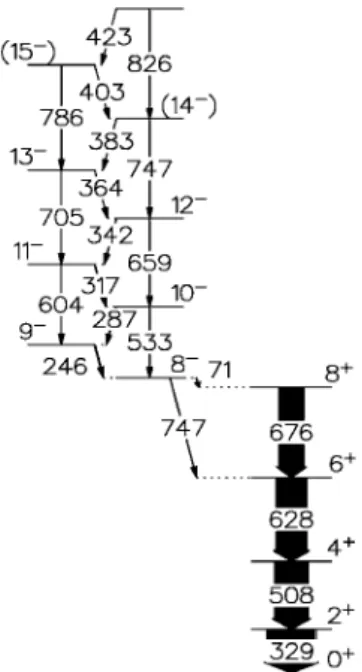
Figure 2 presents the relevant partial level scheme of140Gd obtained in the present measurement. This level scheme is based on the coincidence relationships, intensity balances on each level and energy sums from different paths using the 1α2p–gated matrix.
III. ASSIGNMENTS OF BAND-HEAD SPIN, PARITY, AND LIFETIME
The spin and parity of theIπ=8−state was established by the following arguments: Firstly the experimental total elec-tronic conversion coefficient of the 71 keV transition was de-termined from the ratio of gamma intensities of itself to that of the 676 keV gsb transition, as observed in the 246 and 287 keV gated spectra. The value obtained corresponds to a con-version coefficient ofαexp=0.72(20), consistent with the ex-pected value for a pure E1 (αteo=0.736). The experimental value is clearly in disagreement with other possible assign-ments like M1 or E2 which present very different electronic conversion coefficient values. This establishes that the 71 keV line is of E1 character, and the band has negative parity. Sec-ondly, if the 747 keV transition (from the same state) were of the same multipolarity (E1), it’s decay to the gsb should be governed by an intrinsic transition matrix element of the same order of magnitude as that for the 71 keV, assuming not too different structure of the 8+ and 6+ gsb states. In this case, the energy factor should favor by three orders of magnitude the 747 keV with relation to the 71 keV transition. However, the experimental intensities of both transitions have been cal-culated to be of the same order of magnitude. This, therefore, indicates a multipolarity with weaker strength, viz. M2, with △I=2, to the 747 keV transition. In conclusion, the only
100 200 300 400 500 600 700 800
Eγ(keV) 0
500 1000 1500
Counts
71.2
245.8
287.0
317.4
328.8
342.1
363.7
383.3
403.1
423.0
507.6
627.9
658.8 675.0, 675.9
704.9 746.0, 747 785.7 826.3
604.0
FIG. 1: Sum spectrum of the 246 and 287 keV gate transitions from the 1α2p−gated matrix. The energies of theγ−ray lines are indi-cated in keV (see Sec. III with regards to the 71 and 746 keV line energies).
assignment consistent with these results is of an 8− for the strongly coupled band head.
The lifetime of theIπ=8−band-head was estimated to be of about 1.5 ns. This comes from two independent evidences: First, in the 287 keV gate, the intensity of the 328 keV tran-sition (2+→0+) is reduced to about 85% when compared to that of the 246 keV. This is due to the loss of efficiency when theγ−decay occurs off-center in the GASP spectrometer. The flight velocity of the recoils after traversing the target is about 1cm/ns. Second, the gsb transitions appear to be shifted to lower energies, when gated in-band from above the isomer, by about−0.15% relative to the usual Doppler correctedγ−ray energies. This is again due to the decay off-center, since the transitions become observed by the detectors at larger angles than those originally used in the Doppler corrections of the spectra, which assume decay in the center of the target. Sim-ulations with the GEANT code applied to the specific exper-imental setup of GASP show that these results are consistent with a lifetime of 1.5 ns for the negative parity band-head, with an uncertainty of about 0.4 ns. The apparent energies of the transitions from the isomeric state are therefore also expected to be slightly shifted. For this reason the 0.15% cor-rection has been applied to the energy values of the transitions from the 8−state quoted in table I. For the 747 keV line, this correction is significant and the peak position is close to 746 keV in the spectrum (Fig.1).
IV. DISCUSSION
As stated in the introduction, the systematics of theKπ=
consid-Brazilian Journal of Physics, vol. 36, no. 4B, December, 2006 1373
FIG. 2: Partial level scheme of140Gd showing the strongly coupled band discussed in this work and its decay to the gsb. The transition energies are indicated in keV. The transition intensities are propor-tional to the arrow widths.
erably, generally decreasing from 11 ms in130Ba to 6µs in 138Gd. The hindrance per degree of K forbideness (f
ν) of the decay is defined asFW1/ν, whereν=∆K−λ,λis the transition multipolarity, and FW =t1/2(Eλ)/t1w/2(Eλ) is the hindrance factor, the ratio of the experimental partial half-life to that of the Weisskopf single particle estimate. The values offνfor the N=74 isotones are around 25 for Nd, Sm and Gd, while for Ba it is 44. This variation can be reasonably well interpreted in terms of admixture ofK=8 in the gsb due to interaction with the s (Stockolm) band near band crossing.
From our data we can estimate a value of fν≈13 for the 140Gd 71 keV transition. The partial lifetime for the 747 keV M2 transition results in essentially no hindrance with respect to the Weisskopf estimate.
Total Routhian Surfaces Calculations (TRS), together with the presence of a gamma-vibrational band at low excitation energy, indicate a large degree of triaxiality for140Gd and a reducedβ2deformation (from about 0.28 in N=74 Sm and Gd to 0.21 in140Gd), near the ground state. This could also fa-vor high-K admixture in the structure of the gsb, and reduce the hindrance factor. The interpretation is not clear, however, because no high-K configuration appears to be near yrast ac-cording to the same TRS calculations, since the 7/2+[404]
orbits become fully occupied and away from the Fermi en-ergy as an effect of the addition of 2 neutrons and reduction of deformation. Besides that, the alignment angular momen-tum (the projection on the rotational axis) of the strongly cou-pled band relative to the gsb is much larger in140Gd (4-5) than in the nearby N=74 isotones (Gd, Sm and Nd, around 1). This is not expected since in a high-K configuration the
quasi-particle angular momentum tends to couple along the deformation axis, perpendicularly to the rotation axis. A
4-quasiparticle configuration would be very unlikely since the excitation energy of theKπ=8−relative to the ground state is quite small (2.21 MeV), and in fact, quite similar to the one of the N=74 isotones (2.23 and 2.27 MeV in Gd and Sm re-spectively). A proton configuration, which could present large alignment, would have a low-K, and should be discarded (see also the electromagnetic properties discussed in the next para-graph). We tentatively propose, therefore, that the strongly coupled band is built on a quite deformed shape core contain-ing 2 paired particles from the N=5 shell, and in addition the 7/2+[404]⊗9/2−[514]two quasi-neutron excitation coupled toIπ=8− as in the N=74 nuclei. The N=5 single-particle states 1/2[541] (from f7/2) and 1/2[660](from i13/2) in the deformed shell model are strongly down-sloping as a func-tion ofβ2and are therefore “β−driving”, the excitation energy of the former being lower than the latter. A larger deforma-tion could explain why the alignment is apparently so high in 140Gd. Since the band would have a larger moment of inertia in comparison to the gsb, it develops more collective angular momentum at the same rotational frequency and the concept of quasiparticle alignment becomes inadequate. The difficulty in such explanation resides in the comparatively high strength of the inter-band transition for such a significant shape change and, still, in the small experimental excitation energy. How-ever, this appears to be the most likely interpretation with comparison to the other possibilities. It should be noted that highly deformed bands have been observed at relatively low excitation energy in odd-nuclei of this region, such as137Sm and139Gd [17]. These bands are built upon the ν1/2[660]
(from i13/2) configuration, with large quadrupole moments (Q0=5−7eb, [18, 19]). In133Nd [20] theν1/2[541]band (with an estimated deformation ofβ2=0.29) can be found at much lower excitation energy than theν1/2[660].
Figure 3 presents the experimental ratio of reduced tran-sition probabilities B(M1)/B(E2) in comparison with the nearby nuclei and theoretical estimates. It can be observed that for all nuclei presented the values have the same order of magnitude, being on average lower in140Gd than in the N=74 isotones. The dotted line corresponds to a prediction based on the rotational model with an intrinsic quadrupole moment ofQ0=4.5 eb , the value measured from the lifetime of the first 2+state in136Sm [21], while the dashed line is calculated withQ0=5.5 eb. This last value reproduces better the140Gd data, in agreement with the hypothesis of large deformation.
1374 J.R.B. Oliveira et al.
9 10 11 12 13 14 15
I(h) 1
10
B(M1)/B(E2) [
µ N 2 /e 2 b 2 ]
Q0=4.5 b Q0=5.5 b 138
Gd 136
Sm 134
Nd 140
Gd
−
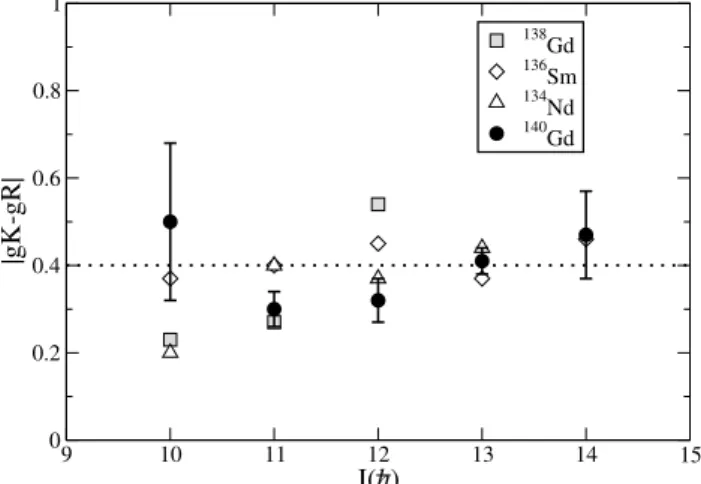
FIG. 3: The experimental ratio of reduced transition probabilities B(M1)/B(E2)as a function of the spin of the state in140Gd. The val-ues for the N=74 isotones are also shown for comparison (the error-bars are roughly of the same order of magnitude as in140Gd, but are not shown for clarity of the figure). Theoretical estimates from the pure rotational model for two values of intrinsic electric quadru-pole moments are also shown by the lines (considering the value of |gK−gR|=0.4).
value ofgR=0.4. This result also corroborates our assump-tions. It should be noted that for 2 quasi-proton configuration with large K the g-factor difference would be much larger and could not be consistent with the present experimental results.
V. CONCLUSION
A strongly coupled band has been observed for the first time in 140Gd. The band-head was determined to be an Iπ=8−isomer state, with a lifetime of about 1.5ns. The band presents strong similarities to the high-K bands in neighbor-ing N=74 isotones, based on the 7/2+[404]⊗9/2−[514]two quasi-neutron configuration coupled toKπ=8−. The appar-ent alignmappar-ent, relative to the ground state band is, however, larger than in the lower N isotones, and can perhaps be ex-plained by an increase in deformation. With a significantly deformed shape (say, ε>0.25), 2 paired particles from the
N=5 shell from the 1/2[541]Nilsson state (from f7/2) are in-corporated, and theν7/2+[404]⊗9/2−[514](Kπ=8−) exci-tation would become the lowest available negative parity con-figuration, providing the necessary characteristics to explain the presently observed band. This assignment is corroborated by the experimental B(M1) and B(E2) branching and mixing ratio values. It remains to be explained the large reduction of the hindrance factor of the isomer decay to the gsb and the relatively low excitation energy of the structure. Search for additional cases of strongly coupled bands in N=76 isotones would be of great interest, as well as the measurement of in-band transition lifetimes.
9 10 11 12 13 14 15
I(h) 0
0.2 0.4 0.6 0.8 1
|gK-gR
|
138 Gd 136
Sm 134
Nd 140
Gd
−
FIG. 4: The experimental and theoretical values of|gK−gR|as a
function of the state spin in140Gd, and in N=74 isotones (with val-ues of the quadrupole momentQ0=5.5 eb, andQ0=4.5 eb, re-spectively). The value expected for the ν7/2+[404]⊗9/2−[514]
(Kπ=8−) configuration is shown by the dotted line.
VI. ACKNOWLEDGMENTS
We acknowledge partial support from FAPESP (Fundac¸˜ao de Amparo `a Pesquisa do Estado de S. Paulo) and CNPq (Conselho Nacional de Desenvolvimento Cient´ıfico e Tec-nol´ogico), and thank the LNL staff for the operation of the accelerator.
[1] L. Goettiget al.,Nucl. Phys. A357, 109 (1981). [2] H.F. Brinkmanet al.,Nucl. Phys.81, 233 (1966). [3] D. Ward, Nucl.et al.,Phys. A117, 309 (1968). [4] D.G. Parkinsonet al.,Nucl. Phys. A194, 443 (1972). [5] P.H. Reganet al.,Phys. Rev. C51, 1745 (1995). [6] D.M. Cullenet al.,Phys. Rev. C58, 846 (1998). [7] A.M. Bruceet al.,Phys. Rev. C55, 620 (1997). [8] E. S. Paulet al.,Phys. Rev. C39, 153 (1989).
[9] D. Bazzacco, in Proc. of the Int. Conf. on Nucl. Struct. at High Ang. Momentum, Ottawa, 1992, Report No. AECL 10613, Vol. 2, p. 376.
[10] E. Farneaet al., Nucl. Instrum. Meth. A,400, 87 (1997). [11] P. Spolaore,et al., Nucl. Instr. Meth. A238, 381 (1985). [12] W. T. Milner, Holifield Heavy Ion Research Facility Computer
Handbook, Oak Ridge National Laboratory, Oak Ridge, Ten-nessee, USA (1987).
[13] D. Radford, Nucl. Instr. Meth. Phys. Res. A361, 297 (1995). [14] F. Falla-Sotelo, MSc Thesis, Universidade de S. Paulo, IFUSP,
Brazil, (2002).
[15] F.R. Espinoza-Quinoneset al., Phys. Rev. C60, 054304 (1999). [16] J.R.B. Oliveiraet al., Phys. Rev. C62, 064301 (2000). [17] C.A. Rossi-Alvarez,et al., Nucl. Phys. A624, 225 (1997). [18] E.S. Paulet al., J. Phys.G 18, 121 (1992).