Brazilian Journal of Physics, vol. 34, no. 1A, March, 2004 259
Phase-Shift Definition for Pion-Nucleon Scattering
from Chiral Perturbation Theory
Isabela P. Cavalcante
Departamento de F´ısica, CCET Campo Grande, Universidade Federal de Mato Grosso do Sul, C.P. 549, 79070-900, Campo Grande, MS, Brazil
and J. S´a Borges
Instituto de F´ısica, Universidade do Estado do Rio de Janeiro Rua S˜ao Francisco Xavier 524, 20559-900, Rio de Janeiro, RJ, Brazil
Received on 15 August, 2003.
Chiral Perturbation Theory is considered as a very precise method when applied to pion-nucleon scattering near threshold and in the unphysical region since in these cases the pion momenta are small. In this framework, third order calculation yields a non-relativistic scattering amplitude with nine free parameters. From the fact that the resulting partial-wave amplitudes do not respect elastic unitarity relation, one has that the phase-shift definition is ambiguous. In this article, we present the comparison of the model with experimental data for two different phase-shift formulas and we conclude that the results are very sensitive to phase-shift definition.
1
Introduction
Although QCD is widely accepted as the fundamental gauge theory underlying the strong interactions, we still lack the analytical tools for ab initio descriptions of low-energy properties and processes. However, new techniques have been developed to extend the results of the current-algebra days andsystematicallyexplore corrections to the soft-pion predictions based on symmetry properties of QCD Green functions.
The starting point is a theorem by Weinberg stating that a perturbative description in terms of the most general ef-fective Lagrangian containing all possible terms compatible with assumed symmetry principles yields the most general Smatrix consistent with the fundamental principles of quan-tum field theory and the assumed symmetry principles [1].
The method to go beyond the soft-pion predictions is called chiral perturbation theory (ChPT) [2] and describes the dynamics of Goldstone bosons in the framework of an effective field theory, which provides a systematic method for discussing the consequences of the global flavor symme-tries of QCD at low energies.
This method has been sucessfully applied to meson de-cay and meson-meson scattering, with the help of Wein-berg’s power counting scheme. This scheme establishes that any given diagram behaves as ED, whereD ≥ 2 is
de-termined by the structure of the vertices and the topology of the diagram in question. For a given value ofD, Wein-berg’s formula unambiguously determines to which order in the momentum and quark mass expansion the Lagrangian needs to be known.
Chiral Perturbation Theory faces problems when
baryons are to be introduced in the formalism. This comes about because the nucleon mass is not small even in the chiral limit and thus the characteristic parametermπ/4πfπ
does not control the low energy expansion any more. A method called Heavy Baryon Chiral Perturbation Theory (HBChPT) was invented to allow one to introduce static baryons in ChPT formalism [3] and to describe the dynam-ics of baryons at low energies: static properties such as masses or magnetic moments, form factors, or, eventually, more complicated processes, such as pion-nucleon scatter-ing, Compton scatterscatter-ing, pion photoproduction etc.
In this paper we analyse low energy pion-nucleon phase-shifts derived from HBChPT. Working at order O(p3), the resulting amplitude[4] depends onninefree parameters which can be adjusted to fit theS−andP−partial-wave phase-shifts to the experimental data[5]. It is known that elastic unitarity is violated at that order of the calculation, so that phase-shift definition is arbitrary. From our present analysis we conclude that the fits are very sensitive to the phase-shift definition. In section II we present the method of HBChPT applied to pion-nucleon scattering and the re-sulting amplitudes. In section III we present the fitting pro-cedure and the conclusions.
2
HBChPT and pion-nucleon
scatter-ing
We are interested in the baryon-to-baryon transition ampli-tude in the presence of external fields
F(~p′, ~p;v, a, s, p) =h~p′; out|~p; inic
260 Isabela P. Cavalcante and J. S´a Borges
determined by the Lagrangian
L=L0QCD+Lext =L0QCD+¯qγµ(vµ+γ5aµ)q−q¯(s−iγ5p)q.
The functionalFconsists of connected diagrams only. For example, the matrix elements of the axial-vector currents A(or similarly for vector currentsV) between one-baryon states is given by
h~p′|Aµ,a(x)|~pi= δ
iδaa µ(x)
F(~p′, ~p;v, a, s, p)
¯ ¯ ¯ ¯
v=0,a=0,s=M,p=0 ,
whereM =diag(mu, md, ms)denotes the quark-mass
ma-trix and
Vµ,a(x) = ¯q(x)γµλ
a
2 q(x), A
µ,a(x) = ¯q(x)γµγ5λa
2 q(x).
The fields entering the Lagrangian are assumed to transform under irreducible representations of the subgroupH which leaves the vacuum invariant whereas the symmetry groupG of the Hamiltonian or Lagrangian is nonlinearly realized.
The physical observables are invariant under field trans-formations, so that we chooseΨto denote the nucleon field andU the SU(2) matrix containing the pion fields. We de-note u2(x) = U(x), and define the nonlinear realization: u′2 =Ru2L+andΨ′ =u′−1RΨ. whereRandLare ma-trices ofSU(2)L⊗SU(2)Rgroup.
The local character of the transformation implies that we need to introduce a covariant derivative by adding the con-nection
Γµ =
1 2
£
u†(∂
µ−irµ)u+u(∂µ−ilµ)u†¤,
to the ordinary derivative. AtO(p)there exists another Her-mitian building block, the so-called vielbein
uµ≡i£u†(∂µ−irµ)u−u(∂µ−ilµ)u†¤,
which under parity transforms as an axial vector. The most general Lagrangian with the smallest number of derivatives is given by
L(1)πN = ¯Ψ³iD/−m+gA
2 γ
µγ5u µ
´
Ψ.
At this point we introduce the basic formalism. The tran-sition amplitude forπa(q) +N(p)→πb(q′) +N(p′) scat-tering is given by
Tab= ¯u(p′)
µ
Aab(s, t, u) +1 2(q
′+q′′)Bab(s, t, u)¶u(p).
The nonrelativistic reduction is
T ≃χ′+
"
A+
Ã
Eπ+
~q2+~q′
·~q
2m
!
B+i~σ·~q ′
×~q
2m B
#
χ.
The decomposition Aab = δabA+ + 1 2[τ
b, τa]A−, and similarly for B, obeys the following crossing proper-ties: A±(s, t, u) = ±A±(u, t, s) and B±(s, t, u) =
∓B±(u, t, s). The total isospin amplitudes are A1/2 = A++ 2A−andA3
/2=A+−A−and similarly forB. For elastic scattering one must have
Imf±
I ℓ(s) =|~q| |fI ℓ±(s)|2, (1)
wherefI ℓ± are the partial wave amplitudes constructed from the Dirac amplitudes.
Let us turn to the tree-level calculation to theπN scat-tering amplitude. Using the approximation
u≃1 +i~τ·~φ
2F0, uµ ≃ − ~τ·∂µφ~
F0 ,Γµ ≃ i
4F2 0
~τ·φ~×∂µφ,~
we get the Lagrangian
L=−1
2
gA F0Ψ¯γ
µγ5τb∂ µφbΨ−
1 4F2
0
¯ Ψγµǫ
cdeτcφd∂µφeΨ.
From the nucleon pole contribution we obtain the resulting amplitudes
A+= g
2 A F2 0
m, A−= 0, B+=−g
2 Am F2
0 ν ν2 − ν2
B
and B−= 1
2F2 0
− g
2 A
2F2 0 −g 2 Am F2 0 ν ν2−ν2
B
.
We are going to show that this corresponds to the leading order heavy-baryon result.
The heavy-baryon formulation of ChPT consists of an expansion in terms of small external momentum. Clearly it cannot simply be the four-momentum of the initial and final nucleons, because their energy components are not small. Instead, one separates an external nucleon four-momentum into a large piece of the order of the nucleon mass and a small residual component.
Let us introduce the so-called velocity-dependent fields. Usingvµwith the propertiesv2= 1,v0≥1and the projec-tors2P± = 1±v, we define
Nv ≡eimv·xPv+Ψ, andHv ≡eimv·xPv−Ψ, so thatΨ(x) = e−imv·x[N
v(x) +Hv(x)]. The fieldsNv
andHv are often called the light and heavy components of
the fieldΨ.
The lowest-order Lagrangian is
L(1)πN= ¯Nv[iv·D+gASv·u]Nv,
where the spin matrixSµ = i
2γ5σµνvνsatisfiesv·S = 0.
When comparing to the relativistic Lagrangian, one sees that the nucleon mass has disappeared from the leading-order Lagrangian. It only shows up in higher orders as powers of1/m. In the power counting schemeL(1)counts asO(q), because the covariant derivativeDµand the chiral vielbein
uµboth count asO(q). The four-momenta of the initial and
Brazilian Journal of Physics, vol. 34, no. 1A, March, 2004 261
Using the expansions of the connection and the vielbein, the lowest order relevant part of the interaction Lagrangian is
Lint=− gA
F0N¯S
µ~τ·∂ µφ~N −
1 4F2
0
vµN¯~τ·φ~×∂ µφ~N.
The corresponding Feynman rules for the vertices, for a sin-gle incoming pion with momentumqand isospinaand for an incoming pion withq, aand an outgoing pion withq′, b, are, respectively:
−gA
F0Sv·qτ
a
andv·(q+q ′)
4F2 0
ǫabcτc
the last gives rise to a contact term. The results for direct channel nucleon pole term effectively reduces to that of a two-component theory as in the Foldy-Wouthuysen trans-formation.
By performing a nonrelativistic reduction, one verifies that, at leading order inm, the relativistic Lagrangian and the heavy-baryon Lagrangian indeed generate the sameπN scattering amplitude. This equivalence follows from an ex-pansion of the functionsA(+)andB(+)because both con-tain terms of orderm.
So far we have concentrated on the leading-order, m -independent, heavy-baryon Lagrangian. However, it is clear that the Lagrangian also generates terms of higher order in
1/mand additional new chiral structures of higher orders in momentum. The1/mcorrection resulting from the leading Lagrangian is
L(2) = 1
2mN¯
"
(v·D)2−D2−igA{S·D, v·u} −
g2
A
4 (v·u)
2+1
2ǫ
µνρσv
ρSσ(iuµuν)
#
N.
AtO(q2)the heavy-baryon Lagrangian contains another contribution which may be obtained as the projection of the relativistic Lagrangian onto the light components,
¯
N£
c1tr(χ+) +c2(v·u)2+c3u·u+c4[Sµv, Svν]uµuν¤N,
whereχ± =u†χu†±uχ†uandχ= 2Bm
q.
The Lagrangian at orderO(q3)is computed in the tree approximation. Its various constants get renormalized in or-der to absorb the divergences of one loop calculation.
¯ Ψ
½d1+d2
4m
³
[uµ,[Dν, uµ]]Dν+ [uµ,[Dµ, uν]]Dν
´´
+ d3
12m3[uµ,[Dν, uλ]]D
µDνDλ+ d5
2m[χ−, uµ]D
µ
+d14 4mσ
µνh[D
λ, uµ]uνiDλ+
d15
4mσ
µνhu
µ[Dν, uλ]iDλ
+d16 2 γ
µγ5hχ+iu µ+
d18
2 γ
µγ5[D µ, χ−]
¾
Ψ.
3
Fit Procedure and Conclusions
The full one-loop amplitude to order q3 is obtained after mass and coupling constant renormalization, and the per-tinent formulas can be found in refs.[6, 7]. The final result can be separated into the tree, loop and counterterm contri-butions. The last one introducesnineparameters that can be used to fit the amplitudes to the experimental data[5].
Now we arrive to the main point of this exercise. As we mentionned before, for a given isospinI, the phase shifts δI
l±(s)can be extracted from the partial waves via flI±(s) =
1 2i|~q|
·
exp(2iδIl±)−1
¸
. (2)
For vanishing inelasticity, the phase shifts are real. More-over, from the heavy baryon approach, the imaginary parts stemming from the loop contributions at orderq3fulfill per-turbative unitarity. In terms of the partial wave amplitudes this reads
ImflI(3)(s) =|~qπ|
µ
ReflI(1)(s)
¶2
, (3) Usually, in effective field theory aplications[8], one defines the phase-shifts by
δlI±(s) = arctan
¡
|~q|ReflI±(s)
¢
. (4)
Alternatively, we will adopt the definition δlI±(s) = arctan
ImfI l±(s)
RefI l±(s)
. (5)
Our proposal is to study the sensivity of the fit procedure to the phase-shift definition. The main motivation is that some low energy constants play important role in the the-oretical evaluation of many physical constants. If the fit-ting procedure was unambiguous, one could have, by phase-shift fit, a powerful method to access several LECs values. Our strategy was to fixninefree parameters in order to fit the HBChPT amplitudes tosixS- and P-wave experimental phase-shifts. In order to do that we use the definition (4) for low values (below200MeV) of the pion three–momentum in the lab system, called~qπ, with normqπ,
qπ=
r
1 4m2
¡
s−M2
π−m2
¢2
−M2
π.
Once fixed the LECs values, we plot the resulting partial-wave phase-shifts from the definition (2) as well.
The resulting values of thenineparameters fixed by a si-multaneous fit ofsixlow-energy phase-shifts are: c1= -1.57, c2= 3.00, c3= -6.05, c4= 3.55,d1¯ + ¯d2= 4.57,d3¯ = -4.67,
¯
d5= 0.197,d14¯ −d15¯ = -8.49 and d18¯ = 2.89.
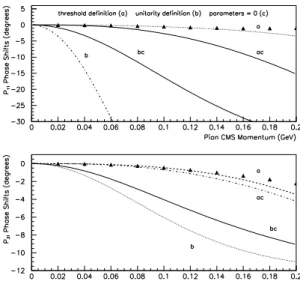
We observe, by inspection of the figures, that the results are sensitive to phase-shift definition. We repeated the com-parison with all model parameters kept equal to zero and we show the results in the same figures. We conclude that the results remain very sensitive with phase-shift definition.
262 Isabela P. Cavalcante and J. S´a Borges
Figure 1. S-wave phase-shifts (in degrees) as functions of pion lab momentum (in GeV); with phase-shift definitons (4) (awith adjusted parameters andacwith vanishing ones) and (2) (respec-tively,bandbc, as for the previous definition).
Figure 2.J= 1/2P-wave phase-shifts (in degrees) as functions of
pion lab momentum (in GeV); with phase-shift definitons (4) and (2); curve labels as in Fig. 1.
Figure 3.J= 3/2P-wave phase-shifts (in degrees) as functions of
pion lab momentum (in GeV); with phase-shift definitons (4) and (2); curve labels as in Fig. 1.
References
[1] S. Weinberg, Physica A96, 327 (1979).
[2] J. Gasser and H. Leutwyler, Nucl. Phys. B250, 465 (1985).
[3] For a review, see V. Bernard, N. Kaiser and U.-G. Meissner, Int. J. Mod. Phys. E4, 193 (1995).
[4] N. Fettes, U.-G. Meissner and S. Steininger, Nucl. Phys. A640 (1998) 199; M. Mojzis, Eur. Phys. J. C2, 181 (1998).
[5] SAID on-line program, R. A. Arndt, R. L. Workmannet al., see http://gwdac.phys.gwu.edu.
[6] V. Bernard, N. Kaiser and Ulf-G. Meissner, Int. J. Mod. Phys. E4, 193 (1995).
[7] V. Bernard, N. Kaiser and Ulf-G. Meissner, Nucl. Phys. B457, 147 (1995).
[8] J. Gasser and Ulf-G. Meissner, Phys. Lett. B258, 219 (1991).