Collider Tests for Neutrino Mass Generation in a
Supersymmetric World with
R
-Parity Violation
M. B. Magro
Instituto de F´ısica, Universidade de S˜ao Paulo, CP 66318, 05389-070, S˜ao Paulo-SP, Brazil.
Received on 18 February, 2003.
We summarize the low energy features of a supersymmetric class of models with bilinearR-parity violation. We analyze two cases where the supersymmetry breaking is mediated either by supergravity or by anomaly induced contributions to the soft parameters and compare both scenarios in the context of recent neutrino conversion data and collider physics. We show that both classes of models have a large potential to discoveries in collider experiments as well as in neutrino experiments.
1
Introduction
Supersymmetry (SUSY) is a promising candidate for physics beyond the Standard Model (SM). The search for supersymmetric partners of the SM particles constitutes an important goal of current high energy colliders like the Teva-tron, and future colliders like the LHC or a lineare+e− col-lider. However, no positive signal has been observed so far. Therefore, if supersymmetry is a symmetry of nature, it is an experimental fact that it must be broken. The three best known classes of models for supersymmetry breaking are gravity-mediated (SUGRA) [1], where SUSY is assumed to be broken in a hidden sector by fields which interact with the visible particles only via gravitational interactions; gauge-mediated [2], where SUSY is broken in a hidden sector and transmitted to the visible sector via SM gauge interactions of messenger particles; and anomaly-mediated supersymmetry breaking (AMSB) [3], which is based on the observation that the super-Weyl anomaly gives rise to loop contribution to sparticle masses. In this work we will concentrate our searches in SUGRA and AMSB prescriptions.
So far most of the effort in searching for supersymmetric signatures has been confined to the framework ofR-parity (RP) conserving realizations; however recent data on solar
and atmospheric neutrinos give a robust evidence for neu-trino conversions [4], probably the most profound discovery in particle physics in the recent years. It has been suggested long ago that neutrino masses and supersymmetry may be deeply tied together [5, 6]. Indeed, SUSY models exhibit-ingR-parity violation can lead to neutrino masses and mix-ings [6] in agreement with the current solar and atmospheric neutrino data.
The high statistics data by the SuperKamiokande collab-oration [4] has confirmed the deficit of atmospheric muon neutrinos, especially at small zenith angles, providing a strong hint for neutrino conversion. Although massless neu-trino conversions [7] can be sizeable in matter, it is fair to say that simplest interpretation of the present data is in terms of massive neutrino oscillations. The atmospheric data indicate
νµ toντflavor oscillations with maximal mixing [8], while
the solar data can be accounted for in terms of either small (SMA) and large (LMA) mixing MSW solutions [9], as well as through vacuum or just-so solutions [10]. A large mixing amongντ andνeis excluded both by the atmospheric data
and by reactor data on neutrino oscillations [11].
It has been recently shown [6] that one can explain the neutrino data through SUGRA models with bilinear R-parity violation (BRpV). The attainable range of the squared difference of the neutrino masses, ∆m2ij, i, j standing for
the neutrino flavors, favors the interpretation of the atmo-spheric neutrino data. It was possible to fix the atmoatmo-spheric angle and at the same time obey the CHOOZ constraint. For the solar angle, however, the results depend on whether one wants to work in a SUGRA motivated scenario or not. For the SUGRA scenario it was shown that thisR-parity vio-lating model allows only the small mixing and MSW so-lution (SMA), while for the minimal supersymmetric case (MSSM) also LMA and vacuum oscillation solutions are possible. Under the assumption of SUGRA conditions the atmospheric scale is calculable by the renormalization group evolution due to the non-zero bottom quark Yukawa cou-pling. In this case one predicts the small mixing angle (SMA) MSW solution to be the only viable solution to the solar neutrino problem. In contrast, for the general MSSM model, where the above assumptions are relaxed, on can implement a bi-maximal [12] neutrino mixing scheme, in which the solar neutrino problem is accounted for through large mixing angle solutions, either MSW or just-so.
sum-marize the main features of a new realization of R-parity violating SUSY models with anomaly-mediated supersym-metry braking.
We consider a supersymmetrical model that includes the following bilinear terms in the superpotential [15]
WBRpV =WM SSM−εabǫiLˆiHˆib , (1)
where the last term violatesR-parity. In order to reproduce the values of neutrino masses indicated by current data [16] we choose the parameter space where|ǫi| ≪ |µ|[6]. The
relevant bilinear terms in the soft supersymmetry breaking sector are
Vsof t = m2HuH
a∗
u Hua+m2HdH
a∗
d Hda+ML2iL˜
a∗
i L˜ai
−εab ³
BµHdaHub+BiǫiL˜aiHub ´
, (2)
where the terms proportional to Bi are the ones that
vio-lateR-parity. The explicitR-parity violating terms induce vacuum expectation values (vev)vi,i= 1,2,3for the
sneu-trinos, in addition to the two Higgs vev’svuandvd.
This paper is organized as follows. We summarize in Section 2 the main features of a bilinear R-parity violat-ing SUSY model with anomaly-mediated SUSY breakviolat-ing. This section also contains an overview of the supersymmet-ric spectrum in this model as well as the properties of the CP-odd, CP-even and charged scalar particles, concentrating on the mixing angles that arise from the introduction of the R-parity violating terms. Section 3 contains a phenomeno-logical study of the production of multileptons at the Fer-milab Tevatron within the framework of a simplest SUGRA model withoutR-parity. We look at the capabilities of the RUN II at the Tevatron probe bilinearR-parity violation. Fi-nally, in Section 4 we draw our final remarks on the models showed here.
2
The AMSB-BRpV Model
In AMSB models, the soft terms are fixed in a non– universal way at the unification scale which we assumed to be MGU T = 2.4×10¹⁶ GeV. We considered the
run-ning of the masses and couplings to the electroweak scale, assumed to be the top mass, using the one–loop renormal-ization group equations (RGE) [17]. In the evaluation of the gaugino masses, we included the next–to–leading or-der (NLO) corrections coming fromαs, the two–loop top
Yukawa contributions to the beta–functions, and threshold corrections enhanced by large logarithms; for details see [18]. The NLO corrections are especially important for the gaugino massM2, leading to a change in the wino mass by more than 20%.
One of the virtues of AMSB models is that theSU(2)⊗
U(1)symmetry is broken radiatively by the running of the RGE from the GUT scale to the weak one. This feature is preserved by our model since the one–loop RGE are not af-fected by the bilinearRP violating interactions [17]. In this
work, we made the simplest assumption thatR-parity is vi-olated only in the third generation. A full three generation
model in under preparation. Therefore, in our model, the electroweak symmetry is broken by the vacuum expectation values of the two Higgs doubletsHdandHu, and the neutral
component of the third left slepton doubletL3. We denotee these fields as
Hd =
µ√1 2[χ
0
d+vd+iϕ0d]
Hd−

,
Hu =
µ
Hu+
1 √
2[χ 0
u+vu+iϕ0u] 
,
e
L3 =
µ√1 2[˜ν
R
τ +v3+iν˜τi0]
˜
τ−

. (3)
The above vev’s vi can be obtained through the
min-imization conditions, or tadpole equations, which in the AMSB–BRpV model are
t0d = (m2Hd+µ2)vd−Bµvu−µǫ3v3+
1 8(g
2+g′2
)vd(v2d−vu2+v23),
t0u = (m2Hu+µ2+ǫ23)vu−Bµvd+B3ǫ3v3−
1 8(g
2+g′2
)vu(vd2−vu2+v23), t03 = (m2L3+ǫ
2
3)v3−µǫ3vd+B3ǫ3vu+
1 8(g
2+g′2
)v3(vd2−vu2+v32), (4)
at tree level. At the minimum we must imposet0
d = t0u =
t03= 0. In practice, the input parameters are the soft masses mHd, mHu, andmL3, the vev’svu,vd, and v3 (obtained frommZ,tanβ, andmντ), andǫ3. We then use the tadpole equations to determineB,B3, and|µ|.
One–loop corrections to the tadpole equations change the value of|µ|byO(20%), therefore, we also included the one–loop corrections due to third generation of quarks and squarks [15]:
ti=t0i + ˜Ti(Q), (5)
whereti, withi=d, u, are the renormalized tadpoles,t0i are
given in (4), andT˜i(Q)are the renormalized one–loop
con-tributions at the scaleQ. Here we neglected the one–loop corrections fort3 since we are only interested in the value ofµ.
Using the procedure underlined above, the whole mass spectrum can be calculated as a function of the input param-etersm0,m3/2,tanβ,sign(µ),ǫ3, andmντ. In Fig. 1, we show a scatter plot of the mass spectrum as a function of the scalar massm0form3/2 = 32TeV,tanβ = 5, andµ <0, varyingǫ3andmντ according to10−
5 < ǫ3 <1GeV and
10−6 < m
ντ <1eV. The widths of the scatter plots show that the spectrum exhibits a very small dependence on ǫ3 andmντ. Throughout this section we use this range forǫ3 andmντ in all figures.
We can see from this figure that, form0&170GeV, the LSP is the lightest neutralinoχ˜0
1 with the lightest chargino
˜
χ+1 almost degenerated with it, as inRP–conserving AMSB.
Nevertheless, the LSP is the lightest stauτ˜1−form0.170
RP–conserving AMSB, but perfectly possible in AMSB–
BRpV since the stau is unstable, decaying intoRP–violating
modes with sizeable branching ratios.
In our model, the CP–odd Higgs sector mixes with the imaginary part of the tau–sneutrino due to the bilinearRP
violating interactions. Writing the mass terms in the form
Vquadratic=
1 2[ϕ
0
d, ϕ0u,ν˜τi0]MP20
ϕ 0 d ϕ0 u ˜
νi0
τ
, (6)
we have
⌋
MP20 = (7)
m2(0)A s2β+µǫ3v3
vd m
2(0)
A sβcβ −µǫ3
m2(0)A sβcβ m2(0)A c2β−µǫ3 v3 vd c2 β s2 β + v2 3 v2 d c2 β s2 βm 2 ˜
ντ −µǫ3
cβ
sβ +
v3
vd
cβ
sβm 2 ˜
ντ
−µǫ3 −µǫ3cβ
sβ +
v3
vd
cβ
sβm 2 ˜
ντ m
2 ˜ ντ , ⌈ 0 200 400 600 800 1000
200 400 600 800 1000
τ1 ~ ντ ~ τ2 ~ H+ t1 ~ t2 ~
Χ1+ ~ (Χ
10) ~
Χ2+ ~
Χ20 ~
Χ30 ~
(Χ40) ~
A0
h0 (H0)
g ~
µ1(2) ~
m0 (GeV)
Mass (GeV)
Figure 1. Supersymmetric mass spectrum in AMSB–BRpV for m3/2 = 32TeV,tanβ = 5, andµ < 0. The values ofǫ3 and
mντ were randomly varied according to10−
5
< ǫ3 <1GeV and
10−6< mν
τ <1eV.
withm2ν˜τ =m 2(0) ˜
ντ +ǫ 2 3+18g
2
Zv23andgZ2 ≡g2+g′
2 . Here,
m2(0)A = Bµ
sβcβ
andm2(0)ν˜τ =ML23+
1 8g
2
Z(vd2−vu2) (8)
are respectively the CP–odd Higgs and sneutrino masses in
theRPconserving limit (ǫ3=v3= 0). In order to write this
mass matrix we have eliminatedm2
Hu,m 2
Hd, andB3using the tadpole equations (4). The mass matrix has an explic-itly vanishing eigenvalue, which corresponds to the neutral Goldstone boson.
This matrix can be diagonalized with a rotation
A0 G0 ˜ νodd τ =RP0
ϕ0 d ϕ0 u ˜
νi0
τ
, (9)
whereG0is the massless neutral Goldstone boson. Between the other two eigenstates, the one with largestν˜τi0
compo-nent is called CP–odd tau–sneutrinoν˜odd
τ and the remaining
state is called CP–odd HiggsA0.
As an intermediate step, it is convenient to make explicit the vanishing mass of the Goldstone boson with the rotation
b
RP0 =
sβ cβ 0
−cβr sβr −vv3dcβr
−v3
vdc 2
βr v
3
vdsβcβr r
, (10)
where
r=q 1
1 + v
2 3 v2 d c2 β , (11)
obtaining a rotated mass matrixRbP0M2
P0RbTP0 which has a column and a row of zeros, corresponding toG0. This pro-cedure simplifies the analysis since the remaining2×2mass matrix for(A0,ν˜τodd)is
⌋
c
MP20 =
m 2(0) A + v2 3 v2 d c4 β s2 βm 2 ˜
ντ +µǫ3
v3
vd
s2 β−c
2 β s2 β ³ v3 vd c2 β
sβm 2 ˜
ντ −µǫ3 1 sβ ´ r ³ v3 vd c2 β
sβm 2 ˜
ντ −µǫ3 1
sβ
´
r m2˜ντr12
-0.1 0 0.1 0.2 0.3 0.4 0.5 0.6 0.7 0.8
4 6 8 10 12 14 16 18 20
(a)
tanβ
sin
θodd
0 2 4 6 8 10 12
4 6 8 10 12 14 16 18 20
(b)
A
0
ν
~ τ
tanβ
m /m
Figure 2. (a) CP–odd Higgs–sneutrino mixing and (b) ratio be-tween the CP–odd Higgs mass and the sneutrino mass as a function oftanβform3/2= 32TeV,µ <0and100< m0<300GeV.
We quantify the mixing between the tau–sneutrino and the neutral Higgs bosons through
sin2θodd=|hν˜τodd|ϕ0ui|2+|hν˜τodd|ϕ0di|2. (13)
If we consider theRP violating interactions as a
perturba-tion, we can show that
sin2θodd≃ ³
v3
vdc 2
βm
2(0) ˜
ντ −µǫ3
´2
s2
β ³
m2(0)A −m2(0)ν˜τ ´ 2 +
v2 3 v2dc
2
β, (14)
indicating that this mixing can be large when the CP–odd Higgs bosonA0and the sneutrinoν˜τare approximately
de-generate.
Figure 2a displays the full sneutrino–Higgs mixing (13), with no approximations, as a function oftanβ form3/2 =
32 TeV, µ < 0 and 100 < m0 < 300 GeV. In a large fraction of the parameter space this mixing is small, since it is proportional to the BRpV parameters squared divided by MSSM mass parameters squared. However, it is possi-ble to find a region where the mixing is sizapossi-ble,e.g., for our choice of parameters this happens attanβ ≈ 15. As ex-pected, the region of large mixing is associated to near de-generate states, as we can see from Fig. 2b where we present
the ratio between the CP–odd Higgs massmAand the CP–
odd tau–sneutrino massmν˜odd
τ as a function oftanβ. The CP-even Higgs/sneutrino sector and the Charged Higgs/charged slepton sector have similar behavior and their R-parity violating mixing angles can be as large as in the CP-odd Higgs/sneutrino sector. For a more detailed analy-sis, see [17].
BRpV also provides a solution to the atmospheric and solar neutrino problems due to their mixing with neutrali-nos, which generates neutrino masses and mixing angles. It was shown in [6] that the atmospheric mass scale is ade-quately described by the tree level neutrino mass
mtreeν3 =
M1g2+M2g′2
4∆0
|Λ~|2, (15)
where∆0 is the determinant of the neutralino sub–matrix and~Λ = (Λ1,Λ2,Λ3), with
Λi=µvi+ǫivd, (16)
where the index i refers to the lepton family. The spec-trum generated is hierarchical, and obtained typically with
Λ1≪Λ2≈Λ3.
As it was mentioned before, for many purposes it is enough to work with RP violation only in the third
gen-eration. In this case, the atmospheric mass scale is well described by Eq. (15) with the replacement |~Λ|2 → Λ2
3. In Fig. , we plot the neutrino mass as a function ofΛ3 in AMSB–BRpV with the input parametersm3/2 = 32TeV, µ < 0, 5 < tanβ < 20,100 < m0 < 1000GeV and
10−5 < ǫ3 < 1 GeV. The quadratic dependence of the neutrino mass onΛ3is apparent in this figure and neutrino masses smaller than 1 eV occur for|Λ3|.0.6 GeV2. More-over, the stars correspond to the allowed neutrino masses when the tau–sneutrino is the LSP. In general the points with a small (large)m0are located in the inner (outer) regions of this scattered plot.
From Fig. 3, we can see that the attainable neutrino masses are consistent with the global three–neutrino oscil-lation data analysis in [19] that favors theντ → νµ
-0.2 0 0.2 0.4 0.6 0.8 1 1.2
-0.8 -0.6 -0.4 -0.2 0 0.2 0.4 0.6 0.8
ντ
Λ3 (GeV 2
)
m (eV)
Figure 3. Tau neutrino mass as a function ofΛ3for5<tanβ <
20,100< m0 <1000GeV,m3/2 = 32TeV andµ <0. The
stars correspond to the points where the tau-sneutrino is the LSP.
3
Multilepton searches at the
Teva-tron
We also have searched forR-parity violating signals at the Run II of the Fermilab Tevatron in a scenario where super-symmetry is broken through SUGRA models. The param-eter space of our SUGRA model, which exhibitsR-parity violation only in the third generation, via the addition of the bilinear terms (1) and (2), is
m0, m1/2, tanβ ,sign(µ), A0, ǫ3andmντ, (17) where the parameters m1/2 andm0 characterize the com-mon gaugino mass and scalar soft SUSY breaking masses at the unification scale, A0is the common trilinear term, and
tanβ is the ratio between the Higgs field vev’s. We charac-terize the BRpV sector by theǫ3term in the superpotential and the tau neutrino massmντ since it is convenient to trade the bilinear vevv3bymντ. In our simplified one-generation description considered here we fix, for definiteness, one rep-resentative value formντ = 0.1eV.
The presence of BRpV induces a mixing between the neutrinos and neutralinos, giving rise to theR-parity violat-ing decays of the LSP. In our model, the lightest neutralino presents leptonic decaysχ˜0
1 → νℓ+ℓ−, semi-leptonic ones
˜
χ0
1→νqq′orℓqq′, and the invisible modeχ˜01→ννν. The importance of the νbbdecay mode increases for large ǫ3, since the effective couplingλ′
333is proportional toǫ3after a suitable rotation. For a fixed value of ǫ3, the branching ratio intoνbbdecreases with increasingmντ, as can be seen from Fig. 4. In general, theχ˜10decays mainly intoτ qq′for largem0or smallǫ3, while its decays are dominated byνbb at smallm0and largeǫ3and/ortanβ.
10-1 1 10 102
10-6 10-5 10-4 10-3 10-2 10-1
mν (eV)
BR (
%
) tanβ = 3 M0 = 50 GeV
τud
ν3bb
-ν3l+l
-10-1 1 10 102
10-6 10-5 10-4 10-3 10-2 10-1
mν (eV)
BR (
%
)
tanβ = 35 M0 = 150 GeV
Figure 4. χ˜1
0branching ratios as a function ofmντ forA0 = 0,
µ >0, andǫ3= 10−3GeV. We fixedm1/2 = 175GeV in the case
oftanβ = 3andm1/2 = 125GeV in the case oftanβ = 35.
The solid lines denoteχ˜0
1 →ν3bb(squares);χ˜01→τ νℓℓ(circles);
andχ˜0
1→ν3ℓ+ℓ−(stars). The dashed lines denoteχ˜01→invisible
(squares);χ˜0
1→τ ud(circles); andχ˜ 0
1→ν3qq(stars).
InR-parity conserving scenarios, the trilepton produc-tion at the Tevatron proceeds viapp → χ˜02χ˜±1 withχ˜±1 → ℓνχ˜01,χ˜02→ℓ+ℓ−χ˜01, and the LSP (χ˜01) leaving the detector invisibly, producing then, 3 leptons in the final state. The main SM backgrounds for the trilepton production are dis-played in Table 3. In order to suppress these backgrounds, we have imposed the soft cuts SC2 defined in Ref. [21], which were tailored for scenarios containing soft signal lep-tons coming fromτ decays. In our analysis, the signal and backgrounds were generated using PYTHIA [22], except for theW Z⋆(γ⋆)which was computed using the complete
ma-trix elements. The trilepton cross section for the SM back-grounds after cuts are shown in Table 3.
un-changed. In fact, the R-parity violating decay modes are strongly suppressed when theRconserving ones have a few GeV of phase space. Assuming that gluinos and squarks are too heavy to be produced at the Tevatron, we considered the following processes: pp → ℓ˜ℓ˜⋆, ν˜ℓ,˜ χ˜0
iχ˜0j (i(j) = 1,2),
˜
χ+1χ˜−1, andχ˜0iχ˜±1 (i= 1,2).
Theχ˜10 decays can contain charged leptons, and there-fore, we should also analyze multilepton (≥ 4ℓ) produc-tion. In order to extract this signal, we applied the trilepton case cuts but accepting leptons with |η(ℓ)| < 3. We also required the presence of an additional isolated lepton with pT > 5GeV and demanded the missing transverse energy
to be larger than 20 GeV. The main SM backgrounds for this process arett,W Z, andZZ productions whose cross sections after cuts are shown in Table I.
Table I. Background cross sections in fb for the trilepton and multilepton signatures at the Tevatron Run II.
σ(fb) trilepton multilepton
WZ (Z→τ τ) 0.17 0.01
W∗Z∗,W∗γ→lll 0.12
-W∗Z∗,W∗γ→ll′l′
0.15
-tt 1.15 0.16
Z∗Z∗ 0.05 0.10
total 1.64 0.27
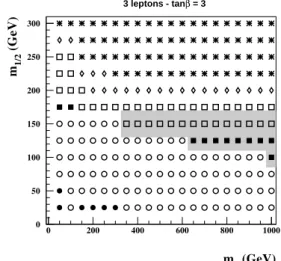
We investigated the regions of the m0 ⊗m1/2 plane where the trilepton and multilepton signals can be estab-lished at the Tevatron for integrated luminosities of 2 fb−1 and 25 fb−1and fixed values ofA0,tanβ,sign(µ),ǫ3, and mντ. We exhibit our results in them0⊗m1/2plane, denot-ing by black circles the theoretically excluded points, and by white circles the experimentally excluded regions by spar-ticle and Higgs boson searches at LEP2 [23]. The black squares represent points accessible to Tevatron experiments at5σlevel with 2 fb−1 of integrated luminosity, while the white squares are accessible with 25 fb−1. Points denoted by diamonds are accessible only at the 3σ level with 25 fb−1, while the stars correspond to the region not accessi-ble to the Tevatron. In the gray area, theχ˜10decay length is rather long and this can modify our results, indicating that these points should be subject to a more detailed analysis. For more information on the decay lenght behavior see the full analysis at [24]. In Fig. 5, we present the region of the m0⊗m1/2plane that can probed at the Tevatron using the trilepton signal forA0 = 0,tanβ = 3,µ >0,ǫ3 = 10−3 GeV, andmντ = 0.1eV. For these values of the parameters, the χ˜10 decays mainly intoτ qq′ and inside the detector for masses larger than 70 GeV.
It is interesting to compare our results presented in Fig. 5 with the ones in Ref. [21]. The presence of BRpV interac-tions reduces the Tevatron reach in the trilepton channel for small values ofm0. Here we have three competing effects: on the one side there are new contributions to the process, however, the decay of the neutralino into νbb produces a larger hadronic activity, destroying the lepton isolation, and
reducing the missingET. Besides that, the leptons from the
˜
χ10decay can give rise to additional isolated leptons which can contribute to the trilepton signal or suppress it due to the presence of more than three isolated leptons.
0 50 100 150 200 250 300
0 200 400 600 800 1000
m0 (GeV)
m1/2
(GeV)
3 leptons - tanβ = 3
Figure 5. Reach of Fermilab Tevatron Run II using the trilepton signal in them0⊗m1/2plane forA0 = 0,tanβ = 3,µ > 0,
ǫ3= 10−3GeV, andmντ = 0.1eV. The black circles are theoreti-cally excluded, while the white circles are experimentally excluded by sparticle and Higgs boson searches at LEP2. The black squares denote points accessible to Tevatron experiments at5σlevel with 2 fb−1of integrated luminosity, while the white squares are
accessi-ble with 25 fb−1. Points denoted by diamonds are accessible at the
3σlevel with 25 fb−1, while the stars correspond to the region not
accessible to Tevatron. The grey area indicates the region where the neutralino has a large decay length, indicating that the results should be carefully revised.
0 50 100 150 200 250 300 350
0 200 400 600 800 1000
m0 (GeV)
m1/2
(GeV)
4 or + leptons - tanβ = 3
Figure 6. Reach of Fermilab Tevatron Run II in the 4 or more lep-ton channel. All parameters and conventions were chosen as in Fig. 5.
0 50 100 150 200 250 300 350
0 200 400 600 800 1000
m0 (GeV)
m1/2
(GeV)
combined results - tanβ = 3
Figure 7. Reach of Fermilab Tevatron Run II combining trilep-ton and multileptrilep-ton results. All parameters and conventions were chosen as in Fig. 5.
Finally, Fig. 8 displays the Tevatron reach for the com-bined channels for the caseA0 = 0,tanβ = 35,µ > 0, ǫ3 = 10−3GeV andm
ντ = 0.1eV. For this choice of pa-rameters, the mainχ˜0
1decay mode isτ qq′, however, there is a sizeable contribution of theνbbchannel at smallm0. As expected, the SUSY reach decreases at smallm0as we in-creasetanβ, however there is a slight gain at largem0. We also can see that the Tevatron reach diminishes whentanβ is increased. Again, the gray area in the Fig. 8 shows the region where the LSP decay is rather long. We can see that for tanβ = 35this region is smaller and we should take with care the results in the region with m1/2 . 140GeV andm0 &190GeV, where the lightest neutralino is lighter than∼60GeV.
0 50 100 150 200 250 300 350
0 200 400 600 800 1000
m0 (GeV)
m1/2
(GeV)
combined results - tanβ = 35
Figure 8. Reach of Fermilab Tevatron Run II combining trilep-ton and multileptrilep-ton results forA0 = 0, tanβ = 35, µ > 0,
ǫ3 = 10−3 GeV andmντ = 0.1eV. The conventions are as in Fig. 5.
4
Conclusions
We have shown in the previous sections that our model ex-hibiting Anomaly Mediated Supersymmetry Breaking and BilinearRPViolation is phenomenologically viable. In
par-ticular, the inclusion of BRpV generates neutrino masses and mixings in a natural way. Moreover, theRP breaking
terms give rise to mixings between the Higgs bosons and the sleptons, which can be rather large despite the smallness of the parameters needed to generate realistic neutrino masses. These large mixings occur in regions of the parameter space where two states are nearly degenerate.
TheRP violating interactions render the LSP unstable
since it can decay via its mixing with the SM particles (lep-tons or scalars). Therefore, the constraints on the LSP are re-laxed and forbidden regions of parameter space become al-lowed, where scalar particles like staus or sneutrinos are the LSP. Furthermore, the large mixing between Higgs bosons and sleptons has the potential to change the decays of these particles. These facts have a profound impact in the phe-nomenology of the model, changing drastically the signals at colliders [25].
We also have studied the trilepton and multilepton reach of the Tevatron in the simplest supergravity model where an effective bilinear term in the superpotential parametrizes the explicit breaking ofR-parity. We have then shown how the presence of BRpV interactions leads to a suppression of the trilepton signal for small values ofm0 and/or large values ofǫ3due to theχ˜10decay into orτ qq′orνbb. However, the
˜
χ1
0decays lead to a drastically extended reach at largem0, compensating the large hadronic decay ofχ˜0
We demonstrated that combining the trilepton and multi-lepton searches increases the Tevatron Run II sensitivity for a large range of SUGRA andR-parity breaking parameters. It is interesting to notice that we can search for SUSY sig-nals in the lowm0 region by looking for events exhibiting bbbℓor bbbin association with missing transverse momen-tum [26]. Moreover, BRpV interactions lead to the produc-tion of extra τ leptons, therefore, it is possible to further increase the Tevatron reach for SUSY by allowingℓ = τ in our analyses since it is possible to detectτ pairs at the Tevatron [27].
In all of the above we have focused on the worst-case scenario, where we have only one generation and this is cho-sen to be the third. Our results are therefore robust, in the sense that the inclusion of additional generations would im-ply new sources of leptons, especially muons.
We would like to thank Fundac¸˜ao de Amparo `a Pesquisa do Estado de S˜ao Paulo (FAPESP) for supporting this work.
References
[1] A. Cahmseddine, R. Arnowitt, and P. Nath, Phys. Rev. Lett.
49, 970 (1982); R. Barbieri, S. Ferrara, and C. Savoy, Phys. Lett. B119, 343 (1982); L. J. Hall, J. Lykken, and S. Wein-berg, Phys. Rev. D27, 2359 (1983).
[2] M. Dine and A. Nelson, Phys. Rev. D48, 1277 (1993); M. Dine, A. Nelson, and Y. Shirman, Phys. Rev. D51, 1362 (1995); M. Dine, A. Nelson, Y. Nir, and Y. Shirman, Phys. Rev. D53, 2658 (1996).
[3] L. Randall and R. Sundrum, Nucl. Phys. B557, 79 (1999); G. Giudice, M. Luty, H. Murayama, and R. Ratazzi, JHEP9812, 027 (1998).
[4] Q. R. Ahmadet al., [SNO Collaboration], Phys. Rev. Lett.89, 011302 (2002); S. Fukudaet al., [Super-Kamiokande Collab-oration], Phys. Lett. B539, 179 (2002); Phys. Rev. Lett.81, 1562 (1998).
[5] C. S. Aulakh and R. N. Mohapatra, Phys. Lett. B119, 13 (1982); L. J. Hall and M. Suzuki, Nucl. Phys. B231, 41 (1984); G. G. Ross and J. W. Valle, Phys. Lett. B151, 375 (1985); J. R. Elliset al., Phys. Lett. B150, 142 (1985).
[6] M. Hirschet al., Phys. Rev. D62, 113008 (2000), [Erratum-ibid. D65, 119901 (2002)]; J. C. Rom˜aoet al., Phys. Rev. D61, 071703 (2000).
[7] J. W. F. Valle, Phys. Lett. B199, 432 (1987).
[8] N. Fornengo, M. C. Gonz´alez-Garc´ıa, and J. W. F. Valle, Nucl. Phys. B580, 58 (2000); M. C. Gonz´alez-Garc´ıa, H.
Nunokawa, O. L. Perez, and J. W. F. Valle, Nucl. Phys. B543, 3 (1999); R. Foot, R. R. Volkas, and O. Yasuda, Phys. Rev. D58, 013006 (1998).
[9] M. C. Gonz´alez-Garc´ıa, P. C. de Holanda, C. Pe˜na-Garay, and J. W. F. Valle, Nucl. Phys. B573, 3 (2000); S. Goswami, D. Majumdar, and A. Raychaudhuri, Phys. Rev. D63, 013003 (2001); J. N. Bahcall, P. I. Kratev, and A. Y. Smirnov, Phys. Rev. D62, 093004 (2000); G. L. Fogli, E. Lisi, D. Montanino, and A. Palazzo, Phys. Rev. D61, 073009 (2000).
[10] V. Barger and K. Whisnant, Phys. Rev. D59, 093007 (1999).
[11] M. Apollonioet al., Phys. Lett. B466, 415 (1999); F. Boehm
et al., Phys. Rev. Lett.84, 3764 (2000).
[12] V. Barger, S. Pakvasa, T. Weiler, and K. Whisnant, Phys. Lett. B437, 107 (1998); A. J. Baltz, A. S. Goldhaber, and M. Gold-haber, Phys. Rev. Lett.81, 5730 (1998).
[13] A. Bartlet al., Nucl. Phys. B600, 39 (2001), and references therein.
[14] W. Porod, M. Hirsch, J. Rom˜ao, and J. W. F. Valle, Phys. Rev. D63, 115004 (2001), and references therein.
[15] M. A. D´ıaz, J. C. Rom˜ao, and J. W. Valle, Nucl. Phys. B524, 23 (1998).
[16] M. Maltoni, T. Scwetz, M. A. Tortola, and J. W. F. Valle,
pre-printhep-ph/0207227.
[17] F. de Campos, M. A. D´ıaz, O. J. P. ´Eboli, M. B. Magro, and P. G. Mercadante, Nucl. Phys. B623, 47 (2002).
[18] T. Gherghetta, G. F. Giudice, and J. D. Wells, Nucl. Phys. B559, 27 (1999).
[19] M. C. Gonz´alez-Garc´ıa, M. Maltoni, C. Pe˜na-Garay, and J. W. F. Valle, Phys. Rev. D63, 033005 (2001).
[20] A. Santamaria and J. W. F. Valle, Phys. Lett. B195, 423 (1987); Phys. Rev. Lett.60, 397 (1988); Phys. Rev. D39, 1780 (1989).
[21] H. Baer, M. Drees, F. Paige, P. Quintana, and X. Tata, Phys. Rev. D61, 095007 (2000).
[22] T. S¨ostrand, Computer Phys. Cammun.82, 74 (1994).
[23] K. Hagiwaraet al., Phys. Rev. D66, 010001 (2002).
[24] M. B. Magroet al., in preparation.
[25] F. de Camposet al., in preparation.
[26] V. D. Barger, T. Han, S. Hesselbach, and D. Marfatia, Phys. Lett. B538, 346 (2002).