J. Braz. Chem. Soc., Vol. 18, No. 8, 1571-1574, 2007. Printed in Brazil - ©2007 Sociedade Brasileira de Química 0103 - 5053 $6.00+0.00
Short RShort RShort RShort RShort R
eporteporteporteporteport
*e-mail: [email protected]
A Mild and Efficient Method for the Preparation of 3-(2’-Aminoaryl)pyrazoles
from 4-Chloroquinolines
Julio C. Borges,a Cesar D. de Oliveira,a Luiz C. da Silva Pinheiro,a Roberta K. F. Marra,a
Misbahul Ain Khan,a,c James L. Wardell,b Solange M. S. V. Wardelld and Alice M. R. Bernardino*,a
a
Instituto de Química, Universidade Federal Fluminense, Campus do Valonguinho, 24020-141 Niterói-RJ, Brazil
b
Chemistry Department, University of Aberdeen, Meston Walk, Old Aberdeen, AB243EU, Scotland
c
Chemistry Department, The Islamia University of Bahawalpur, Bahawalpur, Pakistan
d
Fundação Oswaldo Cruz, Instituto de Tecnologia em Fármacos, Farmanguinhos, 21041-250 Rio de Janeiro-RJ, Brazil
Um método mais suave e eficiente é descrito para a síntese de 3-(2’-aminoaril)pirazóis, a partir das reações de 4-cloroquinolinas com hidrazina em excelentes rendimentos. Estas reações de abertura de anel heterocíclico ocorrem em condições mais suaves do que as descritas anteriormente.
We describe a mild and efficient method for the formation of 3-(2’-aminoaryl)pyrazoles in excellent yields from reactions of 4-chloroquinolines with hydrazine. These heterocyclic ring opening reactions occur under much milder conditions then previously described.
Keywords: pyrazoles, 4-chloroquinolines, X-ray diffraction
Introduction
Pyrazoles and their derivatives are widely used as
pharmaceutical1-5 and agrochemical agents6 and
conse-quently a large number of synthetic routes to pyrazoles has
been reported.7-13 However, there is still great interest in
finding milder and more efficient methods to these valuable compounds. Amino groups undergo various reactions, and as such are excellent and general starting points for the
development of chemical libraries.14 In particular, 3-(2’
-aminoaryl)pyrazoles (1) are useful precursors of more
elaborate pyrazolic molecules.15 A preparation of
3-(2‘-aminophenyl)pyrazoles was first described by Alberti15 from
4-hydroxyquinolines. 4-Chloroquinolines16,17 on treatment
with substituted hydrazines gave 1-substituted-3-(2-aminophenyl)pyrazoles. All these reactions occurred under
drastic conditions using autoclave or sealed tubes.15,16 Later,
other workers reported ring opening reactions of
4-hydroxyquinolines13 and the preparation of the compound
(2‘-aminophenyl)pyrazole by the reduction reaction of
3-(2-nitrophenyl)pyrazole.18
Our research group has developed a route to 3-(2’-aminoaryl)pyrazoles under mild conditions from
4-chloroquinolines (2) and hydrazine in a one-pot process.
Results and Discussion
The 4-chloroquinolines19 (3) are readily prepared from
4-hydroxyquinolines (2) and can be stored for long periods.
The 4-hydroxyquinolines,20 in turn, can be readily made
one-1572 A Mild and Efficient Method for the Preparation of 3-(2’-Aminoaryl)pyrazoles J. Braz. Chem. Soc.
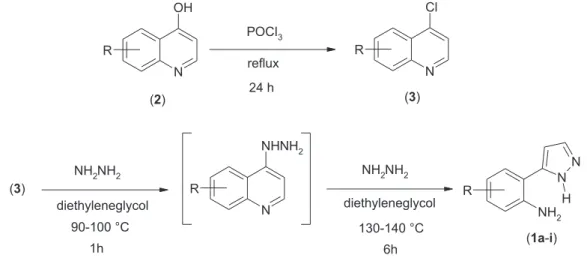
pot synthesis of (1a-i) involves reactions of
4-chloro-quinolines with an excess of hydrazine in diethyleneglycol initally at 90-100 ºC for one hour. Substitutions of the
chlorine atom in 3 by hydrazine occur in this temperature
range to generate intermediate 4-hydrazinoquinolines, which on raising the temperature to 130-140 ºC, react further over a period of six hours to afford the desired
products 1a-i, see Scheme1.
As shown in Table 1, isolated yields range from good to excellent, with electron withdrawing substituents resulting in the higher yields and electron donating substituents resulting in lower yields as expected for a nucleophilic aromatic substitution reaction.
Products were generally identified by 1H NMR, 13C
NMR, FT-IR spectroscopies, mass spectrometry and elementary analysis. Specifically, confirmation of the
structure of 1a was gained by X-ray diffraction.23,24 Atom
arrangements are shown in Figure 1.
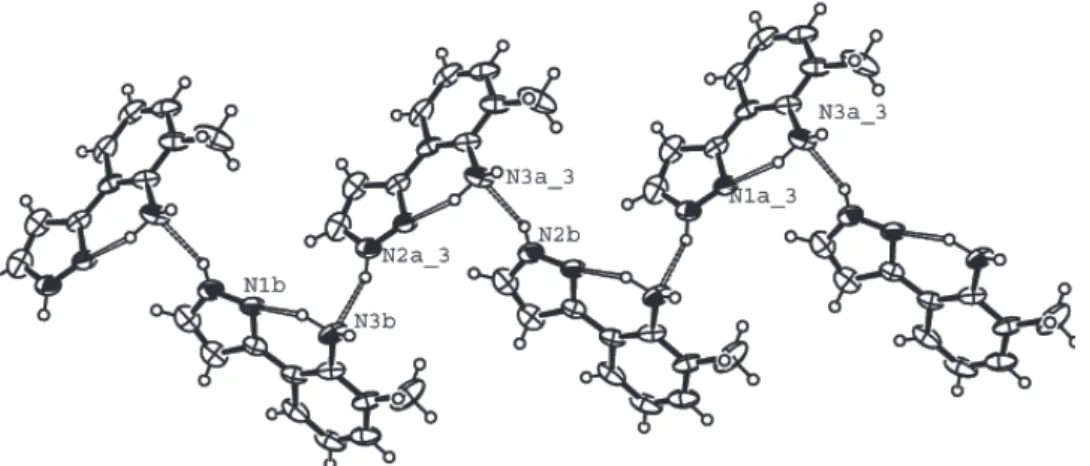
Overall the molecules are nearly planar with the angles between the best planes of the two rings in the order of 12º and torsional angles ranging from 0.06 (0.40) to 12.34 (0.45)º. Intramolecular N3X-HAX…N1X (X=A or B)
hydrogen bonds help to cement the planar arrangements of the two molecules. Intermolecular N2A-H2A…N3B and N2B-H2B…N3A hydrogen bonds link the two independent molecules, alternatively, into molA…molB…molA chains (Figure 2).
Experimental
Preparation of the compounds 3-(2’-aminoaryl) pyrazoles: 0.8 g (0.004 mol) of the 4-chloroquinolines and 2.0 mL of hydrazine was stirred in 6.0 mL of diethyleneglycol at 90-100 ºC for 1 hour. Later the temperature was raised to 130-140 ºC for 6 hours. Finaly, the mixture was dropped in a beaker with ice and water and the crystals formed were filtered.
3-(2’-Amino-3’-methylphenyl)pyrazole, 1a; R = 3’-CH3
mp 111 ºC; FT-IR (KBr) νmax/cm-1: 3400, 3100, 1610,
1485, 765; 1H NMR (CDCl
3, δ in ppm) H4 6.55 (d; 2.4 Hz)
H5 7.48 (d; 2.4 Hz); H4’ 7.02 (dd; 7.5 and 2.4 Hz); H5’ 6.70
(t; 7.5 Hz); H6’ 7.35 (dd; 7.8 and 2.1 Hz); NH2/NH 5.47 (s);
CH3 2.16 (s). 13C NMR (CDCl
3, δ in ppm) C3 150.7; C4
103.7; C5 130.5; C1’ 123.1; C2’ 142.8; C3’ 117.4; C4’ 126.7;
C5’ 116.7; C6’ 129.8; CH3 17.8; MS: m/z 173.0949 (M+,
100%). Anal. Calc. for C10H11N3 (%): C 69.34; H 6.40; N
24.26. Found (%): C 69.16; H 6.21; N 23.98.
Table 1. Yields of compounds 1a-i
Compoundb, c R Yield / (%)a
1a 3’-CH3 71
1b 5’-CH3 65
1c 3’-Cl 91
1d 5’-Cl 80
1e 3’-F 94
1f 5’-F 87
1gd 5’-Br 80
1h 3’-OCH3 70
1i 4’-OCH3 67
aIsolated yields. bIdentified by 1H NMR, 13C NMR, IR-FT, mass spectros-copy and elementary analysis. cAll compounds were recrystalized in etha-nol-H2O (1:1). dObtained as a white solid with mp of 83 ºC, in reference 13 as a brown oil.
Scheme 1.
1573 Borges et al.
Vol. 18, No. 8, 2007
3-(2’-Amino-5’-methylphenyl)pyrazole, 1b; R = 5’-CH3
mp 87 ºC; FT-IR (KBr) νmax / cm-1: 3400, 3190, 1620,
1590, 1510, 1450, 770; 1H NMR (CDCl
3, δ in ppm) H4 6.61
(s); H5 7.57 (s); H3’ 6.69 (d; 8.1 Hz); H4’ 6.94 (d; 7.2 Hz);
H6’ 7.30 (s); CH3 2.27 (s); 13C NMR (CDCl
3, δ in ppm) C3
151.0; C4 103.2; C5 128.8; C1’ 116.8; C2’ 141.9; C3’ 116.6;
C4’ 129.2; C5’ 126.8; C6’ 128.7; CH3 20.3;MS: m/z 173.0876
(M+, 100%). Anal. Calc. for C
10H11N3 (%): C 69.34; H 6.40
N 24.26. Found (%): C 69.23; H 6.55; N 24.01.
3-(2’-Amino-3’-chlorophenyl)pyrazole, 1c; R = 3’-Cl
mp 94 ºC; FT-IR (KBr) νmax / cm-1: 3420, 3080, 1610,
1585, 1490, 1425, 740; 1H NMR (CDCl
3, δ in ppm) H4
6.67 (d; 2.4 Hz); H5 7.62 (d; 2.4 Hz); H4’ 7.24 (dd; 7.8 and 1.5 Hz); H5’ 6.68 (t; 7.8 Hz); H6’ 7.45 (dd; 1.5 and
7.8 Hz); 13C NMR (CDCl
3, δ in ppm) C3 151.2; C4 103.5;
C5 129.4; C1’ 120.0; C2’ 141.1; C3’ 117.5; C4’ 128.4;
C5’ 117.0; C6’ 126.8; MS: m/z 193.0375 (M+, 100%).
Anal. Calc. for C9H8N3Cl (%): C 55.83; H 4.16; N 21.70.
Found (%): C 55.53; H 4.19; N 21.44.
3-(2’-Amino-5’-chlorophenyl)pyrazole, 1d; R = 5’-Cl
mp 58 ºC; FT-IR (KBr) νmax / cm-1: 3400, 3050, 1611,
1487, 765; 1H NMR (CDCl
3, δ in ppm) H4 6.63 (d; 2.4 Hz);
H5 7.60 (d; 2.4 Hz); H3’ 6.68 (d; 8.7 Hz); H4’ 7.05 (dd; 8.4
and 2.4 Hz); H6’ 7.48 (d; 2.4 Hz); 13C NMR (CDCl
3, δ in
ppm) C3 150.3; C4 103.3; C5 129.6; C1’ 117.7; C2’ 143.1;
C3’ 117.5; C4’ 128.2; C5’ 121.9; 127.8; MS: m/z 193.0396
(M+, 100%). Anal. Calc. for C
9H8ClN3 (%): C 55.83; H 4.16;
N 21.70. Found (%): C 55.66; H 4.29; N 21.79.
3-(2’-Amino-3’-fluorophenyl)pyrazole, 1e; R = 3’-F
mp 87 ºC; FT-IR (KBr) νmax / cm-1: 3420, 3160, 1615,
1470, 1245, 755; 1H NMR (CDCl
3, δ in ppm) H4 6.65 (d;
2.1 Hz); H5 7.60 (d; 2.1 Hz); H4’ 6.91-6.99 (m); H5’ 6.67
(t; 8.4 Hz); H6’ 7.31 (7.8 Hz); NH2/NH 5.47 (s); 13C NMR
(CDCl3, δ in ppm) C3 150.8; C4 103.6; C5 129.5; C1’
118.4; C2’ 133.3 (d; 13.6 Hz); C3’ 152.1 (d; 236.6 Hz); C4’ 113.7 (d; 18.4 Hz); C5’ 116.4 (d; 7.8 Hz); C6’ 123.3;
MS: m/z 177.0623 (M+, 100%). Anal. Calc. for C
9H8FN3
(%): C 61.01; H 4.55; N 23.72. Found (%): C 61.15; H 4.58; N 23.81.
3-(2’-Amino-5’-fluorophenyl)pyrazole, 1f; R = 5’-F
mp 92 ºC; FT-IR (KBr) νmax / cm-1: 3400, 3040, 1610,
1467, 810, 725; 1H NMR (CDCl
3, δ in ppm) H4 6.61 (d;
2.4 Hz); H5 7.60 (d; 2.4 Hz); H3’ 6.70 (m); H4’ 6.80 (m);
H6’ 7.20 (m); 13C NMR (CDCl
3, δ in ppm) C3 150.3; C4
103.4; C5 129.7; C1’ 117.5; C2’ 140.2; C3’ 117.5 (d; 8.5 Hz); C4’ 114.2 (d; 23.6 Hz); C5’ 155.6 (d; 233,2 Hz); C6’
115.1 (d; 22.6 Hz); MS: m/z 177.0678 (M+, 100%). Anal.
Calc. for C9H8FN3 (%): C 61.01; H 4.55; N 23.72. Found
(%): C 61.09; H 4.58; N 23.77.
3-(2’-Amino-5’-bromophenyl)pyrazole, 1g; R = 5’-Br
mp 83 ºC; FT-IR (KBr) νmax / cm-1: 3400, 3000,
1610, 1462, 735; 1H NMR (CDCl
3, δ in ppm) H4 6.64
(s); H5 7.60 (s); H3’ 6.64 (d; 7.5 Hz); H4’ 7.18 (dd;
8.4 and 2.1 Hz); H6’ 7.65 (d; 2,1 Hz); 13C NMR
(CDCl3, δ in ppm) C3 150.7; C4 103.7; C5 128.8; C1’
109.4; C2’ 143.9; C3’ 118.8; C4’ 131.1; C5’ 118.8;
C6’ 131.0; MS: m/z 238.0811 (M+, 100%). Anal. Calc.
for C9H8BrN3 (%): C 45.40; H 3.39; N 17.65. Found
(%): C 45.37; H 3.36; N 17.61.
3-(2’-Amino-3’-methoxyphenyl)pyrazole, 1h; R = 3’-OCH3
mp 111 ºC; FT-IR (KBr) νmax / cm-1: 3410, 3100, 2980,
1590, 1495, 1220, 725; 1H NMR (CDCl
3, δ in ppm) H4
6.59 (d; 2.3 Hz); H5 7.53 (d; 2.3 Hz); OCH3 3.88 (s);
NH2/NH 6.41 (s). 13C NMR (CDCl
3, δ in ppm) C3 150.8;
C4 103.5; C5 130.2; C1’ 120.6; C2’ 147.7; C3’ 116.6; C4’
1574 A Mild and Efficient Method for the Preparation of 3-(2’-Aminoaryl)pyrazoles J. Braz. Chem. Soc.
135.0; C5’ 116.4; C6’ 135.1; OCH3 55.7; MS: m/z 189.2120
(M+, 100%). Anal. Calc. for C
10H11N3O (%): C 63.48; H
5.86; N 22.21. Found (%): C 63.21; H 6.02; N 22.48.
3-(2’-Amino-4’-methoxyphenyl)pyrazole, 1i; R = 4’-OCH3
mp 82 ºC; FT-IR (KBr) νmax / cm-1: 3410, 3090, 1610,
1510, 1210, 830, 770; 1H NMR (CDCl
3, δ in ppm) H4
6.45 (d; 2.3 Hz); H5 7.43 (d; 2.3 Hz); OCH3 3.70 (s);
NH2/NH 6.39 (s). 13C NMR (CDCl
3, δ in ppm) C3 150.7;
C4 103.4; C5 129.9; C1’ 115.2; C2’ 145.6; C3’ 117.6; C4’
129.6; C5’ 134.1; C6’ 116.0; OCH3 55.0; MS: m/z 189.2145
(M+, 100%). Anal. Calc. for C
10H11N3O (%): C 63.48; H
5.86; N 22.21. Found (%): C 63.46; H 5.87; N 22.35.
Conclusions
In conclusion we would like to reiterate that the method is a simple and efficient one, not requiring special equipment or harsh conditions. The respectable yields in these reactions also make it a viable method for the
synthesis of 3-(2-amino-aryl/hetaryl)pyrazoles.Following
this procedure, eight new compounds (1a-f, 1h-i) were
thus prepared.
Acknowledgments
We thank the Conselho Nacional de Desenvolvimento Científico e Tecnológico (CNPq), Coordenação de Aperfeiçoamento de Pessoal Docente (CAPES) and the Fundação de Amparo à Pesquisa do Estado do Rio de Janeiro (FAPERJ) for the financial support. We also thank the EPSRC X-ray crystallographic services based at the University of Southampton, England for the data collection.
References
1. Pinto, D. J. P.; Orwat, M. J.; Wang, S.; Fevig, J. M.; Quan, M. L.; Amparo, E.; Cacciola, J.; Rossi, K. A.; Alexander, R. S.; Smallwood, A. M.; Luettgen, J. M.; Liang, L.; Aungust, B. J.; Wright, M. R.; Knabb, R. M.; Wong, P. C.; Wexler, R. R.; Lam, P. Y. S.; J. Med. Chem. 2001, 44, 566.
2. Abdon, I. M.; Saleh, A. M.; Zodhi, H. F.; Molecules 2004, 9, 109.
3. Wong, P. C.; Pinto, D. J. P.; Knabb, R. M.; Cardiovasc. Drug. Rev. 2002, 20, 137.
4. Straub, A.; Stasch, J.; Alonso-Alija, C.; Benet-Buchholz, J.; Ducke, B.; Feurer, A.; Furstner, C.; Bioorg. Med. Chem. 2001, 11, 781.
5. Balbi, A.; Anzaldi, M.; Mazzei, M.; Miele, M.; Bertolotto, M.; Ottonellob, L.; Dallegrib, F.; Bioorg. Med. Chem. 2006, 14, 5152.
6. Ge, M.; Cline, E.; Yang, L.; Tetrahedron Lett. 2006, 47, 5797. 7. Sakya, S. M.; Rast, B.; Tetrahedron Lett. 2003, 44, 7629. 8. Martins, M. A. P.; Cunico, W.; Siqueira, G. M. ; Leidens, V. L.;
Zanatta, N.; Bonacorso, H. G.; Flores, A. F. C.; J. Braz. Chem. Soc. 2005, 16, 275.
9. Bonacorso, H. G.; Oliveira, M. R.; Costa, M. P.; Silva, L. B.; Zanatta, N.; Martins, M. A. B.; Flores, A. F. C.; J. Braz. Chem. Soc. 2005, 16, 868.
10. Martins, M. A. B.; Beck, P.; Machado, P.; Brondani, S.; Moura, S.; Zanatta, N.; Bonacorso, H. G. B.; Flores, A. F. C.; J. Braz. Chem. Soc. 2006, 17, 408.
11. Selvis, S.; Perumal, P. T.; J. Heterocycl. Chem. 2002, 39, 1129. 12. Atlan, V.; Buron, C.; Kaim, L. E.; Synlett 2000, 489. 13. McQuaid, A. L.; Smith, E. C. R.; South, K. K.; Mitch, C. H.;
Schoepp, D. D.; True, R. A.; Calligaro, D. O.; O’Malley, P. J.; Lodge, D.; Ornstein, P. L.; J. Med. Chem. 1992, 35, 3319. 14. Qu, G.; Han, S.; Zhang, Z.; Geng, M.; Xue, F.; J. Braz. Chem.
Soc. 2006, 17, 915.
15. Alberti, C.; Gazz. Chem. Ital. 1957, 87, 772.
16. Bowie, R. A.; Wright, B.; J. Chem. Soc. Perkin Trans. 1 1972, 1109.
17. McQuaid, A. L.; Mitch, C. H.; Ornstein, P. L.; Schoepp, D. D.; Smith, E. C. R.; US Pat. 5,153,196, 1992.
18. Player, M. R.; Baindur, N.; Brandt, B.; Chadha, N.; Patch, R. J.; Asgari, D.; Georgiadis, T.; US Pat. 2005113566, 2005. 19. Schaefer, J. P.; Kulkarni, K. S.; Costin, R.; Higgins, J.; Honig,
L. M.; J. Heterocycl. Chem. 1970, 7, 607.
20. Augui, H; Komatsu, T.; Nakagome, T.; J. Heterocycl. Chem. 1975, 12, 557.
21. Price, C. C.; Roberts, R. M.; J. Am. Chem. Soc. 1946, 68, 1204. 22. Walsh, C. T.; Wright, T.; Chem. Rev. 2005, 105, 562. 23. Crystal data: C10H11N3, colourless, M = 173.22, T = 120 (2)K,
monoclinic, space group c2, a = 25.9750(3), b =9.5820(6), c = 7.8299(7)Å, β = 107.541(3)o, V =1858.2(2) Å3, Z = 8, D
x = 1.238 gcm-3, monochromated Mo-Kα radiation, λ = 0.71073 Å, µ = 0.078 mm-1.
24. Data collection. The unit cell and intensity data were collected on a Bruker-Nonius diffractometer. 5454 reflections were collected, of which 2925 [R(int) = 0.0489]were independent reflections, with the 2θ range for data collection of 2.28 to 24.99º. 25. Structure Solution and Refinement: Structure solution and refinement were achieved using SHELX97 and SHELXL97. Full matrix least squares on F2 of data converged to R1=0.0437, wR2=0.0841 [I>2σI]. Atomic coordinates, bond lengths, angles and thermal parameters have been deposited at the Cambridge Crystallographic Data Center, deposition number CCDC 635098. 26. Sheldrick, G.M.; SHELXS97 and SHELXL97, University of
Göttingen: Germany, 1997.