Printed in Brazil - ©2007 Sociedade Brasileira de Química 0103 - 5053 $6.00+0.00
ArticleArticleArticleArticleArticle
*e-mail: [email protected]; [email protected]
A New Environmental Friendly Clay Catalyst for One-pot Coiodination and
Epoxidation of Alkenes
Karen S.M. Corrêa,a Rafael B. Bernini,b Marcio C.S. de Mattos,*,b Mônica R.M.P. de Aguiar*,a and Alcides W.S. Guarinoc
a
Instituto de Química, Universidade do Estado do Rio de Janeiro, 20590-900 Rio de Janeiro-RJ, Brazil
b
Instituto de Química, Universidade Federal do Rio de Janeiro, CP 68545, 21945-970 Rio de Janeiro-RJ, Brazil
c
Escola de Ciências Biológicas, Universidade Federal do Estado do Rio de Janeiro, 22290-240 Rio de Janeiro-RJ, Brazil
A argila comercial brasileira Bentonit Brasgel® foi caracterizada por análises química e
textural, DRX e RMN no estado sólido de 27Al and 29Si, que indicaram a presença de quartzo-α
e esmectita como argilo-minerais. Essa argila se mostrou um catalisador eficiente para a conversão de alquenos nos respectivos epóxidos através da reação com iodo/água seguida de adição de KOH em hexano in situ (80-91 %). Resultados similares foram obtidos usando-se Bentonit Brasgel™ intercalada com Ag(I).
The commercial Brazilian clay Bentonit Brasgel™ was characterized by chemical and textural analyses, XRD, and 27Al and 29Si MAS-NMR, that indicated the presence of α-quartz and smectite
as clay-minerals. This natural clay proved to be an efficient catalyst for the conversion of alkenes into epoxides by the reaction with iodine/water followed by in situ addition of KOH in hexane (80-91 % yield). Similar results were obtained with Bentonit Brasgel™ intercalated with Ag(I).
Keywords: epoxide, coiodination, iodohydrin, clay, alkenes
Introduction
Nowadays, the search for cleaner process is one of the major challenges in modern chemical industries.1 Moreover, the high versatility, low-cost and gain in yield/ selectivity turn clays very attractive catalysts in the green chemistry point of view as they are reusable and present minimal environmental impact.2 Within this context, the use of clays and clay-minerals in synthetic organic chemistry has increased enormously in the last years.3
Epoxides are useful compounds in synthetic organic chemistry3 and the interest for these valuable compounds has increased with the discovery of some biological activities related to the oxirane ring.5 There are several efficient methodologies for the preparation of epoxides, for example: the oxidation of alkenes with peracids and the cyclization of halohydrins with bases are the most
Recently, we have developed a green and consistent route to iodohydrins by coiodination of alkenes with water (reaction of alkenes with I2 / H2O) catalyzed by some clay-minerals.14 Our results showed that natural Brazilian clays F-117 (a smectite) and F-101 (an interstratified structure with smectite, kaolinite and mica as clay-minerals) proved to be superior to commercial KSF™ and K-10™ clays.15 Furthermore, the Brazilian clays are also superior to other methodologies traditionally applied to perform coiodination of alkenes; such as, excess iodine or catalysis by heavy metal salts.16
Herein, we communicate our results on the characterization and utilization of Bentonit Brasgel™, a commercial Brazilian clay, as an effective catalyst for the preparation of epoxides from alkenes.
Results and Discussion
Figure 1 shows the XRD patterns of commercial Brazilian clay, Bentonit Brasgel™, an activated sodic clay. It presents a strong reflection at 13.598 Å (2θ = 6.5º) which indicates the presence of smectite.15 In addition, this sample shows a peak at 3.38 Å (2θ = 26.7º) corresponding to
α-quartz.17
Table 1 shows the results of the Bentonit Brasgel™
chemical analysis. As observed, this material presents iron contents around 10% and the Si/Al ratio of ca. 4:1.
Textural analysis of commercial Bentonit Brasgel™
clay showed a micropore volume of 0.015 cm3 g-1. This clay exhibits analogous hysteresis, characteristic of mesoporous solids. The surface area (92.99 m2 g-1) is quite close to the others Brazilian clays, as pore diameter is 41.2 Å and specific external area is 58.7 m2 g-1.15
The 27Al MAS-NMR spectra of Bentonit Brasgel™ (Figure S1 in Supplementary Information) shows a peak at 55.72 ppm due to tetrahedral Al ions (4.4 % relative area) and another one at 4.42 ppm which can be attributed to octahedral Al sites (95.6 % relative area).
The analysis of 29Si MAS-NMR spectra of the Bentonit Brasgel™ clay (Figure S2 in Supplementary Information) presented two broad signal: the region of Q3(nAl) between –70 and –93 ppm was attributed the presence of Si from the clay framework, and the peak in the range from –106 to –130 ppm indicated to α-quartz and amorphous silica, Q4(0Al).15
The activity of this commercial clay compared to other catalysts was determined in the coiodination of styrene with MeOH to produce 2-iodo-1-phenyl methyl ether (Table 2). The reaction was carried out for 6 h at room temperature by stirring with the catalyst, 5 mmol of styrene and 10 mmol of I2 in MeOH. The reaction was highly regiosselective and only one product was detected by the analytical techniques employed. All the catalysts used led to the same β-iodoether and in the absence of any catalyst the yield was poor. The reactions catalyzed by clays, by Cu(OAc)2 or excess I218 gave better yield and the best results were obtained using clays as catalysts. The natural Brazilian clays F-117 and F-101 (early used as catalyst for this kind of reaction)14-16,19 as well as Bentonit BrasgelTM clay produced the β-iodoether in similar yields and superior to Montmorillonite K-10TM clay. As it is well known that metal salts can catalyze the coiodination reactions,20 the
Table 2. Yields of 2-iodo-1-phenyl methyl ether
Catalyst Yield / (%)a
- 52
Cu(OAc)2 70
I2 78
K-10TM 80
F-101 87
F-117 89
Bentonit BrasgelTM 90
Bentonit-Ag 91
Bentonit-Cu 91
aYield of pure product, based on styrene.
Table 1. Chemical analysis of Bentonit clay
Element %
SiO2 66.00
Al2O3 16.40
Fe2O3 9.26
MgO2 2.72
NaO 2.34
TiO2 0.90
CaO2 1.44
Others 0.94
commercial Bentonit BrasgelTM clay intercalate with Ag(I) and with Cu(II) were prepared (Ag and Bentonit-Cu). However, these catalysts provided similar activity to the natural clay.
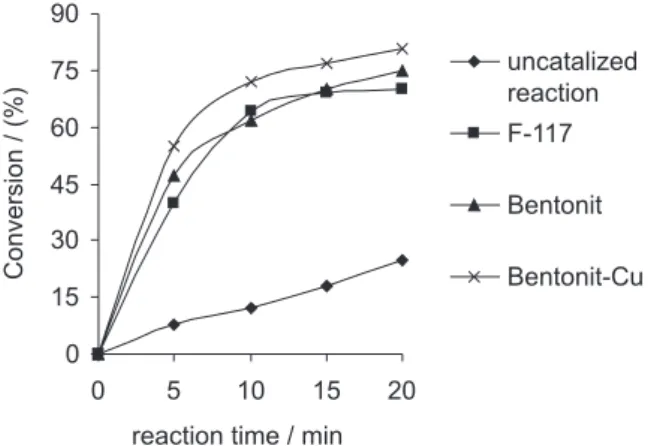
A kinetic study comparing F-117, Bentonit BrasgelTM, Bentonit-Cu clays and the uncatalyzed reaction was performed through the coiodination of styrene with MeOH. The conversion of the substrate to 2-iodo-1-phenyl methyl ether was monitored by HRGC using pentadecane as internal standard. Figure 2 demonstrates that the uncatalyzed reaction is very slow, and although all the clays have similar activity in 6 h, intercalated Bentonit showed a higher catalytic effect in a small reaction time.
Metals are essential in coiodination reactions to decompose the π-complex formed among alkene and iodine to the bridged iodonium ion (Scheme 1).16 Hence, the better catalytic effect of Bentonit-Cu clay showed in Figure 2 could be explained in terms of its higher concentration of metal in the structure.
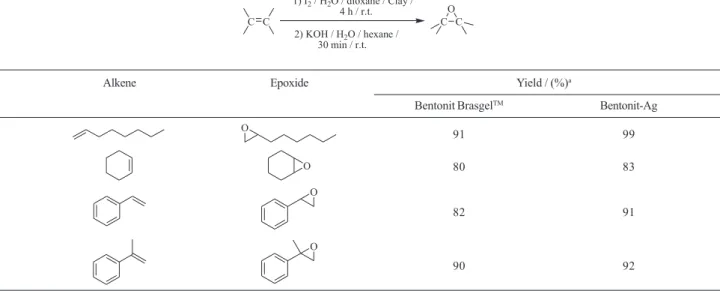
Based on the above results, the coiodination of diverse alkenes with water was performed using I2 (2 mol equiv.) and Bentonit BrasgelTM (0.2 g) clay in aqueous dioxane at room temperature. After 4 hours, KOH was added in a biphasic system13 (hexane/water) to produce the pure epoxides in excellent yields after 30 min. The HRGC of these crude reactions indicated the respective epoxide as
the unique product. Neither unreacted alkene nor the intermediated iodohydrin were detected. As it is well-known that Ag(I) salts can assist solvolysis of alkyl halide,21 the coiodination of alkenes mediated by Bentonit-Ag clay was tested. Using this procedure, the iodohydrins were efficiently obtained, but only traces of epoxides were formed. However, using Bentonit-Ag clay as catalyst for the coiodination reaction, followed by one-pot addition of the KOH / biphasic system, produced smoothly the corresponding epoxides in higher yields. Table 3 summarizes all the results.
Conclusions
The preparation of epoxides by reaction of alkenes with iodine in the presence of the Commercial Brazilian clay followed by in situ cyclization with KOH in a biphasic system is efficiently achieved. This simple methodology is an alternative route for the epoxidation of acid-sensitive alkenes or the epoxidation of alkenes yielding acid-sensitive epoxides. Furthermore, our methodology is safe and very attractive considering the environmental issues that require the substitution of toxic reagents by friendlier solid catalysts and the advantages of heterogeneous catalysis in terms of easy work up procedures.2
Experimental
General
The commercial Brazilian Bentonit Brasgel™ clay was kindly donated by Bentonit União do Nordeste Co. All chemicals are commercially available and were used without further purification. At the end of reactions the solvent was evaporated on a rotatory evaporator and then concentrated under reduced pressure(267 Pa) and 50 oC (bath).
Characterization of Bentonit Brasgel™ clay
Chemical analyses of the clay samples were made using an Inductive Couple Plasma emission
Figure 2. Conversion of styrene into 2-iodo-1-phenyl methyl ether cata-lyzed by clays as a function of the reaction time.
spectroscopy (ICP-AES) on a Perkin-Elmer plasma. Surface area and pore size distribution of the samples were determined by adsorption-desorption of nitrogen at 77 K using Micromeritics A.S.A.P. 2000. Surface area was calculated using BET isotherm method. X-ray diffraction studies were performed with an automated SIEMENS type-F diffractometer in step scanning mode
θ - 2θ. The high-voltage was supplied by a high stability Philips PW1830/25 generator. A graphite monochromator was used to select copper Kα-doublet (λ ≅ 1.54 Å). The scanning was performed in fixed-time mode in the interval 2o ≤ 2θ ≤ 45o with a step increment of 0.05o. Solid state nuclear magnetic resonance spectra were obtained on a Bruker DRX300 spectrometer (7.05 Tesla), operating at 59.6 MHz (29Si) and 78.2 MHz (27Al). A 4mm MAS probe and spinning rates of 5 kHz for 29Si and 12 kHz for 27Al were employed. Samples of kaolinite (-91.5 ppm) and AlCl3.6H2O (0.0 ppm) were used as external references.
Characterization of reaction products
1H NMR and 13C NMR spectra were acquired on a Bruker AC-200 (200 MHz and 50 MHz, respectively) spectrometer for CDCl3 solutions with TMS as internal standard. HRGC analysis were performed on a HP-5890-II gas chromatograph with FID by using a 30 m (length), 0.25 mm (ID) and 25 µm (phase thickness) RTX-5 silica capillary column and He (flow rate 50 cm s-1) as carrier gas (split 1:20). Mass spectra were obtained on a Hewlett-Packard HP5896-A HRGC-MS using electron impact ionization (70 eV).
Typical procedure for the preparation of intercalated Bentonit clays
Commercial Bentonit BrasgelTM clay was intercalated with Cu(II) or Ag(I) by treating it with solution of the corresponding metal salt (CuSO4 or AgNO3, 10% p/v). This mixture was kept at 60 oC under stirring for 24 h. After the exchange, the intercalated clays were filtered, washed several times with deionized water, and dried at 110 oC for 12 h.
Preparation of 2-Iodo-1-phenyl methyl ether
Typical procedure for coiodination of styrene with methanol mediated by clays
To a stirred suspension of styrene (5 mmol) and the clay (0.2 g) in methanol (20 cm3), was added iodine (10 mmol) in small portions at room temperature. After 6 h, the clay was filtered off, Et2O (10 cm3) was added and the organic layer was washed with a saturated solution of Na2S2O3 (3 × 5 cm3). The organic extract was dried (anhydrous Na2SO4) and filtered through a small column of SiO2. The solvent was evaporated to give 2-iodo-1-phenyl methyl ether pure as a colorless oil. The identity of the product was determined by comparison of its analytical data with the previously reported.22
1H NMR: δ 3.20 (s, 3H), 3.32 (dd, J 4.4 and 9.0 Hz, 2H), 4.45-4.30 (dd, J 4.4 and 8.8 Hz, 1H), 7.35 (m, 5H) ppm. 13C NMR: δ 10.2 (CH
2), 57.2 (CH3), 83.4 (CH), 126.0 (CH), 128.2 (CH), 128.9 (CH), 140.1 (C). MS: m/z 77, 91, 104, 121 (100%), 135, 262 (M+, 2%).
Table 3. Yield of epoxides
Alkene Epoxide Yield / (%)a
Bentonit BrasgelTM Bentonit-Ag
91 99
80 83
82 91
90 92
Kinetic study
The coiodination of styrene with methanol catalyzed by clays was performed as described above. The conversion of the substrate into 2-iodo-1-phenyl methyl ether at different reaction times was determined by HRGC using pentadecane as internal standard.
Typical procedure for the preparation of epoxides
To a stirred suspension of styrene (5 mmol) and the clay (0.2 g) in dioxane (20 cm3), was added iodine (10 mmol) in small portions at room temperature for 4 h. Then KOH (34 mmol) was added to the two-phase solution in the 1:1 ratio of hexane/dioxane. After 30 min, CH2Cl2 (15 cm3) was added and the organic layer separated, washed with a saturated solution of Na2S2O3 (3 × 5 cm3), dried (anhydrous Na
2SO4) and filtered through a small column of SiO2. The solvent was evaporated to give the pure epoxide as a colorless (or light orange) oil. The identity of the product was determined by comparison of its analytical data with the previously reported.11
Cyclohexene oxide
1H NMR: δ 1.37-1.16 (m, 4H), 1.87-1.74 (m, 4H), 3.05 (s, 2H), ppm. 13C NMR: δ 19.4 (CH
2), 24.2 (CH2), 55.1 (CH) ppm. MS: m/z 69, 83 (100%), 97, 98 (M+, 3%).
Styrene oxide
1H NMR: δ 2.79 (dd, J 5.5 Hz and 2.6 Hz, 1H), 3.13 (dd, J 5.5 Hz and 4.0 Hz, 1H), 3.86 (dd J 2.6 Hz and 4.0 Hz, 1H), 7.34 (m, 5H) ppm. 13C NMR: δ 51.3 (CH
2), 52.5 (CH), 125.6 (CH), 128.3 (CH), 128.9 (CH), 137.7 (C) ppm. MS: m/z 54, 89, 90, 91 (100%), 119, 120 (M+, 30%).
α-Methylstyrene oxide
1H NMR: δ 1.69 (s, 3H), 2.92 (d, 1H), 3.00 (d, 1H), 7.30 (m, 5H), ppm. 13C NMR: δ 21.9 (CH
3), 56.9 (CH2), 57.1 (CH), 124.9 (CH2), 127.6 (CH2), 128.5 (CH2), 141.3 (C) ppm. MS: m/z 78, 103, 105, 106, 133 (100%), 134 (M+, 20%).
1-Octene oxide
1H NMR: 0.88 (t, 3H), 1.20-1.55 (m, 10H), 2.45 (dd, J 8.2 and 3.9 Hz, 1H), 2.75 (dd, J 8.2 and 1.1 Hz, 1H), 2.98 (m, 1H) ppm. 13C NMR: 14.0 (CH
3), 22.6 (CH2), 26.1 (CH2), 29.2 (CH2), 31.8 (CH2), 32.5 (CH2), 47.0 (CH2), 52.4 (CH) ppm.
Acknowledgments
We thank CNPq and FAPERJ for financial support. M.C.S.M. and M.R.M.P.A. thank CNPq for fellowships. R.B.B. and K.S.M.C. thank PIBIC/UFRJ, PIBIC/UERJ, and FAPERJ for fellowships. We are also grateful to Bentonit Brazilian Corporation for natural Brazilian Bentonit BrasgelTM clay donation.
Supplementary Information
27Al MAS-NMR (Figure S1) and 29Si MAS-NMR spectrum of Bentonit Brasgel™ clay (Figure S2) are available free of charge at http://jbcs.sbq.org.br, as PDF file.
References
1. Sheldon, R. A.; Downing, R. S.; Appl. Catal., A 1999, 189, 163. 2. Anastas, P.T.; Warner, J.C.; Green Chemistry: Theory and Practice, Oxford University Press: Oxford, 2000; Lenardão, E. J.; Freitag, R. A.; Dabdoub, M. J.; Batista, A. C. F.; Silveira, C. C.; Quim. Nova2003, 26, 123.
3. Badathala, V.; Synlett2004, 388; Varma, R. S.; Tetrahedron
2002, 58, 1235; Vaccari, A.; Appl. Clay Sci. 1999, 14, 161. 4. Smith, J. G.; Synthesis1984, 629; Rao, A. S.; Paknikar, S. K.;
Kirtane, J. G.; Tetrahedron1983, 39, 2323.
5. Marco-Contelles, J.; Molina, M. T.; Anjum, S.; Chem. Rev.2004,
104, 2857.
6. Bretherick, L.; Hazards in the Chemical Laboratory; 4th ed;
Royal Society of Chemistry: London, 1986; pp. 446-447. 7. Recent examples: Liu, S.-Y.; Nocera, D. G.; Tetrahedron Lett.
2006, 47, 1923; Kureshy, R. I.; Singh, S.; Khan, N. H.; Abdi, S. H. R.; Ahmed, I.; Bhatt, A.; Jasra, R. V.; Catal. Lett. 2006, 107, 127; Rebelo, L. H.; Gonçalves, A. R.; Pereira, M. M.; Simões, M. M. Q.; Neves, M. G. P. M. S.; Cavaleiro, J. A. S.; J. Mol. Catal. A: Chem.2006, 256, 321.
8. Corma, A.; J. Catal. 2003, 216, 298.
9. Grigoropoulou, G.; Clark, J. H.; Elings, J. A.; Green Chem. 2003,
5, 1;
10. Weissermel, K.; Industrial Organic Chemistry, 3rd ed;
Wiley-VCH: Wienheim, 1997; pp. 266, 267.
11. Sanseverino, A. M.; da Silva, F. M.; Jones Jr., J.; de Mattos, M. C. S. Quim. Nova2001, 24, 637; Rodriguez, J.; Dulcère, J.-P.;
Synthesis1993, 1177.
12. Sanseverino, A. M.; de Mattos, M. C. S.; Synth. Commun. 1998,
28, 559.
13. Wengert, M.; Sanseverino, A. M.; de Mattos, M. C. S.; J. Braz. Chem. Soc.2002, 13, 700.
15. Villegas, R. A. S.; Santo Jr., J. L. E.; de Mattos, M. C. S., de Aguiar, M. R. M. P.; Guarino, A. W. S.; J. Braz. Chem. Soc.
2005, 16, 565.
16. Villegas, R. A. S.; Santo Jr., J. L. E.; de Mattos, M. C. S., de Aguiar, M. R. M. P.; Guarino, A. W. S. Catal. Commun.2007,
8, 97.
17. Guarino, A. W. S.; San Gil, R. A. S.; Polivanov, H.; Menezes, S. M. C.; J. Braz. Chem. Soc.1997, 8, 581.
18. Sanseverino, A. M.; de Mattos, M. C. S.; Synthesis1998, 1584. 19. Villegas, R. A. S.; Santo Jr., J. L. E.; Sanseverino, A. M.; de Mattos, M. C. S., de Aguiar, M. R. M. P.; Guarino, A. W. S.;
Synth. Commun.2005, 35, 1627.
20. de Mattos, M. C. S.; Sanseverino, A. M.; J. Chem. Res. 2004, 638; de Mattos, M. C. S.; Sanseverino, A. M.; J. Chem. Res. (S)
1994,440.
21. Schauble, J. H.; Trauffer, E. A.; Deshpande, P. P.; Evans, R. D.;
Synthesis 2005, 1333; Vona, J. A.; Steigman, J.; J. Am. Chem. Soc.1959, 81, 1095.
22. Yusubov, M. S.; Yusubova, R. Y.; Filimonov, V. D.; Ki-Whan, C.; Russ. J. Org. Chem.2002, 38, 902.
Printed in Brazil - ©2007 Sociedade Brasileira de Química 0103 - 5053 $6.00+0.00
Supplementary InformationSupplementary InformationSupplementary InformationSupplementary InformationSupplementary Information
*e-mail: [email protected]; [email protected]
Figure S1.27Al MAS-NMR spectra of Bentonit Brasgel clay.
A New Environmentally Friendly Clay Catalyst for One-pot Coiodination and
Epoxidation of Alkenes
Karen S.M. Corrêa,a Rafael B. Bernini,b Marcio C.S. de Mattos,*,b Mônica R.M.P. de Aguiar*,a and Alcides W.S. Guarinoc
a
Instituto de Química, Universidade do Estado do Rio de Janeiro, 20590-900 Rio de Janeiro-RJ, Brazil
b
Instituto de Química, Universidade Federal do Rio de Janeiro, CP 68545, 21945-970 Rio de Janeiro-RJ, Brazil
c