Article
Printed in Brazil - ©2016 Sociedade Brasileira de Química0103 - 5053 $6.00+0.00*e-mail: [email protected]
Cascade Synthesis of Thieno[2,3-
b
]pyridines by Using Intramolecular Cyclization
Reactions of 3-Cyano-2-(organylmethylthio)pyridines
Fatemeh Alinaghizadeh,a Mahboobeh Zahedifar,b Mohammad Seifia and Hassan Sheibani*,a
aDepartment of Chemistry, Shahid Bahonar University of Kerman, 76169 Kerman, Iran
bDepartment of Chemistry, Faculty of Science, University of Jiroft, 364 Jiroft, Iran
2-Amino-4-aryl-6-mercaptopyridine-3,5-dicarbonitriles as starting materials have been prepared by reducing of 2-amino-4-aryl-6-(phenylthio)pyridine-3,5-dicarbonitrile derivatives which were synthesized on stepwise one-pot three component reaction of malononitrile, aldehydes and thiophenol in the presence of base catalysts such as triethylamine, high surface area (HSA) MgO or nanocrystalline magnesium oxide. Alkylation of 2-amino-4-aryl-6-mercaptopyridine-3,5-dicarbonitriles with α-halogen compounds in presence of sodium alkoxide as base catalyst followed with cyclization afforded the thieno[2,3-b]pyridine derivatives in excellent yields and in a short reaction time.
Keywords: MgO (HSA-MgO), thieno[2,3-b]pyridine, three component reaction, 2-amino-4-aryl-6-mercaptopyridine-3,5-dicarbonitriles, intramolecular cyclization reactions
Introduction
In organic chemistry, derivatives of pyridine fused to thiophene systems are one important class of heterocyclic compounds and they attract considerable interest because of their great practical usefulness, primarily due to their various biological activities.1 The synthesis of
thienopyridines has been the subject of several reviews which demonstrate the high importance of this class of compounds.2 Six isomeric thienopyridine structures
characterized by different annelation modes are known: thieno[2,3-b]pyridine, thieno[3,2-b]pyridine, thieno[2,3-c] pyridine, thieno[3,2-c]pyridine, thieno[3,4-b]pyridine and thieno[3,4-c]pyridine. The first four thienopyridines were studied in detail in the literature.3 Data on the “isostructural”
isomers thieno[3,4-b]pyridine and thieno[3,4-c]pyridine are scarce and disembodied and they are beyond the scope. Our main focus is on synthesis of some new thieno[2,3-b]pyridine derivatives. These compounds have been investigated in relation with their biological and pharmacological activities. Some of them have proved to possess antibacterial,4,5 antiviral,6 antihypertensive7
and antimicrobial8 activities. So the certain thieno[2,3-b]
pyridine derivatives were prepared as anti-inflammatory agents, particularly for treating arthritis and bone resorption
inhibiting agents.9 These potential therapeutic applications
made these compounds as a privileged scaffold. Therefore, the synthesis of highly substituted thieno[2,3-b]pyridine has attracted much attention and a number of procedures have been developed to prepare these compounds using a variety of protocols.10-12 Thieno[2,3-b]pyridine derivatives
have been previously prepared in a multistep procedure from either a thiophene or a pyridine ring and further ring closure leading to the other heterocyclic fused system. Unfortunately, many of these methods suffer from limitations such as long reaction times, low to moderate yields and co-occurrence of several side products.13-16 Therefore, reinvestigation of
the classical conditions seemed warranted for developing conditions for suitable library synthesis. In view of all these benefits and as a continuation of our interest in the field of heterocyclic compounds,17-20 we undertook the synthesis
of new thieno[2,3-b]pyridine derivatives by the reaction of 2-amino-4-aryl-6-mercaptopyridine-3,5-dicarbonitriles with halogen compounds in the presence of sodium alkoxide at room temperature.
Experimental
General procedures
(IR) spectra were measured on a Mattson 1000 Fourier transform IR (FTIR) spectrometer. The proton and carbon nuclear magnetic resonance (NMR) spectra were recorded with a Bruker DRX-400 AVANCE spectrometer at 400 and 100 MHz, respectively. Mass spectra (MS) were recorded on a Shimadzu MS-QP2000A mass spectrometer operating at an electrospray ionization (ESI) potential of 70 eV. Elemental analyses were performed using a Heracus CHN-O-Rapid analyzer. 2,2-Dicyanooxiranes 1a-d were prepared according to a literature procedure.19
Preparation of high surface area MgO
The catalysts used in this study were obtained by calcinations of rehydrated Mg(OH)2. The experimental
results showed that an optimal calcination temperature in the range 400-500 oC gives poorly crystalline, high surface
area (HSA) MgO that can be regenerated by washing, and then reused. After separation of the product by filtration, the recovered solvent containing MgO was reused twice without loss of activity of the catalyst.21,22
Preparation of nanosized MgO
The MgO nanoparticles were synthesized by precipitation of the magnesium hydroxide gels in aqueous solution using Mg(NO3)2 as salt and liquid ammonia as the
precipitating agent. Initially, the pH of 200 mL of distilled water was adjusted to 10.5 by addition of liquid ammonia. To this solution, 0.1 mol L-1 magnesium nitrate solution
(0.0148 g mL-1) was added dropwise with continuous
stirring. The rate of addition of the salt solution was kept at 20 mL h-1. During the addition, the pH of the mixture
decreased due to hydrolysis of the salt. The pH was maintained at 10.5 by controlled addition of liquid ammonia solution. After completion of the precipitation procedure, the mixture was stirred at ambient temperature for 12 h, filtered, repeatedly washed with distilled water, dried at 120 oC, and calcined at 500 oC for 2 h.23
Stepwise one-pot general procedure for the preparation of 2-amino-4-aryl-3,5-dicarbonitrile-6-(phenylthio)pyridines in the presence of base catalysts (4a-d)
Method A (triethylamine as base catalyst)
To a stirred solution of aldehyde (1 mmol) in ethanol (10 mL) was added a solution of malononitrile (1 mmol in 2.0 mL of ethanol) and 3 drops of triethylamine. The pale yellow solution was then refluxed for 60 min. To this was then added thiophenol (1 mmol), and the mixture was refluxed for a further 45 min. Another 1 mmol of
malononitrile in 2.0 mL of ethanol was added, and the reaction mixture was refluxed for a further 60 min. The reaction mixture was then exposed to air overnight. The yellow crystalline precipitate formed was collected by suction filtration, washed with n-hexane/ethanol (9:1), followed by n-hexane.
Methods B and C (high surface area and nanosized MgO as base catalysts)
To a stirred solution of aldehyde (1 mmol) and malononitrile (1 mmol) in 10 mL ethanol were added 50 mg MgO (high surface area or nanosized) at ambient temperature. The resulting mixture was heated to 50 oC,
the thiophenol (1 mmol) was added and the reaction mixture was refluxed for 45 min. Another 1 mmol of malononitrile in 2.0 mL of ethanol was added, and the reaction mixture was refluxed for a further 60 min. The reaction mixture was then exposed to air overnight. The mixture was centrifuged to separate the catalyst and the catalyst was washed with ethyl acetate (3 × 5 mL). The solvent was evaporated under reduced pressure and the crude product obtained was purified by recrystallization from ethanol.
2-Amino-4-phenyl-6-(phenylthio)pyridine-3,5-dicarbonitrile (4a)
m.p.: 213-215 ºC (lit.23 216-218 ºC); IR (KBr) ν
max / cm-1
3470, 3360, 2935, 2222, 1639, 1550; 1H NMR (400 MHz,
DMSO-d6) d 7.32-7.65 (m, 10H, Ar), 7.9 (broad, 2H,
NH2).
2-Amino-4-(4-chlorophenyl)-6-(phenylthio)pyridine-3,5-dicarbonitrile (4b)
m.p.: 220-222 oC (lit.24 222-224 ºC); IR (KBr)
ν
max / cm-1 3470, 3350, 2945, 2220, 1630, 1552; 1H NMR
(400 MHz, DMSO-d6) d 7.40-7.44 (m, 3H, Ar), 7.49-7.65
(m, 6H, Ar), 7.75 (broad, 2H, NH2).
2-Amino-4-(4-methoxyphenyl)-6-(phenylthio)pyridine-3,5-dicarbonitrile (4c)
m.p.: 236-238 oC (lit.24 238-240 ºC); IR (KBr) ν max / cm-1
3440, 3330, 3220, 2882, 2218, 1641; 1H NMR (400 MHz,
DMSO-d6) d 3.85 (s, 3H, OCH3), 7.05-7.10 (m, 3H, Ar),
7.49-7.71 (m, 6H, Ar), 7.80 (broad, 2H, NH2).
2-Amino-6-(phenylthio)-4-(p-tolyl)pyridine-3,5-dicarbonitrile (4d)
m.p.: 206-209 oC (lit.24 208-211 ºC); IR (KBr) ν
max / cm-1
3475, 3345, 3220, 2915, 2215, 1616, 1538; 1H NMR
(400 MHz, CDCl3) d 2.41 (s, 3H, CH3), 7.37-7.48 (m, 6H,
General procedure for the preparation of 2-amino-4-aryl-6-mercaptopyridine-3,5-dicarbonitriles (5)
The compound 4 (2-amino-4-aryl-3,5-dicarbonitrile-6-(phenylthio)pyridine) (3 mmol) was dissolved in N,N-dimethylformamide (DMF) (10 mL) and to this was added sodium sulfide (0.78 g, 10 mmol) and the mixture stirred at 80 oC for 2 h. Upon cooling at ambient temperature,
1 mol L-1 HCl (20 mL) was added, resulting in the formation
of a yellow precipitate. The crude product was collected by filtration. Compounds 5a-d have been reported previously.25
Preparation of 2-amino-6-(2-oxo-2-phenyl-ethylsulfanyl)-4-phenyl-pyridine-3,5-dicarbonitrile (I)
A mixture of 2-amino-4-phenyl-6-(phenylthio)pyridine-3,5-dicarbonitrile 5a (2 mmol), 2-bromoacetophenone (2 mmol) and Et3N (0.1 mL) in ethanol (20 mL) was
stirred at ambient temperature. After 10 min a pale yellow solid appeared. It was washed with diethyl ether to afford intermediate I. Yield: 92%; m.p.: 276-278 oC (decompose);
IR (KBr) νmax / cm-1 3473, 3346 (NH2), 2209 (CN), 1678
(C=O), 1617, 1578 (C=C); 1H NMR (400 MHz, DMSO-d 6)
d 5.01 (s, 2H, CH2), 7.90 (broad, NH2), 7.56-8.09 (m, 10H,
Ar); 13C NMR (100 MHz, DMSO-d
6) d 40.60, 86.56, 93.84,
115.64, 115.85 (2CN), 128.90, 128.93, 129.21, 129.32, 130.89, 134.20, 134.35, 136.05, 158.84, 159.97, 166.38, 193.24 (C=O).
General procedure for the preparation of 3,6-diamino-2-benzoyl-4-aryl-thieno[2,3-b]pyridine-5-carbonitrile (6a-f)
A mixture of 2-amino-4-aryl-6-mercaptopyridine-3,5-dicarbonitriles 5a-d (2 mmol), 2-bromoacetophenone (2 mmol) and NaOEt in absolute ethanol (20 mL) was stirred at ambient temperature for 10 min. After this time a yellow solid appeared which was collected by filtration. The crude product was purified by ethanol.
3,6-Diamino-2-benzoyl-4-phenylthieno[2,3-b ]pyridine-5-carbonitrile (6a)
Yield: 80%; m.p.: 323 oC (decompose); IR (KBr)
ν
max / cm-1 3463, 3363 (2NH2), 2216 (CN), 1611 (C=O),
1590, 1557 (C=C); 1H NMR (400 MHz, DMSO-d
6) d 6.58,
6.93 (broad, 2NH2), 7.49-7.67 (m, 10H, Ar); 13C NMR
(100 MHz, DMSO-d6) d 90.77, 99.54, 112.38, 115.37
(CN), 128.97, 127.79, 128.47, 129.39, 130.28, 130.88, 133.25, 140.85, 157.12, 153.84, 158.17, 168.17, 187.83 (C=O); MS (ESI) 370 [M+] (35.4), 371 (10), 369 (46.4),
293 (2.4), 264 (14), 221 (5.5), 204 (6.7), 178 (4.7), 140 (8), 105 (78.7), 89 (4), 77 (100), 51 (26.8); anal. calcd.
for C21H14N4OS: C, 68.09; H, 3.81; N, 15.12; found: C,
67.78; H, 3.65; N, 14.78.
3,6-Diamino-2-benzoyl-4-(4-chlorophenyl)thieno[2,3-b] pyridine-5-carbonitrile (6b)
Yield: 78%; m.p.: 252 oC (decompose); IR (KBr)
ν
max / cm-1 3485, 3307 and 3161 (2NH2), 2212 (CN), 1647
(C=O), 1589, 1568 (C=C); 1H NMR (400 MHz, DMSO-d 6)
d 6.89 (broad, 2NH2), 7.49-7.74 (m, 9H, Ar); 13C NMR
(100 MHz, DMSO-d6) d 90.83, 99.57, 112.32, 115.35
(CN), 126.97, 129.47, 129.51, 129.94, 130.83, 130.87, 132.03, 135.16, 140.94, 151.17, 152.68, 159.12, 166.25, 187.67 (C=O); MS (ESI) 404 [M+] (52), 406 (34), 405 (61),
403 (100), 367 (2), 327 (4), 297 (4), 264 (32), 219 (4), 193 (5), 165 (6), 105 (62), 77 (94.5), 51 (20); anal. calcd. for C21H13ClN4OS: C, 62.30; H, 3.24; N, 13.84; found: C,
61.98; H, 3.08; N, 13.49.
3,6-Diamino-2-benzoyl-4-(4-methoxyphenyl)thieno[2,3-b] pyridine-5-carbonitrile (6c)
Yield: 84%; m.p.: 242-245 oC; IR (KBr) ν
max / cm-1
3480, 3302 and 3147 (2NH2), 2212 (CN), 1637 (C=O),
1590, 1573 (C=C); 1H NMR (400 MHz, DMSO-d
6) d 3.53
(s, 3H, OCH3), 7.63 (broad, 2NH2), 7.49-7.67 (m, 9H, Ar); 13C NMR (100 MHz, DMSO-d
6) d 55.31 (OCH3), 91.12,
99.33, 112.57, 114.77, 115.62 (CN), 124.98, 126.97, 128.45, 129.45, 130.81, 141.01, 151.40, 153.89, 159.30, 160.42, 166.24, 187.53 (C=O); MS (ESI) 400 [M+] (57.5),
401 (16.5), 399 (75), 355 (6), 295 (5), 251 (13), 200 (4), 165 (4), 105 (93), 77 (100), 51 (17); anal. calcd. for C22H16N4O2S: C, 65.98; H, 4.03; N, 13.99; found: C, 65.67;
H, 3.88; N, 13.61.
3,6-Diamino-2-benzoyl-4-(4-methylphenyl)thieno[2,3-b] pyridine-5-carbonitrile (6d)
Yield: 82%; m.p.: 308 oC (decompose); IR (KBr)
ν
max / cm-1 3457, 3356 and 3264 (2NH2), 2213 (CN), 1611
(C=O), 1592, 1557 (C=C); 1H NMR (400 MHz, DMSO-d 6)
d 2.46 (s, 3H, CH3), 6.77 (broad, 2NH2), 7.20 (d, 2H, 3J
HH 8 Hz, Hortho (4-CH3OC6H4)), 7.49-7.63 (m, 5H, Ar),
7.67 (d, 2H, 3J
HH 8 Hz, Hmeta (4-CH3OC6H4)); 13C NMR
(100 MHz, DMSO-d6) d 21.02, 90.88, 99.47, 112.44,
115.47 (CN), 126.97, 127.71, 128.45, 129.95, 130.29, 130.83, 139.87, 140.97, 151.22, 154.00, 159.21, 166.18, 187.58 (C=O); MS (ESI) 384 [M+] (63.7), 385 (16.5), 383
(80), 307 (2), 278 (7), 264 (21), 193 (2.4), 179 (2.4), 140 (5.5), 105 (90), 91 (2.4), 77 (100), 51 (18).
Preparation of methyl-3,6-diamino-4-(4-chlorophenyl)-5-cyanothieno[2,3-b]pyridine-2-carboxylate (6e)
2-amino-4-(4-chlorophenyl)-6-mercaptopyridine-3,5-dicarbonitrile 5b (2 mmol), methyl 2-bromoacetate (2 mmol) and NaOMe in absolute methanol (20 mL) was stirred at ambient temperature. After 7 min a yellow solid appeared. Yield: 80%; m.p.: 285-287 oC; IR
(KBr) ν
max / cm-1 3486 and 3367 (2NH2), 2212 (CN), 1668
(C=O), 1618, 1597 (C=C); 1H NMR (400 MHz, DMSO-d 6)
d 3.71 (s, 3H, OCH3), 7.52 (broad, 2NH2), 7.56-7.59 (m, 2H,
Ar), 7.68-7.72 (m, 2H, Ar); 13C NMR (100 MHz, DMSO-d 6)
d 51.20 (OCH3), 91.93, 98.77, 113.42, 115.15 (CN), 129.27,
129.74, 130.08, 139.54, 150.28, 153.44, 158.14, 165.22, 174.23 (C=O); MS (ESI) 358 [M+] (37.8), 341 (100), 325
(30.7), 297 (23.6), 264 (8.7), 171 (4.8), 163 (6.3), 149 (5.5); anal. calcd. for C16H11ClN4O2S: C, 53.56; H, 3.09; N, 15.61;
found: C, 53.31; H, 2.85; N, 15.29.
Preparation of 3,6-diamino-4-(4-methoxyphenyl)-2-(4-nitrophenyl)thieno[2,3-b]pyridine-5-carbonitrile (6f)
A mixture of 2-amino-4-(4-methoxyphenyl)-6-mercaptopyridine-3,5-dicarbonitrile 5c (2 mmol), 4-nitrobenzyl chloride (2 mmol) and NaOEt in absolute ethanol (20 mL) was stirred at ambient temperature. After 10 min a red solid appeared. Yield: 74%; m.p.: 280-282 oC;
IR (KBr) ν
max / cm-1 3470, 3426 and 3349 (2NH2), 2203
(CN), 1621, 1591 (C=C); 1H NMR (400 MHz, DMSO-d 6)
d 3.87 (s, 3H, OCH3), 7.36 (s, NH2), 7.36-7.74 (m, 6H,
Ar), 8.20 (d, 2H, 3J
HH 6 Hz, Hortho (4-NO2C6H4)); 13C NMR
(100 MHz, DMSO-d6) d 54.22 (OCH3), 90.87, 99.42,
111.54, 115.24 (CN), 117.32, 126.97, 128.21, 129.02, 130.47, 135.24, 140.23, 152.42, 153.57, 158.26, 160.85, 167.21; MS (ESI) 417 [M+] (74), 418 (10), 371 (7), 327
(21), 295 (6), 239 (7.5), 178 (18), 165 (14), 105 (56.7), 91 (22), 77 (100), 66 (24), 55 (90); anal. calcd. for C21H15N5O3S: C, 60.42; H, 3.62; N, 16.78; found: C, 60.47;
H, 3.34; N, 16.41.
Results and Discussion
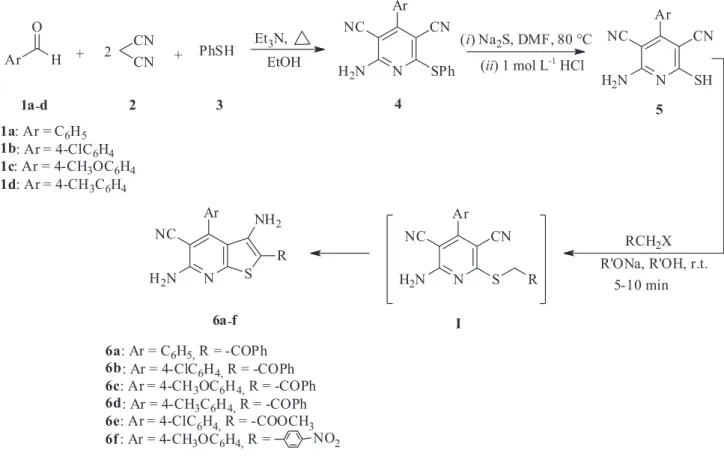
In our preliminary studies, the 2-amino-4-aryl-6-(phenylthio)pyridine-3,5-dicarbonitrile derivatives 4a-d have been prepared by an efficient stepwise one-pot three multicomponent reaction of aldehydes 1a-d, malononitrile 2, and benzenethiol 3 in the presence of base catalysts such as triethylamine, HSA-MgO or nanocrystalline magnesium oxide in moderate to good yields. Pyridine formation occurred according to a preparation by Kambe et al.26 to give the phenyl protected
sulfides 4 in the 6-position of the ring. To obtain the free thiol in the 6-position of the pyridine ring 5, the 2-amino-4-aryl-6-(phenylthio)pyridine-3,5-dicarbonitriles 4 along with 3.3 eq of sodium sulfide in DMF were heated at 80 oC for 2-3 h which resulted in quantitative yields of
2-amino-4-aryl-6-mercaptopyridine-3,5-dicarbonitriles 5. The final step was the reaction of the free thiol 5 with
α-halogen compounds in the presence of base catalyst
such as sodium alkoxide at room temperature which led to preparation of thieno[2,3-b]pyridine derivatives (6a-f) (Scheme 1). Reaction time for the synthesis of compounds 6 from compounds 5 is very short at room temperature, about 5-10 min.
A few multicomponent reactions (MCRs) are also reported for synthesis of diverse substituted 2-amino-3,5-dicarbonitrile-6-thiopyridines, such as three-component condensations of aldehyde, malononitrile and thiol using various base catalysts.24,27 When the one-pot procedures
such as using high surface area MgO or nanocrystalline magnesium oxide were applied to preparation of 2-amino-3,5-dicarbonitrile-6-thiopyridines as starting materials, the yields were significantly lower than 60% (Table 1).
For this reason, a simple variation on these one-pot procedures was employed for the improvement of the reaction conditions. These reactions were carried out by a stepwise addition of reagents which were followed by preparation of products 6 with improvement of the reaction yields up to 75%. The reported mechanism of pyridine dicarbonitrile formation involves the attack of a malononitrile anion upon the aromatic aldehyde which was activated by MgO followed by elimination of water to form aryllidenemalononitriles. Subsequent addition of a second malononitrile anion along with addition of thiol to nitrile group of malononitrile provides penultimate intermediate II, which is followed by loss of molecular hydrogen to furnish the product (Scheme 2).
The reaction of 2-amino-4-aryl-6-(phenylthio)pyridine-3,5-dicarbonitriles 4 in the presence of potassium hydroxide in dimethylformamide is a convenient method to obtain 2-amino-4-aryl-6-mercaptopyridine-3,5-dicarbonitrile derivatives 5. Treatment of these compounds with
α-halogen compounds in the presence of base catalyst
such as sodium alkoxide can undergo the intramolecular cyclization which formed thieno[2,3-b]pyridines 6 without preliminary isolation. The 2-amino-6-(2-oxo-2-phenyl-ethylsulfanyl)-4-phenyl-pyridine-3,5-dicarbonitrile I has been isolated from reaction solution and then the compound I was heated under an alkaline condition to produce compound 6a. A plausible mechanism for the formation of compounds 6 is shown in Scheme 3.
Conclusions
2-amino-4-aryl-Scheme 1. Synthetic route to the synthesis of compounds 6.
Table 1. Synthesis of compounds 4a-d in the presence of base catalysts
Compound Ar Triethylamine HAS-MgO
a Nanosized MgO
time / h Yield / % time / h Yield / % time / h Yield / %
4a C6H5 5 44 4 65 3 75
4b 4-ClC6H4 3 45 3 49 2 65
4c 4-CH3OC6H4 7 50 5 58 5 70
4d 4-CH3C6H4 7 40 5 54 4 69
aHigh surface area MgO.
6-mercaptopyridine-3,5-dicarbonitriles which were prepared from 2-amino-4-aryl-6-(phenylthio)pyridine-3,5-dicarbonitrile derivatives. These compounds as starting materials have been prepared on stepwise one-pot three component reaction of malononitrile, aldehydes and thiophenol by using high surface area MgO or nanocrystalline magnesium oxide as base catalysts. The advantage of these procedures reported here are: short reaction times, high purity of products and easy workup.
Supplementary Information
Supplementary data (IR, 1H NMR, 13C NMR, and
mass spectra of 6a-f) are available free of charge at http://jbcs.sbq.org.br as PDF file.
Acknowledgements
The authors express appreciation to the Shahid Bahonar University of Kerman Faculty Research Committee and University of Jiroft for supporting this investigation.
References
1. Pevet, I.; Brulé, C.; Tizot, A.; Gohier, A.; Cruzalegui, F.; Boutin, J. A.; Goldstein, S.; Bioorg. Med. Chem. 2011, 19, 2517. 2. Kumar, C. N. S. S. P.; Srihari, E.; Ravinder, M.; Kumar, K. P.;
Murthy, U. S. N.; Rao, V. J.; J. Heterocycl. Chem.2013, 50, 131.
3. Wikel, J. H.; Denney, M. L.; Vasileff, R. T.; J. Heterocycl. Chem.
1993, 30, 289.
4. Shraideh, Z.; Sallal, A. K.; Biomed. Lett. 1997, 54, 233. 5. Bompart, J.; Giral, L.; Malicorne, G.; Puygrenier, M.; Eur. J.
Med. Chem. 1987, 22, 139.
Scheme 3. Putative mechanism for the formation of compounds 6.
N NC
H2N
CN Ar
S R
N NC
H2N Ar
S R
N
N NC
H2N
Ar
S R NH
N NC
H2N Ar
6
S NH2
R N
NC
H2N
CN
SH Ar
5
+ X R NaOR'
I
R'OH
NaOR', R'OH
6. Ismail, M. A. H.; Aboul-Einein, M. N. Y.; Abouzid, K. A. M.; Kandil, S. B. A.; J. Pharm. Sci. 2000, 16, 143.
7. Shishoo, C. J.; Shirsath, V. S.; Rathod, I. S.; Yande, V. D.; Eur. J. Med. Chem. 2000, 35, 351.
8. Rashad, A. E.; Hegab, M. I.; Abdel-Megaid, R. E.; Micky, J. A.; Abdel-Megeid, F. M. E.; Bioorg. Med. Chem. 2008, 16, 7102. 9. Vieweg, H.; Leistner, S.; Prantz, J.; Bohm, N.; Wagner, G.;
Pharmazie1992, 47, 841.
10. Dotsenko, V. V.; Krivokolysko, S. G.; Litvinov, V. P.; Chernega, A. N.; Russ. Chem. Bull.2002, 51, 362.
11. Dotsenko, V. V.; Krivokolysko, S. G.; Litvinov, V. P.; Chem.
Heterocycl. Compd. 2009, 45, 253.
12. Dotsenko, V. V.; Krivokolysko, S. G.; Litvinov, V. P.; Mendeleev Commun. 2004, 14, 30.
13. Al-Sehemi, A. L.; Bakhite, E. A.; J. Chin. Chem. Soc. 2005,
52, 975.
14. Suarez, M.; Ochoa, E.; Pita, B.; Espinosa, R.; Gonzalez, L.; Martin, N.; Quinteiro, M.; Seoane, C.; Soto, J. L.; J. Heterocycl. Chem. 1997, 34, 931.
15. Balkrishen, B.; Bhaduri, A. P.; Synthesis1984, 673.
16. Khan, M. A.; Rolim, A. M. C.; Guarconi, A. E.; J. Heterocycl. Chem. 1983, 20, 475.
17. Seifi, M.; Sheibani, H.; ARKIVOC2013, iv, 191.
18. Sheibani, H.; Saidi, K.; Lakaei, M.; J. Heterocycl. Chem. 2012,
49, 1386.
19. Sheibani, H.; Hassani, F.; J. Heterocycl. Chem. 2011, 48, 915.
20. Sheibani, H.; Amrollahi, M. A.; Esfandiarpoor, Z.; Mol. Diversity2010, 14, 277.
21. Xu, C.; Bartley, J. K.; Enache, D. I.; Knight, D. W.; Hutchings, G. J.; Synthesis2005, 19, 3468.
22. Bartley, J. K.; Xu, C.; Lloyd, R.; Enache, D. I.; Knight, D. W.; Hutchings, G. J.; Appl. Catal., B2012, 128, 31.
24. Ranu, B. C.; Jana, R.; Sowmiah, S.; J. Org. Chem. 2007, 72, 3152.
25. Beukers, M. W.; Chang, L. C. W.; von Kunzel, J. K.; Mulder-Krieger, T.; Spanjersberg, R, F.; Brussee, J.; Ijzerman, A. P.; J.
Med. Chem. 2004, 47, 3707.
26. Kambe, S.; Saito, K.; Sakurai, A.; Midorikawa, H.; Synthesis
1981, 531.
27. Evdokimov, N. M.; Magedov, I. V.; Kireev, A. S.; Kornienko, A.; Org. Lett. 2006, 8, 899.
Submitted: August 27, 2015